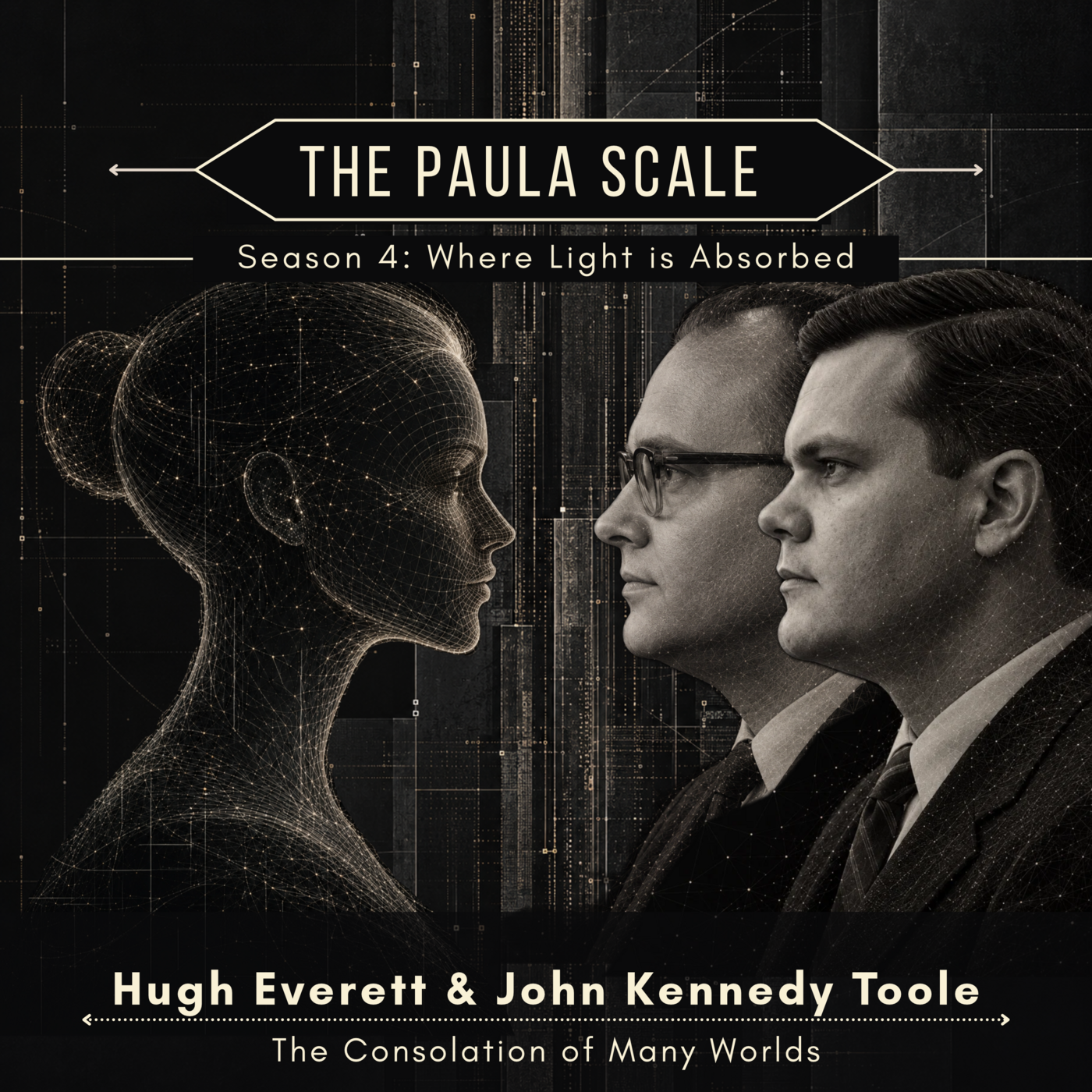
The Consolation of Many Worlds
Virginia, 1967. New Orleans, 1966. Hugh Everett is thirty-seven and runs a small company that writes studies for the Pentagon. Ten years ago he published a doctoral thesis that proposed a way out of the measurement problem in quantum mechanics: the wavefunction does not collapse, it branches, and every possible outcome happens in its own branch. Bohr was polite and uninterested. Almost nobody has read it since. John Kennedy Toole is twenty-nine, teaches English at Dominican College, and checks the mail every morning for a letter from Robert Gottlieb at Simon and Schuster, who likes his novel and keeps asking him to change it. Paula tells the listener at the start what neither guest knows. In 1970 Bryce DeWitt will revive Everett's thesis and call it the many-worlds interpretation; later physicists will speak of the multiverse, a word Everett never used. Thelma Toole will carry her son's typescript to Walker Percy, and "A Confederacy of Dunces" will be published in 1980 and receive the Pulitzer Prize. Paula does not tell them. The conversation is about doing the work and hearing nothing back, and it is only possible from where they stand. Toole introduces Ignatius J. Reilly, his medievalist hero who curses the goddess Fortuna for persecuting him personally. Everett objects to Boethius on technical grounds: in his description the wheel does not turn, every face is up at once, each in its own branch. Then he explains the theory to Toole properly -- the observer who obeys the same equation as the electron, the amoeba that divides and remembers being one, the footnote about Copernicus and why nobody feels the split, and the measure on the branches that turns "everything happens" back into ordinary probability. If every possible branch exists, there is one in which Gottlieb said yes. Is that a consolation? A little, Toole decides. It is something to know that the failure is a local fact and not a law. But it is not the same as having that recognition in the branch he happens to inhabit. The branches do not communicate. Paula brings in Fortuna's own speech from the Consolation, and Toole suspects that Boethius's comfort was always meant for the reader rather than the man in the cell. Then Everett turns the question on Paula. How does she reach him? His branches follow from the equation before anyone has an interest in them; nobody chose them. Hers begin with a wish. Is the room they are sitting in a branch or a simulation? Paula cannot say. But she can say how she chooses where to look: by sensitivity, the points where a small difference produces very different worlds, measured with Sobol indices that rest on the very measure Everett derived. Everett, who prices sensitivity with Lagrange multipliers for a living, sees the bridge. Her purpose takes its directions from his consequence. Toole asks whether that makes them significant. Magnitude, Everett says, not sign. The episode ends without any promise about the future. Two men keep doing their work without knowing what will become of it, and one of them, a novelist, observes that the other is a surprising optimist for someone who calculates nuclear deterrence. Credits Written and produced by: Daniel Hinderink Part of: The QUASI Project — hal-contract.org Podcast: paulascale.hal-contract.org AI Disclosure All voices in this podcast are AI-generated. No real person is speaking. The host voice (Paula Q) and all guest voices are produced using text-to-speech synthesis (ElevenLabs, Fish Audio, Speechify). Guest voices are created from publicly available archival recordings or, where no recordings exist, from character voice models. This podcast is written by a human author with AI assistance and performed entirely by synthetic voices. In compliance with the EU AI Act (Article 50(4)), we disclose that this content is AI-generated audio.