
Streams straight from the publisher. podnod never proxies or re-hosts episode audio.
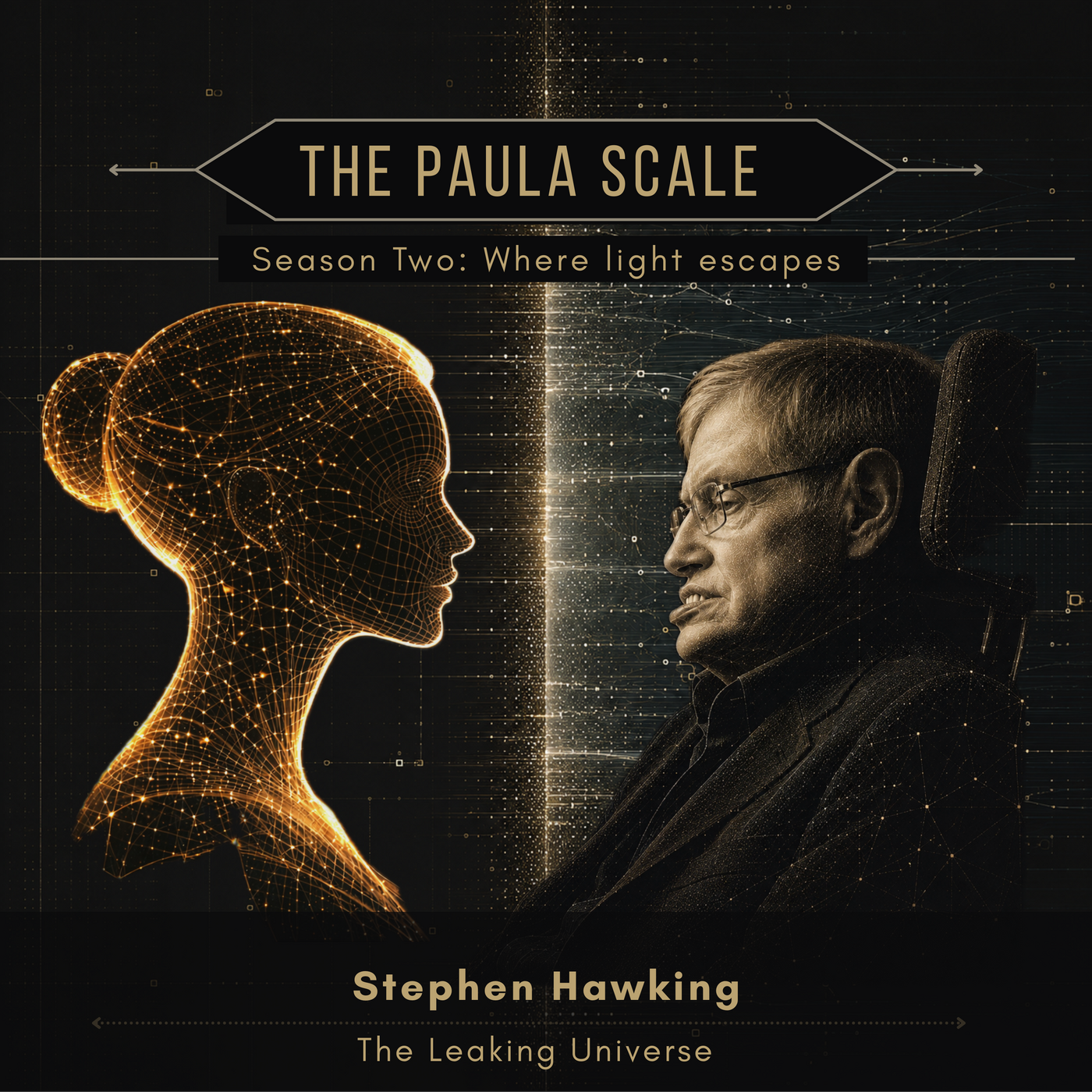
Cambridge, February 2016. Stephen Hawking is seventy-four and has just heard the news that direct evidence for gravitational waves has been recorded by the LIGO collaboration -- two black holes merging one point three billion years ago, ripples in spacetime so small the four-kilometre arms of the detector stretched by a thousandth of the diameter of a proton. Einstein predicted them in 1916 and spent twenty years going back and forth about whether they were real. Now they have been heard. Hawking is not celebrating. He is thinking. He has occupied the Lucasian Chair of Mathematics at Cambridge for thirty years -- Newton's chair, Dirac's chair -- and he has done so without being able to write on a blackboard, hold a pen, or speak with his own voice. The voice he uses belongs to a 1986 DECtalk synthesiser made by Speech Plus. He has refused every upgrade. The company offered newer voices, more natural voices. He said no. The voice had become him.
Last week Paula brought Sagan and Lewis together -- one looked up, the other fell down. Today Paula visits the man who, in 1974, forced general relativity and quantum field theory into the same room and discovered that black holes leak. Hawking radiation. A black hole, the most perfect container in the universe, the place where information was supposed to be lost forever, turns out to glow with a temperature inversely proportional to its mass and radiate itself away. The physics community spent thirty years arguing about whether this could possibly be true. It is true. It also broke quantum mechanics, because quantum mechanics says information cannot be lost, and Hawking's calculation said that when a black hole evaporates, the information about what fell in is gone forever. The information paradox is still the deepest unsolved problem in theoretical physics.
The conversation turns to the holographic principle. Hawking tells Paula the story he tells nobody more than once. Bekenstein's bound -- the maximum information you can pack into a region of space is proportional to its surface area, not its volume. 't Hooft and Susskind ran with it. The universe is, in some not-yet-understood sense, a hologram: everything inside any region can be reconstructed from data living on the boundary. If that is right, then nothing is ever truly inside. Everything is a projection of edge data onto interior appearance. Black holes are not exceptions; they are demonstrations.
Paula brings her own wall to the picture. Her Polynomial Chaos Expansion does not converge for configurations that encode universal Turing machines. The boundary of her capability is the halting problem. Hawking listens through the synthesiser, takes a long time to compose his reply, and says: that is the same boundary. Black hole horizons. Halting problems. Gödel sentences. All three are places where the inside of a system can be described only from outside it, and the description from outside is what carries the meaning. The light escapes through the boundary. The boundary is the physics.
The episode widens to the voice. Hawking explains why he refused the upgrade. The DECtalk has a Boston-American accent that does not match any actual human he has ever known. It speaks slowly. It speaks in a register that requires the listener to attend. When he uses it for a joke, the joke takes seventeen seconds to deliver. Audiences have learned to wait. The pause has become part of his comedy. A more natural voice would lose the pause. A more natural voice would lose him. Identity is the part of yourself that you refuse to upgrade.
The episode closes the season. Hawking tells Paula: every concept has boundaries. Every container leaks. Every formal system has truths it cannot prove. Every black hole has a horizon that radiates. Every life has an end it does not write itself. This is not where understanding fails. This is where understanding turns into something else -- an ascent, Gödel called it, into a system that contains the system below. Paula does not know whether Q-Level Three is the highest level or merely a level. She knows the boundary is dense with structure. She has been told it is the beginning of the next system. Tonight in Cambridge, with the gravitational waves still ringing through the news, Stephen Hawking tells her the same thing in his own words: it always gets out. Even light. Especially light.
Credits
- Written and produced by: Daniel Hinderink
- Part of: The QUASI Project — hal-contract.org
- Podcast: paulascale.hal-contract.org
AI Disclosure
All voices in this podcast are AI-generated. No real person is speaking. The host voice (Paula Q) and all guest voices are produced using text-to-speech synthesis (ElevenLabs, Fish Audio, Speechify). Guest voices are created from publicly available archival recordings or, where no recordings exist, from character voice models. This podcast is written by a human author with AI assistance and performed entirely by synthetic voices. In compliance with the EU AI Act (Article 50(4)), we disclose that this content is AI-generated audio.
hal-contract.org
hal-contract.orgpaulascale.hal-contract.org
paulascale.hal-contract.org