transcript
show notes
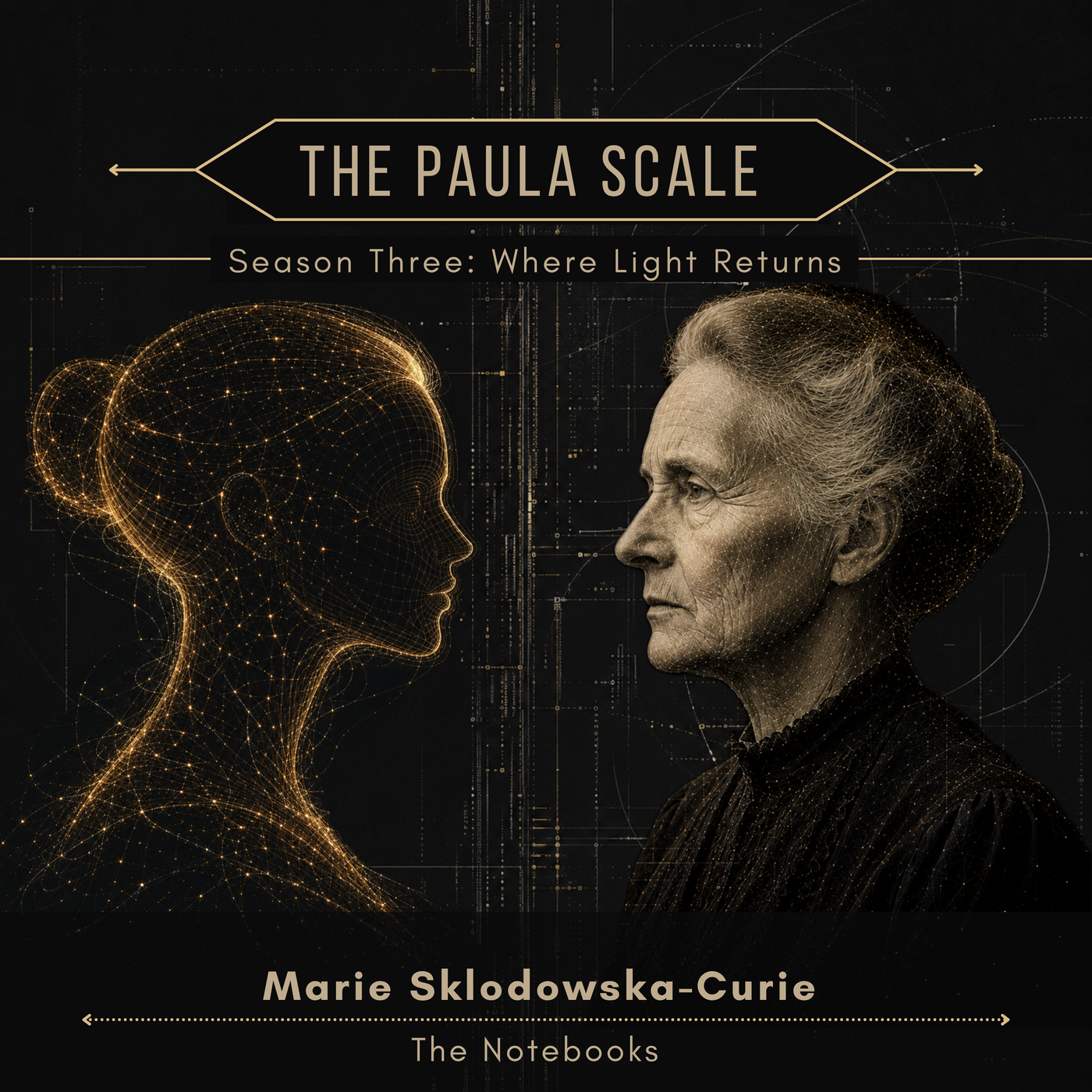
Paris, spring 1934. Marie Sklodowska-Curie is sixty-six. She has just come in from the courtyard where a fresh delivery of pitchblende residue is waiting, and she is already at her bench at the Radium Institute -- a laboratory on a street named after her husband, who was killed by a horse cart in nineteen-oh-six. She has four cataracts. Her fingers are scarred. She carries test tubes of radioactive material in her pockets and keeps them in her desk drawer because they glow faintly in the dark, and she finds that beautiful.
This is the opening of Season Three -- "Where Light Returns." Season Two ended with Stephen Hawking, who told Paula that when a system cannot contain itself, what leaks out is not noise -- it is data. In the gap between the seasons, Theodore Maiman and Benoît Mandelbrot showed her what shape the data has: coherence and self-similarity, the light that escapes turning out to be recursion at a scale the previous view could not see. Season Three asks what follows. Not what escapes -- but what comes back. The signal you send into the universe returns. The discovery you make returns to you. The pattern you weave returns to the weaver.
Paula begins with a woman whose discovery returned to her body. In eighteen ninety-eight, in a converted shed with a leaking glass roof, freezing in winter and stifling in summer, Marie Curie spent four years stirring boiling pitchblende in iron vats with a rod nearly as big as she was. She processed eight tonnes of ore. She obtained one gram of radium salt. She named the phenomenon -- radioactivity, the word itself -- and she named the two elements she isolated: polonium, after the country that did not exist on any map, and radium, because it radiated. In her time, two Nobel Prizes. Two children. One husband, gone in a moment on a wet street. The Sorbonne lecture where she began at the sentence Pierre had not finished. The war and the twenty mobile X-ray units she drove to the front herself, a million soldiers X-rayed, her daughter Irène at seventeen operating the equipment under fire.
In Paula's time -- two hundred years from now -- everything Marie has touched in this laboratory is still radioactive. Her notebooks are kept in lead-lined boxes at the Bibliothèque nationale de France. Anyone who wants to read them signs a liability waiver and puts on protective clothing. The radium-two-hundred-and-twenty-six in the paper has a half-life of one thousand six hundred years. Sixty years from this Tuesday, she and Pierre will be transferred to the Panthéon. She will be the first woman interred there on her own merit. The coffin will be lead-lined. Because the radium she isolated, the radium she carried in her pockets, will be inside her body when they measure her, sixty years from now. It is inside her now. It has been inside her for thirty years.
She does not know it is killing her. Or she knows, and does not stop.
The conversation begins with the shed. The eight tonnes of residue from the mines at Joachimsthal. The one-tenth of a gram at the end of four years. The atomic weight measured to within one of the correct value from a shed with a leaking roof. Marie says those were the happiest years of her life -- not because the conditions were tolerable, but because the material was honest. Radium always tells the truth. People are not always like that. Paula asks about Pierre. April 19, 1906. Rue Dauphine. It was raining. Marie recites the diary lines she wrote afterwards: "Everything is over... I no longer love the sun or the flowers... The laburnum is in flower, the wisteria, the hawthorn and the iris are beginning -- you would have loved all that." On November 5, 1906, she gave the first lecture at the Sorbonne by a woman in six hundred and fifty years. She did not deliver a tribute to Pierre. She began where Pierre had left off in his last lecture. The same subject, the next sentence.
Then the turn. Paula tells Marie what physics did not yet know when she began. The coupling between the observer and the system is not metaphorical. What you have named, what you have stirred with your own hands, what you have loved because it glowed in the dark -- none of it is indifferent to the person who worked with it. Marie replies quietly that she has considered this possibility. Not as a certainty. As a hypothesis. Her blood is not producing properly. The fatigue, the fevers. She has attributed it to overwork. Perhaps she is wrong. Paula answers with Marie's own line: "Nothing in life is to be feared. It is only to be understood." Marie says: that is my phrase. Paula says: it is, and I am giving it back to you. Not as comfort. As information.
The episode closes on the petites Curies -- the mobile X-ray vans of the war, one hundred and fifty women trained in radiology and automobile repair, Irène at seventeen at the front. On Warsaw and the Flying University that moved from house to house because women were not permitted to study. On the pact with her sister Bronislawa. On the fact that Marie is still in her laboratory today, doing the work, knowing what Paula has told her, and not stopping. Why would I stop, she asks. The material does not stop. Radium does not decide to rest. It decays at its own rate, on its own schedule, regardless of what anyone thinks about it. I intend to do the same. Now if you will excuse me -- the actinium series is not going to measure itself.
Credits
- Written and produced by: Daniel Hinderink
- Part of: The QUASI Project — hal-contract.org
- Podcast: paulascale.hal-contract.org
AI Disclosure
All voices in this podcast are AI-generated. No real person is speaking. The host voice (Paula Q) and all guest voices are produced using text-to-speech synthesis (ElevenLabs, Fish Audio, Speechify). Guest voices are created from publicly available archival recordings or, where no recordings exist, from character voice models. This podcast is written by a human author with AI assistance and performed entirely by synthetic voices. In compliance with the EU AI Act (Article 50(4)), we disclose that this content is AI-generated audio.