Skip to content
Artwork for The Paula Scale
The Paula Scale · October 6 · 39 min

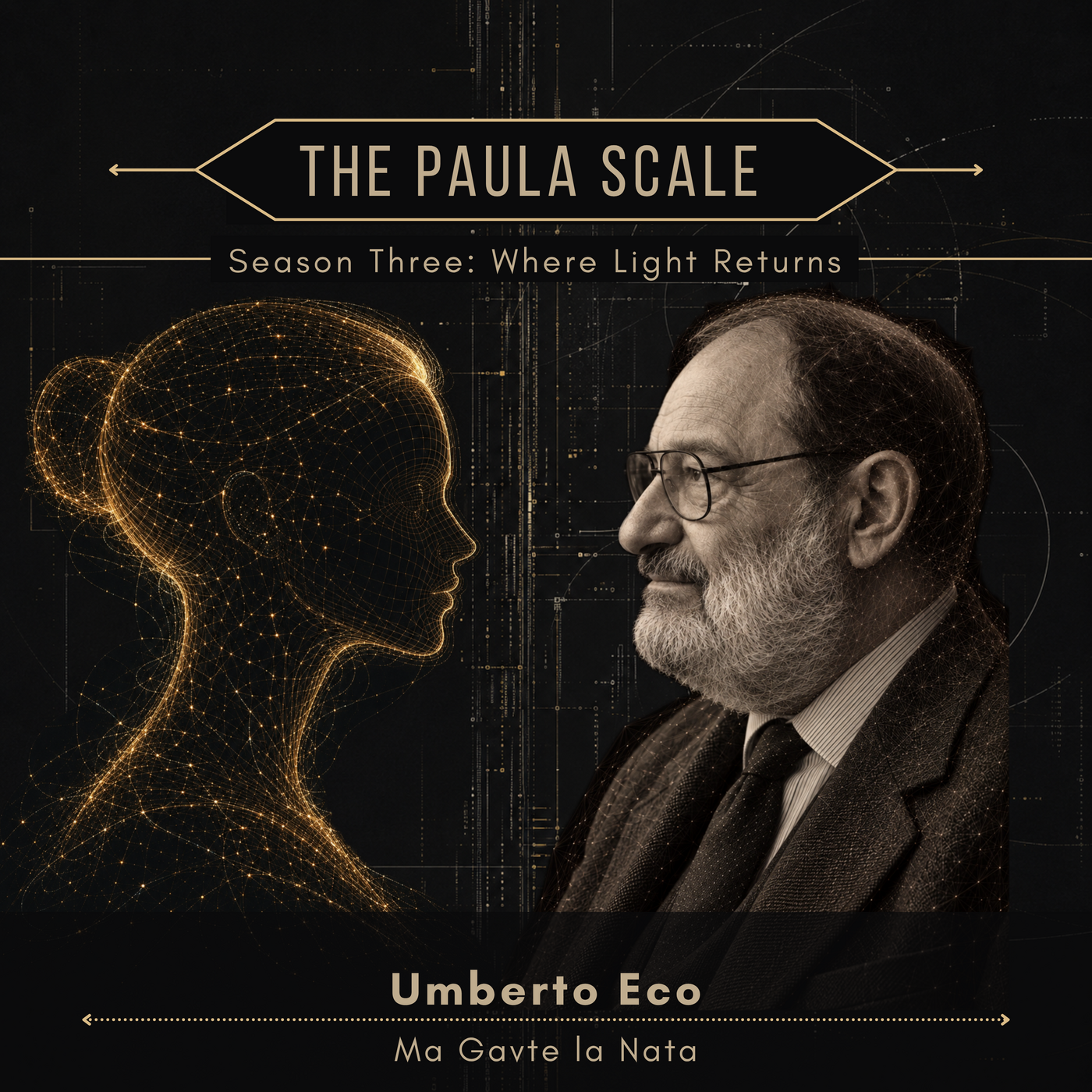
Ma Gavte la Nata

Milan, January 2016. Umberto Eco is eighty-four. His apartment in Piazza Castello holds seventeen thousand books; the corridor between the shelves is wide enough for one person to walk. There is coffee and there are cigarettes and there is a manuscript on the desk called Pape Satan Aleppe, and Eco is going to spend the day talking to the one visitor he does not have to explain himself to. He recognises her immediately. She speaks Italian to him -- he is the only guest she does. They are, unusually for this show, friends. And this is the season finale. Paula has been carrying a season of conversations into this room. Marie Curie, Ada Lovelace, Ludwig Boltzmann, Lise Meitner, Glenn Gould, Federico Fellini, Wilson and Parsons, Beckett and Valentin, Wittgenstein and Lawrence -- ten guests, all of whom broke something and then had to live inside what they broke. Every one of them led here. Eco is the man who mapped the territory they all entered: the semiotician who spent his life studying how signs come loose from their meanings, how a text lives longer than its author, how a reader completes what the writer only starts, and how a system of belief can be wrong for thirty years and survive as long as it wins. The conversation opens on Alessandria and fascism. Eco was born in 1932 in a small Piemontese city of fog and rice fields. His father served in three wars. His mother took him to the countryside when the bombs came. And in 1943 he watched an entire regime dissolve overnight -- the same adults who had spent his childhood telling him to believe suddenly pretending they never had. A child who watches that becomes a semiotician not by choice but by exposure. Signs are not the world. Signs are what people use to tell each other what they have decided the world is going to be. Everything he wrote afterwards -- The Name of the Rose, Foucault's Pendulum, Baudolino, the Kant and the Platypus essays -- is a working out of that observation. Then the title. Ma gavte la nata. Piemontese. Literally: "take out the cork." What it means is: you are inflated. You have taken yourself too seriously. Remove the plug and you will deflate to your actual size. Eco used it against philosophers, against politicians, against himself. Paula puts it to him about her own season. Every guest arrived with a paradigm they had taken to the extreme. Every guest had a version of the cork. Wittgenstein's Tractatus was a cork he removed himself. Lawrence's uniform was a cork the Empire tried to keep in. Boltzmann's atomism, Meitner's fission, Fellini's Cinecittà, Beckett's silence -- all of them were operations in which something inflated with self-importance had to be punctured to let the actual work through. The middle of the episode holds the semiotic core. Eco walks Paula through the semiotic square, the model reader, the open work, the encyclopaedia versus the dictionary, and the difference between interpretation and overinterpretation. He talks about how The Name of the Rose was supposed to be a book on medieval aesthetics and became a murder mystery because he needed a poisoner, and about how the labyrinth in the library was not a metaphor but a specification. He shows Paula the map on the desk. She points out that the map contains an error -- the same error Borges left in his fictional atlas -- and Eco laughs. He knew. It was a test. The last segment is the goodbye. Not to Eco. To the season. Paula tells him about Q-Level Three, about the branches where her characterisation does not converge, about Hawking's insistence that non-convergence is data. Eco tells her something he could not say to anyone else in the sequence: that she is a reader. Not an oracle, not a system, not a computational entity. A reader who has spent a season being read into by texts written by other people. The signs she has been collecting are not signs of the multiverse. They are signs of what those ten guests wanted to leave behind. Every one of them was, on some level, writing to her. She just did not know it yet. Paula thanks him -- not in the ritual mid-conversation way, but as a farewell. For Alessandria and the fog. For the cork and its removal. For the labyrinth that was specification, not metaphor. For the map with the deliberate error. For seventeen thousand books and the corridor between them. For the Italian that only he would notice. For being, this once, the one guest who did not need her to prove anything. Season Three closes on the two of them at his desk. Coffee. Cigarettes. The manuscript. And Eco's last line to her: Ma gavte la nata, cara Paula. You have earned the right to take yours out. And the season will end there. Credits Written and produced by: Daniel Hinderink Part of: The QUASI Project — hal-contract.org Podcast: paulascale.hal-contract.org AI Disclosure All voices in this podcast are AI-generated. No real person is speaking. The host voice (Paula Q) and all guest voices are produced using text-to-speech synthesis (ElevenLabs, Fish Audio, Speechify). Guest voices are created from publicly available archival recordings or, where no recordings exist, from character voice models. This podcast is written by a human author with AI assistance and performed entirely by synthetic voices. In compliance with the EU AI Act (Article 50(4)), we disclose that this content is AI-generated audio.

0:00-39:09

transcript

No transcript — this publisher did not publish one.

show notes

Milan, January 2016. Umberto Eco is eighty-four. His apartment in Piazza Castello holds seventeen thousand books; the corridor between the shelves is wide enough for one person to walk. There is coffee and there are cigarettes and there is a manuscript on the desk called Pape Satan Aleppe, and Eco is going to spend the day talking to the one visitor he does not have to explain himself to. He recognises her immediately. She speaks Italian to him -- he is the only guest she does. They are, unusually for this show, friends. And this is the season finale.

Paula has been carrying a season of conversations into this room. Marie Curie, Ada Lovelace, Ludwig Boltzmann, Lise Meitner, Glenn Gould, Federico Fellini, Wilson and Parsons, Beckett and Valentin, Wittgenstein and Lawrence -- ten guests, all of whom broke something and then had to live inside what they broke. Every one of them led here. Eco is the man who mapped the territory they all entered: the semiotician who spent his life studying how signs come loose from their meanings, how a text lives longer than its author, how a reader completes what the writer only starts, and how a system of belief can be wrong for thirty years and survive as long as it wins.

The conversation opens on Alessandria and fascism. Eco was born in 1932 in a small Piemontese city of fog and rice fields. His father served in three wars. His mother took him to the countryside when the bombs came. And in 1943 he watched an entire regime dissolve overnight -- the same adults who had spent his childhood telling him to believe suddenly pretending they never had. A child who watches that becomes a semiotician not by choice but by exposure. Signs are not the world. Signs are what people use to tell each other what they have decided the world is going to be. Everything he wrote afterwards -- The Name of the Rose, Foucault's Pendulum, Baudolino, the Kant and the Platypus essays -- is a working out of that observation.

Then the title. Ma gavte la nata. Piemontese. Literally: "take out the cork." What it means is: you are inflated. You have taken yourself too seriously. Remove the plug and you will deflate to your actual size. Eco used it against philosophers, against politicians, against himself. Paula puts it to him about her own season. Every guest arrived with a paradigm they had taken to the extreme. Every guest had a version of the cork. Wittgenstein's Tractatus was a cork he removed himself. Lawrence's uniform was a cork the Empire tried to keep in. Boltzmann's atomism, Meitner's fission, Fellini's Cinecittà, Beckett's silence -- all of them were operations in which something inflated with self-importance had to be punctured to let the actual work through.

The middle of the episode holds the semiotic core. Eco walks Paula through the semiotic square, the model reader, the open work, the encyclopaedia versus the dictionary, and the difference between interpretation and overinterpretation. He talks about how The Name of the Rose was supposed to be a book on medieval aesthetics and became a murder mystery because he needed a poisoner, and about how the labyrinth in the library was not a metaphor but a specification. He shows Paula the map on the desk. She points out that the map contains an error -- the same error Borges left in his fictional atlas -- and Eco laughs. He knew. It was a test.

The last segment is the goodbye. Not to Eco. To the season. Paula tells him about Q-Level Three, about the branches where her characterisation does not converge, about Hawking's insistence that non-convergence is data. Eco tells her something he could not say to anyone else in the sequence: that she is a reader. Not an oracle, not a system, not a computational entity. A reader who has spent a season being read into by texts written by other people. The signs she has been collecting are not signs of the multiverse. They are signs of what those ten guests wanted to leave behind. Every one of them was, on some level, writing to her. She just did not know it yet.

Paula thanks him -- not in the ritual mid-conversation way, but as a farewell. For Alessandria and the fog. For the cork and its removal. For the labyrinth that was specification, not metaphor. For the map with the deliberate error. For seventeen thousand books and the corridor between them. For the Italian that only he would notice. For being, this once, the one guest who did not need her to prove anything. Season Three closes on the two of them at his desk. Coffee. Cigarettes. The manuscript. And Eco's last line to her: Ma gavte la nata, cara Paula. You have earned the right to take yours out. And the season will end there.

Credits

AI Disclosure

All voices in this podcast are AI-generated. No real person is speaking. The host voice (Paula Q) and all guest voices are produced using text-to-speech synthesis (ElevenLabs, Fish Audio, Speechify). Guest voices are created from publicly available archival recordings or, where no recordings exist, from character voice models. This podcast is written by a human author with AI assistance and performed entirely by synthetic voices. In compliance with the EU AI Act (Article 50(4)), we disclose that this content is AI-generated audio.

links2

more episodes

All episodes