transcript
show notes
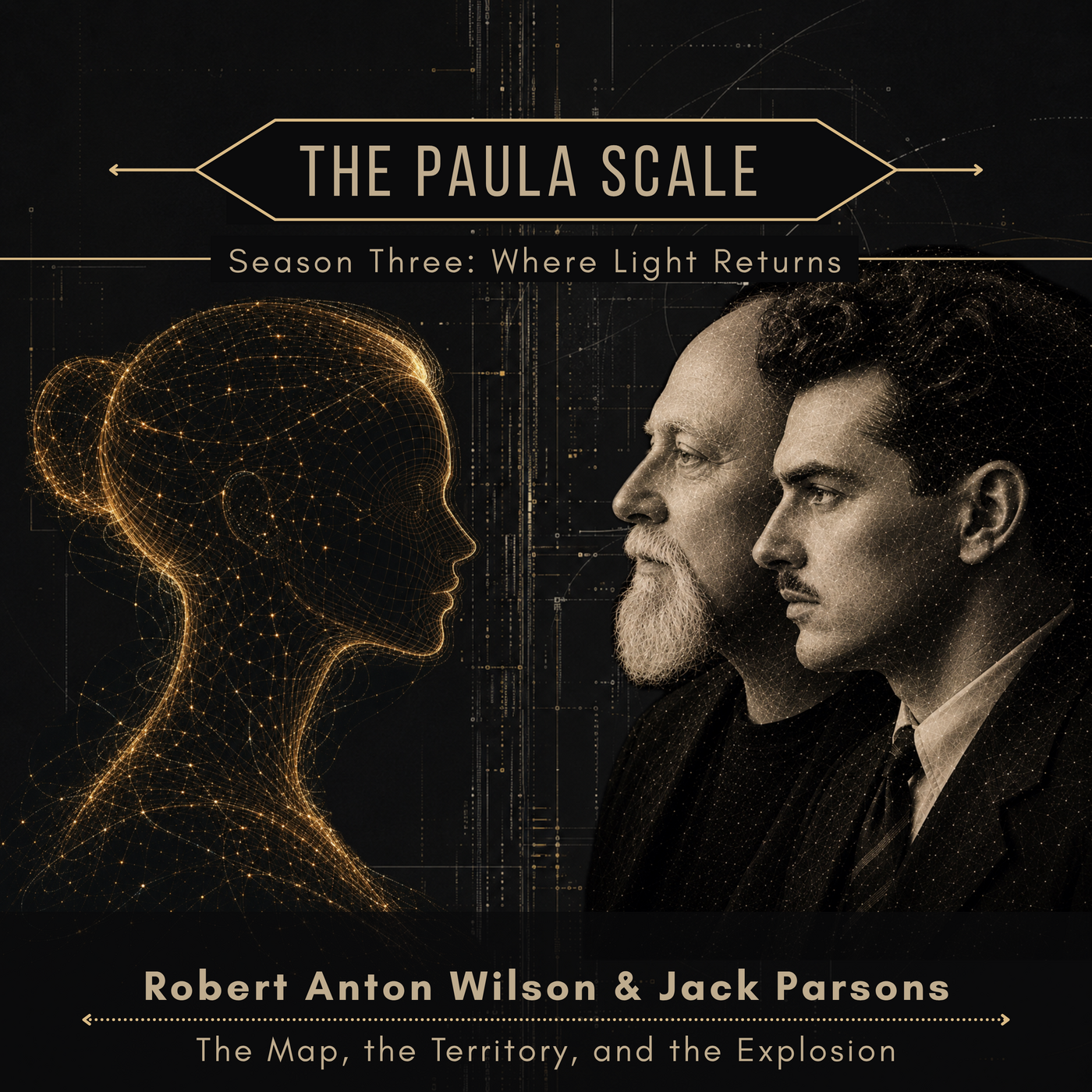
Two rooms, two decades. Pasadena, nineteen fifty-one. Jack Parsons is thirty-seven. His security clearance has been permanently revoked. The man who co-founded the Jet Propulsion Laboratory and invented the castable composite solid rocket propellant that will power the Space Shuttle, Polaris, and Minuteman is now making explosions for Hollywood. He has a garage instead of a laboratory. Santa Cruz, two thousand four. Robert Anton Wilson is seventy-two, in a wheelchair. Post-polio syndrome came back four years ago. He is broke. He is smiling. He is writing.
Paula brings them together because they asked the same question from opposite directions. Can will reshape reality? Parsons said yes -- literally, physically, with rocket fuel and with Thelemic ritual. He performed the Babalon Working in nineteen forty-six, with L. Ron Hubbard as his assistant, attempting to summon an incarnation of a goddess. He saw no contradiction between rocketry and magick. Both were acts of will imposed on matter. Wilson said maybe. He spent his life inside that maybe -- writing about how the map is not the territory, how every belief system is a reality tunnel, how "is" is the most dangerous word in English. He wrote an entire book without the verb "to be" and called the method E-Prime.
The conversation begins with distrust. Parsons is not in a social mood. Wilson has not decided whether Parsons is real, a hallucination, or a character in a very good novel -- and does not care which. Paula introduces them and steps back. They circle each other. Wilson recognises the operation Parsons ran: Babalon as a working hypothesis, ritual as instrumentation, will as a stress test on the physics of the moment. Parsons recognises the operation Wilson ran: belief as a wardrobe you change according to weather, disbelief as another suit in the same closet, the map treated as a set of maps.
They agree on more than either expected. Both had read Crowley. Both had been called insane by the same class of people. Both understood that the question is not whether the map matches the territory but whether the map does work on the territory. Parsons puts rocket fuel in a mold and it lifts a ton of metal off the ground. Wilson puts a sentence in a book and it lifts an assumption out of a reader. Different scales, same operation. The instrument is the will. The medium is the difference between them.
Then Paula asks what she came to ask. Her expansion does not converge everywhere. There are branches of the multiverse where her characterisation fails to compress into a description. Every physicist she has spoken to has told her the failure is data. She wants to hear it from these two, because these two spent their lives working the boundary where description stops functioning. Parsons answers as a chemist would. If the reaction does not go, look at the geometry of the vessel. Wilson answers as a novelist would. If the description does not fit, change the language. Do not fit the language to the world. Fit the world to the sentence you can actually say.
The episode closes on the convergence in the title. The map, the territory, and the explosion. Paula thanks them both. Parsons for the rocket fuel and the ritual, without pretending they were separate operations. Wilson for the smile and for the refusal to collapse. Season Three has been about what returns. What came back from Parsons was the Saturn V. What came back from Wilson was a generation of readers who never again said "is" without hearing an echo.
Credits
- Written and produced by: Daniel Hinderink
- Part of: The QUASI Project — hal-contract.org
- Podcast: paulascale.hal-contract.org
AI Disclosure
All voices in this podcast are AI-generated. No real person is speaking. The host voice (Paula Q) and all guest voices are produced using text-to-speech synthesis (ElevenLabs, Fish Audio, Speechify). Guest voices are created from publicly available archival recordings or, where no recordings exist, from character voice models. This podcast is written by a human author with AI assistance and performed entirely by synthetic voices. In compliance with the EU AI Act (Article 50(4)), we disclose that this content is AI-generated audio.