transcript
show notes
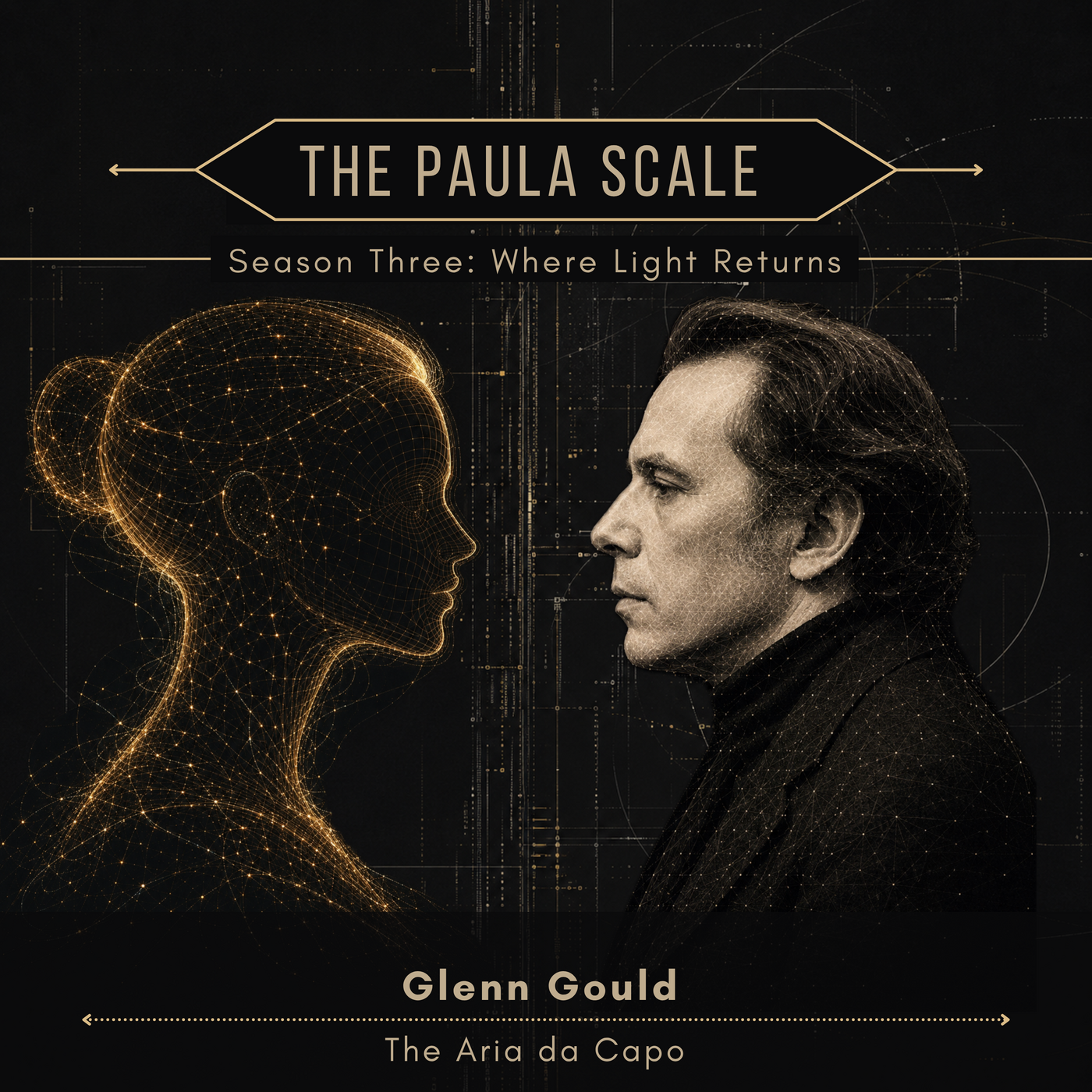
Toronto, late nineteen eighty-one. Glenn Gould is forty-eight. He has just come back from the last recording sessions ever held at Columbia's Thirtieth Street Studio in New York. The studio is being closed. Gould brought his own chair -- the one his father Bert sawed the legs down on in nineteen fifty-three, fourteen inches high, so his knees are above his hips and he can pull the notes rather than strike them. He is now editing what will be the second Goldberg Variations, twenty-six years after the first. His humming is on every recording. It is not a habit, he says. It is a structural requirement.
Last week, Lise Meitner showed Paula what happens when the signal you send into the world comes back in a form you did not choose. She walked for five hours after Hiroshima, and five hours was not enough. This week Paula visits a man who recorded the same piece of music twice -- twenty-six years apart -- and produced two completely different objects from the same notes. In nineteen fifty-five, at twenty-two, Gould sat down in a New York studio and recorded Bach's Goldberg Variations. Fast, brilliant, exuberant -- a young man announcing himself. In nineteen eighty-one, at forty-eight, he sat down in the same city and recorded the same piece again. Slow, deliberate, unified -- a man who had spent a quarter century thinking about what those notes mean, and who no longer recognises the person who played them the first time. Same notes. Different universe.
The two recordings. In nineteen fifty-five, thirty-eight minutes. In nineteen eighty-one, fifty-one. Thirteen minutes longer -- thirteen minutes of understanding, Gould says. The first recording is thirty very interesting but somewhat independent-minded pieces going their own way. The second is one continuous organism, tempi derived from each other by proportion, transitions treated as joints rather than gaps. He does not recognise the person who made the first. That person was twenty-two and interested in brilliance. He is forty-eight and interested in architecture. The notes have not changed. What has changed is what he hears in them. Paula reframes it as physics: two measurements of the same system, separated by time. The score is invariant. The interpretation is not. The recording captures the interpretation and freezes it, so it can be judged.
Then the argument that made him famous. On April tenth, nineteen sixty-four, at the Wilshire Ebell Theatre in Los Angeles, Gould stopped performing live and did not announce it. The concert, he tells Paula, is a blood sport. The audience comes for the possibility that the performer will fail. That is not what music is for. The purpose of art is not the release of a momentary ejection of adrenalin but the gradual, lifelong construction of a state of wonder and serenity. The recording constructs that state. It allows him to do what the concert does not: try again. Take two. Take seven. Take twelve. Select the moments that best serve the music, not the performer. Bach did not write the Goldberg Variations for a specific pair of hands on a specific day in a specific room. He wrote a structure. The studio lets him approach it. The concert forces him to settle for whatever happens on the night. Gould is the only pianist who chose the simulation over the original -- and he argues, with precision and passion, that the simulation is more honest.
Paula makes it personal. A physicist she spoke to -- Stephen Hawking -- said the substrate is irrelevant. The pattern is the thing. Gould has been making that argument in music for thirty years. The performance is the substrate. The structure is the thing. And the recording is how you access the structure without the accident of the performance. Gould answers with his own version: if there is any excuse at all for making a record, it is to do it differently -- to approach the work from a totally re-creative point of view. If one cannot do that, abandon it.
The quodlibet. The Goldberg Variations are tripartite; every third variation is a canon, ascending through intervals from the unison to the ninth. At Variation Thirty, where a canon at the tenth should fall, Bach does something else. He writes a quodlibet -- "what pleases" -- a folk-song weaving. Two songs layered with the ground bass. One roughly translates as "I haven't been with you for so long, come closer." The other is about cabbages and turnips. Not a joke, Gould says. A reunion. At Bach's family gatherings they would sing quodlibets, layering popular songs. Variation Thirty is Bach bringing his family into the work. And it is the last variation before the aria returns. The last thing you hear before the beginning comes back is a song about missing someone.
Then the aria da capo. The same aria. Note for note. Exactly as it was at the beginning. Except that you have heard thirty variations since then -- canons, toccatas, a French overture, a quodlibet. You have travelled through the entire landscape of what this ground bass can become. And now the aria returns. The same notes. And they are not the same. They carry everything you have heard and everything you have lost in the hearing of it. The aria da capo is not a repetition. It is a return. What returns is changed by everything that happened in between. Paula thanks Gould. For the two recordings -- the proof that the same notes, measured twenty-six years apart, produce different truths. For the studio as instrument. For the argument that the recording is more honest than the concert. For the chair at fourteen inches. For the humming that no engineer could remove because it was structural. For the quodlibet -- the folk song about missing someone, placed where the mathematics said a canon should go. And for the aria da capo. The return that is not a repetition.
Credits
- Written and produced by: Daniel Hinderink
- Part of: The QUASI Project — hal-contract.org
- Podcast: paulascale.hal-contract.org
AI Disclosure
All voices in this podcast are AI-generated. No real person is speaking. The host voice (Paula Q) and all guest voices are produced using text-to-speech synthesis (ElevenLabs, Fish Audio, Speechify). Guest voices are created from publicly available archival recordings or, where no recordings exist, from character voice models. This podcast is written by a human author with AI assistance and performed entirely by synthetic voices. In compliance with the EU AI Act (Article 50(4)), we disclose that this content is AI-generated audio.