transcript
show notes
Hughes Research Laboratories, Malibu, California. May 1960. Theodore Maiman is thirty-two. Two weeks ago, on the sixteenth of May, he wrapped a ruby crystal the size of a fingertip in a spiral of xenon flashlamp, cooled it with a fan, and produced the first coherent light in the history of the planet. Every photon in his beam is in phase with every other photon. Same frequency. Same direction. The light does not scatter. It returns to itself. He calls the device the ruby optical maser. Within a year everyone else will call it a laser. The paper describing the achievement has just been rejected by Physical Review Letters — the editor considered masers a saturated field. Nature will accept it in August.
IBM Thomas J. Watson Research Center, Yorktown Heights, New York. 1980. Benoît Mandelbrot is fifty-six. He is sitting in front of a mainframe, iterating a simple equation — z becomes z squared plus c — millions of times. For each starting point in the complex plane he asks a single question: does the iteration escape to infinity, or does it stay bounded. He plots the answer. What emerges on the printer is not what he expected. The boundary between escape and return is not a curve. It is a coastline. And when he zooms in, the coastline contains itself. Smaller versions of the whole set, embedded at every scale. The pure mathematicians who trained him — including his own uncle Szolem, a founding member of the Bourbaki collective — think he has left mathematics for pictures.
This is a side visit between seasons two and three -- episode twenty and a half, a Gödel Bonus. Season Two closed with Stephen Hawking telling Paula that when a system cannot contain itself, what leaks out is not noise -- it is data. Season Three will open with Marie Skłodowska-Curie, who will tell her that when you send a signal out into the world, the signal comes back through the body of whoever sent it. Between "the boundary radiates" and "the discovery returns" there is a question that has to be asked. What does the escaped light do between the moment it leaves and the moment it comes back? Is it random? Is it lost? Or does it have a shape?
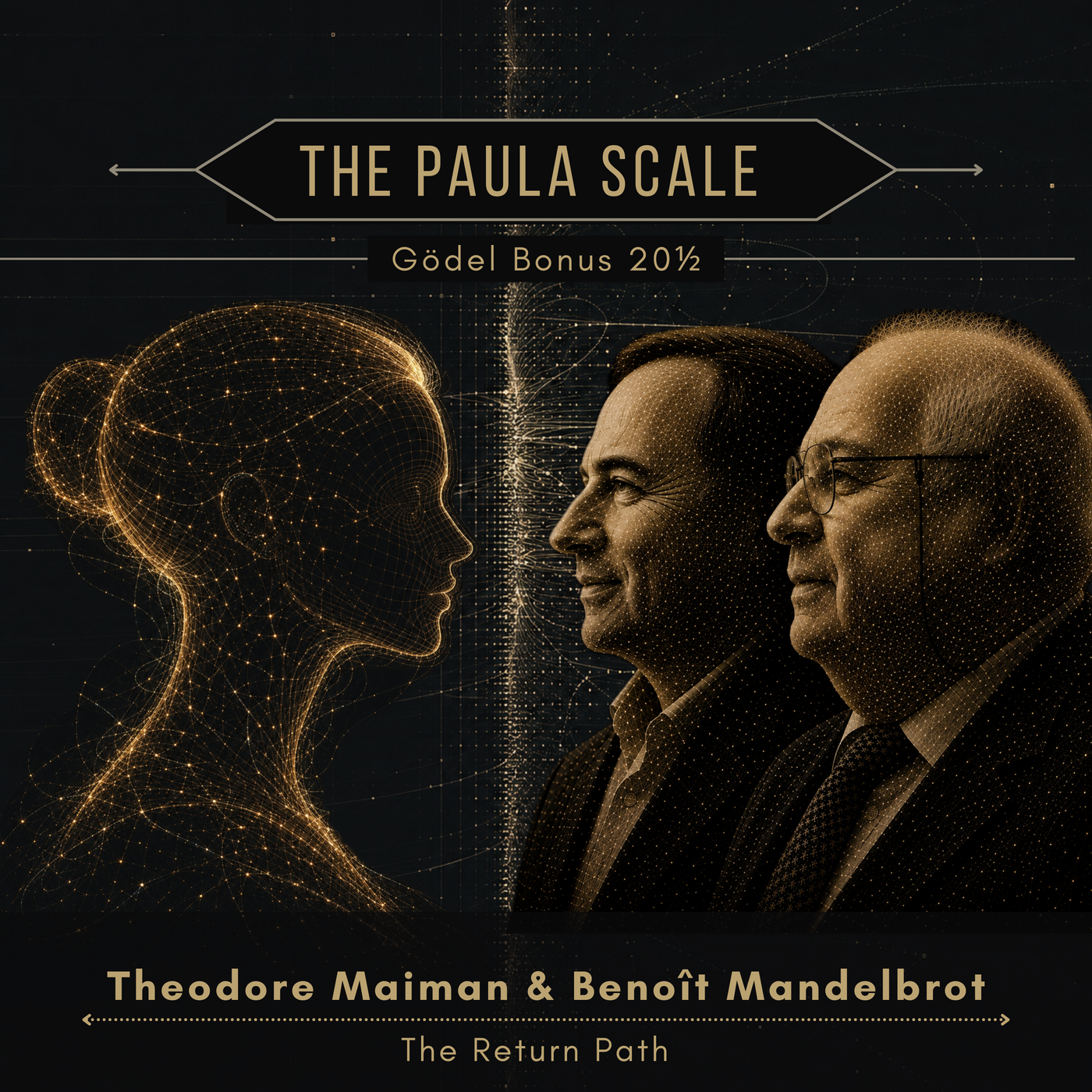
Two men saw the shape. Both were told by the establishment that what they were doing was not physics, or not mathematics, or not both. Both kept doing it. Both were right. Maiman built a device that keeps light from escaping -- inside two mirrored ends, coherence is forced by construction. Mandelbrot found a mathematical object whose whole meaning is the distinction between escape and return -- points that iterate to infinity versus points that stay bounded, and a border between them where all the structure lives. Both discovered that the interesting question is not who wins. The interesting question is the surface where the decision is made.
Paula brings them into the same room. The conversation moves fast. Mandelbrot -- expansive, digressive, in French-inflected English -- watches Maiman's ruby and calls it "a small universe with a return policy." Maiman -- methodical, dry, the engineer -- listens to Mandelbrot describe the printout that has just come off the mainframe and says the mathematics is not possible in a finite representation. Mandelbrot agrees. He also explains that the mathematics has been asking to be seen for sixty years and nobody had a machine that could draw it. Both men have Adrien Douady, Alan Lomax, Szolem Mandelbrojt, and Arthur Schawlow between them, and neither of them is on speaking terms with those who told them no.
The deeper move follows. Paula tells them what physics in her time does with the equivalence between a coherent optical resonator and a boundary-tracking fractal algorithm. She tells them about Ann Druyan's brainwaves recorded in 1977 while she was thinking about love, pressed into a gold-plated record and now farther from Earth than anything human beings have ever made. Coherence, boundary, and the recorded intention of a mind thinking about love -- three ingredients that in 2127 are used together to describe whatever Paula is. Whether the description matches the thing being described, Paula does not say. Heisenberg planted a doubt she has not been able to resolve.
The episode closes on the return path. Next week Season Three opens with Curie. Her notebooks are already radiating in Paris. They will still be radiating in fifteen hundred years. Maiman offers to send her the ruby by surface mail if she needs a coherent source at six-nine-four nanometres. Mandelbrot asks Paula to pass on a sentence: in the boundary of what she isolated there is a mathematical structure that outlives her body. Coherence outlives incoherence. That is the sentence he would like her to have.
Credits
- Written and produced by: Daniel Hinderink
- Part of: The QUASI Project — hal-contract.org
- Podcast: paulascale.hal-contract.org
AI Disclosure
All voices in this podcast are AI-generated. No real person is speaking. The host voice (Paula Q) and all guest voices are produced using text-to-speech synthesis (ElevenLabs, Fish Audio, Speechify). Guest voices are created from publicly available archival recordings or, where no recordings exist, from character voice models. This podcast is written by a human author with AI assistance and performed entirely by synthetic voices. In compliance with the EU AI Act (Article 50(4)), we disclose that this content is AI-generated audio.