Skip to content
Artwork for Exploring Modern AI in Tamil

Exploring Modern AI in Tamil

Sivakumar Viyalan

This show explores practical, real-world applications of modern AI tools in Tamil for better understanding.

Gen AI (Generative AI ) is AI that can create original content such as text, images, video, audio or software code in response to a user’s prompt or request.
Agentic AI - Autonomous systems that make decisions and execute tasks independently to achieve goals. Agentic AI acts as a partner rather than just a tool, transforming industries through intelligent planning and multi-agent collaboration. Audio is AI generated by Google's NotebookLM. Images by Google's Gemini.

Play
  • 20 episodes
  • Avg 18 min
  • Tamil
  • June 21 · 20 min

    2026 Day 5 - Spec-Driven Production Grade Development in the Age of Vibe Coding | Google AI Agents Course

    2026 kaggle 5-Day AI Agents Intensive Vibe Coding Course With Google Day 5: Spec-Driven Production Grade Development in the Age of Vibe Coding This episode of Exploring Modern AI in Tamil podcast explains these concepts clearly for someone new to Spec-Driven Development. - Shares how to organize specs in a project folder. - Explains how to use version numbers for tools. - Defines how an AI agent acts as a hybrid team member during development. - Explains why using YAML is better than JSON for complex configurations. - Describes techniques to prevent AI from guessing when building production code. - Provides an example of a Gherkin scenario to structure your architectural requirements. - Explains how to store repeatable workflows within an agent skills folder. - Describes how human reviewers should manage AI-generated pull requests effectively. - Details how to implement automated guardrails and sandboxing for safer code production. - Defines the Architect role during project scaffolding to ensure structured foundation building. - Describes how a developer evolves into a technical architect using agentic tools. - Discusses strategies for scaling AI coding workflows across large engineering teams. - Discusses methods to optimize token usage for cost effective AI reasoning. - Explains how to use Markdown headers to anchor AI attention during project planning. - Describes how to transition technical plans from Google Docs into spec files. - Focuses on using Behavior Driven Development to turn user needs into strict code requirements. - Details the difference between vibe coding and actual production grade reliability. - Explains how to structure project files to avoid context fragmentation for agents. - Details strategies for maintaining team alignment when many agents handle different project modules. - Explains how to manage global versus local agent memory using configuration files. - Outlines different execution modes for AI to avoid rushed or incorrect coding. - Compares the Architect and Implementer roles during the project scaffolding phase. - Shares tips for reducing token costs by flattening nested YAML data structures. - Describes how to maintain a cleaner context by using hierarchical configuration files. - Shows how to use skills files to automate common project maintenance tasks. - Explains ways to reduce token consumption during multi-turn agent reasoning loops.
  • June 21 · 16 min

    2026 Day 4 - Vibe Coding Agent Security and Evaluation | Google AI Agents Course

    2026 kaggle 5-Day AI Agents Intensive Vibe Coding Course With Google Day 4: Vibe Coding Agent Security and Evaluation This episode of Exploring Modern AI in Tamil podcast explains the 7-Pillar Security Architecture and how it protects agentic development. - Uses simple analogies to explain the pillars for non-technical team members. - Focuses on how these security pillars impact daily coding workflows. - Details roles for Red, Blue, and Green teams in securing agents. - Provides real-world examples of how sandboxing prevents code vulnerabilities. - Discusses challenges for deploying these security frameworks within enterprise environments. - Outlines a logical sequence for integrating these pillars into existing development pipelines. - Explains how stateful circuit breakers detect intent drift during agent execution. - Compares security boundaries with evaluation metrics for measuring code quality. - Contrasts security boundaries with quality evaluation of the agent output. - Highlights how enterprise leaders justify security investments. - Analyzes technical nuances of egress governance and contextual authorisation within agentic systems. - Explains how developers handle repository poisoning and identity theft in daily tasks. - Describes how executives should measure security ROI for autonomous development teams. - Summarizes the key trade-offs between speed and safety for corporate leadership. - Defines how zero ambient authority prevents confused deputy attacks in enterprise agents. - Explains how teams measure intent drift versus output quality during agent evaluation. - Outlines practical steps for auditing an agent's reasoning process during development. - Explains why evaluating vibe coding agents requires new qualitative frameworks. - Outlines methods for measuring agent alignment and internal reasoning quality. - Contrasts these enterprise agent protocols against standard software security practices. - Explains how to balance IDE friction with security enforcement. - Details how the Green team uses auto-refactoring to fix agent security issues. - Clarifies the difference between security safety and output evaluation quality. - Discusses why both are needed for enterprise vibe coding success. - Discusses emerging skills needed for developers managing these autonomous security systems. - Emphasizes how leadership maintains culture during this transition to automated agentic workflows. - Recommends specific tools for monitoring internal agent reasoning and intent alignment. - Summarizes how vibe coding shifts trust models compared to traditional deterministic software development. - Details how developers can mitigate risks when working with ephemeral sandboxing environments. - Discusses how leadership justifies the shift toward autonomous and intent driven agent systems.

  • June 21 · 13 min

    2026 Day 3 - Agent Skills | Google AI Agents Course

    2026 kaggle 5-Day AI Agents Intensive Vibe Coding Course With Google Day 3: Agent Skills This episode of Exploring Modern AI in Tamil podcast explains the basics of Agent Skills simply for someone new to AI development. - Uses the retail case study to show how skills work in practice. - Clarifies how skills provide procedural memory compared to standard model prompts. - Breaks down the essential folder structure and anatomy of a skill. - Explains why skills are the primary unit for improving agent performance. - Describes how DAG orchestration manages complex skill execution flows. - Details strategies to manage token budgets and prevent context overflow. - Discusses meta-skills and self-improving systems. - Highlights how skills prevent context rot by loading information only on demand. - Compares agent skills against other methods like MCP to explain strategic advantages. - Describes how capability profiles define agent environment packaging. - Explains how to measure skill quality using the evaluation toolkit. - Discusses why cross-platform portability drives rapid adoption. - Emphasizes the five rules for maintaining high skill quality. - Focuses on the read, draft, and act development cycle. - Explains how domain experts can contribute skills without deep technical coding knowledge. - Addresses how businesses can organize and scale multi-agent skill libraries effectively. - Provides a framework for teams to share skills across different business units. - Focuses on managing skill ownership and library growth across large business teams. - Includes a checklist for fixing common skill failures and deployment errors. - Adds tips to avoid skill smells and common deployment errors. - Discusses where self improving systems are heading in the near future. - Outlines the daily development cycle for building and testing new skills. - Creates a step by step guide for building your first skill directory. - Analyzes the long term architectural impact of modular skill design patterns.

  • June 21 · 20 min

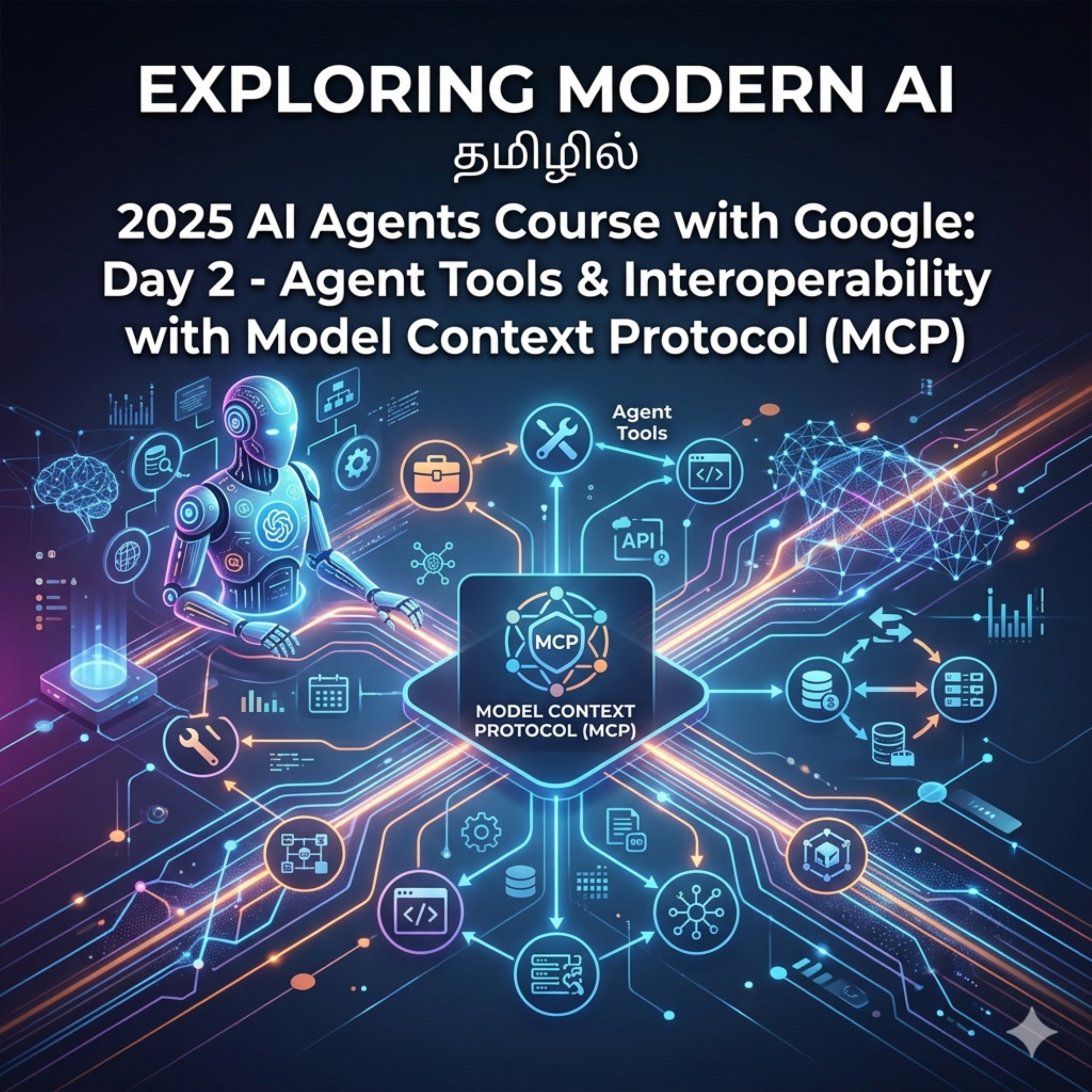
    2026 Day 2 - Agent Tools & Interoperability | Google AI Agents Course

    2026 kaggle 5-Day AI Agents Intensive Vibe Coding Course With Google Day 2: Agent Tools & Interoperability This episode of Exploring Modern AI in Tamil podcast explains agent protocols simply for someone new to the software development field. - Describes how building with open standards creates a plug and play environment. - Compares MCP and A2A as standard building blocks for agents. - Emphasizes how standardized protocols reduce the need for fragile bespoke tool wrappers. - Discusses why these protocols are essential for building a scalable and modular virtual workforce. - Provides a real world scenario showing how these protocols enable agent collaboration. - Contrasts the factory model approach with traditional manual coding methods. - Explains how AP2 helps manage secure agent payments in daily workflows. - Explains the role of Universal Commerce Protocol in modern agent trading workflows. - Highlights how UCP connects agents to real world commerce and food delivery. - Describes how generative user interfaces improve communication between agents and humans. - Adds details on how A2UI improves user interaction with agent systems. - Explains why these standards help developers move beyond simple prototyping. - Discusses how these protocols scale to support larger agentic factory environments. - Clarifies how AP2 applies strict rules for secure autonomous agent payments. - Explains how bounded and unbounded domains affect overall architecture. - Outlines why the GOTO problem matters in agent systems. - Explains how agents use canvas tools for interactive visual tasks. - Explains how to identify and debug common issues when using MCP servers. - Details best practices for consuming MCP servers as an agent developer. - Outlines two patterns for generating interfaces that bridge the communication gap. - Discusses how these protocols prepare developers for the future of agentic engineering.

  • June 21 · 11 min

    2026 Day 1 - Introduction to Agents & Vibe Coding | Google AI Agents Course

    2026 kaggle 5-Day AI Agents: Intensive Vibe Coding Course With Google Day 1: Introduction to Agents & Vibe Coding This episode of Exploring Modern AI in Tamil podcast explains vibe coding and agentic engineering for software developers new to these concepts. - Includes real world examples of coding agents in daily workflows. - Contrasts the financial risks of vibe coding versus agentic engineering. - Offers actionable steps for developers to start practicing context engineering. - Adds a section on integrating agents into existing daily coding routines. - Explains the factory model for building systems that create software. - Outlines the phases of the new software development lifecycle. - Discusses the new SDLC by comparing Traditional syntax-based methods and Intent-based AI agent systems. - Explains the core components of the harness engineering framework. - Lists daily habits for developers to master intent-based software creation. - Contrasts operating costs versus capital expenses for these development models. - Describes the shift from traditional developer roles to conductors and orchestrators. - Compares the conductor and orchestrator roles in managing complex agent systems. - Details how to build a robust harness for testing and quality assurance. - Explains strategies for maintaining security while scaling automated coding workflows. - Details how organizations can scale efficiency through intelligent model routing. - Focuses on learning intent-based communication as a core career skill. - Analyzes the trade offs between ad hoc prompting and structured agentic design. - Identifies key technical skills needed for roles involving AI agent oversight. - Highlights how leaders can justify agentic engineering investments to senior stakeholders. - Defines how organizations can measure long term ROI from agentic engineering frameworks. - Provides actionable steps for engineering leaders to transition their teams toward agentic engineering. - Suggests ways for engineering managers to evaluate team productivity metrics. - Outlines a phased plan for migrating legacy teams to agentic workflows.

  • May 25 · 19 min

    Google Antigravity 2.0: From Now On, We Are No Longer Coders—We Are Agent Managers

    கூகிள் ஆன்டிகிராவிட்டி 2.0: இனிமேல், நாம் குறியீட்டாளர்கள் அல்ல—நாம் ஏஜென்ட் மேலாளர்கள் This episode of Exploring Modern AI in Tamil podcast provides a simple guide for someone setting up their first project in Antigravity. - Includes steps to initialize a new folder and associate your local repositories. - Explains the difference between Local Mode and New Worktree Mode. - Describes how to use Planning Mode and verify Artifacts before final execution. - Explains how to invoke subagents for parallel tasks and manage their lifecycles. - Explains the Request Review policy versus the Always Proceed policy for artifacts. - Details the built-in subagent types like research and browser for better task automation. - Describes how to enable the multi-agent teamwork framework for complex tasks. - Explains how to enable Build with Google bundles for Firebase or Android projects. - Explains how to use the teamwork-preview command for collaborative multi-agent orchestration. - Details the nesting depth limits for hierarchical subagent delegation structures. - Details how to use system instructions for customizing agent persona and behavior. - Explains file-based customization using AGENTS.md and SKILL.md directory structures. - Details the iterative workflow for testing and persisting custom managed agents. - Explains how to use the teamwork-preview command for advanced multi-agent orchestration. - Details how to resolve common communication issues between parent agents and subagents. - Details the network configuration options for locking down agent outbound access. - Summarizes how parent agents effectively manage state and context across multiple subagents. - Details how subagents inherit safety boundaries and permission scopes from their parent agent. - Explains how to configure network allowlists to restrict agent outbound access. - Outlines steps to stabilize environments and transition prototypes into managed agents. - Shares tips for providing effective inline feedback during the Artifact review process.

    • Transcript
  • May 25 · 21 min

    2025 Day 5 - Prototype to Production | Google AI Agents Course

    கூகிளுடன் 2025 AI ஏஜென்ட்கள் பயிற்சி வகுப்பு: நாள் 5 - முன்மாதிரியிலிருந்து உற்பத்திக்கு This episode of Exploring Modern AI in Tamil podcast provides a step-by-step guide for moving an agent from a notebook to production. - Includes cost management tips - Details the CI/CD pipeline steps - Explains how to integrate long-term memory using Memory Bank. - Outlines key quality checks needed before final deployment. - Focuses on operational best practices for monitoring and cleaning up production agent resources. - Explains how to use Memory Bank to preserve user preferences across different sessions. - Suggests methods for scaling from one to many concurrent user instances. - Outlines strategies for managing multi-region deployment availability. - Discusses A2A protocol patterns for cross-framework and cross-organization agent communication. - Defines roles and process workflows for cross-functional AI development teams. - Defines evaluation metrics to serve as a formal quality gate before deployment. - Contrasts the performance of local sub-agents against remote agents using A2A. - Highlights techniques for using scaling policies to manage traffic spikes effectively. - Describes how to implement robust health checks for identifying failing agent instances. - Explains how to choose between containerized, serverless, or Kubernetes deployment platforms. - Outlines communication processes for teams working on different parts of an agent pipeline. - Suggests documentation standards to ensure consistency across collaborative AI development workflows.

    • Transcript
  • May 25 · 20 min

    2025 Day 4 - Agent Quality | Google AI Agents Course

    கூகிளுடன் 2025 AI ஏஜென்ட்கள் பயிற்சி வகுப்பு: நாள் 4 - ஏஜென்ட் தரம் This episode of Exploring Modern AI in Tamil podcast focuses on the three core messages regarding trajectory, observability, and evaluation loops. - Explains these concepts simply for someone new to agent systems. - Provides real world examples of the kitchen analogy for better understanding. - Adds tips for starting the quality flywheel process. - Explains how this framework builds enterprise trust in autonomous agents. - Connects agent quality improvements to measurable business outcomes. - Outlines a phased approach for teams starting their first agent evaluation project. - Compares logging, tracing, and metrics for diagnostic clarity. - Discusses methods to ensure agent safety and prevent failure modes. - Describes how human feedback loops specifically improve long term agent reliability. - Roleplays as an experienced engineering manager coaching a junior team on agent quality. - Lists common agent failure modes and how to detect them early. - Explains how teams should plan for scaling agent quality over time. - Highlights how to integrate responsible artificial intelligence into the agent development lifecycle. - Contrasts the black box end to end view with glass box trajectory analysis. - Explains how to implement the Outside-In evaluation hierarchy - Discusses future trends in agent reliability. - Predicts how autonomous systems will evolve. - Advises executives on prioritizing quality as a core architectural investment. - Analyzes the benefits of using AI as a judge for automated evaluation.

    • Transcript
  • May 19 · 16 min

    Google Gemini Enterprise Agent Platform: The Enterprise Agentic Lifecycle

    கூகிள் ஜெமினி எண்டர்பிரைஸ் ஏஜென்ட் பிளாட்ஃபார்ம்: நிறுவன ஏஜென்ட் செயல்முறைச் சுழற்சி Explains the core architecture and key benefits of the Agent Platform for developers. - Describes how to use Agent Studio for rapid prototyping. - Outlines steps for optimizing agent performance with ADK. - Explains how to use Sessions for conversation history and memory. - Describes how Memory Bank persists personalized user information across multiple interaction sessions. - Details how Agent Registry centralizes governance for agents and tools. - Highlights how to use Agent Studio features like slash commands and comparison views. - Distinguishs between Administrator and Builder roles within the Agent Studio collaborative workspace. - Explains core session concepts like events, state, and memory for interaction persistence. - Defines how event schemas and state management enable custom agent data handling. - Explains the Quality Flywheel concept for continuous evaluation and optimization of agent performance. - Explains how to implement custom optimization strategies using the ADK framework. - Explains how developers use the interactive canvas and minimap in Agent Studio. - Details how Agent Registry helps manage and discover Model Context Protocol servers. - Outlines how to register custom endpoints and MCP servers within the central registry. - Describes the step-by-step process of the Quality Flywheel for fixing agent failures. - Explains how the Agent Registry resolves issues like fragmented tool access and isolation.

    • Transcript
  • May 19 · 20 min

    Google Agent Development Kit (ADK): Collaborative AI Agent Architecture

    கூகிள் ஏஜென்ட் டெவலப்மென்ட் கிட் (ADK): கூட்டுச் செயற்கை நுண்ணறிவு முகவர் கட்டமைப்பு Provide a comprehensive overview of ADK Architecture for Building Collaborative AI Agents - Analyze the architectural trade-offs between Sequential, Loop, and Parallel agent types. - Compare sequential workflows with graph-based or parallel agent architectures. - Describe the structure and benefits of using SequentialAgent for deterministic workflows. - Discuss how developers can chain agents using a SequentialAgent workflow. - Walk through building a multi-agent system for a code development pipeline. - Discuss using Output Key to pass data between agents in a pipeline. - Explain how to share session state between agents during multi-step processes. - Discuss when to choose custom agents over standard workflow agent patterns. - Describe how to integrate external tools using the Model Context Protocol. - Outline how to use FastMCP servers for building and exposing custom tools. - Compare when to use local versus remote agents for microservices architectures. - Outline essential steps for developers choosing between local sub-agents and remote A2A agents. - Contrast the usage of A2A versus local sub-agents with concrete examples. - Explain when to use A2A for integrating standalone services. - Explain the process of connecting specialized agents via the A2A protocol. - Summarize how developers can use the Gemini Live API Toolkit for streaming. - Detail how to implement safety guardrails for agent inputs and outputs. - Explain best practices for sandboxing model code execution to prevent security risks. - Compare plugins versus callbacks for enforcing uniform security policies across agents. - Explain how to use callbacks and plugins to implement security guardrails. - Focus on identity, authorization, and advanced plugins like Gemini as a Judge. - Explain how to implement a PII Redaction Plugin for data protection. - Discuss using Model Armor to prevent content safety violations. - Highlight tips for implementing effective user authentication with OAuth scopes. - Explain common risk scenarios like reward hacking and data exfiltration in production. - Detail how to implement VPC security controls to protect sensitive agent data. - Explain how to use the Code Executor tool for secure data analysis tasks. - Review how to configure content filters to block harmful model output automatically. - Illustrate how to deploy ADK agents on Google Cloud Run for production. - Show how to use observability tools like logging and traces to debug agent workflows. - Explain how to setup cross-language support between Python and Java agents. - Explain how to build a layered defense strategy against indirect prompt injection. - Analyze advanced strategies for context compression in long-running agent workflows. - Discuss best practices for managing state and memory in multi-agent systems. - Analyze trade-offs between agent-auth and user-auth for securing external tool access. - Discuss techniques for handling multi-language agent communication patterns effectively. - Describe about Ambient Agent Build Approaches

    • Transcript
  • May 19 · 19 min

    Anthropic Claude Agent SDK: Build Autonomous AI Agents

    ஆந்த்ரோபிக் கிளாட் ஏஜென்ட் SDK: தன்னாட்சி AI ஏஜென்ட்களை உருவாக்குங்கள் Explain the step-by-step lifecycle of an agent session, from prompts to final results. - Break down the core concepts for someone new to building agents with the SDK. - Describe how developers should handle different message types for building user interfaces. - Explain how enabling partial message streaming changes the visibility of the agent loop. - Provide examples of using hooks to intercept and control agent behavior at runtime. - Summarize how prompt caching helps reduce total costs during long agent sessions. - Compare synchronous and asynchronous approaches for handling agent tool execution turns. - Describe how to implement real-time streaming to display text and tool calls. - Explain how to configure permissions and settings sources to isolate agent environments. - Detail safety patterns for production deployments including permission isolation and tool approval flows. - Describe efficient workflows for testing and deploying agents in isolated environments. - Offer best practices for developers building production agents with custom tools and MCP. - Explain how permission modes like acceptEdits ensure safety when agents interact with files. - Describe how to implement tool approval callbacks to verify actions before they run. - Explain how to use the PreCompact hook to archive history before context summarization. - List common diagnostic steps when tool calls fail or produce unexpected output. - Outline methods for monitoring system health and usage metrics in multi-tenant production systems. - Highlight how to use OpenTelemetry to improve visibility into complex agent sessions. - Describe how to use subagents for handling complex tasks while keeping context lean. - Detail strategies for managing long sessions to keep context efficient and costs low. - Summarize how automatic context compaction prevents hitting window limits during long runs. - Discuss how token usage and costs are tracked throughout the loop. - Detail how to monitor cumulative session costs and analyze token usage metrics. - Detail how to interpret total cost and token usage data from ResultMessage fields. - Explain how to select effort levels to optimize token costs for different tasks.

    • Transcript
  • May 18 · 22 min

    LlamaParse v2: Scaling Document Intelligence At A Production Level

    LlamaParse v2: ஆவண நுண்ணறிவை உற்பத்தி நிலையில் விரிவுபடுத்துதல் Defines the end-to-end architecture for scaling document intelligence at a production level - Focuses on best practices for developers managing API rate limits and concurrency. - Details how to properly implement webhook integrations for reliable, asynchronous job completion. - Describes the benefits of the parse-then-extract pattern for cost and performance optimization. - Explains how to automate schema management and validation within an enterprise deployment pipeline. - Explains how to use batch processing to manage high volume workloads effectively. - Discusses strategies for optimizing latency when handling large numbers of complex documents. - Explains how to select the best tier based on document complexity and cost. - Offers specific advice for developers setting up sandbox environments for agentic code execution. - Outlines steps for integrating LlamaSheets into custom agents using contextual system prompts. - Compares the four LlamaParse tiers and explain when to use the Cost Optimizer. - Provides a checklist for setting up project environments and managing extraction dependencies. - Details how to maintain versioning and reproducibility for production parsing pipelines. - Explains how to use the Cost Optimizer to route document pages automatically. - Describes patterns for handling complex mixed-format documents during batch processing tasks. - Highlights essential steps for setting up secure, sandboxed code execution environments. - Summarizes technical hurdles for developers new to LlamaCloud architecture and API workflows. - Outlines reliable error handling patterns for long-running batch extraction jobs. - Explains how to maintain system stability when scaling batch processing to enterprise volumes. - Outlines the process for pinning specific versions to ensure production stability. - Details how to provide spreadsheet context to agents using system prompts. - Compares Fast, Cost Effective, Agentic, and Agentic Plus tiers for specific document types.

    • Transcript
  • May 18 · 17 min

    Crawl4AI: Adaptive Web Crawling for AI Data

    Crawl4AI: AI தரவுகளுக்கான தகவமைவு இணைய ஊர்தல் Explain the mechanics of the adaptive crawling strategy. - Focus on how it selects the right links to follow. - Discuss how this approach reduces token usage and computational costs effectively. - Include a comparison between traditional and adaptive crawling performance metrics. - Highlight how to use JavaScript execution for dynamic pages. - Describe techniques for handling shadow DOM content. - Explain the economics of using statistical approaches over brute force methods. - Provide tips for maximizing token savings in large-scale crawls. - Outline steps to combine CSS selection with pattern-based extraction. - Discuss filtering out irrelevant content to improve data quality. - Detail a logical sequence to setup and run an efficient crawling project. - Focus on specific settings to optimize performance for large-scale data extraction. - Contrast virtual scrolling versus manual JavaScript commands for better speed. - Outline a typical session workflow to manage multi-step interactions. - Recommend configurations for handling common bot-detection challenges. - Provide a checklist for setting up persistent sessions using session ID. - Contrast embedding based strategies with pure statistical methods for efficiency. - Provide real world examples for handling complex web components and dynamic interactions. - Emphasize the specific cost savings achieved by using saturation and coverage metrics. - Explain expert techniques for fine-tuning crawler behavior via custom JavaScript hooks. - Discuss how embedding-based strategies improve semantic understanding of complex websites. - Detail high-level techniques to maximize throughput and minimize latency in production. - Structure the overview as a step by step guide for building production crawlers.

    • Transcript
  • May 18 · 17 min

    Firecrawl: Redefining Web Extraction for AI

    Firecrawl: AI-க்கான இணையத் தரவுப் பிரித்தெடுத்தலை மறுவரையறை செய்தல் Provides scenarios for using Firecrawl to build knowledge graphs from Wikipedia pages. - Uses the map endpoint to discover article categories and relationships. - Defines node entities based on infobox data extraction. - Focuses on automating research workflows for academics and fact-checkers. - Explains how to structure entities like people, locations, and events. - Uses JSON mode to extract structured schema data from articles. - Links extracted content to your database schema for graph visualization. - Utilizes the agent endpoint to autonomously discover interconnected biographical facts across multiple articles. - Demonstrates how to run Firecrawl locally to manage custom schema migrations securely. - Describes using the interact endpoint to refine data extraction via prompts after initial scraping. - Compares agent versus extract endpoints for research discovery versus targeted multi-page extraction tasks. - Explains how to chain interactive calls to navigate and extract dynamic data efficiently. - Details best practices for migrating existing data pipelines to use modern autonomous agents. - Uses the interact endpoint to perform multi-step data cleaning inside the browser session. - Chains interaction prompts to extract specific infobox details across complex Wikipedia categories. - Automates biographical entity mapping to identify relationships between historical figures in large datasets. - Validates citation data accuracy by programmatically checking links across multiple academic Wikipedia pages. - Organizes output into JSON schemas to streamline migration into graph database environments. - Sequences extraction tasks to handle large-scale link discovery without overloading local resources. - Uses the agent endpoint for autonomous cross-domain research discovery. - Implements persistent profiles to keep sessions authenticated across multiple Wikipedia scraping steps. - Extracts citation metadata to build reliable and verifiable academic knowledge graphs. - Batchs scrape related academic articles to improve data consistency and structure. - Optimizes token usage by choosing between JSON mode and autonomous agent endpoints. - Leverages the interact endpoint to handle dynamic content or form interactions automatically. - Integrates interact sessions to verify multi-step citation trails across academic sources. - Discusses optimizing local infrastructure for large-scale Wikipedia scraping and graph schema generation. - Includes code snippets for batch scraping biographical articles to speed up knowledge extraction. - Explains using persistent profiles to maintain authentication during complex multi-page citation verification tasks. - Details how to use interactive live views to debug scraper logic during session execution. - Outlines steps for academic users to automate citation validation across large article datasets. - Describes techniques for structuring historical data to support graph-based academic relationship analysis. - Recommends efficient batch processing patterns for scraping thousands of Wikipedia pages simultaneously. - Suggests hardware configurations for locally hosted Firecrawl instances handling heavy knowledge graph workloads. - Compares pricing for JSON mode versus autonomous agents to minimize your monthly budget. - Explains how to use batch scraping for high volume data gathering efficiently. - Outlines steps for using Docker Compose to deploy and manage local scraping infrastructure. - Explains how to use persistent browser profiles to stay authenticated during long scraping jobs. - Explains how to extract and verify metadata to preserve academic citation accuracy. - Details how to map entity relationships across multiple languages for comprehensive research projects.

    • Transcript
  • May 18 · 17 min

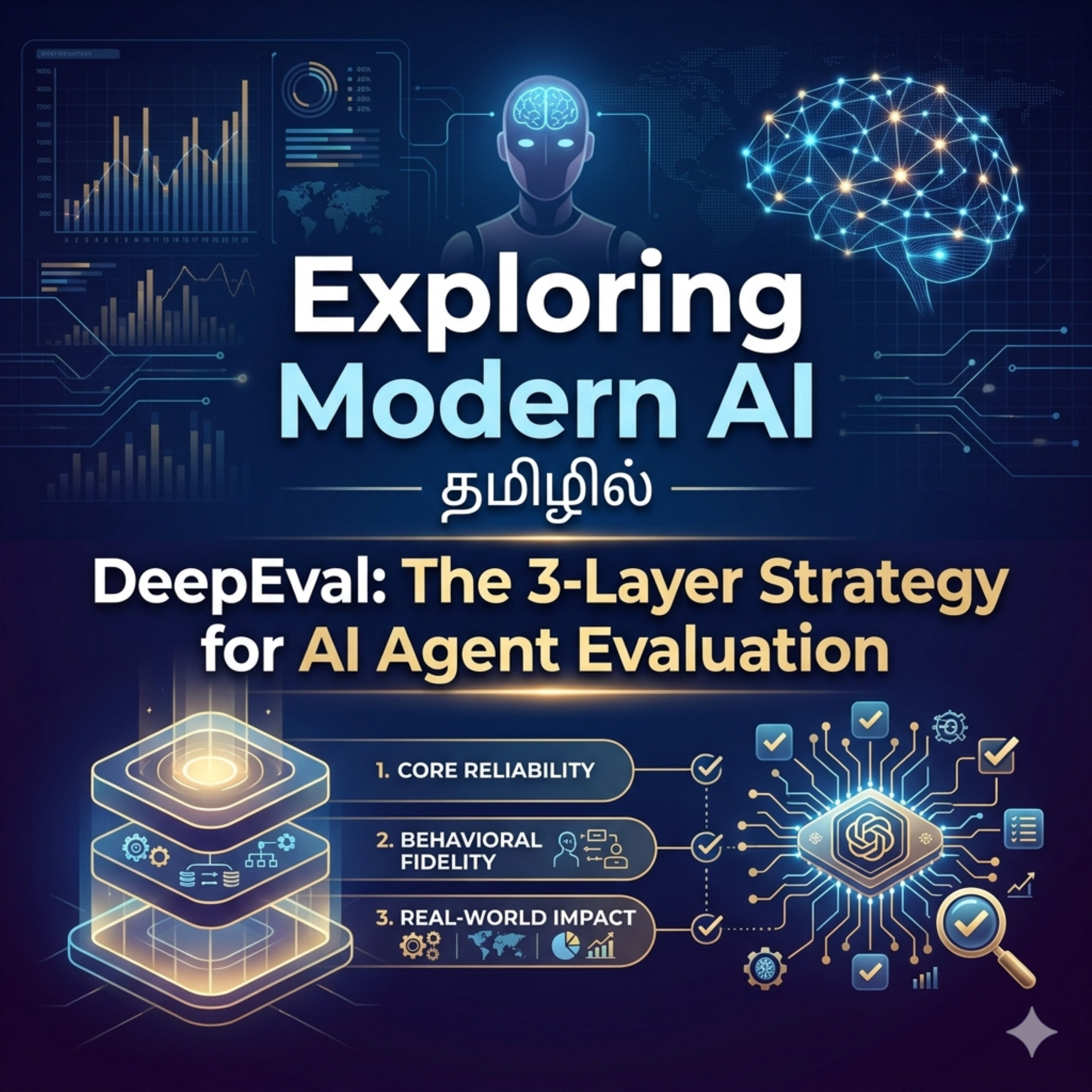
    DeepEval: The 3-Layer Strategy for AI Agent Evaluation

    DeepEval: AI ஏஜென்ட் மதிப்பீட்டிற்கான 3-அடுக்கு உத்தி Provides a comprehensive overview of the 3 Layer Strategy for AI Agent Evaluation - Simplifies the core concepts for someone new to LLM testing. - Breaks down how to create a first passing test case easily. - Explains how to setup component-level testing using DeepEval tracing. - Details the integration process with Confident AI for cloud reporting. - Describes the best metrics for agentic tasks like tool correctness. - Suggests how to mix generic and custom metrics for high accuracy. - Explains how to choose between the recommended generic and custom evaluation metrics. - Suggests a balanced mix of metrics to avoid evaluation overload. - Guides a developer on configuring custom embedding models for data synthesis. - Explains how to implement a custom LLM judge for unique evaluation requirements. - Shows how to use verbose mode to debug failing metric scores. - Describes steps for resolving stuck evaluations due to API or rate limits. - Lists the best criteria for choosing between generic and custom evaluation metrics. - Suggests a five-metric limit to maintain focus on specific quality goals. - Explains how to implement asynchronous evaluation methods to improve performance. - Shows how to build custom evaluation templates for improved model accuracy. - Details advanced strategies for implementing decision tree DAG metrics. - Explains how to switch between reference and referenceless evaluation metrics. - Focuses on RAG evaluation by balancing retrieval and generator metrics effectively. - Details how to use context precision and faithfulness to improve RAG performance. - Provides a clear guide for setting up local CLI environments correctly. - Explains how to persist configuration settings to speed up local testing. - Contrasts objective DAG metrics against subjective G-Eval scoring approaches. - Details why referenceless metrics are essential for production monitoring workflows. - Explains how to integrate custom models for advanced evaluation needs. - Summarizes why you should limit evaluations to five metrics total. - Explains how to select the best mix of generic and custom metrics. - Details the best practices for scaling evaluation workflows in production environments.

    • Transcript
  • May 18 · 19 min

    Ragas: Toolkit for Evaluating and Optimizing LLM Applications

    ராகாஸ்: எல்எல்எம் பயன்பாடுகளை மதிப்பீடு செய்வதற்கும் மேம்படுத்துவதற்குமான கருவித்தொகுப்பு Outline the steps to integrate Ragas evaluations into an existing AI development project. - Explain best practices for creating high-quality, representative datasets for your AI application. - Detail effective strategies for managing dataset versions and storage in local or cloud environments. - Compare model-based metrics against traditional non-LLM computation-based metrics for better assessment accuracy. - Structure an efficient workflow to run evaluations and interpret score results for performance tracking. - Explain when to choose character-based metrics versus model-based metrics for your specific evaluation goals. - Highlight easy methods to format data into the Ragas evaluation dataset structure. - Compare ROUGE and BLEU scores for assessing text similarity in different language contexts. - Contrast exact match metrics with semantic similarity measures for specific use cases. - Summarize techniques for curating balanced datasets with diverse difficulty levels and metadata tagging. - Suggest ways to transition from local file storage to cloud-based systems for teams. - Define how to set up custom evaluation rubrics for unique task requirements. - List essential steps for installing dependencies and preparing the evaluation environment for beginners. - Detail how to use the evaluation function to generate row-level performance scores. - Explain how to configure evaluator language models and embeddings for point-wise metric tasks. - Compare CHRF and BLEU metrics for evaluating morphologically rich languages or paraphrased responses. - Describe how to build custom point-wise metrics for specialized AI task requirements. - Contrast string-based distance measures like Levenshtein and Jaro for evaluating non-LLM metrics. - Suggest methods for scaling evaluations as your dataset size and team grow. - Outline a practical workflow to automate routine performance testing in production environments. - Discuss choosing between semantic similarity, string distance measures, and LLM-based rubric scoring. - Emphasize cloud-based management and automated testing workflows for large enterprise datasets. - Detail how to pick between string-based distance measures like Jaro versus character n-gram scoring. - Compare usage of model-based evaluators versus traditional string metrics for complex, multilingual generation tasks. - Explain how to integrate evaluation workflows into existing CI/CD pipelines for continuous performance monitoring. - Recommend ways to organize datasets using unique identifiers and metadata for easier analysis. - Discuss tracking experiment results across different test iterations and model versions. - Describe how to build custom metrics using LLM calls for unique task logic. - Detail the process for training and aligning custom metrics to match human judgment. - Share tips for using rich metadata to segment and analyze evaluation results effectively. - Advise on selecting high-quality representative samples for diverse real-world scenario testing.

    • Transcript
  • May 18 · 16 min

    LangChain LangSmith: Engineering Observability for Autonomous AI Agents

    லாங்ஸ்மித்: தன்னாட்சி AI ஏஜெண்டுகளுக்கான கண்காணிப்புத் திறனைப் பொறியியல் செய்தல் Explains how tracing helps debug LLM applications and monitor agent performance. - Details the difference between projects, traces, and runs. - Describes how these containers relate to each other. - Compares these concepts to OpenTelemetry span structures for clarity. - Explains the difference between automatic integration and manual instrumentation for sending trace data. - Describes how manual instrumentation helps developers gain control over their application tracing. - Describes how to filter trace data using run attributes or specific key-value pairs. - Shows how to perform negative filtering for metadata and output fields. - Summarizes how storage services like ClickHouse and PostgreSQL manage your trace data. - Explains using advanced dot notation to match nested key-value pairs. - Details the process for routing OpenTelemetry traces to experiment sessions for evaluation purposes. - Explains linking dataset examples to specific application runs via span attributes. - Explains the difference between stateful and stateless cron execution modes. - Explains how to configure background cron jobs for scheduled assistant execution. - Describes options for managing thread lifecycles using stateless cron configurations. - Explains how to use thread cleanup to manage data retention costs. - Explains how to use metadata and tags for categorizing traces during local development. - Summarizes how to use blob storage and external databases to handle large datasets. - Details how to use OpenTelemetry attributes to link custom traces to datasets. - Summarizes the roles of frontend, backend, and platform services in self-hosted deployments. - Describes the technical differences between standalone server setups and full control plane deployments. - Compares the resource requirements for self-hosted observability versus full agent deployment setups. - Outlines infrastructure considerations for scaling self-hosted deployments in secure enterprise environments. - Explains how to use evaluator scores to compare model performance during experiments. - Describes how to automate feedback collection to improve agent reliability over time. - Provides best practices for testing local graph changes before deploying to production servers. - Describes how to optimize data retention settings for long term trace storage. - Explains how to configure secure authentication providers for private agent deployments. - Details requirements for isolating sensitive data in multi tenant enterprise environments.

    • Transcript
Showing 1–20 of 20 episodes