Skip to content
Artwork for Exploring Modern AI in Tamil
Exploring Modern AI in Tamil · June 21 · 16 min

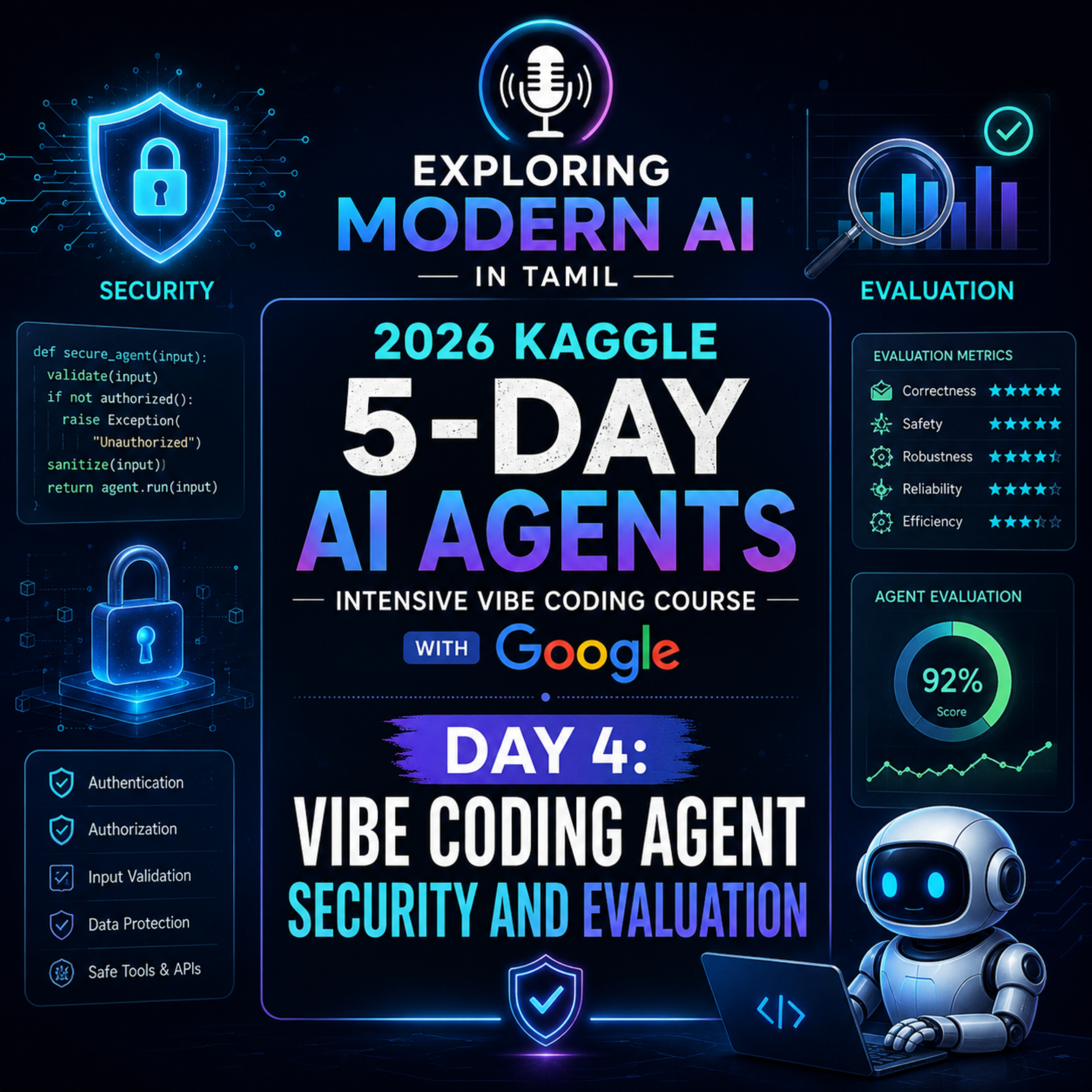
2026 Day 4 - Vibe Coding Agent Security and Evaluation | Google AI Agents Course

2026 kaggle 5-Day AI Agents Intensive Vibe Coding Course With Google Day 4: Vibe Coding Agent Security and Evaluation This episode of Exploring Modern AI in Tamil podcast explains the 7-Pillar Security Architecture and how it protects agentic development. - Uses simple analogies to explain the pillars for non-technical team members. - Focuses on how these security pillars impact daily coding workflows. - Details roles for Red, Blue, and Green teams in securing agents. - Provides real-world examples of how sandboxing prevents code vulnerabilities. - Discusses challenges for deploying these security frameworks within enterprise environments. - Outlines a logical sequence for integrating these pillars into existing development pipelines. - Explains how stateful circuit breakers detect intent drift during agent execution. - Compares security boundaries with evaluation metrics for measuring code quality. - Contrasts security boundaries with quality evaluation of the agent output. - Highlights how enterprise leaders justify security investments. - Analyzes technical nuances of egress governance and contextual authorisation within agentic systems. - Explains how developers handle repository poisoning and identity theft in daily tasks. - Describes how executives should measure security ROI for autonomous development teams. - Summarizes the key trade-offs between speed and safety for corporate leadership. - Defines how zero ambient authority prevents confused deputy attacks in enterprise agents. - Explains how teams measure intent drift versus output quality during agent evaluation. - Outlines practical steps for auditing an agent's reasoning process during development. - Explains why evaluating vibe coding agents requires new qualitative frameworks. - Outlines methods for measuring agent alignment and internal reasoning quality. - Contrasts these enterprise agent protocols against standard software security practices. - Explains how to balance IDE friction with security enforcement. - Details how the Green team uses auto-refactoring to fix agent security issues. - Clarifies the difference between security safety and output evaluation quality. - Discusses why both are needed for enterprise vibe coding success. - Discusses emerging skills needed for developers managing these autonomous security systems. - Emphasizes how leadership maintains culture during this transition to automated agentic workflows. - Recommends specific tools for monitoring internal agent reasoning and intent alignment. - Summarizes how vibe coding shifts trust models compared to traditional deterministic software development. - Details how developers can mitigate risks when working with ephemeral sandboxing environments. - Discusses how leadership justifies the shift toward autonomous and intent driven agent systems.

0:00-16:15

transcript

No transcript — this publisher did not publish one.

show notes

2026 kaggle 5-Day AI Agents Intensive Vibe Coding Course With Google Day 4: Vibe Coding Agent Security and Evaluation


This episode of Exploring Modern AI in Tamil podcast explains the 7-Pillar Security Architecture and how it protects agentic development.

- Uses simple analogies to explain the pillars for non-technical team members.

- Focuses on how these security pillars impact daily coding workflows.

- Details roles for Red, Blue, and Green teams in securing agents.

- Provides real-world examples of how sandboxing prevents code vulnerabilities.

- Discusses challenges for deploying these security frameworks within enterprise environments.

- Outlines a logical sequence for integrating these pillars into existing development pipelines.

- Explains how stateful circuit breakers detect intent drift during agent execution.

- Compares security boundaries with evaluation metrics for measuring code quality.

- Contrasts security boundaries with quality evaluation of the agent output.

- Highlights how enterprise leaders justify security investments.

- Analyzes technical nuances of egress governance and contextual authorisation within agentic systems.

- Explains how developers handle repository poisoning and identity theft in daily tasks.

- Describes how executives should measure security ROI for autonomous development teams.

- Summarizes the key trade-offs between speed and safety for corporate leadership.

- Defines how zero ambient authority prevents confused deputy attacks in enterprise agents.

- Explains how teams measure intent drift versus output quality during agent evaluation.

- Outlines practical steps for auditing an agent's reasoning process during development.

- Explains why evaluating vibe coding agents requires new qualitative frameworks.

- Outlines methods for measuring agent alignment and internal reasoning quality.

- Contrasts these enterprise agent protocols against standard software security practices.

- Explains how to balance IDE friction with security enforcement.

- Details how the Green team uses auto-refactoring to fix agent security issues.

- Clarifies the difference between security safety and output evaluation quality.

- Discusses why both are needed for enterprise vibe coding success.

- Discusses emerging skills needed for developers managing these autonomous security systems.

- Emphasizes how leadership maintains culture during this transition to automated agentic workflows.

- Recommends specific tools for monitoring internal agent reasoning and intent alignment.

- Summarizes how vibe coding shifts trust models compared to traditional deterministic software development.

- Details how developers can mitigate risks when working with ephemeral sandboxing environments.

- Discusses how leadership justifies the shift toward autonomous and intent driven agent systems.