Skip to content
Artwork for Exploring Modern AI in Tamil
Exploring Modern AI in Tamil · June 21 · 20 min

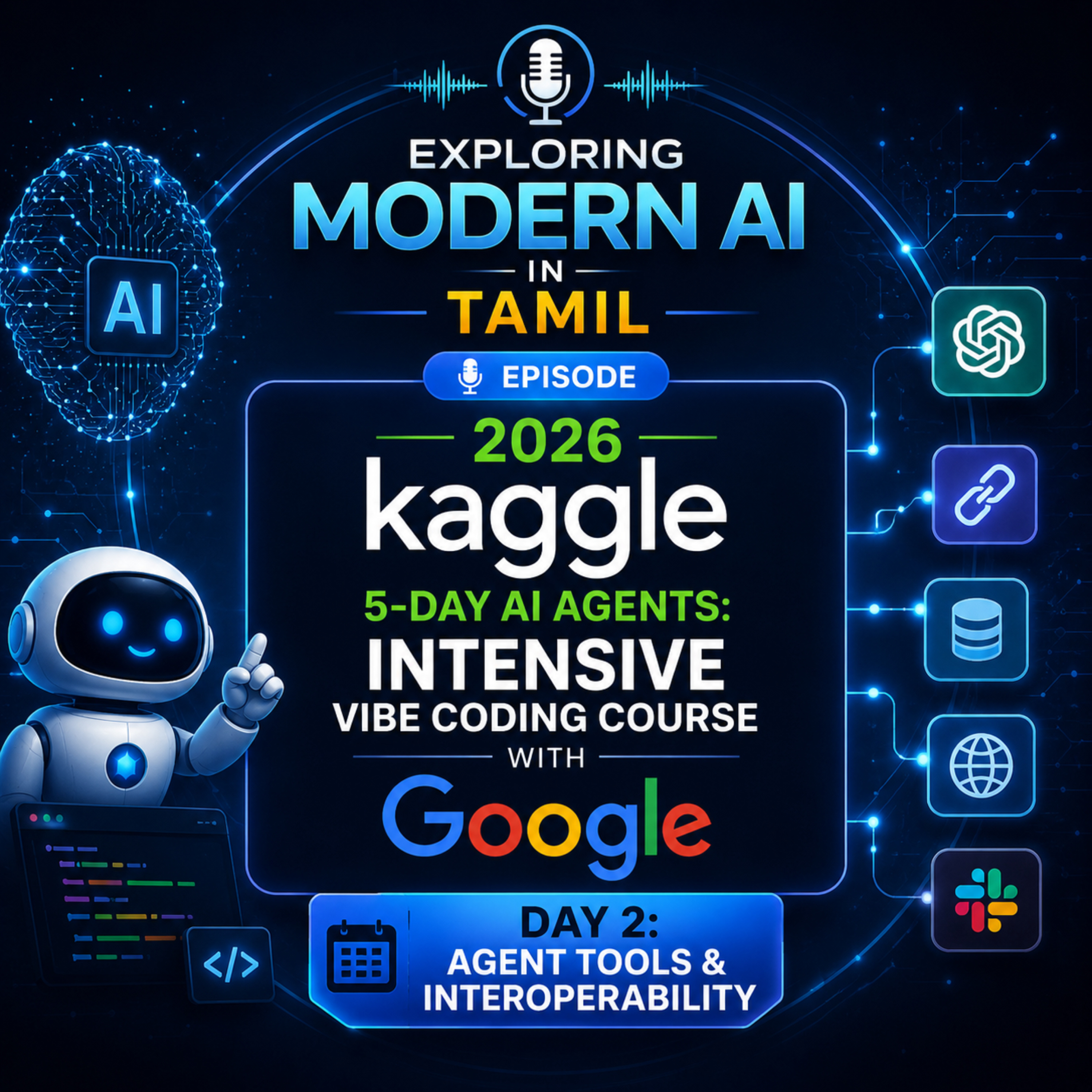
2026 Day 2 - Agent Tools & Interoperability | Google AI Agents Course

2026 kaggle 5-Day AI Agents Intensive Vibe Coding Course With Google Day 2: Agent Tools & Interoperability This episode of Exploring Modern AI in Tamil podcast explains agent protocols simply for someone new to the software development field. - Describes how building with open standards creates a plug and play environment. - Compares MCP and A2A as standard building blocks for agents. - Emphasizes how standardized protocols reduce the need for fragile bespoke tool wrappers. - Discusses why these protocols are essential for building a scalable and modular virtual workforce. - Provides a real world scenario showing how these protocols enable agent collaboration. - Contrasts the factory model approach with traditional manual coding methods. - Explains how AP2 helps manage secure agent payments in daily workflows. - Explains the role of Universal Commerce Protocol in modern agent trading workflows. - Highlights how UCP connects agents to real world commerce and food delivery. - Describes how generative user interfaces improve communication between agents and humans. - Adds details on how A2UI improves user interaction with agent systems. - Explains why these standards help developers move beyond simple prototyping. - Discusses how these protocols scale to support larger agentic factory environments. - Clarifies how AP2 applies strict rules for secure autonomous agent payments. - Explains how bounded and unbounded domains affect overall architecture. - Outlines why the GOTO problem matters in agent systems. - Explains how agents use canvas tools for interactive visual tasks. - Explains how to identify and debug common issues when using MCP servers. - Details best practices for consuming MCP servers as an agent developer. - Outlines two patterns for generating interfaces that bridge the communication gap. - Discusses how these protocols prepare developers for the future of agentic engineering.

0:00-20:18

transcript

No transcript — this publisher did not publish one.

show notes

2026 kaggle 5-Day AI Agents Intensive Vibe Coding Course With Google Day 2: Agent Tools & Interoperability

This episode of Exploring Modern AI in Tamil podcast explains agent protocols simply for someone new to the software development field.

- Describes how building with open standards creates a plug and play environment.

- Compares MCP and A2A as standard building blocks for agents.

- Emphasizes how standardized protocols reduce the need for fragile bespoke tool wrappers.

- Discusses why these protocols are essential for building a scalable and modular virtual workforce.

- Provides a real world scenario showing how these protocols enable agent collaboration.

- Contrasts the factory model approach with traditional manual coding methods.

- Explains how AP2 helps manage secure agent payments in daily workflows.

- Explains the role of Universal Commerce Protocol in modern agent trading workflows.

- Highlights how UCP connects agents to real world commerce and food delivery.

- Describes how generative user interfaces improve communication between agents and humans.

- Adds details on how A2UI improves user interaction with agent systems.

- Explains why these standards help developers move beyond simple prototyping.

- Discusses how these protocols scale to support larger agentic factory environments.

- Clarifies how AP2 applies strict rules for secure autonomous agent payments.

- Explains how bounded and unbounded domains affect overall architecture.

- Outlines why the GOTO problem matters in agent systems.

- Explains how agents use canvas tools for interactive visual tasks.

- Explains how to identify and debug common issues when using MCP servers.

- Details best practices for consuming MCP servers as an agent developer.

- Outlines two patterns for generating interfaces that bridge the communication gap.

- Discusses how these protocols prepare developers for the future of agentic engineering.