
Skip to content
Artwork for Law School
EducationCourses

Law School

The Law School of America

The Law School of America podcast is designed for listeners who what to expand and enhance their understanding of the American legal system. It provides you with legal principles in small digestible bites to make learning easy. If you're willing to put in the time, The Law School of America podcasts can take you from novice to knowledgeable in a reasonable amount of time.

Play
  • 123 episodes
  • daily
  • Avg 1 hr 10 min
  • English
Counted on this page — what you have heard stays on this device, so it is not something the list can be paged by.
  • July 18 · 1 hr 4 min

    Professional Responsibility and MPRE: Money, Property, Advertising, Solicitation, Transactions with Nonclients, Lawyer Roles, Public Duties, and Judicial Conduct

    » 📘VIEW THE COMPANION STUDY GUIDE📘[💡FREE💡] « ▬▬▬▬▬▬▬▬▬▬ EPISODE SUMMARY Professional responsibility extends beyond courtroom advocacy. Lawyers must handle money and property properly, communicate truthfully with the public and nonclients, avoid misleading advertising, obey solicitation limits, clarify professional roles, support the legal system, and understand judicial ethics. Client and third-party property must be kept separate from lawyer property. Client funds generally belong in trust, not in operating accounts. Commingling means improper mixing. Conversion means improper use. Unearned fees may need to remain in trust until earned. Settlement funds must be handled with notice, accounting, prompt distribution, and protection of valid third-party claims. Disputed funds must remain separated until resolved. Lawyer advertising is allowed if truthful and not misleading. A lawyer may state fields of practice, but specialization claims must be accurate and properly supported. Solicitation is more restricted than advertising, especially direct live person-to-person contact for pecuniary gain toward someone known to need legal services in a particular matter. Coercion, duress, harassment, and unwanted solicitation are improper. Referral and lead-generation arrangements must not mislead clients, compromise independence, or involve improper fee sharing. Firm names and professional communications must not misrepresent identity, affiliation, or responsibility for services. A lawyer must be truthful in statements to others and must not knowingly make false statements of material fact or law. The lawyer must respect third-person rights and may not use methods that unlawfully burden, embarrass, delay, or invade legal rights. Lawyers may serve as advisors, evaluators, negotiators, mediators, arbitrators, and third-party neutrals, but must clarify their roles. A mediator does not represent both parties merely by mediating. An evaluator must consider whether the evaluation is compatible with the client relationship and whether informed consent is required. Lawyers have duties to the public and legal system, including access to justice, responsible conduct concerning appointments, avoidance of improper influence, and truthful statements about judges and adjudicative officers. Judges must preserve independence, integrity, and impartiality. They must avoid impropriety and appearance concerns, regulate extrajudicial activities, avoid improper ex parte communications, disqualify themselves when impartiality might reasonably be questioned, and comply with rules governing gifts, public comments, and campaign activity. The central lesson is that ethics is a full-profession system. Money, advertising, negotiation, nonclient communications, neutral roles, public duties, and judicial behavior all belong to Professional Responsibility.

  • July 17 · 1 hr 11 min

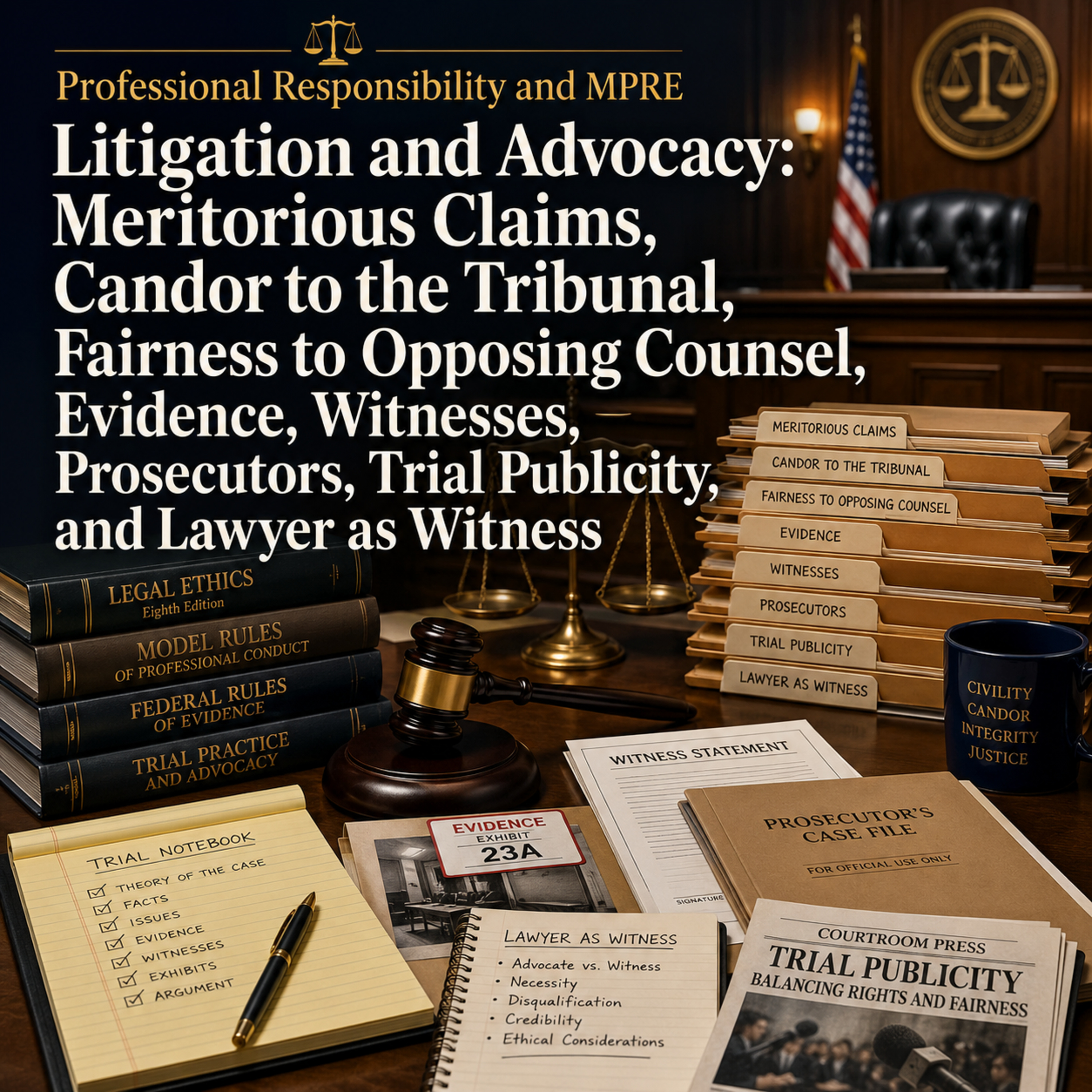
    Professional Responsibility & MPRE: Litigation & Advocacy - Meritorious Claims, Candor to the Tribunal, Fairness to Opposing Counsel, Evidence, Witnesses, Prosecutors, Trial Publicity & Lawyer as Witn

    » 📘VIEW THE COMPANION STUDY GUIDE📘[💡FREE💡] « ▬▬▬▬▬▬▬▬▬▬ EPISODE SUMMARY Advocacy has boundaries. A lawyer may represent a client forcefully, but must not file frivolous claims, mislead courts, falsify evidence, obstruct discovery, coach witnesses to lie, improperly contact represented persons, or prejudice proceedings through public statements. A lawyer must not bring or defend a proceeding or assert an issue without a nonfrivolous basis in law and fact. Good-faith arguments for changing the law are allowed. Criminal defense lawyers may require the prosecution to prove every element. Candor to the tribunal requires truthful statements of fact and law, correction of prior material false statements, disclosure of controlling adverse legal authority not disclosed by the opponent, and refusal to offer evidence known to be false. If material false evidence has been offered, the lawyer must take reasonable remedial measures, which may include disclosure to the tribunal if necessary. Ex parte proceedings require heightened candor because the opposing party is absent. The lawyer must disclose material facts needed for an informed decision, even if adverse. Fairness to opposing parties and counsel prohibits obstruction of evidence, destruction or concealment of material, falsification of proof, assistance with false testimony, improper discovery conduct, and unsupported trial assertions. Witness preparation is allowed; witness coaching is not. A lawyer may prepare a witness to testify truthfully but may not shape false testimony. A lawyer must not communicate about the matter with a represented person without consent or legal authorization. With unrepresented persons, the lawyer must avoid implying neutrality and may generally advise only to seek counsel when interests may conflict. Trial publicity is limited when public statements are substantially likely to materially prejudice a proceeding. Lawyers may provide certain basic information and may respond narrowly to undue prejudicial publicity. A lawyer generally may not serve as advocate at a trial where the lawyer is likely to be a necessary witness, subject to limited exceptions. Prosecutors have special duties as ministers of justice. They must not prosecute without probable cause, must respect counsel-related rights, must disclose exculpatory and mitigating evidence, and must avoid improper public condemnation of the accused. The central lesson is that advocacy is controlled by truth, fairness, and institutional integrity. A lawyer may fight hard, but must not convert representation into deception, obstruction, or abuse.

  • July 16 · 1 hr 6 min

    Professional Responsibility & MPRE: Conflicts of Interest - Current, Former & Prospective Clients, Consent, Business Transactions, Gifts, 3rd-Party Payment, Aggregate Settlements, Imputation, & Screen

    » 📘VIEW THE COMPANION STUDY GUIDE📘[💡FREE💡] « ▬▬▬▬▬▬▬▬▬▬ EPISODE SUMMARY Conflicts of interest protect loyalty, confidentiality, independent professional judgment, and client trust. A conflict may arise from direct adversity, material limitation, former-client duties, prospective-client information, personal interests, business transactions, third-party payment, or imputation within a firm. A current-client conflict exists when representation is directly adverse to another current client or when there is a significant risk that representation will be materially limited by duties to another client, a former client, a third person, or the lawyer’s own interests. Some conflicts are consentable, but only if the lawyer reasonably believes competent and diligent representation is possible, the law does not prohibit the representation, and the matter does not involve one client asserting a claim against another client in the same proceeding. Informed consent requires explanation of material risks and reasonably available alternatives. When required, consent must be confirmed in writing. Business transactions with clients require fair and reasonable terms, written disclosure, written advice to seek independent counsel, reasonable opportunity to do so, and signed informed consent. Lawyers must not misuse client information, solicit substantial gifts, acquire literary rights during representation, improperly provide financial assistance, or allow third-party payers to control the representation. Aggregate settlements require informed written consent from each client after full disclosure. Limiting malpractice liability and settling malpractice claims with clients or former clients require special safeguards. Sexual relationships with clients are generally prohibited unless the relationship predated representation. Former-client conflicts bar materially adverse representation in the same or substantially related matter without informed consent confirmed in writing. Prospective-client conflicts may arise when the lawyer receives significantly harmful information. Imputation can spread conflicts within a firm, though screening may be available in some circumstances. The MPRE lesson is classification. Identify whether the conflict involves a current client, former client, prospective client, personal interest, business transaction, third-party payer, aggregate settlement, or firm imputation. Then ask whether the conflict is consentable and whether the required consent or screening has occurred.

Showing 121–123 of 123 episodes