Skip to content
Artwork for Law School
EducationCourses

Law School

The Law School of America

The Law School of America podcast is designed for listeners who what to expand and enhance their understanding of the American legal system. It provides you with legal principles in small digestible bites to make learning easy. If you're willing to put in the time, The Law School of America podcasts can take you from novice to knowledgeable in a reasonable amount of time.

Play
  • 142 episodes
  • daily
  • Avg 1 hr 10 min
  • English
Counted on this page — what you have heard stays on this device, so it is not something the list can be paged by.
  • Yesterday · 1 hr 15 min

    Seven-Day Law School and Bar Examination Review - Day Five: Property - Estates, Future Interests, Land Transactions, Servitudes, Recording, and Foreclosure

    🦃 🍂 THANKSGIVING WEEK STUDY BREAK! 🍂 🦃 Close the casebook for a moment and open a little holiday chaos! 🎮 🐸 FROGGER — FINALS WEEK! 📚 Ready to hop into your next study break? 👉 🐸 CLICK HERE TO PLAY FROGGER! 🎯 🦃 TURKEY ON THE RUN! 💨 This turkey has other plans for Thanksgiving—and none involve gravy! 🍽️ 👉 🦃 CLICK HERE TO JOIN THE GREAT TURKEY ESCAPE! 🚀 ⚖️ Your holiday study break, served by The Law School of America 🏛️ ⚖️ Study Materials for Review Week! ⚖️ 🎮 Turn your study session into a legal challenge with LEX Blaster! 👉 🚀 CLICK HERE TO PLAY LEX BLASTER! 🎯 📖 EXPLORE IT. PRACTICE IT. UNDERSTAND IT. 🏛️ Go deeper with the interactive companion guide from The Law School of America. 👉 ✨ CLICK HERE TO OPEN YOUR STUDY GUIDE! 📚 🎧 EPISODE SUMMARY 🎧 Property Law Overview Property law governs legal interests in land, dividing present possession (fee simple, defeasible fees, life estates) from future interests (reversions, remainders, executory interests), subject to rules like the Rule Against Perpetuities. Key ownership forms include concurrent estates (tenancy in common, joint tenancy), leaseholds, easements, covenants, and public land-use regulations (zoning, takings). Conveyancing involves land-sale contracts, deeds, title covenants, recording acts (race, notice, race-notice), adverse possession, and mortgage foreclosures. Examination Sequence Identify Property → Classify Interests → Determine Creation & Validity → Analyze Possession & Transfer → Determine Notice & Priority → Apply Restrictions → Identify Remedies. Analysis requires accurately reconstructing conveyances to determine acquired rights, effective transfers, and priority among conflicting interests. ℹ️ INFORMATION, PRIVACY POLICY & TERMS OF USE ℹ️ The Podcast and Website Purpose The Law School Podcast and 1L Study Aide webpage supplements law-school and Bar Exam study with strategies, condensed rules, quizzes, and flashcards. Educational Disclaimer Content is for educational and informational purposes only. It is not legal advice, creates no attorney-client relationship, and does not guarantee law-school or Bar Exam success. Privacy Policy No account or login is required. This webpage uses no forms or analytics to collect personal information. Quiz and flashcard activity stays in your browser and may clear when local site data is removed. Terms of Use By using this webpage, you agree to use its content only for lawful, personal, noncommercial educational purposes. It supplements—not replaces—courses, textbooks, official materials, or qualified instruction.

    • Transcript
  • Thursday · 1 hr 33 min

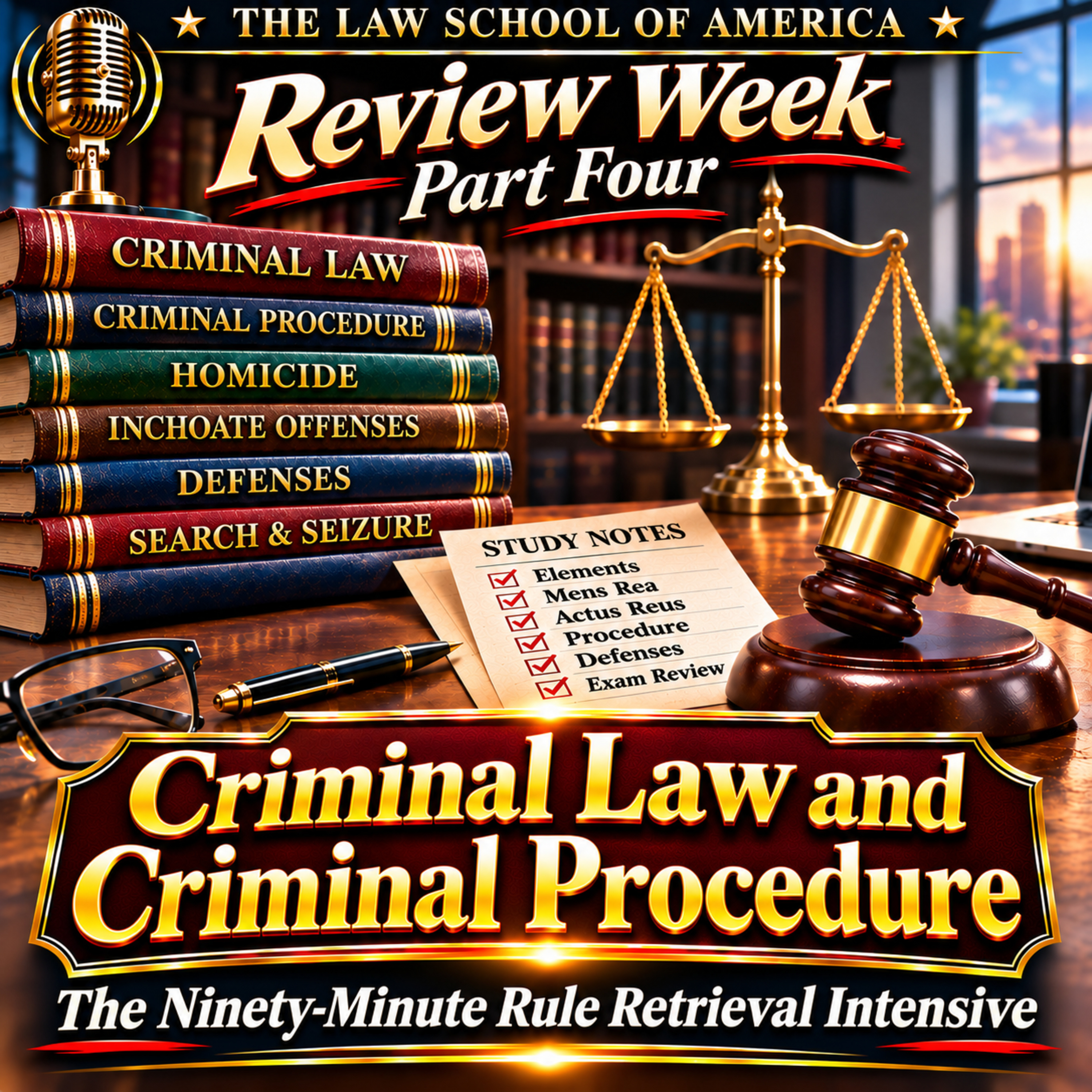
    Seven-Day Law School and Bar Examination Review - Day Four: Criminal Law & Procedure - Voluntary Act or Omission, Mens Rea, Concurrence, Causation, Elements, Parties/Inchoate, Defenses, Procedure

    🦃 🍂 THANKSGIVING WEEK STUDY BREAK! 🍂 🦃 Close the casebook for a moment and open a little holiday chaos! 🎮 🐸 FROGGER — FINALS WEEK! 📚 Ready to hop into your next study break? 👉 🐸 CLICK HERE TO PLAY FROGGER! 🎯 🦃 TURKEY ON THE RUN! 💨 This turkey has other plans for Thanksgiving—and none involve gravy! 🍽️ 👉 🦃 CLICK HERE TO JOIN THE GREAT TURKEY ESCAPE! 🚀 ⚖️ Your holiday study break, served by The Law School of America 🏛️ ⚖️ Study Materials for Review Week! ⚖️ 🎮 Turn your study session into a legal challenge with LEX Blaster! 👉 🚀 CLICK HERE TO PLAY LEX BLASTER! 🎯 📖 EXPLORE IT. PRACTICE IT. UNDERSTAND IT. 🏛️ Go deeper with the interactive companion guide from The Law School of America. 👉 ✨ CLICK HERE TO OPEN YOUR STUDY GUIDE! 📚 🎧 EPISODE SUMMARY 🎧 A complete answer must resolve both. Concurrence and causation link conduct, mental state, and harm. Homicide, property crimes, inchoate offenses, accomplice liability, and defenses each turn on specific statutory and intent requirements.Constitutional procedure—spanning Fourth, Fifth, and Sixth Amendment protections, the exclusionary rule, identification, pleas, and sentencing—regulates government action.The core framework remains: Act/Omission → Mental State → Concurrence → Causation → Elements → Inchoate/Parties → Defenses → Constitutional Procedure.Examinations require addressing both substantive guilt and evidence admissibility.ℹ️ INFORMATION, PRIVACY POLICY & TERMS OF USE ℹ️ The Podcast and Website Purpose The Law School Podcast and 1L Study Aide webpage supplements law-school and Bar Exam study with strategies, condensed rules, quizzes, and flashcards. Educational Disclaimer Content is for educational and informational purposes only. It is not legal advice, creates no attorney-client relationship, and does not guarantee law-school or Bar Exam success. Privacy Policy No account or login is required. This webpage uses no forms or analytics to collect personal information. Quiz and flashcard activity stays in your browser and may clear when local site data is removed. Terms of Use By using this webpage, you agree to use its content only for lawful, personal, noncommercial educational purposes. It supplements—not replaces—courses, textbooks, official materials, or qualified instruction.

    • Transcript
  • Wednesday · 1 hr 30 min

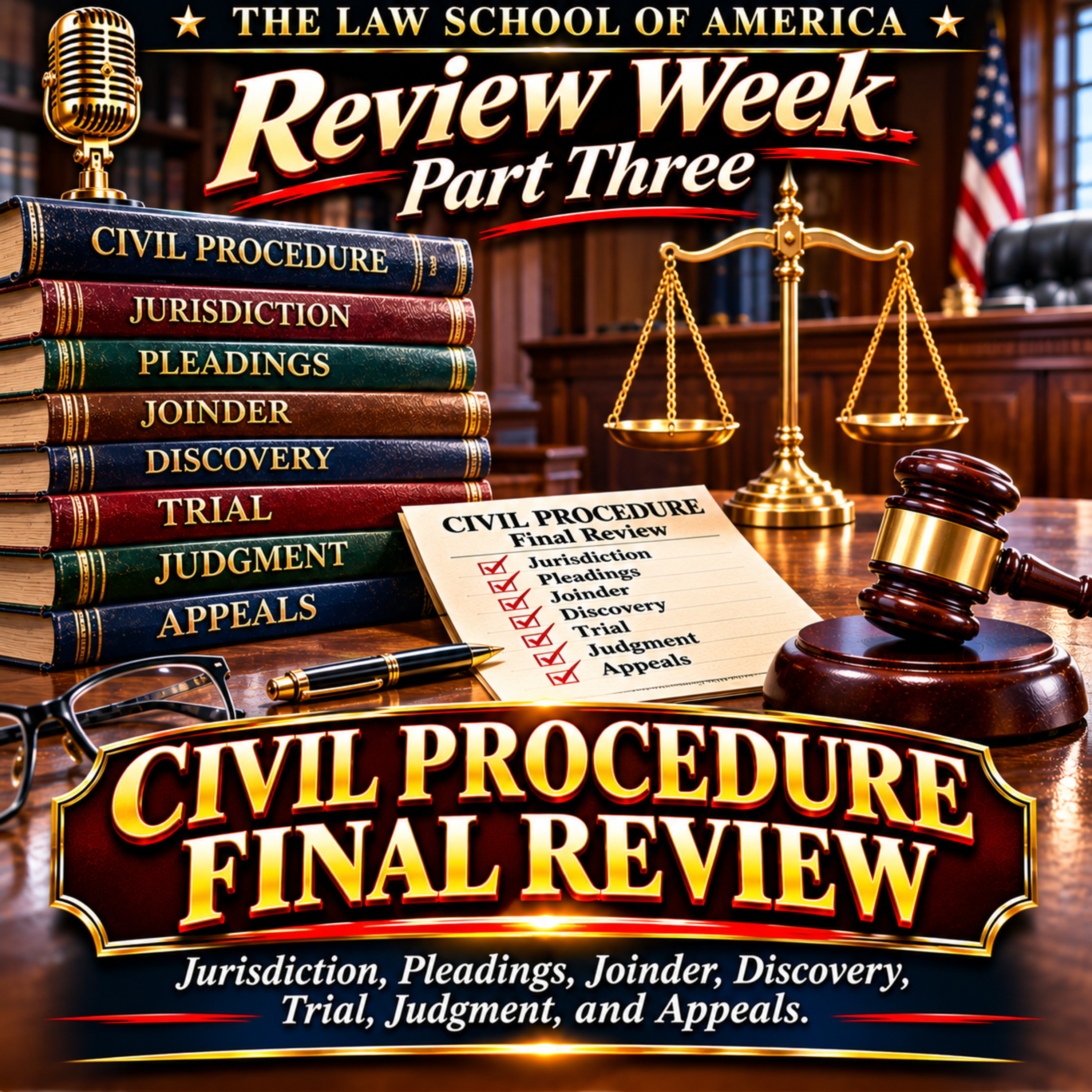
    Seven-Day Law School and Bar Examination Review - Day Three: Civil Procedure - Jurisdiction, Pleadings, Joinder, Discovery, Trial, Judgment, and Appeals

    🦃 🍂 THANKSGIVING WEEK STUDY BREAK! 🍂 🦃 Close the casebook for a moment and open a little holiday chaos! 🎮 🐸 FROGGER — FINALS PREPARATION WEEK! 📚 Ready to hop into your next study break? 👉 🐸 CLICK HERE TO PLAY FROGGER! 🎯 🦃 TURKEY ON THE RUN! 💨 This turkey has other plans for Thanksgiving—and none involve gravy! 🍽️ 👉 🦃 CLICK HERE TO JOIN THE GREAT TURKEY ESCAPE! 🚀 ⚖️ Your holiday study break, served by The Law School of America 🏛️ ⚖️ Study Materials for Review Week! ⚖️ 🎮 Turn your study session into a legal challenge with LEX Blaster! 👉 🚀 CLICK HERE TO PLAY LEX BLASTER! 🎯 📖 EXPLORE IT. PRACTICE IT. UNDERSTAND IT. 🏛️ Go deeper with the interactive companion guide from The Law School of America. 👉 ✨ CLICK HERE TO OPEN YOUR STUDY GUIDE! 📚 🎧 EPISODE SUMMARY 🎧 A complete Civil Procedure analysis identifies the relevant procedural stage, states the controlling rule, applies the factual requirements, evaluates objections and exceptions, and explains the legal consequence. The Erie doctrine governs when federal courts apply state substantive law versus federal procedural law. Pleading rules mandate adequate facts, recognize defenses, require filing compliance, and permit amendments. Joinder governs multi-claim and multi-party participation, subject to subject-matter jurisdiction requirements. Discovery enables access to relevant, proportional information while safeguarding privilege, work product, and undue burden. Pretrial dispositions include dismissal, default, judgment on the pleadings, or summary judgment. Trial procedures govern jury trial rights and legal/evidentiary rulings. Posttrial motions, final-judgment rules, and appeals handle error correction and review. Preclusion limits repetitive claim and issue litigation. The examination sequence is: Subject-Matter Jurisdiction → Personal Jurisdiction → Notice and Service → Venue → Governing Law → Pleadings → Joinder → Discovery → Disposition → Trial → Judgment → Preclusion → Appeal. A complete Civil Procedure analysis identifies the procedural stage, states the rule, applies the facts, evaluates defenses/exceptions, and states the outcome. ℹ️ INFORMATION, PRIVACY POLICY & TERMS OF USE ℹ️ The Podcast and Website Purpose The Law School Podcast and 1L Study Aide webpage supplements law-school and Bar Exam study with strategies, condensed rules, quizzes, and flashcards. Educational Disclaimer Content is for educational and informational purposes only. It is not legal advice, creates no attorney-client relationship, and does not guarantee law-school or Bar Exam success. Privacy Policy No account or login is required. This webpage uses no forms or analytics to collect personal information. Quiz and flashcard activity stays in your browser and may clear when local site data is removed. Terms of Use By using this webpage, you agree to use its content only for lawful, personal, noncommercial educational purposes. It supplements—not replaces—courses, textbooks, official materials, or qualified instruction.

  • Tuesday · 1 hr 6 min

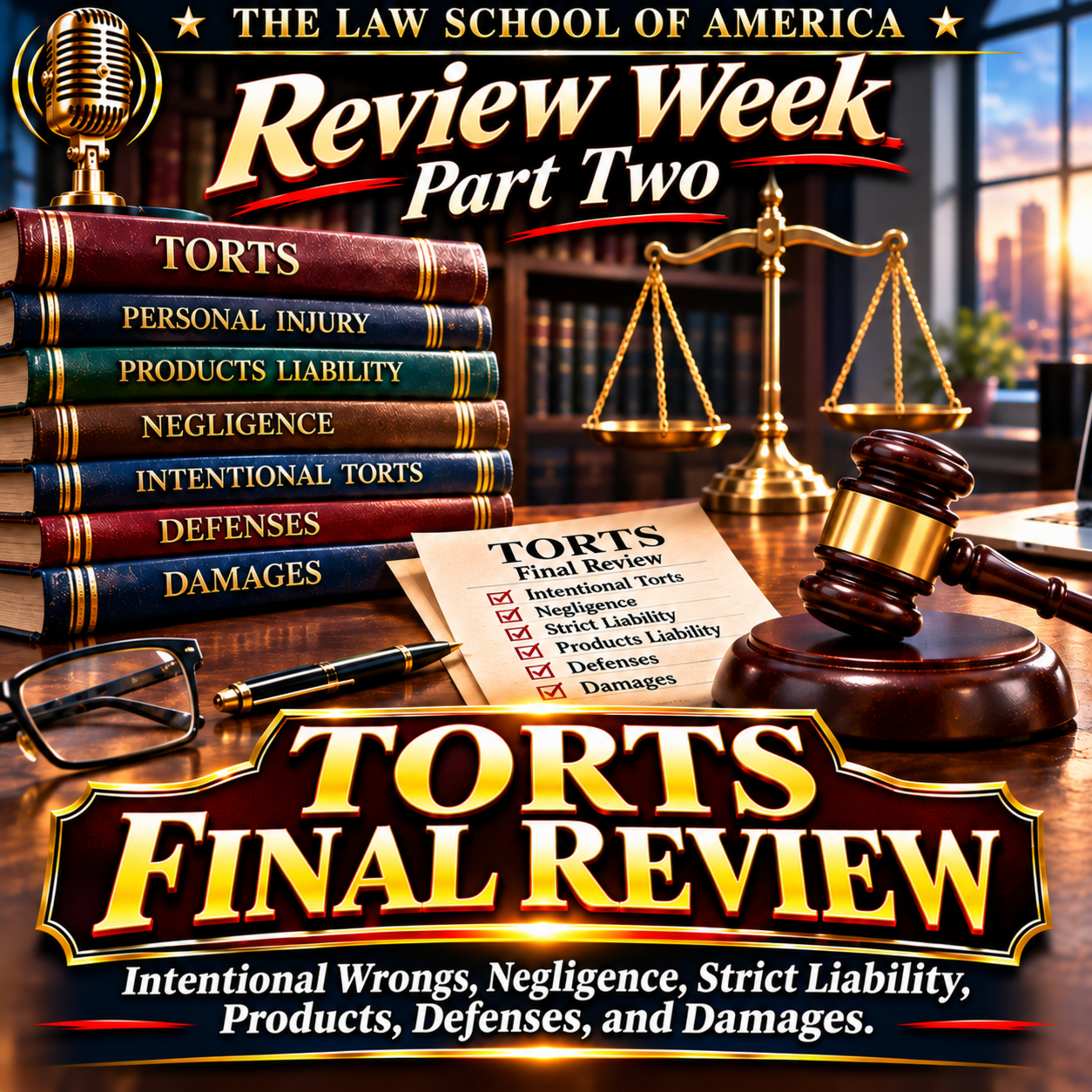
    Seven-Day Law School and Bar Examination Review - Day Two: Torts - Intentional Wrongs, Negligence, Strict Liability, Products, Defenses, and Damages

    🦃 🍂 THANKSGIVING WEEK STUDY BREAK! 🍂 🦃 Close the casebook for a moment and open a little holiday chaos! 🎮 🐸 FROGGER — FINALS PREPARATION WEEK! 📚 Ready to hop into your next study break? 👉 🐸 CLICK HERE TO PLAY FROGGER! 🎯 🦃 TURKEY ON THE RUN! 💨 This turkey has other plans for Thanksgiving—and none involve gravy! 🍽️ 👉 🦃 CLICK HERE TO JOIN THE GREAT TURKEY ESCAPE! 🚀 ⚖️ Your holiday study break, served by The Law School of America 🏛️ ⚖️ Study Materials for Review Week! ⚖️ 🎮 Turn your study session into a legal challenge with LEX Blaster! 👉 🚀 CLICK HERE TO PLAY LEX BLASTER! 🎯 📖 EXPLORE IT. PRACTICE IT. UNDERSTAND IT. 🏛️ Go deeper with the interactive companion guide from The Law School of America. 👉 ✨ CLICK HERE TO OPEN YOUR STUDY GUIDE! 📚 🎧 EPISODE SUMMARY 🎧 Tort liability is best analyzed systematically. Intentional torts protect personal, emotional, and property security through distinct claims like battery, assault, false imprisonment, IIED, trespass, and conversion. Privileges like consent, defense doctrines, shopkeeper detention, and necessity may justify interference within reasonable limits. Negligence requires duty, breach, actual causation, proximate causation, and damages, with special standards for specific actors and duties. Negligence per se and res ipsa loquitur assist in proving breach. Recovery may be reduced or barred by comparative/contributory negligence, assumption of risk, or failure to mitigate. Strict liability covers animal harms and abnormally dangerous activities. Products liability addresses manufacturing, design, and warning defects alongside negligence, warranty, and misrepresentation claims. Defamation, privacy, economic torts, and nuisance protect additional interests. Multiple defendants involve direct liability, respondeat superior, independent contractor rules, joint and several liability, contribution, and indemnity. Damages (compensatory, nominal, punitive) must match the injury, while wrongful-death and survival claims involve distinct legal interests. Core Framework: Protected Interest → Liability Theory → Elements → Causation → Defense → Other Responsible Parties → Damages. Analyze each plausible tort separately before finalizing overall responsibility. ℹ️ INFORMATION, PRIVACY POLICY & TERMS OF USE ℹ️ The Podcast and Website Purpose The Law School Podcast and 1L Study Aide webpage supplements law-school and Bar Exam study with strategies, condensed rules, quizzes, and flashcards. Educational Disclaimer Content is for educational and informational purposes only. It is not legal advice, creates no attorney-client relationship, and does not guarantee law-school or Bar Exam success. Privacy Policy No account or login is required. This webpage uses no forms or analytics to collect personal information. Quiz and flashcard activity stays in your browser and may clear when local site data is removed. Terms of Use By using this webpage, you agree to use its content only for lawful, personal, noncommercial educational purposes. It supplements—not replaces—courses, textbooks, official materials, or qualified instruction.

  • Monday · 1 hr 5 min

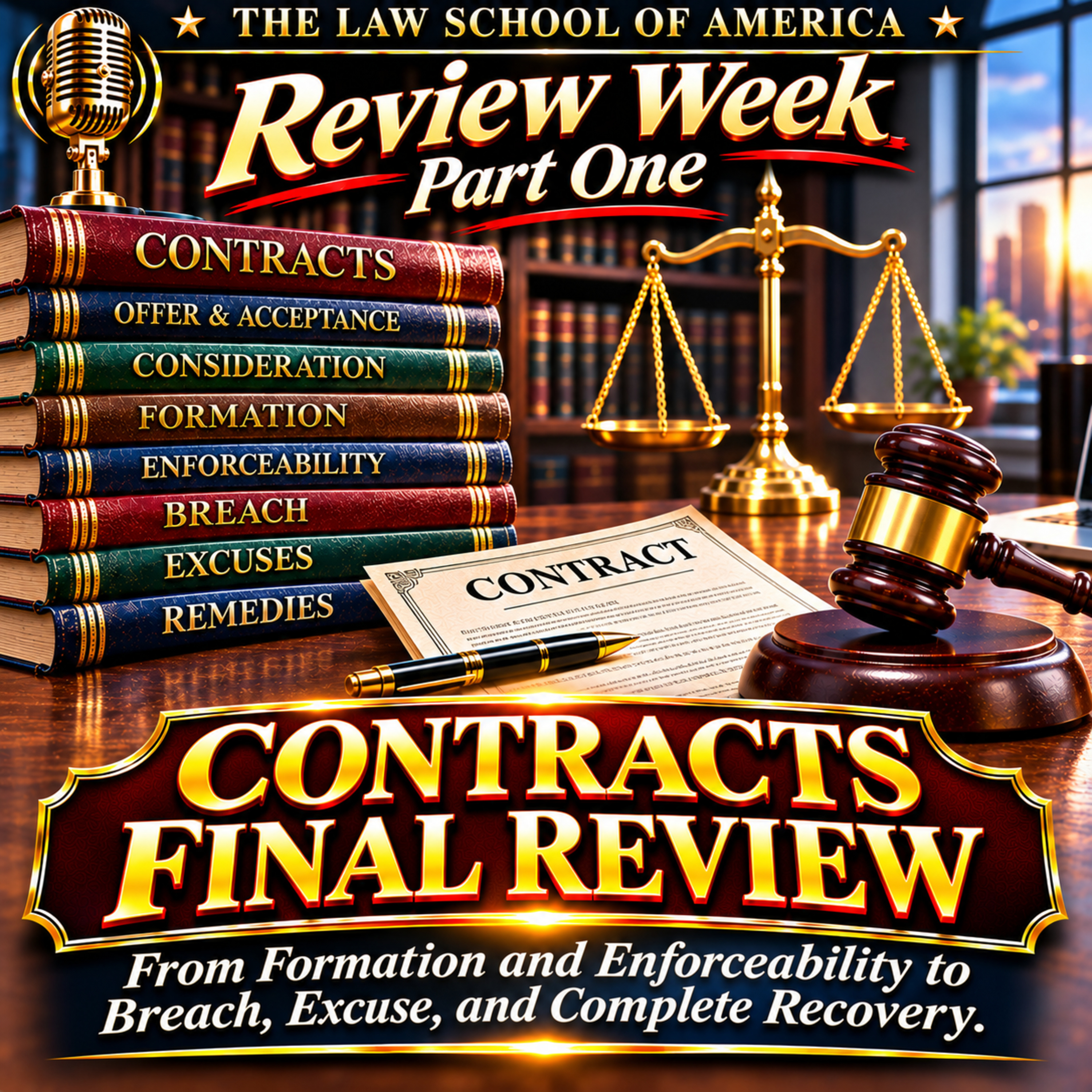
    Seven-Day Law School and Bar Examination Review - Day One: Contracts - From Formation and Enforceability to Breach, Excuse, and Complete Recovery

    🦃 🍂 THANKSGIVING WEEK STUDY BREAK! 🍂 🦃 Close the casebook for a moment and open a little holiday chaos! 🎮 🐸 FROGGER — FINALS PREPARATION WEEK! 📚 Ready to hop into your next study break? 👉 🐸 CLICK HERE TO PLAY FROGGER! 🎯 🦃 TURKEY ON THE RUN! 💨 This turkey has other plans for Thanksgiving—and none involve gravy! 🍽️ 👉 🦃 CLICK HERE TO JOIN THE GREAT TURKEY ESCAPE! 🚀 ⚖️ Your holiday study break, served by The Law School of America 🏛️ ⚖️ Study Materials for Review Week! ⚖️ 🎮 Turn your study session into a legal challenge with LEX Blaster! 👉 🚀 CLICK HERE TO PLAY LEX BLASTER! 🎯 📖 EXPLORE IT. PRACTICE IT. UNDERSTAND IT. 🏛️ Go deeper with the interactive companion guide from The Law School of America. 👉 ✨ CLICK HERE TO OPEN YOUR STUDY GUIDE! 📚 🎧 EPISODE SUMMARY 🎧 Contracts law analyzes transactions chronologically. First, determine if common law or UCC Article 2 applies. Next, evaluate offer, open terms, and acceptance for mutual assent. Promises require consideration or a recognized substitute. Interpret terms using integration, the parol-evidence rule, and trade practices. Check enforceability against the Statute of Frauds and defenses like capacity, duress, misrepresentation, mistake, unconscionability, or illegality. If enforceable, conditions trigger duties, and performance rules establish satisfaction or breach. Distinguish common-law substantial performance and material breach from Article 2 standards for tender, cure, acceptance, revocation, and installment contracts. Anticipatory repudiation and adequate assurance address pre-performance issues. Impossibility, impracticability, frustration of purpose, or force majeure may excuse nonperformance. Article 2 warranties cover defective goods. Assignment, delegation, novation, and third-party beneficiary rules address non-original parties. Remedies address breach through expectation, reliance, or restitution damages, subject to foreseeability, certainty, mitigation, contractual terms, and single-recovery limits. Always analyze contracts as evolving transactions: Governing Law → Formation → Consideration → Terms → Defenses → Conditions → Performance → Breach → Excuse → Remedies. This framework reliably resolves Contracts essays, multiple-choice questions, and commercial disputes. ℹ️ INFORMATION, PRIVACY POLICY & TERMS OF USE ℹ️ The Podcast and Website Purpose The Law School Podcast and 1L Study Aide webpage supplements law-school and Bar Exam study with strategies, condensed rules, quizzes, and flashcards. Educational Disclaimer Content is for educational and informational purposes only. It is not legal advice, creates no attorney-client relationship, and does not guarantee law-school or Bar Exam success. Privacy Policy No account or login is required. This webpage uses no forms or analytics to collect personal information. Quiz and flashcard activity stays in your browser and may clear when local site data is removed. Terms of Use By using this webpage, you agree to use its content only for lawful, personal, noncommercial educational purposes. It supplements—not replaces—courses, textbooks, official materials, or qualified instruction.

  • Sunday · 1 hr 41 min

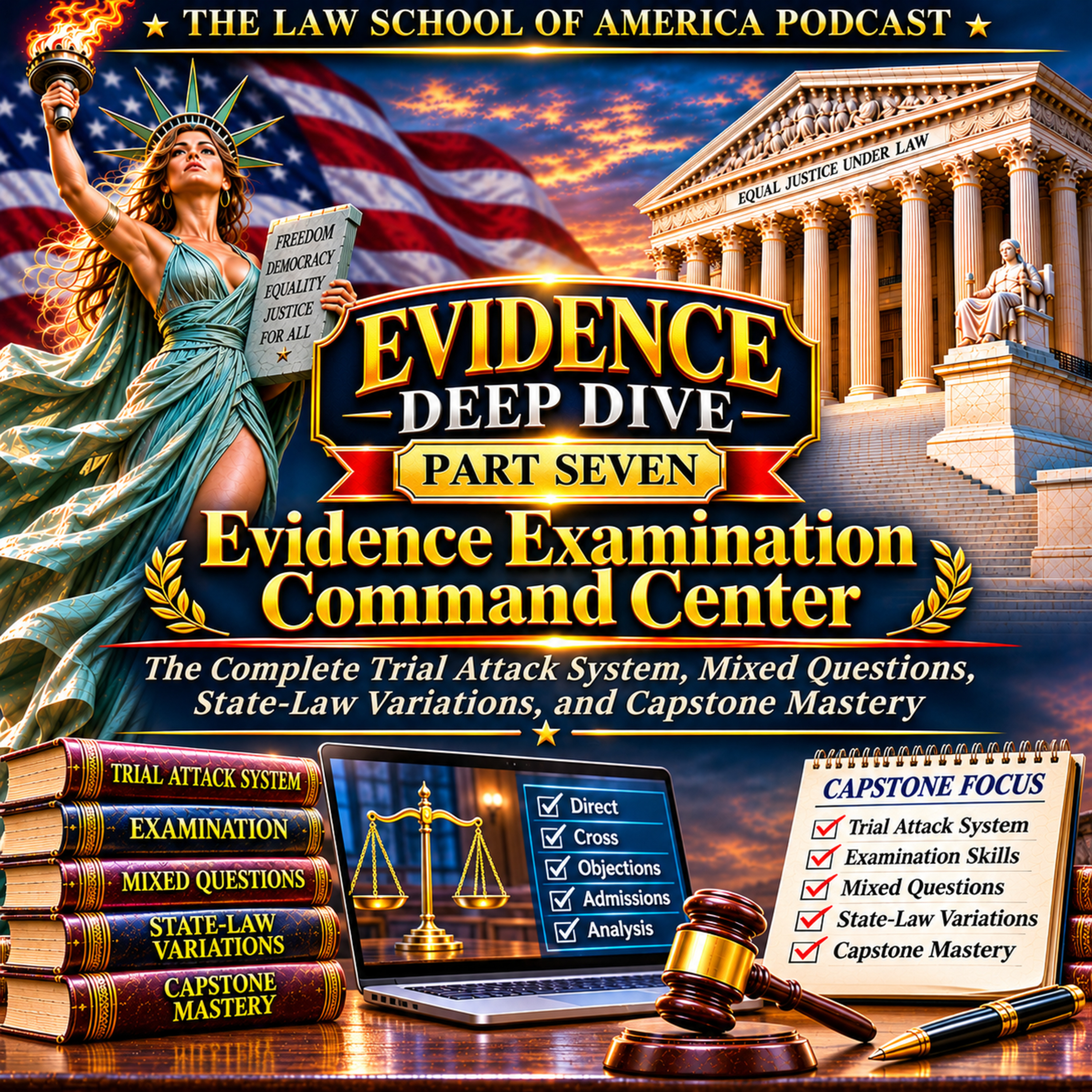
    Evidence Deep Dive Part Seven: Evidence Examination Command Center — The Complete Trial Attack System, Mixed Questions, State-Law Variations, and Capstone Mastery

    ⚖️ MAKE EVIDENCE LAW CLICK! ⚖️ 🎮 Turn your study session into a legal challenge with LEX Blaster! 👉 🚀 CLICK HERE TO PLAY LEX BLASTER! 🎯 📖 EXPLORE IT. PRACTICE IT. UNDERSTAND IT. 🏛️ Go deeper with the interactive companion guide from The Law School of America. 👉 ✨ CLICK HERE TO OPEN YOUR STUDY GUIDE! 📚 🎧 EPISODE SUMMARY 🎧 Evidence analysis begins with the item, the offering party, the opponent, and the proposed inference. Relevance supplies an initial connection; Rule 403 and specialized exclusions regulate particular risks and policies. Character, habit, witness foundations, opinions, and impeachment each have distinct requirements. A familiar label does not establish its elements. Hearsay requires identification of a human assertion and its offered use. Prior statements and opposing-party statements have different conditions. Rules 803, 804, and 807 supply separate routes, and every layer of a combined account must be supported. An absent declarant's credibility remains open to appropriate attack. The version of Rule 801 governing the proceeding is especially important for unsworn prior inconsistent statements across the December 2026 change. In a criminal prosecution, testimonial statements require a separate confrontation analysis. A substitute expert cannot avoid that inquiry by describing truth-dependent assertions as the basis of an opinion. Privilege can independently bar relevant information. Authentication establishes a supported claim about identity or origin, while original-writing rules govern proof of contents. Neither establishes that every assertion is admissible or true. The warehouse-fire exhibits require individual rulings because different defects control different items. Accurate summaries of voluminous admissible records may be substantive evidence; illustrative aids remain explanatory. State variations belong in a verified supplement, and civil-criminal differences must be addressed when the proceeding changes. A complete examination answer identifies the controlling condition, applies the actual facts, considers a lawful limited use, gives a specific ruling, and preserves any disputed issue for review. ℹ️ INFORMATION, PRIVACY POLICY & TERMS OF USE ℹ️ The Podcast and Website Purpose The Law School Podcast and 1L Study Aide webpage supplements law-school and Bar Exam study with strategies, condensed rules, quizzes, and flashcards. Educational Disclaimer Content is for educational and informational purposes only. It is not legal advice, creates no attorney-client relationship, and does not guarantee law-school or Bar Exam success. Privacy Policy No account or login is required. This webpage uses no forms or analytics to collect personal information. Quiz and flashcard activity stays in your browser and may clear when local site data is removed. Terms of Use By using this webpage, you agree to use its content only for lawful, personal, noncommercial educational purposes. It supplements—not replaces—courses, textbooks, official materials, or qualified instruction.

  • November 21 · 1 hr 14 min

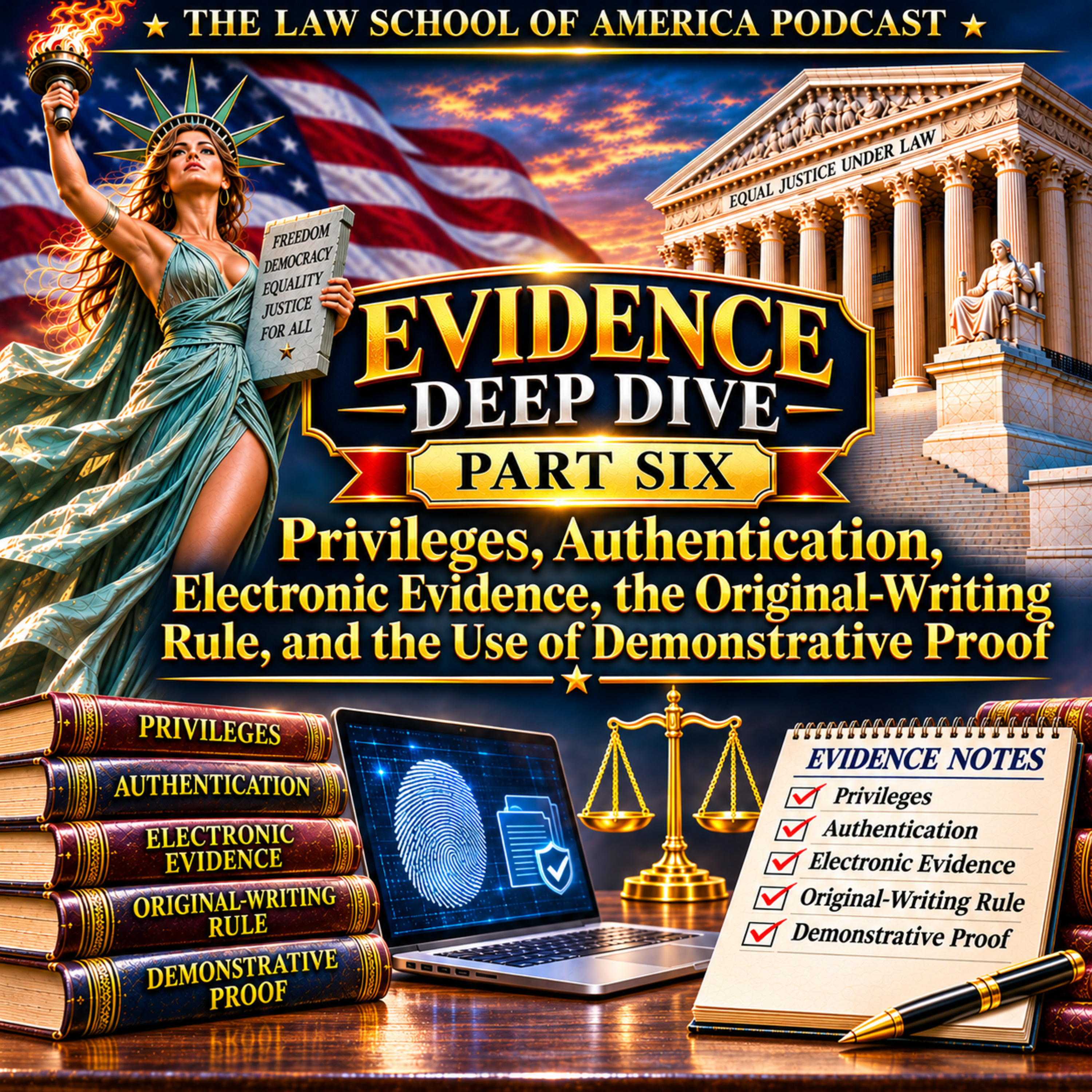
    Evidence Deep Dive Part Six: Privileges, Authentication, Electronic Evidence, the Original-Writing Rule, and the Use of Demonstrative Proof

    ⚖️ MAKE EVIDENCE LAW CLICK! ⚖️ 🎮 Turn your study session into a legal challenge with LEX Blaster! 👉 🚀 CLICK HERE TO PLAY LEX BLASTER! 🎯 📖 EXPLORE IT. PRACTICE IT. UNDERSTAND IT. 🏛️ Go deeper with the interactive companion guide from The Law School of America. 👉 ✨ CLICK HERE TO OPEN YOUR STUDY GUIDE! 📚 🎧 EPISODE SUMMARY 🎧 Privilege can bar disclosure of relevant evidence, but its scope depends on the governing law, the relationship, the communication or material, and the holder's conduct. Attorney-client privilege protects qualifying confidential legal communications rather than the underlying facts. Work product protects litigation preparation through a different doctrine. Rule 502 limits specified waiver consequences and distinguishes accidental disclosure, selective intentional use, private agreements, and federal court orders. Spousal testimony and confidential marital communications require separate analyses of timing, coverage, and control. Federal psychotherapist privilege does not create a general privilege for all medical treatment. Spiritual communications depend on the adviser's role and confidentiality. The Fifth Amendment separately protects against compelled testimonial self-incrimination, including certain testimonial aspects of document production. Authentication requires sufficient evidence that an item is what the proponent claims. Electronic evidence calls for careful attention to authorship, origin, accuracy, custody, and human assertions. Self-authentication can simplify the foundation without resolving hearsay, privilege, reliability, or other admissibility requirements. A digital copy can faithfully reproduce a source that is itself false or fabricated. The original-writing rule concerns proof of contents. Accurate electronic outputs and duplicates often qualify, while specified exceptions permit other proof. Rule 1006 allows substantive summaries of voluminous admissible material; Rule 107 governs explanatory aids that are not evidence. The complete examination answer identifies the proposed use, supplies each necessary foundation, addresses each independent objection, and states how the court should permit, limit, or exclude the offered material. ℹ️ INFORMATION, PRIVACY POLICY & TERMS OF USE ℹ️ The Podcast and Website Purpose The Law School Podcast and 1L Study Aide webpage supplements law-school and Bar Exam study with strategies, condensed rules, quizzes, and flashcards. Educational Disclaimer Content is for educational and informational purposes only. It is not legal advice, creates no attorney-client relationship, and does not guarantee law-school or Bar Exam success. Privacy Policy No account or login is required. This webpage uses no forms or analytics to collect personal information. Quiz and flashcard activity stays in your browser and may clear when local site data is removed. Terms of Use By using this webpage, you agree to use its content only for lawful, personal, noncommercial educational purposes. It supplements—not replaces—courses, textbooks, official materials, or qualified instruction.

  • November 20 · 1 hr 10 min

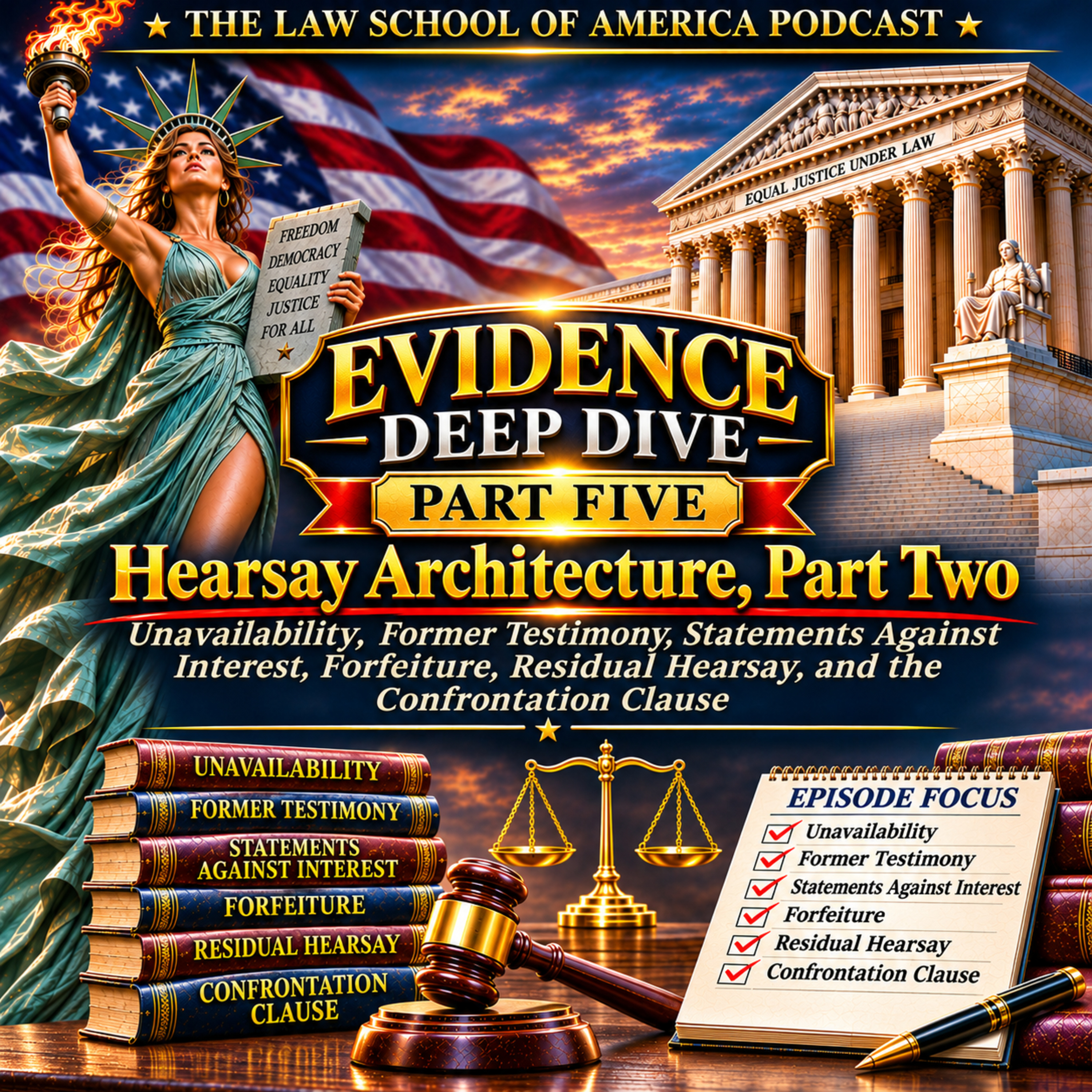
    Evidence Deep Dive Part Five: Hearsay Architecture, Part Two — Unavailability, Former Testimony, Statements Against Interest, Forfeiture, Residual Hearsay, and the Confrontation Clause

    ⚖️ MAKE EVIDENCE LAW CLICK! ⚖️ 🎮 Turn your study session into a legal challenge with LEX Blaster! 👉 🚀 CLICK HERE TO PLAY LEX BLASTER! 🎯 📖 EXPLORE IT. PRACTICE IT. UNDERSTAND IT. 🏛️ Go deeper with the interactive companion guide from The Law School of America. 👉 ✨ CLICK HERE TO OPEN YOUR STUDY GUIDE! 📚 🎧 EPISODE SUMMARY 🎧 Rule 804 requires qualifying unavailability and a separate exception. Privilege, refusal despite an order, testimony establishing memory loss, death or qualifying illness, and absence despite the required reasonable efforts have distinct foundations. A proponent cannot intentionally manufacture the absence needed to obtain a favorable hearsay ruling. Former testimony requires a qualifying proceeding and an opportunity with a similar motive to develop the testimony. Dying declarations require belief in imminent death, a statement concerning its cause or circumstances, and the proper type of case. Statements against interest require genuine adversity to a specified interest, with the current corroboration requirement when offered in a criminal case as against penal interest. Personal or family history has defined subjects and relationships. Forfeiture requires wrongful interference causing unavailability with the required purpose. Rule 807 demands sufficient trustworthiness, comparative probative value, and reasonable notice. Rule 806 permits appropriate attacks on an admitted hearsay declarant's credibility without requiring the declarant's presence or an opportunity to explain every inconsistency. Neither rule automatically eliminates other evidentiary restrictions. Confrontation independently protects criminal defendants against testimonial truth assertions without the necessary opportunity for cross-examination. Emergency purpose, formal investigative purpose, medical context, and the function of forensic statements must be assessed from the circumstances. An expert cannot cure the problem by relaying another analyst's testimonial assertions as opinion support. A codefendant confession requires attention to direct identification, actual redaction, and the permitted use against each defendant. The complete analysis follows each assertion from its declarant to its proposed use. It states the hearsay basis, addresses every additional layer, resolves any constitutional obstacle, and specifies the evidentiary ruling. Reliability, admissibility, and confrontation answer related questions, but one does not automatically establish the others. ℹ️ INFORMATION, PRIVACY POLICY & TERMS OF USE ℹ️ The Podcast and Website Purpose The Law School Podcast and 1L Study Aide webpage supplements law-school and Bar Exam study with strategies, condensed rules, quizzes, and flashcards. Educational Disclaimer Content is for educational and informational purposes only. It is not legal advice, creates no attorney-client relationship, and does not guarantee law-school or Bar Exam success. Privacy Policy No account or login is required. This webpage uses no forms or analytics to collect personal information. Quiz and flashcard activity stays in your browser and may clear when local site data is removed. Terms of Use By using this webpage, you agree to use its content only for lawful, personal, noncommercial educational purposes. It supplements—not replaces—courses, textbooks, official materials, or qualified instruction.

  • November 19 · 1 hr 5 min

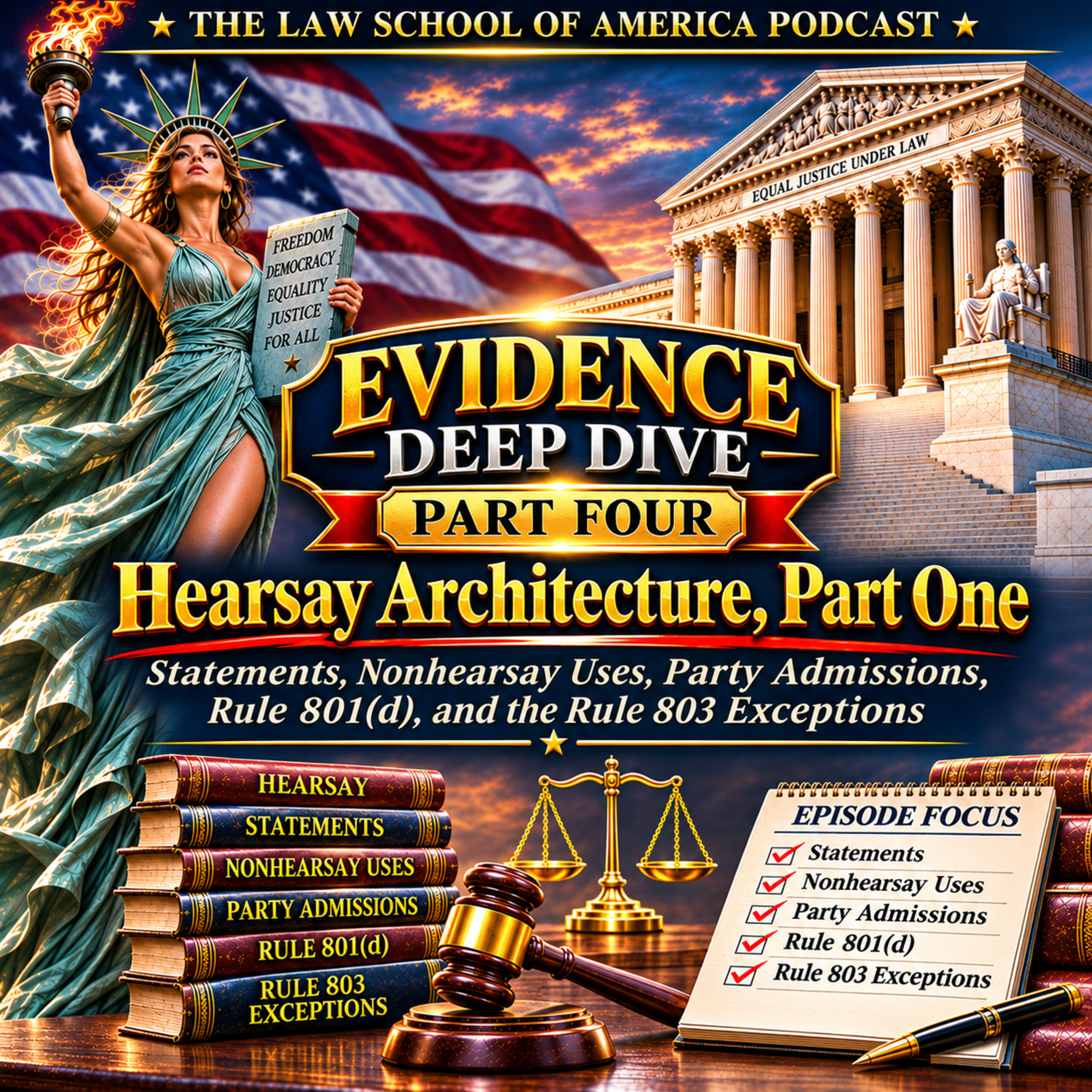
    Evidence Deep Dive Part Four: Hearsay Architecture, Part One — Statements, Nonhearsay Uses, Party Admissions, Rule 801(d), and the Rule 803 Exceptions

    ⚖️ MAKE EVIDENCE LAW CLICK! ⚖️ 🎮 Turn your study session into a legal challenge with LEX Blaster! 👉 🚀 CLICK HERE TO PLAY LEX BLASTER! 🎯 📖 EXPLORE IT. PRACTICE IT. UNDERSTAND IT. 🏛️ Go deeper with the interactive companion guide from The Law School of America. 👉 ✨ CLICK HERE TO OPEN YOUR STUDY GUIDE! 📚 🎧 EPISODE SUMMARY 🎧 Hearsay requires a human assertion made outside current testimony and offered for its truth, subject to the exclusions in Rule 801(d). Nonassertive conduct, genuinely automated measurements, legally operative words, and relevant nontruth uses require different analysis. Always state the proposition the evidence is offered to establish. Qualifying prior witness statements require current testimony and an opportunity for cross-examination. Prior inconsistent statements must be analyzed under the governing version of Rule 801(d)(1)(A), with the December 2026 amendment separated from the November rule. Prior consistent statements must answer a qualifying credibility attack; prior identifications have their own requirements. Opposing-party statements depend on direction of use and a proper attribution basis. They do not generally require unavailability or an originally self-inculpatory assertion. Adoption, authority, employment, conspiracy, and directly derived claims or liability each demand their particular foundation. Rule 803 provides exceptions without a general unavailability requirement. Timing and perception govern present sense impressions; continuing stress governs excited utterances; the content and purpose of a statement govern mental-condition and medical exceptions. Recorded recollections, learned treatises, business records, and public records have distinct foundations and limits on presentation or use. The remaining exceptions address defined subjects such as family history, property, commercial information, reputation, and judgments. Each necessary hearsay layer must independently qualify. Authentication, relevance, unfair prejudice, constitutional confrontation, and other restrictions remain separate. The complete analysis identifies the speaker, assertion, truth purpose, foundation, and permitted use at every step. ℹ️ INFORMATION, PRIVACY POLICY & TERMS OF USE ℹ️ The Podcast and Website Purpose The Law School Podcast and 1L Study Aide webpage supplements law-school and Bar Exam study with strategies, condensed rules, quizzes, and flashcards. Educational Disclaimer Content is for educational and informational purposes only. It is not legal advice, creates no attorney-client relationship, and does not guarantee law-school or Bar Exam success. Privacy Policy No account or login is required. This webpage uses no forms or analytics to collect personal information. Quiz and flashcard activity stays in your browser and may clear when local site data is removed. Terms of Use By using this webpage, you agree to use its content only for lawful, personal, noncommercial educational purposes. It supplements—not replaces—courses, textbooks, official materials, or qualified instruction.

  • November 18 · 1 hr 22 min

    Evidence Deep Dive Part Three: Witnesses, Impeachment, Rehabilitation, Lay Opinions, and Expert Gatekeeping

    ⚖️ MAKE EVIDENCE LAW CLICK! ⚖️ 🎮 Turn your study session into a legal challenge with LEX Blaster! 👉 🚀 CLICK HERE TO PLAY LEX BLASTER! 🎯 📖 EXPLORE IT. PRACTICE IT. UNDERSTAND IT. 🏛️ Go deeper with the interactive companion guide from The Law School of America. 👉 ✨ CLICK HERE TO OPEN YOUR STUDY GUIDE! 📚 🎧 EPISODE SUMMARY 🎧 Witness competency establishes eligibility to testify; personal knowledge establishes the basis for particular fact testimony. Oaths, interpreter requirements, and the restrictions on judges and jurors protect the process through which information reaches the factfinder. Verdict inquiry ordinarily excludes internal deliberative matters while recognizing defined external-information, outside-influence, verdict-entry, and constitutional racial-bias exceptions. The court controls examination, leading questions, and the order of proof. Witness exclusion from the courtroom differs from an additional order restricting access to testimony elsewhere. Refreshing recollection produces present-memory testimony; recorded recollection permits use of an accurate fresh-memory record when present recollection remains inadequate. Impeachment rules vary with the theory. Bias and material contradiction may support extrinsic evidence, while Rule 608 generally prohibits extrinsic proof of specific acts offered solely to establish truthful character. Rule 609 supplies distinct standards for convictions. Prior inconsistent statements require attention to Rule 613 and the governing version of Rule 801. Rehabilitation must answer the actual attack. Lay opinion requires perception, helpfulness, and ordinary rather than specialized reasoning. Expert testimony requires demonstrated qualification, helpfulness, sufficient data, reliable methods, and reliable application. Rules 703 through 706 separately regulate bases, disclosure, ultimate issues, presentation, and court-appointed experts. The controlling task is to identify the precise testimony and apply every rule governing its proposed use. ℹ️ INFORMATION, PRIVACY POLICY & TERMS OF USE ℹ️ The Podcast and Website Purpose The Law School Podcast and 1L Study Aide webpage supplements law-school and Bar Exam study with strategies, condensed rules, quizzes, and flashcards. Educational Disclaimer Content is for educational and informational purposes only. It is not legal advice, creates no attorney-client relationship, and does not guarantee law-school or Bar Exam success. Privacy Policy No account or login is required. This webpage uses no forms or analytics to collect personal information. Quiz and flashcard activity stays in your browser and may clear when local site data is removed. Terms of Use By using this webpage, you agree to use its content only for lawful, personal, noncommercial educational purposes. It supplements—not replaces—courses, textbooks, official materials, or qualified instruction.

  • November 17 · 1 hr 6 min

    Evidence Deep Dive Part Two: Propensity, Character, Other Acts, Habit, Sexual-Misconduct Evidence, and the Limits of Behavioral Inference

    ⚖️ MAKE EVIDENCE LAW CLICK! ⚖️ 🎮 Turn your study session into a legal challenge with LEX Blaster! 👉 🚀 CLICK HERE TO PLAY LEX BLASTER! 🎯 📖 EXPLORE IT. PRACTICE IT. UNDERSTAND IT. 🏛️ Go deeper with the interactive companion guide from The Law School of America. 👉 ✨ CLICK HERE TO OPEN YOUR STUDY GUIDE! 📚 🎧 EPISODE SUMMARY 🎧 Character evidence asks what kind of person someone is and, when used circumstantially, invites an inference about conduct on a particular occasion. Rule 404 generally prohibits that propensity inference, while allowing defined criminal defendant and victim exceptions. Character that is itself an essential element presents a different use. Rule 405 regulates proof. Reputation and opinion are ordinarily the methods for permitted circumstantial character evidence. Relevant specific incidents may be explored on cross-examination of a character witness, but this does not ordinarily authorize extrinsic proof of those incidents. Specific acts may be proved substantively when character itself is an essential element. Rule 404(b) requires a genuine nonpropensity explanation, sufficient factual support, and Rule 403 analysis. Criminal prosecution notice and appropriate limiting instructions are separate parts of the framework. Rule 406 permits conformity reasoning from a sufficiently specific and regular habit or organizational practice. Rule 412 restricts evidence concerning victims’ sexual behavior and predisposition, with defined exceptions and protective procedures. Rules 413 through 415 authorize relevant propensity evidence involving qualifying sexual assault or child molestation, subject to definitions, disclosure, foundation, and Rule 403. Throughout the analysis, identify the purpose before selecting the rule, select the rule before choosing the method, and evaluate the permitted inference before deciding what the jury may consider. ℹ️ INFORMATION, PRIVACY POLICY & TERMS OF USE ℹ️ The Podcast and Website Purpose The Law School Podcast and 1L Study Aide webpage supplements law-school and Bar Exam study with strategies, condensed rules, quizzes, and flashcards. Educational Disclaimer Content is for educational and informational purposes only. It is not legal advice, creates no attorney-client relationship, and does not guarantee law-school or Bar Exam success. Privacy Policy No account or login is required. This webpage uses no forms or analytics to collect personal information. Quiz and flashcard activity stays in your browser and may clear when local site data is removed. Terms of Use By using this webpage, you agree to use its content only for lawful, personal, noncommercial educational purposes. It supplements—not replaces—courses, textbooks, official materials, or qualified instruction.

  • November 16 · 1 hr 4 min

    Evidence Deep Dive Part One: The Evidence Gatekeeping System — Relevance, Rule 403, Preliminary Questions, Judicial Notice, Policy Exclusions, and Trial Objections

    ⚖️ MAKE EVIDENCE LAW CLICK! ⚖️ 🎮 Turn your study session into a legal challenge with LEX Blaster! 👉 🚀 CLICK HERE TO PLAY LEX BLASTER! 🎯 📖 EXPLORE IT. PRACTICE IT. UNDERSTAND IT. 🏛️ Go deeper with the interactive companion guide from The Law School of America. 👉 ✨ CLICK HERE TO OPEN YOUR STUDY GUIDE! 📚 🎧 EPISODE SUMMARY 🎧 The admissibility inquiry starts with the precise proposition for which evidence is offered. Relevance requires a probability-changing connection to a consequential fact, while sufficiency concerns the combined proof and the ultimate burden. Preliminary admissibility findings ordinarily belong to the judge under Rule 104(a); conditional relevance under Rule 104(b) requires sufficient support for a reasonable jury finding. Rule 403 permits exclusion when specified dangers substantially outweigh probative value. Stipulations and alternatives affect that assessment without automatically controlling every evidentiary choice. Rule 105 confines evidence to legitimate uses, and Rule 106 permits necessary contemporaneous completion, including over a hearsay objection. Rule 107 governs illustrative aids, while Rule 1006 addresses qualifying summaries admitted as evidence. Judicial notice requires indisputability and has different jury effects in civil and criminal cases. Ordinary federal civil presumptions shift production rather than persuasion, subject to governing statutes, rules, and the state-law direction in Rule 302. Policy exclusions must be analyzed according to the protected activity and proposed purpose. Finally, timely specific objections, adequate offers of proof, and a clear record preserve review, while harmless-error and plain-error principles determine whether an evidentiary mistake can justify relief. ℹ️ INFORMATION, PRIVACY POLICY & TERMS OF USE ℹ️ The Podcast and Website Purpose The Law School Podcast and 1L Study Aide webpage supplements law-school and Bar Exam study with strategies, condensed rules, quizzes, and flashcards. Educational Disclaimer Content is for educational and informational purposes only. It is not legal advice, creates no attorney-client relationship, and does not guarantee law-school or Bar Exam success. Privacy Policy No account or login is required. This webpage uses no forms or analytics to collect personal information. Quiz and flashcard activity stays in your browser and may clear when local site data is removed. Terms of Use By using this webpage, you agree to use its content only for lawful, personal, noncommercial educational purposes. It supplements—not replaces—courses, textbooks, official materials, or qualified instruction.

  • November 15 · 1 hr 9 min

    Individual Rights Deep Dive Part Seven: Individual Rights Examination Command Center — Firearms, Takings, Ex Post Facto Laws, Constitutional Remedies, and Complete Exam Mastery

    ⚖️ MAKE INDIVIDUAL RIGHTS LAW CLICK! ⚖️ 🎮 Turn your study session into a legal challenge with LEX Blaster! 👉 🚀 CLICK HERE TO PLAY LEX BLASTER! 🎯 📖 EXPLORE IT. PRACTICE IT. UNDERSTAND IT. 🏛️ Go deeper with the interactive companion guide from The Law School of America. 👉 ✨ CLICK HERE TO OPEN YOUR STUDY GUIDE! 📚 🎧 EPISODE SUMMARY 🎧 The Second Amendment uses text and historical tradition, with careful attention to the scope of recent holdings. Takings analysis distinguishes appropriation, use restrictions, exactions, public purpose, and specialized compensation rules. Ex post facto laws, attainders, and contractual impairment have distinct constitutional elements. A complete answer also identifies the cause of action, defendant, relief, and immunity. The capstone method joins these inquiries while preserving the separate tests required for each constitutional claim. ℹ️ INFORMATION, PRIVACY POLICY & TERMS OF USE ℹ️ The Podcast and Website Purpose The Law School Podcast and 1L Study Aide webpage supplements law-school and Bar Exam study with strategies, condensed rules, quizzes, and flashcards. Educational Disclaimer Content is for educational and informational purposes only. It is not legal advice, creates no attorney-client relationship, and does not guarantee law-school or Bar Exam success. Privacy Policy No account or login is required. This webpage uses no forms or analytics to collect personal information. Quiz and flashcard activity stays in your browser and may clear when local site data is removed. Terms of Use By using this webpage, you agree to use its content only for lawful, personal, noncommercial educational purposes. It supplements—not replaces—courses, textbooks, official materials, or qualified instruction.

  • November 14 · 1 hr

    Individual Rights Deep Dive Part Six: Freedom of Religion — Free Exercise, Establishment, Religious Schools, Government Aid, Public Employees, and Religious Institutions

    ⚖️ MAKE INDIVIDUAL RIGHTS LAW CLICK! ⚖️ 🎮 Turn your study session into a legal challenge with LEX Blaster! 👉 🚀 CLICK HERE TO PLAY LEX BLASTER! 🎯 📖 EXPLORE IT. PRACTICE IT. UNDERSTAND IT. 🏛️ Go deeper with the interactive companion guide from The Law School of America. 👉 ✨ CLICK HERE TO OPEN YOUR STUDY GUIDE! 📚 🎧 EPISODE SUMMARY 🎧 Religious belief receives protection without judicial evaluation of theological truth. Religious conduct requires attention to neutrality, general applicability, exemptions, and any specialized constitutional or statutory rule. Generally available benefits ordinarily cannot exclude qualifying religious participants merely because they are religious. Public schools must distinguish private expression from official devotion and evaluate qualifying parental burdens under current doctrine. Establishment analysis follows historical practices and understandings. Institutional autonomy protects religious governance and ministerial selection. Statutory protections extend beyond the constitutional baseline, but their coverage, defendants, defenses, and remedies must be analyzed separately. ℹ️ INFORMATION, PRIVACY POLICY & TERMS OF USE ℹ️ The Podcast and Website Purpose The Law School Podcast and 1L Study Aide webpage supplements law-school and Bar Exam study with strategies, condensed rules, quizzes, and flashcards. Educational Disclaimer Content is for educational and informational purposes only. It is not legal advice, creates no attorney-client relationship, and does not guarantee law-school or Bar Exam success. Privacy Policy No account or login is required. This webpage uses no forms or analytics to collect personal information. Quiz and flashcard activity stays in your browser and may clear when local site data is removed. Terms of Use By using this webpage, you agree to use its content only for lawful, personal, noncommercial educational purposes. It supplements—not replaces—courses, textbooks, official materials, or qualified instruction.

  • November 13 · 58 min

    Individual Rights Deep Dive Part Five: Freedom of Speech Part Two — Unprotected Expression, Commercial Speech, Schools, Public Employees, Press, Association, and Campaign Finance

    ⚖️ MAKE INDIVIDUAL RIGHTS LAW CLICK! ⚖️ 🎮 Turn your study session into a legal challenge with LEX Blaster! 👉 🚀 CLICK HERE TO PLAY LEX BLASTER! 🎯 📖 EXPLORE IT. PRACTICE IT. UNDERSTAND IT. 🏛️ Go deeper with the interactive companion guide from The Law School of America. 👉 ✨ CLICK HERE TO OPEN YOUR STUDY GUIDE! 📚 🎧 EPISODE SUMMARY 🎧 Incitement requires intent, imminence, and likelihood. True-threat prosecutions require at least recklessness about threatening character. Fighting words, obscenity, and material involving actual minors have defined boundaries. Defamation depends on factual meaning, plaintiff status, fault, public concern, and damages. Advertising restrictions and compelled disclosures have specialized tests. Public employment and public schools require attention to institutional roles. Press access, publication, benefits, and association raise distinct constitutional inquiries. Campaign-finance analysis begins with the spender and transaction, including the June 2026 invalidation of the challenged political-party coordinated spending limits. ℹ️ INFORMATION, PRIVACY POLICY & TERMS OF USE ℹ️ The Podcast and Website Purpose The Law School Podcast and 1L Study Aide webpage supplements law-school and Bar Exam study with strategies, condensed rules, quizzes, and flashcards. Educational Disclaimer Content is for educational and informational purposes only. It is not legal advice, creates no attorney-client relationship, and does not guarantee law-school or Bar Exam success. Privacy Policy No account or login is required. This webpage uses no forms or analytics to collect personal information. Quiz and flashcard activity stays in your browser and may clear when local site data is removed. Terms of Use By using this webpage, you agree to use its content only for lawful, personal, noncommercial educational purposes. It supplements—not replaces—courses, textbooks, official materials, or qualified instruction.

  • November 12 · 1 hr 6 min

    Individual Rights Deep Dive Part Four: Freedom of Speech Part One — Content, Viewpoint, Public Forums, Expressive Conduct, Compelled Speech, and Prior Restraints

    ⚖️ MAKE INDIVIDUAL RIGHTS LAW CLICK! ⚖️ 🎮 Turn your study session into a legal challenge with LEX Blaster! 👉 🚀 CLICK HERE TO PLAY LEX BLASTER! 🎯 📖 EXPLORE IT. PRACTICE IT. UNDERSTAND IT. 🏛️ Go deeper with the interactive companion guide from The Law School of America. 👉 ✨ CLICK HERE TO OPEN YOUR STUDY GUIDE! 📚 🎧 EPISODE SUMMARY 🎧 Speech analysis requires identifying expression, governmental responsibility, the restriction’s classification, and the relevant forum or context. Content discrimination ordinarily demands strict scrutiny; neutral time, place, and manner rules receive their own review. Limited forums, nonpublic forums, and government speech require careful distinctions. Expressive conduct, compelled messages, licensed conversation, and prior restraints each raise additional questions. Vagueness, overbreadth, and the difference between facial and as-applied relief complete the analysis. ℹ️ INFORMATION, PRIVACY POLICY & TERMS OF USE ℹ️ The Podcast and Website Purpose The Law School Podcast and 1L Study Aide webpage supplements law-school and Bar Exam study with strategies, condensed rules, quizzes, and flashcards. Educational Disclaimer Content is for educational and informational purposes only. It is not legal advice, creates no attorney-client relationship, and does not guarantee law-school or Bar Exam success. Privacy Policy No account or login is required. This webpage uses no forms or analytics to collect personal information. Quiz and flashcard activity stays in your browser and may clear when local site data is removed. Terms of Use By using this webpage, you agree to use its content only for lawful, personal, noncommercial educational purposes. It supplements—not replaces—courses, textbooks, official materials, or qualified instruction.

  • November 11 · 1 hr 21 min

    Individual Rights Deep Dive Part Three: Equal Protection and Political Equality — Race, Sex, Alienage, Affirmative Action, Voting Rights, and Representation

    ⚖️ MAKE INDIVIDUAL RIGHTS LAW CLICK! ⚖️ 🎮 Turn your study session into a legal challenge with LEX Blaster! 👉 🚀 CLICK HERE TO PLAY LEX BLASTER! 🎯 📖 EXPLORE IT. PRACTICE IT. UNDERSTAND IT. 🏛️ Go deeper with the interactive companion guide from The Law School of America. 👉 ✨ CLICK HERE TO OPEN YOUR STUDY GUIDE! 📚 🎧 EPISODE SUMMARY 🎧 Equal protection begins with precise classification. Race and national origin ordinarily trigger strict scrutiny; sex and nonmarital birth ordinarily receive intermediate scrutiny; many economic, age, and disability distinctions receive rational-basis review. Alienage, political functions, and election regulation require important qualifications. Discriminatory effects and discriminatory purpose are distinct, while fundamental rights can change review independently of group status. In districting, population equality, racial sorting, statutory dilution, and partisan advantage remain separate legal theories governed by their respective requirements. ℹ️ INFORMATION, PRIVACY POLICY & TERMS OF USE ℹ️ The Podcast and Website Purpose The Law School Podcast and 1L Study Aide webpage supplements law-school and Bar Exam study with strategies, condensed rules, quizzes, and flashcards. Educational Disclaimer Content is for educational and informational purposes only. It is not legal advice, creates no attorney-client relationship, and does not guarantee law-school or Bar Exam success. Privacy Policy No account or login is required. This webpage uses no forms or analytics to collect personal information. Quiz and flashcard activity stays in your browser and may clear when local site data is removed. Terms of Use By using this webpage, you agree to use its content only for lawful, personal, noncommercial educational purposes. It supplements—not replaces—courses, textbooks, official materials, or qualified instruction.

  • November 10 · 1 hr 11 min

    Individual Rights Deep Dive Part Two: Substantive Due Process and Fundamental Liberty — Privacy, Family, Marriage, Reproductive Rights, Medical Decisions, Travel, and Economic Regulation

    ⚖️ MAKE INDIVIDUAL RIGHTS LAW CLICK! ⚖️ 🎮 Turn your study session into a legal challenge with LEX Blaster! 👉 🚀 CLICK HERE TO PLAY LEX BLASTER! 🎯 📖 EXPLORE IT. PRACTICE IT. UNDERSTAND IT. 🏛️ Go deeper with the interactive companion guide from The Law School of America. 👉 ✨ CLICK HERE TO OPEN YOUR STUDY GUIDE! 📚 🎧 EPISODE SUMMARY 🎧 Fundamental-liberty analysis requires precise identification of the right and faithful application of its governing precedent. Modern doctrine generally defers to ordinary economic regulation while protecting established marriage, family, contraception, intimacy, and treatment-refusal interests within their recognized boundaries. Abortion, assisted death, travel, and educational funding each require their own analysis. Separate substantive protection from procedural safeguards, public funding, and independent statutory or equality claims. ℹ️ INFORMATION, PRIVACY POLICY & TERMS OF USE ℹ️ The Podcast and Website Purpose The Law School Podcast and 1L Study Aide webpage supplements law-school and Bar Exam study with strategies, condensed rules, quizzes, and flashcards. Educational Disclaimer Content is for educational and informational purposes only. It is not legal advice, creates no attorney-client relationship, and does not guarantee law-school or Bar Exam success. Privacy Policy No account or login is required. This webpage uses no forms or analytics to collect personal information. Quiz and flashcard activity stays in your browser and may clear when local site data is removed. Terms of Use By using this webpage, you agree to use its content only for lawful, personal, noncommercial educational purposes. It supplements—not replaces—courses, textbooks, official materials, or qualified instruction.

  • November 9 · 1 hr 17 min

    Individual Rights Deep Dive Part One: Constitutional Rights and Procedural Due Process — State Action, Incorporation, Scrutiny, Protected Interests, and the Right to a Hearing

    ⚖️ MAKE INDIVIDUAL RIGHTS LAW CLICK! ⚖️ 🎮 Turn your study session into a legal challenge with LEX Blaster! 👉 🚀 CLICK HERE TO PLAY LEX BLASTER! 🎯 📖 EXPLORE IT. PRACTICE IT. UNDERSTAND IT. 🏛️ Go deeper with the interactive companion guide from The Law School of America. 👉 ✨ CLICK HERE TO OPEN YOUR STUDY GUIDE! 📚 🎧 EPISODE SUMMARY 🎧 Constitutional analysis begins with governmental responsibility and the particular protection invoked. State action can arise through exclusive public functions, coercion, joint participation, or pervasive entwinement. Incorporation extends most Bill of Rights guarantees to state and local government. Procedural due process requires a protected interest, a governmental deprivation, and adequate procedures suited to the context. Entitlement, risk of error, urgency, and the availability of meaningful review determine what the government must provide and when it must provide it. ℹ️ INFORMATION, PRIVACY POLICY & TERMS OF USE ℹ️ The Podcast and Website Purpose The Law School Podcast and 1L Study Aide webpage supplements law-school and Bar Exam study with strategies, condensed rules, quizzes, and flashcards. Educational Disclaimer Content is for educational and informational purposes only. It is not legal advice, creates no attorney-client relationship, and does not guarantee law-school or Bar Exam success. Privacy Policy No account or login is required. This webpage uses no forms or analytics to collect personal information. Quiz and flashcard activity stays in your browser and may clear when local site data is removed. Terms of Use By using this webpage, you agree to use its content only for lawful, personal, noncommercial educational purposes. It supplements—not replaces—courses, textbooks, official materials, or qualified instruction.

  • November 8 · 1 hr 16 min

    Property Deep Dive Part Seven: Property Exam Command Center — Complete Attack Outline, Mixed Bar Questions, Essay Strategy, NextGen Skills, and Final Capstone

    ⚖️ MAKE PROPERTY LAW CLICK! ⚖️ 🎮 Turn your study session into a legal challenge with LEX Blaster! 👉 🚀 CLICK HERE TO PLAY LEX BLASTER! 🎯 📖 EXPLORE IT. PRACTICE IT. UNDERSTAND IT. 🏛️ Go deeper with the interactive companion guide from The Law School of America. 👉 ✨ CLICK HERE TO OPEN YOUR STUDY GUIDE! 📚 🎧 EPISODE SUMMARY 🎧 Classify every interest, identify its source, test validity, and follow the timeline. Separate possession from ownership, contractual liability from property obligations, and priority from enforceability. In Blackacre, A’s death, B’s survival, road permission, purchaser notice, and the limited mortgage collateral control different disputes. Finish by identifying the prevailing interest, remaining factual uncertainty, and a remedy tailored to the claimant. ℹ️ INFORMATION, PRIVACY POLICY & TERMS OF USE ℹ️ The Podcast and Website Purpose The Law School Podcast and 1L Study Aide webpage supplements law-school and Bar Exam study with strategies, condensed rules, quizzes, and flashcards. Educational Disclaimer Content is for educational and informational purposes only. It is not legal advice, creates no attorney-client relationship, and does not guarantee law-school or Bar Exam success. Privacy Policy No account or login is required. This webpage uses no forms or analytics to collect personal information. Quiz and flashcard activity stays in your browser and may clear when local site data is removed. Terms of Use By using this webpage, you agree to use its content only for lawful, personal, noncommercial educational purposes. It supplements—not replaces—courses, textbooks, official materials, or qualified instruction.

Showing 1–20 of 142 episodes