Skip to content
Artwork for Law School
EducationCourses

Law School

The Law School of America

The Law School of America podcast is designed for listeners who what to expand and enhance their understanding of the American legal system. It provides you with legal principles in small digestible bites to make learning easy. If you're willing to put in the time, The Law School of America podcasts can take you from novice to knowledgeable in a reasonable amount of time.

Play
  • 110 episodes
  • daily
  • Avg 1 hr 9 min
  • English
Counted on this page — what you have heard stays on this device, so it is not something the list can be paged by.
  • July 25 · 1 hr 2 min

    July Bar Sprint: Full Mixed Simulation — Timing, Endurance, Error Control, Guessing Strategy, Essay Triage, and Mental Reset

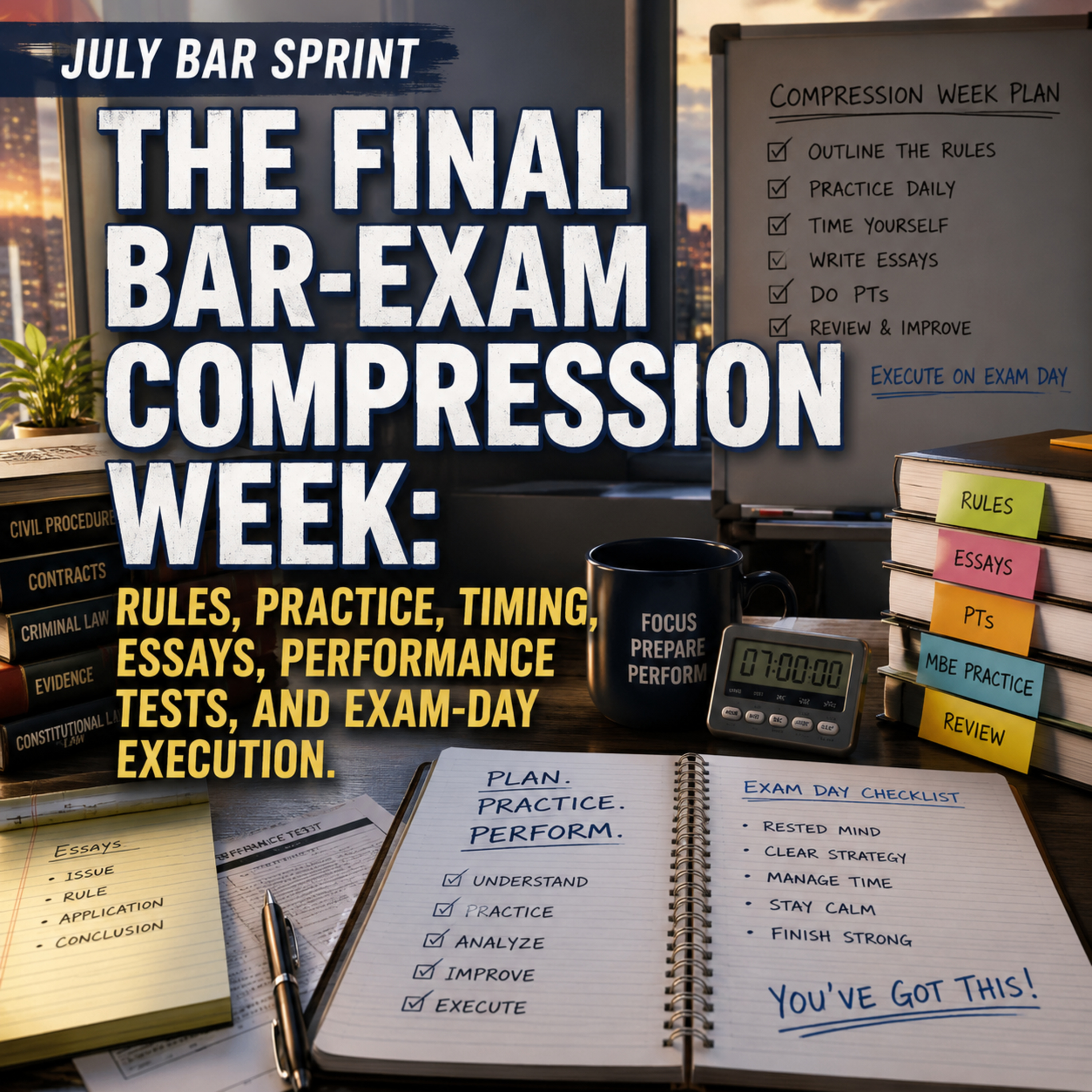
    » 📘VIEW THE COMPLETE STUDY GUIDE📘[💡FREE💡]« » 📘VIEW TODAY'S STUDY GUIDE📘[💡FREE💡] « ▬▬▬▬▬▬▬▬▬▬ EPISODE SUMMARY Saturday is the full mixed-simulation and endurance day. Its purpose is not to learn large amounts of new law. It is to practice exam rhythm, expose the last correctable problems, and develop the ability to continue working through fatigue and uncertainty. For current MBE candidates, one hundred questions in three hours creates an average pace of approximately one minute and forty-eight seconds per question. Candidates should use pacing checkpoints rather than spending equal time on every item. The guessing method requires the candidate to eliminate answers that misstate the law, address the wrong issue, ignore a controlling fact, or state the rule too broadly. The candidate should then select the answer that applies the governing rule to the dispositive fact. When uncertainty remains, the candidate should mark, guess, and move. Essay endurance requires strict time control. When thirty minutes expire, the candidate should move to the next essay. In an emergency, a ten-minute answer should contain descriptive headings, one-sentence rules, direct factual application, and short conclusions. MPT endurance depends on creating the answer shell early. Headings preserve structure even when time or energy declines. Error control requires the candidate to expect difficult questions, unexpected essays, awkward tasks, doubt, time pressure, and fatigue. These are ordinary exam conditions. The correct response is a brief mental reset followed by forward motion. The current UBE simulation consists of one hundred timed MBE questions in the morning, followed after a break by three timed essays or one MPT plus one essay. A NextGen simulation should use an official-style three-hour mixed block followed by a performance or legal-writing task and targeted foundational-law review. Review should identify patterns without becoming an exhausting late-night autopsy. The final exam rescue sheet should contain the candidate’s top twenty missed rules, timing reminders, essay-structure reminders, an MPT format checklist, a logistics checklist, and the panic-control sentence: “Read the call, find the rule, apply the facts, move.” Saturday should also include confirmation of identification, admission documents, technology, permitted equipment, travel, lodging, food, medication, accommodations, and reporting requirements.

  • July 24 · 50 min

    July Bar Sprint: MPT and Performance Sprint — Task Memo, File, Library, Rule Synthesis, Objective Writing, Persuasive Writing, and Time Control

    » 📘VIEW THE COMPLETE STUDY GUIDE📘[💡FREE💡]« » 📘VIEW TODAY'S STUDY GUIDE📘[💡FREE💡] « ▬▬▬▬▬▬▬▬▬▬ EPISODE SUMMARY The Friday sprint focuses on performance testing. The MPT requires no memorized outside law, but it demands disciplined reading, organization, legal synthesis, fact application, professional writing, and time control. The task memo tells the candidate what to produce. The file supplies the facts. The library supplies the law. The answer must follow the requested format. The first rule is to obey the task memo. An objective memorandum, persuasive brief, client letter, demand letter, bench memorandum, motion argument, settlement proposal, contract provision, and policy memorandum serve different purposes and require different forms. A disciplined ninety-minute method allocates time to reading the task memo, creating an answer shell, extracting rules from the library, marking facts in the file, writing, and reviewing. Candidates may vary the reading sequence, but they should use a consistent method already practiced. Rule synthesis requires the candidate to combine multiple authorities into elements, factors, exceptions, and usable standards. Cases should be used as analogies and distinctions rather than copied in large blocks. Objective writing should be balanced, predictive, and candid about weaknesses. Persuasive writing should frame the law and facts for the client while remaining accurate. Client letters should explain likely outcomes, risks, options, and next steps in clear language. Common traps include ignoring the task memo, using outside law, copying authorities without analysis, using the wrong format, writing long introductions, running out of time, omitting adverse facts, and failing to answer the client’s actual question. MPT skills also support NextGen tasks involving legal research, writing, issue spotting, evaluation, counseling, negotiation, and client management. The Friday assignment is one timed ninety-minute MPT or official NextGen-style performance task, followed by review for task compliance, rule synthesis, fact use, organization, and conclusion.

  • July 23 · 1 hr 5 min

    July Bar Sprint: Essay Sprint — MEE Rule Blocks, Issue Spotting, Fact Application, Organization, and July 2026 Subject Priorities

    » 📘VIEW THE COMPLETE STUDY GUIDE📘[💡FREE💡]« » 📘VIEW TODAY'S STUDY GUIDE📘[💡FREE💡] « ▬▬▬▬▬▬▬▬▬▬ EPISODE SUMMARY The Thursday sprint focuses on producing scoreable bar essays under timed conditions. A bar essay is a legal scoring document, not a classroom meditation or literary exercise. The basic essay structure is heading, rule, application, and conclusion. Descriptive issue headings give the grader a map. Rule blocks demonstrate legal knowledge. Fact-specific application usually earns the greatest share of points. Conclusions resolve each issue. Issue spotting begins with the call of the question. The candidate should then identify legally significant parties, dates, transactions, jurisdictional facts, mental states, communications, writings, transfers, injuries, objections, procedural posture, defenses, and remedies. After the July 2026 MEE subject adjustment, prime essay study should focus on the subjects that remain within the applicable examination format. Candidates must separately confirm any jurisdiction-specific essay subjects. When the exact rule cannot be recalled, the candidate should use the rule-survival method. A legally plausible rule based on remembered elements and policy can support partial credit. Blank space cannot. Common essay failures include missing headings, summarizing facts without analysis, stating rules without applying facts, discussing facts without rules, overdeveloping minor issues, ignoring remedies or defenses, writing one-sided analysis, and failing to finish. The thirty-minute method allocates approximately three to five minutes to reading, three minutes to outlining, twenty minutes to writing, and two to four minutes to review. When time is short, headings and rule statements should be written before detailed analysis. The Thursday assignment is three timed essays in ninety minutes: one MBE-subject essay, one Civil Procedure essay, and one Business Associations or Agency essay. Each answer should then be reviewed for issues, rules, factual application, conclusions, and omissions.

  • July 22 · 1 hr 11 min

    July Bar Sprint: MBE Sprint Part Two — Evidence, Real Property, Constitutional Law, Criminal Law and Procedure

    » 📘VIEW THE COMPLETE STUDY GUIDE📘[💡FREE💡]« » 📘VIEW TODAY'S STUDY GUIDE📘[💡FREE💡] « ▬▬▬▬▬▬▬▬▬▬ EPISODE SUMMARY The Wednesday sprint completes the MBE review with Evidence, Real Property, Constitutional Law, and Criminal Law and Procedure. Evidence questions should be analyzed in sequence: identify the evidence, determine its purpose, identify the objection, consider any exclusion or exception, and rule. The central hearsay question is always: “Offered for what purpose?” Real Property questions require classification. The candidate must identify the estate, future interest, leasehold, easement, covenant, deed, recording claim, mortgage, or possessory right before applying the governing rule. Constitutional Law questions should be organized around actor, power, right, and scrutiny. Strict scrutiny applies only when a recognized constitutional trigger is present. Criminal Law requires attention to the act, mental state, concurrence, causation, offense elements, inchoate liability, accomplice liability, and defenses. Criminal Procedure requires separation of the amendments. The Fourth Amendment governs searches and seizures. The Fifth Amendment governs compelled testimonial self-incrimination and Miranda. The Sixth Amendment governs post-charge counsel and related protections. The Wednesday assignment is a timed fifty-question mixed set. The candidate should select the ten worst missed questions and write both the governing rule and the reason the incorrect answer was tempting.

  • July 21 · 1 hr 10 min

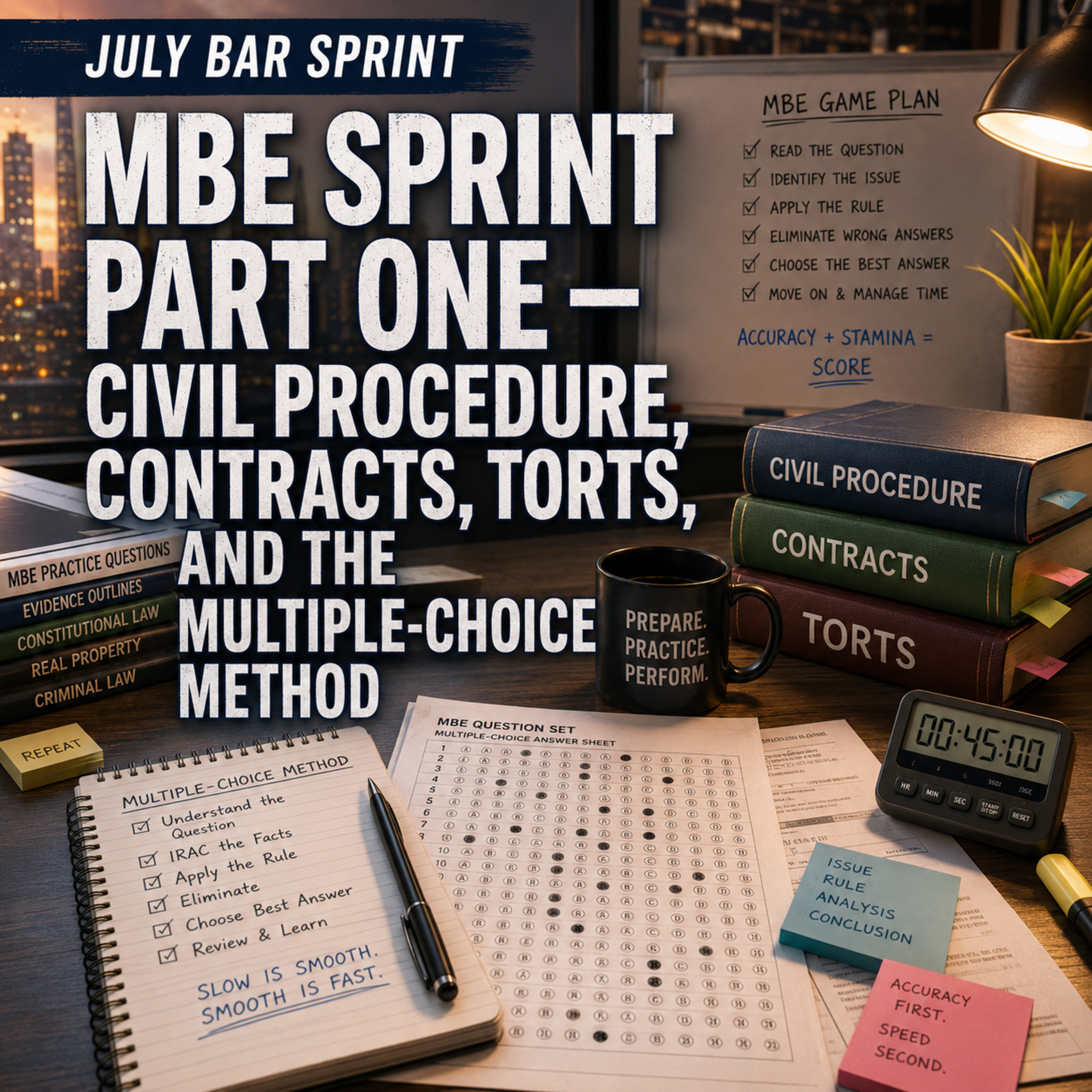
    July Bar Sprint: MBE Sprint Part One — Civil Procedure, Contracts, Torts, and the Multiple-Choice Method

    » 📘VIEW THE COMPLETE STUDY GUIDE📘[💡FREE💡]« » 📘VIEW TODAY'S STUDY GUIDE📘[💡FREE💡] « ▬▬▬▬▬▬▬▬▬▬ EPISODE SUMMARY The Tuesday sprint focuses on MBE execution in Civil Procedure, Contracts, and Torts. The objective is not to relearn the entire subjects. It is to sharpen issue recognition, rule retrieval, and answer-choice discipline. A reliable MBE method begins by reading the call of the question. The candidate should identify the subject and subtopic, locate legally operative facts, state the governing rule, eliminate legally impossible answers, choose the best answer, and move. Civil Procedure questions frequently turn on procedural posture. Candidates should distinguish motions to dismiss, summary judgment, judgment as a matter of law, post-trial motions, and appeals. High-yield areas include jurisdiction, venue, pleadings, Rule 12 waiver, joinder, discovery, summary judgment, trial motions, and preclusion. The central warning is to avoid stage confusion. Contracts questions should be analyzed in order: formation, terms, defenses, performance, breach, and remedy. High-yield areas include governing law, offer and acceptance, consideration, the Statute of Frauds, parol evidence, defenses, conditions, breach, excuse, third-party rights, and remedies. The central warning is not to analyze damages before identifying the duty and breach. Torts questions require precise proof of elements. High-yield areas include intentional torts, privileges, negligence, duty, breach, causation, defenses, vicarious liability, strict liability, products liability, defamation, privacy, economic torts, and nuisance. The central warning is to resist emotional overreaction. Serious injury does not replace duty, breach, causation, or the absence of a defense. The Tuesday assignment is a timed fifty-question mixed set emphasizing the three subjects. Every missed or uncertain question should be rewritten as a one-sentence rule.

  • July 20 · 51 min

    July Bar Sprint: The Final Bar Map Score Strategy, Subject Triage, Timing, Rule Compression, and the Last-Week Study System

    » 📘VIEW THE COMPLETE STUDY GUIDE📘[💡FREE💡] « » 📘VIEW TODAY'S STUDY GUIDE📘[💡FREE💡] « ▬▬▬▬▬▬▬▬▬▬ EPISODE SUMMARY The final bar sprint marks the transition from learning mode to performance mode. Learning mode asks what remains unknown. Performance mode asks what the candidate can reliably produce under timed conditions. A successful final-week plan should reflect the score architecture of the applicable examination. Multiple-choice questions require daily attention, written components require organized legal production, and performance tasks require disciplined use of provided authorities and facts. Subject review should follow a three-part triage system. Protect strong subjects through short maintenance. Repair high-yield weaknesses through targeted work. Limit the time devoted to obscure or low-yield panic topics. The candidate’s materials should be compressed and stable: short attack sheets, a rule notebook, representative questions, essay and performance-task structures, a timing schedule, and a personal error log. This is not the time to create a new comprehensive outline. The daily schedule should place demanding performance work in the morning, review and repair at midday, writing or practical tasks in the afternoon, and light memorization, logistics, and recovery in the evening. Sleep protection is part of preparation. Rules should be compressed into statements that are short enough to retrieve but complete enough to organize legal analysis. The candidate should prioritize issue identification, workable rules, factual application, supported conclusions, and completion. Finally, the candidate should treat mistakes as diagnostic information rather than personal judgments. The final sprint is a management problem. The candidate must manage doctrine, time, energy, attention, and confidence. The governing command is: “I will earn points by identifying issues, stating workable rules, applying facts, finishing every task, and moving when time expires.”

  • July 19 · 59 min

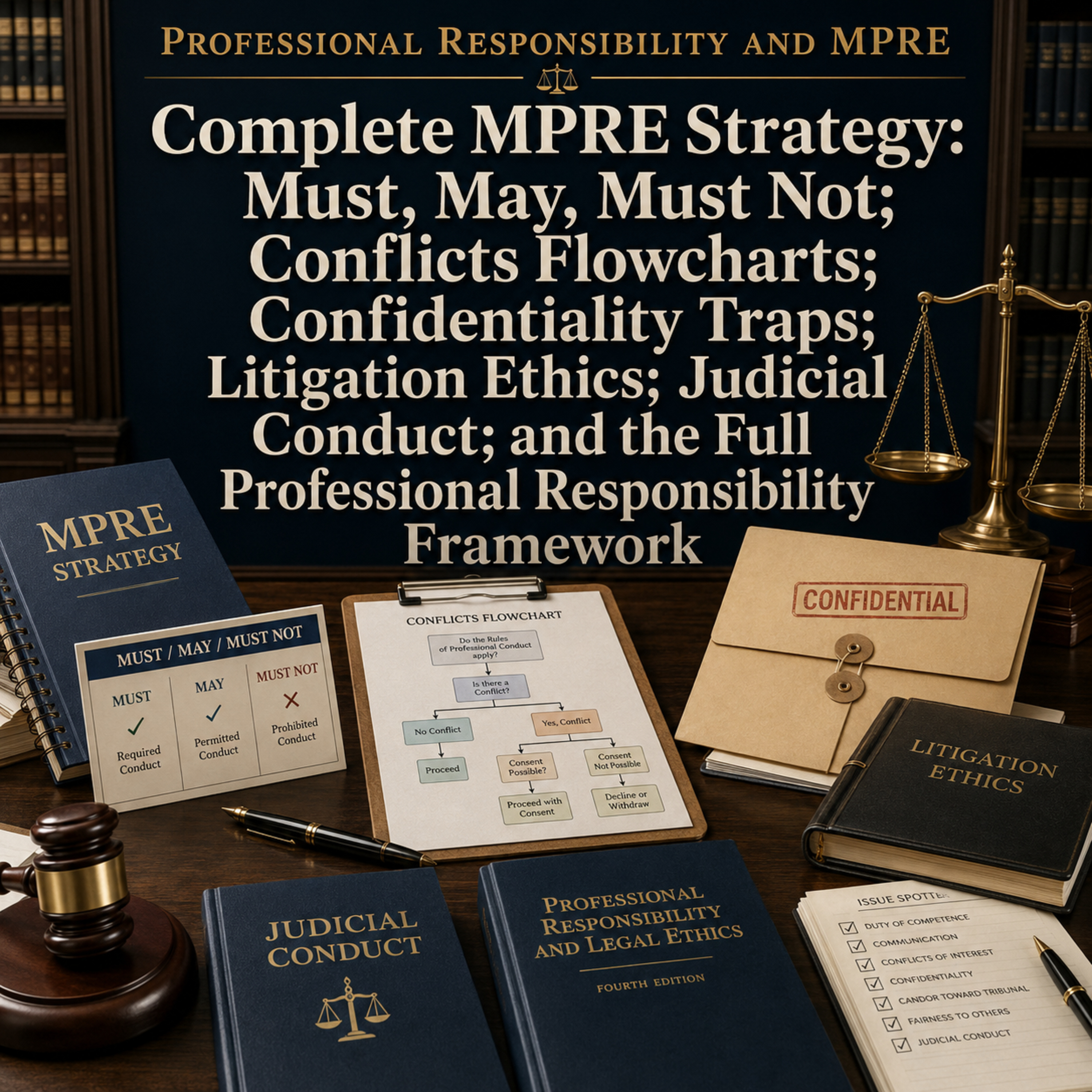
    Professional Responsibility: Complete MPRE Strategy- Must, May, Must Not; Conflicts Flowcharts; Confidentiality Traps; Litigation Ethics; Judicial Conduct; & Full Professional Responsibility Framework

    » 📘VIEW THE COMPANION STUDY GUIDE📘[💡FREE💡] « ▬▬▬▬▬▬▬▬▬▬ EPISODE SUMMARY MPRE success comes from rule sequence. Begin by identifying the lawyer’s role, the relationship, the duty category, and whether the lawyer must act, may act, or must not act. Then ask whether consent, writing, withdrawal, disclosure, screening, reporting, or court permission changes the result. Mandatory duties include competence, diligence, communication, safekeeping property, avoiding frivolous claims, correcting false statements to tribunals, disclosing controlling adverse authority, reporting certain serious misconduct when confidentiality does not bar reporting, withdrawing when required, and protecting client interests upon termination. Permissive rules include certain confidentiality disclosures, limited-scope representation with informed consent, withdrawal for specified good cause, and consentable conflicts with proper consent. Prohibitions include unauthorized disclosure, nonconsentable conflicts, assistance in crime or fraud, false statements, false evidence, obstruction, improper contact with represented persons, commingling or conversion, misleading advertising, improper solicitation, and unauthorized practice. High-yield MPRE traps include confusing confidentiality with privilege, forgetting client control over settlement and core criminal decisions, treating all conflicts as waivable, assuming third-party payers are clients, mishandling trust funds, ignoring tribunal candor, forgetting prosecutor duties, contacting represented persons, and overusing extreme answer choices. The full Professional Responsibility framework is practical. Identify the actor, relationship, duty, and command. Then choose the answer that protects client autonomy, confidentiality, loyalty, tribunal integrity, public trust, and professional independence in the precise way the rules require. The central lesson is disciplined professional judgment. A lawyer’s duties are not private instincts or personal preferences. They are enforceable professional obligations, and the MPRE tests whether students can apply them with accuracy.

  • July 18 · 1 hr 4 min

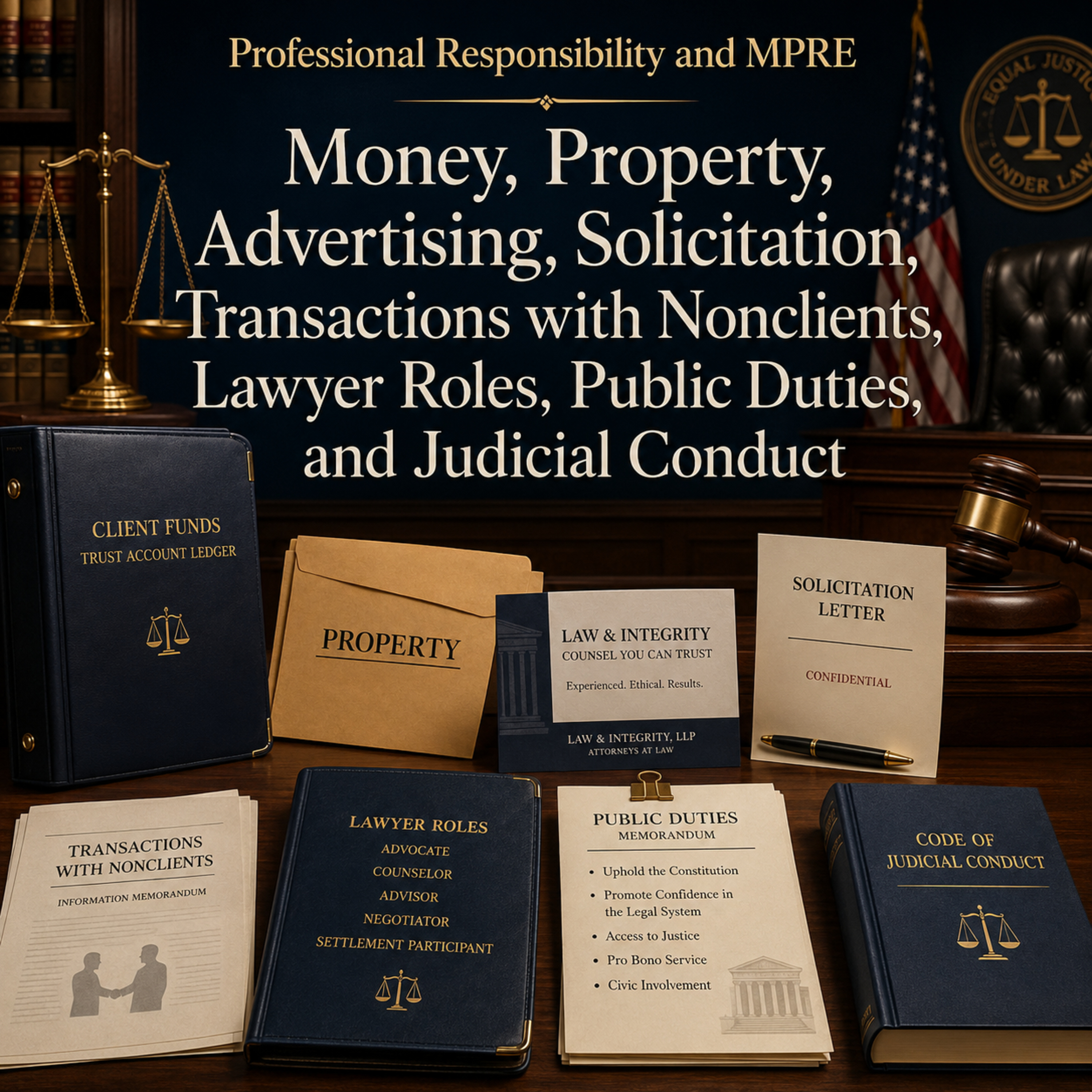
    Professional Responsibility and MPRE: Money, Property, Advertising, Solicitation, Transactions with Nonclients, Lawyer Roles, Public Duties, and Judicial Conduct

    » 📘VIEW THE COMPANION STUDY GUIDE📘[💡FREE💡] « ▬▬▬▬▬▬▬▬▬▬ EPISODE SUMMARY Professional responsibility extends beyond courtroom advocacy. Lawyers must handle money and property properly, communicate truthfully with the public and nonclients, avoid misleading advertising, obey solicitation limits, clarify professional roles, support the legal system, and understand judicial ethics. Client and third-party property must be kept separate from lawyer property. Client funds generally belong in trust, not in operating accounts. Commingling means improper mixing. Conversion means improper use. Unearned fees may need to remain in trust until earned. Settlement funds must be handled with notice, accounting, prompt distribution, and protection of valid third-party claims. Disputed funds must remain separated until resolved. Lawyer advertising is allowed if truthful and not misleading. A lawyer may state fields of practice, but specialization claims must be accurate and properly supported. Solicitation is more restricted than advertising, especially direct live person-to-person contact for pecuniary gain toward someone known to need legal services in a particular matter. Coercion, duress, harassment, and unwanted solicitation are improper. Referral and lead-generation arrangements must not mislead clients, compromise independence, or involve improper fee sharing. Firm names and professional communications must not misrepresent identity, affiliation, or responsibility for services. A lawyer must be truthful in statements to others and must not knowingly make false statements of material fact or law. The lawyer must respect third-person rights and may not use methods that unlawfully burden, embarrass, delay, or invade legal rights. Lawyers may serve as advisors, evaluators, negotiators, mediators, arbitrators, and third-party neutrals, but must clarify their roles. A mediator does not represent both parties merely by mediating. An evaluator must consider whether the evaluation is compatible with the client relationship and whether informed consent is required. Lawyers have duties to the public and legal system, including access to justice, responsible conduct concerning appointments, avoidance of improper influence, and truthful statements about judges and adjudicative officers. Judges must preserve independence, integrity, and impartiality. They must avoid impropriety and appearance concerns, regulate extrajudicial activities, avoid improper ex parte communications, disqualify themselves when impartiality might reasonably be questioned, and comply with rules governing gifts, public comments, and campaign activity. The central lesson is that ethics is a full-profession system. Money, advertising, negotiation, nonclient communications, neutral roles, public duties, and judicial behavior all belong to Professional Responsibility.

  • July 17 · 1 hr 11 min

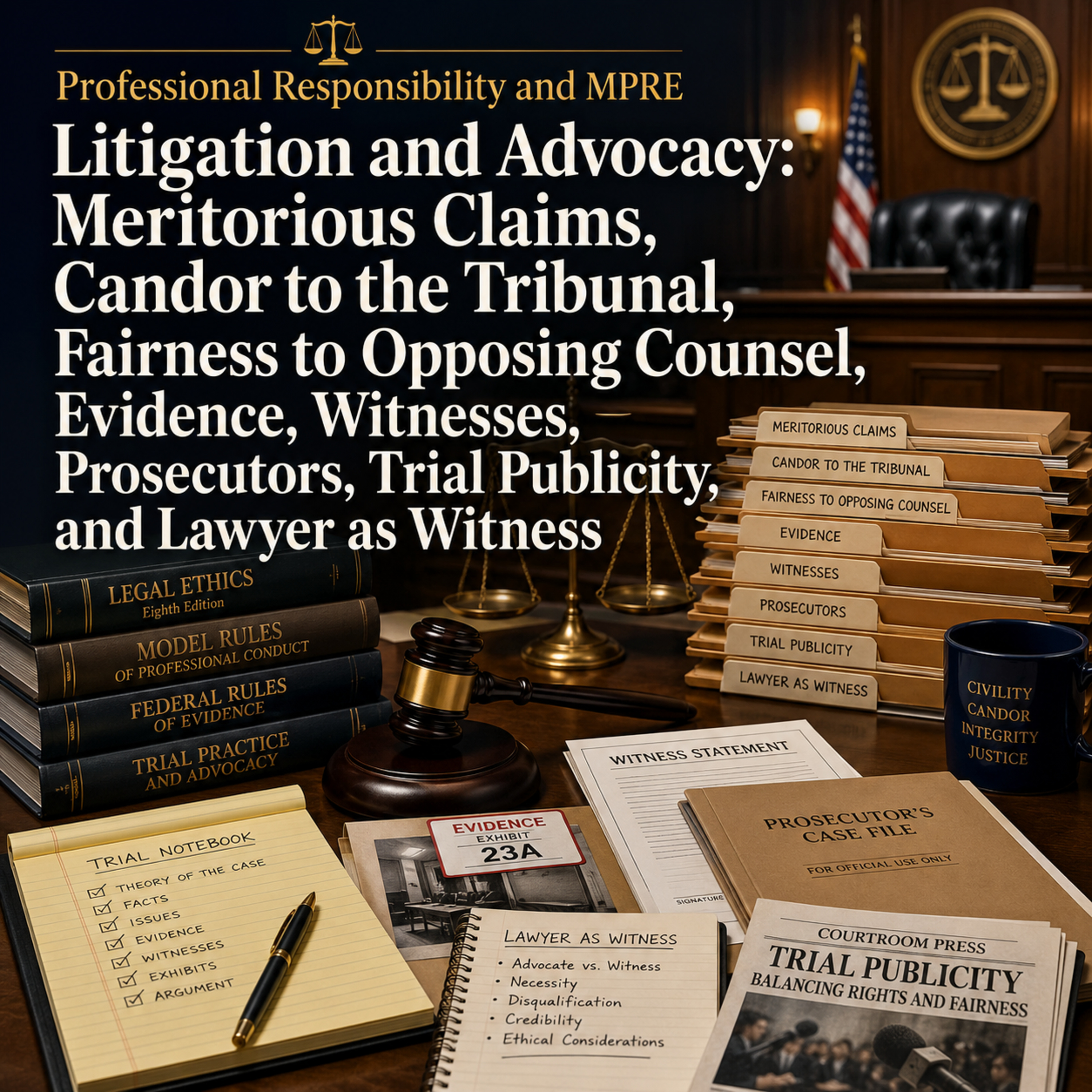
    Professional Responsibility & MPRE: Litigation & Advocacy - Meritorious Claims, Candor to the Tribunal, Fairness to Opposing Counsel, Evidence, Witnesses, Prosecutors, Trial Publicity & Lawyer as Witn

    » 📘VIEW THE COMPANION STUDY GUIDE📘[💡FREE💡] « ▬▬▬▬▬▬▬▬▬▬ EPISODE SUMMARY Advocacy has boundaries. A lawyer may represent a client forcefully, but must not file frivolous claims, mislead courts, falsify evidence, obstruct discovery, coach witnesses to lie, improperly contact represented persons, or prejudice proceedings through public statements. A lawyer must not bring or defend a proceeding or assert an issue without a nonfrivolous basis in law and fact. Good-faith arguments for changing the law are allowed. Criminal defense lawyers may require the prosecution to prove every element. Candor to the tribunal requires truthful statements of fact and law, correction of prior material false statements, disclosure of controlling adverse legal authority not disclosed by the opponent, and refusal to offer evidence known to be false. If material false evidence has been offered, the lawyer must take reasonable remedial measures, which may include disclosure to the tribunal if necessary. Ex parte proceedings require heightened candor because the opposing party is absent. The lawyer must disclose material facts needed for an informed decision, even if adverse. Fairness to opposing parties and counsel prohibits obstruction of evidence, destruction or concealment of material, falsification of proof, assistance with false testimony, improper discovery conduct, and unsupported trial assertions. Witness preparation is allowed; witness coaching is not. A lawyer may prepare a witness to testify truthfully but may not shape false testimony. A lawyer must not communicate about the matter with a represented person without consent or legal authorization. With unrepresented persons, the lawyer must avoid implying neutrality and may generally advise only to seek counsel when interests may conflict. Trial publicity is limited when public statements are substantially likely to materially prejudice a proceeding. Lawyers may provide certain basic information and may respond narrowly to undue prejudicial publicity. A lawyer generally may not serve as advocate at a trial where the lawyer is likely to be a necessary witness, subject to limited exceptions. Prosecutors have special duties as ministers of justice. They must not prosecute without probable cause, must respect counsel-related rights, must disclose exculpatory and mitigating evidence, and must avoid improper public condemnation of the accused. The central lesson is that advocacy is controlled by truth, fairness, and institutional integrity. A lawyer may fight hard, but must not convert representation into deception, obstruction, or abuse.

  • July 16 · 1 hr 6 min

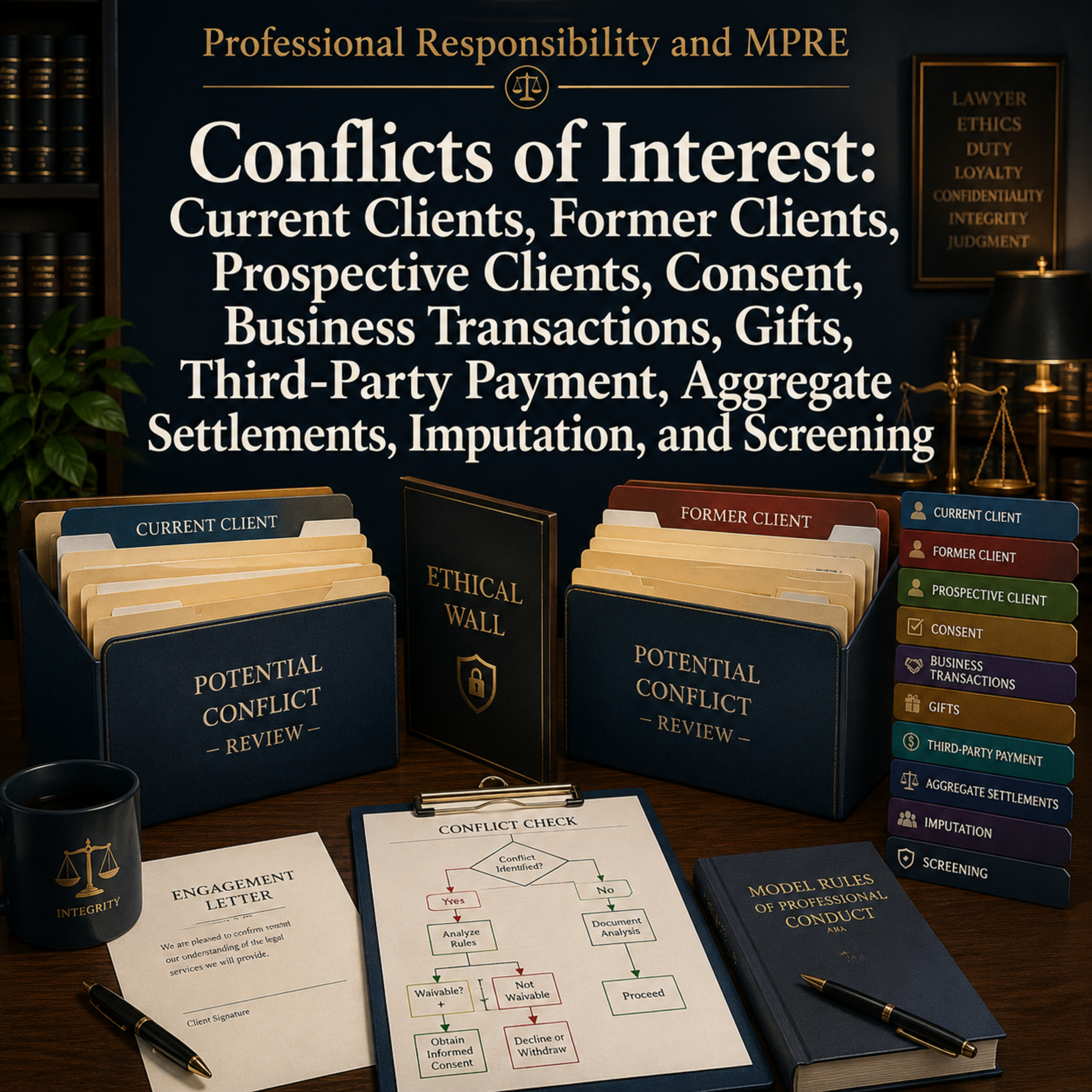
    Professional Responsibility & MPRE: Conflicts of Interest - Current, Former & Prospective Clients, Consent, Business Transactions, Gifts, 3rd-Party Payment, Aggregate Settlements, Imputation, & Screen

    » 📘VIEW THE COMPANION STUDY GUIDE📘[💡FREE💡] « ▬▬▬▬▬▬▬▬▬▬ EPISODE SUMMARY Conflicts of interest protect loyalty, confidentiality, independent professional judgment, and client trust. A conflict may arise from direct adversity, material limitation, former-client duties, prospective-client information, personal interests, business transactions, third-party payment, or imputation within a firm. A current-client conflict exists when representation is directly adverse to another current client or when there is a significant risk that representation will be materially limited by duties to another client, a former client, a third person, or the lawyer’s own interests. Some conflicts are consentable, but only if the lawyer reasonably believes competent and diligent representation is possible, the law does not prohibit the representation, and the matter does not involve one client asserting a claim against another client in the same proceeding. Informed consent requires explanation of material risks and reasonably available alternatives. When required, consent must be confirmed in writing. Business transactions with clients require fair and reasonable terms, written disclosure, written advice to seek independent counsel, reasonable opportunity to do so, and signed informed consent. Lawyers must not misuse client information, solicit substantial gifts, acquire literary rights during representation, improperly provide financial assistance, or allow third-party payers to control the representation. Aggregate settlements require informed written consent from each client after full disclosure. Limiting malpractice liability and settling malpractice claims with clients or former clients require special safeguards. Sexual relationships with clients are generally prohibited unless the relationship predated representation. Former-client conflicts bar materially adverse representation in the same or substantially related matter without informed consent confirmed in writing. Prospective-client conflicts may arise when the lawyer receives significantly harmful information. Imputation can spread conflicts within a firm, though screening may be available in some circumstances. The MPRE lesson is classification. Identify whether the conflict involves a current client, former client, prospective client, personal interest, business transaction, third-party payer, aggregate settlement, or firm imputation. Then ask whether the conflict is consentable and whether the required consent or screening has occurred.

Showing 101–110 of 110 episodes