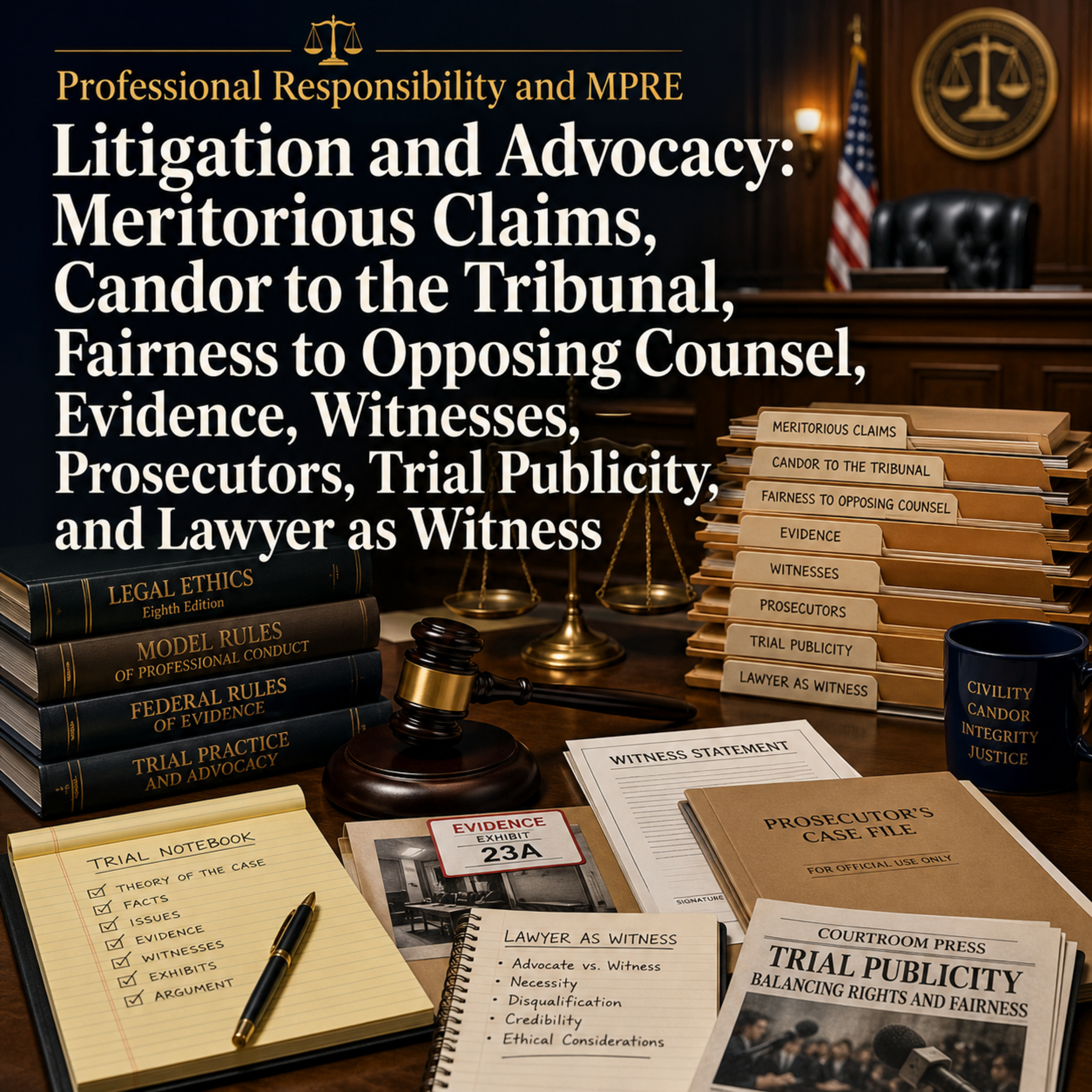
Professional Responsibility & MPRE: Litigation & Advocacy - Meritorious Claims, Candor to the Tribunal, Fairness to Opposing Counsel, Evidence, Witnesses, Prosecutors, Trial Publicity & Lawyer as Witn
Streams straight from the publisher. PodNod never proxies or re-hosts episode audio.
▬▬▬▬▬▬▬▬▬▬
EPISODE SUMMARY
Advocacy has boundaries. A lawyer may represent a client forcefully, but must not file frivolous claims, mislead courts, falsify evidence, obstruct discovery, coach witnesses to lie, improperly contact represented persons, or prejudice proceedings through public statements.
A lawyer must not bring or defend a proceeding or assert an issue without a nonfrivolous basis in law and fact. Good-faith arguments for changing the law are allowed. Criminal defense lawyers may require the prosecution to prove every element.
Candor to the tribunal requires truthful statements of fact and law, correction of prior material false statements, disclosure of controlling adverse legal authority not disclosed by the opponent, and refusal to offer evidence known to be false. If material false evidence has been offered, the lawyer must take reasonable remedial measures, which may include disclosure to the tribunal if necessary.
Ex parte proceedings require heightened candor because the opposing party is absent. The lawyer must disclose material facts needed for an informed decision, even if adverse.
Fairness to opposing parties and counsel prohibits obstruction of evidence, destruction or concealment of material, falsification of proof, assistance with false testimony, improper discovery conduct, and unsupported trial assertions.
Witness preparation is allowed; witness coaching is not. A lawyer may prepare a witness to testify truthfully but may not shape false testimony.
A lawyer must not communicate about the matter with a represented person without consent or legal authorization. With unrepresented persons, the lawyer must avoid implying neutrality and may generally advise only to seek counsel when interests may conflict.
Trial publicity is limited when public statements are substantially likely to materially prejudice a proceeding. Lawyers may provide certain basic information and may respond narrowly to undue prejudicial publicity.
A lawyer generally may not serve as advocate at a trial where the lawyer is likely to be a necessary witness, subject to limited exceptions.
Prosecutors have special duties as ministers of justice. They must not prosecute without probable cause, must respect counsel-related rights, must disclose exculpatory and mitigating evidence, and must avoid improper public condemnation of the accused.
The central lesson is that advocacy is controlled by truth, fairness, and institutional integrity. A lawyer may fight hard, but must not convert representation into deception, obstruction, or abuse.
📘VIEW THE COMPANION STUDY GUIDE📘[💡FREE💡]
thelawschoolofamerica.com