Skip to content
Artwork for Law School
EducationCourses

Law School

The Law School of America

The Law School of America podcast is designed for listeners who what to expand and enhance their understanding of the American legal system. It provides you with legal principles in small digestible bites to make learning easy. If you're willing to put in the time, The Law School of America podcasts can take you from novice to knowledgeable in a reasonable amount of time.

Play
  • 98 episodes
  • daily
  • Avg 1 hr 9 min
  • English
Counted on this page — what you have heard stays on this device, so it is not something the list can be paged by.
  • August 22 · 55 min

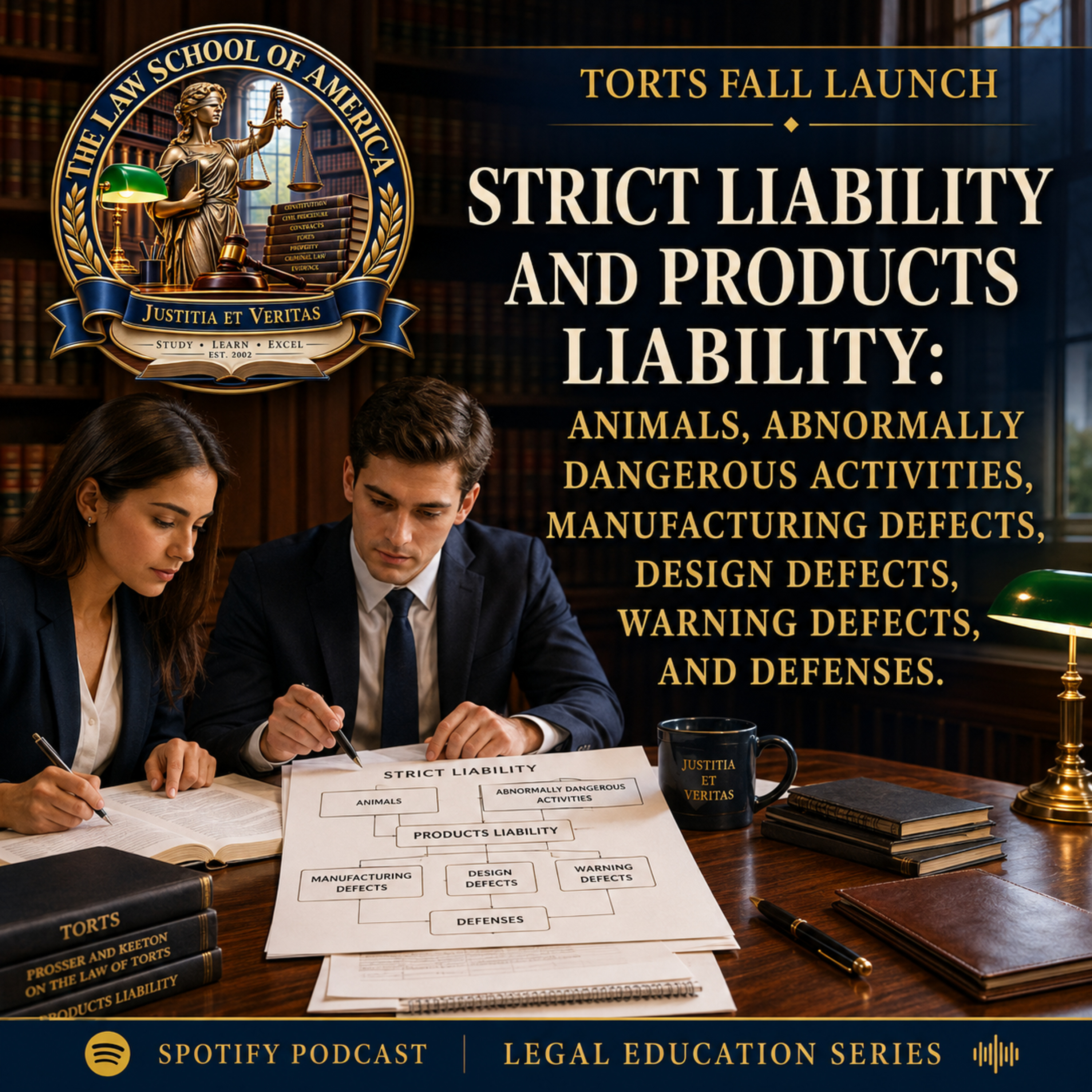
    Torts Fall Launch: Strict Liability and Products Liability: Animals, Abnormally Dangerous Activities, Manufacturing Defects, Design Defects, Warning Defects, and Defenses

    📘 FREE COMPANION STUDY GUIDE 📘 👉 CLICK HERE TO OPEN YOUR FREE STUDY GUIDE 👈 Turn this episode into an exam-ready study plan. 🎧 EPISODE SUMMARY 🎧 Strict liability does not mean absolute liability. The plaintiff must still prove that a recognized strict-liability doctrine applies, that the relevant danger or defect caused the injury, that the injury falls within the appropriate scope of risk, and that legally compensable harm occurred. Possessors of wild animals are generally strictly liable for harm resulting from dangerous characteristics typical of the animal. Reasonable care does not ordinarily eliminate liability for those characteristic risks. Domestic animals ordinarily create strict liability only when the owner knows or has reason to know of a dangerous tendency abnormal for that type of animal. The traditional “one-bite rule” does not literally require a prior bite. Abnormally dangerous activities may produce strict liability when they create a high risk of severe harm, reasonable care cannot eliminate the danger, the activity is uncommon, the location is inappropriate, and the dangerous attributes outweigh community value. Classification is context-specific. Strict liability for abnormally dangerous activities extends only to the type of harm that makes the activity abnormally dangerous. Defective products may create liability under strict products liability, negligence, warranty, and misrepresentation theories. Strict products liability generally requires a defective product supplied by a commercial seller, a defect existing when the product left the defendant’s control, no substantial relevant alteration before injury, causation, and legally cognizable harm. A manufacturing defect exists when a particular unit departs from its intended design. The plaintiff compares the individual product with properly manufactured units. A design defect concerns the product line as designed. Courts may use consumer expectations, risk-utility balancing, or a reasonable-alternative-design requirement. The consumer-expectation test asks whether the product is more dangerous than an ordinary consumer reasonably expects. Risk-utility analysis compares the probability and severity of harm with product utility, alternative designs, cost, consumer knowledge, and ability to avoid danger. Some modern approaches require proof of a technologically and economically feasible alternative design that would reduce foreseeable harm without destroying reasonable product utility. A warning defect may exist when a product lacks adequate instructions or warnings concerning foreseeable nonobvious risks. Adequate warnings should be understandable, visible, specific, prominent, and appropriately directed. Warning causation must also be shown. The key lesson for Saturday is that strict liability removes the ordinary requirement of proving unreasonable conduct, but it does not remove disciplined analysis. The student must still identify the precise source of strict liability, the relevant defect or abnormal risk, causation, damages, and any applicable defense.ℹ️ INFORMATION, PRIVACY POLICY & TERMS OF USE ℹ️ The Podcast and Website Purpose The Law School Podcast and 1L Study Aide webpage supplements law-school and Bar Exam study with strategies, condensed rules, quizzes, and flashcards. Educational Disclaimer Content is for educational and informational purposes only. It is not legal advice, creates no attorney-client relationship, and does not guarantee law-school or Bar Exam success. Privacy Policy No account or login is required. This webpage uses no forms or analytics to collect personal information. Quiz and flashcard activity stays in your browser and may clear when local site data is removed. Terms of Use By using this webpage, you agree to use its content only for lawful, personal, noncommercial educational purposes. It supplements—not replaces—courses, textbooks, official materials, or qualified instruction.
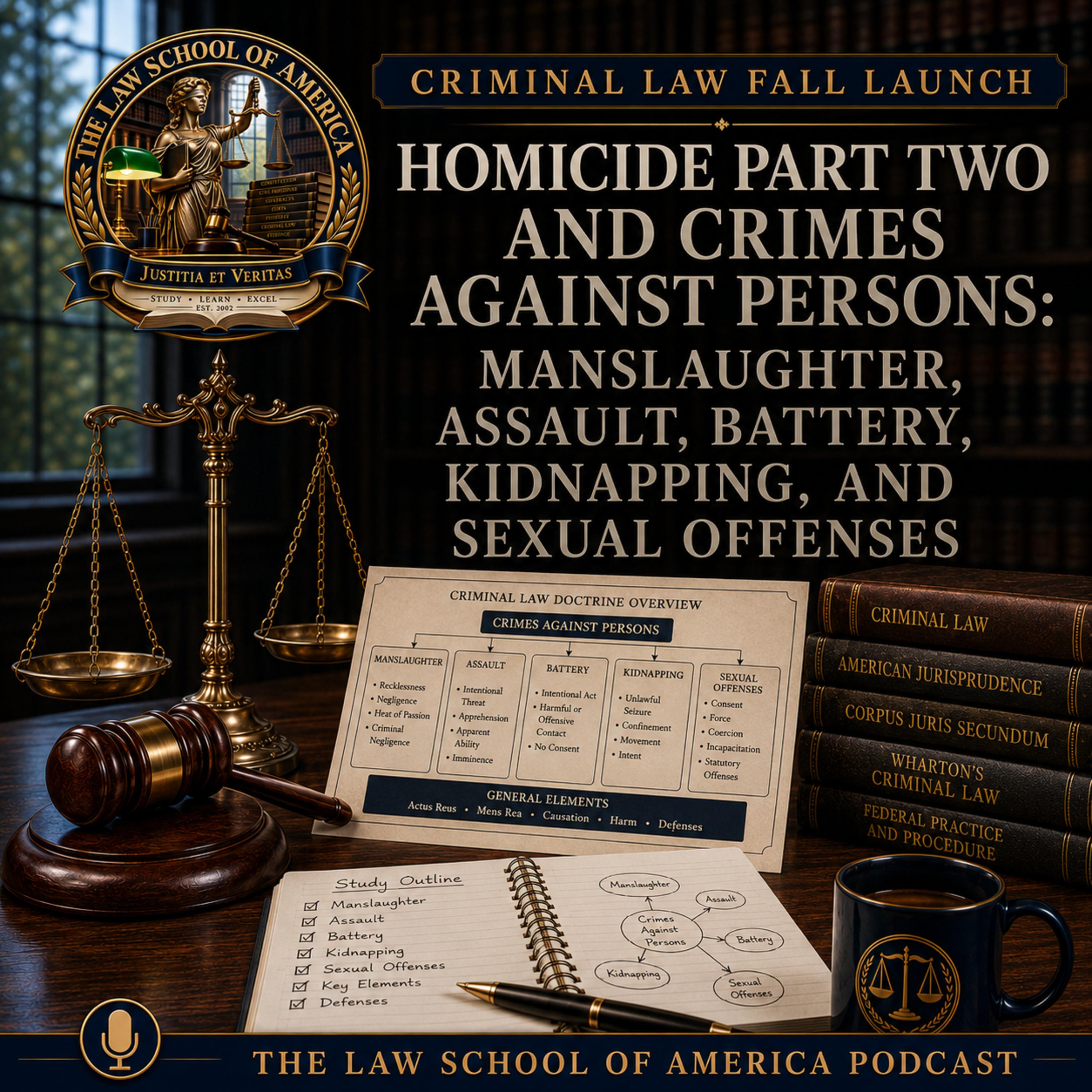
  • August 21 · 1 hr 7 min

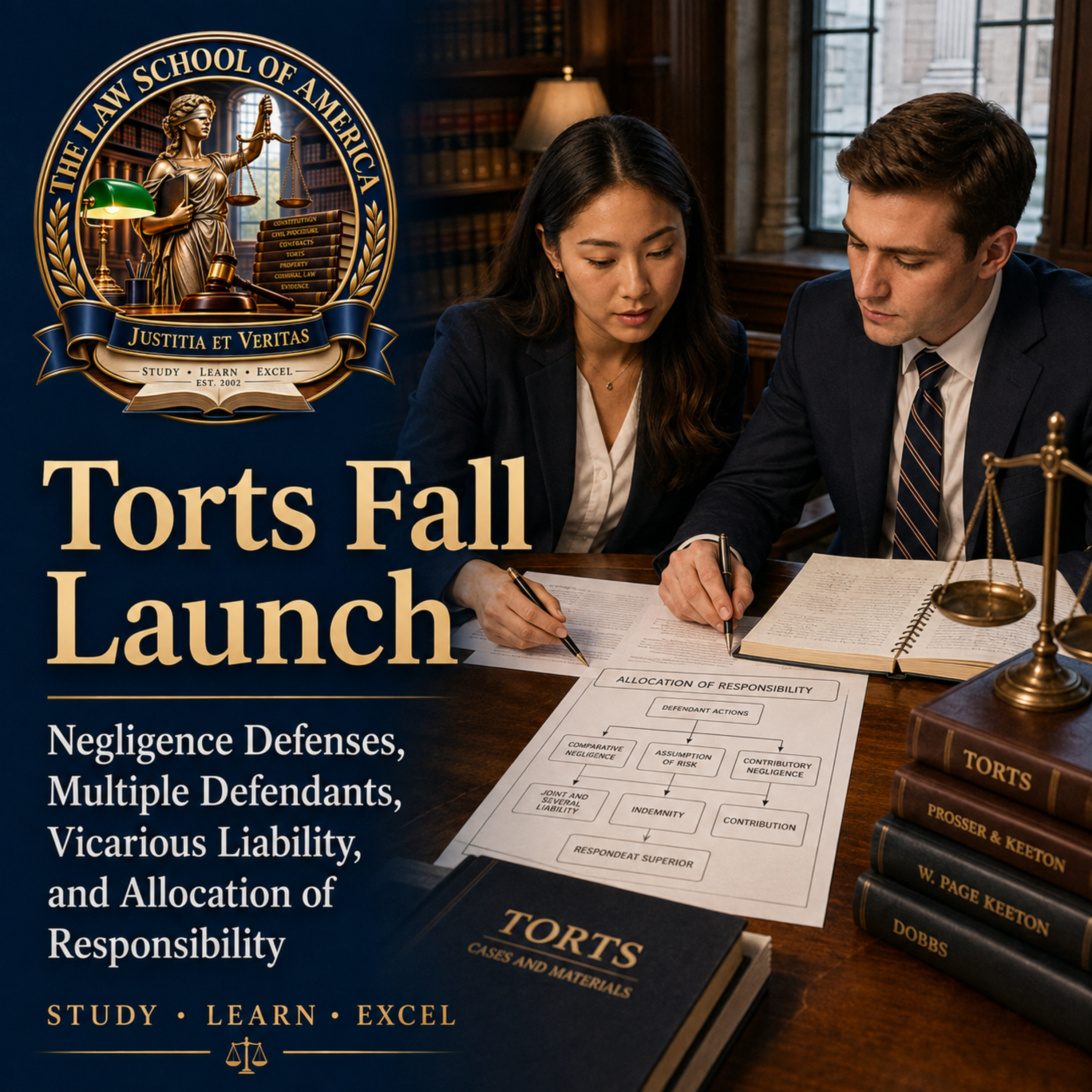
    Torts Fall Launch: Negligence Defenses, Multiple Defendants, Vicarious Liability, and Allocation of Responsibility

    📘 FREE COMPANION STUDY GUIDE 📘 👉 CLICK HERE TO OPEN YOUR FREE STUDY GUIDE 👈 Turn this episode into an exam-ready study plan. 🎧 EPISODE SUMMARY 🎧 After the plaintiff establishes negligence, tort law must determine how responsibility is allocated. Traditional contributory negligence completely bars a plaintiff whose own negligence contributed to the injury. Last clear chance historically permitted recovery when the defendant had the final opportunity to avoid the accident despite the plaintiff’s prior negligence. Comparative negligence reduces recovery according to plaintiff responsibility. Pure comparative negligence permits recovery even when the plaintiff is mostly at fault. Modified systems bar recovery at a specified threshold. Students must distinguish systems barring plaintiffs at 50 percent from systems barring plaintiffs only when fault exceeds 50 percent. Assumption of risk appears in several forms. Express assumption involves waivers, releases, exculpatory clauses, or contractual allocations. Enforceability depends on clarity, public policy, scope, and the nature of defendant misconduct. Traditional implied assumption requires knowledge, appreciation, and voluntary encounter with a particular risk. Many comparative-fault systems merge this doctrine into comparative negligence. Primary assumption of risk concerns whether the defendant owed a duty regarding risks inherent in an activity. It should be distinguished from unreasonable plaintiff risk-taking and contractual waiver. Mitigation applies after injury. The plaintiff must take reasonable steps to avoid additional loss. Comparative negligence concerns conduct contributing to the initial injury; mitigation concerns later conduct increasing damages. Multiple defendants may combine to produce indivisible harm. Traditional joint and several liability allows the plaintiff to collect the entire judgment from any jointly responsible defendant. Modern statutes may instead use several liability or hybrid systems. Contribution allows a tortfeasor who pays more than an appropriate share to obtain reimbursement from other responsible tortfeasors. Indemnity shifts the entire loss from one responsible party to another. Vicarious liability imposes responsibility for another person’s tort based on a legal relationship. Under respondeat superior, an employer may be liable for an employee’s tort committed within the scope of employment. A minor personal detour may remain within the scope of employment, while a substantial personal frolic may fall outside it. Liability can resume when the employee returns to the employer’s business. The key lesson for Friday is that establishing negligence does not determine who ultimately bears the loss. Tort law separately allocates responsibility among plaintiffs, multiple defendants, employers, employees, contractors, and other responsible actors. ℹ️ INFORMATION, PRIVACY POLICY & TERMS OF USE ℹ️ The Podcast and Website Purpose The Law School Podcast and 1L Study Aide webpage supplements law-school and Bar Exam study with strategies, condensed rules, quizzes, and flashcards. Educational Disclaimer Content is for educational and informational purposes only. It is not legal advice, creates no attorney-client relationship, and does not guarantee law-school or Bar Exam success. Privacy Policy No account or login is required. This webpage uses no forms or analytics to collect personal information. Quiz and flashcard activity stays in your browser and may clear when local site data is removed. Terms of Use By using this webpage, you agree to use its content only for lawful, personal, noncommercial educational purposes. It supplements—not replaces—courses, textbooks, official materials, or qualified instruction.
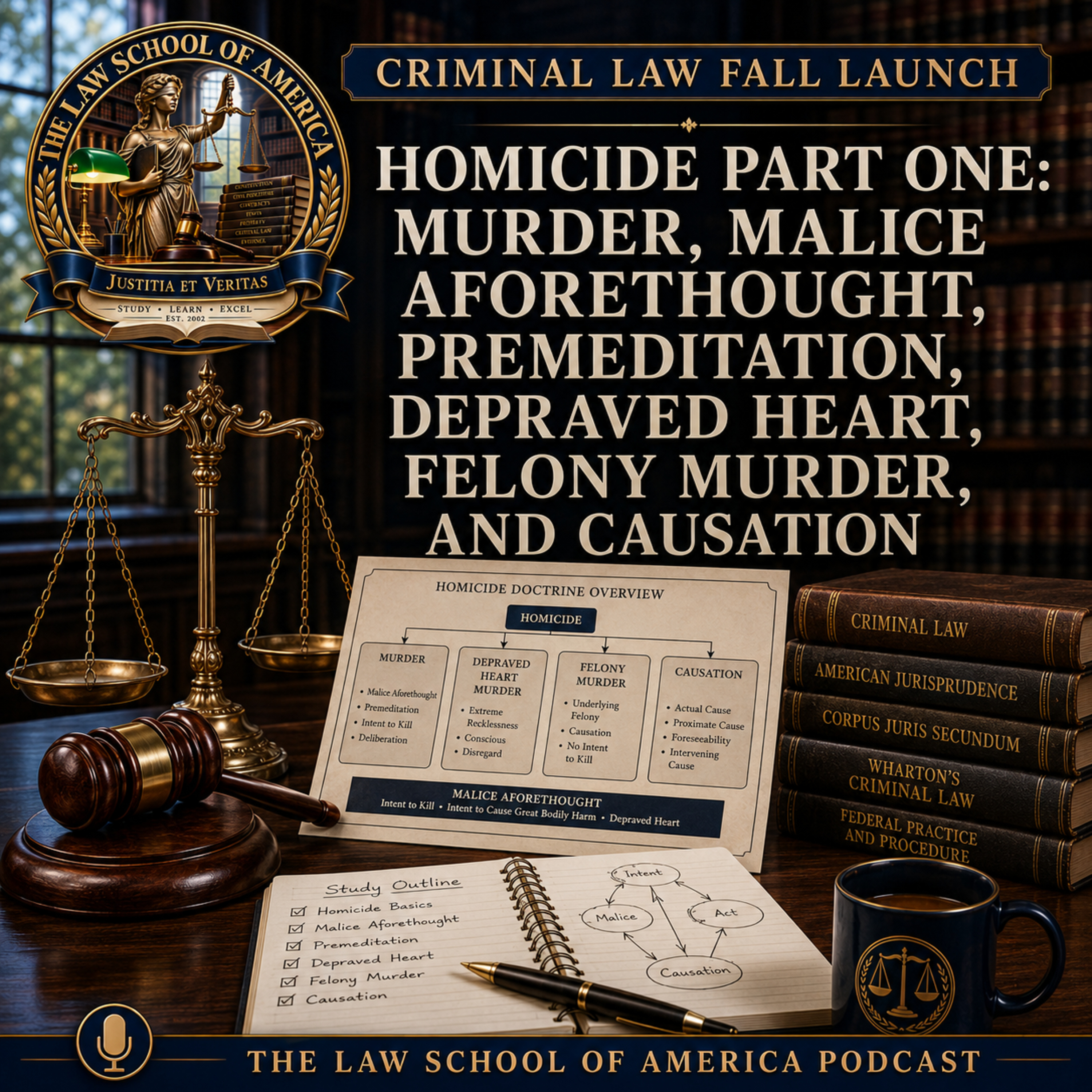
  • August 20 · 1 hr

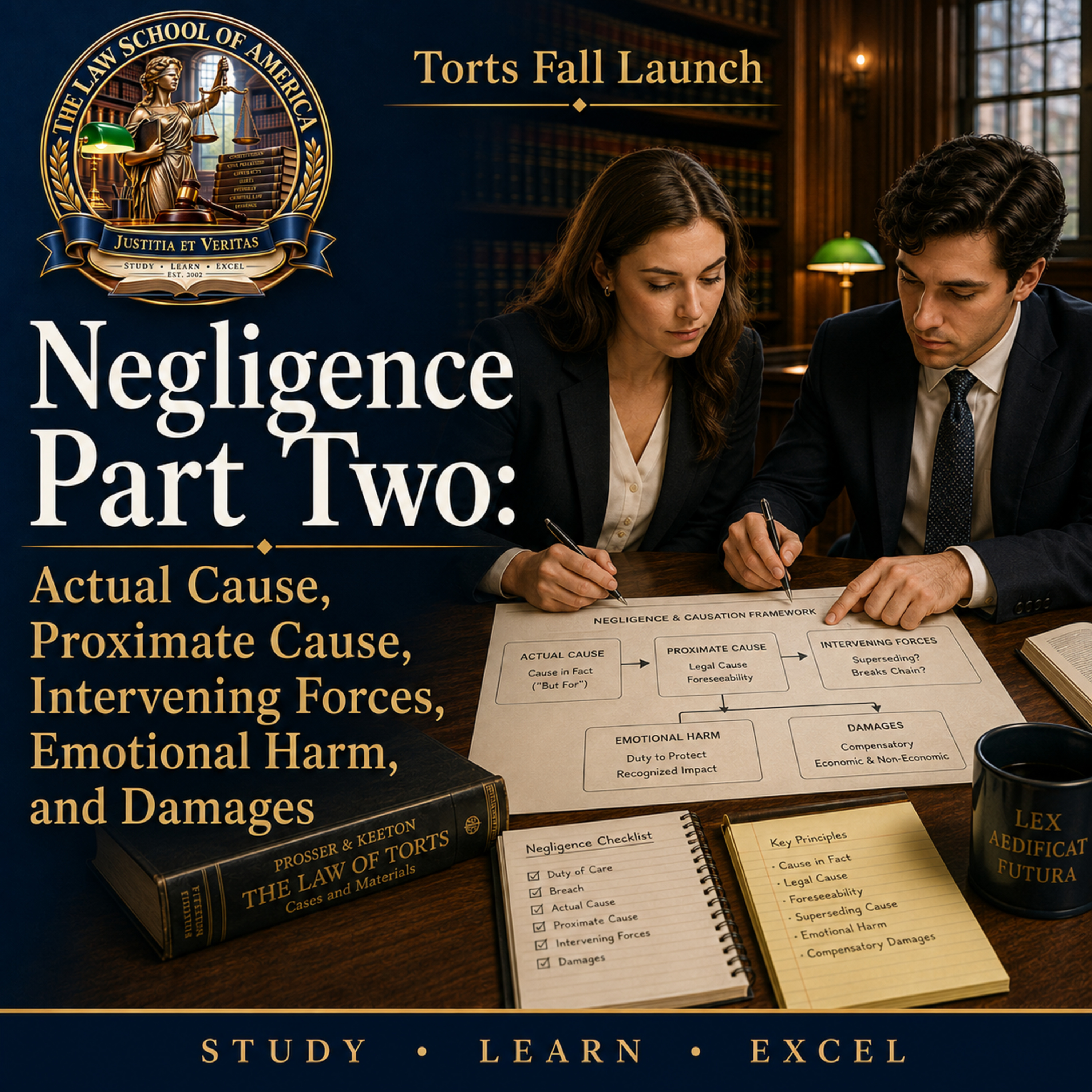
    Torts Fall Launch: Negligence Part Two: Actual Cause, Proximate Cause, Intervening Forces, Emotional Harm, and Damages

    📘 FREE COMPANION STUDY GUIDE 📘 👉 CLICK HERE TO OPEN YOUR FREE STUDY GUIDE 👈 Turn this episode into an exam-ready study plan. 🎧 EPISODE SUMMARY 🎧 Negligence requires more than careless conduct. The plaintiff must establish actual causation, proximate causation, and actual damages. Actual causation ordinarily uses the but-for test: but for the defendant’s breach, would the injury have occurred? If the answer is no, factual causation is established. Multiple sufficient causes require special treatment when several independent acts were each sufficient to cause the same harm. Alternative liability may shift the causal burden when multiple defendants acted negligently but uncertainty prevents identification of the actual wrongdoer. Loss-of-chance doctrine may address medical negligence that reduces a patient’s probability of survival or recovery. Proximate cause limits liability to injuries within the scope of the risks that made the defendant’s conduct negligent. The exact mechanism and extent of harm need not always be foreseeable, but the general type of injury ordinarily must fall within the relevant risk. An intervening event does not automatically cut off liability. Ordinary medical negligence, reasonable rescue, reactions to danger, normal natural forces, and foreseeable negligent conduct often remain within the scope of responsibility. A superseding cause is sufficiently extraordinary or outside the original risk to cut off liability. Intentional and criminal acts are not automatically superseding when the defendant’s negligence increased the risk that those acts would occur. The rescue doctrine recognizes that danger invites rescue and generally treats reasonable rescue attempts as foreseeable. The eggshell-plaintiff rule requires the defendant to take the plaintiff as found. Once the defendant is responsible for the relevant type of physical harm, the unforeseeable severity caused by the plaintiff’s vulnerability generally does not reduce liability. Negligent infliction of emotional distress varies among jurisdictions. Major approaches include zone-of-danger recovery, bystander recovery, and special-relationship situations in which emotional well-being is central to the undertaking. Negligence requires actual compensable injury. Damages may include medical expenses, lost wages, lost earning capacity, property damage, pain and suffering, emotional distress, disability, disfigurement, loss of enjoyment, and reasonably certain future losses. The traditional collateral-source rule generally prevents a tortfeasor from reducing liability because the plaintiff received compensation from an independent source, although statutory modifications vary. Wrongful-death actions compensate designated survivors for losses resulting from death. Survival actions preserve claims the decedent could have asserted had death not occurred. The key lesson for Thursday is that causation is a two-stage inquiry: did the defendant actually contribute to the harm, and is the resulting harm within the scope of the defendant’s legal responsibility? ℹ️ INFORMATION, PRIVACY POLICY & TERMS OF USE ℹ️ The Podcast and Website Purpose The Law School Podcast and 1L Study Aide webpage supplements law-school and Bar Exam study with strategies, condensed rules, quizzes, and flashcards. Educational Disclaimer Content is for educational and informational purposes only. It is not legal advice, creates no attorney-client relationship, and does not guarantee law-school or Bar Exam success. Privacy Policy No account or login is required. This webpage uses no forms or analytics to collect personal information. Quiz and flashcard activity stays in your browser and may clear when local site data is removed. Terms of Use By using this webpage, you agree to use its content only for lawful, personal, noncommercial educational purposes. It supplements—not replaces—courses, textbooks, official materials, or qualified instruction.
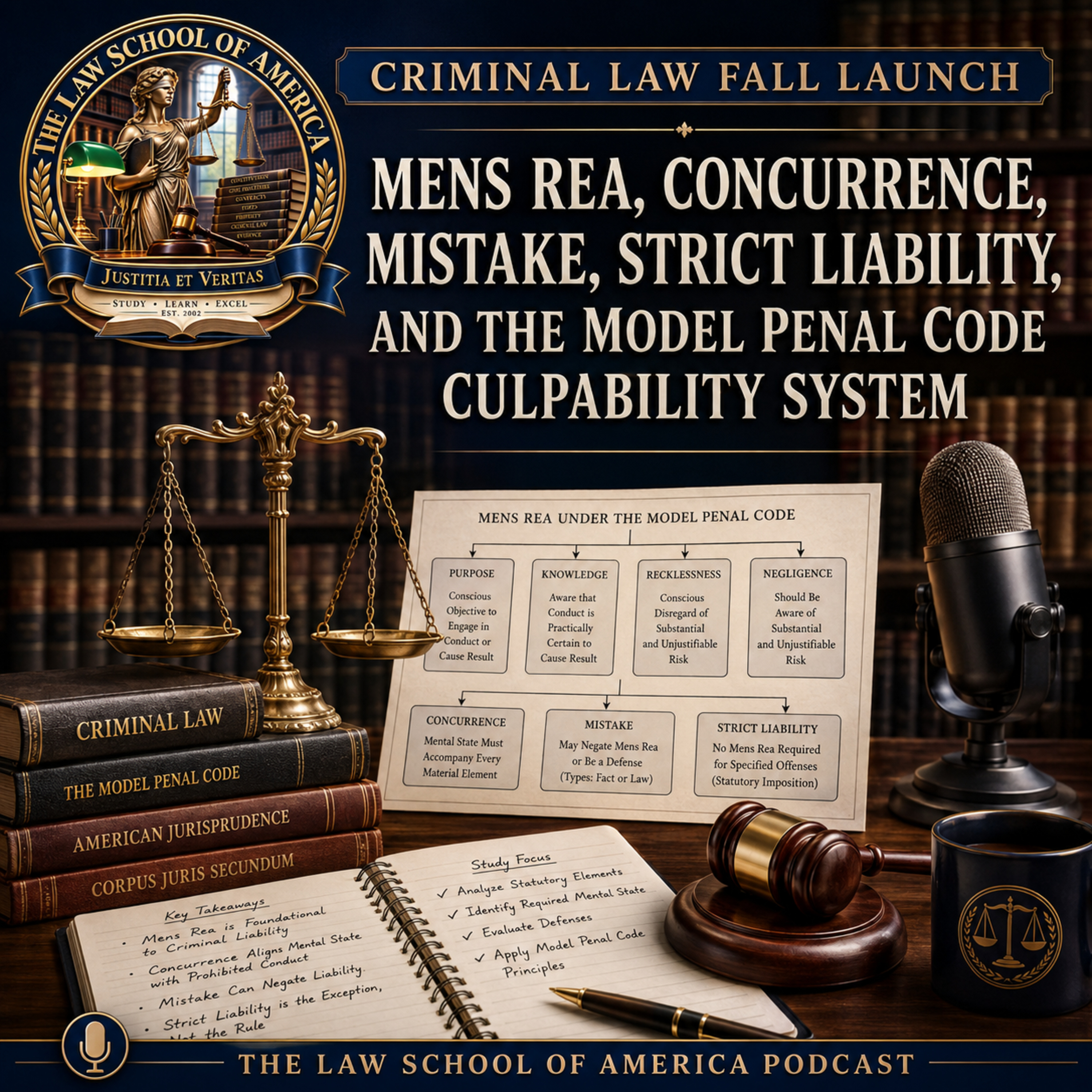
  • August 19 · 1 hr 6 min

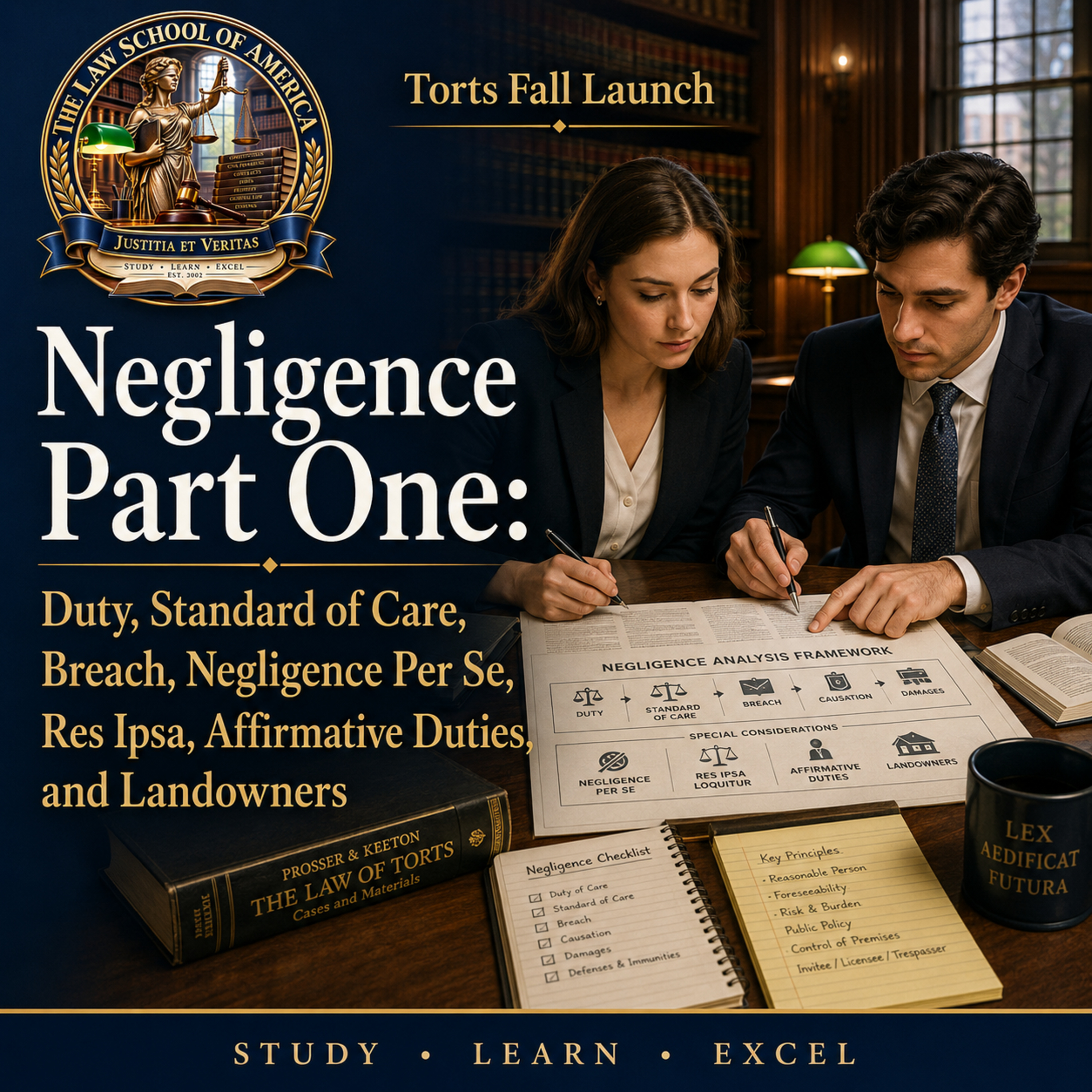
    Torts Fall Launch: Negligence Part One: Duty, Standard of Care, Breach, Negligence Per Se, Res Ipsa, Affirmative Duties, and Landowners

    📘 FREE COMPANION STUDY GUIDE 📘 👉 CLICK HERE TO OPEN YOUR FREE STUDY GUIDE 👈 Turn this episode into an exam-ready study plan. 🎧 EPISODE SUMMARY 🎧Negligence requires more than careless conduct. The plaintiff must establish actual causation, proximate causation, and actual damages. Actual causation ordinarily uses the but-for test: but for the defendant’s breach, would the injury have occurred? If the answer is no, factual causation is established. Multiple sufficient causes require special treatment when several independent acts were each sufficient to cause the same harm. Alternative liability may shift the causal burden when multiple defendants acted negligently but uncertainty prevents identification of the actual wrongdoer. Loss-of-chance doctrine may address medical negligence that reduces a patient’s probability of survival or recovery. Proximate cause limits liability to injuries within the scope of the risks that made the defendant’s conduct negligent. The exact mechanism and extent of harm need not always be foreseeable, but the general type of injury ordinarily must fall within the relevant risk. An intervening event does not automatically cut off liability. Ordinary medical negligence, reasonable rescue, reactions to danger, normal natural forces, and foreseeable negligent conduct often remain within the scope of responsibility. A superseding cause is sufficiently extraordinary or outside the original risk to cut off liability. Intentional and criminal acts are not automatically superseding when the defendant’s negligence increased the risk that those acts would occur. The rescue doctrine recognizes that danger invites rescue and generally treats reasonable rescue attempts as foreseeable. The eggshell-plaintiff rule requires the defendant to take the plaintiff as found. Once the defendant is responsible for the relevant type of physical harm, the unforeseeable severity caused by the plaintiff’s vulnerability generally does not reduce liability. Negligent infliction of emotional distress varies among jurisdictions. Major approaches include zone-of-danger recovery, bystander recovery, and special-relationship situations in which emotional well-being is central to the undertaking. Negligence requires actual compensable injury. Damages may include medical expenses, lost wages, lost earning capacity, property damage, pain and suffering, emotional distress, disability, disfigurement, loss of enjoyment, and reasonably certain future losses. The traditional collateral-source rule generally prevents a tortfeasor from reducing liability because the plaintiff received compensation from an independent source, although statutory modifications vary. Wrongful-death actions compensate designated survivors for losses resulting from death. Survival actions preserve claims the decedent could have asserted had death not occurred. The key lesson for Thursday is that causation is a two-stage inquiry: did the defendant actually contribute to the harm, and is the resulting harm within the scope of the defendant’s legal responsibility? ℹ️ INFORMATION, PRIVACY POLICY & TERMS OF USE ℹ️ The Podcast and Website Purpose The Law School Podcast and 1L Study Aide webpage supplements law-school and Bar Exam study with strategies, condensed rules, quizzes, and flashcards. Educational Disclaimer Content is for educational and informational purposes only. It is not legal advice, creates no attorney-client relationship, and does not guarantee law-school or Bar Exam success. Privacy Policy No account or login is required. This webpage uses no forms or analytics to collect personal information. Quiz and flashcard activity stays in your browser and may clear when local site data is removed. Terms of Use By using this webpage, you agree to use its content only for lawful, personal, noncommercial educational purposes. It supplements—not replaces—courses, textbooks, official materials, or qualified instruction.
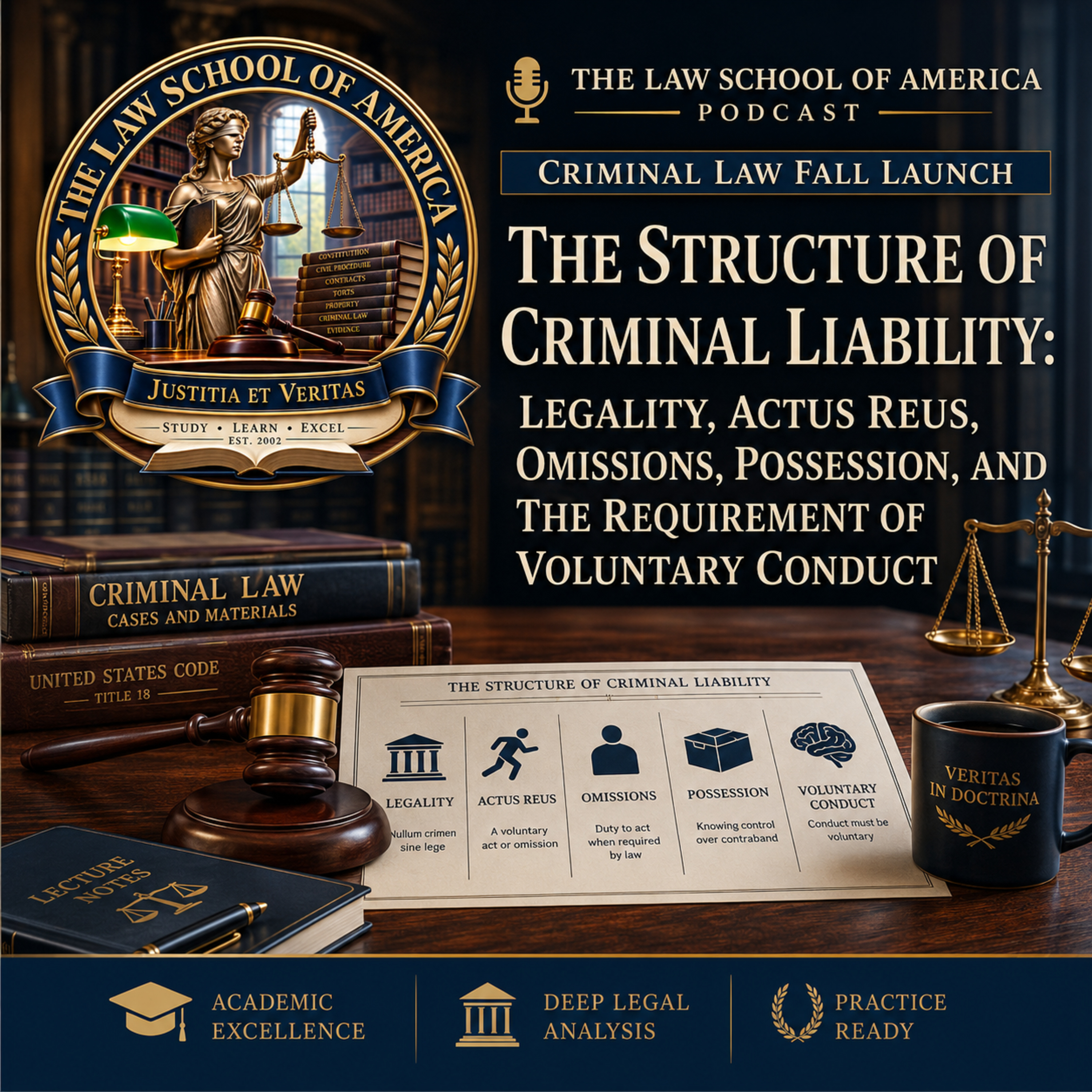
  • August 18 · 1 hr 2 min

    Torts Fall Launch: Intentional Property Torts and Privileges: Trespass, Conversion, Consent, Self-Defense, Defense of Others, Property Protection, and Necessity

    📘 FREE COMPANION STUDY GUIDE 📘 👉 CLICK HERE TO OPEN YOUR FREE STUDY GUIDE 👈 Turn this episode into an exam-ready study plan. 🎧 EPISODE SUMMARY 🎧Trespass to land protects the possessor’s right to exclusive possession of real property. Liability generally requires intentional entry, causing a person or object to enter, remaining after permission expires, or failing to remove an object when required. The defendant need only intend the physical intrusion. Mistake about ownership ordinarily is not a defense. Traditional trespass generally requires physical invasion. Actual damages are not ordinarily necessary, and nominal damages may vindicate the possessory right. Trespass to chattels protects personal property against dispossession, use, or interference. Unlike technical trespass to land, the tort generally requires dispossession or measurable harm. Conversion involves interference with personal property so serious that the defendant may be required to pay the item’s full value. Theft, destruction, unauthorized sale, prolonged possession, and refusal to return may constitute conversion. Minor interference generally points toward trespass to chattels. Consent may be express, implied from conduct, or implied by law. It may be invalid because of fraud concerning an essential matter, duress, incapacity, or certain known mistakes. The defendant must remain within the scope of consent. Self-defense permits reasonable and proportionate force when the defendant reasonably believes such force is necessary to prevent imminent harmful or offensive contact. Reasonable mistake may be protected. Retaliation is not. Deadly force generally requires threatened death or serious bodily harm. Defense of others similarly permits reasonable intervention to protect another. Modern doctrine generally protects reasonable mistakes, while older alter-ego approaches may depend on the defended person’s actual rights. Defense of property generally allows reasonable nondeadly force but not deadly force solely to protect property. Mechanical devices cannot ordinarily use greater force than the owner could use personally. Recapture of chattels permits limited, prompt, reasonable force following wrongful dispossession. Voluntary transfers ordinarily must be challenged through legal process. The shopkeeper’s privilege permits reasonable detention based on reasonable suspicion when the detention is conducted in a reasonable manner and for a reasonable time. Necessity permits interference with property to prevent greater harm. Public necessity ordinarily provides a complete privilege when action protects the public from widespread disaster. Private necessity ordinarily provides an incomplete privilege: the entry is lawful, but the defendant remains responsible for actual damage caused. The key lesson for Tuesday is that proving the elements of an intentional tort is only the first half of the analysis. The student must next ask whether the defendant possessed a privilege and, if so, whether the defendant stayed within the privilege’s boundaries. ℹ️ INFORMATION, PRIVACY POLICY & TERMS OF USE ℹ️ The Podcast and Website Purpose The Law School Podcast and 1L Study Aide webpage supplements law-school and Bar Exam study with strategies, condensed rules, quizzes, and flashcards. Educational Disclaimer Content is for educational and informational purposes only. It is not legal advice, creates no attorney-client relationship, and does not guarantee law-school or Bar Exam success. Privacy Policy No account or login is required. This webpage uses no forms or analytics to collect personal information. Quiz and flashcard activity stays in your browser and may clear when local site data is removed. Terms of Use By using this webpage, you agree to use its content only for lawful, personal, noncommercial educational purposes. It supplements—not replaces—courses, textbooks, official materials, or qualified instruction.
  • August 17 · 1 hr 12 min

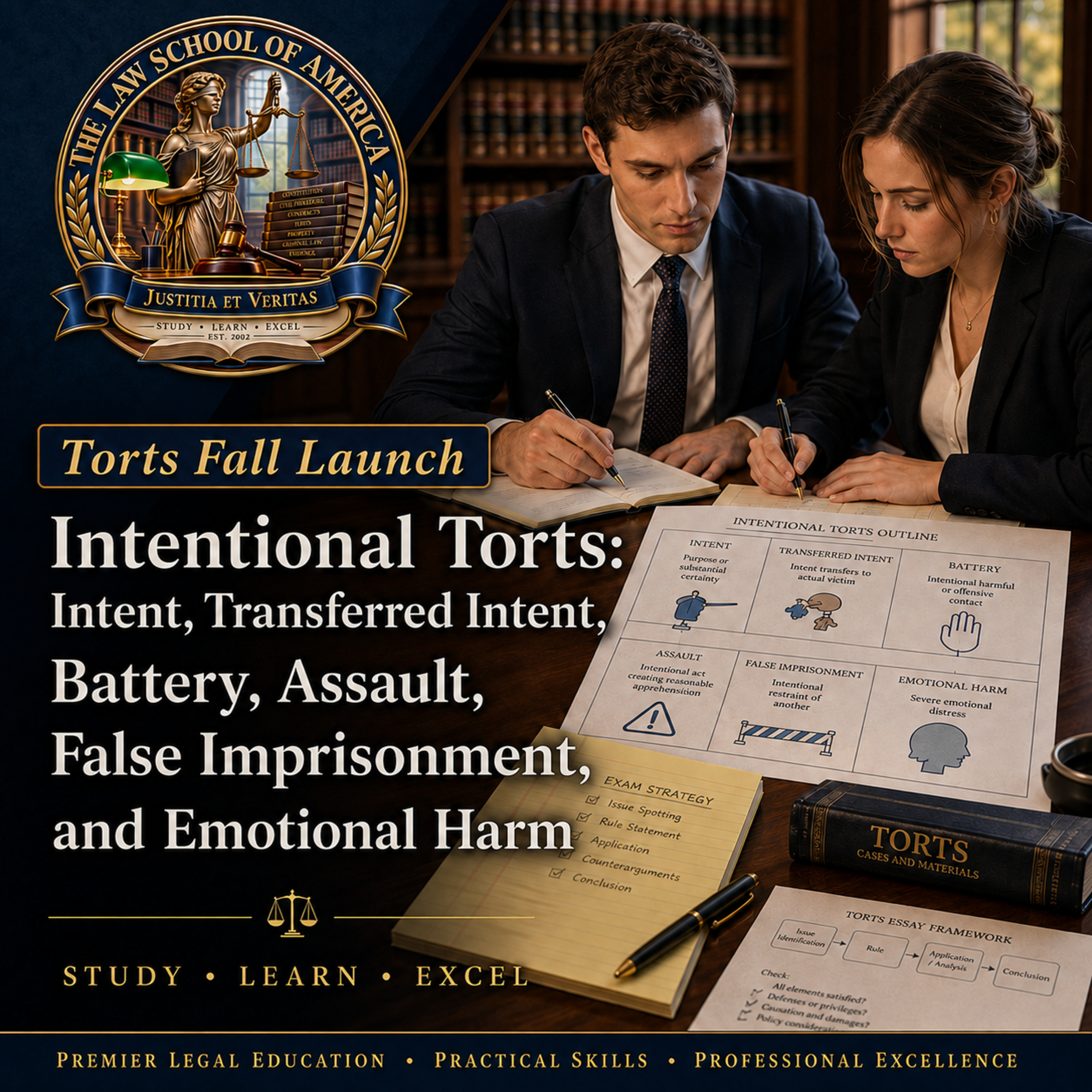
    Torts Fall Launch: Intentional Torts: Intent, Transferred Intent, Battery, Assault, False Imprisonment, and Emotional Harm

    📘 FREE COMPANION STUDY GUIDE 📘 👉 CLICK HERE TO OPEN YOUR FREE STUDY GUIDE 👈 Turn this episode into an exam-ready study plan. 🎧 EPISODE SUMMARY 🎧 Intentional torts protect distinct interests and require precise analysis of the defendant’s mental state. Intent generally exists when the defendant acts with the purpose of causing the legally relevant consequence or knows with substantial certainty that it will occur. Intent differs from motive. A benevolent motive does not eliminate intentional-tort liability when the required intent exists. Intent also differs from negligence and recklessness. Negligence involves unreasonable risk. Recklessness involves conscious disregard of substantial risk. Intent requires purpose or substantial certainty. Mistake ordinarily does not eliminate intent when the defendant intended the act constituting the invasion. Children and persons with mental impairments may possess tort intent if they actually form the required mental state. Transferred intent traditionally operates among battery, assault, false imprisonment, trespass to land, and trespass to chattels. Intent may transfer between victims and among those traditional torts. Battery protects bodily integrity and dignity. It requires intent, harmful or offensive contact with the plaintiff’s person, and causation. Physical injury is unnecessary. Contact may be indirect and may involve objects intimately connected with the plaintiff. Assault protects freedom from apprehension of imminent harmful or offensive contact. Apprehension means awareness, not fear. The plaintiff ordinarily must perceive the threat while it is imminent. Apparent ability may be sufficient even when actual ability is absent. False imprisonment protects freedom of movement. It requires intended confinement within bounded limits, awareness or resulting harm, and causation. A known reasonable means of escape defeats complete confinement, but a dangerous, humiliating, hidden, or otherwise unreasonable route does not. IIED requires extreme and outrageous conduct, intent or recklessness, causation, and severe emotional distress. Ordinary insults and annoyances generally do not suffice. Repetition, abuse of authority, exploitation of vulnerability, threats, and particularly vulnerable plaintiffs may make conduct more likely to qualify as outrageous. The key lesson for Monday is that intentional-tort liability turns on the exact mental state and the exact interest invaded. Strong analysis does not ask merely whether the defendant acted intentionally. It asks what the defendant intended, what happened to the plaintiff, and which tort’s elements accurately describe that invasion. ℹ️ INFORMATION, PRIVACY POLICY & TERMS OF USE ℹ️ The Podcast and Website Purpose The Law School Podcast and 1L Study Aide webpage supplements law-school and Bar Exam study with strategies, condensed rules, quizzes, and flashcards. Educational Disclaimer Content is for educational and informational purposes only. It is not legal advice, creates no attorney-client relationship, and does not guarantee law-school or Bar Exam success. Privacy Policy No account or login is required. This webpage uses no forms or analytics to collect personal information. Quiz and flashcard activity stays in your browser and may clear when local site data is removed. Terms of Use By using this webpage, you agree to use its content only for lawful, personal, noncommercial educational purposes. It supplements—not replaces—courses, textbooks, official materials, or qualified instruction.
  • August 16 · 1 hr 13 min

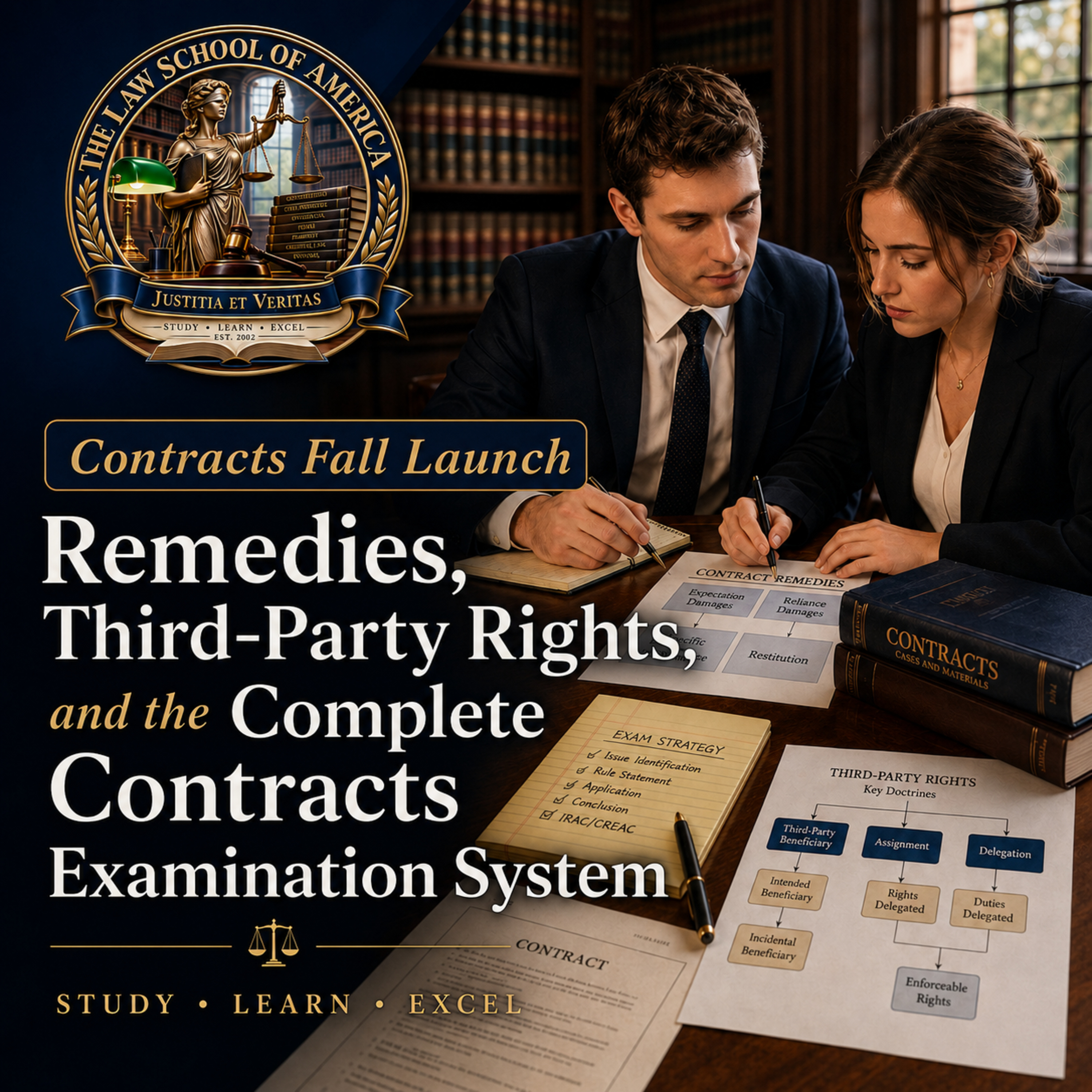
    Contracts Fall Launch: Remedies, Third-Party Rights, and the Complete Contracts Examination System

    📘 FREE COMPANION STUDY GUIDE 📘 👉 CLICK HERE TO OPEN YOUR FREE STUDY GUIDE 👈 Turn this episode into an exam-ready study plan. 🎧 EPISODE SUMMARY 🎧Contract remedies primarily compensate rather than punish. Expectation damages protect the benefit of the bargain. Reliance damages reimburse losses caused by reliance. Restitution prevents unjust enrichment. Expectation damages may include loss in value, incidental loss, and consequential loss, reduced by costs or losses avoided. Construction damages may involve cost of completion, cost of repair, diminution in value, expected profit, expenses incurred, payments received, and costs avoided. Consequential damages require foreseeability, causation, reasonable certainty, and reasonable mitigation. Incidental damages cover reasonable expenses incurred in responding to breach. A claimant must mitigate but need not take unreasonable risks, accept inferior performance, enter a humiliating relationship, or make extraordinary expenditures. Article 2 provides buyer remedies including cover, market damages, damages for accepted goods, cancellation, incidental and consequential damages, specific performance, and replevin. Seller remedies include withholding or stopping delivery, resale, market damages, an action for the price in limited cases, incidental damages, cancellation, and lost-volume profit. Liquidated damages are enforceable when damages were difficult to estimate and the amount is reasonable rather than punitive. Specific performance is available when damages are inadequate and enforcement is sufficiently certain, feasible, and equitable. Injunction, rescission, and reformation provide additional equitable relief. An assignment transfers rights. A delegation transfers duties. Delegation ordinarily does not release the original obligor. A novation substitutes a new obligor and releases the original party by agreement. An intended third-party beneficiary may enforce a contract after rights vest. An incidental beneficiary ordinarily may not. Vesting may occur through reliance, suit, requested assent, or contractual terms. The complete Contracts analysis follows a predictable path: governing law, formation, consideration or alternative enforcement, terms, defenses, performance, breach, excuse, third-party rights, and remedies. The central lesson for Sunday is that even a complicated Contracts problem becomes manageable when every fact is placed within the proper doctrinal stage and every claimed remedy is connected to a proven breach and a legally protected interest. ℹ️ INFORMATION, PRIVACY POLICY & TERMS OF USE ℹ️ The Podcast and Website Purpose The Law School Podcast and 1L Study Aide webpage supplements law-school and Bar Exam study with strategies, condensed rules, quizzes, and flashcards. Educational Disclaimer Content is for educational and informational purposes only. It is not legal advice, creates no attorney-client relationship, and does not guarantee law-school or Bar Exam success. Privacy Policy No account or login is required. This webpage uses no forms or analytics to collect personal information. Quiz and flashcard activity stays in your browser and may clear when local site data is removed. Terms of Use By using this webpage, you agree to use its content only for lawful, personal, noncommercial educational purposes. It supplements—not replaces—courses, textbooks, official materials, or qualified instruction.
  • August 15 · 1 hr 15 min

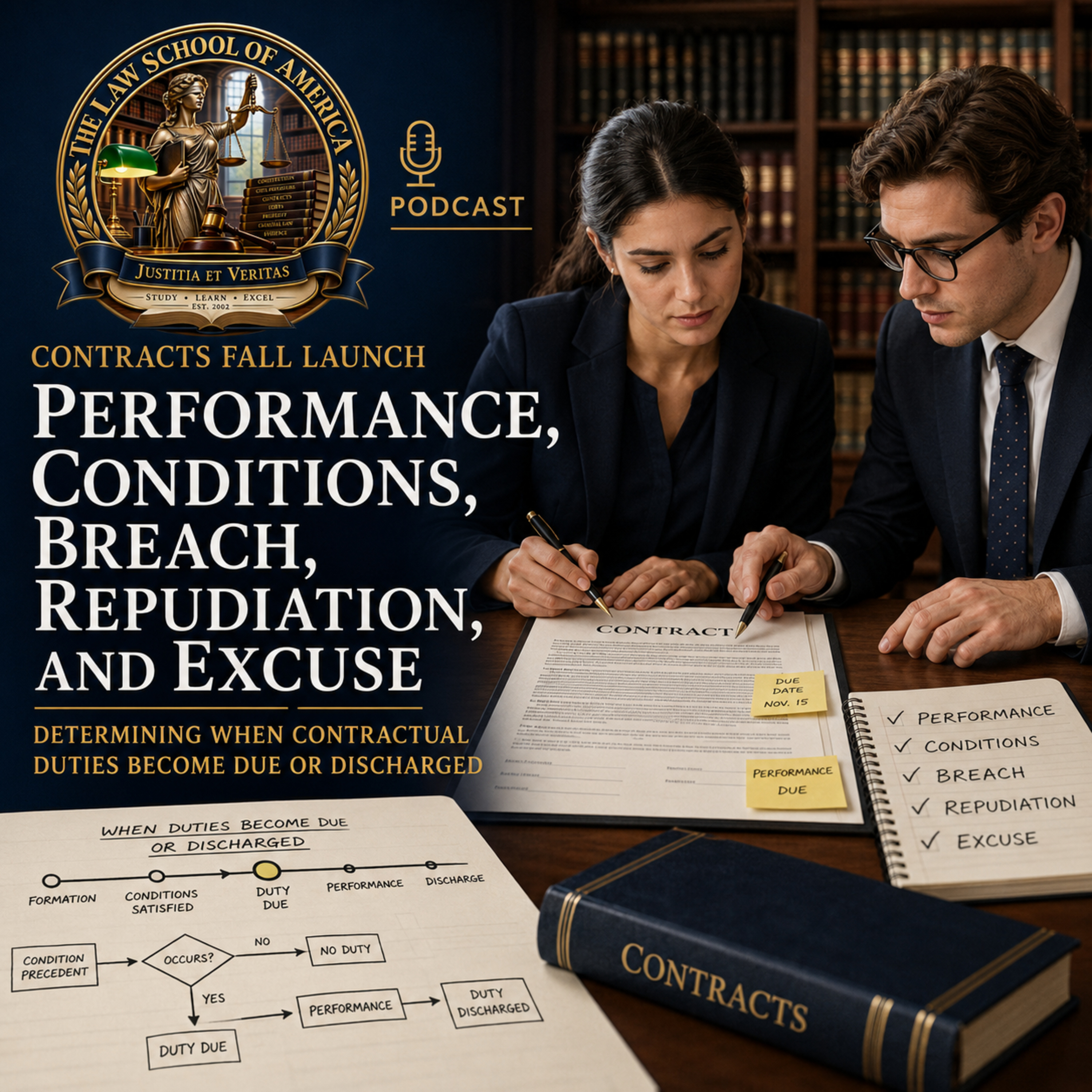
    Contracts Fall Launch: Performance, Conditions, Breach, Repudiation, and Excuse: Determining When Contractual Duties Become Due or Discharged

    📘 FREE COMPANION STUDY GUIDE 📘 👉 CLICK HERE TO OPEN YOUR FREE STUDY GUIDE 👈 Turn this episode into an exam-ready study plan. 🎧 EPISODE SUMMARY 🎧A condition is an event that must occur, unless excused, before a contractual duty becomes due or is discharged. A promise is a contractual commitment whose nonperformance constitutes breach. The same language may create both. Express conditions are created by the parties and generally require strict compliance. Constructive conditions are imposed by law and often permit substantial performance. Conditions may be precedent, concurrent, or subsequent. They may be satisfied through occurrence, performance, certification, approval, time, or notice. A party may not wrongfully prevent a condition and then rely on its nonoccurrence. Waiver may excuse compliance with a condition and may arise expressly or through conduct. Under common law, substantial performance allows recovery of the contract price minus damages for defects. A material breach excuses the injured party’s remaining performance; a minor breach permits damages but ordinarily does not discharge remaining duties. A divisible contract may permit recovery for completed units even when later units are breached. Under Article 2, the perfect-tender rule generally permits rejection when goods fail in any respect to conform. The seller may have a right to cure. Acceptance limits rejection but does not necessarily eliminate damages. Revocation requires a nonconformity substantially impairing value and additional circumstances justifying the original acceptance. Installment contracts use substantial-impairment standards rather than ordinary perfect tender. Anticipatory repudiation requires an unequivocal indication of unwillingness or inability to perform. A repudiating party may retract before the injured party materially relies, cancels, or treats the repudiation as final. Reasonable insecurity may support a demand for adequate assurances. Failure to provide adequate assurance may become repudiation. Impossibility may discharge objectively impossible performance. Impracticability may excuse performance made extremely and unreasonably difficult by an extraordinary event. Frustration may apply when performance remains possible but the mutually understood principal purpose is substantially destroyed. Force-majeure clauses expressly allocate extraordinary risks and may displace default excuse doctrines. Their application depends on language, causation, notice, mitigation, and the degree to which performance was prevented or delayed. The key lesson for Saturday is that contractual liability depends not only on what was promised, but also on whether duties became due, whether performance was sufficient, and whether nonperformance was breached, waived, or legally excused. ℹ️ INFORMATION, PRIVACY POLICY & TERMS OF USE ℹ️ The Podcast and Website Purpose The Law School Podcast and 1L Study Aide webpage supplements law-school and Bar Exam study with strategies, condensed rules, quizzes, and flashcards. Educational Disclaimer Content is for educational and informational purposes only. It is not legal advice, creates no attorney-client relationship, and does not guarantee law-school or Bar Exam success. Privacy Policy No account or login is required. This webpage uses no forms or analytics to collect personal information. Quiz and flashcard activity stays in your browser and may clear when local site data is removed. Terms of Use By using this webpage, you agree to use its content only for lawful, personal, noncommercial educational purposes. It supplements—not replaces—courses, textbooks, official materials, or qualified instruction.
  • August 14 · 1 hr 3 min

    Contracts Fall Launch: Defenses to Enforcement: Statute of Frauds, Capacity, Duress, Misrepresentation, Mistake, Unconscionability, Illegality, and Public Policy

    📘 FREE COMPANION STUDY GUIDE 📘 👉 CLICK HERE TO OPEN YOUR FREE STUDY GUIDE 👈 Turn this episode into an exam-ready study plan. 🎧 EPISODE SUMMARY 🎧An apparent agreement may fail because no contract formed, the agreement is void, the contract is voidable, or a legal rule makes an otherwise valid contract unenforceable. The Statute of Frauds requires certain agreements to be evidenced by signed writings. Traditional categories include marriage-related promises, agreements not performable within one year, interests in land, personal promises by estate representatives, suretyship promises, and qualifying sales of goods. The one-year provision turns on whether full performance is theoretically possible within one year, not whether it is probable. Article 2 generally requires a writing indicating a contract, signed by the party to be charged, and stating quantity. Merchant confirmations, specially manufactured goods, judicial admissions, accepted payment, and accepted goods may satisfy or avoid the writing requirement. Multiple related writings and electronic records may collectively satisfy formal requirements. Part performance and promissory estoppel may provide relief in appropriate cases. A minor’s contracts are generally voidable by the minor. The minor may disaffirm, later ratify, or incur restitutionary liability for the reasonable value of necessities. Mental incapacity and intoxication may make a contract voidable when the condition seriously impaired understanding or reasonable action and the other party knew or had reason to know. Formal guardianship may produce a void agreement under some rules. Duress requires an improper threat that induces assent while leaving no reasonable alternative. Undue influence involves unfair persuasion arising from domination, vulnerability, trust, or confidence. A fraudulent or material misrepresentation may make a contract voidable when it induces justified reliance. Misrepresentation may occur through false statements, concealment, half-truths, or nondisclosure when a duty to disclose exists. Fraud in the execution concerns deception about the document’s nature and may prevent assent. Fraud in the inducement concerns deceptive reasons for entering a known agreement and ordinarily makes the contract voidable. Mutual mistake may justify avoidance when both parties were mistaken about a basic assumption, the mistake materially affected the exchange, and the adversely affected party did not bear the risk. Unilateral mistake receives narrower relief. Unconscionability examines serious unfairness in the bargaining process and contractual terms. A court may refuse enforcement, sever an offensive term, or limit its application. Contracts violating law or important public policy may be unenforceable. Courts may examine the law’s purpose, relative fault, protected class, seriousness of the misconduct, forfeiture, and public interest. The central lesson is that contractual autonomy depends on legally meaningful consent and lawful subject matter. Courts enforce bargains, but they do not automatically enforce every apparent agreement. ℹ️ INFORMATION, PRIVACY POLICY & TERMS OF USE ℹ️ The Podcast and Website Purpose The Law School Podcast and 1L Study Aide webpage supplements law-school and Bar Exam study with strategies, condensed rules, quizzes, and flashcards. Educational Disclaimer Content is for educational and informational purposes only. It is not legal advice, creates no attorney-client relationship, and does not guarantee law-school or Bar Exam success. Privacy Policy No account or login is required. This webpage uses no forms or analytics to collect personal information. Quiz and flashcard activity stays in your browser and may clear when local site data is removed. Terms of Use By using this webpage, you agree to use its content only for lawful, personal, noncommercial educational purposes. It supplements—not replaces—courses, textbooks, official materials, or qualified instruction.
  • August 13 · 1 hr 18 min

    Contracts Fall Launch: Contract Terms: Interpretation, Parol Evidence, UCC Gap Fillers, Battle of the Forms, Warranties, and Good-Faith Performance

    📘 FREE COMPANION STUDY GUIDE 📘 👉 CLICK HERE TO OPEN YOUR FREE STUDY GUIDE 👈 Turn this episode into an exam-ready study plan. 🎧 EPISODE SUMMARY 🎧 Formation establishes that a contract exists, while interpretation determines its requirements. Contract terms can derive from oral statements, writings, course of performance, course of dealing, trade usage, statutory gap fillers, warranties, and implied duties. Contracts are read as a whole, prioritizing specific and negotiated terms over boilerplate, applying trade meanings to technical terms, and construing unresolved ambiguities against the drafter. Ambiguity requires multiple reasonable meanings; mere disagreement is insufficient. The parol-evidence rule bars prior or contemporaneous evidence that contradicts an integrated writing. A complete integration bars supplemental terms, whereas a partial integration allows consistent additional terms. The rule does not bar evidence proving fraud, mistake, invalidity, ambiguity, conditions precedent, lack of consideration, or subsequent modifications. Express terms receive the greatest weight, prevailing over inconsistent course of performance, course of dealing, or usage of trade. UCC Article 2 provides default terms for price, delivery, time, and termination, but quantity must be stated or measured via valid requirements or output terms. The battle of the forms separates formation from terms. A definite acceptance forms a contract despite additional or different terms unless acceptance is expressly conditional on assent. Between merchants, additional terms enter the agreement unless the offer limits acceptance, the terms materially alter it, or the offeror objects. Different terms are removed via the knockout rule, and conduct can establish a contract. Express warranties arise from affirmations, descriptions, or samples forming the basis of the bargain, excluding mere puffery. The implied warranty of merchantability ensures fitness for ordinary purposes, while fitness for a particular purpose requires the seller's knowledge of the specific use and the buyer's reliance. Warranty disclaimers must meet conspicuousness requirements and generally cannot negate inconsistent express warranties. Remedy limitations restrict available relief rather than eliminating the underlying contractual obligation. Every contract imposes a duty of good faith in performance and enforcement, preventing opportunistic abuse of discretion without rewriting express terms. The central lesson is that a contract extends beyond a single document, incorporating express text, commercial context, statutory rules, warranties, and good-faith obligations. ℹ️ INFORMATION, PRIVACY POLICY & TERMS OF USE ℹ️ The Podcast and Website Purpose The Law School Podcast and 1L Study Aide webpage supplements law-school and Bar Exam study with strategies, condensed rules, quizzes, and flashcards. Educational Disclaimer Content is for educational and informational purposes only. It is not legal advice, creates no attorney-client relationship, and does not guarantee law-school or Bar Exam success. Privacy Policy No account or login is required. This webpage uses no forms or analytics to collect personal information. Quiz and flashcard activity stays in your browser and may clear when local site data is removed. Terms of Use By using this webpage, you agree to use its content only for lawful, personal, noncommercial educational purposes. It supplements—not replaces—courses, textbooks, official materials, or qualified instruction.
  • August 12 · 1 hr 14 min

    Contracts Fall Launch: Consideration and Alternative Enforcement: Bargained Exchange, Illusory Promises, Modification, Promissory Estoppel, and Restitution

    📘 FREE COMPANION STUDY GUIDE 📘 👉 CLICK HERE TO OPEN YOUR FREE STUDY GUIDE 👈 Turn this episode into an exam-ready study plan. 🎧 EPISODE SUMMARY 🎧A successful pre-fall plan integrates reading, class participation, note review, outlining, legal writing, active recall, examination practice, feedback, professional development, health, and personal obligations. For every course, the student should identify the structure, prepare assigned materials, attend actively, review notes, synthesize rules, update the outline, practice retrieval, apply doctrine, seek feedback, correct errors, and repeat. The weekly academic cycle includes preparation before class, active engagement during class, review after class, and synthesis at the end of the week. Time blocking should assign defined tasks rather than vague intentions. The schedule should include class, reading, writing, outlining, practice, employment, family, meals, exercise, sleep, commuting, administration, and buffer time. Students should track how long recurring tasks actually take. Workload estimates should be revised according to evidence. Tasks can be classified as immediate and high consequence, important but not immediate, routine maintenance, or optional enrichment. Nonurgent but essential work such as outlining and practice must be protected. Concentration improves when distractions are controlled. Students should silence notifications, limit phone access, use defined work intervals, choose consistent locations, and avoid multitasking. Sleep and physical health support memory, attention, emotional regulation, judgment, and reading comprehension. Meals, hydration, movement, medical care, medication, counseling, and support should be included in the plan. Students should distinguish ordinary academic stress from serious health concerns and know how to access counseling, accommodations, health services, advising, peer support, and emergency assistance. Employment and family duties must be scheduled honestly. Students may need earlier starts, reduced extracurricular commitments, childcare backup, commuting buffers, and coordination with employers or family members. Bar integration begins in ordinary coursework. Students should preserve clean outlines, attack outlines, practice results, essay feedback, error logs, rule charts, and professor materials from foundational subjects. The first thirty days should implement and test the system. Week one establishes basic readiness. Week two adjusts workload and begins practice. Week three emphasizes recall and application. Week four uses assessment and error review to revise the plan. The central lesson is that the student should enter the semester with a working academic operating system. The plan should be specific, repeatable, realistic, and adjustable. Its purpose is not to make every week perfect. Its purpose is to ensure that preparation, learning, practice, health, and professional growth continue throughout the semester. ℹ️ INFORMATION, PRIVACY POLICY & TERMS OF USE ℹ️ The Podcast and Website Purpose The Law School Podcast and 1L Study Aide webpage supplements law-school and Bar Exam study with strategies, condensed rules, quizzes, and flashcards. Educational Disclaimer Content is for educational and informational purposes only. It is not legal advice, creates no attorney-client relationship, and does not guarantee law-school or Bar Exam success. Privacy Policy No account or login is required. This webpage uses no forms or analytics to collect personal information. Quiz and flashcard activity stays in your browser and may clear when local site data is removed. Terms of Use By using this webpage, you agree to use its content only for lawful, personal, noncommercial educational purposes. It supplements—not replaces—courses, textbooks, official materials, or qualified instruction.
  • August 11 · 1 hr 1 min

    Contracts Fall Launch: Offer and Acceptance: Creation, Termination, Irrevocability, Unilateral Contracts, the Mailbox Rule, and Electronic Assent

    📘 FREE COMPANION STUDY GUIDE 📘 👉 CLICK HERE TO OPEN YOUR FREE STUDY GUIDE 👈 Turn this episode into an exam-ready study plan. 🎧 EPISODE SUMMARY An offer is a present objective manifestation of willingness to contract on reasonably definite terms, communicated to an offeree and inviting acceptance that will conclude the bargain. Only the invited person or class may accept. A person ordinarily must know of an offer before accepting it, including in reward cases. The power of acceptance may terminate through lapse, revocation, rejection, counteroffer, death or incapacity, destruction or illegality of the subject matter, or failure of a condition. An offer lapses at the stated time or after a reasonable time. Revocation is ordinarily effective upon receipt and may be direct or indirect. Rejection is generally effective upon receipt. A common-law counteroffer ordinarily rejects the original offer, but a mere inquiry may leave the offer open. Offers may become irrevocable through an option contract, an Article 2 merchant firm offer, reasonable foreseeable reliance, or beginning invited performance under a unilateral-contract offer. An option contract is a separate promise to keep an offer open supported by consideration. A merchant firm offer requires a merchant, an offer to buy or sell goods, a signed writing, and assurance that the offer will remain open. No consideration is required, but the statutory period of irrevocability cannot exceed three months without consideration. Reasonable, foreseeable, and substantial reliance may temporarily protect an offer from revocation, especially in construction bidding. Beginning actual performance under a unilateral-contract offer ordinarily creates an option allowing reasonable time for completion, though preparation alone may be insufficient. Acceptance is an objective manifestation of assent made in the manner invited or required by the offer. Bilateral contracts involve exchanges of promises. Unilateral contracts involve acceptance through completed performance. At common law, acceptance generally must mirror the offer. A conditional response is a counteroffer, while an acceptance followed by a request may still form a contract. Under Article 2, an order for goods may be accepted by a prompt promise to ship or prompt shipment. Shipment of nonconforming goods ordinarily constitutes acceptance and breach unless clearly identified as an accommodation, in which case the shipment is a counteroffer. Under the mailbox rule, an authorized acceptance is generally effective upon dispatch. Rejections, revocations, and counteroffers are generally effective upon receipt. Important exceptions involve offers requiring receipt, option contracts, improper transmission, and conflicting rejection-and-acceptance sequences. Silence ordinarily is not acceptance, although circumstances involving retained benefits, intended silence, prior dealings, or dominion over property may justify an exception. Electronic contracts depend on traditional assent principles. Clickwrap agreements are stronger when the user receives clear notice and affirmatively a... ℹ️ INFORMATION, PRIVACY POLICY & TERMS OF USE Website Purpose The 1L Study Aide webpage supplements law-school and Bar Exam study with strategies, condensed rules, quizzes, and flashcards. Educational Disclaimer Content is for educational and informational purposes only. It is not legal advice, creates no attorney-client relationship, and does not guarantee law-school or Bar Exam success. Privacy Policy No account or login is required. This webpage uses no forms or analytics to collect personal information. Quiz and flashcard activity stays in your browser and may clear when local site data is removed. Terms of Use By using this webpage, you agree to use its content only for lawful, personal, noncommercial educational purposes. It supplements—not replaces—courses, textbooks, official materials, or qualified instruction.
  • August 10 · 1 hr 37 min

    Contracts Fall Launch: The Contract-Law System: Sources of Law, Objective Assent, Governing Law, and the Formation Framework

    📘 FREE COMPANION STUDY GUIDE 📘 👉 CLICK HERE TO OPEN YOUR FREE STUDY GUIDE 👈 Turn this episode into an exam-ready study plan. 🎧 EPISODE SUMMARY A contract is a legally enforceable promise or set of promises. Contract law determines which commitments create legal obligations and what consequences follow when those obligations are not performed. A complete contract problem commonly moves through preliminary negotiations, offer, acceptance, consideration or another enforcement basis, determination of terms, performance, changed circumstances, breach, and remedy. The principal sources of contract law include common law, Uniform Commercial Code Article 2, Restatement principles, statutes, international law in appropriate transactions, and judicial decisions. Common law generally governs services, employment, real property, construction, insurance, intellectual-property licenses, and professional services. Article 2 generally governs transactions in movable, tangible goods. Mixed transactions may be analyzed under the predominant-purpose test, which considers contract language, the supplier’s business, relative costs, and the parties’ reason for contracting. Some jurisdictions use a gravamen approach focusing on the part of the transaction that produced the dispute. Contract formation ordinarily depends on objective manifestations rather than undisclosed intentions. The question is what a reasonable person would understand from the parties’ words and conduct in context. Mutual assent is generally analyzed through offer and acceptance. Common law traditionally requires greater certainty and closer matching. Article 2 permits greater flexibility when the parties intended to contract and a court has a reasonably certain basis for a remedy. Preliminary negotiations include requests for information, price quotations, advertisements, estimates, expressions of future intent, and some letters of intent. The central question is whether the speaker expressed a present willingness to be bound upon acceptance without further approval. Advertisements are generally invitations for customers to make offers. An advertisement may itself be an offer when it is clear, definite, explicit, limited in quantity or recipients, and leaves nothing open for negotiation. An agreement must be sufficiently definite for a court to identify the parties’ obligations and provide a remedy. Article 2 can fill some open terms, but quantity generally remains essential, subject to requirements and output arrangements. An agreement to agree may be unenforceable when essential matters remain unresolved. A preliminary arrangement may nevertheless create enforceable obligations concerning good-faith negotiation, exclusivity, an option, confidentiality, or fixed preliminary terms. Contract law generally respects freedom of contract, but autonomy is limited by capacity, fraud, duress, undue influence, unconscionability, illegality, public policy, consumer law, employment law, antidiscrimination rules, and good-faith obligations. ℹ️ INFORMATION, PRIVACY POLICY & TERMS OF USE Website Purpose The 1L Study Aide webpage supplements law-school and Bar Exam study with strategies, condensed rules, quizzes, and flashcards. Educational Disclaimer Content is for educational and informational purposes only. It is not legal advice, creates no attorney-client relationship, and does not guarantee law-school or Bar Exam success. Privacy Policy No account or login is required. This webpage uses no forms or analytics to collect personal information. Quiz and flashcard activity stays in your browser and may clear when local site data is removed. Terms of Use By using this webpage, you agree to use its content only for lawful, personal, noncommercial educational purposes. It supplements—not replaces—courses, textbooks, official materials, or qualified instruction.
  • August 9 · 50 min

    Pre-Fall Law School Study Plan: The Complete Pre-Fall Operating System: Weekly Scheduling, Focus, Health, Professional Development, Bar Integration, and the First Thirty Days

    📘 FREE COMPANION STUDY GUIDE 📘 👉 CLICK HERE TO OPEN YOUR FREE STUDY GUIDE 👈 Turn this episode into an exam-ready study plan. 🎧 EPISODE SUMMARY 🎧 A successful pre-fall plan integrates reading, class participation, note review, outlining, legal writing, active recall, examination practice, feedback, professional development, health, and personal obligations. For every course, the student should identify the structure, prepare assigned materials, attend actively, review notes, synthesize rules, update the outline, practice retrieval, apply doctrine, seek feedback, correct errors, and repeat. The weekly academic cycle includes preparation before class, active engagement during class, review after class, and synthesis at the end of the week. Time blocking should assign defined tasks rather than vague intentions. The schedule should include class, reading, writing, outlining, practice, employment, family, meals, exercise, sleep, commuting, administration, and buffer time. Students should track how long recurring tasks actually take. Workload estimates should be revised according to evidence. Tasks can be classified as immediate and high consequence, important but not immediate, routine maintenance, or optional enrichment. Nonurgent but essential work such as outlining and practice must be protected. Concentration improves when distractions are controlled. Students should silence notifications, limit phone access, use defined work intervals, choose consistent locations, and avoid multitasking. Sleep and physical health support memory, attention, emotional regulation, judgment, and reading comprehension. Meals, hydration, movement, medical care, medication, counseling, and support should be included in the plan. Students should distinguish ordinary academic stress from serious health concerns and know how to access counseling, accommodations, health services, advising, peer support, and emergency assistance. Employment and family duties must be scheduled honestly. Students may need earlier starts, reduced extracurricular commitments, childcare backup, commuting buffers, and coordination with employers or family members. Bar integration begins in ordinary coursework. Students should preserve clean outlines, attack outlines, practice results, essay feedback, error logs, rule charts, and professor materials from foundational subjects. The first thirty days should implement and test the system. Week one establishes basic readiness. Week two adjusts workload and begins practice. Week three emphasizes recall and application. Week four uses assessment and error review to revise the plan. The central lesson is that the student should enter the semester with a working academic operating system. The plan should be specific, repeatable, realistic, and adjustable. Its purpose is not to make every week perfect. Its purpose is to ensure that preparation, learning, practice, health, and professional growth continue throughout the semester. ℹ️ INFORMATION, PRIVACY POLICY & TERMS OF USE ℹ️ The Podcast and Website Purpose The Law School Podcast and 1L Study Aide webpage supplements law-school and Bar Exam study with strategies, condensed rules, quizzes, and flashcards. Educational Disclaimer Content is for educational and informational purposes only. It is not legal advice, creates no attorney-client relationship, and does not guarantee law-school or Bar Exam success. Privacy Policy No account or login is required. This webpage uses no forms or analytics to collect personal information. Quiz and flashcard activity stays in your browser and may clear when local site data is removed. Terms of Use By using this Podcast and webpage, you agree to use its content only for lawful, personal, noncommercial educational purposes. It supplements—not replaces—courses, textbooks, official materials, or qualified instruction.
  • August 8 · 49 min

    Pre-Fall Law School Study Plan: Examination Preparation From Week One: Multiple Choice, Essays, Practice Exams, Feedback, Time Management, and Professor-Specific Strategy

    📘 FREE COMPANION STUDY GUIDE 📘 👉 CLICK HERE TO OPEN YOUR FREE STUDY GUIDE 👈 Turn this episode into an exam-ready study plan. 🎧 EPISODE SUMMARY 🎧Examination preparation should begin during the first weeks of the semester. The final should not be the first time a student writes a timed legal analysis or completes a mixed set of questions. Students should identify the examination format, including essays, multiple choice, open-book or closed-book rules, word limits, time limits, section weights, permitted materials, provided statutes, software, and professor expectations. Multiple-choice questions test rule knowledge, issue recognition, fact sensitivity, exceptions, procedural posture, and answer-choice discipline. Students should begin untimed and progress to timed sets. Every missed question should be classified according to its actual cause. Essay preparation should progress from issue listing and rule writing to application paragraphs, untimed answers, timed answers, and full examinations. Strong essays identify issues, state concise rules, apply facts, address counterarguments, and reach supported conclusions. Every important fact should be connected to an element, factor, defense, timing rule, jurisdictional requirement, or remedy. Facts are evidence, not narrative decoration. Time should be divided according to point value. Students should use short planning periods, establish stopping times, and avoid sacrificing later questions to perfect earlier answers. Word limits require direct headings, concise rules, decisive facts, and elimination of repetition. Open-book examinations still require knowledge and organization. Materials should verify details rather than replace understanding. Closed-book examinations require active recall, rule memorization, attack outlines, timed writing, and spaced review. Practice examinations should eventually be completed under realistic conditions and reviewed against reliable feedback. The feedback cycle is attempt, review, classify, correct, and practice again. Midterms should be treated as diagnostics. Lessons regarding missed rules, omitted issues, weak analysis, disorganization, or timing should be incorporated immediately. Professor-specific strategy should respond to legitimate evidence about policy, case names, minority rules, statutory interpretation, economic reasoning, history, professional judgment, remedies, and other course priorities. The central lesson is that examination ability develops through repeated performance. Students should practice the work they will be graded on, diagnose mistakes accurately, and use every practice session to improve the next one. ℹ️ INFORMATION, PRIVACY POLICY & TERMS OF USE ℹ️ The Podcast and Website Purpose The Law School Podcast and 1L Study Aide webpage supplements law-school and Bar Exam study with strategies, condensed rules, quizzes, and flashcards. Educational Disclaimer Content is for educational and informational purposes only. It is not legal advice, creates no attorney-client relationship, and does not guarantee law-school or Bar Exam success. Privacy Policy No account or login is required. This webpage uses no forms or analytics to collect personal information. Quiz and flashcard activity stays in your browser and may clear when local site data is removed. Terms of Use By using this Podcast and webpage, you agree to use its content only for lawful, personal, noncommercial educational purposes. It supplements—not replaces—courses, textbooks, official materials, or qualified instruction.

  • August 7 · 50 min

    Pre-Fall Law School Study Plan: Legal Research and Writing Readiness: Research Plans, Rule Synthesis, CREAC, Citation, Drafting, Revision, and Academic Integrity

    📘 FREE COMPANION STUDY GUIDE 📘 👉 CLICK HERE TO OPEN YOUR FREE STUDY GUIDE 👈 Turn this episode into an exam-ready study plan. 🎧 EPISODE SUMMARY 🎧 Legal Research and Writing requires professional-quality work that is authority-based, rule-driven, reader-centered, fact-specific, and carefully organized. Students must decode assignments by identifying the client, issue, jurisdiction, audience, document type, tone, deadline, length limit, citation system, permitted sources, and purpose before researching. Objective writing predicts outcomes and addresses adverse authority or weaknesses. Persuasive writing advocates by framing rules favorably, emphasizing supportive facts, distinguishing adverse cases, using persuasive headings, and requesting specific relief. Both require accuracy and candor. Research requires a plan identifying jurisdiction, court hierarchy, statutes, rules, regulations, key terms, claims, defenses, and secondary sources, supported by a research log. Primary authority includes constitutions, statutes, regulations, court rules, judicial opinions, and administrative decisions. Secondary authority explains law and leads to primary sources but cannot replace controlling law. Mandatory authority binds the court, while persuasive authority only influences it. Students must evaluate each authority's jurisdiction, court level, publication status, opinion type, factual relevance, and validity. Every source must be updated for reversal, overruling, negative treatment, limitations, amendments, and jurisdictional changes. Rule synthesis integrates multiple authorities into one framework by identifying common elements, factors, applications, exceptions, burdens, and policy explanations. CREAC (Conclusion, Rule, Explanation, Application, Conclusion) provides a disciplined organizational structure for analysis. The explanation section shows how courts apply rules using decisive facts, conduct, factor weighting, exceptions, analogies, and distinctions, avoiding disconnected quotations. The application section compares specific case facts with precedent, explains similarities and differences, addresses adverse facts and counterarguments, and reaches a supported conclusion. Each analytical paragraph must contain one controlling point, relevant authority, specific factual application, and a logical transition. Citations support propositions and enable verification. Students must master case citations, short forms, signals, parentheticals, quotations, pinpoint citations, statutes, rules, and electronic sources. Drafting follows a research outline and provisional rules, while revision proceeds from structure to rules, application, authority, sentences, and final proofreading. Academic-integrity policies governing collaboration, artificial intelligence, research assistance, editing, citation, prior work, and unauthorized materials must be followed precisely. Professional communication requires clear subjects, respectful greetings, concise explanations, specific requests, deadlines, and professional closings. The central lesson is that precise legal writing... ℹ️ INFORMATION, PRIVACY POLICY & TERMS OF USE ℹ️ The Podcast and Website Purpose The Law School Podcast and 1L Study Aide webpage supplements law-school and Bar Exam study with strategies, condensed rules, quizzes, and flashcards. Educational Disclaimer Content is for educational and informational purposes only. It is not legal advice, creates no attorney-client relationship, and does not guarantee law-school or Bar Exam success. Privacy Policy No account or login is required. This webpage uses no forms or analytics to collect personal information. Quiz and flashcard activity stays in your browser and may clear when local site data is removed. Terms of Use By using this Podcast & webpage, you agree to use its content only for lawful, personal, noncommercial educational purposes. It supplements—not replaces—courses, textbooks, official materials, or qualified instruction.
  • August 6 · 53 min

    Pre-Fall Law School Study Plan: Outlining From the First Week: Full Outlines, Attack Outlines, Checklists, Flowcharts, Rule Statements, and Active Recall

    📘 FREE COMPANION STUDY GUIDE 📘 👉 CLICK HERE TO OPEN YOUR FREE STUDY GUIDE 👈 Turn this episode into an exam-ready study plan. 🎧 EPISODE SUMMARY 🎧 A law-school outline is an organized statement of the law. It is not a stack of case briefs or a chronological transcript of class. The full course outline should contain the professor’s organization, major topics, rules, elements, definitions, exceptions, defenses, statutes, case illustrations, commentary, policy, minority approaches, remedies, and doctrinal connections. The outline should generally follow the professor’s course structure. Commercial outlines may help clarify doctrine and identify gaps, but they should not replace the student’s synthesis. Outlining should begin during the first or second week and continue weekly. The goal is to maintain a current map, not to create an immediately perfect product. Every major doctrine should be reduced to an examination-ready rule statement identifying the governing standard, required elements, definitions, exceptions, burdens, and legal consequences. Cases should illustrate rules rather than overwhelm the outline. The student should preserve the case’s decisive facts and doctrinal contribution instead of inserting full briefs. An attack outline is a compressed issue sequence designed for examination execution. It should be short enough to use under pressure. A checklist supplies legal triggers for issue spotting. A flowchart organizes doctrines that require sequential decisions. Students should not rely on rereading. Active recall requires retrieving rules without first looking at the answer. Useful methods include blank-page writing, flashcards, self-quizzing, oral explanation, practice questions, flowchart reconstruction, and teaching another student. Spaced review revisits doctrine at expanding intervals. Interleaved practice mixes topics so that the student must identify which rule applies instead of being told the category. Open-book examinations still require rule mastery. The student should use a clear table of contents, headings, page numbers, tabs or hyperlinks, attack sheets, and quick-reference charts. Materials should verify details rather than replace knowledge. Closed-book examinations require rule memorization, attack outlines, spaced recall, timed writing, and selective mnemonics. The outline should be revised through a feedback loop. Missed issues, unclear rules, hidden exceptions, sequence errors, retrieval failures, and weak applications require different corrections. The central lesson is that outlines are built to produce analysis. A useful outline makes the law easier to retrieve, organize, apply, compare, and write under time pressure. ℹ️ INFORMATION, PRIVACY POLICY & TERMS OF USE Website Purpose The Podcast and 1L Study Aide webpage supplements law-school and Bar Exam study with strategies, condensed rules, quizzes, and flashcards. Educational Disclaimer Content is for educational and informational purposes only. It is not legal advice, creates no attorney-client relationship, and does not guarantee law-school or Bar Exam success. Privacy Policy No account or login is required. This webpage uses no forms or analytics to collect personal information. Quiz and flashcard activity stays in your browser and may clear when local site data is removed. Terms of Use By using this webpage, you agree to use its content only for lawful, personal, noncommercial educational purposes. It supplements—not replaces—courses, textbooks, official materials, or qualified instruction.
  • August 5 · 53 min

    Pre-Fall Law School Study Plan: From Classroom to Course Mastery: Note-Taking, Participation, Weekly Synthesis, Office Hours, and Study Groups

    📘 FREE COMPANION STUDY GUIDE 📘 👉 CLICK HERE TO OPEN YOUR FREE STUDY GUIDE 👈 Turn this episode into an exam-ready study plan. 🎧 EPISODE SUMMARY Classroom learning requires preparation, active participation, selective note-taking, prompt review, weekly synthesis, strategic help-seeking, and individual practice. Before class, know the assigned cases, subject, rules, procedural posture, material facts, unresolved questions, and connection to the course. Prepare for flexible discussion, not a memorized speech. Participation develops exam and professional skills: stating rules, responding under pressure, distinguishing cases, applying rules to new facts, recognizing uncertainty, defending reasoning, and revising answers. Notes should capture what the professor adds—rules, clarifications, hypotheticals, changed facts, exceptions, policy, comparisons, common errors, and exam warnings—not every sentence. A three-column system can separate assigned rules, professor explanations, and student questions or exam uses. For each hypothetical, record the changed fact, issue, rule, result, and reasoning. Review within twenty-four hours whenever possible: correct notes, add missing rules, answer questions, connect cases to doctrine, and reduce the class to a short synthesis. Weekly synthesis turns classes into a framework of topics, rules, cases, exceptions, policy, hypotheticals, errors, unresolved questions, practice, and prior material. Office hours work best after students attempt the problem, state the rule, identify uncertainty, offer a tentative analysis, and request clarification. Support includes academic-success faculty, teaching assistants, writing specialists, librarians, mentors, accessibility and counseling services, bar programs, workshops, and practice-exam libraries. Study groups should be small, regular, prepared, agenda-driven, and time-limited. Focus on rules, hypotheticals, questions, issue spotting, and outline testing—not rumors or dependence. Group study cannot replace individual rule recall, issue spotting, essay writing, multiple-choice analysis, outline construction, reading comprehension, and time management. Central lesson: Attendance alone does not create mastery. Learning occurs when students process the class, organize doctrine, ask focused questions, test rules, and apply the material independently. ℹ️ INFORMATION, PRIVACY POLICY & TERMS OF USE ℹ️ The Podcast and Website Purpose The Law School Podcast and 1L Study Aide webpage supplements law-school and Bar Exam study with strategies, condensed rules, quizzes, and flashcards. Educational Disclaimer Content is for educational and informational purposes only. It is not legal advice, creates no attorney-client relationship, and does not guarantee law-school or Bar Exam success. Privacy Policy No account or login is required. This webpage uses no forms or analytics to collect personal information. Quiz and flashcard activity stays in your browser and may clear when local site data is removed. Terms of Use By using this webpage, you agree to use its content only for lawful, personal, noncommercial educational purposes. It supplements—not replaces—courses, textbooks, official materials, or qualified instruction.
  • August 4 · 45 min

    Pre-Fall Law School Study Plan: Reading Like a Law Student: Cases, Statutes, Rules, Notes, Holdings, Dicta, and Efficient Case Briefing

    » 📘VIEW THE COMPANION STUDY GUIDE📘[💡FREE💡] « ▬▬▬▬▬▬▬▬▬▬ EPISODE SUMMARY Legal reading is selective, structured, and purpose-driven. Students read cases to extract legal tools, including rules, elements, standards, exceptions, burdens, reasoning methods, policy, procedural posture, analogies, distinctions, and doctrinal development. Before reading closely, the student should identify the course topic, chapter, introductory notes, relevant statute or rule, and relationship to prior assignments. Procedural posture determines what the court is reviewing and how it treats facts. Dismissal, summary judgment, trial, and appeal involve different records and standards. Material facts are facts that affect application of the governing rule. Students should focus on facts repeated by the court, used in application, employed to distinguish precedent, or capable of changing the result. A useful issue statement combines law and decisive facts. Rule extraction requires identifying the general rule, elements, definitions, exceptions, burdens, standards, remedies, and policy. The governing rule must be distinguished from party arguments, historical quotations, dicta, and dissenting approaches. The holding is the court’s resolution of the issue necessary to decide the case. It should connect the rule to the decisive facts. Reasoning explains how the court moved from rule to result through precedent, analogy, distinction, text, history, structure, policy, fairness, economics, or practical concerns. Dicta consists of statements unnecessary to the result. It may be persuasive and educational but should not be confused with the holding. Concurrences and dissents reveal alternative reasoning, policy disputes, and possible future developments. A full case brief may include the case name, court, posture, facts, issue, rule, holding, reasoning, disposition, separate opinions, and exam relevance. As skill develops, students may use condensed or book briefing. The goal is efficiency, not maximum note length. Statutes and rules should be divided into regulated persons, commands, triggers, definitions, exceptions, deadlines, cross-references, waiver provisions, and remedies. Notes and problems should not be ignored because they often contain qualifications and examination-worthy variations. Reading should operate within reasonable time limits. Students should preview, read for structure, extract legal tools, prepare for class, and return after class for synthesis. The central lesson is that a law student does not read to preserve every word. A law student reads to identify what the law requires, which facts matter, why the court reached its result, and how the doctrine can be used in a new problem. About & Legal Application Information, Privacy Policy, and Terms of Use. App Purpose This 1L Study Aide is a supplementary educational tool designed for law students and Bar Exam candidates. It provides strategic advice, rule compression techniques, and interactive quizzes to assist in academic preparation and exam performance. Disclaimer (Not Legal Advice) The content provided in this application is for educational and informational purposes only. It does not constitute legal advice, nor does it establish an attorney-client relationship. This application does not guarantee a passing score on the Bar Exam or success in any law school course. Privacy Policy Your privacy is our priority. This application operates entirely as a local, client-side tool. No Data Collection: We do not collect, store, transmit, or share any personal data, usage data, or analytics. No Account Required: You do not need to create an account or log in to use this app. Offline Functionality: All quiz scores and flashcard progress remain solely on your device's local memory and are cleared when the app is restarted.

  • August 3 · 52 min

    Pre-Fall Law School Study Plan: Build the Semester Before It Begins: Course Mapping, Academic Calendars, Professor Research, Materials, and Administrative Readiness

    » 📘 VIEW THE FREE COMPANION STUDY GUIDE 📘 « About, Privacy Policy, and Terms of Use This page explains the purpose of the 1L Study Aide, its privacy practices, and the terms governing its use. Application Purpose The 1L Study Aide is a supplemental educational resource for law students, Bar Exam candidates, and others studying legal principles. It provides study strategies, condensed rule statements, quizzes, flashcards, and related exam-preparation tools. The application supplements, but does not replace, law school courses, textbooks, official materials, commercial Bar review programs, or instruction from qualified legal educators. Educational Disclaimer All content is provided solely for educational and informational purposes. It is not legal advice, professional advice, or a legal opinion. Use of the application does not create an attorney-client, teacher-student, fiduciary, or other professional relationship. Laws, court decisions, examination rules, and testing standards may change. Users should confirm important information through current, authoritative sources. No Guarantee of Results The application does not guarantee admission to law school, improved grades, successful course completion, Bar Exam eligibility, or a passing examination score. Results depend on preparation, study habits, course requirements, testing conditions, and individual performance. Privacy Policy The 1L Study Aide is designed to operate locally within the user’s browser or device. No Personal Data Collection: The application does not collect, store, transmit, sell, or share personal information. No Tracking: The application does not use analytics, advertising trackers, or behavioral tracking technologies. No Account Required: Users do not need to register, provide an email address, or log in. Local Operation: Application functions are performed on the user’s device. Local Study Progress: Scores, flashcard progress, and preferences may be stored temporarily in the browser or device and may be cleared when the application is restarted, reset, or browser data is deleted. No Third-Party Sharing: The application does not disclose personal information to advertisers, data brokers, or other third parties. Terms of Use By using the application, you agree to use it only for lawful, personal, and educational purposes. You may not interfere with its operation, introduce malicious software, attempt unauthorized access, or use it in violation of applicable law. Intellectual Property Unless otherwise stated, the application’s original text, quizzes, flashcards, graphics, organization, software, and study materials are protected by copyright and other intellectual-property laws. Materials may be used for personal study but may not be copied, republished, sold, commercially distributed, or represented as another person’s work without written permission. Limitation of Liability The application and its content are provided on an “as is” and “as available” basis. To the fullest extent permitted by law, the owners, developers, authors, publishers, and content providers are not liable for losses, damages, incorrect answers, missed deadlines, examination results, or other consequences arising from use of or reliance on the application. Policy Updates This policy may be revised to reflect changes in the application, its features, or applicable requirements. Continued use after an update constitutes acceptance of the revised terms.

Showing 61–80 of 98 episodes