Overthrowing a Scientific Dogma: Clovis First
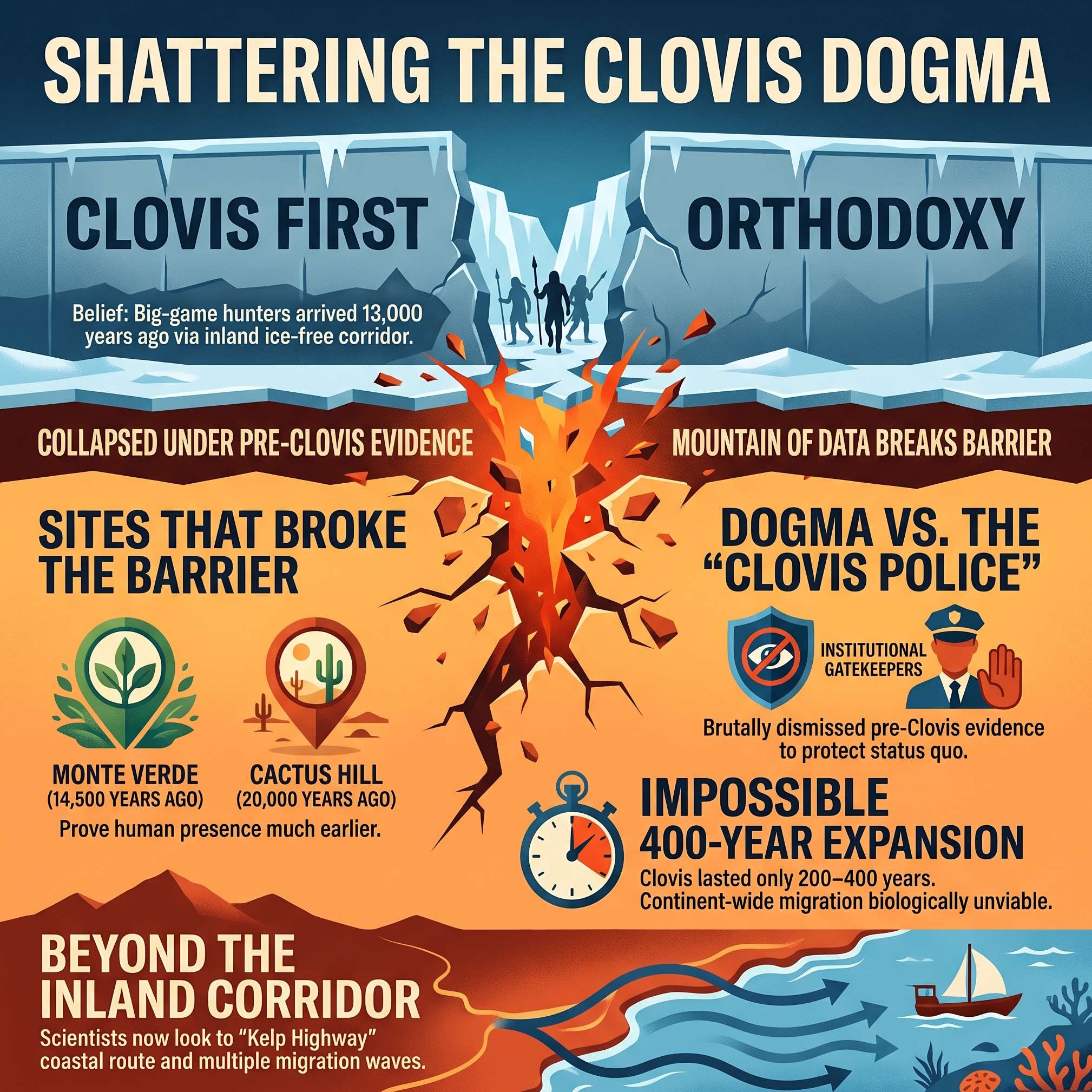
Examining the revolutionary impact of the Cactus Hill and Monte Verde archaeological sites on our understanding of human migration to the Americas. These locations offer compelling evidence of human activity dating back 14,500 to 20,000 years, directly challenging the long-held "Clovis First" theory that suggested a much later arrival via an ice-free inland corridor. Researchers such as Tom Dillehay and Michael Waters have utilized advanced radiocarbon dating and interdisciplinary studies to prove that early populations likely traveled along the Pacific or Atlantic coasts long before previously assumed. Beyond merely dating artifacts, exploring how these ancient groups transitioned from nomadic foragers into complex, settled societies with rich ceremonial traditions. Sites like Huaca Prieta in Peru and the Mapuche mounds in Chile illustrate the enduring social structures and cultural resilience of these indigenous populations over millennia. Ultimately, these records document a shift in the scientific community toward a more nuanced and ancient timeline for the peopling of the Western Hemisphere.