Skip to content
Artwork for The Deep Dive
The Deep Dive · May 27 · 45 min

AI in Medicine

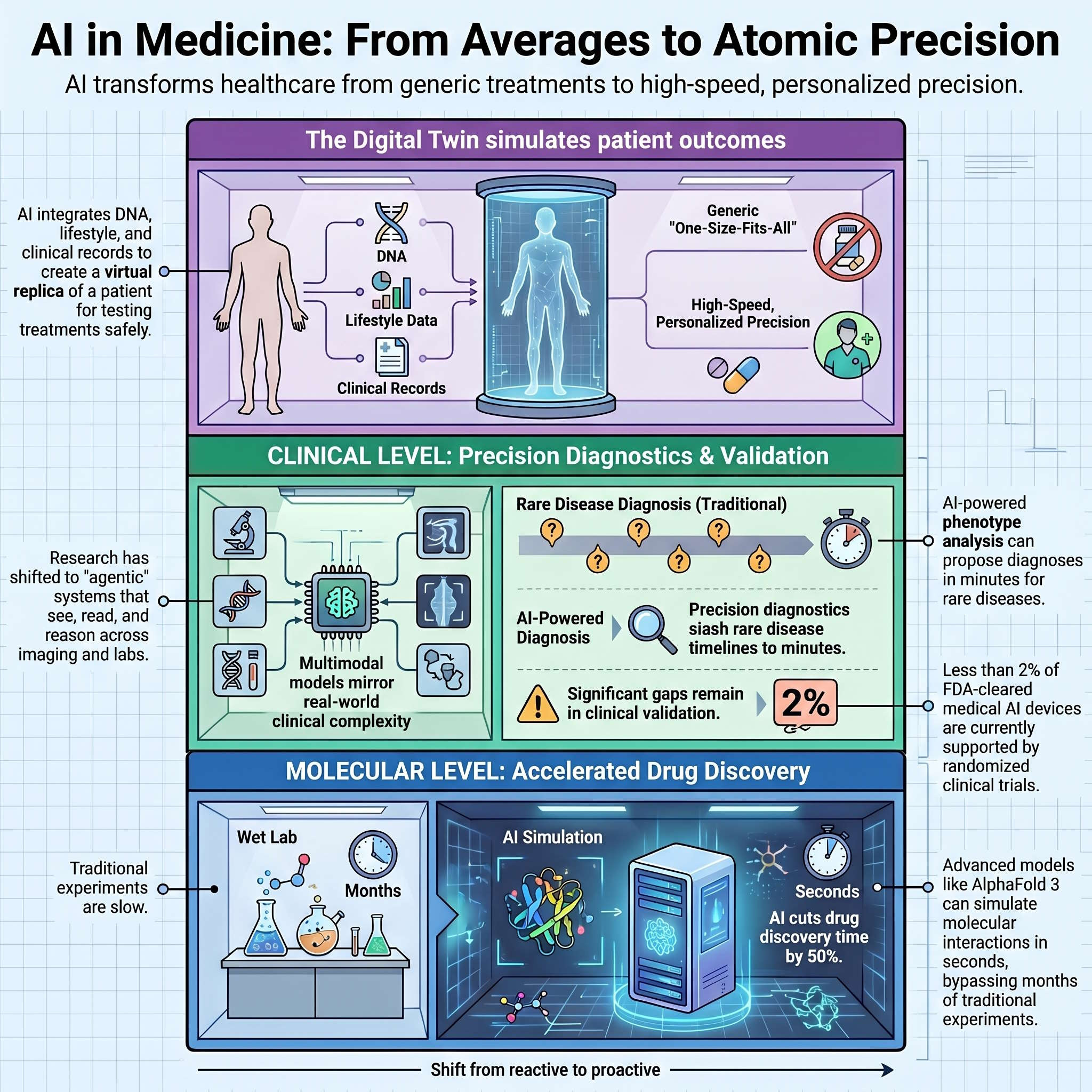
Exploring the transformative impact of artificial intelligence on the future of healthcare, with a primary focus on drug discovery and personalized medicine. Organizations like Isomorphic Labs and UW Medicine are utilizing sophisticated models to accelerate the design of new treatments for complex diseases, shifting from slow lab experiments to rapid computational simulations. Technical breakthroughs such as AlphaFold 3 and the PATH algorithm are enhancing our ability to predict molecular interactions with greater speed and transparency. Beyond drug design, we discuss how AI-driven precision medicine tailors care to individual genetic profiles and clinical histories to improve patient outcomes. However, experts emphasize that widespread adoption requires addressing critical challenges regarding algorithmic bias, data privacy, and the need for continuous clinical validation. Overall, the data presents AI as a powerful tool for operational efficiency and scientific innovation, provided it is implemented through responsible governance.

0:00-45:03

transcript

No transcript — this publisher did not publish one.

show notes

Exploring the transformative impact of artificial intelligence on the future of healthcare, with a primary focus on drug discovery and personalized medicine. Organizations like Isomorphic Labs and UW Medicine are utilizing sophisticated models to accelerate the design of new treatments for complex diseases, shifting from slow lab experiments to rapid computational simulations. Technical breakthroughs such as AlphaFold 3 and the PATH algorithm are enhancing our ability to predict molecular interactions with greater speed and transparency. Beyond drug design, we discuss how AI-driven precision medicine tailors care to individual genetic profiles and clinical histories to improve patient outcomes. However, experts emphasize that widespread adoption requires addressing critical challenges regarding algorithmic bias, data privacy, and the need for continuous clinical validation. Overall, the data presents AI as a powerful tool for operational efficiency and scientific innovation, provided it is implemented through responsible governance.