Skip to content
Artwork for Philosophy Overdose
HistorySociety & CulturePhilosophyEducation

Philosophy Overdose

Philosophy Overdose

A collection of public and academic philosophy videos, mostly analytic philosophy but occasionally continental philosophy too. The channel looks for thought-provoking lectures and interviews, particularly what is rare and involves famous figures. There is occasionally an attempt at translation as well, especially that of German and French.

Nothing here is monetized, the channel is wholly non-commercial. Everything here is for the purpose of education and spreading around good philosophy content. If there's any problem, let me know, and I can take it down.

Feel free to let me know if there's anything you'd like me to post, including one of your own lectures.

Philosophy, Epistemology, Ethics, History of Philosophy, Political Philosophy, History of Ideas, Ontology, Critical Thinking, Moral Philosophy, Philosophy of Science, Logic, Philosophy of Mind, Metaphysics, Philosophy of Religion, Social Philosophy, Philosophy of Language, Consciousness, Philosophy of Mathematics, etc.

Links:
Facebook: https://www.facebook.com/PhilosophyOverdoseYoutube/

Play
  • 140 episodes
  • Avg 50 min
  • English
Counted on this page — what you have heard stays on this device, so it is not something the list can be paged by.
  • Sunday · 1 hr 32 min

    Can Machines Become Conscious? (2025)

    David Chalmers and Michael Graziano discuss consciousness and AI with moderator Anil Ananthaswamy at Princeton University in 2025 as part of the Large AI Model Lecture Series. 00:00 Introduction 08:31 Discussion #philosophy #artificialintelligence #consciousness #psychology #davidchalmers #philosophyofmind #debate Learn more about your ad choices. Visit megaphone.fm/adchoices

  • Sunday · 4 min

    Frank Jackson on the Knowledge Argument

    A clip of Frank Jackson discussing his famous knowledge argument involving Mary and why he ended up changing his mind about it. This clip comes from an interview with Alan Saunders back in 2012. #philosophy #philosophyofmind #consciousness #metaphysics #materialism Learn more about your ad choices. Visit megaphone.fm/adchoices

  • Sunday · 1 hr 12 min

    Science and Free Will - Herbert Feigl (1963)

    Audio recording of a lecture given by professor Herbert Feigl on free will and science at Coffman Union in 1963 at the University of Minnesota. After introducing the traditional problem of free will, he goes on to discuss how determinism and indeterminism fit into our conception of science. He then goes on to argue that free will is not only consistent with determinism, but it seems to presuppose it. He thereby tries to dissolve the traditional issue by showing the underlying compatibility between free will and that of causal determinism. #philosophy #determinism #science #freewill #causality #causation #philosophyofscience Learn more about your ad choices. Visit megaphone.fm/adchoices

  • Sunday · 1 hr 4 min

    2 Romanticism - First Attack on Enlightenment (Isaiah Berlin 1965)

    Isaiah Berlin gives the 2nd lecture in a series of 6 on Romanticism and its roots. All 6 lectures: https://www.youtube.com/playlist?list=PLhP9EhPApKE_9uxkmfSIt2JJK6oKbXmd- For Berlin, the Romantics set in motion a vast, unparalleled revolution in humanity’s view of itself. They destroyed the traditional notions of objective truth and validity in ethics with incalculable, all-pervasive results. As he said of the Romantics elsewhere: “The world has never been the same since, and our politics and morals have been deeply transformed by them. Certainly this has been the most radical, and indeed dramatic, not to say terrifying, change in men’s outlook in modern times.” In these brilliant lectures Berlin surveys the myriad attempts to define Romanticism, distills its essence, traces its developments from its first stirrings to its apotheosis, and shows how its lasting legacy permeates our own outlook. Combining the freshness and immediacy of the spoken word with Berlin’s inimitable eloquence and wit, the lectures range over a cast of the greatest thinkers and artists of the eighteenth and nineteenth centuries, including Kant, Rousseau, Diderot, Schiller, Schlegel, Novalis, Goethe, Blake, Byron, and Beethoven. Berlin argues that the ideas and attitudes held by these and other figures helped to shape twentieth-century nationalism, existentialism, democracy, totalitarianism, and our ideas about heroic individuals, individual self-fulfillment, and the exalted place of art. This is the record of an intellectual bravura performance–of one of the century’s most influential philosophers dissecting and assessing a movement that changed the course of history. These Mellon lectures were delivered in Washington in 1965. 00:00 Program for the Lectures 01:07 Enlightenment Tradition 22:44 Montesquieu & Relativism 26:42 David Hume & Skepticism 32:07 Germans & Sour Grapes 44:32 Hamann & Counter-Enlightenment #Philosophy #Romanticism #IsaiahBerlin Learn more about your ad choices. Visit megaphone.fm/adchoices

  • Sunday · 47 min

    Metaphilosophy and Russell vs Wittgenstein on Judgment

    After a brief discussion of the nature of philosophy and the origins of analytic philosophy, Fraser MacBride discusses Bertrand Russell and Ludwig Wittgenstein on the nature of relations and the structure of judgment or belief, how our thought relates to external objects in the world. Among the topics discussed include metaphilosophy and the history of analytic philosophy, F. H. Bradley's infamous regress argument against the reality of relations, Russell's correspondence theory of truth and various accounts of judgment, including his famous multiple relation theory. "The question of relations is one of the most important that arise in philosophy, as most other issues turn on it: monism and pluralism; the question of whether anything is wholly true except the whole of truth, or wholly real except the whole of reality; idealism and realism, in some of their forms; perhaps the very existence of philosophy as a subject distinct from science and possessing a method of its own.” Bertrand Russell #Philosophy #Wittgenstein #BertrandRussell Learn more about your ad choices. Visit megaphone.fm/adchoices

  • Sunday · 1 hr 7 min

    1 The "Representational" Theory of Knowledge - Reid's Critique of Hume (Dan Robinson)

    Professor Dan Robinson gives the first in a series of 8 lectures on Thomas Reid's critique of David Hume at Oxford in 2014. Hume defends the thesis according to which “ALL THE PERCEPTIONS OF THE HUMAN MIND RESOLVE THEMSELVES INTO…IMPRESSIONS AND IDEAS”. Accordingly, “We may prosecute this enquiry to what length we please; where we shall always find, that every idea which we examine is copied from a similar impression”. Under “David Hume”, the Stanford Encyclopedia of Philosophy begins with, “The most important philosopher ever to write in English”. His most formidable contemporary critic was the fellow Scot, Thomas Reid, the major architect of so-called Scottish Common Sense Philosophy. The most significant features of Hume’s work, as understood by Reid, are the representive theory of perception, the nature of causation and causal concepts, the nature of personal identity and the foundations of morality. Each of these topics is presented in a pair of lectures, the first summarizing Hume’s position and the second Reid’s critique of that position. All Lectures: https://www.youtube.com/playlist?list=PLhP9EhPApKE9nki7CXFPi7PMOi5W2g2-q #philosophy #davidhume #epistemology #perception #empiricism #skepticism #philosophyofmind #historyofphilosophy Learn more about your ad choices. Visit megaphone.fm/adchoices

  • Sunday · 5 min

    Karl Popper on the Open Society (1974)

    A short of clip of Karl Popper discussing the Open Society from a 1974 interview. The translation is mine. For more Popper: https://www.youtube.com/playlist?list=PLhP9EhPApKE_VarWCx1d_Uogn_GxsVf-o #philosophy #karlpopper #politicaltheory #politicalphilosophy #opensociety Learn more about your ad choices. Visit megaphone.fm/adchoices

  • Sunday · 1 hr 10 min

    Resurrection of the Body? Physicalism and the Possibility of Life After Death

    Can a Christian be a physicalist? And is there a coherent story to tell about how a physical entity can survive bodily death? In this talk, Rebekah Rice evaluates proposals by Christian philosophers who have answered "yes" to both questions and have gone on to propose theories about the possibility of resurrection given physicalism. Rebekah Rice, Assistant Professor of Philosophy at Seattle Pacific University, gave this lecture back in 2012. 00:00 Lecture 49:45 Q&A #philosophy #metaphysics #philosophyofmind #philosophyofreligion #personalidentity #materialism Learn more about your ad choices. Visit megaphone.fm/adchoices
  • Sunday · 55 min

    3 Space, Time and the "Analogies of Experiences" - Kant's Critique of Pure Reason (Dan Robinson)

    Dan Robinson gives the 3rd lecture in a series of 8 on Immanuel Kant's Critique of Pure Reason. Kant's so-called "Copernican" revolution in metaphysics begins with the recognition of the observer's contribution to the observation. Thus, to the extent that Hume's empiricism restricts knowledge to experience, empiricism succeeds only by accepting the a priori grounding of experience itself. This series looks at German Philosopher Immanuel Kant's seminal philosophical work 'The Critique of Pure Reason'. The lectures aim to outline and discuss some of the key philosophical issues raised in the book and to offer students and individuals thought provoking Kantian ideas surrounding metaphysics. Each lecture looks at particular questions raised in the work such as how do we know what we know and how do we find out about the world, dissects these questions with reference to Kant's work and discusses the broader philosophical implications. Anyone with an interest in Kant and philosophy will find these lectures thought provoking but accessible. This is series of lectures was given in 2011 at Oxford. Note, the audio has been improved. All 8 lectures: https://www.youtube.com/playlist?list=PLhP9EhPApKE_OdgqNgL0AJX9-gwr4tmLw #philosophy #kant #epistemology #metaphysics #empiricism #skepticism #historyofphilosophy Learn more about your ad choices. Visit megaphone.fm/adchoices

  • Sunday · 1 hr 40 min

    The Afterlife: How People Who Don’t Yet Exist Matter More to Us than People Who Do

    Samuel Scheffler (University Professor of Philosophy and Law at New York University) delivers the first of his 2012 Tanner lectures at Berkeley with commentary from Susan R. Wolf (Edna J. Koury Professor of Philosophy at the University of North Carolina Chapel Hill). Note, the introduction has been edited out. 00:00 Lecture 59:50 Susan Wolf 1:15:53 Response #philosophy #ethics #moralphilosophy Learn more about your ad choices. Visit megaphone.fm/adchoices

  • Sunday · 19 min

    Same-Sex Marriage Arguments

    Professor Martha Nussbaum discusses the main arguments against same-sex marriage in a clip which comes from a 2010 lecture at the Harvard Book Store on her book, From Disgust to Humanity: Sexual Orientation and Constitutional Law. Although this topic would've seemed out of date a decade ago, it seems increasingly less so in the current socio-political climate. #philosophy #ethics #socialissues #law #debate Learn more about your ad choices. Visit megaphone.fm/adchoices

  • Sunday · 1 hr 39 min

    Philosophy of Mathematics and Frege - Michael Dummett (1994)

    Audio recording of a 1994 lecture by Michael Dummett on Frege and the philosophy of mathematics at the LSE on the occasion of his Lakatos Award for an outstanding contribution to the philosophy of science. For a good intro to the philosophy of mathematics, check out: https://www.youtube.com/watch?v=UhX1ouUjDHE and https://www.youtube.com/watch?v=XyXWnGFKTkg #philosophy #epistemology #mathematics #frege #kant #historyofphilosophy Learn more about your ad choices. Visit megaphone.fm/adchoices

  • Sunday · 4 min

    Free Will Pessimism

    A short clip of Galen Strawson discussing his master argument against the very possibility of free will and moral responsibility; one which applies whether or not determinism is true. This comes from an episode of the In Our Time podcast a few years back on the topic of free will. For more information and full episodes, go to: https://www.bbc.co.uk/programmes/b006qykl "The _causa sui_ is the best self-contradiction that has been conceived so far; it is a sort of rape and perversion of logic. But the extravagant pride of man has managed to entangle itself profoundly and frightfully with just this nonsense. The desire for 'freedom of the will' in the superlative metaphysical sense, which still holds sway, unfortunately, in the minds of the half-educated; the desire to bear the entire and ultimate responsibility for one’s actions oneself, and to absolve God, the world, ancestors, chance, and society involves nothing less than to be precisely this _causa sui_ and, with more than Baron Munchhausen’s audacity, to pull oneself up into existence by the hair, out of the swamps of nothingness." -Nietzsche #philosophy #freewill #determinism #causality #causation #metaphysics Learn more about your ad choices. Visit megaphone.fm/adchoices
  • Sunday · 58 min

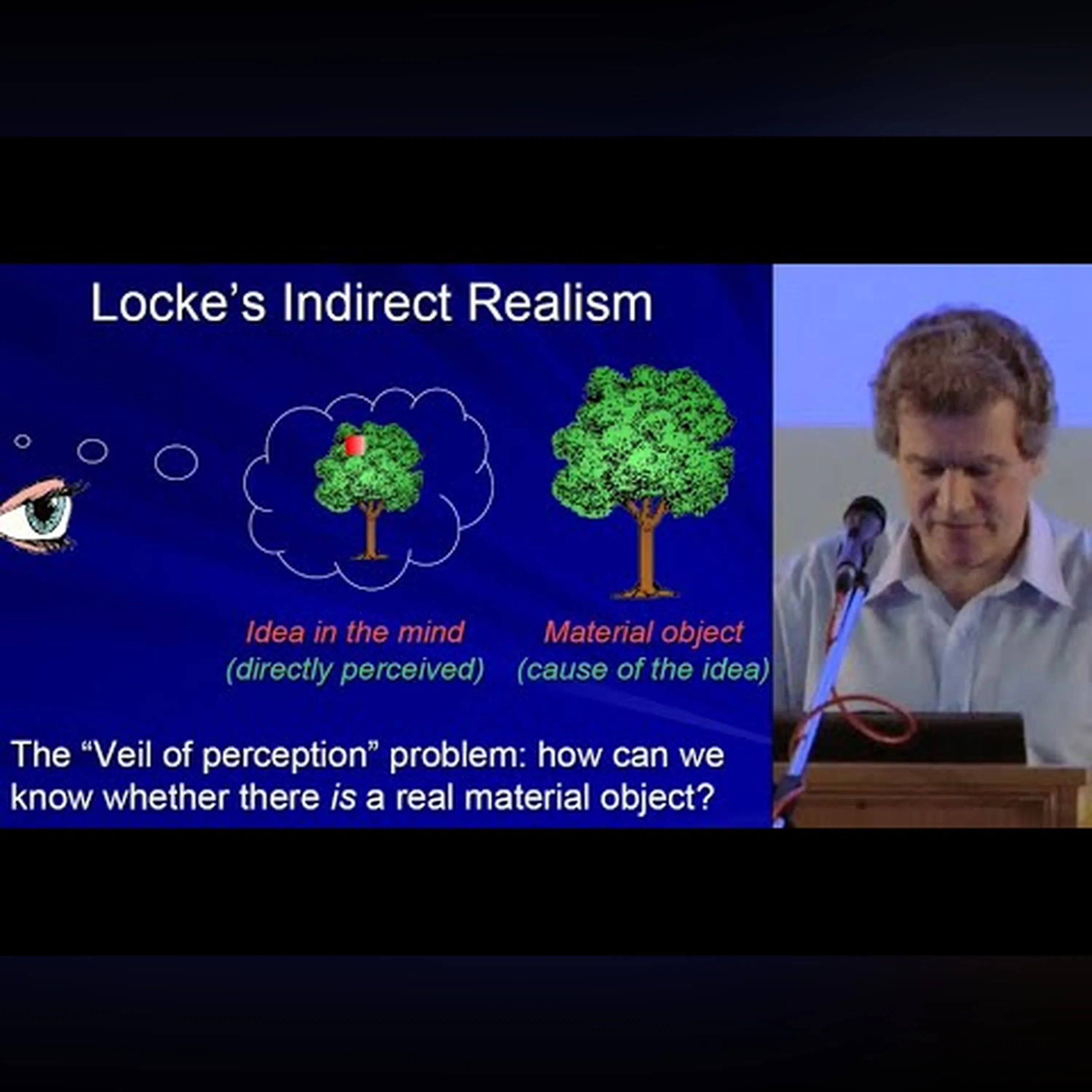
    Perception, Abstraction and Idealism - General Philosophy (Peter Millican)

    In this lecture on General Philosophy, Professor Peter Millican discusses the problem of perception, the distinction between primary and secondary qualities, resemblance, abstraction, and idealism. This comes from a 2010 series on General Philosophy. The slides have been added. This series of lectures was delivered by Peter Millican to first-year philosophy students at the University of Oxford. The lectures comprise of the 8-week General Philosophy course, delivered to first year undergraduates. These lectures aim to provide a thorough introduction to many philosophical topics and to get students and others interested in thinking about key areas of philosophy. Taking a chronological view of the history of philosophy, each lecture is split into 3 or 4 sections which outline a particular philosophical problem and how different philosophers have attempted to resolve the issue. Individuals interested in the 'big' questions about life such as how we perceive the world, who we are in the world and whether we are free to act will find this series informative, comprehensive and accessible. More lectures on General Philosophy: https://www.youtube.com/playlist?list=PLhP9EhPApKE_xo2wvkm6qPZrUlAiRNHXb Source: https://podcasts.ox.ac.uk/series/general-philosophy 00:00 Intro to Primary & Secondary Qualities 01:04 The Mechanisms of Perception 02:41 What are Objects Like? 04:20 Locke & Corpuscularianism 07:47 Pains, Colours, & Shapes 09:24 A Problematic Text 11:03 In Objects, or Just In the Mind? 14:29 Why Resemblance? 16:01 Can an Idea Resemble an Object? 18:41 Structural Resemblance? 21:44 Solidity 23:42 Hume’s Criticism 25:11 Empiricism & Understanding 26:23 The Attack on Abstraction 29:25 The Case for Idealism 30:26 “Something I Know Not What” 35:16 Locke’s Indirect Realism 36:13 An Unacceptable Interpretation 38:30 Sense Data 39:08 How To Prove the Causal Link? 40:50 Phenomenalism 43:20 Direct Realism 45:59 Is a Lockean View Defensible? 48:29 Explanatory Realism #philosophy #epistemology #perception #skepticism #philosophyofmind #historyofphilosophy Learn more about your ad choices. Visit megaphone.fm/adchoices
  • Sunday · 1 hr 45 min

    Foundations of Liberal Equality 2 - Ronald Dworkin (1988)

    Audio recording of a lecture by Ronald M. Dworkin as part of his 1988 Tanner lectures on human values at Stanford University on the foundations of liberalism. This was the second of his Tanner lectures. Note, this is a re-upload. 00:00 Lecture 1:07:14 Q&A #philosophy #ethics #politicalphilosophy #moralphilosophy #politicaltheory #liberalism Learn more about your ad choices. Visit megaphone.fm/adchoices
  • Sunday · 5 min

    Concepts vs Percepts (Ray Monk)

    A short, somewhat random clip of Ray Monk discussing the distinction between concepts and percepts (or "intuitions" in the Kantian jargon), as well as some of the possible implications for modern science and beyond. More Short Clips: https://www.youtube.com/playlist?list=PLhP9EhPApKE8v8UVlc7JuuNHwvhkaOvzc This is from a talk given by Ray Monk a few years back on the philosophical landscape of 1905, which can be found here: https://www.youtube.com/watch?v=6yfwFoVlcMk #philosophy #epistemology #kant #historyofphilosophy Learn more about your ad choices. Visit megaphone.fm/adchoices

  • Sunday · 1 hr 1 min

    Ernest Nagel on the Philosophy of Science (1954)

    Audio recording of a 1954 lecture given by Professor Ernest Nagel on the philosophy of science at the Cooper Union Forum. #philosophy #philosophyofscience #epistemology #science Learn more about your ad choices. Visit megaphone.fm/adchoices
  • Sunday · 38 min

    Plato on Knowledge - The Meno and Theaetetus (History of Philosophy)

    Peter Adamson discusses Plato's dialogues the Meno and the Theaetetus, which address various epistemological topics, including Meno's paradox, Plato's theory of recollection, the nature of knowledge, relativism, and the difference between knowledge and true belief (e.g. what must be added to a true belief to turn it into knowledge, and why knowledge is more valuable than mere true belief). This comes from Peter Adamson's amazing podcast on the History of Philosophy from a few years back, which can be found here: https://www.historyofphilosophy.net 00:00 The Meno 14:59 Theaetetus #philosophy #plato #epistemology #socrates #historyofphilosophy Learn more about your ad choices. Visit megaphone.fm/adchoices

  • Sunday · 59 min

    The Virtual and The Real (David Chalmers)

    Distinguished philosopher Dr. David Chalmers discusses some of the philosophical issues that arise regarding virtual reality technology in a lecture back in 2017 at the Community Library in Idaho. #philosophy #epistemology #davidchalmers #metaphysics #virtualreality Learn more about your ad choices. Visit megaphone.fm/adchoices
  • Sunday · 1 hr 32 min

    What Is Rationality, Anyway?

    Dr. Peter Dennis gives a public lecture on the nature of rationality at the LSE in 2015. Peter Dennis is an LSE Fellow in the Department of Philosophy, Logic and Scientific Method and a Forum for European Philosophy Fellow. 00:00 Talk 54:04 Q&A #philosophy #rationality #epistemology Learn more about your ad choices. Visit megaphone.fm/adchoices

Showing 101–120 of 140 episodes