Skip to content
Artwork for Philosophy Overdose
HistorySociety & CulturePhilosophyEducation

Philosophy Overdose

Philosophy Overdose

A collection of public and academic philosophy videos, mostly analytic philosophy but occasionally continental philosophy too. The channel looks for thought-provoking lectures and interviews, particularly what is rare and involves famous figures. There is occasionally an attempt at translation as well, especially that of German and French.

Nothing here is monetized, the channel is wholly non-commercial. Everything here is for the purpose of education and spreading around good philosophy content. If there's any problem, let me know, and I can take it down.

Feel free to let me know if there's anything you'd like me to post, including one of your own lectures.

Philosophy, Epistemology, Ethics, History of Philosophy, Political Philosophy, History of Ideas, Ontology, Critical Thinking, Moral Philosophy, Philosophy of Science, Logic, Philosophy of Mind, Metaphysics, Philosophy of Religion, Social Philosophy, Philosophy of Language, Consciousness, Philosophy of Mathematics, etc.

Links:
Facebook: https://www.facebook.com/PhilosophyOverdoseYoutube/

Play
  • 119 episodes
  • Avg 59 min
  • English
Counted on this page — what you have heard stays on this device, so it is not something the list can be paged by.
  • Today · 1 hr 13 min

    Ernest Nagel on the Philosophy of Science (1954)

    Audio recording of a 1954 lecture given by Professor Ernest Nagel on the philosophy of science at the Cooper Union Forum. #philosophy #philosophyofscience #epistemology #science Learn more about your ad choices. Visit megaphone.fm/adchoices

  • Today · 57 min

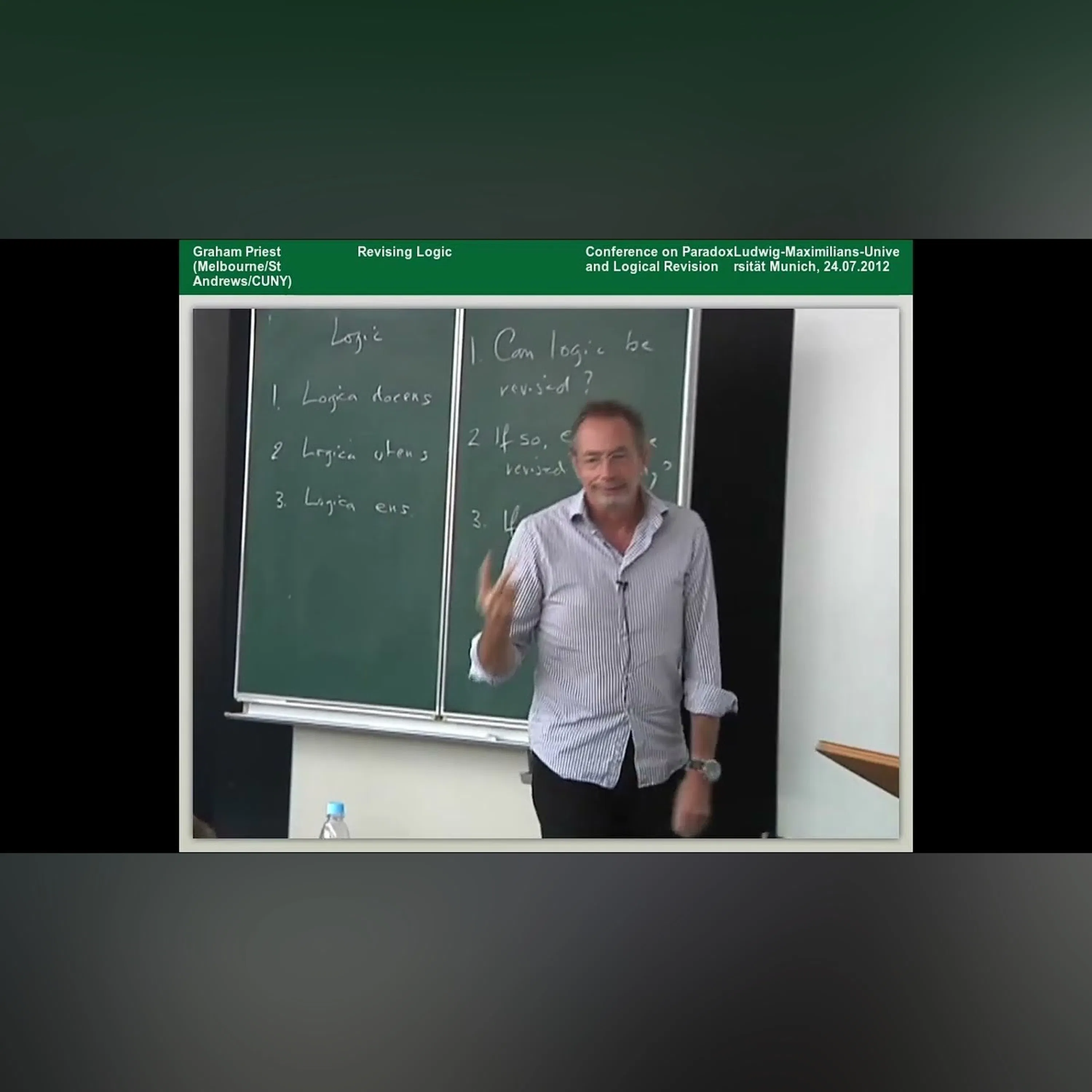
    Revising Logic - Graham Priest

    A re-upload of a talk which was given by Graham Priest on revising logic at a conference on paradox and logical revision at the University of Munich back in 2012. #philosophy #rationality #epistemology Learn more about your ad choices. Visit megaphone.fm/adchoices

  • Today · 1 hr 32 min

    Gadamer on Education and Tradition (1979)

    Audio recording of a 1979 lecture by Hans-Georg Gadamer on tradition and education that was delivered in English at the University of Dallas. #philosophy #gadamer #historyofphilosophy Learn more about your ad choices. Visit megaphone.fm/adchoices
  • Today · 1 hr 21 min

    Reason, Tone and Judgment - Raimond Gaita (2013)

    Professor Raimond Gaita gives the first talk in a series on 'Prejudice, Reason and Understanding' at the Australian National University as part of the Freilich Foundation's Eminent Lecturer Series back in 2013. Some years ago, Mirko Bagaric, then Professor and Dean of Law at Deakin University in Melbourne, published in the Age an opinion piece in which he argued that we should torture people in certain circumstances if doing so would save many lives. His article provoked incredulity amongst some people: what had seemed to them to be undiscussable and which they believed had partly defined their political culture just because it was undiscussable, was again “on the agenda”. Bagaric was in his turn incredulous that people could be so lacking in respect for rational discussion as to believe that some matters were undiscussable or unthinkable, and that they could be so morally and politically irresponsible as to deem undiscussable something that could potentially save thousands of lives. In the first two lectures, Raimond Gaita tries to bring out what he takes to be most serious in the incredulity voiced by Bagaric and his critics in order to explore what it shows about political discourse that aspires to be a conversation of citizens. He will explore why the ideal that even in ethics and politics, reliable and sound cognitive achievements is best achieved in a tone-free zone, is widespread amongst philosophers, at least in the analytical tradition. He will suggest that attractive as it may be as an elaboration of how best to rise to the claims of reason, it erodes the kind of judgment and sobriety necessary to critical thought about ethics and politics and thereby impoverishes our understanding of what the distinction between legitimate illegitimate persuasion comes to in those realms. It erodes entirely, he will argue, the conditions necessary for the conversation of citizens. In these lectures, Raimond Gaita explores an ideal of a democratic politics as ‘a conversation of citizens’. Reflection germane to the topic goes back at least to the time of Socrates. In Plato’s Gorgias, whose bitter political tone has often been noted, Socrates says to an aspiring young orator that he is good at oratory but bad a conversation. He meant, in part, that oratory betrays a trust intrinsic to real 'conversation’ that one’s partner in conversation will respect ones need to be legitimately persuaded to a belief – that she will not exploit her skills and one’s vulnerability to them, for example. For that reason, Socrates did not look upon oratory as a morally neutral skill that could serve good or bad ends. He regarded it, as many now regard spin, as rotten through and through. More often than not, belief requires trust and so an inquiry into persuasion which honors that trust, will be in part an inquiry into how to discipline trust so that it becomes the expression of good judgment rather than gullibility, for example. Reason, its limits, judgment, trust, sobriety, and realism as these show themselves in ethics and politics is the topic. 00:00 Talk 40:04 Q&A #philosophy #ethics #moralphilosophy Learn more about your ad choices. Visit megaphone.fm/adchoices
  • Yesterday · 8 min

    Divine Command Theory and the Euthyphro Objection

    Russ Shafer-Landau explains the Euthyphro Dilemma and why it presents a serious problem to Divine Command Theory. This comes from a talk on objective morality without God: https://youtu.be/50CQwa15R7A #philosophy #ethics #metaethics #moralphilosophy #historyofphilosophy Learn more about your ad choices. Visit megaphone.fm/adchoices

  • Yesterday · 1 hr 7 min

    Theories of Welfare - Ethics and Society Course

    The nature of well-being is discussed in this introductory lecture from a 2023 course on Ethics and Society by Professor Samuel Zincke Elgin at UCSD, the University of California (UC San Diego). #philosophy #ethics #moralphilosophy #utilitarianism #hedonism Learn more about your ad choices. Visit megaphone.fm/adchoices

  • Yesterday · 1 hr 49 min

    Nietzsche on the Value of Truth - Ken Gemes

    Audio recording of the second lecture by Ken Gemes on Nietzsche. Nietzsche claims that with the rejection of religious underpinning of the value of truth (e.g. truth as God’s word and as something absolute), we can now raise the question of why and to what extent we should value truth. He argues that our need for meaning conflicts with our will to truth because such a will tends to destroy all mythologies including the mythology of value – our will to truth reveals that values are not objectively 'out there' in the world, but are merely our own projections onto the world. This knowledge eviscerates the world of meaning. This does not mean that Nietzsche rejects the value of truth. He instead rejects the notion, inherited from the Judeo-Christian worldview, that truth is an unconditional value. Such a notion of truth, destructive of all myth and meaning, is unliveable. The very claim that the truth is valuable, even if not unconditionally valuable, is itself one of those myths that help give life meaning. You can find the previous talk here: https://www.youtube.com/watch?v=CHShypzrqGw Note, this is a re-upload. 00:00 Talk 46:53 Q&A #nietzsche #philosophy #ethics #historyofphilosophy Learn more about your ad choices. Visit megaphone.fm/adchoices

  • Yesterday · 1 hr 5 min

    Pragmatism and Truth - Rorty, Putnam, and Conant (2002)

    Audio recording of a discussion between Richard Rorty, Hilary Putnam, and James Conant on pragmatism and truth. This comes from an episode of Odyssey on WBEZ Chicago from back in 2002 with host Gretchen Helfrich. Note, this is a reupload. #philosophy #epistemology #rorty #pragmatism #historyofphilosophy #debate Learn more about your ad choices. Visit megaphone.fm/adchoices

  • Yesterday · 1 hr 4 min

    The Eclipse of Reason - Sidney Morgenbesser (1967)

    Audio recording of a 1967 lecture given by Sidney Morgenbesser on reason and its eclipse at the Cooper Union Forum in New York. Sidney Morgenbesser was a professor of philosophy at Columbia University. #philosophy #epistemology #science Learn more about your ad choices. Visit megaphone.fm/adchoices
  • Yesterday · 7 min

    The Experience Machine

    A clip of professor Shelly Kagan discussing the famous thought experiment of the experience machine which comes from Robert Nozick and which serves as an argument against hedonism about well-being. This comes from a lecture on death given at the Southern Methodist University back in 2013. More on the nature of well-being: https://plato.stanford.edu/entries/well-being/ #philosophy #hedonism #ethics #nozick #moralphilosophy Learn more about your ad choices. Visit megaphone.fm/adchoices
  • Yesterday · 5 min

    Wittgenstein on Rules and Private Language

    A reupload of something that I put together awhile back. The audio is from: https://youtu.be/v_hQpvQYhOI Some relevant quotes: "But how can a rule show me what I have to do at this point? Whatever I do is, on some interpretation, in accord with the rule...Any interpretation still hangs in the air along with what it interprets, and cannot give it any support. Interpretations by themselves do not determine meaning." Wittgenstein "This was our paradox: no course of action could be determined by a rule, because any course of action can be made out to accord with the rule." Wittgenstein "To think one is obeying a rule is not to obey a rule. Hence it is not possible to obey a rule 'privately': otherwise thinking one was obeying a rule would be the same thing as obeying it." Wittgenstein #philosophy #wittgenstein #bryanmagee #language #searle Learn more about your ad choices. Visit megaphone.fm/adchoices

  • Yesterday · 5 min

    Karl Popper on the Open Society (1974)

    A short of clip of Karl Popper discussing the Open Society from a 1974 interview. The translation is mine. For more Popper: https://www.youtube.com/playlist?list=PLhP9EhPApKE_VarWCx1d_Uogn_GxsVf-o #philosophy #karlpopper #politicaltheory #politicalphilosophy #opensociety Learn more about your ad choices. Visit megaphone.fm/adchoices

  • Yesterday · 1 hr 17 min

    2 Romanticism - First Attack on Enlightenment (Isaiah Berlin 1965)

    Isaiah Berlin gives the 2nd lecture in a series of 6 on Romanticism and its roots. All 6 lectures: https://www.youtube.com/playlist?list=PLhP9EhPApKE_9uxkmfSIt2JJK6oKbXmd- For Berlin, the Romantics set in motion a vast, unparalleled revolution in humanity’s view of itself. They destroyed the traditional notions of objective truth and validity in ethics with incalculable, all-pervasive results. As he said of the Romantics elsewhere: “The world has never been the same since, and our politics and morals have been deeply transformed by them. Certainly this has been the most radical, and indeed dramatic, not to say terrifying, change in men’s outlook in modern times.” In these brilliant lectures Berlin surveys the myriad attempts to define Romanticism, distills its essence, traces its developments from its first stirrings to its apotheosis, and shows how its lasting legacy permeates our own outlook. Combining the freshness and immediacy of the spoken word with Berlin’s inimitable eloquence and wit, the lectures range over a cast of the greatest thinkers and artists of the eighteenth and nineteenth centuries, including Kant, Rousseau, Diderot, Schiller, Schlegel, Novalis, Goethe, Blake, Byron, and Beethoven. Berlin argues that the ideas and attitudes held by these and other figures helped to shape twentieth-century nationalism, existentialism, democracy, totalitarianism, and our ideas about heroic individuals, individual self-fulfillment, and the exalted place of art. This is the record of an intellectual bravura performance–of one of the century’s most influential philosophers dissecting and assessing a movement that changed the course of history. These Mellon lectures were delivered in Washington in 1965. 00:00 Program for the Lectures 01:07 Enlightenment Tradition 22:44 Montesquieu & Relativism 26:42 David Hume & Skepticism 32:07 Germans & Sour Grapes 44:32 Hamann & Counter-Enlightenment #Philosophy #Romanticism #IsaiahBerlin Learn more about your ad choices. Visit megaphone.fm/adchoices
  • Yesterday · 2 hr 5 min

    The Afterlife: How People Who Don’t Yet Exist Matter More to Us than People Who Do

    Samuel Scheffler (University Professor of Philosophy and Law at New York University) delivers the first of his 2012 Tanner lectures at Berkeley with commentary from Susan R. Wolf (Edna J. Koury Professor of Philosophy at the University of North Carolina Chapel Hill). Note, the introduction has been edited out. 00:00 Lecture 59:50 Susan Wolf 1:15:53 Response #philosophy #ethics #moralphilosophy Learn more about your ad choices. Visit megaphone.fm/adchoices

  • Yesterday · 1 hr 9 min

    Perception, Abstraction and Idealism - General Philosophy (Peter Millican)

    In this lecture on General Philosophy, Professor Peter Millican discusses the problem of perception, the distinction between primary and secondary qualities, resemblance, abstraction, and idealism. This comes from a 2010 series on General Philosophy. The slides have been added. This series of lectures was delivered by Peter Millican to first-year philosophy students at the University of Oxford. The lectures comprise of the 8-week General Philosophy course, delivered to first year undergraduates. These lectures aim to provide a thorough introduction to many philosophical topics and to get students and others interested in thinking about key areas of philosophy. Taking a chronological view of the history of philosophy, each lecture is split into 3 or 4 sections which outline a particular philosophical problem and how different philosophers have attempted to resolve the issue. Individuals interested in the 'big' questions about life such as how we perceive the world, who we are in the world and whether we are free to act will find this series informative, comprehensive and accessible. More lectures on General Philosophy: https://www.youtube.com/playlist?list=PLhP9EhPApKE_xo2wvkm6qPZrUlAiRNHXb Source: https://podcasts.ox.ac.uk/series/general-philosophy 00:00 Intro to Primary & Secondary Qualities 01:04 The Mechanisms of Perception 02:41 What are Objects Like? 04:20 Locke & Corpuscularianism 07:47 Pains, Colours, & Shapes 09:24 A Problematic Text 11:03 In Objects, or Just In the Mind? 14:29 Why Resemblance? 16:01 Can an Idea Resemble an Object? 18:41 Structural Resemblance? 21:44 Solidity 23:42 Hume’s Criticism 25:11 Empiricism & Understanding 26:23 The Attack on Abstraction 29:25 The Case for Idealism 30:26 “Something I Know Not What” 35:16 Locke’s Indirect Realism 36:13 An Unacceptable Interpretation 38:30 Sense Data 39:08 How To Prove the Causal Link? 40:50 Phenomenalism 43:20 Direct Realism 45:59 Is a Lockean View Defensible? 48:29 Explanatory Realism #philosophy #epistemology #perception #skepticism #philosophyofmind #historyofphilosophy Learn more about your ad choices. Visit megaphone.fm/adchoices

  • Yesterday · 36 min

    What Is Probability? Difficulties Understanding Probability

    Professor David Wallace discusses the nature of probability and some of the philosophical puzzles that arise regarding how to understand and make sense of probability. He begins by distinguishing between subjective probabilities (which are about our beliefs) and objective probabilities (which are about the world itself). He then goes on to discuss various interpretations of probability and some of the difficulties that arise for each. This comes from a talk given in a series on the many-worlds interpretation of quantum mechanics back in 2015 at Oxford. 00:00 Concepts of Probability 01:04 Subjective Probability 02:14 More-Objective Probabilities 03:49 Very Objective Probabilities 05:52 Two Questions about Objective Probability 08:40 Frequentism 13:52 Probability from Symmetry 16:59 Probability as Primitive 18:10 The "Why" Question 20:10 The Principal Principle 24:43 A Dearth of Solutions to the Why Question #philosophy #probability #epistemology #philosophyofscience #historyofphilosophy Learn more about your ad choices. Visit megaphone.fm/adchoices
  • Yesterday · 4 min

    Free Will Pessimism

    A short clip of Galen Strawson discussing his master argument against the very possibility of free will and moral responsibility; one which applies whether or not determinism is true. This comes from an episode of the In Our Time podcast a few years back on the topic of free will. For more information and full episodes, go to: https://www.bbc.co.uk/programmes/b006qykl "The _causa sui_ is the best self-contradiction that has been conceived so far; it is a sort of rape and perversion of logic. But the extravagant pride of man has managed to entangle itself profoundly and frightfully with just this nonsense. The desire for 'freedom of the will' in the superlative metaphysical sense, which still holds sway, unfortunately, in the minds of the half-educated; the desire to bear the entire and ultimate responsibility for one’s actions oneself, and to absolve God, the world, ancestors, chance, and society involves nothing less than to be precisely this _causa sui_ and, with more than Baron Munchhausen’s audacity, to pull oneself up into existence by the hair, out of the swamps of nothingness." -Nietzsche #philosophy #freewill #determinism #causality #causation #metaphysics Learn more about your ad choices. Visit megaphone.fm/adchoices
  • Yesterday · 2 hr 12 min

    Foundations of Liberal Equality 2 - Ronald Dworkin (1988)

    Audio recording of a lecture by Ronald M. Dworkin as part of his 1988 Tanner lectures on human values at Stanford University on the foundations of liberalism. This was the second of his Tanner lectures. Note, this is a re-upload. 00:00 Lecture 1:07:14 Q&A #philosophy #ethics #politicalphilosophy #moralphilosophy #politicaltheory #liberalism Learn more about your ad choices. Visit megaphone.fm/adchoices
  • Yesterday · 1 hr 45 min

    Animal Selves and the Good - Christine Korsgaard (2016)

    A common defense of the various and sometimes cruel ways in which human beings use the other animals is that human beings are just more important than the other animals are: what happens to human beings matters more. In this lecture, Christine Korsgaard begins by arguing that the trouble with this claim is not so much that it is false, as that it makes almost no sense at all. The difficulty rests in the fact that everything that is important must be important to someone. A defense of this claim requires nothing less than a theory of why there is such a thing as “the good” at all. She will sketch such a theory and then raise some objections to it, which will take us into an examination of the relation between having a self and having a good. Although it is not true that some creatures are “more important” than others, it is true that the fact that some creatures have less of a self means that things may be, in a general way, less important to them. This talk was given by Christine M. Korsgaard (Arthur Kingsley Porter Professor of Philosophy at Harvard) at the University of Berkeley as part of the 2016 Howison Lectures in Philosophy. 00:00 Talk 56:02 Q&A #philosophy #ethics #moralphilosophy #animalethics Learn more about your ad choices. Visit megaphone.fm/adchoices

Showing 1–20 of 119 episodes