Skip to content
Artwork for Philosophy Overdose
HistorySociety & CulturePhilosophyEducation

Philosophy Overdose

Philosophy Overdose

A collection of public and academic philosophy videos, mostly analytic philosophy but occasionally continental philosophy too. The channel looks for thought-provoking lectures and interviews, particularly what is rare and involves famous figures. There is occasionally an attempt at translation as well, especially that of German and French.

Nothing here is monetized, the channel is wholly non-commercial. Everything here is for the purpose of education and spreading around good philosophy content. If there's any problem, let me know, and I can take it down.

Feel free to let me know if there's anything you'd like me to post, including one of your own lectures.

Philosophy, Epistemology, Ethics, History of Philosophy, Political Philosophy, History of Ideas, Ontology, Critical Thinking, Moral Philosophy, Philosophy of Science, Logic, Philosophy of Mind, Metaphysics, Philosophy of Religion, Social Philosophy, Philosophy of Language, Consciousness, Philosophy of Mathematics, etc.

Links:
Facebook: https://www.facebook.com/PhilosophyOverdoseYoutube/

Play
  • 119 episodes
  • Avg 59 min
  • English
Counted on this page — what you have heard stays on this device, so it is not something the list can be paged by.
  • Yesterday · 1 hr 10 min

    2 Reid and Common Sense Realism - Reid's Critique of Hume (Dan Robinson)

    Professor Dan Robinson gives the second in a series of 8 lectures on Thomas Reid's critique of David Hume at Oxford in 2014. Is it the case that every simple idea is a “copy” of a simple impression? Hume is but the latest to deny that we have direct access to the external world. The “ideal” theory, relegating ideas to a mental realm whose occupants are but “copies” of some indefinite thing, is the sure path to skepticism and is at variance with the proper methods of science. Under “David Hume”, the Stanford Encyclopedia of Philosophy begins with, “The most important philosopher ever to write in English”. His most formidable contemporary critic was the fellow Scot, Thomas Reid, the major architect of so-called Scottish Common Sense Philosophy. The most significant features of Hume’s work, as understood by Reid, are the representive theory of perception, the nature of causation and causal concepts, the nature of personal identity and the foundations of morality. Each of these topics is presented in a pair of lectures, the first summarizing Hume’s position and the second Reid’s critique of that position. All Lectures: https://www.youtube.com/playlist?list=PLhP9EhPApKE9nki7CXFPi7PMOi5W2g2-q #philosophy #davidhume #epistemology #skepticism #perception #philosophyofmind #historyofphilosophy Learn more about your ad choices. Visit megaphone.fm/adchoices
  • Yesterday · 1 hr 1 min

    Language, Thought, and Politics

    John Searle (the University of California, Berkeley) and Michael Silverstein (the University of Chicago) discuss George Orwell on the relation between language, thought, and politics with host Gretchen Helfrich in an episode of Odyssey from Chicago Public Radio back in 2003. #philosophy #orwell #language #politics Learn more about your ad choices. Visit megaphone.fm/adchoices

  • Yesterday · 3 min

    Wittgenstein's Notion of Family Resemblance

    Audio from: https://youtu.be/v_hQpvQYhOI More Short Clips: https://www.youtube.com/playlist?list=PLhP9EhPApKE8v8UVlc7JuuNHwvhkaOvzc You may also want to check out the following on Wittgenstein vs Socrates: https://www.youtube.com/watch?v=Lp8KXhYlhsg #philosophy #wittgenstein #bryanmagee #historyofphilosophy Learn more about your ad choices. Visit megaphone.fm/adchoices

  • Yesterday · 5 min

    Gadamer on Augustine on Time (1987)

    A short clip of Hans-Georg Gadamer discussing Augustine on time. This is re-upload. The translation is mine. More Gadamer: https://www.youtube.com/playlist?list=PLhP9EhPApKE_MbPzGOh27qfdqiCaf7Uot #philosophy #gadamer #time Learn more about your ad choices. Visit megaphone.fm/adchoices
  • Yesterday · 1 hr 9 min

    Free Will - General Philosophy (Peter Millican)

    In this lecture on General Philosophy, Professor Peter Millican discusses free will and the problem of moral responsibility. This comes from a 2010 series on General Philosophy. The slides have been added. This series of lectures was delivered by Peter Millican to first-year philosophy students at the University of Oxford. The lectures comprise of the 8-week General Philosophy course, delivered to first year undergraduates. These lectures aim to provide a thorough introduction to many philosophical topics and to get students and others interested in thinking about key areas of philosophy. Taking a chronological view of the history of philosophy, each lecture is split into 3 or 4 sections which outline a particular philosophical problem and how different philosophers have attempted to resolve the issue. Individuals interested in the 'big' questions about life such as how we perceive the world, who we are in the world and whether we are free to act will find this series informative, comprehensive and accessible. More lectures on General Philosophy: https://www.youtube.com/playlist?list=PLhP9EhPApKE_xo2wvkm6qPZrUlAiRNHXb Source: https://podcasts.ox.ac.uk/series/general-philosophy #philosophy #freewill #determinism #causality #causation #mind #metaphysics #psychology Learn more about your ad choices. Visit megaphone.fm/adchoices

  • Yesterday · 1 hr 42 min

    Aldous Huxley on the Ultimate Revolution (1962)

    Audio recording of a 1962 lecture by Aldous Huxley at UC Berkeley. He discusses some of the themes of his famous work Brave New World regarding authoritarian state control and the various methods of psychological manipulation. #philosophy #aldoushuxley #bravenewworld #authoritarianism #totalitarianism #socialtheory #psychology Learn more about your ad choices. Visit megaphone.fm/adchoices

  • Yesterday · 4 min

    Robert Nozick on Karl Popper's Anti-Inductivism (2001)

    Audio recording of Robert Nozick presenting an argument against Karl Popper's anti-inductivist view of scientific knowledge in a clip from a 2001 interview by Juliαn Sαnchez on Nozick's most recent book "Invariances: The Structure of the Objective World". #philosophy #karlpopper #epistemology #science #nozick Learn more about your ad choices. Visit megaphone.fm/adchoices

  • Yesterday · 1 hr 5 min

    Fallibilism's Payoff - Catherine Elgin

    Catherine Elgin discusses fallibilism in a 2016 lecture at the University of Edinburgh. Elgin's talk "True Enough": https://youtu.be/P5pKJGXuCNE #philosophy #epistemology #skepticism #science Learn more about your ad choices. Visit megaphone.fm/adchoices
  • Yesterday · 1 hr 21 min

    Nietzsche on Nihilism and the Death of God - Ken Gemes

    Audio recording of the first of two lectures by Ken Gemes on Nietzsche. In this first talk, Ken Gemes introduces Nietzsche as the philosopher of the death of God. Nietzsche claims that we have not yet fully understood the ramifications of the modern rejection of belief in God. Giving up the belief in God undermines all our values, though many cling to those values in the absence of God or of any other justificatory basis for those values. When we truly appreciate the meaning of the death of God, we will, says Nietzsche, lapse into nihilism; the inability to find any foundation for values and meaning in the world. This Nietzsche presciently predicts as the future of Europe for the next two hundred years. Nietzsche does not endorse nihilism but seeks to move beyond it to a new affirmation of this world, the one and only world. But what does Nietzsche mean exactly by nihilism? This is discussed in the talk. The next lecture by Ken Gemes on Nietzsche: https://www.youtube.com/watch?v=7ejV1cHZL58 Note, this is a re-upload. 00:00 Talk 31:42 Q&A #philosophy #nietzsche #nihilism #atheism #historyofphilosophy Learn more about your ad choices. Visit megaphone.fm/adchoices

  • Yesterday · 1 hr 27 min

    The Supremacy of Method - Ernest Nagel (1973)

    Audio recording of a 1973 lecture by Ernest Nagel on the supremacy of method at Columbia University. #philosophy #science #epistemology #philosophyofscience #skepticism #relativism #historyofphilosophy Learn more about your ad choices. Visit megaphone.fm/adchoices

  • Yesterday · 24 min

    Russell-Copleston Debate on God's Existence (1948)

    Bertrand Russell and Frederick Copleston debate the existence of God in this famous radio debate from 1948. Copleston here presents the argument from contingency, which is a kind of cosmological argument for God's existence. It is now in the public domain. Note, the audio has been improved. Frederick Copleston on Schopenhauer: https://youtu.be/6x8ydL5Jp70 Peter Millican on God & Morality: https://www.youtube.com/watch?v=WOTvCtv9ht8 Simone de Beauvoir on God & Existentialism: https://www.youtube.com/watch?v=tJnWHVwvYSQ #philosophy #bertrandrussell #theism #atheism #god #philosophyofreligion #historyofphilosophy #debate Learn more about your ad choices. Visit megaphone.fm/adchoices

  • Yesterday · 1 hr 12 min

    Knowledge and Scepticism - General Philosophy (Peter Millican)

    In this lecture on General Philosophy, Professor Peter Millican discusses the traditional analysis of knowledge, Gettier cases, externalism, scepticism, and the ethics of belief. This comes from a 2010 series on General Philosophy. The slides have been added. This series of lectures was delivered by Peter Millican to first-year philosophy students at the University of Oxford. The lectures comprise of the 8-week General Philosophy course, delivered to first year undergraduates. These lectures aim to provide a thorough introduction to many philosophical topics and to get students and others interested in thinking about key areas of philosophy. Taking a chronological view of the history of philosophy, each lecture is split into 3 or 4 sections which outline a particular philosophical problem and how different philosophers have attempted to resolve the issue. Individuals interested in the 'big' questions about life such as how we perceive the world, who we are in the world and whether we are free to act will find this series informative, comprehensive and accessible. Source: https://podcasts.ox.ac.uk/series/general-philosophy More lectures on General Philosophy: https://www.youtube.com/playlist?list=PLhP9EhPApKE_xo2wvkm6qPZrUlAiRNHXb #philosophy #epistemology #skepticism #historyofphilosophy Learn more about your ad choices. Visit megaphone.fm/adchoices

  • Yesterday · 1 hr 1 min

    4 Reid on Causation and Active Powers - Reid's Critique of Hume (Dan Robinson)

    Professor Dan Robinson gives the fourth in a series of 8 lectures on Thomas Reid's critique of David Hume at Oxford in 2014. “It is evident that a power is a quality, and therefore can’t exist without a subject to which it belongs…This (Humean) suggestion— There exists some power that cannot be attributed to any thing, any subject, which has the power —is an absurdity…No principle seems to have been more universally acknowledged by mankind ever since the first dawn of reason than that every change we observe in nature must have a cause…Another argument to show that all men have a notion or idea of active power is that there are many mental operations—performed by everyone who has a mind, and necessary in the ordinary conduct of life—which presuppose that we have active power”. Under “David Hume”, the Stanford Encyclopedia of Philosophy begins with, “The most important philosopher ever to write in English”. His most formidable contemporary critic was the fellow Scot, Thomas Reid, the major architect of so-called Scottish Common Sense Philosophy. The most significant features of Hume’s work, as understood by Reid, are the representive theory of perception, the nature of causation and causal concepts, the nature of personal identity and the foundations of morality. Each of these topics is presented in a pair of lectures, the first summarizing Hume’s position and the second Reid’s critique of that position. All Lectures: https://www.youtube.com/playlist?list=PLhP9EhPApKE9nki7CXFPi7PMOi5W2g2-q #philosophy #davidhume #causation #causality #historyofphilosophy Learn more about your ad choices. Visit megaphone.fm/adchoices
  • Yesterday · 1 hr 8 min

    7 Hume’s “Sentimentalist” Theory of Morals - Reid's Critique of Hume (Dan Robinson)

    Professor Dan Robinson gives the seventh in a series of 8 lectures on Thomas Reid's critique of David Hume at Oxford in 2014. In his Enquiry Concerning the Principles of Morals [1751], Hume states: “The final sentence, it is probable, which pronounces characters and actions amiable or odious, praise-worthy or blameable; that which stamps on them the mark of honour or infamy, approbation or censure; that which renders morality an active principle and constitutes virtue our happiness, and vice our misery; it is probable, I say, that this final sentence depends on some internal sense or feeling, which nature has made universal in the whole species”. The ruling motives are shaped by considerations of utility. “The rage and violence of public war; what is it but a suspension of justice among the warring parties, who perceive, that this virtue is now no longer of any USE or advantage to them? The laws of war, which then succeed to those of equity and justice, are rules calculated for the ADVANTAGE and UTILITY…” Under “David Hume”, the Stanford Encyclopedia of Philosophy begins with, “The most important philosopher ever to write in English”. His most formidable contemporary critic was the fellow Scot, Thomas Reid, the major architect of so-called Scottish Common Sense Philosophy. The most significant features of Hume’s work, as understood by Reid, are the representive theory of perception, the nature of causation and causal concepts, the nature of personal identity and the foundations of morality. Each of these topics is presented in a pair of lectures, the first summarizing Hume’s position and the second Reid’s critique of that position. All Lectures: https://www.youtube.com/playlist?list=PLhP9EhPApKE9nki7CXFPi7PMOi5W2g2-q #philosophy #davidhume #ethics #moralphilosophy #historyofphilosophy Learn more about your ad choices. Visit megaphone.fm/adchoices

  • Yesterday · 50 min

    8 The Paralogisms and Antinomies of Pure Reason - Kant's Critique of Pure Reason (Dan Robinson)

    Dan Robinson gives the final lecture in a series of 8 on Immanuel Kant's Critique of Pure Reason. Reason, properly disciplined, draws permissible inferences from the resulting concepts of the understanding. The outcome is knowledge. When rightly employed, the perceptual and cognitive powers match up the right way with the real world and ground the knowledge-claims of the developed sciences. However, there is a strong tendency to stretch these processes beyond the permissible boundaries and seek what Kant refers to as "transcendental ideas" that go beyond the realm of actual or possible experience. This series looks at German Philosopher Immanuel Kant's seminal philosophical work 'The Critique of Pure Reason'. The lectures aim to outline and discuss some of the key philosophical issues raised in the book and to offer students and individuals thought provoking Kantian ideas surrounding metaphysics. Each lecture looks at particular questions raised in the work such as how do we know what we know and how do we find out about the world, dissects these questions with reference to Kant's work and discusses the broader philosophical implications. Anyone with an interest in Kant and philosophy will find these lectures thought provoking but accessible. This is series of lectures was given in 2011 at Oxford. Note, the audio has improved. All 8 lectures: https://www.youtube.com/playlist?list=PLhP9EhPApKE_OdgqNgL0AJX9-gwr4tmLw #philosophy #kant #epistemology #metaphysics #skepticism #historyofphilosophy Learn more about your ad choices. Visit megaphone.fm/adchoices
  • Yesterday · 1 hr 20 min

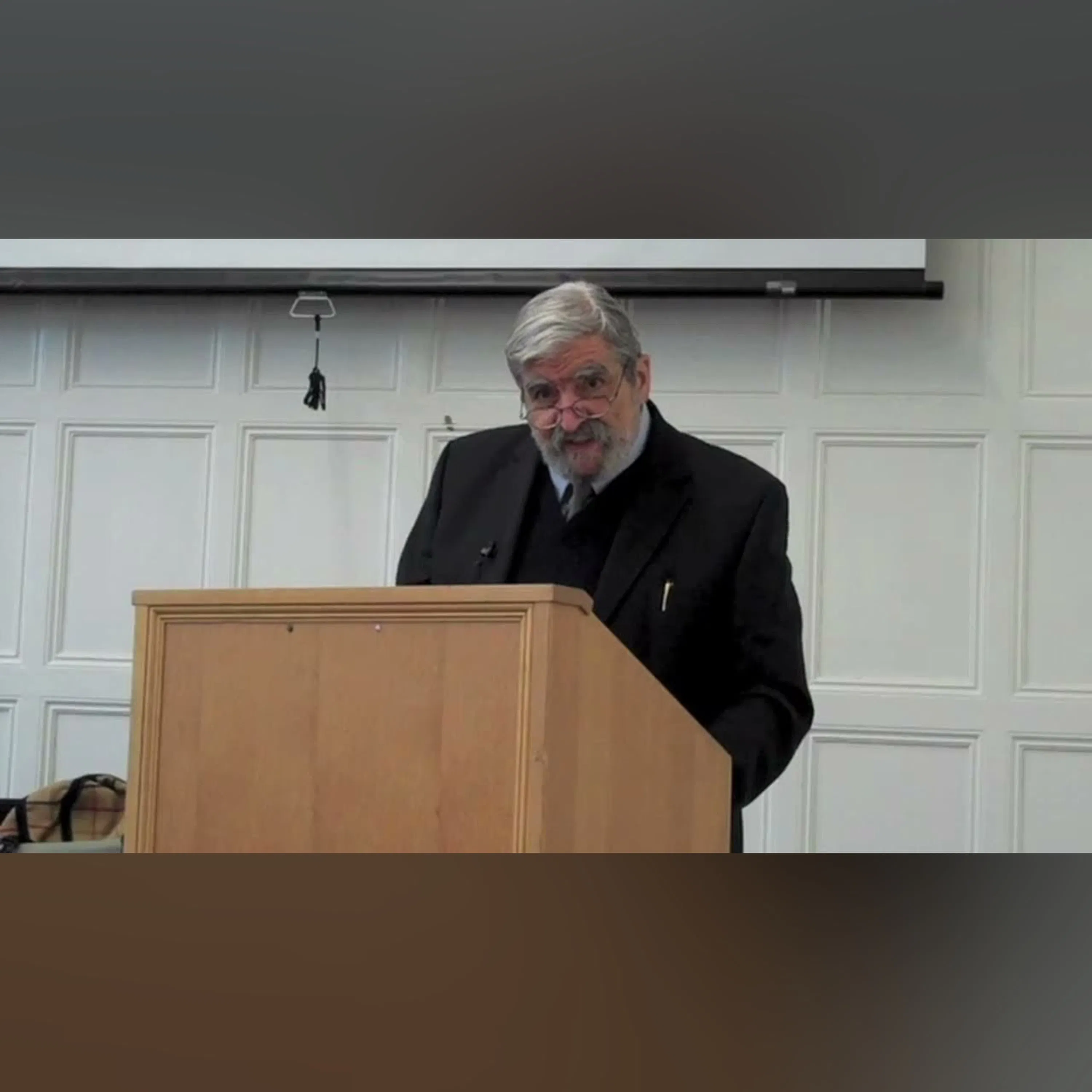
    Wittgenstein on the Mind - Norman Malcolm (1968)

    Rare audio recording of a 1968 lecture by Norman Malcolm on Ludwig Wittgenstein's views about the nature of the mind. He explains why Wittgenstein rejected the notion of the mind as some mysterious inner thing which is private and hidden from view, and which somehow serves as the cause of outward behavior. On the other hand, he also explains why it cannot be identified with mere external behavior either. He goes on to discuss Wittgenstein’s view that there can be no explanation for why people go on in the same way and apply words in similar ways to new cases. For there can be no image, rule, or essence in the head which would be able to play that role and do the kind of work that one would need it to do. #philosophy #wittgenstein #philosophyofmind #language #philosophyoflanguage #historyofphilosophy Learn more about your ad choices. Visit megaphone.fm/adchoices

  • Yesterday · 1 hr

    Reason and Feeling in Ethics - Brand Blanshard (1966)

    Audio recording of a 1966 lecture by Brand Blanshard on reason and ethics given at Wheaton College (Massachusetts). #philosophy #ethics #moralphilosophy #utilitarianism #historyofphilosophy Learn more about your ad choices. Visit megaphone.fm/adchoices

  • Yesterday · 15 min

    The Absurdity of Moral Relativism and Subjectivism - A Polemic

    Skeletons will dance, positions will be refuted. This is a re-upload from the previous channel. It was made in 2016. You may also like the following: https://youtu.be/DFHPH3m-KR8 #philosophy #relativism #ethics #postmodernism #historyofphilosophy Learn more about your ad choices. Visit megaphone.fm/adchoices

  • Yesterday · 1 hr 33 min

    The Romantic Revolution in Politics and Morals - Isaiah Berlin (1969)

    Audio recording of a 1969 lecture by Isaiah Berlin on the romantic revolution in politics and morals at Washington University in St Louis as part of the Assembly lecture series. #philosophy #romanticism #isaiahberlin #intellectualhistory #history Learn more about your ad choices. Visit megaphone.fm/adchoices

  • Yesterday · 2 hr 8 min

    John Locke's Political Philosophy

    After briefly discussing Thomas Hobbes, Professor Charles Anderson discusses the thought of John Locke. This comes from a course on Political, Economic, & Social Thought given at the University of Wisconsin many years ago. 00:00 Thomas Hobbes 21:50 John Locke #philosophy #locke #politicalphilosophy #politicaltheory #historyofphilosophy #hobbes #philosopher Learn more about your ad choices. Visit megaphone.fm/adchoices

Showing 21–40 of 119 episodes