Skip to content
Artwork for Relatively Stable
Society & CultureRelationshipsPhilosophy

Relatively Stable

Kimberly Carter

In Relatively Stable we delve into the journeys of those who have faced challenges, uncovered their passions, and discovered resilience along the way. Whether you're here for the stories, seeking inspiration, or simply drawn to the wisdom we glean from horses—and life—you’re in the right place. Let’s dive into the narratives that remind us how to stay relatively stable, no matter what comes our way.

stableroots.substack.com
Play
  • 23 episodes
  • weekly
  • Avg 22 min
  • English
Counted on this page — what you have heard stays on this device, so it is not something the list can be paged by.
  • Thursday · 34 min

    Alpha is a Misnomer

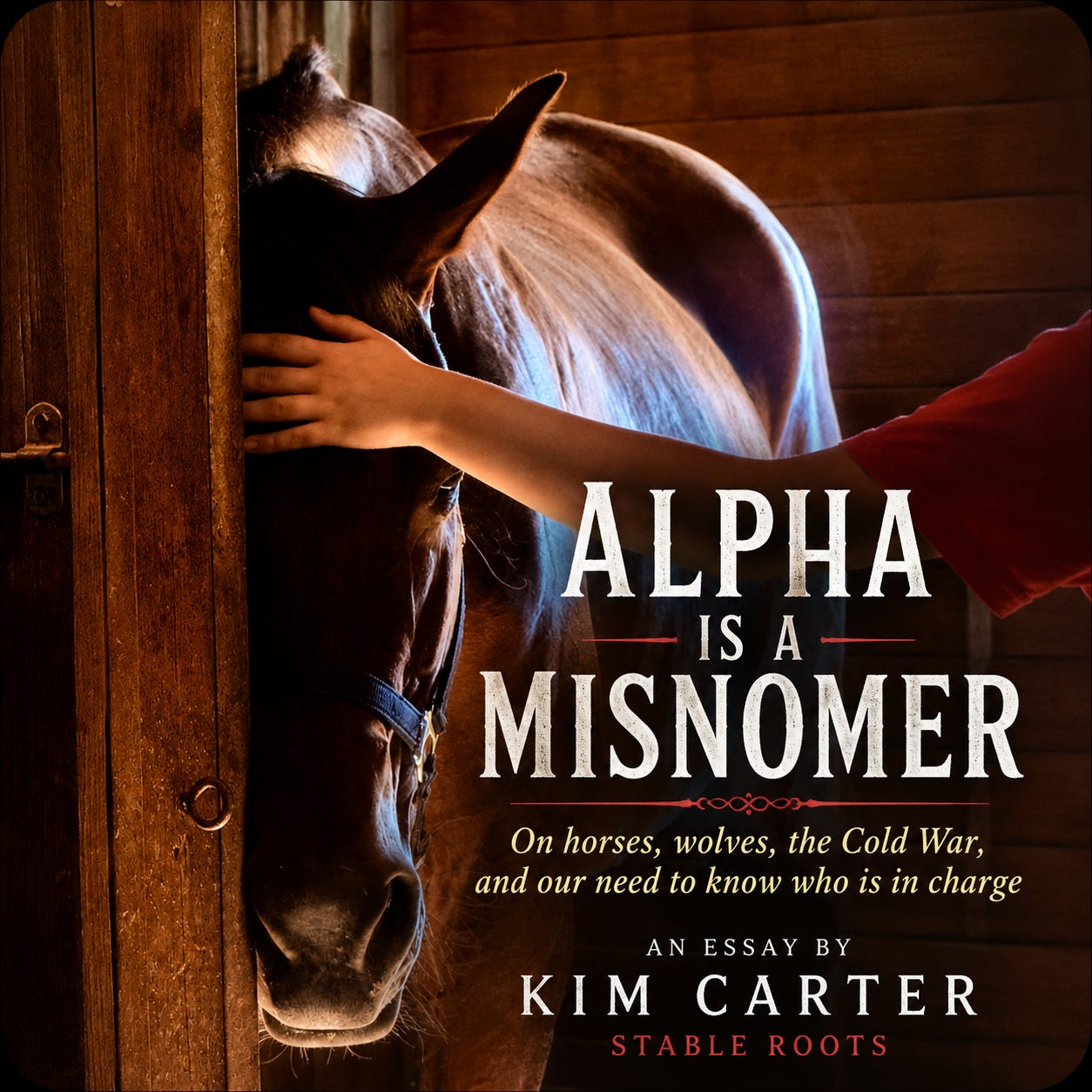
    Alpha is a Misnomer: On horses, wolves, the Cold War, and our need to know who is in charge Who is actually in charge in a herd of horses? For a very long time, we thought we knew. We built entire systems of horsemanship around dominance, hierarchy, and the idea that a good human needed to establish themselves as the leader. Somewhere along the way, the language of Natural Horsemanship became tangled up with Alpha wolves, Cold War thinking, and our very human desire to arrange the world into neat little pyramids with somebody firmly planted at the top. There was just one problem. The wolves weren't actually behaving the way we thought they were. And, if we pay close enough attention, neither are the horses. In this episode, I follow the Alpha from David Mech's early wolf research through the Cold War and into the rise of Natural Horsemanship — and then back out into my own pastures, where Bentley, Max, Pepper, and one world-class dork named Julian have been quietly dismantling some of the things I thought I knew. Because horses certainly have dominance relationships. They move each other. They compete for resources. They have friendships, alliances, preferences and grudges. But dominance isn't necessarily leadership. Sometimes the horse moving everyone away from the hay isn't the horse anyone follows when something strange appears along the fence line. Sometimes the big, bossy gelding is actually the anxious wingman. And sometimes the horse you are absolutely certain is terrorizing a mare is, in fact, desperately trying to hide behind another horse because she will not leave him alone. Twenty-six years into making horses my profession, I'm becoming considerably less interested in deciding who is in charge. I want to know who knows something. And Julian, world-class dork that he is, is still trying to teach me how to pay attention. In this episode David Mech and the history of the Alpha wolf • what captive wolves taught us — and didn't • the Cold War and our cultural obsession with dominance • the rise of Natural Horsemanship • Pat Parelli and the commercialization of leadership • dominance versus leadership in horse herds • what Bentley taught me about Max • the unfortunate prosecution of an innocent Julian • confirmation bias in the pasture • and why changing our minds may be one of the most important things we can learn to do. Written and read by Kim Carter Stable Roots on Substack: Seeing the understory in our everyday lives. This is a public episode. If you'd like to discuss this with other subscribers or get access to bonus episodes, visit stableroots.substack.com/subscribe

  • S2 · E21
    August 20 · 20 min

    A Total Eclipse of the Foxtail

    A weed can be growing beside you for years without causing a bit of trouble. Then somebody teaches you its name — and tells you to be afraid of it. Suddenly, it’s everywhere. This week, between two eclipses, I am roaming a horse pasture hunting foxtail, an ancient grass that has followed agriculture for thousands of years and that I had been conditioned to fear during my unfortunate former life selling hay. There are horses. There are weeds. There are extremely particular hay buyers. There is a basic white girl ordering at Starbucks. There is a brief agricultural history lesson and a small amount of science about whether foxtail is actually plotting to destroy your horse from the inside of a hay bale. But mostly, this is a story about what happens when we learn the name of something that frightens us and suddenly can’t see anything else. Because awareness and danger are not the same thing. And sometimes the thing taking up our entire field of vision was growing there all along. In this week’s VoiceOver of Stable Roots: foxtail, eclipse season, the impossible human desire for nature without all the nature mess, and what the horses seem to understand about the difference between a weed and the whole damn field. Read the full essay and subscribe to Stable Roots for a new piece every Thursday. Relatively Stable is the VoiceOver companion to Stable Roots, written and read by Kim Carter. This is a public episode. If you'd like to discuss this with other subscribers or get access to bonus episodes, visit stableroots.substack.com/subscribe
  • S2 · E30
    August 13 · 17 min

    I'm Sorry, Please Forgive Me

    I'm Sorry, Please Forgive Me (I love you, thank you) This week, I’m thinking about all the things we apologize for that might not require an apology at all. Things like: talking to ourselves, talking to horses, taking up space, having bodies that change. Things like having feeling things we would rather pretend we don’t feel. It begins with a client asking me if it’s okay to speak to a horse and Penny, our resident Amish unicorn, once again refusing to walk over a pole. It wanders through the strange intimacy of discovering my own back in the shower and realizing that, after a lifetime spent believing otherwise, I am not weak. I am not damaged. I am capable. And then we arrive at schadenfreude. Exactly one year after learning that we would have to leave the farm we called home for twenty years, I went looking for information about the subdivision proposed for the land we left behind. What I found cracked open something I thought I had put away. This is an essay about the spells we cast when we say things aloud, the bodies we misunderstand because we cannot see them clearly, the strength that sometimes reveals itself only after the thing we feared most has already happened, and the complicated little bubbles of satisfaction that rise to the surface when life hands us an unexpected ending. There is also: horse emergencies during showers, hay in places that defy physics, a Belgian named Drax escaping through a stall window, the indignities of aging, Friday’s perpetually missing neck collar, buried horses, hypothetical hauntings, and one deeply satisfying opportunity to say: I f*****g told you. I'm sorry. Please forgive me. I love you. Thank you. Written and read by Kim Carter Stable Roots / Relatively Stable Get full access to Stable Roots at stableroots.substack.com/subscribe

  • S2 · E29
    August 6 · 17 min

    But Will There Be Riding?

    But Will There Be Riding? A social media post that took five minutes for me to write reached more than 40,000 people in a couple hours. It wasn't my weekly essay, nor a podcast. It was just a little announcement for an introvert-friendly book club held in the hallway of a horse barn. As strangers began signing up for an event built around silence, I found myself wrestling with an unexpected question: How do you protect something whose greatest value is that almost nothing happens? This week, I'm writing about social media, boundaries, horses, and why our culture is so uncomfortable with stillness. Along the way, I answer the most frequently asked question in the barn: "But will there be riding?" Often, the most important thing a horse teaches us isn't found in the saddle at all. In this episode: - Why a simple Facebook post unexpectedly went viral - The challenge of protecting quiet spaces as they grow - What horses understand about presence that humans often forget - The surprising value of doing less instead of more - Why Books at the Barn isn't really about books Referenced in this episode: 📖 Stable Roots — Weekly essays exploring horses, land, grief, wonder, and the ordinary moments that shape a life. 🐴 Bramblewood Stables — Horsemanship, coaching, farm memberships, and community gatherings in Simpsonville, South Carolina. 📚 Books at the Barn — A free monthly gathering where everyone brings whatever they're reading (or writing), and we spend an hour together in companionable silence before optional conversation afterward. If this episode resonated with you, I'd love it if you'd share it with someone who could use permission to slow down for an hour. Your support helps preserve this old farm and keeps these weekly stories coming. This is a public episode. If you'd like to discuss this with other subscribers or get access to bonus episodes, visit stableroots.substack.com/subscribe
  • S2 · E28
    July 30 · 17 min

    A Time for Everything

    This week in Stable Roots, a rug becomes much more than a rug. As I begin clearing out the room where my father died, I unknowingly prepare my heart for the loss of a dear friend. A conversation over Middle Eastern food, a horse covered in mysterious welts beneath the moonlight, and an old hospice nurse's wisdom all converge into a single realization: we almost never understand the purpose of our ordinary moments until they're behind us. This week's essay is about grief, timing, horses, and the unrelated threads that stitch our life together. In this episode: - Why one room in our farmhouse is called The Mourning Room - The surprising connection between Turkish rugs, asymmetrical music, and the rhythm of riding horses - What Bentley's midnight medical mystery taught me about paying attention - The intersection of faith, science, and the mysteries don't fit neatly in a box. - Why the horses may understand rest better than we do I hope this story feels like coming home. Thank you for listening and for walking this journey alongside me. 🌿 About Stable Roots Stable Roots is my weekly collection of essays from Lavender Hill, where the horses, the land, and farm life reveal extraordinary truths about being human. If these stories resonate with you, I'd love for you to subscribe, share an episode with a friend, or tell me your thoughts. Every small act helps more people discover this work and supports the ongoing restoration of Lavender Hill and our senior herd of horses. Love, Kim This is a public episode. If you'd like to discuss this with other subscribers or get access to bonus episodes, visit stableroots.substack.com/subscribe
  • S2 · E27
    July 23 · 18 min

    Horse with a Pearl Earring

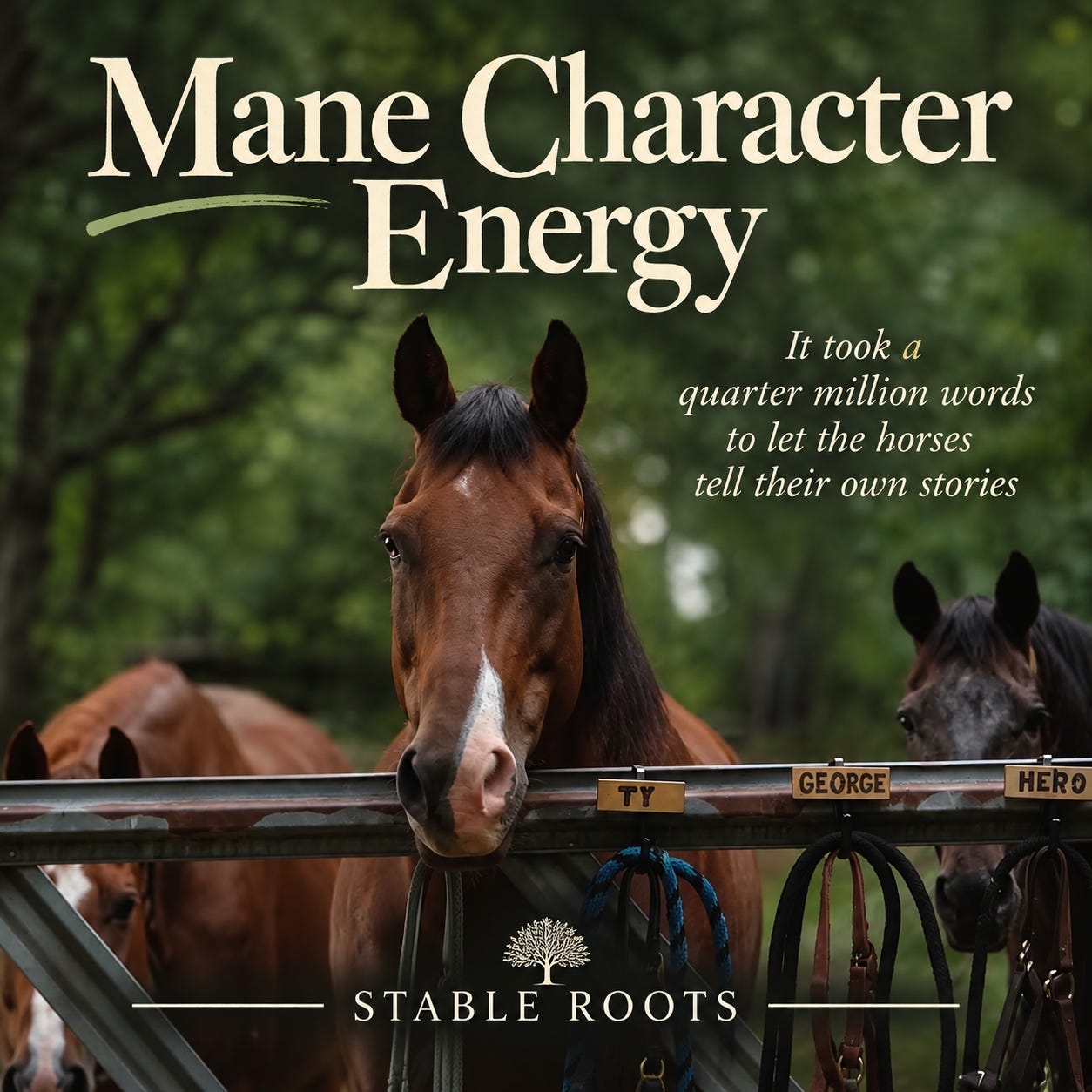
    Horse with a Pearl Earring What do a missing pearl earring, a flea-bitten gray mare named Penny, and three teenagers sleeping in a horse pasture have in common? This week in Stable Roots, I follow a story that began with the certainty that one of my horses had swallowed an earring and ended somewhere entirely different. Along the way, I explore why horses instinctively take the fewest steps necessary, why humans so often invent extra ones, and how living on our new farm is teaching me the difference between responsibility and carrying imagined catastrophes. You'll also meet three young women who have grown up at Bramblewood and started what I hope becomes a lasting tradition: spending a summer night beneath the stars with the horses. Watching them reminded me that preserving farmland isn't just about protecting open space—it's about making room for memories that shape a lifetime. In this episode: - The night I was convinced Penny swallowed my pearl earring. - Why horses are masters of efficiency. - The lesson of "taking fewer steps." - The surprising gift of saying yes instead of automatically saying no. - A new Bramblewood tradition born under a sky full of stars. How Lavender Hill is changing not only the landscape around me, but the landscape inside me. If Stable Roots has become part of your week, I'd love for you to subscribe, leave a review, or share this episode with someone who might need it. If this story reminds you why places like Bramblewood matter, you can also help preserve this work. Your gifts directly support the care of the horses, the stewardship of Lavender Hill, and a place where future generations can build memories like the ones shared in this week's essay. Every contribution, large or small, helps keep this land, these stories, and this community growing. ❤️ Support Bramblewood: at this link. Thank you for walking this path with me each week. Love,Kim This is a public episode. If you'd like to discuss this with other subscribers or get access to bonus episodes, visit stableroots.substack.com/subscribe
  • S2 · E26
    July 16 · 17 min

    The Trees Speak

    A few weeks before my wedding, a tree started singing. Christopher and I were standing beside an old pond, preparing to say our vows beneath its branches, when we heard a sound neither of us could explain. We listened. Then we moved our ceremony. Days later, Hurricane Helene forever changed the landscape around us. This week on Stable Roots, we follow the language of the forest through folklore, forestry, science, and one unforgettable South Carolina forester who seemed to live on an entirely different timeline. Along the way, we explore the mystery of Dropped Bough Syndrome, Tolkien's Ents, and what healthy trees can teach us about carrying too much for too long. Perhaps the trees have been speaking all along. In this episode: - The tree that changed our wedding plans - Hurricane Helene and the forests of the Upstate - The mystery of Summer Branch Drop - Meeting a real-life "Ent" - Why foresters think in decades instead of deadlines - What trees can teach us about letting go If you enjoy these weekly essays, subscribe to Stable Roots. Every Thursday you'll receive a new story from Bramblewood Stables at Lavender Hill, along with its companion voiceover. Paid subscribers become part of the farm collective, helping sustain the writing, the farm, and this growing community rooted in curiosity, resilience, and the quiet work of paying attention. Thank you for listening. Love, Kim This is a public episode. If you'd like to discuss this with other subscribers or get access to bonus episodes, visit stableroots.substack.com/subscribe

  • S2 · E25
    July 9 · 23 min

    The Joy of Mowing

    What if mowing wasn't a chore? This week in Stable Roots, Kim Carter reflects on why climbing onto a tractor has become one of the most restorative parts of life at Lavender Hill. What begins as a story about bush hogging pastures unfolds into a meditation on attention, empowerment, Elizabeth Gilbert's All the Way to the River, the surprising history of lawns, the secret language of roadside ditches, and why Johnson grass might have more to teach us than we'd like to admit. Sometimes the most ordinary work invites us into the deepest conversations—with ourselves, with the land, and with the seasons quietly unfolding around us. Whether you spend your days on a tractor, in a garden, at a workbench, or behind a desk, this episode is an invitation to slow down, pay attention, and discover the unexpected joy hidden in work you can actually finish. In this episode: Why buying a tractor changed more than the way I mowed Measuring an afternoon in Elizabeth Gilbert instead of hours Bush hogging versus suburban lawns The hidden history of the American lawn Reading the stories written in ditches What Johnson grass can teach us about land—and ourselves Why tangible work quiets a busy mind Question for listeners: What work tires your body but fills your spirit? I'd love to hear your answer in the comments. Stable Roots is a weekly essay and narrated podcast exploring horses, historic places, Appalachian culture, faith, human behavior, and the quiet lessons hidden in ordinary life. Subscribe for free or become a paid subscriber to support the work and receive audio narrations, the full archive, and exclusive subscriber content. Written and narrated by Kim Carter Bramblewood Stables at Lavender Hill, Simpsonville, SC New episodes every Thursday. This is a public episode. If you'd like to discuss this with other subscribers or get access to bonus episodes, visit stableroots.substack.com/subscribe
  • S2 · E24
    June 25 · 28 min

    Granny Magic

    Granny Magic: A witness statement from the Blue Ridge Mountains What if the old women knew something we've forgotten? This week, I'm taking you back to one hot summer afternoon when I ran into a burning kerosene heater, my cousins called Aunt Daisy, and she "talked the fire" out of my burn with a prayer passed down through generations. That memory opens the door to a much larger conversation about Appalachian folk traditions, the rise of cottagecore and grannycore, the tension between faith and science, and why so many of us are suddenly longing for the wisdom our own grandparents often left behind. Along the way, I share the story of my remarkable Aunt Winchester, explore the rituals that still survive throughout the Blue Ridge Mountains, and offer my own witness statement about mystery, prayer, healing, horses, and the things I've experienced that I cannot explain away. Whether you believe every story or remain wonderfully skeptical, I hope this episode reminds you that paying attention has always been one of humanity's oldest forms of wisdom. Because perhaps the real magic was never in the rituals themselves. Perhaps it was in remembering how to notice. In this episode: - The day Aunt Daisy prayed the fire out of my burn - The mountain women who carried healing traditions through generations - Why cottagecore and grannycore have become cultural movements - The relationship between Appalachian folk practices and Christianity - Talking fire, stopping blood, weather signs, moon lore, dreams, saints, and horses - Why I believe science and mystery belong in the same conversation - My own witness statement about living in a world that is far stranger than we've been taught If this episode resonates with you, I'd love to welcome you to Stable Roots, where every week I explore the intersection of horses, history, grief, faith, psychology, and the stories that shape the way we live. Love,Kim This is a public episode. If you'd like to discuss this with other subscribers or get access to bonus episodes, visit stableroots.substack.com/subscribe
  • S2 · E23
    June 18 · 25 min

    Shut Up and Listen

    The Ability to Be Taught Why horses care less about what we think we know. What if the most important learning skill isn't intelligence? This week, Kim Carter begins with a one-minute drone video of horses running across a field in Upstate South Carolina and follows an unexpected thread into a much bigger question: What does it mean to pay attention? From horse-crazy barn rats and child labor law research in the pre-internet era to a stubborn girth buckle, fragmented attention, working memory, and the surprising science behind learning styles, this essay explores why children often learn differently than adults—and why horses may be some of the best teachers we have. Along the way, you'll discover: • Why research has largely debunked the idea of visual, auditory, and kinesthetic learners • What psychologists mean by working memory—and why instructions sometimes seem to vanish before we can use them • The surprising reason adults often struggle more than children when learning something new • How modern life trains us to divide our attention into smaller and smaller pieces • Why horses consistently reward curiosity, presence, and the willingness to be a beginner At its heart, this isn't a story about riding lessons. It's about competence, attention, and the increasingly rare ability to stop what we're doing long enough to receive new information. Whether you've spent your life around horses or have never touched one, this episode offers a fresh perspective on learning, listening, and why some of the most important lessons in life begin when we're willing to admit we don't already know the answer. Featured topics:Attention • Learning Styles • Working Memory • Neuroplasticity • Horses as Teachers • Child Development • Adult Learning • Focus in a Distracted World • Personal Growth Key Quote "The best learners are people willing to breathe through their discomfort and listen. And if we're lucky, the horse is patient enough to wait for us to remember how." This is a public episode. If you'd like to discuss this with other subscribers or get access to bonus episodes, visit stableroots.substack.com/subscribe
  • S2 · E22
    June 11 · 19 min

    A Future Me Problem

    What year is your problem from? In this week's Stable Roots, Kim explores a simple thought experiment that came to her in the wee hours between waking and sleeping: What happens when you take a problem you're facing today and place it in another time period? Would a fallen tree have felt different in 1825? What about a dead mouse in a feed bag? Would the problem still exist, or would it reveal itself as a product of modern technology, expectations, and endless decision-making? Through stories from life at Lavender Hill—including a storm-damaged water oak, a Sunday morning botulism scare, and a veterinarian's reminder that knowledge and control are not the same thing—Kim examines why modern life can feel so exhausting even when we have more tools than ever before. Sometimes the problem isn't the problem. Sometimes it's everything we've attached to it. This episode is an invitation to take three steps backward, widen the frame, and ask a different question: What year is my problem from? In This Episode The origin of the phrase "That's a future me problem" Why some modern worries would have made no sense in 1825 The hidden burden of endless options and decision-making A fallen tree, Hurricane Helene, and the cloud of choices surrounding simple problems What a dead mouse in a feed bag taught Kim about uncertainty The difference between knowledge and control Why waiting has become such a difficult skill A practical exercise for gaining perspective when a problem feels overwhelming Memorable Quote "Not every problem belongs to today. Some belong to tomorrow. Some belong to the past. And some problems aren't problems at all, but questions that time hasn't answered yet." Stable Roots on Relatively Stable is the audio companion to Kim Carter's weekly Substack essays, recorded from Lavender Hill in Upstate South Carolina, where horses, history, grief, resilience, and ordinary life intersect in unexpected ways. Read and subscribe to Stable Roots. Follow Kim on Facebook. This is a public episode. If you'd like to discuss this with other subscribers or get access to bonus episodes, visit stableroots.substack.com/subscribe
  • S2 · E21
    June 4 · 17 min

    I'm So Glad I Was Evicted

    The best solutions often come at the worst cost. For two decades, Kim grew a business and a life inside the protective casing of fear—terrified of what would happen if she were ever forced to leave the farm she called home. But human time moves fast, and when an eviction notice arrived to signal that the land was being developed, a twenty-year tenancy vanished in a blink. In this audio essay, Kim reflects on the long, overlapping histories we leave on borrowed ground, the difference between a grand illusion and a true sanctuary, and how a sudden uprooting led her to the 200-year-old threshold of Lavender Hill. We are all just passing through, but some evictions force us to transplant our lives into much richer soil. In This Episode: The Ghost of Morpheus: A twenty-something dream of a grand estate in Tryon, NC, and the warning hidden inside a beautiful illusion. Pot-Bound Roots: Navigating twenty years as a "humble apologist" on borrowed land, overshadowed by the footprints of those who came before. Operating on Land Time: The sudden shock of a six-month eviction notice and the confrontation with a geographic clock. Discovering Lavender Hill: An impossible listing beside a prison, two juvenile armadillos acting like puppies, and a hidden meadow that became a love song. The Reality of Sanctuary: Learning to live in a place that demands partnership rather than deference. Notable Quotes: "Like a garden bed filled with mint, my shoots overlapped with the Turk’s broad trunks, and the shared history of other trainers who had come before us in that space, on that land." "It felt like I was walking into a dream, but one that didn’t come with a warning." "To a mountain or a pasture, a twenty-year tenancy is just a blink, a single season in a vast, geologic clock... Every landlord, every trainer, every husband, and every writer is eventually evicted by time itself." Connect with the Farm: If Stable Roots feels like a conversation you'd like to keep having, join our community. Every week, Kim Carter writes about horses, land, grief, belonging, and how we sometimes have to get lost to find ourselves. Read the original essay & see the photos: at Substack. Support the work: Consider upgrading to a paid subscription to directly support the horses, the land, and the stories harvested at Lavender Hill. This is a public episode. If you'd like to discuss this with other subscribers or get access to bonus episodes, visit stableroots.substack.com/subscribe
  • S2 · E20
    May 28 · 27 min

    The Dreaming

    This week's essay started as a dream about a house I didn't know I owned. Then, it became something bigger — an investigation into why the nature of my dreaming changed the moment I moved to Lavender Hill Farm, and what it means that I'm finally, for the first time in my life, sleeping straight through the night. In this episode I'm reading the full essay, which traces the dreaming through the science of REM sleep, the mystery of the Voynich Manuscript — a fifteenth-century illustrated codex full of plants that don't exist and a script no one has decoded in six hundred years — and into the work of Carl Jung, who went into his own basement at thirty-eight and came back with a map. The essay also visits my cousin Janette, a botanist who told me years ago that she no longer daydreamed, which terrified me at the time. It took me decades to understand what she meant — and to recognize that something else was moving in to take daydreaming's place. If you've been paying attention to your own dreams lately, or noticing that something in your interior life has shifted, this one is for you. In this episode: The house as the self — Jung, Bachelard, and why so many of us dream of rooms we didn't know we have What actually happens in the final hours of sleep, and why most of us never stay down long enough to find it The Voynich Manuscript and the long human tradition of trying to record what lives inside us Active imagination — Jung's practice of going back into the dream and asking the figures what they want The second half of life and the gold that's too close to see Links and references: The Voynich Manuscript — viewable in full at the Beinecke Rare Book and Manuscript Library, Yale University Carl Jung, The Red Book: Liber Novus, edited by Sonu Shamdasani, W.W. Norton & Company, 2009 (affiliate link) Gaston Bachelard, The Poetics of Space, 1958 (affiliate link) If my work resonates with you: Stable Roots publishes weekly essays on the land, the interior life, and the slow work of paying attention. Free subscribers receive each essay in their inbox. Paid subscribers support the farm and the writing, and get a little more of everything. Stable Roots is written and read by Kim Carter and recorded at Lavender Hill Farm This is a public episode. If you'd like to discuss this with other subscribers or get access to bonus episodes, visit stableroots.substack.com/subscribe
  • S2 · E19
    May 21 · 17 min

    The Grass Isn't Always Greener

    This week's episode is the audio companion to the Stable Roots essay — and it starts with Hero, my little chestnut Quarter Horse, army-crawling under an electric fence in the middle of the night to graze the forbidden rushes by the pond. I thought he was being a pain. Turns out, he was a prophet. What begins as a pasture management problem in the middle of a Foothills drought opens into something much bigger — the difference between forcing compliance and allowing recovery, in the land, in our horses, and in ourselves. In this episode: — Why drought weeds are nature's emergency response team, not a sign of failure — What tall fescue's vault strategy teaches us about resilience — The one-rein stop as a metaphor: compliance isn't the same as willingness — How Hero accidentally saved the topsoil by escaping at night — Why I'm trading a perfectly managed life for a recovery-driven one Read the full essay and subscribe at Stable Roots. This is a public episode. If you'd like to discuss this with other subscribers or get access to bonus episodes, visit stableroots.substack.com/subscribe
  • S2 · E18
    May 14 · 16 min

    We Don't Save Old Farms

    We Don't Save Old Farms: (They Save Us) In this week’s Stable Roots, Kim Carter traces the layered history of Lavender Hill — the 200-year-old farm in Simpsonville, SC now home to Bramblewood Stables — through old letters, photographs, buried spring stones, and an antique hand plow that may have originated from the land itself. What begins as research into the farm’s past slowly becomes something more intimate: a meditation on stewardship, memory, and the feeling of stepping into a conversation already underway long before your arrival. This episode explores: - The transformation of Holly Springs Acres into Lavender Hill - Charles and Alona Lavender’s restoration of the farm after the Korean War - The excavation of the original spring house - Forgotten infrastructure and old ways of living with the land - And what it means to enter a relationship with a place instead of simply owning it Read the full essay and explore Stable Roots: Stable Roots on Substack Learn more about Bramblewood Stables at Lavender Hill: Bramblewood Stables South Carolina Department of Agriculture listing for Lavender Hill Farm: Lavender Hill Farm and Bramblewood Stables Last week’s companion piece on disappearing farmland in Upstate South Carolina continues the larger conversation around land stewardship, development pressure, and preservation. Follow along with the ongoing restoration and history work at Lavender Hill on Facebook and Instagram. This is a public episode. If you'd like to discuss this with other subscribers or get access to bonus episodes, visit stableroots.substack.com/subscribe
  • S2 · E17
    May 7 · 28 min

    Your New Neighbors are Costing You a Fortune

    In 2020, the world tilted on its axis. For the Upstate of South Carolina, that tilt sent a wave of 100,000 new residents crashing into our pastures. As we cross the milestone of one million neighbors, the infinite horizon of the American South has officially hit a bottleneck. This week, Kim dives into the canyon between agricultural value and development prices. From the ingenious survival strategy of European track systems to the personal desperation of cashing out a retirement to save her farm by purchasing thirty acres, we’re talking about the high cost of holding the line. Is a farm just a vacant lot waiting for a purpose, or is it the essential, self-sustaining lung of a growing city? In this episode, we discuss: The Million-Resident Milestone: The rapid expansion of the Greenville-Anderson-Greer, South Carolina metro area. The Mother of Invention: Why land scarcity in the Netherlands and the UK forced a smarter way to keep horses, and why we’re next. The Hidden Subsidy: The math that proves farms actually lower your taxes, while subdivisions send you the bill. Legislative Victories: A look at the Old White Horse Road Corridor victory and the new SC laws fighting to protect 7 million acres by 2050. Lavender Hill: A raw look at the survival of a 30-acre heart of a 1,100-acre legacy. Once our dirt is buried under six inches of concrete, the conversation is over. The soil doesn’t get a second chance. And neither do we. Connect & Support: Read the full essay and see the data: at Stable Roots on Substack Subscribe to Stable Roots: Join our community of land stewards and help us hold the line against the asphalt funnel. Follow on Facebook: @kim.carter.equestrian And on Instagram: @two_point About Stable Roots: Stable Roots is a weekly exploration of land, legacy, and the grit it takes to keep them both. Hosted by Kim Carter, a farm owner and advocate in the Upstate of South Carolina, we look at the intersections of agriculture, economics, and the equestrian life in an increasingly crowded world. This is a public episode. If you'd like to discuss this with other subscribers or get access to bonus episodes, visit stableroots.substack.com/subscribe
  • S2 · E16
    April 30 · 28 min

    We Are All Watching the Same Shoreline

    We Are All Watching the Same Shoreline This week I did something I don't usually do — I went down a rabbit hole that started with my clients asking about rain and ended at a United Nations report declaring global water bankruptcy. I work outside every day. I watch the same fields, the same fence lines, the same pond across the street from my kitchen window. And what I've been watching all winter is a shoreline that keeps moving in the wrong direction. Most people around me have no idea we're living inside the driest stretch this region has seen since 1895. They're caring, smart people but their water comes from a tap and their lawn starting to look brown feels like a southern summer rather than a symptom of something much larger. In this episode I'm reading the full piece from this week's Stable Roots. It covers the US Drought Monitor — which was built the same year our pond at Lavender Hill was excavated — the record-breaking drought numbers for the Southeast, what it would actually take to correct the deficit, and why a hurricane may be the only thing that fixes it. From there I zoom all the way out to the UN's January declaration of global water bankruptcy, the shrinking lakes and collapsing aquifers, the cities that are literally sinking, and the Colorado River agreements written for a river that no longer exists. Then I bring it back home. To the rain that fell on Saturday. To the oak grove in the cemetery pasture. To what my grandfather was really afraid of in 1999, and what he couldn't have known to fear. And to the clover fixing nitrogen into dry ground without any help from anyone, because the land is not done. Neither are we. All sources are footnoted in the full piece at Stable Roots. Links below. Read the full piece: Stable Roots on Substack Follow me on: Facebook | Substack | Instagram | If this episode resonated with you, share it with someone who lives indoors. This is a public episode. If you'd like to discuss this with other subscribers or get access to bonus episodes, visit stableroots.substack.com/subscribe
  • S2 · E15
    April 23 · 21 min

    You’re Not Lost, You’re Just Relocating

    You're Not Lost, You're Just Relocating We’ve been taught that running is a sign of weakness, a character flaw, or a symptom of fear. But if we look at the architecture of the horse, we see a different story. A horse doesn't run to disappear; it runs to gain the distance required to turn around and face the threat. In this episode, we dive into the "biology of the turn." We explore why we feel so exhausted by the modern world (it’s not the running—it’s the lack of resolution) and how to distinguish between chronic flight and the sacred movement toward perspective. Whether you are currently in a sprint or standing in the pause, this conversation is an invitation to stop accumulating threats and start gathering meaning. In This Episode: - The Architecture of Go: Why horses are built for speed, but designed for study. - The Ghost in the Graveyard: Reinterpreting Rumi’s advice on facing what haunts us. - Chronic Flight vs. Wise Distance: How to tell if your "running" is healing you or harming your relationships. - The Biology of the Turn: Why we cannot find clarity until we regulate our nervous systems. - Relocating, Not Lost: A reframe for those who have walked away from lives that no longer fit. Join the Greater World of Stable Roots: If this episode resonated with you, there are several ways to plant deeper roots in this community. - The Stable Roots Substack: Read the full essay and join the conversation in the comments. - Support the Farm: Our work is funded by readers and listeners like you. Become a paid subscriber to ensure the horses and humans here have a place to "turn and look." - Work with Kim: If you’re in the middle of a sprint and need someone to hold the wider view while you catch your breath, visit my new digital home. - Bramblewood Stables: See the landscape of the farm and the horses mentioned in today's episode. Connect with Kim: - Instagram: @two-point - Facebook: kim.carter.equestrian "The horse knows something that is immensely hard for people to understand—the body moves before clarity and choices come into focus." Subscribe/Follow on: [Apple Podcasts] | [Spotify] | [YouTube] This is a public episode. If you'd like to discuss this with other subscribers or get access to bonus episodes, visit stableroots.substack.com/subscribe
  • S2 · E14
    April 16 · 22 min

    The Witness

    Bearing Witness — What It Means to Be Seen, to See Others, and to See Yourself This week in Stable Roots, Kim Carter writes about witnessing — what it truly means to be present for someone, and how our instinct to fix things often gets in the way. After a surprise visit from two of the most important people in her life, Kim found herself thinking about the kitchen table, a hidden drawer full of medicine, and what it looks like when someone actually stays in the field of hard things with you instead of trying to move you through them. In this episode: → Why our instinct to help is often really our instinct to make our own discomfort stop → The Old English roots of the word "witness" — and why it was originally about knowing, not watching → What horses, elephants, and mares can teach us about co-regulation and presence → The difference between people who love the version of you that's winning and those who can love the version of you that's simply trying → How to become a witness to your own life while you're still living it There are witnesses to the medicine. This episode is one of them. — Stable Roots at Relatively Stable is written and hosted by Kim Carter. New episodes every week. Follow along on Substack | Facebook: Kim Carter This is a public episode. If you'd like to discuss this with other subscribers or get access to bonus episodes, visit stableroots.substack.com/subscribe
  • S2 · E13
    April 9 · 22 min

    The Biological Prayer

    The world is talking. It has always been talking. We are the only species that decided, somewhere along the way, to stop transmitting. This week's episode is the second in the Invisible Altar series — and it goes somewhere unexpected. We start in the barn, with the frozen silence of a person who has just been offered a list of options and can't locate, anywhere inside themselves, what they actually want. And we end with humpback whales singing across four hundred miles of open ocean, elephants grieving into the ground, wolves locating each other across valleys and forests, and a horse's hoof picking up seismic signals through the earth. These aren't separate subjects. They're the same one. IN THIS EPISODE Why consent and choice are the hardest exercises we do at Bramblewood Stables at Lavender Hill — and what that reveals about how far humans have drifted from their own signal The science of how humpback whales transmit evolving songs across entire ocean basins — and what MIT researchers recently discovered about a sperm whale phonetic alphabet How elephants grieve through infrasound frequencies the earth carries better than air, sending mourning through the ground from one set of feet to another What Pacinian corpuscles are, why horses have them in their hooves, and why you have them in your feet — and what it means that both of you have been standing on a transmitting earth this whole time Why the leaves coming in at Lavender Hill this week changed the frequency of the entire farm — and what the people who hadn't visited in two weeks felt in their bodies before they understood what had changed What happens to the body when we interrupt our own transmission long enough — and how the channel back is shorter than we think THIS WEEK'S PRACTICE At the end of the episode you'll find an audit and a practice. The short version: find one signal your body has been trying to send this week that didn't get to complete — a breath, a sigh, a walk, a hand on something living — and give it five unwitnessed minutes. The wolves don't explain the howl. You don't have to either. IF THIS EPISODE FOUND YOU Last week's episode — the first in the Invisible Altar series — introduced the idea of the farm as a place of practice, and Indigo the cat as an unlikely teacher. If you haven't heard it, it's a good place to start. Next week we go further in: what it means to build a practice around something you can't fully name yet, and why that might be exactly the point. FIND THE FULL ESSAY + SOURCES Read this week's essay on Substack. If Relatively Stable is finding you at the right moment, the best thing you can do is share it with one person who might need it too. Leave a review if your podcast app allows it — it matters more than the algorithms want you to think. And if you want the written version delivered to you each week, Stable Roots is where this all lives. Come find me there. Love, Kim This is a public episode. If you'd like to discuss this with other subscribers or get access to bonus episodes, visit stableroots.substack.com/subscribe
Showing 1–20 of 23 episodes