Skip to content
Artwork for Manufacturing the Future

Manufacturing the Future

Epicor

Manufacturing the Future is dedicated to helping manufacturing leaders future-proof their operations. Each episode features interviews with innovative manufacturing executives, subject matter experts, and thought leaders who share actionable insights, tips, and best practices to embrace technology so they can streamline operations, prepare for what lies ahead, and continue to keep the world turning.

Play
  • 20 episodes
  • fortnightly
  • Avg 34 min
  • English
  • August 13 · 36 min

    Harmar's Stephen Hightower on the data problem hiding behind AI in manufacturing

    "They have a data problem that's wearing an AI costume. Because if you don't have accurate data, it doesn't matter what you do, you just do it faster." – Stephen Hightower A sharp wake-up call from Stephen Hightower, Chief Technology Officer at Harmar, who put a moratorium on development until his team fixed the data underneath. The problem he's solving isn't just data quality, it's the operational waste that builds up when three integrated enterprise systems don't agree with each other, manual workarounds become tribal knowledge, and spreadsheets quietly replace the systems people no longer trust. When your data is broken, AI doesn't fix it. It just does the wrong thing faster. In This Episode: Stephen walks through how he's rebuilding data confidence at Harmar, a manufacturer of mobility and accessibility solutions. He describes launching a Master Data Initiative using CRUD and RACI matrices to assign clear ownership for every critical data element across engineering, ERP, and customer systems. He explains why cycle time, quality, and unit cost are the only three metrics that matter in manufacturing, and how tracking integration error rates across systems exposes where data breaks down. Stephen also shares how his Lean Six Sigma background, starting in the late 90s at Lockheed Martin, shaped his approach to treating broken tech stacks as waste to be eliminated through root cause analysis and corrective action. He describes putting monitoring tools in place to gain insight the ERP system wasn't providing, deploying a digital worker to handle customer care calls so his team can move up the value chain, and using the financial close cycle time as a diagnostic for how well a business is really running. He's also candid about AI's limitations: he uses Claude for data analysis and engineering cycle time problems, but stresses that every AI output requires human verification because it will, in his words, "lie to you all day long." Topics: Why most AI failures start with a data problem wearing an AI costume Running a master data initiative using CRUD and RACI matrices for clear ownership Tracking integration error rates across enterprise systems to expose waste Applying Lean Six Sigma to broken technology stacks Finding the hidden spreadsheets that signal system waste and broken trust Using monitoring tools to gain real operational insight the ERP wasn't providing Deploying a digital worker for customer care operations Why financial close cycle time reveals operational health The "go find the spreadsheets" test for any manufacturing business A conversation with Stephen Hightower of Harmar about why most manufacturers have a data problem wearing an AI costume, and how master data management and Lean Six Sigma applied to technology fix it from the inside. Download, Listen, and Subscribe Apple | Spotify | YouTube Or search "Manufacturing the Future" wherever you listen to podcasts!
  • July 30 · 15 min

    Tyler Madsen and Jason Bassett on cutting spec review from 2 hours to 15 seconds with AI

    "What used to take me two hours takes me about 15 seconds now." – Tyler Madsen A striking before and after from Tyler Madsen, Director at Madsen's Millwork & Custom Cabinets, who rebuilt their estimating workflow by feeding drawings and specifications into an AI bot that strips out irrelevant data and returns only what's needed to quote a job. The broader problem he and IT & Asset Manager Jason Bassett are solving isn't just speed, it's the operational drag that builds up when a manufacturing shop is still running on paper drawings, manual data sorting, and an IT person who becomes the bottleneck every time someone needs an answer. When information lives on paper, you get version control failures, field installers working off outdated drawings, and a team spending its time managing data instead of acting on it. In This Episode: Tyler and Jason walk through how Madsen's Millwork has digitized its day to day operations, from estimating to the shop floor to field installation. Tyler describes feeding specs and drawings into an AI bot that strips out irrelevant data for quoting. Jason covers the physical changes on the shop floor: big screen displays at every workstation now pull live drawings, replacing paper that created double data sets and made version control nearly impossible. He also gives field installers the same live job data on site, so a mid job change reaches them in real time, and describes building knowledge banks inside Epicor Prism pre-loaded with the questions his team most commonly brought to IT, so employees self-serve instantly instead of waiting on him. They're also candid about what isn't solved yet: getting skilled trades workers to trust and adopt AI day to day remains an open challenge, and they also flag hallucinations as a real operational risk that requires experienced human oversight to catch. Topics Cutting spec review from two hours to 15 seconds using an AI bot Building Epicor Prism knowledge banks to eliminate the IT bottleneck AI owns data retrieval; humans own judgment, their workflow decision framework The mutual checking model: humans verify AI output, AI challenges human decisions Replacing paper drawings with live digital displays at every shop workstation Field installers accessing real-time job drawings remotely during installation Using client AI renderings as the engineering starting point for custom projects Why getting skilled trades workers to trust AI remains their biggest unsolved challenge Hallucination risk in manufacturing operations and how to stay vigilant Download, Listen, and Subscribe Epicor | ⁠Apple⁠ | ⁠Spotify⁠ | ⁠YouTube⁠ Or search “Manufacturing the Future” wherever you listen to podcasts!
  • July 16 · 33 min

    Mike Wargocki on how Framebridge pushed gross margin from 27% to 40% during peak season

    "Everything is basically a fact-finding mission. You're trying to figure out what you can do, how fast you can do it, and how efficiently you can do it." – Mike Wargocki Manufacturing leaders who scale fast tend to break their own operations without realizing it, not through a single bad decision, but through a string of reasonable ones: reinvesting in an existing plant one quarter too late, forcing identical equipment into buildings that were never built for it, or promoting an early team member into a role they were never suited for. The trouble is that most of these metrics and mistakes don't show up on a standard dashboard. Mike Wargocki has spent his career finding the operational truths that hold across food, biotech, and custom consumer manufacturing, and figuring out which numbers actually predict performance versus which ones just look good in a report.Much of this conversation draws on Mike's time at Framebridge, a company rethinking how custom framing is designed, produced, and delivered. Framebridge built a direct-to-consumer model that turned a traditionally complex, expensive process into something far more accessible, and has produced over two million custom frames as a result. The company has continued scaling quickly, bringing new manufacturing facilities online across the US to support both e-commerce and retail growth. In This Episode: Mike Wargocki, VP of US Operations at DINGS' Motion USA, walks through the operational lessons he built over a career spanning research chemistry, food, biotech, and custom consumer manufacturing. He explains why OEE stops being a useful metric once production gets custom, and why he shut down a limestone cave facility outside St. Louis despite its near-free refrigeration, once quality started slipping. He breaks down the real cost of forcing identical equipment across a multi-site network, how to time a new facility build against a real growth plateau instead of a projected one, and how his team planned peak season staffing at Framebridge without blowing the annual budget. He also shares where he sees manufacturing leaders waste money without noticing, why early employees aren't always the right fit for the next stage of growth, and how his team has used AI tools to help non-native English speakers write difficult workplace communications. Topics discussed: Why OEE fails as a metric in custom manufacturing The real cost of forcing equipment uniformity across facilities Timing new facility builds against a growth plateau Balancing peak season staffing without blowing the annual budget Closing a newly built facility over a hidden quality trade-off Applying a chemist's fact-finding approach to operations leadership Right-sizing early team members as a company scales Using AI to help non-native speakers write difficult communications Download, Listen, and Subscribe Apple | Spotify | YouTube Or search “Manufacturing the Future” wherever you listen to podcasts!
  • June 18 · 14 min

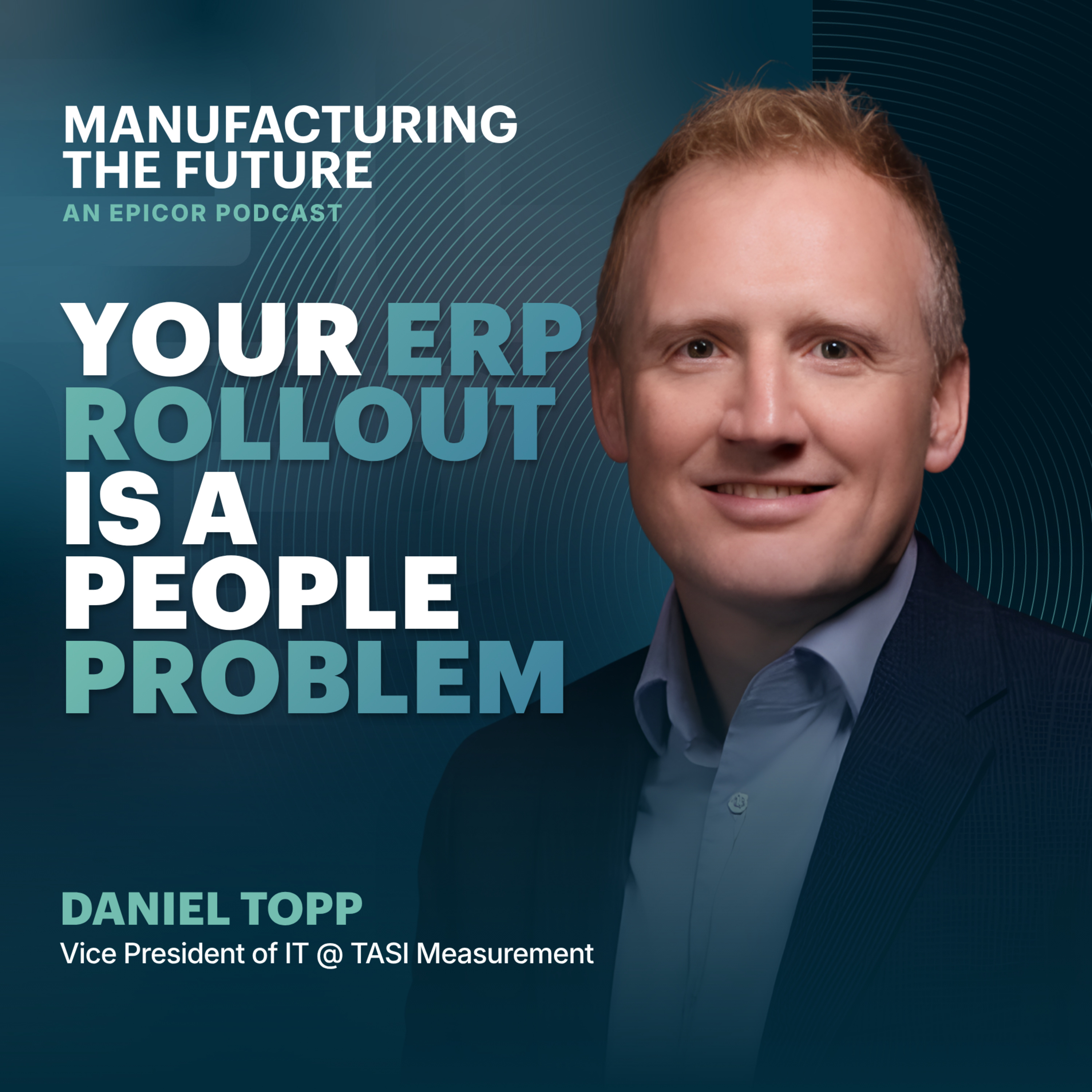
    Daniel Topp on why ERP projects fail at training, not technology

    "We're common where possible and unique where necessary." A deceptively simple principle from Daniel Topp, VP of IT at TASI Measurement, that gets very complicated when you're managing ERP across 16 autonomous business units and integrating newly acquired companies on a rolling basis. The real question is how you operationalize it so it doesn't collapse under the weight of competing business unit priorities and leadership requests for customization. TASI Measurement is a global industrial measurement holding company with more than 1,000 employees, headquartered in Largo, Florida, operating through a highly decentralized structure where each business unit runs independently under the broader group. In This Episode: Daniel walks through the specific systems he's built to keep ERP standardization from becoming a constant negotiation. That includes a formal customization approval process requiring sign-off from key stakeholders before any deviation from off-the-shelf is permitted, and a 30-60-90 day acquisition integration playbook that separates non-negotiables like IT security tools from ERP decisions, which get evaluated through a risk and value heat map. He explains why data migration is where repeat ERP transformations actually improve, and why building a dedicated headquarters-level migration team, rather than relying on business unit staff, is what makes the process repeatable and scalable. He also makes the case that locking in structural decisions like chart of accounts early in a project is the difference between finishing on time and losing months at the end. On AI, his position is direct: having it available inside your ERP without a structured rollout plan is a liability, not an advantage. Topics: Why ERP projects fail at training and change management, not implementation Formal customization approval process requiring stakeholder sign-off 30-60-90 day acquisition integration playbook and what's non-negotiable from day one Risk and value heat map for sequencing ERP integration priorities across acquisitions Gold standards center of excellence and how it serves newly acquired businesses Why locking in decisions like chart of accounts early can make or break a project timeline Building a dedicated, headquarters-level data migration team as a repeatable capability Unstructured AI rollout inside ERP as an organizational liability Translating IT efficiency into quantified dollar savings to shift IT from cost center to strategic partner Meta Description: A conversation with Daniel Topp, VP of IT at TASI Measurement, about how he built repeatable systems for managing ERP standardization and acquisition integration across 16 autonomous business units, and what it actually takes to position IT as a strategic partner in a decentralized global organization. Download, Listen, and Subscribe Apple | Spotify | YouTube Or search “Manufacturing the Future” wherever you listen to podcasts!
  • S4 · E1
    April 16 · 1 hr 3 min

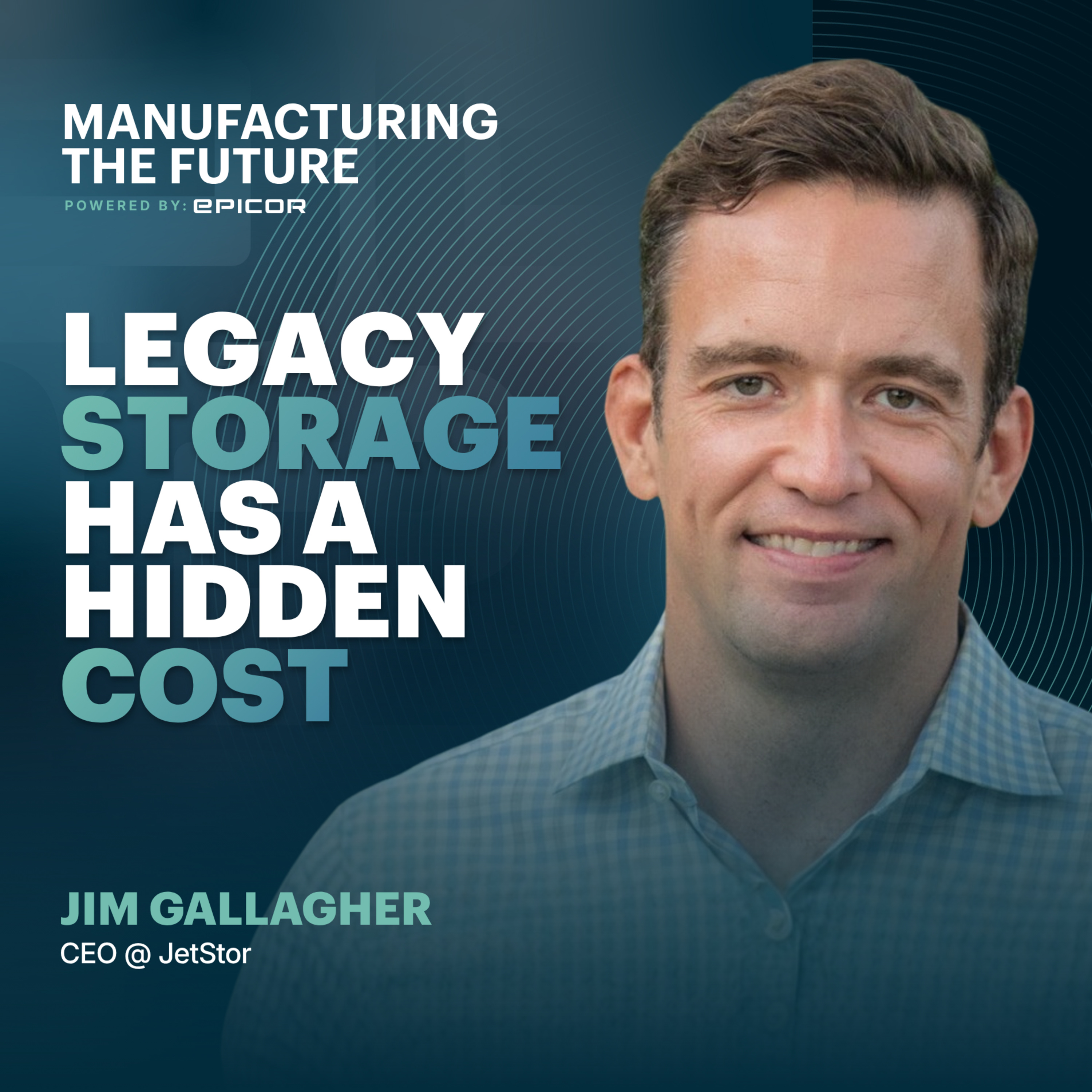
    JetStor’s Jim Gallagher on Why 'Good Enough' Infrastructure Costs More Than You Think

    "Every company is becoming both a data company and a bank. If you're not doing this stuff and not keeping an eye on it, other people are." A lasting warning from Jim Gallagher, CEO at JetStor, who argues that although manufacturers are generating more data than ever, most haven't built the infrastructure to actually use it. The common mistake isn't a lack of storage; it's treating storage as a flat, one-size-fits-all decision rather than a tiered architecture matched to how data gets used. Without that foundation, companies can't run real-time analytics, can't prepare for AI workloads, and are quietly accumulating technical debt that compounds over time. Jetstor is a US-based enterprise storage company with more than 30 years in the business. The company designs and manufactures scalable storage systems built for demanding workloads, including virtualization, high-performance computing, media production, and data-intensive manufacturing environments. In This Episode: Jim walks through how manufacturers should be structuring their data strategy, starting with a three-tier classification framework: tier 1: for real-time, latency-sensitive workloads; tier 2: active archive for data that still needs to be accessible; and tier 3: deep archive for long-term retention. He explains why staying with legacy infrastructure isn't actually "free.” Jim closes with a concrete challenge for manufacturing leaders: when was the last time your team actually tested your backups? Topics Why storage is not a flat ecosystem, and the performance-cost trade-offs that actually matter Three-tier data classification: real-time, active archive, and deep archive The "data lake" trap: why unstructured data hoarding happens and what it actually costs Why training workloads and inference workloads need entirely different architectures The 1-2% annual hardware failure rate and what that means for legacy infrastructure planning How the DevOps movement in IT foreshadows the IT/OT convergence coming to manufacturing Why "when did you last test your backups" is the question manufacturing leaders should be asking right now Ransomware as a business risk, data insurance products, and what underwriting requirements actually look like Why manufacturers that have been gathering data for decades may be sitting on unexpected revenue streams Apple | Spotify | YouTube

  • Dec 11, 2025 · 33 min

    Eaton's Cameron Peahl on Building Additive Strategies That Work

    Meet Cameron Peahl, Global Additive Manufacturing Strategy Manager for Industry 4.0 & Program Manager for I4.0 Digital Factories at Eaton Cameron Peahl, Global Additive Manufacturing Strategy Manager for Industry 4.0 & Program Manager for I4.0 Digital Factories at Eaton, brings over 12 years of hands-on experience transforming how one of the world's largest power management companies approaches additive manufacturing. "It's a cultural journey through Industry 4.0. It's not a technology journey," Cameron emphasize, highlighting a fundamental truth many organizations overlook. Manufacturing leaders face a critical challenge: how to adopt emerging technologies like additive manufacturing without falling into expensive pitfalls or creating unused "paperweights" collecting dust in factory corners. The misconception that 3D printing can simply replace traditional manufacturing processes has led countless organizations to failed investments and disillusionment. Meanwhile, those who dismiss additive entirely miss transformative opportunities for operations support, rapid prototyping, and product innovation. Cameron's path at Eaton began as a manufacturing engineer on the factory floor in Rhode Island, progressing through quality roles before leading the company's Additive Manufacturing Center of Excellence. His team achieved an industry first: putting a 3D printed part in a commercial aircraft fuel system. This journey taught him that successful additive implementation requires understanding where the technology genuinely adds value versus where conventional manufacturing remains superior. In This Episode This episode explores Eaton's four-pillar strategy covering prototyping, operations support, supply chain resiliency, and superior production. Cameron shares why operations support has delivered unexpected massive returns, how to select reliable technology that teams will actually adopt, and why investing in organizational culture trumps technology purchases. His practical advice helps manufacturers avoid common mistakes while building innovation engines that transform workplace engagement and deliver measurable ROI. Topics Understanding Eaton's four-pillar additive manufacturing strategy covering prototyping, tooling, operations support, supply chain resiliency, and superior production at scale. Why supply chain resiliency through direct part replacement is the most challenging pillar and often leads to failed implementations. How operations support with 3D printing has delivered massive unexpected value and transformed factory culture. The importance of selecting reliable, easy-to-use additive systems that don't become barriers to adoption across diverse global factories. Balancing investments between additive and traditional manufacturing methods by understanding where each provides genuine value. Key roles and mindsets needed when moving from prototyping to production, including systems-level thinking and design. Lessons from aerospace component development on why part consolidation and performance improvements create better business cases than cost reduction. Current materials innovations improving layer adhesion and Z-strength that unlock new opportunities for additive manufacturing applications. How AI enables real-time factory insights, closed-loop process control, and autonomous manufacturing operations for additive and beyond. Building innovation-driven organizational cultures that embrace technology adoption, accept calculated failures, and pull for digital transformation initiatives. Resources 60 Minutes segment on 3D-printed houses Get in touch with your host, Kerrie Jordan: LinkedIn Twitter Download, Listen, and Subscribe Apple | Spotify | YouTube

  • Nov 27, 2025 · 35 min

    Tulip's Natan Linder on Why AI Is Everywhere and Nowhere

    Meet Natan Linder, Co-founder & CEO of Tulip Natan Linder, Co-founder & CEO of Tulip, brings a unique perspective to manufacturing technology, shaped by years spent working directly in production environments. As he explains, the genesis of Tulip came from observing a fundamental gap: "There's a missing piece of software platform in the stack that is designed for the people who actually do the work in operations." His career working on collaborative robotics, 3D printing, and embedded systems consistently brought him face-to-face with frontline workers who lacked the digital tools that office workers take for granted. Manufacturing organizations struggle with rigid systems that cannot adapt quickly enough to changing business needs. Traditional enterprise software requires lengthy implementation cycles, detailed specifications, and often delivers solutions that are outdated by the time they go live. This inflexibility prevents manufacturers from achieving the continuous improvement and agility necessary to remain competitive in today's rapidly evolving markets. The lack of accessible tools for industrial engineers, quality experts, and process specialists means valuable domain expertise remains locked in spreadsheets and tribal knowledge rather than being captured in scalable digital workflows. Tulip was founded in 2014 by engineers from MIT Media Lab, including Natan and his co-founder Roni Kubot. The company emerged from a simple but powerful insight: manufacturing needed a no-code, cloud-based platform that would allow frontline operations experts to create custom applications without requiring traditional software development. By giving industrial process engineers, quality teams, and operations managers the ability to digitize their workflows and capture data on their own terms, Tulip enables what Natan calls composable operations, where production systems can be built bottom-up by the people who understand the work best. In This Episode Natan Linder discusses why he believes digital transformation is a meaningless term that should be replaced with continuous transformation. He explains how AI is finally becoming useful in operational environments when properly governed and integrated into platforms that understand manufacturing context. The conversation covers composability versus modularity, the importance of empowering frontline workers with first-class technology tools, and why manufacturing competitiveness depends on giving organizations the ability to iterate and improve rapidly rather than waiting months for new software features. Topics How spending years in production environments led to identifying the missing software layer designed specifically for frontline operations. Modular vs. composable systems and why composable operations enable organizations to adapt and evolve production systems. Why digital transformation is a meaningless buzzword and should be replaced with continuous transformation as an ongoing practice and mindset. How AI has been used in manufacturing for decades but generative AI requires proper governance and context to be useful. The critical importance of empowering frontline workers with the same quality of technology tools that knowledge workers have enjoyed. Focusing on solution-first thinking aligned with business goals rather than adopting technology just because others are doing it. How global supply chain reconfiguration is driven by geopolitical factors, customer proximity needs, and the desire for reduced dependencies on single sources. The role of no-code platforms in enabling industrial engineers and process experts to capture domain knowledge and create digital workflows independently. Resources Augmented Ops, Natan’s podcast Get in touch with your host, Kerrie Jordan: LinkedIn Twitter Download, Listen, and Subscribe Apple | Spotify | YouTube

  • Nov 6, 2025 · 58 min

    Theresa Caragol & Brenda Nobleza on How Partners Accelerate Digital Transformation

    Meet Theresa Caragol & Brenda Nobleza In a special episode of Manufacturing the Future, Theresa Caragol, Founder & CEO of AchieveUnite, shared a powerful insight about the changing landscape of business relationships: "I do fundamentally believe we are entering the era of partners and the organizations that partner the best will be the most successful long term." Brenda Nobleza, VP of Channel Sales at Epicor, reinforced this vision, explaining that "our manufacturing customers, they're not just looking for software, they're looking for solutions, they're looking for partnership, they're looking for a joint investment in their company and their growth." Together, they unpack what it takes to build channel partnerships that truly drive growth in manufacturing. Manufacturing companies are looking for partners who will align with their strategy and become part of the team taking them to the next level. The old transactional model of channel relationships is giving way to strategic partnerships where vendors, partners, and customers collaborate to solve complex business problems, accelerate digital transformation, and leverage emerging technologies like AI. AchieveUnite emerged from Theresa's desire to balance global business leadership with family life, evolving from consulting work into a company that now employs a team of experts focused on partner performance and channel consulting. Meanwhile, Epicor is undergoing its own transformation, embracing partners more than ever and creating a culture of team selling across the organization. In This Episode Throughout the episode, both leaders emphasize that successful partnerships require cultural alignment, transparency, and mutual investment. They discussed the importance of focusing on business outcomes rather than transactions, the role of AI in partner enablement, and why trust has become an essential currency in modern business. For manufacturing leaders, the message is clear: the ecosystem you build through partnerships can become as strategic an asset as your products themselves. Topics Understanding why investing in long-term partnerships achieves higher revenues and profitability than focusing on transactions. The Partnership Intelligence framework and how identifying trust-building styles accelerates and partner success. Why cultural alignment is the number one criterion when selecting new channel partners for manufacturing technology companies. How transparent communication and mutual goal-setting create the foundation for trusted relationships between vendors and partners. The evolution from direct vs indirect sales models to collaborative ecosystems where multiple partners co-create customer solutions. Why manufacturers benefit when vendors have strong partner networks that deliver faster, more agile, and flexible solutions. How AI is transforming partner enablement through personalized content delivery, training certifications, and improved processes. The importance of mentoring emerging talent and creating career paths that develop future leaders in manufacturing technology. Shifting organizational culture from product-focused to partnership-focused mentality through top-down leadership. Why business outcomes rather than technology features should drive partnerships between vendors, partners, and customers. Resources Partnering Success: The Force Multiplier to Achieve Exponential Growth by Theresa Caragol Good to Great by Jim Collins Crossing the Chasm by Geoffrey Moore Mindshift by Barbara Oakley National Association of Corporate Directors (NACD

  • Sep 25, 2025 · 38 min

    Bristlecone's Ramji Mani and Jennifer Chew on Why AI Won't Fix Broken Processes

    Meet Ramji Mani & Jennifer Chew of Bristlecone Supply chain leaders Ramji Mani, VP of Digital Supply Chain Ecosystem & Executive Board and Jennifer Chew, VP of Solution & Consulting at Bristlecone, bring decades of transformation experience to Manufacturing the Future. "You need to fix your processes to make sure that the processes can support what the business needs and that gets translated into technology," says Mani, highlighting a truth many organizations overlook in their digital transformation journeys. Bristlecone tackles complex supply chain challenges across diverse industries, from helping a Canadian blood organization deliver life-saving products to ensuring pizza companies have doors ready at every outlet at the cheapest price. Their consultants work at the intersection of people, process, data, and technology to deliver value however clients define it, whether through bottom-line improvements, customer service excellence, or operational efficiency. Founded in 1998 and headquartered in San Jose, California, Bristlecone emerged with a mission to be the best partner of choice for supply chain transformation. With over 300 completed engagements across more than 20 industry verticals, the company has built expertise in process optimization, change management, and risk resilience while partnering with major solution providers to deliver integrated supply chain, procurement, and analytics solutions. In This Episode In this episode, Ramji and Jennifer debunk persistent supply chain myths, from the belief that AI will solve everything to the assumption that existing data quality is sufficient for transformation. They share practical insights on managing tariff challenges, implementing successful AI solutions, diagnosing supply chain red flags, and balancing sustainability initiatives with business objectives while emphasizing the critical importance of change management in achieving lasting transformation success. Topics Debunking the myth that AI will solve all supply chain problems without proper process foundation and human oversight. Understanding why most companies overestimate their data quality and how poor data undermines transformation initiatives completely. Recognizing that technology implementation alone cannot fix supply chain problems without addressing underlying business processes first. Building value-centric roadmaps with measurable KPIs to guide supply chain transformation investments and prioritization decisions. Managing supply chain disruptions from tariffs through strategic sourcing, scenario planning, and network optimization initiatives. Identifying supply chain red flags through comprehensive analysis that reveals hidden problems behind seemingly positive metrics. Implementing AI solutions successfully by moving beyond pilot paralysis toward scaled, integrated business transformation approaches. Balancing sustainability initiatives with productivity and profitability goals across different industries and regulatory environments. Navigating organizational change resistance through effective communication, stakeholder engagement, and capacity management during transformations. Developing supply chain talent for the future workforce while adapting to AI-enhanced tools and changing skill requirements. Get in touch with Jennifer Chew: LinkedIn Get in touch with Ramji Mani: LinkedIn Get in touch with your host, Kerrie Jordan: LinkedIn Twitter Download, Listen, and Subscribe Apple | Spotify | YouTube

  • Sep 11, 2025 · 42 min

    Dollar Shave Club's Justin Brown on Disrupting Industries and Leading Through Crisis

    Meet Justin Brown, Chief Supply Chain Officer at Dollar Shave Club Justin Brown, Chief Supply Chain Officer at Dollar Shave Club, understands the evolution of direct-to-consumer business models in competitive markets. As he reflects on the company's origins, "We came onto the scene and offered like an eight dollar pack or even obviously in the very early days, dollar razors and you could order them and get them directly shipped to your door, which was incredibly convenient." This approach to market disruption demonstrates how identifying customer pain points can transform entire industries. Justin tackles the challenge facing direct-to-consumer businesses: balancing growth with profitability in an increasingly crowded marketplace. With average order values around ten dollars and customer acquisition costs reaching seventy to eighty dollars, Dollar Shave Club must continuously optimize operations while expanding into retail channels. This requires innovative approaches to cost management, shipping optimization, and technology implementation that maintain competitive advantages without sacrificing customer experience. Dollar Shave Club began as a disruptive force in the razor industry, offering affordable alternatives to expensive traditional products through convenient subscription services. Justin has led the transformation from a pure direct-to-consumer model to an omnichannel business serving major retailers. This evolution required building new supply chain capabilities, implementing advanced technologies, and developing resilient operations that could adapt to changing market conditions and global uncertainties. In This Episode The episode covers Justin's approach to technology adoption, from AI-powered customer engagement systems to automated shipping rate optimization tools. He shares insights on managing geopolitical risks and offers practical advice on building resilient teams through empathetic leadership and clear communication strategies. Topics Direct-to-consumer supply chain challenges and the economics of low-value, high-frequency orders in competitive markets. Technology investment strategies focusing on ROI-driven decisions for planning tools, AI solutions, and shipping optimization platforms. AI implementation in customer engagement operations to reduce costs while improving satisfaction scores and response times. Rate shopping and transportation management systems for optimizing shipping costs across multiple carriers and zones. Managing global supply chain disruptions through tariff mitigation strategies, near-shoring, and supplier diversification initiatives. Geopolitical risk management including maintaining operations in Israel during conflicts while developing contingency plans. Leadership philosophy emphasizing empathy, regular communication, and supporting remote teams through organizational changes and crises. Decision-making frameworks balancing structured annual planning processes with rapid response capabilities for unexpected situations. Supply chain metrics and KPIs focusing on cost per unit, service levels, customer satisfaction, and inventory optimization. Meta Description A conversation with Justin Brown of Dollar Shave Club about building resilient omnichannel supply chains while managing global disruptions, implementing AI solutions, and leading teams through crises. Get in touch with Justin Brown: LinkedIn Get in touch with your host, Kerrie Jordan: LinkedIn Twitter Download, Listen, and Subscribe Apple | Spotify | YouTube

  • Aug 28, 2025 · 25 min

    SwagUp's Prashant Shah on Upgrading Supply Chains from Cost Centers to Profit Drivers

    Meet Prashant Shah, Head of Supply Chain & Operations at SwagUp Prashant Shah, Head of Supply Chain & Operations at SwagUp, brings a unique perspective to supply chain transformation shaped by his military background and 15 years of corporate experience. As he explains in our conversation, "In the military, through the military experience, I will say the one thing that came out very clearly that logistics means wars. We continue to say that in the military that if we want to win wars, logistics is the way to go. And same thing in business." The promotional merchandise industry faces significant fragmentation challenges, with companies traditionally working with multiple vendors to source different items like hoodies, mugs, and notebooks. SwagUp addresses this pain point by creating a comprehensive one-stop solution with over 5,000 products available online, handling everything from design and production to warehousing and global fulfillment through their user-friendly platform. Founded in 2017 and headquartered in New Jersey, SwagUp has grown rapidly by positioning itself as both a promotional company and a technology company, building most of their systems internally. Their mission to "make swag simple" resonated strongly in the market, leading to their acquisition by BDA in 2024, which expanded their reach while maintaining their innovative culture and customer-first approach. In This Episode This episode explores Prashant's insights on transforming supply chain operations from traditional cost centers into strategic profit drivers. He discusses his framework for technology implementation, the role of AI in amplifying human judgment rather than replacing it, and shares practical examples of counterintuitive decisions that led to dramatic improvements in operational efficiency and customer satisfaction. Topics Debunking the myth that cost savings equals supply chain success in modern business operations. Transforming supply chain departments from back-office functions into front-line competitive advantages for organizations. Implementing AI technologies to amplify human judgment and accelerate decision-making processes from days to minutes. Framework for digital transformation focusing on customer friction points and manual bottleneck identification processes. Counterintuitive leadership decisions like slowing warehouse processes to reduce returns from 20% to 3%. Dangerous assumptions about scaling supply chains and why yesterday's solutions won't work for tomorrow's growth. Supply chain leader involvement in acquisition processes and post-merger integration challenges facing growing organizations. Building flexibility into supply chain design early to enable scaling by design rather than brute force. Advice for supply chain leaders to focus on resilience over efficiency and build adaptable teams. Get in touch with Prashant Shah: LinkedIn Website Get in touch with your host, Kerrie Jordan: LinkedIn Twitter Download, Listen, and Subscribe Apple | Spotify | YouTube

  • Aug 14, 2025 · 37 min

    Guidewheel's Lauren Dunford on Transforming Factory Ops with AI-Powered Sensors

    Meet Lauren Dunford, CEO & Co-founder of Guidewheel Lauren Dunford, CEO & Co-founder of Guidewheel, brings a refreshing perspective to manufacturing technology. "The nice thing about Guidewheel from the customers is starting with the simple fast 80/20 and then we can layer on lots of things," she explains, describing how their approach prioritizes immediate value over complex implementations. Guidewheel addresses a critical challenge in manufacturing: gaining operational visibility without the massive disruption of traditional digitization projects. Many manufacturers struggle with the complexity and cost of connecting diverse equipment across their facilities, often deterred by the "nightmare projects" that involve extensive PLC integration across different makes, models, and ages of machinery. Lauren's company solves this by monitoring the one thing all equipment has in common: electricity consumption. The company was founded after Lauren's experience of making difficult calls to customers about production delays. This frustration, combined with her Stanford MBA work, led to the development of Guidewheel's innovative sensor technology. The company has evolved from a failed energy management system into a comprehensive factory operations platform, guided entirely by customer feedback and real-world applications. In This Episode Guidewheel's Factory Ops platform demonstrates how the right technology approach can simultaneously drive productivity improvements and sustainability goals. By starting with controllable downtime and operational efficiency, manufacturers achieve immediate business value while naturally uncovering opportunities for energy savings and emissions reduction, creating a sustainable flywheel of continuous improvement and environmental benefit. Topics How Guidewheel's "Fitbit for factories" approach transforms manufacturing visibility through simple electrical monitoring sensors. Leveraging universal power consumption data to monitor equipment performance across different makes, models, and ages of machinery. Overcoming traditional barriers to manufacturing digitization by avoiding complex PLC integration and focusing on practical solutions. Implementing AI algorithms for automatic cycle time detection, anomaly prediction, and prescriptive maintenance recommendations in manufacturing. Balancing mission-driven sustainability goals with commercial success through the upper-right quadrant of profitable environmental solutions. Creating sustainable manufacturing practices by starting with productivity improvements that naturally lead to energy efficiency gains. Attracting and empowering the next generation of manufacturing workers through intuitive, delightful technology tools and platforms. Building successful manufacturing technology companies through customer-driven product development and iterative learning from real factory applications. Developing platform ecosystems that enable custom manufacturing applications and developer communities for specialized industrial use cases. Transforming manufacturing operations from reactive to predictive through real-time data visibility and AI-powered throughput forecasting. Get in touch with Lauren Dunford: LinkedIn Website Get in touch with your host, Kerrie Jordan: LinkedIn Twitter Download, Listen, and Subscribe Apple | Spotify | YouTube Or search “Manufacturing the Future” wherever you listen to podcasts!
  • Jul 31, 2025 · 35 min

    Brinker International's James Butler on Fire Prevention Awards for Restaurant Supply Chains

    Meet James Butler, SVP & Chief Supply Chain and Corporate Strategy Officer at Brinker International, "I always tell the team, our vision is to be the world's leading supply chain, restaurant supply chain organization. And that really comes down to five pillars that I've ordered in exactly their level of importance. And the very first one is food safety and quality," says James Butler, SVP & Chief Supply Chain and Corporate Strategy Officer at Brinker International, showcasing his unwavering commitment to excellence in supply chain management. James addresses one of the most complex challenges in modern business: managing supply chains that must deliver consistent quality across thousands of locations while maintaining the highest food safety standards. Restaurant supply chains face unique pressures, including perishable inventory, multiple daily deliveries, and the need to support rapid growth without compromising operational excellence. His role uniquely combines supply chain operations with corporate strategy, allowing him to align tactical execution with long-term business objectives. James's journey to Brinker began with a diverse career spanning sales, consulting at Deloitte, and supply chain leadership at major companies including Georgia Pacific and KFC. His experience during the pandemic at KFC, where he navigated product shortages, steep inflation, and changing consumer demands, prepared him for the strategic challenges he faces today. This breadth of experience across industries has given him a unique perspective on creative problem-solving and the importance of building resilient, forward-thinking supply chain operations. In This Episode James Butler's leadership philosophy centers on transforming traditional supply chain teams from reactive "firefighters" into proactive "fire preventers." Through his innovative Smokey Bear Award and emphasis on building stronger processes, he demonstrates how strategic thinking can elevate supply chain operations from tactical necessity to competitive advantage, ultimately supporting Brinker's mission to deliver exceptional dining experiences across their global restaurant network. Topics Pandemic-era lessons in supply chain resilience, including managing product shortages and rapidly changing consumer demands. The "fall in love with the problem, not the solution" methodology to drive effective problem-solving. Transforming supply chain teams from reactive firefighters to proactive fire preventers through cultural change and recognition programs. Food safety and quality as the non-negotiable foundation of all restaurant supply chain operations and decision-making processes. Managing complex logistics for thousands of suppliers delivering to 1,600+ restaurants while maintaining consistency and availability. Technology implementation strategies that prioritize understanding optimal processes before selecting and customizing software solutions to fit workflows. Aligning supply chain operations with corporate strategy to drive restaurant growth and enhance the guest experience. Sustainability initiatives and responsible sourcing practices in restaurant supply chains, including partnerships with suppliers on emissions reduction. Innovation management in traditionally risk-averse environments, including balancing creativity with operational reliability and food safety requirements. Get in touch with James Butler: LinkedIn Website Get in touch with your host, Kerrie Jordan: LinkedIn Twitter Download, Listen, and Subscribe Apple | Spotify | YouTube

  • Jul 17, 2025 · 44 min

    Madsen's Millwork & Custom Cabinets’ Tyler Madsen on Preserving Craftsmanship with AI

    Meet Tyler Madsen, Director of Madsen's Millwork & Custom Cabinets Tyler Madsen, Director of Madsen's Millwork & Custom Cabinets, exemplifies how traditional craftsmanship can thrive through technological innovation. "If you're not updating your technology, updating your equipment, updating your processes, you're going to be left behind," Tyler explains. "The most important thing here is speed. It's not just quality, it's how rapidly we can pump out quality." Madsen's Millwork, founded in 1962, specializes in high-end custom woodworking for educational, residential, and commercial spaces, employing 75 skilled craftsmen and producing up to 30% of the region's architectural woodwork. The company needed to maintain its reputation for excellence while adapting to post-pandemic business realities and evolving customer expectations. Under Tyler's leadership alongside his brother Josh, the company has embraced digital transformation while honoring traditional values. They've implemented sustainable practices like their innovative biomass heating system, which converts wood waste into energy, demonstrating their commitment to both environmental responsibility and operational efficiency. In This Episode In this milestone 50th episode, Tyler shares how upgrading from Epicor 905 to Kinetic and implementing AI tools like Prism has revolutionized their operations. From streamlining complex estimating processes to empowering field teams with real-time data access, Madsen's proves that embracing technology enhances rather than replaces traditional craftsmanship, enabling faster delivery without compromising quality. Topics Taking over a family business during COVID-19 pandemic while dealing with personal loss and operational challenges. Upgrading from legacy Epicor 905 system directly to Kinetic cloud ERP for improved operational efficiency. Implementing Epicor's Prism agentic AI to streamline estimating processes and specification document review workflows. Using AI to filter through complex architectural drawings and door schedules to eliminate human errors. Balancing traditional woodworking craftsmanship standards with modern technology adoption for competitive advantage in manufacturing. Empowering field installers with cloud-based tablets for real-time access to project data and documentation. Sustainable manufacturing practices including biomass heating systems that convert wood waste into building energy. Team adoption strategies for AI technology and overcoming resistance to digital transformation initiatives. Career paths in the woodworking industry including vocational training, apprenticeships, and skill development opportunities. Get in touch with Tyler Madsen: LinkedIn Website Get in touch with your host, Kerrie Jordan: LinkedIn Twitter Download, Listen, and Subscribe Apple | Spotify | YouTube

  • Jul 3, 2025 · 33 min

    Retrocausal's Zeeshan Zia on AI as Manufacturing Worker Copilots

    Meet Zeeshan Zia, CEO & Co-founder of Retrocausal "If the operator is about to put the tip of the soldering iron at the wrong place, the system offers an alert right there and then, helping them reduce that scrap rate from 30% down to 3%," says Zeeshan Zia, CEO & Co-founder of Retrocausal, describing a process his team helped a medical device manufacturing client improve. His story showcases how enterprise partners want AI that understands human activities, not just fancy interfaces. Retrocausal tackles the forgotten 80 percent of manufacturing jobs still performed by humans while robotics investments focus on the automated 20 percent. Their AI doesn't replace workers — it catches mistakes like double-torquing bolts while missing others entirely, preventing $1,200 endoscopy cameras from hitting trash bins. Born from Zeeshan's realization that augmented reality hardware wasn't the bottleneck, Retrocausal decoupled AI capabilities from head-mounted displays. The Seattle company now deploys facial blurring and body pixelation so thoroughly that even strict union environments show the least resistance to their tools compared to other process analytics solutions. In This Episode Beyond preventing defects, their platform enables production supervisors to perform industrial engineering tasks through simple video uploads — the AI breaks down processes, generates Excel sheets, and suggests line rebalancing. Zeeshan reflects on how manufacturers have shifted from innovation teams driving AI adoption to plant managers and line leaders becoming true believers, largely thanks to ChatGPT educating the broader public on AI's potential. Topics People-centric approach to AI implementation in manufacturing environments that empowers workers rather than replacing them. Real-world applications of AI copilots including Assembly, Kaizen, and Ergo systems for different manufacturing roles. Dramatic quality improvements achieved through AI intervention, reducing scrap rates from thirty percent to three percent. Addressing worker concerns about privacy, standardization, and individual work preferences when implementing AI monitoring systems. Challenges of implementing AI in high-mix, low-volume job shops versus standardized assembly line operations. The role of AI in accelerating worker onboarding and enabling career advancement from operator to supervisor roles. Evolution of manufacturer attitudes toward AI adoption, with investment rates increasing from thirty to forty percent annually. Importance of choosing holistic AI solutions over point solutions to avoid system fragmentation and integration challenges. Accessibility features built into AI tools to accommodate workers of different skill levels and physical capabilities. Impact of reshoring trends and Industry 4.0 on creating new opportunities for AI-enabled manufacturing agility. Get in touch with Zeeshan Zia: LinkedIn Website Get in touch with your host, Kerrie Jordan: LinkedIn Twitter Download, Listen, and Subscribe Apple | Spotify | YouTube Or search “Manufacturing the Future” wherever you listen to podcasts!
  • Jun 26, 2025 · 26 min

    Eaton's Alexandre Georgetti on Humanizing Manufacturing Automation

    Meet Alexandre Georgetti, Director of Global i4.0 Automation Strategy at Eaton "Don't go for a technology just because it's cool. Go for a technology that is going to address a problem," advises Alexandre Georgetti, Director of Global i4.0 Automation Strategy at Eaton, emphasizing the importance of strategic thinking over technological fascination in automation decisions. Manufacturing organizations worldwide face increasing pressure to automate processes while maintaining workforce engagement and operational efficiency. The challenge lies in identifying which processes to automate first, ensuring successful human-robot collaboration, and implementing technologies that truly solve business problems rather than just adopting the latest innovations. Eaton, a global power management company operating in more than 175 countries with over 92,000 employees, leads the charge in smart manufacturing adoption. Under Alexandre's leadership, the company's automation strategy spans approximately 200 sites across diverse business units, from electrical components to aerospace systems. This breadth of operations provides unique insights into successful automation implementation across different cultures and manufacturing environments. In This Episode Alexandre shares his expertise on emerging automation technologies, including humanoid robots, collaborative robots with advanced gripping capabilities, and AI-driven learning systems. He emphasizes the importance of maintaining a continuous improvement mindset while implementing automation, and shares practical strategies for ensuring successful human-robot collaboration. Topics The evolution of manufacturing automation technologies, including humanoid robots, collaborative robots, and AI-driven learning systems transforming factory operations. The critical relationship between continuous improvement methodologies and automation implementation for achieving optimal manufacturing outcomes. Strategies for prioritizing automation projects based on factors including worker safety, value-added activities, and process bottlenecks. Cultural considerations and regional differences in implementing automation across global manufacturing facilities. Implementation strategies for autonomous mobile robots in material handling, including considerations for facility-wide compatibility. The role of data analytics in both planning and optimizing automation initiatives across manufacturing operations. Balancing automation investments with workforce development to ensure long-term operational success. Framework development for evaluating and implementing automation technologies across diverse manufacturing environments. Practical advice for manufacturing leaders beginning or advancing their Industry 4.0 automation journey. Resources “Industry 4.0: The factory of the future becomes the factory of today,” from Eaton’s website Get in touch with Alexandre Georgetti: LinkedIn Website Get in touch with your host, Kerrie Jordan: LinkedIn Twitter Download, Listen, and Subscribe Apple | Spotify | YouTube Or search “Manufacturing the Future” wherever you listen to podcasts!
  • Jun 13, 2025 · 24 min

    The Marks Group's Gene Marks on Navigating Tariffs and Preparing for AI Revolution

    Meet Gene Marks, Business Keynote Speaker, Author, Columnist, & Business Owner at The Marks Group "If you're doing business with China, you've got some serious challenges," warns Gene Marks, Business Keynote Speaker, Author, Columnist, & Business Owner at The Marks Group. As a prolific business columnist for publications like The Guardian and Forbes, and the head of his own company, Gene brings decades of experience helping small and mid-sized businesses navigate economic challenges. Manufacturing companies today face a perfect storm of challenges: shifting tariff policies creating supply chain uncertainty, rapidly evolving AI technologies demanding implementation strategies, and persistent workforce shortages requiring innovative talent acquisition approaches. Gene addresses all three with practical, tactical advice drawn from his network of successful manufacturing clients across the country. Gene's journey into business advisory began unexpectedly: he was running his CPA firm when he decided to start writing as a creative outlet. His column for the Philadelphia Business Journal, "The Penny Pincher's Almanac," gained popularity and launched his career as a trusted voice for small and mid-sized businesses. This therapeutic writing practice evolved into a second career spanning prestigious publications and speaking engagements where he shares wisdom gleaned from successful manufacturing companies. In This Episode In our wide-ranging conversation, Gene provides immediately actionable strategies for manufacturers dealing with tariffs (like utilizing bonded warehouses to defer costs), a practical three-step approach to prepare for AI implementation (clean your data, engage with vendors, create policies), and unexpected advice on talent acquisition (look for service industry workers with great attitudes who can be trained in technical skills). Gene emphasizes that although technology creates tremendous opportunities, success ultimately depends on having the right people to implement it, making talent acquisition and development perhaps the most critical challenge manufacturers face today. Topics Current status of tariffs, particularly the extraordinary 145-185% rates on Chinese goods, and strategies for navigating international trade disruptions. Strategic use of bonded warehouses and free trade zones to defer tariffs and potentially reduce costs during periods of trade uncertainty. The reality of AI implementation versus the hype, with practical guidance on current limitations and future potential for manufacturing. Three essential steps to prepare for AI: cleaning existing data, engaging with software vendors on roadmaps, and developing comprehensive AI policies. How ERP systems enable data-driven decisions during supply chain disruptions, including selective price increase strategies based on customer profitability. The critical importance of developing an AI policy governing appropriate usage, permissions, and documentation within manufacturing organizations. Why small and mid-sized manufacturers must invest in data preparation now to capitalize on AI automation capabilities coming in the next few years. Innovative approaches to talent acquisition that prioritize attitude, adaptability and customer service skills over technical expertise that can be taught. Predictions on tariff negotiations and their likely resolution with most countries except China, where manufacturers need long-term alternatives. The competitive necessity of embracing AI and automation despite employee concerns, with strategies for communicating benefits to the workforce. Download, Listen, and Subscribe Apple | Spotify | Google Get in touch with Gene Marks: LinkedIn MediumX Get in touch with your host, Kerrie Jordan: LinkedIn Twitter

  • May 29, 2025 · 25 min

    DSG Supply's Dan Klepack on Modernizing Industrial Distribution Through Technology

    Meet Dan Klepack, Chief Supply Chain Officer at DSG Supply Drawing from his diverse experience across defense, retail, and industrial distribution, Dan Klepack, Chief Supply Chain Officer at DSG Supply, brings a unique perspective to supply chain modernization. From building fighter jets to leading a supply chain, a process is a process and the disciplines transfer seamlessly. Dan explains, “There's a right way to do it and there's a standard operating procedure that needs to be written to do it.” His journey from manually tracking assembly line performance on paper to leveraging advanced ERP systems demonstrates how technology has fundamentally shifted the focus from data collection to problem-solving. DSG faces the complex challenge of managing diverse product categories across electrical, plumbing, HVAC, and industrial automation sectors while meeting growing customer expectations for supply chain visibility. Unlike competitors who specialize in single categories, DSG's breadth creates unique operational challenges that require sophisticated technology solutions to balance the competing demands of operations teams seeking repeatability and sales teams needing flexibility. Founded 125 years ago, DSG operates as an employee-owned company with 62 branches spanning from Montana to Michigan, and leverages Epicor distribution solutions across their business. This employee ownership model creates a distinctive culture where every team member has a financial stake in the company's success, fostering collaborative problem-solving and shared accountability in decision-making processes that impact modernization efforts. In This Episode Dan explores how industrial distribution is evolving to meet B2B customers' expectations for the same level of supply chain transparency they experience as consumers. He discusses the industry-wide "Where's My Stuff?" initiative, where competitors collaborate to solve visibility challenges, and shares practical advice on preparing organizations culturally for technology adoption while emphasizing that successful modernization requires understanding your business fundamentals before investing in solutions. Topics DSG Supply's employee ownership model and how it influences collaborative decision-making and technology investment strategies across operations. Evolution of supply chain technology from manual tracking systems to integrated ERP solutions that enable problem-solving focus. Balancing operational repeatability requirements with sales team flexibility needs through strategic technology implementation and data-driven decision making. Managing diverse product categories including electrical, plumbing, HVAC, and industrial automation within a single distribution network. Growing customer expectations for supply chain visibility driven by consumer experience standards applied to B2B relationships. Industry-wide collaboration through initiatives like "Where's My Stuff?" bringing competitors together to solve shared visibility challenges. Change management strategies for technology adoption focusing on cultural readiness and team engagement rather than just technical capabilities. Integration approaches for modern distribution centers emphasizing the importance of understanding business fundamentals before technology investment. Future trends including artificial intelligence applications across supply chain functions from inventory management to predictive analytics implementation.

  • May 15, 2025 · 25 min

    Leaf Home's Michael Matisz on Building a 48-Hour Nationwide Supply Chain Network

    Meet Michael Matisz, Vice President of Supply Chain at Leaf Home "You have to have a component of quality with all the components of speed," says Michael Matisz, Vice President of Supply Chain at Leaf Home. This philosophy has driven Leaf Home's remarkable transformation from a single-product company to North America's largest home improvement enterprise, serving over 2 million households with solutions from gutter protection to water purification and stair lifts. The home improvement industry traditionally suffers from lengthy delivery and installation timelines, creating customer frustration and slowing business growth. Michael's team tackled this challenge by developing a revolutionary supply chain model that enables Leaf Home to deliver custom solutions anywhere in the United States within 48 hours, allowing installation within the same business week while competitors might take months to complete similar projects. Leaf Home's journey began with a simple supply chain for their flagship LeafFilter product, consisting of just 12 SKUs and a few vendors. Michael joined in 2015, and helped establish inventory and supplier management systems that positioned the company for the hypergrowth it would experience during the COVID pandemic. Starting with affordable warehouse and transportation management systems costing just $1,000 annually, the company gradually built more sophisticated operations while maintaining its commitment to rapid customer service. In This Episode Michael shares practical wisdom on building resilient supply chains despite economic volatility, treating suppliers as strategic partners rather than just vendors, and balancing inventory positions across a hub-and-spoke distribution network. His engineering background provides a unique perspective on understanding supplier operations, while his retail experience from Joann Stores equipped him to manage exponential SKU growth. He also offers valuable insights on forecasting, sustainability initiatives, and creating supply chains flexible enough to navigate everything from seasonal fluctuations to unexpected tariff changes and interest rate impacts. Topics Transforming a simple 12-SKU supply chain into a nationwide network that delivers custom home improvement solutions within 48 hours of order placement. Building strategic vendor partnerships by "selling" suppliers on your company's growth potential rather than just focusing on procurement negotiations. Implementing a hub-and-spoke distribution model with six locations across North America to ensure 48-72 hour delivery times nationwide. Leveraging a manufacturing engineering background to better understand supplier operations and align business needs with manufacturing capabilities. Balancing inventory positions across multiple distribution centers to optimize speed while managing increased inventory investment costs. Starting with affordable technology solutions that evolve alongside company growth rather than overinvesting initially. Navigating volatility in forecasting caused by economic factors like Federal Reserve rate changes impacting customer financing options. Creating redundancy in the supply chain network to provide flexibility for introducing new product lines and expanding into new geographical markets. Addressing sustainability initiatives through reverse logistics, lifetime product warranties, and minimizing manufacturing waste in plastic-based products. Identifying opportunities during supply chain disruptions like tariff changes rather than merely reacting defensively to challenging circumstances. Meta Description A conversation with Michael Matisz of Leaf Home about how he built a nationwide supply chain network that delivers custom home improvement solutions within 48 hours, fueling the company's transformation into North America's largest home improvement enterprise. Get in touch with Michael Matisz: LinkedIn Website Get in touch with your host, Kerrie Jordan: LinkedIn Twitter Listen on WEBSITE Listen on Apple Listen on Spotify Watch on YouTube

  • May 1, 2025 · 38 min

    AVI-SPL's Jeremy Codiroli on Building a Data-Driven, Customer-Centric Global Supply Chain

    Meet Jeremy Codiroli "I tell everybody I want to hire on my team that you need to love chaos," says Jeremy Codiroli, VP of Global Supply Chain at AVI-SPL, highlighting his leadership philosophy that has transformed the company's supply chain operations. This embracing of chaos, rather than trying to eliminate it, has become a competitive advantage as his team navigates the complexities of global supply chain management. AVI-SPL faced significant challenges as a global audio-visual integration company with no dedicated supply chain team. The audio-visual industry traditionally lacked supply chain maturity, with each office handling logistics independently. This fragmented approach created inefficiencies, inconsistencies, and missed opportunities for cost savings and customer satisfaction. Additionally, as the last contractors on job sites, they faced unique scheduling pressures and the risk of technology obsolescence with expensive inventory. Founded in 1979 and headquartered in Tampa, Florida, AVI-SPL has grown to become the world's largest audio-visual and unified communications integrator, serving 80% of Fortune 100 companies globally. Jeremy joined the company during an acquisition and initially focused on process improvement before recognizing the critical need for dedicated supply chain management. What began as a one-person initiative has rapidly expanded to a global team of over 100 professionals in just 18 months, delivering significant business impact. In This Episode In this episode, Jeremy shares how his team is leveraging cutting-edge technologies like AI, including a specialized chatbot for international trade decisions and advanced logistics planning systems. He emphasizes the importance of embracing chaos rather than trying to eliminate it, using data to drive every decision, and maintaining a customer-centric approach that passes cost savings directly to clients. Jeremy also discusses their impressive sustainability initiatives, including a 10% reduction in fleet fuel usage and an innovative "hyper-localized" e-waste program. Throughout the conversation, his passion for creating an "elite supply chain" shines through, demonstrating how supply chain excellence can drive competitive advantage in any industry. Topics The importance of embracing chaos in supply chain management rather than trying to eliminate it, creating competitive advantages through adaptability and responsiveness. How data-driven decision making forms the foundation of all supply chain initiatives, ensuring changes are based on metrics rather than opinions. The unique challenges of the audio-visual industry, including scheduling pressures as the last contractors on site and the risk of technology obsolescence. Innovative AI applications including a specialized international trade chatbot trained on company-specific strengths and weaknesses and advanced logistics planning. The development of a customer-centric supply chain approach that passes cost savings directly to clients and enhances service delivery. Sustainability initiatives including a 10% reduction in fleet fuel usage and a "hyper-localized" e-waste program that minimizes transportation impact. Strategies for managing global supply chain complexities across different regions, systems, and capabilities while maintaining consistency. The importance of upstream data visibility, exemplified by AVI-SPL becoming the first audio-visual integrator to join the Department of Transportation's FLOW program. Creating a culture of continuous improvement through a no dumb ideas philosophy and the "fail fast, learn fast" approach to innovation. Meta Description A conversation with Jeremy Codiroli of AVI-SPL about how he built a data-driven global supply chain organization that embraces chaos, leverages AI innovations, and maintains a customer-centric approach to deliver competitive advantages in the audio-visual integration industry. Get in touch with Jeremy Codiroli: LinkedIn Website Get in touch with your host, Kerrie Jordan: LinkedIn Twitter

Showing 1–20 of 20 episodes