Java 27 in Practice: Smaller Heaps, Smarter Defaults, and Valhalla on the Horizon (#101)
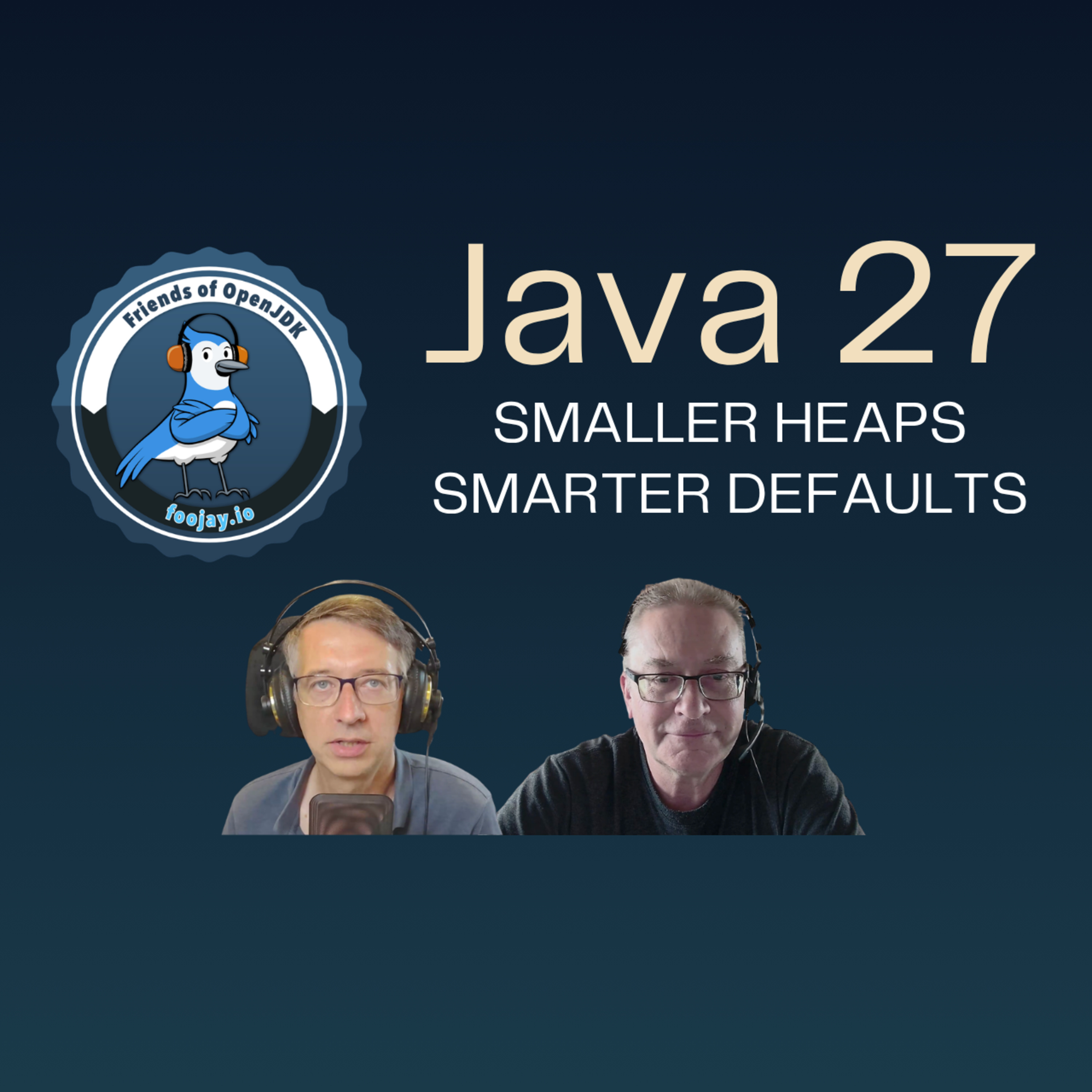
Episode 101 of the Foojay Podcast. JDK 27 arrives on 15 September 2026 without finalising a single new piece of language syntax. It is still worth the upgrade: object headers shrink from 64 bits to 32, which the JEP measures at 22% less heap and 8% less CPU on SPECjbb2015, and G1 becomes the default garbage collector on every machine. Both changes live inside the JVM, so an application you compiled years ago picks them up with no code change at all. Simon Ritter, Deputy CTO at Azul and Java Champion, takes us through all nine JEPs in the release, explains why a non-LTS version is still worth testing against, and makes the point that "long-term support" describes the binary you download rather than anything in OpenJDK itself. We also cover the move from quarterly to monthly security updates that started in August 2026, and then look ahead to March 2027, when Project Valhalla reaches its first preview after roughly twelve years of work. Topics include: Compact object headers by default, and what 22% less heap actually buys you in production Post-quantum key exchange in TLS 1.3, and the harvest-now-decrypt-later attack it defends against JFR redaction: keeping access tokens and passwords out of flight recordings you share Structured concurrency in its seventh preview, and why an evolving API stays in preview The Vector API's twelfth incubation, and what it is waiting for Value Objects in Java 28: a new value keyword, 179,000 lines, 1,800 files, and why it will not be final in JDK 29 Whether a Simple JSON API in the JDK will survive its previews, or go the way of string templates Guest: Simon Ritter Deputy CTO at Azul, Java Champion Simon on LinkedIn Simon on Foojay Links: Full show notes, with every JEP linked JDK 27 What CSPUs Mean for Your Release Pipeline What to Know About Garbage Collection as a Java Developer! Project Valhalla Timestamps: 00:00 Introduction of the topic and guest 01:27 How long Simon has been doing Java 01:54 Why release 27 is important, even when not being a Long Term Support release 04:55 Quarterly and monthly security updates between new version releases 08:07 Which JVM versions are most used in companies 09:23 JEP 534: Compact Object Headers by Default 14:51 JEP 523: Make G1 the Default Garbage Collector in All Environments 18:59 JEP 527: Post-Quantum Hybrid Key Exchange for TLS 1.3 22:55 JEP 538: PEM Encodings of Cryptographic Objects (Third Preview) 25:35 JEP 536: JFR In-Process Data Redaction 28:02 JEP 531: Lazy Constants (Third Preview) 29:55 JEP 532: Primitive Types in Patterns, instanceof, and switch (Fifth Preview) 33:13 JEP 533: Structured Concurrency (Seventh Preview) 38:21 JEP 537: Vector API (Twelfth Incubator) 40:28 Looking forward to Java 28 and Project Valhalla 42:31 JEP 401: Value Objects and JEP 539: Strict Field Initialization 47:36 Can we expect this to be finalized in Java 29? 48:26 LTS releases every 1, 2, or 3 years? 49:55 JEP 541: Deprecate macOS/x64 51:53 JEP 540: Simple JSON API (Incubator) 55:30 Conclusion, what to remember from this release