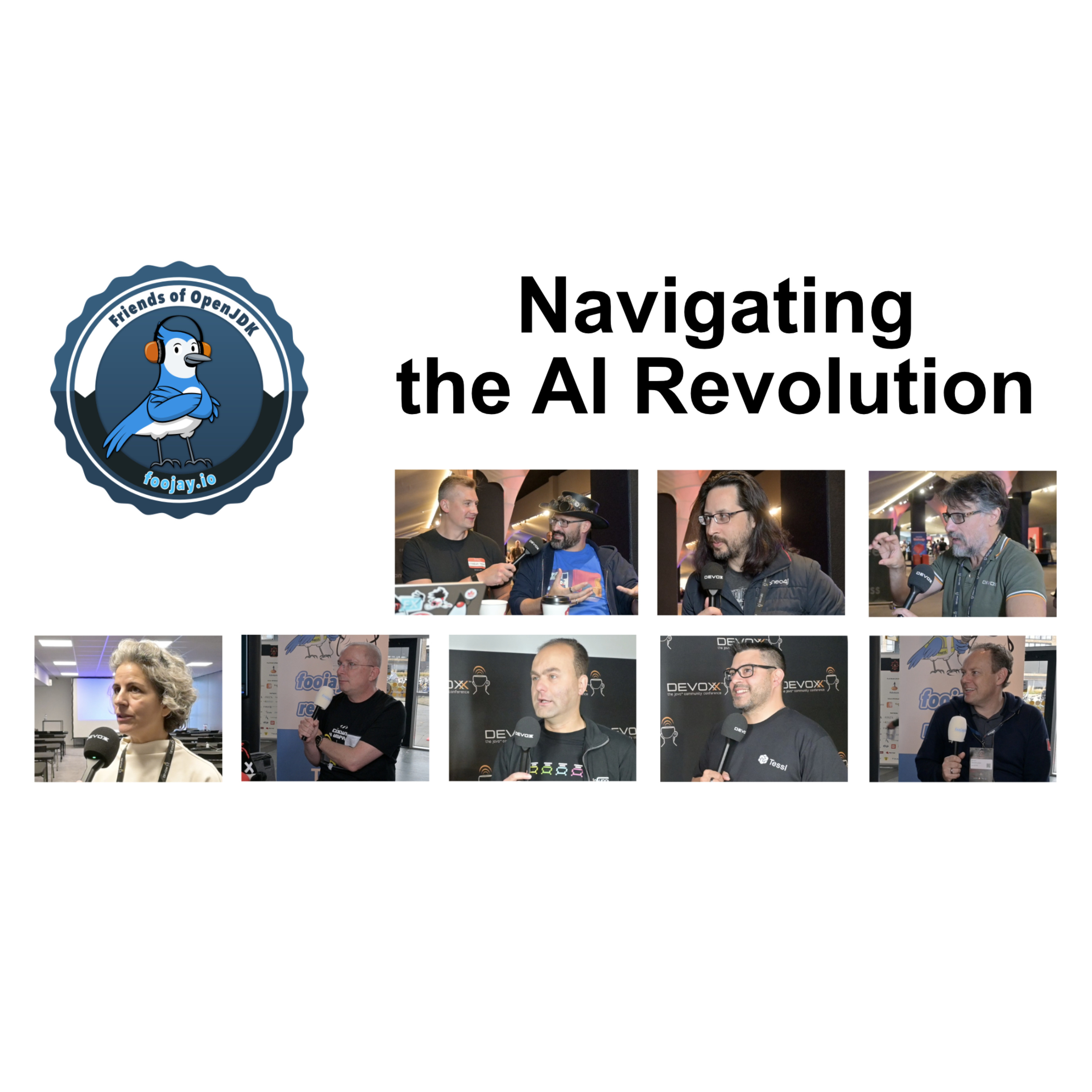
Agents, MCP, and Graph Databases: Java Developers Navigate the AI Revolution (#86)
transcript
show notes
The AI revolution isn't replacing Java developers. No, it's forcing us to think harder.
Welcome to another episode of the Foojay Podcast! Today, we're talking about AI and Java, how it's changing the way we work, what we need to watch out for, and why understanding what's really happening matters more than ever.
I recorded interviews at Devoxx and JFall and spoke with people who build and use this technology every day.
Marianne Hoornenborg opened my eyes to something important: every time an AI generates a token, there's a massive amount of computation happening behind the scenes.
Viktor Gamov and Baruch Sadogursky did something really cool: they tested six different AI coding tools live on stage with the same task. The results were all over the place! But they found that the tools with access to good documentation performed much better.
Stephen Chin showed me how graph databases can make AI responses more reliable by providing a solid source of truth rather than relying on vector search.
Mario Fusco works on LangChain4J, a leading Java framework for AI. He explained that breaking down large tasks into smaller ones and using specialized agents can help reduce errors—hallucinations, as they're called.
Jeroen Benckhuijsen and Martijn Dashorst shared their experiences working with enterprise Java. Even as frameworks are becoming lighter and we're running everything in containers, there are still complex problems that require real developer expertise.
Maarten Mulders reminds us that AI is a tool, not a replacement—especially when you're solving problems no one has tackled before. You still need to know what you're doing.
And finally, Simon Maple from Tessel discussed moving beyond vibe coding towards a more reliable, production-ready approach, using specifications to guide AI tools.
00:00 Introduction of topics and guests
02:12 Marianne Hoornenborg
- https://www.linkedin.com/in/mhoornenborg/
- The Simple Math behind AI
- The cost of tokens when using LLMs
06:54 Viktor Gamov and Baruch Sadogursky
- https://www.linkedin.com/in/vikgamov/
- https://www.linkedin.com/in/jbaruch/
- Robocoders, about the many agentic tools that can be used for vibe coding
- https://context7.com/
16:24 Stephen Chin
- https://www.linkedin.com/in/steveonjava/
- Graph versus relational databases
- Explaining MCP and Agents
23:09 Mario Fusco
- https://www.linkedin.com/in/mario-fusco-3467213/
- AI and LangChain4j in Quarkus
- Coding tools with AI
35:43 Jeroen Benckhuijsen
- https://www.linkedin.com/in/jeroenbenckhuijsen/
- Java in business, Evolutions in Java
- Making use of containers and Kubernetes
- Learning from the community
41:44 Martijn Dashorst
- https://www.linkedin.com/in/dashorst/
- Investigating an OOM-killer in Kubernetes with the help of AI
49:37 Maarten Mulders
- https://www.linkedin.com/in/mthmulders/
- How AI may impact our jobs
- How to improve your Maven builds
56:13 Simon Maple
- https://www.linkedin.com/in/simonmaple/
- AI developer tool Tessl
- Spec-driven vibe coding
- Secure AI development
01:02:12 Conclusion