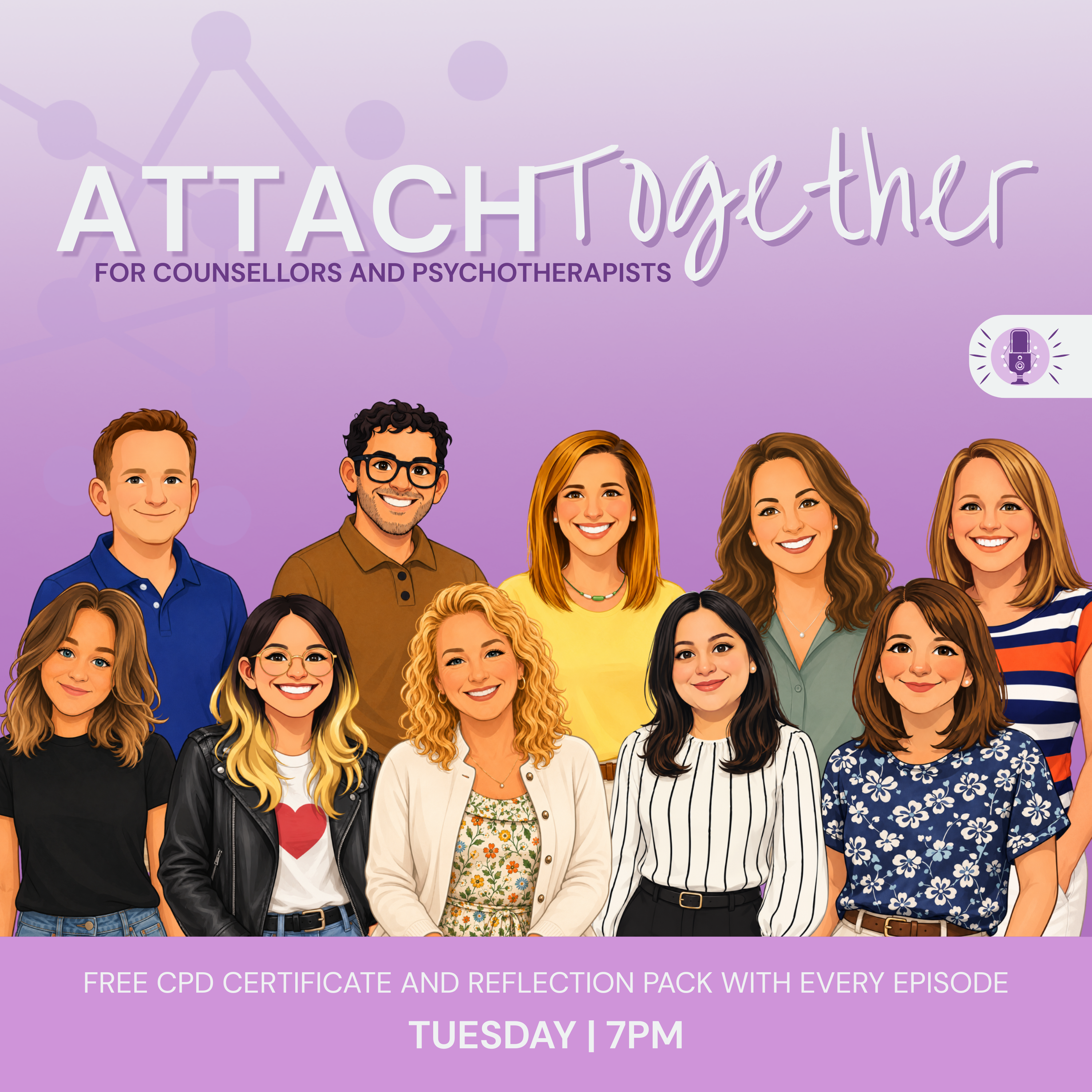
Artwork for Attach Together
Education

Attach Together

Optima Health Services

Attached Together is a podcast exploring attachment theory, attachment styles, and psychotherapy in clinical practice.

Created by the therapists and tutors at Optima Health Services, this podcast is for counsellors, psychotherapists, and mental health professionals who want grounded, thoughtful conversations about attachment, trauma, relationships, and everyday therapeutic work.

Each episode examines how attachment shapes the way we love, cope, regulate, and connect - both in our personal lives and in the therapy room. Expect practical insights, reflective discussion, and training-level knowledge that bridges theory and practice without unnecessary jargon.

Listeners can also receive a CPD certificate for each episode, making it easy to integrate ongoing professional development into your week while deepening your understanding of attachment-informed practice.

Whether you’re working with anxious, avoidant, or disorganised attachment, supporting couples, or strengthening your clinical formulation skills, Attached Together offers thoughtful, experience-based conversations rooted in real therapeutic work.

  • 16 episodes
  • Updated July 28

Episodes16

  • July 28 · 28 min

    Attachment Ruptures in Therapy: What If Getting It Wrong Is Where Healing Begins?

    Attachment rupture and repair sits at the heart of attachment theory, attachment styles, relationships and therapy. But what happens when a client feels misunderstood, rejected or even judged by their therapist? In this episode of Attached Together, attachment-based psychotherapist Uruj Anjum is joined by Gav, an attachment-based and IFS-trained therapist, to explore why ruptures are not a sign that therapy has failed. In fact, when they are recognised and repaired, they can become some of the most meaningful moments in the therapeutic relationship. A missed detail. A difficult question. A cancelled session. A boundary that feels like rejection. These moments may seem small, but for a client with a history of abandonment, criticism or emotional disconnection, they can reactivate much older attachment wounds. Together, Uruj and Gav discuss how therapists can notice these shifts, stay present when things feel uncomfortable, and respond without becoming defensive or rushing to make everything feel better. Attachment rupture and repair is the process of recognising a break in emotional connection and working together to restore safety, trust and understanding. You will hear why secure attachment is not built through perfect attunement, but through repeated experiences of disconnection followed by repair. The conversation also explores how clients may internalise shame when conflict has never been safely resolved, and how therapy can offer a different experience: one in which hurt can be expressed without the relationship ending. The episode includes a powerful ethical dilemma: What do you say when a client tells you, “I felt judged by you last week”? Gav considers how therapists can hold two truths at once: that they may not have intended to judge the client, while also taking the client’s experience seriously. In this episode Why rupture is inevitable in meaningful therapeutic relationships How attachment styles shape responses to boundaries and misunderstanding The link between unrepaired conflict, shame and self-blame How to recognise withdrawal, anger and disconnection in the room Why therapist defensiveness can deepen a rupture How supervision and personal therapy support relational work How attachment rupture and repair can contribute to earned secure attachment Common questions explored Does a rupture mean therapy has gone wrong? No. Ruptures are a natural part of close relationships. What matters is whether they can be recognised and explored. How does attachment affect rupture in therapy? A client’s attachment history may shape how they experience mistakes, boundaries, absences and changes in the therapist’s tone or availability. How can a therapist begin repair? By noticing the shift, regulating their own response, acknowledging the client’s experience and becoming curious about what happened between them. Chapters 00:16 Introduction 02:04 Gav’s background 03:10 Why rupture and repair matters 04:07 How secure attachment develops 06:42 Rupture in the therapeutic relationship 08:58 Why ruptures are inevitable 12:55 What repair looks like 14:16 When repair is a new experience 16:47 Working with shame 18:47 Supporting the therapist 20:46 Earned secure attachment 23:06 “I felt judged by you” 26:05 Final reflections FREE CPD Certificate & Reflection Pack You can download the FREE CPD Certificate for this episode via our website www.optimahealthservices.co.uk and join our listener list to receive the Reflection Pack for future episodes.

  • July 20 · 37 min

    Attachment and Couple Conflict: Why the Argument Is Never Just the Argument

    CPD Certificate Attachment theory helps us understand how attachment styles shape relationships, particularly when conflict enters the therapy or counselling room. In this episode of Attach Together, Jo is joined by relationship counsellor Jane Brown to explore affect regulation in couples therapy and what happens when two activated attachment systems meet. Affect regulation is the capacity to notice, evaluate and manage emotional experience and its expression without becoming overwhelmed. For couples, difficulties with affect regulation can quickly become a familiar dance. One partner pursues connection. The other withdraws. Both may be dysregulated, both are protecting something, and the argument in front of the therapist is rarely only about the bins, the phone or who forgot what. Jo and Jane reflect on how attachment trauma and early relational experiences can shape these cycles, and why slowing the process down is often more useful than searching for an immediate solution. In this episode, we explore: • The pursuer–distancer dynamic through attachment theory • Why both partners may be dysregulated during conflict • The therapist's own affect regulation and the urge to fix • Somatic awareness and connection check-ins • Rupture, repair and co-regulation in relationships • Helping each partner take responsibility for self-regulation • Connection rituals, positive safe words and playful experiences • The window of tolerance and psychoeducation • Working with escalation in online couples therapy • Remaining a secure base for both partners Jane shares practical interventions she uses in affect regulation in couples therapy, including asking couples to rate connection, noticing what greater connection would look like in the room, and creating a planned safe-word strategy for moments when either partner moves outside their window of tolerance. The conversation also considers the therapist's position. How do we observe the couple's dance without stepping onto the dance floor ourselves? And what happens when our own wish to make a difference pulls us towards fixing, directing or inadvertently siding with one partner? Common questions What is affect regulation in couples therapy? It is the process of helping partners manage emotional activation so they can remain connected, communicate and respond rather than simply react. How do attachment styles affect couple conflict? Attachment styles can shape protective strategies such as pursuing, proximity-seeking, withdrawing or avoiding. These strategies can then trigger the other partner's attachment system. Why is co-regulation important in relationships? Co-regulation offers an experience of safety with another person. Over time, repeated experiences of connection and repair can support greater trust and relational security. Chapters 00:00 Welcome and introduction 01:32 What is affect regulation? 02:53 The pursuer–distancer dynamic 04:41 The therapist's place in the couple's dance 08:09 Connection check-ins with couples 12:50 Why the argument is rarely the whole story 15:01 Psychoeducation and the window of tolerance 17:07 Contracting around affect regulation 18:55 Connection rituals 19:25 Responsibility for self-regulation 21:07 Using a positive safe word 22:53 Play, fun and date-night rituals 24:52 Closing the day together 27:49 The therapist's urge to fix 30:06 Managing escalation in online couples therapy 32:51 Becoming more directive with couples Resources and ideas mentioned Gottman-informed ideas around play and connection Imago-informed listening Positive safe-word strategies

  • July 13 · 25 min

    Attachment and Creative Approaches in Therapy: Working Beyond Words

    CPD Certificate In this episode, Georgina Sturmer and Darren look at creativity through the lens of attachment theory, asking how play, metaphor and objects can open up the work without overwhelming the client. Creative work is much broader than drawing or painting. A game of Uno, a collection of stones, visual cards, nesting dolls or a shared metaphor may give a client another way to show us something about their internal world. Creative approaches in therapy use play, imagery, metaphor, sensory experience or physical objects to support emotional exploration and communication. For some clients, talking can feel pressured. They may worry about saying the wrong thing, getting their story right or naming an emotion accurately. Creative work can sometimes soften that pressure and bring us closer to felt experience. In this episode, we explore: Creativity beyond pens, paper and paint Play, the inner child and pre-verbal experience Using games to support connection Stones, visual cards and sand tray work Shame and the fear of getting creativity “wrong” Avoidant attachment and creative work Drawing with the non-dominant hand Noticing rather than interpreting Nesting dolls and attachment metaphors Creative approaches in online therapy The swimming pool metaphor Creativity in supervision Therapist enthusiasm, pacing and relational safety Creativity and Attachment-Informed Therapy A client’s response to creativity can tell us something about the process between us. Some clients may engage quickly. Others may become hesitant, embarrassed or self-critical. For clients with more avoidant attachment tendencies, creative work may initially feel unfamiliar or exposing. The task is not to push through that hesitation. It is to notice it. Creative work can be useful when a client feels stuck, struggles to find language or seems unsure how to use the therapy space. But the intervention should remain in service of the client, rather than the therapist’s enthusiasm for a particular approach. Common Questions What are creative approaches in therapy? Creative approaches in therapy use play, metaphor, images, sensory materials or objects to help clients explore emotional and relational experiences. How can creativity support attachment-informed therapy? It can offer another route into attachment trauma, attachment styles and relationships, particularly when direct emotional language feels difficult. Are creative approaches only for children? No. Adults may also find play, metaphor and sensory work helpful, especially when experiences feel difficult to explain verbally. Can creative approaches be used online? Yes. Therapists can use drawings, objects, visual metaphors and shared imagery in online therapy as well as face-to-face work. YouTube Chapters 00:00 Welcome to Season Two 00:55 Creativity in the therapy room 01:31 What is a creative approach? 04:09 Stones and visualising the client’s world 06:47 Choosing a creative intervention 09:05 Sand tray and sensory experience 09:48 Attachment styles and creativity 10:58 The wardrobe drawing exercise 13:51 Nesting dolls in therapy 16:59 Creative work online 18:56 Castles, bridges and defensive strategies 20:06 Creativity in supervision 21:34 Keeping the client at the centre For more conversations about attachment theory, attachment styles, attachment trauma, attachment-informed therapy and relationships, subscribe to Attached Together

  • June 9 · 46 min

    Attachment Parenting Repair, Good Enough Parenting & the Pressure to Get It Right

    This bonus episode of Attach Together feels different from our usual conversations. Kiah, who edits the podcast and works alongside Darren and the Optima team, joins not as a clinical host, but as a parent of two young children. After listening back to previous episodes, she brings a question many parents may quietly recognise: Am I getting this wrong? Together, Kiah and Darren explore attachment theory, attachment styles, relationships, and therapy through the everyday realities of parenting: screen time, guilt, tiredness, dinner-time battles, social media pressure, and the hope that repair may matter more than perfection. Attachment parenting repair means noticing when something has gone wrong between parent and child, and finding a way back into connection. The episode returns to the idea of “good enough” parenting. Children do not need perfect attunement all the time. They need enough moments of being seen, soothed, enjoyed and returned to. For counsellors, psychotherapists, psychologists and therapy trainees, this conversation also asks something important: when we talk about attachment-informed practice, does our language help parents feel more reflective, or more ashamed? In this episode Kiah and Darren reflect on: why attachment theory can feel overwhelming for parents the difference between repair and perfection how parents may repeat, reject or overcorrect from their own childhoods screen time, smartphones and guilt the “perfect parent” image on social media the ABC model: antecedent, behaviour and consequence why therapists may over-analyse their own parenting how small moments of play and repair build safety over time Common questions What is attachment parenting repair? Attachment parenting repair is the process of returning to connection after a difficult or misattuned moment. It may involve apology, humour, touch, explanation, play, or simply coming back with warmth. Does attachment theory mean parents must get everything right? No. Attachment theory does not ask parents to be perfect. Repair after rupture is part of how children learn that relationships can survive difficulty. How do attachment styles affect parenting? A parent’s attachment style may shape how they respond to crying, closeness, conflict, independence or overwhelm. Becoming aware of those patterns can make parenting more conscious. YouTube chapters 01:02 Good enough parenting 02:33 Attunement, rupture and repair 07:46 Wondering about attachment style 10:24 Screen time and parenting pressure 13:21 Social media and external authority 21:20 Brain development, play and connection 28:50 Repairing difficult parenting moments 32:15 Do therapists over-analyse parenting? 36:06 The ABC model of behaviour 38:15 Dinnertime struggles 41:40 Changing antecedents and consequences Resources mentioned Winnicott’s idea of the “good enough” mother Kate Silverton, There’s No Such Thing as Naughty Kate Silverton, Still No Such Thing as Naughty ABC model: antecedent, behaviour and consequence Optima Level 5 and Level 7 Diplomas in attachment-based psychotherapy A CPD certificate link is available in the show notes. You may also use this episode for personal reflection, supervision or CPD learning.

  • May 1 · 19 min

    Mindfulness Burnout Prevention for Therapists

    Mindfulness burnout prevention helps therapists, counsellors and psychologists notice early signs of exhaustion, emotional fatigue and professional disconnection before burnout becomes entrenched. In this bonus episode of Attach Together, Darren speaks with Christopher Dines, author, mindfulness practitioner, coach and former DJ, about MBP: Mindfulness Burnout Prevention. Christopher has published eight books on mindfulness and addiction, including The Kindness Habit, co-authored with Dr Barbara Mariposa. This conversation explores how mindfulness burnout prevention supports mental health professionals at risk of burnout, isolation and emotional depletion. Rather than simply focusing on meditation, MBP encourages awareness of thoughts, emotions, bodily sensations, lifestyle, relational needs and professional limits. For attachment-informed practitioners, this matters deeply. Therapists often become a secure base for others, yet may struggle to notice when their own capacity is becoming depleted. 🔎 What You’ll Learn What mindfulness burnout prevention means Early warning signs of therapist burnout The difference between tiredness, exhaustion and burnout Why therapists can feel isolated in modern practice How online therapy has changed professional connection Why community helps prevent emotional depletion How mindfulness creates space, clarity and regulation Why asking for help is a professional strength Common Search Questions What is mindfulness burnout prevention? Mindfulness burnout prevention uses awareness, reflection and supportive community to help therapists notice and respond to early signs of professional fatigue. How does burnout affect therapists? Burnout can lead to exhaustion, apathy, resentment, reduced empathy, isolation and feeling disconnected from clinical work. Why is community important for therapists? Community offers therapists connection, reflection and support from others who understand the emotional demands of the work. How does mindfulness help prevent burnout? Mindfulness helps practitioners notice stress, bodily tension, emotional withdrawal and reduced capacity earlier, supporting better boundaries and self-care. 🕑Chapters 00:00 Welcome to this bonus episode 01:25 What is MBP? 02:25 Christopher’s recovery journey and mindfulness practice 05:54 When mindfulness became more widely recognised 07:07 How MBP developed for therapists and psychologists 09:21 Warning signs of burnout 11:15 What support can look like 12:51 The emotional demands of therapy work 14:02 Online therapy, isolation and the shrinking gap between work and life 15:59 Key takeaways: asking for help and finding community 17:20 Bonus reflection on retreats, group meditation and practitioner support Resources Mentioned Mindfulness Burnout Prevention: mindfulnessburnoutprevention.com Christopher Dines’ books on mindfulness and addiction The Kindness Habit by Christopher Dines and Dr Barbara Mariposa Optima Health Services CPD certificate and reflection pack Optima therapist retreat with Darren, Jo and guest speaker Linda Cundy FREE CPD Certificate & Reflection Pack You can download the FREE CPD Certificate for this episode via our website www.optimahealthservices.co.uk and join our listener list to receive the Reflection Pack for future episodes.

  • April 28 · 26 min

    Attachment Defences in Therapy: Understanding Protective Patterns in Clients

    Attachment defences in therapy are protective patterns clients use when they feel relationally threatened, emotionally exposed, or unsafe in connection. In this final episode of Season One of Attach Together, Georgina and Darren return to the foundations of attachment theory, attachment styles, relationships and therapy to explore how defences show up in the counselling room - and how therapists can respond with patience, curiosity and clinical care. This episode is especially relevant for counsellors, psychotherapists, psychologists and therapy trainees who want to deepen their attachment-informed practice. Rather than viewing defences as resistance or pathology, Darren invites us to understand them as normal human strategies for safety, shaped by early relational experience. Attachment defences in therapy are not signs that a client is difficult or unwilling. They are often the client’s best attempt to stay safe. 🔎 You’ll Learn The difference between attachment traits and attachment defences How avoidant and preoccupied attachment patterns intensify under pressure Why clients may withdraw, escalate, intellectualise or seek reassurance How therapists can avoid colluding with defensive strategies The role of mentalisation, countertransference and pacing How PACE - patience/playfulness, acceptance, curiosity and empathy - can support attachment-informed therapy What to consider when meeting clients, former clients or your own therapist in professional spaces Common Questions What are attachment defences in therapy? Attachment defences in therapy are protective strategies clients use when they feel unsafe, vulnerable or relationally exposed. They often develop from earlier experiences where closeness, need, conflict or emotional expression felt risky. How do attachment defences affect relationships? Attachment defences shape how people manage conflict, closeness and vulnerability. Some people withdraw to feel safe, while others intensify bids for connection, reassurance or validation. How do attachment defences appear in counselling? In counselling, defences may appear when a client feels emotionally close, challenged, misunderstood or exposed. They may become cognitive, shut down, seek reassurance, argue their position, change the subject or test whether the therapist will remain steady. How should therapists respond? Therapists can slow the pace, stay curious, avoid shame and notice what the defence is protecting. The task is not to dismantle the defence too quickly, but to build enough relational safety for exploration. 🕑 Chapters 00:00 Introduction to Attach Together 00:16 Welcome and episode context 01:28 Why focus on attachment defences? 02:32 What is attachment? 03:05 Attachment traits versus defences 05:02 Defences under pressure 08:17 Defences as safety strategies 10:04 Using attachment defences in practice 10:44 Avoiding collusion 12:10 Working with avoidant defences 13:17 Countertransference and therapist responses 15:43 Pace, PACE and attachment-informed work 17:47 Understanding our own patterns 18:00 Normalising attachment defences 20:35 Dilemma: seeing clients out of context 21:08 Contracting and professional boundaries 24:55 Re-contracting at endings 25:07 Optima retreat update 26:30 Season One closing reflections FREE CPD Certificate & Reflection Pack You can download the FREE CPD Certificate for this episode via our website www.optimahealthservices.co.uk and join our listener list to receive the Reflection Pack for future episodes.

  • April 21 · 25 min

    Attachment and Trauma in therapy: How Trauma and Attachment Show Up in the Counselling Room

    Attachment theory, attachment styles, relationships, and therapy are all central to this episode as Darren is joined by Gav, counsellor, tutor, and attachment-based psychotherapist, for a grounded conversation about the link between trauma and attachment in clinical practice. This episode explores a vital idea for therapists: trauma is not only about what happened, but also about what did not happen - the safety, attunement, soothing, and protection that were missing when they were needed most. Together, Darren and Gav unpack how early relational wounds shape attachment styles, emotional regulation, trust, and adult relationship patterns, and how these dynamics show up in the counselling room. You’ll hear a practical discussion of secure, anxious, avoidant, and disorganised attachment, including why disorganised attachment can feel especially destabilising in therapy. The conversation also looks at how clients may move towards closeness and then pull away, why defences develop for good reason, and why attachment-informed work often requires patience, pacing, and a strong focus on relational safety. For counsellors in training and qualified practitioners alike, this episode offers a clear and clinically useful framework for understanding how trauma and attachment are often inseparable. Darren and Gav also reflect on therapist self-awareness, countertransference, burnout, and the importance of regulation in the room. The episode closes with a thoughtful counsellor dilemma on contact between sessions, exploring how boundaries, client need, and the therapist’s own attachment pattern can all shape the response. 🔎What you'll learn trauma through an attachment lens how unmet needs shape internal working models secure, anxious, avoidant, and disorganised attachment trust, regulation, and defences in therapy countertransference and therapist self-awareness boundaries and between-session contact Common questions answered in this episode What is attachment trauma? Attachment trauma is the emotional and relational impact of early caregiving experiences where a child’s needs for safety, attunement, soothing, or protection were not met consistently. How does attachment trauma affect relationships? It can shape trust, closeness, emotional regulation, self-worth, and the expectations people carry into adult relationships. How does attachment trauma show up in therapy? It may appear as avoidance, dependency, fear of closeness, dysregulation, intellectualising, boundary-testing, or difficulty trusting the therapist. 🕑Chapters 00:00 Introduction 01:02 What trauma often means to people 03:33 Trauma as what did not happen 05:30 Attachment styles explained 07:20 Disorganised attachment and fear 09:22 Countertransference and therapist awareness 10:32 Burnout, self-care, and regulation 11:26 How trauma shows up in the room 13:41 Why the work takes time 17:35 Dysregulation, addiction, and soothing 20:20 Counsellor dilemma: contact between sessions 23:01 Therapist attachment and boundaries 24:10 Final reflections 🎓Resources Mentioned • Optima Level 5 & Level 7 Diplomas in Attachment Theory & Attachment-Based Psychotherapy FREE CPD Certificate & Reflection Pack You can download the FREE CPD Certificate for this episode via our website www.optimahealthservices.co.uk and join our listener list to receive the Reflection Pack for future episodes.

  • April 14 · 32 min

    Attachment and the Emotional Meaning of Food

    Attachment theory, attachment styles, relationships and therapy all shape how clients experience food, soothing and care. In this episode of Attach Together, Darren is joined by therapist, supervisor and Optima tutor Jo Oxley to explore attachment and disordered eating through an attachment-informed lens. Attachment and disordered eating is not only about food choices. It can reflect early relational experiences around feeding, comfort, attunement, shame, reward, control and soothing. Jo explores how food may become more than nutrition: it can carry memories of care, absence, pressure, comfort, deprivation or emotional survival. In this episode Jo and Darren explore how feeding is one of the earliest attachment experiences we have, and how those moments can shape internal working models around safety, need, nurture and self-soothing. The conversation also considers how family dinner-table dynamics, emotional neglect, reward systems, and modern digital distractions may all influence a person’s relationship with food. 🔎What you’ll learn How feeding becomes an early relational experience, not just a biological one Why food can become linked to comfort, soothing and emotional survival The role of family dinner-table dynamics in shaping later food patterns Why food may function as a substitute attachment figure The difference between disordered eating and a formal eating disorder How shame, guilt, reward and self-denial can become entangled with eating Whether different insecure attachment styles may relate differently to food How therapists can work with clients who bring food into the therapy room 🕝 Chapters 00:00 Introduction 01:24 Why explore attachment and food? 03:00 Feeding as an early attachment experience 06:19 Family dinner tables and relational meaning 08:23 Phones, disconnection and food rituals 10:09 Food as soothing, reward and shame 12:16 Food addiction and emotional regulation 17:53 Which attachment styles are most affected? 20:35 Therapeutic takeaway for practitioners 23:25 Dilemma: client eating during the session 28:21 Training opportunities at Optima 31:47 Closing reflections Common questions What is attachment and disordered eating? It is the link between early attachment experiences and later patterns of using food for comfort, control, soothing or emotional survival. How does attachment affect eating patterns? Attachment affects how people regulate distress, seek comfort, experience need and relate to care. Food may become a way to manage feelings when relational soothing feels unavailable or unsafe. How can disordered eating show up in therapy? Clients may describe bingeing, yo-yo dieting, guilt around food, using food as reward, or bringing food into sessions as a form of comfort, defence or relational support. What should therapists listen for? Listen for the story beneath the food: early feeding experiences, family dynamics, shame, comfort, self-worth, loneliness, stress and unmet relational needs. 🎓Resources Mentioned • Optima Level 5 & Level 7 Diplomas in Attachment Theory & Attachment-Based Psychotherapy Linda Cundy — Love in a Digital Age FREE CPD Certificate & Reflection Pack You can download the FREE CPD Certificate for this episode via our website www.optimahealthservices.co.uk and join our listener list to receive the Reflection Pack for future episodes.

  • April 7 · 20 min

    Attachment Supervision for Therapists

    🎓 Get your CPD certificate from our website. Attachment Supervision for Therapists: Understanding Attachment Styles in Therapy & Professional Relationships Attachment theory, attachment styles, relationships, and therapy all come together in this episode as we explore supervision through an attachment-informed lens. Rather than viewing supervision purely as a space for guidance and skill development, this conversation reframes it as a deeply relational process rooted in attachment dynamics. Darren is joined by Georgina Sturmer, BACP-accredited psychotherapist, supervisor, and lecturer in attachment-based psychotherapy, to explore how supervision functions as both a secure base and safe haven for therapists. 🔎What You'll Learn 1. Supervision as a Secure Base Supervision provides a foundation for exploration and growth Therapists need emotional safety to reflect honestly Co-regulation enhances clinical thinking and presence 2. Attachment Styles in Supervision Anxious (preoccupied) supervisees may seek reassurance Avoidant (dismissive) supervisees may intellectualise and avoid emotional reflection Secure supervision supports flexibility across all functions 3. The “Attachment Dance” Dynamics between supervisor and supervisee mirror relational patterns Group supervision introduces systemic attachment processes Awareness reduces blind spots in clinical work 4. The Three Functions of Supervision Through an Attachment Lens Restorative (emotional support) Normative (ethical accountability) Formative (learning and development) Attachment styles influence where therapists feel most comfortable. 🕝Chapters 00:00 Introduction to Attachment Supervision 02:00 Supervision as a Relational Space 03:45 Secure Base & Safe Haven in Supervision 06:00 Attachment Styles in Supervisees 09:00 The Attachment Dance in Supervision 12:00 Avoidant vs Anxious Dynamics 14:30 Choosing a Supervisor 17:30 Listener Dilemma: Avoiding Challenges in Supervision 20:00 Final Reflections Common Questions What is attachment supervision in therapy? Attachment supervision in therapy is a relational approach to supervision that considers how attachment styles influence the supervisory relationship and clinical reflection. How do attachment styles affect supervision? Attachment styles shape how therapists engage in supervision, including their comfort with feedback, emotional reflection, and vulnerability. Why is supervision a relational space? Supervision involves attunement, trust, and co-regulation, making it similar to therapy in its relational depth. How can supervision improve therapy outcomes? When therapists feel safe and supported, they can reflect more deeply, leading to more effective and ethical client work. FREE CPD Certificate & Reflection Pack You can download the FREE CPD Certificate for this episode via our website www.optimahealthservices.co.uk and join our listener list to receive the Reflection Pack for future episodes.

  • March 31 · 24 min

    Understanding Mentalization in Attachment Theory

    🎓 Get your CPD certificate from our website. Attachment theory, attachment styles, relationships, and therapy are all deeply connected through the concept of mentalization in therapy. In this episode of Attach Together, Darren is joined by Joanne Kay, psychodynamic and attachment-based therapist and Level 5 trainer, to explore one of the most essential - and often misunderstood - processes in attachment-informed practice. Mentalization in therapy refers to our ability to make sense of our own internal world while also holding the mind of another person. It is a foundational capacity that develops within early attachment relationships and directly impacts how clients engage in therapy, relationships, and emotional regulation. 🔎What You’ll Learn What mentalization actually means in clinical practice How mentalization develops through early attachment relationships The difference between baseline (trait) and moment-to-moment (state) mentalizing Why mentalization collapses under stress and dysregulation The link between nervous system regulation and reflective capacity How therapists can adopt a not-knowing stance Recognising when certainty replaces curiosity in the therapy room Working with “resistance” through a mentalizing lens The role of supervision in restoring reflective thinking 🕝Chapters 00:00 Introduction 01:24 What is Mentalization? 03:09 Mentalization as Attachment Process 05:50 Not-Knowing Stance in Therapy 07:46 Development in Early Relationships 09:29 Trait vs State Mentalization 11:55 Regulation and Mentalizing 14:00 Ruptures in Therapy 16:54 Core Definition 18:46 Client “Resistance” Explored 21:05 Therapist Self-Reflection 23:05 Supervision and Mentalizing Common Questions What is mentalization in therapy? Mentalization in therapy is the ability to understand thoughts, feelings, and intentions in ourselves and others within relational contexts. How does mentalization affect relationships? It allows individuals to interpret behaviour with curiosity rather than assumption, improving emotional connection and reducing conflict. Why does mentalization collapse under stress? Because dysregulation activates survival responses, limiting access to reflective thinking and higher brain integration. How can therapists support mentalization? By prioritising regulation, maintaining a not-knowing stance, and modelling curiosity in the therapeutic relationship. 🎓Resources Mentioned • Optima Level 5 & Level 7 Diplomas in Attachment Theory & Attachment-Based Psychotherapy Bowlby - Attachment Theory Peter Fonagy - Attachment Theory and Psychoanalysis FREE CPD Certificate & Reflection Pack You can download the FREE CPD Certificate for this episode via our website www.optimahealthservices.co.uk and join our listener list to receive the Reflection Pack for future episodes.

  • March 24 · 26 min

    Attachment Theory: Theory of Mind in Therapy Why Clients Struggle to Understand Other Minds

    🎓 Get your CPD certificate from our website. Understanding Attachment Styles, Mentalisation & Relationships How do attachment relationships shape the development of theory of mind? In this episode of Attach Together - an attachment theory podcast for therapists, Darren and Jo explore the relationship between attachment theory, theory of mind, emotional regulation and relational development. Theory of mind - sometimes called mentalisation - is the ability to understand that other people have their own thoughts, feelings, beliefs and intentions. Through an attachment lens, this capacity develops within secure caregiving relationships. When caregivers respond sensitively and reflectively, children begin to understand both their own mind and the minds of others. But when early attachment experiences are marked by anxiety, disconnection or emotional overwhelm, this developmental process can be interrupted. For therapists working with attachment styles and relational patterns, understanding theory of mind provides powerful insight into: emotional regulation relational misunderstandings perspective taking therapeutic stuckness This conversation also explores how therapists can help clients develop theory of mind within the therapeutic relationship. Jo shares practical clinical insights including Daniel Siegel’s hand-brain model, ways to bring the prefrontal cortex back online, and how calming the nervous system allows clients to think about minds more reflectively. The episode finishes with a clinical dilemma many therapists will recognise: The client who is always late. Through an attachment-informed perspective, the discussion explores how lateness might relate to: avoidance strategies anxiety about emotional closeness practical life pressures therapeutic pacing and safety 🔎Key Takeaways for Therapists • Attachment theory provides the soil in which theory of mind develops • Secure caregiving supports the ability to understand other minds • Anxiety can take the thinking brain offline • Regulation helps restore reflective capacity • Therapy can help clients develop mentalisation later in life • Slowing the therapeutic pace can support relational safety 🕝 Chapters 00:00 Introduction to the Attach Together Podcast 01:40 What Is Theory of Mind in Attachment Theory? 04:00 How Children Develop Theory of Mind 06:10 The Famous Smarties Experiment Explained 08:20 Attachment Security & Mentalisation 10:45 The Hand Brain Model (Daniel Siegel) 13:20 Anxiety, Cortisol & the Thinking Brain 15:00 Regulation Techniques for Clients 17:00 Using Theory of Mind in Therapy 21:40 Therapist Dilemma — The Client Who Is Always Late 24:00 Avoidant Attachment & Therapy Engagement 26:00 Final Takeaway for Therapists 🎓Resources Mentioned • Daniel Siegel - Hand Brain Model • Simon Baron-Cohen - Theory of Mind Research FREE CPD Certificate & Reflection Pack You can download the FREE CPD Certificate for this episode via our website www.optimahealthservices.co.uk and join our listener list to receive the Reflection Pack for future episodes.

  • March 17 · 28 min

    Working with Disorganised Attachment in Therapy

    🎓 Get your CPD certificate from our website. Understanding Disorganised Attachment in Relationships, Trauma & Attachment-Informed Therapy Disorganised attachment is one of the most complex and misunderstood attachment styles in attachment theory. In this episode of Attach Together, Darren is joined by counsellor and attachment-based psychotherapist Gav McKee to explore how disorganised attachment develops, how it shapes adult relationships, and how therapists can work safely and effectively with clients who carry unresolved attachment trauma. For therapists working with trauma, personality disorder presentations, complex PTSD, or dissociation, understanding this attachment style is essential. This conversation explores the clinical realities of working with unresolved attachment in therapy, including relational dynamics, emotional dysregulation, dissociation, and the importance of pacing and safety. 🔎What You'll Learn • What disorganised attachment is and how it develops • The research of Mary Ainsworth, Mary Main and Judith Solomon • The concept of fright without solution in attachment theory • How trauma can be transmitted across generations • Why disorganised attachment often appears alongside complex PTSD • The push-pull dynamic often seen in adult relationships • Emotional flooding, dissociation and shame in attachment trauma • Why safety and stabilisation must come before trauma processing • How therapists can become a consistent and regulating relational presence Clinical Takeaways for Therapists • Disorganised attachment often originates when the caregiver is both comfort and threat • Clients may experience intense approach-avoid patterns in relationships • Emotional dysregulation and dissociation are common presentations • Therapy must prioritise relational safety before trauma processing • The therapeutic relationship itself becomes a corrective attachment experience 🕝Chapters 00:00 Introduction to the Attachment Theory Podcast 01:40 What Is Disorganised Attachment? 03:25 Fright Without Solution Explained 06:52 Intergenerational Trauma and Attachment 08:34 How Disorganised Attachment Appears in Adults 11:29 Relationship Patterns and Emotional Dysregulation 13:17 Working Safely with Disorganised Attachment 15:19 The Therapist as a Secure Base 18:55 Can Disorganised Attachment Be Resolved? 23:34 Clinical Dilemma: Dissociation in Therapy 26:02 Grounding Clients in the Therapy Room 27:11 The Value of Attachment Training 27:11 The Value of Attachment Training 🎓Resources Mentioned • Mary Ainsworth – Strange Situation research • Mary Main & Judith Solomon – Disorganised attachment classification FREE CPD Certificate & Reflection Pack You can download the FREE CPD Certificate for this episode via our website www.optimahealthservices.co.uk and join our listener list to receive the Reflection Pack for future episodes.

  • March 10 · 25 min

    Anxious Ambivalent Attachment in Relationships

    🎓 Get your CPD certificate from our website. Preoccupied Attachment, Attachment Theory, Therapy & Relationships In this episode of Attach Together - the attachment theory podcast for counsellors and psychotherapists, we explore anxious ambivalent attachment, often described as preoccupied attachment. We explore how anxious ambivalent attachment develops, how it appears in adult relationships, and how therapists can support clients experiencing intense relational anxiety, reassurance seeking and fear of abandonment. Host Darren, BACP-accredited counsellor and attachment-based psychotherapist, is joined by Uruj Anjum, BACP-accredited psychotherapist, supervisor and lecturer in attachment-based psychotherapy at Optima. Together, they unpack: • What preoccupied attachment means beyond the stereotype • How inconsistent caregiving shapes anxious ambivalent attachment • Why reassurance seeking and overthinking often appear in relationships • The nervous system dynamics beneath attachment anxiety • Why preoccupied clients are often drawn to therapy • The therapeutic task of slowing emotional overwhelm • Boundary management with reassurance-seeking clients • Understanding the “doorknob confession” through an attachment lens 🔎What You'll Learn Preoccupied attachment is protection, not pathology Clients with anxious attachment styles often developed sophisticated strategies in childhood to maintain closeness with unpredictable caregivers. Emotional intensity reflects attachment alarm. When connection feels uncertain, the attachment system activates strongly - creating hypervigilance to tone, messages and relational shifts. Therapy focuses on containment and mentalisation. Slowing down emotional overwhelm allows clients to move from pure emotional activation toward reflective thinking. Boundaries create safety Maintaining consistent boundaries is a crucial part of providing a secure therapeutic base. 🕝Chapters: 00:00 Introduction to the Attach Together Podcast 02:10 What Is Preoccupied Attachment? 04:50 Fear of Abandonment in Attachment Styles 07:00 How Anxious Ambivalent Attachment Develops 10:20 The “Full Fridge” Metaphor Explained 11:27 Working With Preoccupied Clients in Therapy 13:40 Slowing Down Emotional Overwhelm 16:00 Repetition and Circular Narratives in Therapy 18:20 Boundaries With Preoccupied Clients 20:05 Therapist Dilemma: The Doorknob Confession 22:20 Maintaining Boundaries in Session 24:50 Why Boundaries Matter for Clients 25:20 Closing Reflections FREE CPD Certificate & Reflection Pack You can download the FREE CPD Certificate for this episode via our website www.optimahealthservices.co.uk and join our listener list to receive the Reflection Pack for future episodes. 🎓 Resources Mentioned Optima Level 5 & Level 7 Diplomas in Attachment Theory & Attachment-Based Psychotherapy Bowlby - Attachment Theory If this episode supported your practice, follow the podcast and share it with a colleague interested in attachment theory and attachment styles in therapy.

  • March 3 · 27 min

    Avoidant Attachment in Therapy: Defences, Distance & Building Secure Connection

    🎓 Get your CPD certificate from our website. In this episode of Attach Together, we explore one of the most misunderstood attachment styles: avoidant attachment. What does avoidant attachment really mean from an attachment theory perspective? How does it show up in the therapy room? And how can therapists build connection without overwhelming clients who experience closeness as unsafe? Darren and Georgina unpack: How avoidant attachment develops in early caregiving environments Why “independence” can actually be compulsive self-reliance The emotional cost of being praised for stoicism What therapists feel in the room (countertransference clues) Humour, intellectualising and distance as protective strategies How to work slowly and relationally to build safety When boundary-testing may signal growth, not resistance Drawing on attachment theory, relational practice and insights from John Bowlby and Stan Tatkin, this episode offers grounded, practical reflections for counsellors, psychotherapists, psychologists and trainees. If you’ve ever felt deskilled, distanced or unsure how to “reach” an avoidant client - this conversation will reassure and guide you. 🔎 What You’ll Learn What Avoidant Attachment Really Is Not procrastination. Not laziness. But a protective relational strategy shaped by early experiences where emotions felt unsafe or unwelcome. Clues in the Therapy Room Flat affect, humour, intellectualising, minimising, brief communication - and the therapist’s own felt sense of distance. Why We Must Go Slowly Building safety may mean resisting the urge to “go to feelings” too quickly. Compulsive Self-Reliance vs True Independence How attachment patterns are reinforced by societal praise - and the hidden emotional cost. Boundaries & Contact Between Sessions Why an avoidant client reaching out may represent relational growth - and how to respond in an attachment-informed way. ⏱ Chapters 00:00 – Introduction to the Attachment & Relationships Podcast 02:00 – What is Avoidant Attachment? 05:00 – Why Avoidant Clients Rarely Seek Therapy 08:00 – Building Safety Before Emotion 11:00 – Humour, Deflection & Therapist Spidey Senses 15:00 – Compulsive Self-Reliance Explained 18:00 – Moving Beyond Defences 21:00 – Dilemma: Clients Contacting You Between Sessions 25:00 – Attachment-Informed Boundaries 28:00 – Level 5 & Level 7 Diplomas in Attachment-Based Psychotherapy 🎓 Resources Mentioned Optima Level 5 & Level 7 Diplomas in Attachment Theory & Attachment-Based Psychotherapy Restoring Your Secure Base: Attachment-Informed Therapist Retreat If this episode supported your practice, follow the podcast and share it with a colleague interested in attachment theory and attachment styles in therapy.

  • February 24 · 29 min

    Internal Working Models

    Internal Working Models in Attachment Theory: What They Are and How Therapy Updates Them Get your CPD Certificate Here In this episode of Attach Together, Darren is joined by Jo Oxley (founder of Optima) to unpack one of the most important concepts in attachment-informed practice: internal working models (also called inner working models). Jo explains models are formed and become an unconscious “blueprint” for how we experience ourselves, other people, and relationships. With a wonderfully accessible metaphor (yes, Inside Out makes an appearance), They explore how secure beginnings can build a sense of worth and safety, and how inconsistent or emotionally unavailable care can lead to avoidant or preoccupied strategies in later life. They discuss why shame and fear often sit underneath insecure attachment patterns, and how therapy supports change by building new relational experiences - creating “new pathways” that can gradually replace old default routes. This episode is a grounded, practical listen for counsellors, psychotherapists, trainees, and anyone wanting to understand how attachment patterns show up in real life -and how they can be updated. Takeaways What are Internal Working Models? Understand models as unconscious templates formed through attachment experiences -shaping expectations of self, other, and relationship. Secure vs Insecure: How Early Experiences Become a Blueprint Explore how attuned caregiving tends to support confidence and exploration, and how emotional unavailability or inconsistency can shape threat-based expectations. Avoidant Strategies: “I’ll Cope on My Own” How avoidant patterns develop as a protective strategy when care is unreliable, and why shame can sit underneath self-reliance. Preoccupied Strategies: Fear, Hypervigilance, and Reassurance-Seeking Understand inconsistency fuels uncertainty and alarm, often leading to clinging, protest, and push–pull relational dynamics. How Therapy Helps Update IWM Why change happens in relationship — and how repeated new experiences can build new neural pathways (the “new path through the woods” idea). Therapist Dilemma: When a Client is Distressed by Friendship Breakdown A short reflection on working with relational rupture, meaning-making, and bringing patterns into awareness through the body and the therapeutic relationship. If You Found This Episode Helpful… If this episode supported your practice or your learning, please follow the podcast and share it with a colleague or fellow trainee who enjoys attachment-informed conversations. Resources Mentioned in This Episode Optima Training Programmes – Level 5 and Level 7 Diplomas in Attachment Theory and Attachment-Based Psychotherapy (https://optimahealthservices.co.uk/attachment-psychotherapeutic-counselling-level-5-diploma-cpcab/) Restoring Your Secure Base: Attachment-Informed Therapist Retreat – A two-day retreat with teaching, reflection, rest, and CPD https://optimahealthservices.co.uk/therapist-retreat/ There is a CPD reflection pack available if you would like this please click this link and we will send you all the resources including, reflective questions, 3 things to try in your practice and insights.

  • February 22 · 50 sec

    Trailer

    New podcast coming soon, subscribe and follow now so you don't miss the first episode.