Skip to content
Artwork for Aswath Damodaran
BusinessEntrepreneurshipEducation

Aswath Damodaran

Aswath Damodaran

I teach corporate finance, valuation and investment philosophies at the Stern School of Business at New York University. I have online versions of all three courses here, as well as other finance-related videos.
1. The Corporate Finance Online playlist has an introductory video and 36 sessions that cover all of corporate finance (at least as I see it).
2. The Valuation playlist has 25 sessions that cover valuation approaches, issues and questions.
3. The Investment Philosophies playlist has sessions that cover different investment philosophies.
4. The Accounting and Statistics playlists reflect my quirky and unorthodox introductions to two disciplines that are critical to my valuation and corporate finance classes.
5. The Blog Posts playlist has sessions that go wit my blog posts and reflect my standing as a dabbler, rather than expert, in all things finance-related.
If you need the supporting material for any of the classes, check the links below.

Links:
Corporate finance materials: http://www.stern.nyu.edu/~adamodar/New_Home_Page/corpfin.html
Valuation materials: http://www.stern.nyu.edu/~adamodar/New_Home_Page/equity.html
Investment Philosophies: http://www.stern.nyu.edu/~adamodar/New_Home_Page/invphil.htm
Books: http://www.stern.nyu.edu/~adamodar/New_Home_Page/public.htm
My website: http://www.damodaran.com

Unofficial fan audio feed — not affiliated with or endorsed by the original creator. All content belongs to its respective owner.

Play
  • 211 episodes
  • daily
  • Avg 58 min
  • English
Counted on this page — what you have heard stays on this device, so it is not something the list can be paged by.
  • October 17 · 22 min

    Data 2017 Update 9: Dividends, Rodney Dangerfield of Corporate Finance

    The dividend decision of a firm is akin to harvesting for a farmer, the coming to fruition of all your good decisions and hard work. Rather than being the residual decision (the one made after your investment and financing decisions), in many firms, it is set first and everything else follows. In this session, I look at dividend yields & payouts around the world and the shift towards buybacks happening in the US (and spilling over to the rest of the world). Slides: http://www.stern.nyu.edu/~adamodar/pdfiles/blog/dataupdate9.pdf Blog Post: http://aswathdamodaran.blogspot.com/2017/02/january-2017-data-update-9-dividends.html Data: Dividends by country: http://www.stern.nyu.edu/~adamodar/pc/blog/dividendcountry2017.xlsx Dividends by sector: http://www.stern.nyu.edu/~adamodar/pc/blog/dividendindustry2017.xlsx Learn more about your ad choices. Visit megaphone.fm/adchoices

  • October 16 · 1 hr 31 min

    Session 12: The Tail that wags the Dog? Terminal Value in DCF

    In this session, we looked at the elephant in the DCF room, the terminal value, and laid out broad constraints that keep it in check. In furtherance of that discussion, I would like you take a look at five posts that I had on terminal value on my blog that cover the spectrum of questions related to it: http://aswathdamodaran.blogspot.com/2016/11/myth-51-if-you-don-believe-in-forever.html http://aswathdamodaran.blogspot.com/2016/11/myth-52-as-g-rto-infinity-and-beyond.html http://aswathdamodaran.blogspot.com/2016/11/myth-53-growth-is-good-more-growth-is.html http://aswathdamodaran.blogspot.com/2016/11/myth-54-negative-growth-rates-forever.html http://aswathdamodaran.blogspot.com/2016/11/myth-55-terminal-value-ate-my-dcf.html Start of the class test: https://pages.stern.nyu.edu/~adamodar/pdfiles/eqnotes/tests/termvalue.pdf Slides: https://pages.stern.nyu.edu/~adamodar/podcasts/valUGspr23/session12slides.pdf Post class test: https://pages.stern.nyu.edu/~adamodar/pdfiles/eqnotes/postclass/session12Btest.pdf Post class test: https://pages.stern.nyu.edu/~adamodar/pdfiles/eqnotes/postclass/session12Bsoln.pdf Learn more about your ad choices. Visit megaphone.fm/adchoices

  • October 16 · 1 hr 28 min

    Session 4: Risk free Rates (continued) and first steps on ERP

    We started the class by completing the discussion of risk free rates, exploring why risk free rates vary across currencies and what to do about really low or negative risk free rates. The blog post below captures my thoughts on negative risk free rates: http://aswathdamodaran.blogspot.com/2016/03/negative-interest-rates-unreal.html We are about halfway through the discussion of equity risk premiums but the contours of the discussion should be clear. a. Historical equity risk premiums are not only backward looking but are noisy (have high standard errors). You can the historical return data for the US on my website by going to http://www.stern.nyu.edu/~adamodar/New_Home_Page/data.html Click on current data, and look to the top of the table of downloadable data items. b. Country risk premium: The last few months should be a reminder of why country risk is not diversifiable. As you see markets are volatile around the world, I think you have a rationale for a country risk premium. You can get default spreads for country bonds on my site under updated data. If you are interested in assessing and measuring country risk, to get from default spreads to equity risk premiums, you need two more numbers. The first is the standard deviation for the equity market in the country that you are trying to estimate the premium for. Try the Bloomberg terminal. Find the equity index for the country in question (Bovespa for Brazil, Merval for Argentina etc.) and type in HVT. This should give you the annualized standard deviation in the index - change the default to weekly and use the 100-week standard deviation. Do the same for the country bond in question. The two standard deviations should yield the relative volatility. If you have trouble finding either number, just multiply the default spread by 1.4 to get a rough measure of the country risk premium. If you want my estimates of country risk premiums, check under updated data on my website. The direct link is below: http://www.stern.nyu.edu/~adamodar/pc/datasets/ctryprem.xls You can also see my latest blog post on country risk here: http://aswathdamodaran.blogspot.com/2017/01/january-2017-data-update-4-country-risk.html Start of the class test: http://www.stern.nyu.edu/~adamodar/pdfiles/eqnotes/tests/riskfree.pdf Slides: http://www.stern.nyu.edu/~adamodar/podcasts/valUGspr17/session4.pdf Post class test: http://www.stern.nyu.edu/~adamodar/pdfiles/eqnotes/postclass/session4test.pdf Post class test solution: http://www.stern.nyu.edu/~adamodar/pdfiles/eqnotes/postclass/session4soln.pdf Learn more about your ad choices. Visit megaphone.fm/adchoices

  • October 16 · 42 min

    Data Update 7 for 2023: Dividends, Buybacks and Cashflows

    Dividends are residual cash flows, and in a well-functioning business should represent the last step in a sequence that starts with investing choices, with financing choices occurring concurrently and ending with dividends. In practice, though, there are companies that allow dividend policy to climb to the top of the sequence skewing investing and financing decisions. In this post, I provide a process for estimating potential dividends, and talk about how those potential dividends change over the life cycle. I then look at how buybacks have surged as the preferred option for many companies, and not just in the US, and argue that it is the flexibility of buybacks (being able to drastically change already announced buybacks) that makes them so attractive to businesses, concerned about earnings predictability. I end with a discussion of the fictions around buybacks - that they can add or destroy value (they cannot... they redistributed value), that they are being funded with debt (firms that buyback stocks have far lighter debt loads than first that do not), that they are bad for the economy (not true, since the buyback cash finds it way back into other companies that reinvest it) and that it is unfair to other stakeholders. Buffett's description of buyback critics as economic illiterates might be too kind, since much of the criticism comes from a mixture of ignorance and idealogical zeal. Slides: https://pages.stern.nyu.edu/~adamodar/pdfiles/blog/DataUpdate7for2023.pdf Blog Post: https://aswathdamodaran.blogspot.com/2023/03/data-update-7-for-2023-dividends.html Learn more about your ad choices. Visit megaphone.fm/adchoices

  • October 16 · 14 min

    Data 2017 Update 8: Debt, the Dark and Light Side!

    Debt has a light side (tax benefits, added discipline) and a dark side (distress and agency costs) and lots of distractions. In this session, I look at how that trade off plays in debt ratios across the globe and across sections. (Sorry about the typos on the slides in the video, but fixed on the slides below) Slides: http://www.stern.nyu.edu/~adamodar/pdfiles/blog/dataupdate8.pdf Blog post: http://aswathdamodaran.blogspot.com/2017/02/january-2017-data-update-8-dark-and.html Data: 1. Debt, by country: http://www.stern.nyu.edu/~adamodar/pc/blog/debtcountry2017.xlsx 2. Debt, by industry: http://www.stern.nyu.edu/~adamodar/pc/blog/debtindustry2017.xls Learn more about your ad choices. Visit megaphone.fm/adchoices

  • October 16 · 1 hr 38 min

    Session 11: Terminal Value Closure and First steps on the Loose Ends

    In this class, we started by tying up loose ends on terminal value, with the dangers of waiting too long to put your company into stable growth and the importance of long term excess returns in determining terminal value. We then looked at building a DCF model, and how your choices of which cash flows to discount, the discount rate to use and the growth rates/patterns for a business have to be tailored to the firms. In the second half of the class, we talked about the loose ends in valuation, i.e., all the things you do after you have discounted cash flows back at the discount rate and why they matter. We started with cash, the simplest and most direct of all assets to value, and talked about why investors may attach a premium or discount to the cash balance of a company, arguing that discounts reflect a lack of trust in management. I mentioned a paper that looks at how the market discriminates across companies, when it comes to valuing cash balances. We then moved on to cross holdings, and why they are difficult to incorporate into value, and some approximations that you can try, when valuing them. In the next session, after the break, we will continue with the loose ends discussion. Start of the class test: https://www.stern.nyu.edu/~adamodar/pdfiles/eqnotes/tests/termvalue.pdf Slides: https://www.stern.nyu.edu/~adamodar/podcasts/valspr23/session11slides.pdf Post class test: https://www.stern.nyu.edu/~adamodar/pdfiles/eqnotes/postclass/session11test.pdf Post class test solution: https://www.stern.nyu.edu/~adamodar/pdfiles/eqnotes/postclass/session11soln.pdf Learn more about your ad choices. Visit megaphone.fm/adchoices

  • October 15 · 1 hr 29 min

    Session 3: DCF Overview and First Steps on Discount Rates

    This class started with a look at a major investment banking valuation of a target company in an acquisition and why having a big name on a valuation does not always mean that a valuation follows first principles. After setting the table for the key inputs that drive value - cash flows, growth, risk, we looked at the process for estimating the cost of equity in a valuation. The key concept is that of a "marginal" investor, who is diversified and looking at risk through that investor's eyes. We spent the rest of the session talking about what should be (but no longer is) the simplest input into the process: the risk free rate. Start of the class test: http://www.stern.nyu.edu/~adamodar/pdfiles/eqnotes/tests/kennecott.pdf Slides: http://www.stern.nyu.edu/~adamodar/podcasts/valUGspr17/session3.pdf Post class test: http://www.stern.nyu.edu/~adamodar/pdfiles/eqnotes/postclass/session3test.pdf Post class test solution: http://www.stern.nyu.edu/~adamodar/pdfiles/eqnotes/postclass/session3soln.pdf Learn more about your ad choices. Visit megaphone.fm/adchoices

  • October 15 · 1 hr 24 min

    Session 13: More loose ends in valuation

    In this class, started with cross holdings, and why they are difficult to incorporate into value, and to other assets that you may consider adding on, because we have not considering them yet. On the latter, the key component to remember is not to double count an asset, by first counting its cash flow and then the value of the asset itself. We the moved on to how to define debt, arguing forr a narrow definition for cost of capital purposes, but a broader definition for netting out from enterprise value. We also argued that management options and restricted stock need to be incorporated into value per share and how to do it. Start of the class test: https://pages.stern.nyu.edu/~adamodar/pdfiles/eqnotes/tests/looseendsMod.pdf Slides: https://pages.stern.nyu.edu/~adamodar/podcasts/valUGspr23/session13slides.pdf Post class test: https://pages.stern.nyu.edu/~adamodar/pdfiles/eqnotes/postclass/session13Ctest.pdf Post class test: https://pages.stern.nyu.edu/~adamodar/pdfiles/eqnotes/postclass/session13Csoln.pdf Learn more about your ad choices. Visit megaphone.fm/adchoices

  • October 15 · 1 hr 31 min

    Session 12: Measuring Investment Returns

    In this session, we started on measuring investment returns, drawing on the theme from Jerry Macguire (Show me the money). After making an argument for the primacy of cash flows, we looked at how a good measure of return is time weighted and incremental and how every investment is a project (small or large). We spent the bulk of the class describing the Rio Disney investment, and then computing the return on capital on that investment, based upon expected revenues and operating income. We also looked at what the hurdle rate for the investment should be, drawing on the notion that the discount rate for a project should reflect the risk of that project (business, geography etc.). We also extended the return on capital concept to entire companies to judge the quality of existing investments. In the last part of the class, we talked about the process of getting from earnings to cash flows, by adding back depreciation and amortization, subtracting capital expenditures and change in working capital. Depreciation leaves an imprint because it saves taxes, capital expenditure drain cash flows and investments in inventory tie up cash. Slides: https://pages.stern.nyu.edu/~adamodar/podcasts/cfspr23/session12slides.pdf Post class test: https://pages.stern.nyu.edu/~adamodar/pdfiles/cfovhds/postclass/session12test.pdf Post class test solution: https://pages.stern.nyu.edu/~adamodar/pdfiles/cfovhds/postclass/session12soln.pdf Learn more about your ad choices. Visit megaphone.fm/adchoices

  • October 14 · 1 hr 28 min

    Session 13: Incremental Cashflows and Dealing with Uncertainty

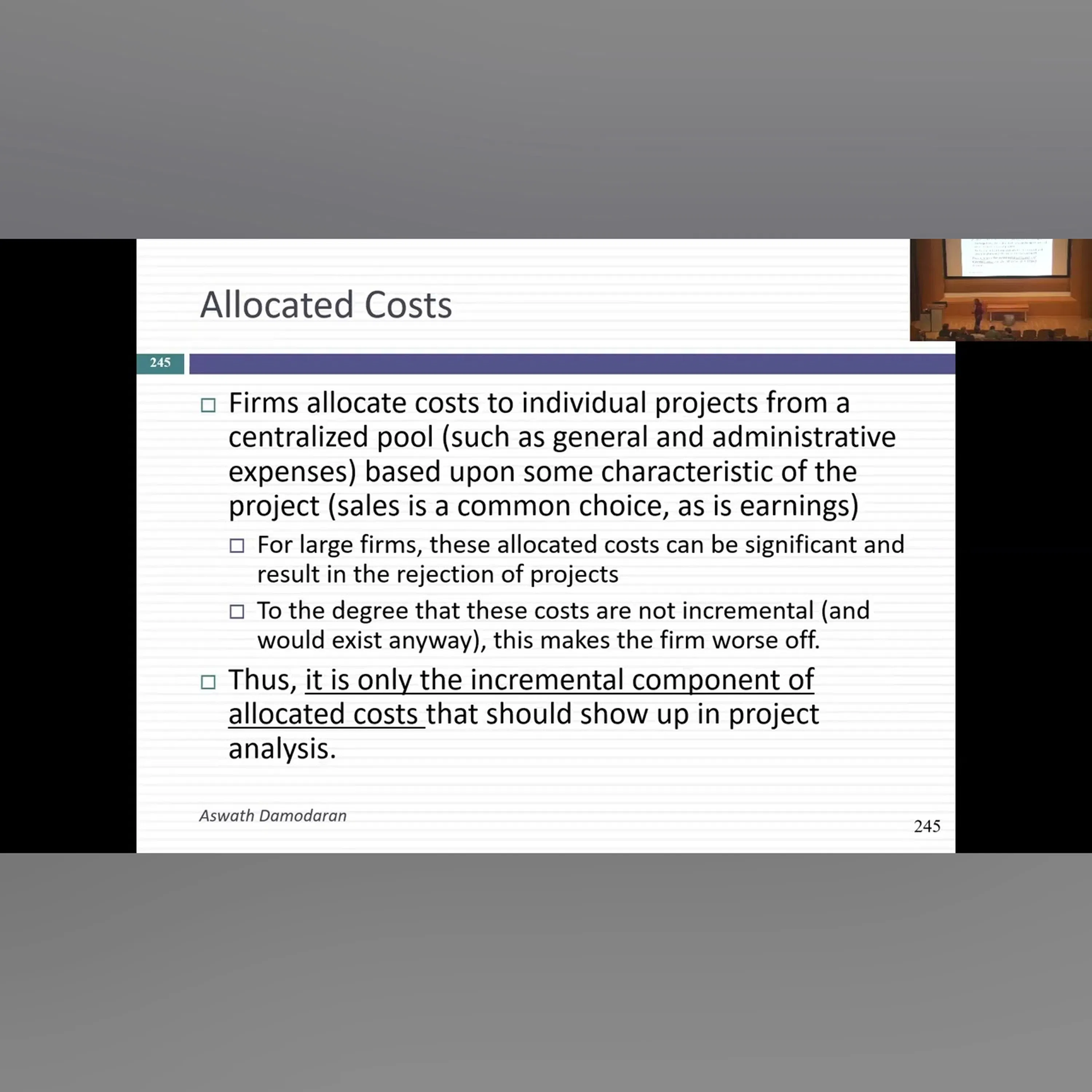
    In this class, we started the move from cash flows to incremental cash flows by asking two questions: (1) What will happen if you take the project and (2) What will happen if you do not? If the answer is the same to both questions, the item is not incremental. That is why "sunk" costs, i.e., money already spent, should not affect investment decision making. It is also the reason that we add back the portion of allocated G&A that is fixed and thus has nothing to do with this project. Finally, we looked at two time-weighted, incremental cash flow approaches to calculating returns, NPV and IRR, and used them to analyze the Rio Disney theme part. In the second half of the class, I talked about why currency choices should not affect investment decisions (but sometimes do) as well as ways of dealing with uncertainty, ranging from payback to simulations. If, like me, you find yourself fascinated by simulations, but your statistics is a little rusty, you can try this paper I have on statistical distributions. https://papers.ssrn.com/sol3/papers.cfm?abstract_id=3237778 You don’t have to read the whole paper, just the appendix. I have attached the post class test for today, with the solution. In the final part of the class, we looked at time weighting cash flows, why and how we do it. Slides: https://pages.stern.nyu.edu/~adamodar/podcasts/cfspr23/session13slides.pdf Post class test: https://pages.stern.nyu.edu/~adamodar/pdfiles/cfovhds/postclass/session13test.pdf Post class test solution: https://pages.stern.nyu.edu/~adamodar/pdfiles/cfovhds/postclass/session13soln.pdf Learn more about your ad choices. Visit megaphone.fm/adchoices

  • October 13 · 1 hr 39 min

    Session 13: More on stories and first valuations

    In this class, we continued our discussion of stories, and how critical it is to keep the feedback loop open, so that you can make your stories better. We also talked about how story breaks, shifts and changes. Since I talked about dealing with new earnings reports, I thought you may find these two posts of interest in how narratives shift, and with them, values: Reacting to Earnings Reports: http://aswathdamodaran.blogspot.com/2014/08/reacting-to-earnings-reports-lets-get.html Narrative Resets: http://aswathdamodaran.blogspot.com/2015/08/narrative-resets-revisiting-tech-trio.html We started with a conventional valuation of Con Ed in class, but we will move to more interesting storylines and valuations next class. Start of the class test: https://www.stern.nyu.edu/~adamodar/pdfiles/eqnotes/tests/storytest.pdf Slides: https://www.stern.nyu.edu/~adamodar/podcasts/valspr23/session13slides.pdf Learn more about your ad choices. Visit megaphone.fm/adchoices

  • October 13 · 19 min

    Data 2017 Update 4: Country Risk

    To do corporate financial analyses or value companies, you have to grapple with and come up with a way of incorporating country risk that goes beyond looking at where a company is incorporated. In this session, I go through my approach for measuring country risk and bringing it into equity risk premiums. Slides: http://www.stern.nyu.edu/~adamodar/pdfiles/blog/dataupdate4.pdf Blog Post: Data links: Sovereign ratings: http://www.stern.nyu.edu/~adamodar/pc/blog/sovrRatingsJan17.xls Sovereign CDS spreads: http://www.stern.nyu.edu/~adamodar/pc/blog/sovrCDSJan17.xls PRS Scores: http://www.stern.nyu.edu/~adamodar/pc/blog/PRSJan17.xls ERP & CRP by country: http://www.stern.nyu.edu/~adamodar/pc/datasets/ctryprem.xls Learn more about your ad choices. Visit megaphone.fm/adchoices

  • October 13 · 1 hr 26 min

    Session 15: More on story telling and first valuations

    In this class, we continued our discussion of stories, and how critical it is to keep the feedback loop open, so that you can make your stories better. We also talked about how story breaks, shifts and changes. Since I talked about dealing with new earnings reports, I thought you may find these two posts of interest in how narratives shift, and with them, values: Reacting to Earnings Reports: http://aswathdamodaran.blogspot.com/2014/08/reacting-to-earnings-reports-lets-get.html Narrative Resets: http://aswathdamodaran.blogspot.com/2015/08/narrative-resets-revisiting-tech-trio.html We started with a conventional valuation of Con Ed in class, but we will move to more interesting storylines and valuations next class. Start of the class test: https://pages.stern.nyu.edu/~adamodar/pdfiles/eqnotes/tests/dcfintro.pdf Slides: https://pages.stern.nyu.edu/~adamodar/podcasts/valUGspr23/session15slides.pdf Learn more about your ad choices. Visit megaphone.fm/adchoices
  • October 12 · 1 hr 37 min

    Session 14: Equity Analysis, Acquisition Valuation and NPV vs IRR

    We started this session by looking at to how taking an equity perspective can alter how you measure returns and cash flows, and alter the hurdle rate you use, using an iron ore project for Vale as illustration. We also looked looked at an acquisition as a really big project, and argued that the same rules should apply to acquisitions as to regular projects. The cash flows should include any side benefits and costs and the cost of capital you use should reflect the risk of the project (target company), not the entity looking at the project (acquiring firm). We moved on to comparing NPV versus IRR as decision rules, and why they might yield different answers for mutually exclusive projects, of both same and different lives. Slides: https://pages.stern.nyu.edu/~adamodar/podcasts/cfspr23/session14slides.pdf Post class test: https://pages.stern.nyu.edu/~adamodar/pdfiles/cfovhds/postclass/session14test.pdf Post class test solution: https://pages.stern.nyu.edu/~adamodar/pdfiles/cfovhds/postclass/session14soln.pdf Learn more about your ad choices. Visit megaphone.fm/adchoices

Showing 41–60 of 211 episodes