
October 21 · 1 hr 23 min

Aswath Damodaran
I teach corporate finance, valuation and investment philosophies at the Stern School of Business at New York University. I have online versions of all three courses here, as well as other finance-related videos.
1. The Corporate Finance Online playlist has an introductory video and 36 sessions that cover all of corporate finance (at least as I see it).
2. The Valuation playlist has 25 sessions that cover valuation approaches, issues and questions.
3. The Investment Philosophies playlist has sessions that cover different investment philosophies.
4. The Accounting and Statistics playlists reflect my quirky and unorthodox introductions to two disciplines that are critical to my valuation and corporate finance classes.
5. The Blog Posts playlist has sessions that go wit my blog posts and reflect my standing as a dabbler, rather than expert, in all things finance-related.
If you need the supporting material for any of the classes, check the links below.
Links:
Corporate finance materials: http://www.stern.nyu.edu/~adamodar/New_Home_Page/corpfin.html
Valuation materials: http://www.stern.nyu.edu/~adamodar/New_Home_Page/equity.html
Investment Philosophies: http://www.stern.nyu.edu/~adamodar/New_Home_Page/invphil.htm
Books: http://www.stern.nyu.edu/~adamodar/New_Home_Page/public.htm
My website: http://www.damodaran.com
Unofficial fan audio feed — not affiliated with or endorsed by the original creator. All content belongs to its respective owner.

Learn more about your ad choices. Visit megaphone.fm/adchoices

In this class we began by looking at the four rules that keep terminal value in check. We then looked at which model to use in valuing a company and then moved on to the loose ends in valuation, items we often pay little heed to or attach arbitrary premiums/discounts for. We began by looking at cash and whether it should command a premium at some companies (if they have a good track record and have restrictions on raising capital) and a discount at others (if investors don't trust you with the cash). We then looked at cross holdings in other companies and the numerous barriers to valuing them. Start of the class test: http://www.stern.nyu.edu/~adamodar/pdfiles/eqnotes/tests/termvalue.pdf Slides: http://www.stern.nyu.edu/~adamodar/podcasts/valUGspr17/session11.pdf Post class test: http://www.stern.nyu.edu/~adamodar/pdfiles/eqnotes/postclass/session11atest.pdf Post class test solution: http://www.stern.nyu.edu/~adamodar/pdfiles/eqnotes/postclass/session11asoln.pdf Learn more about your ad choices. Visit megaphone.fm/adchoices
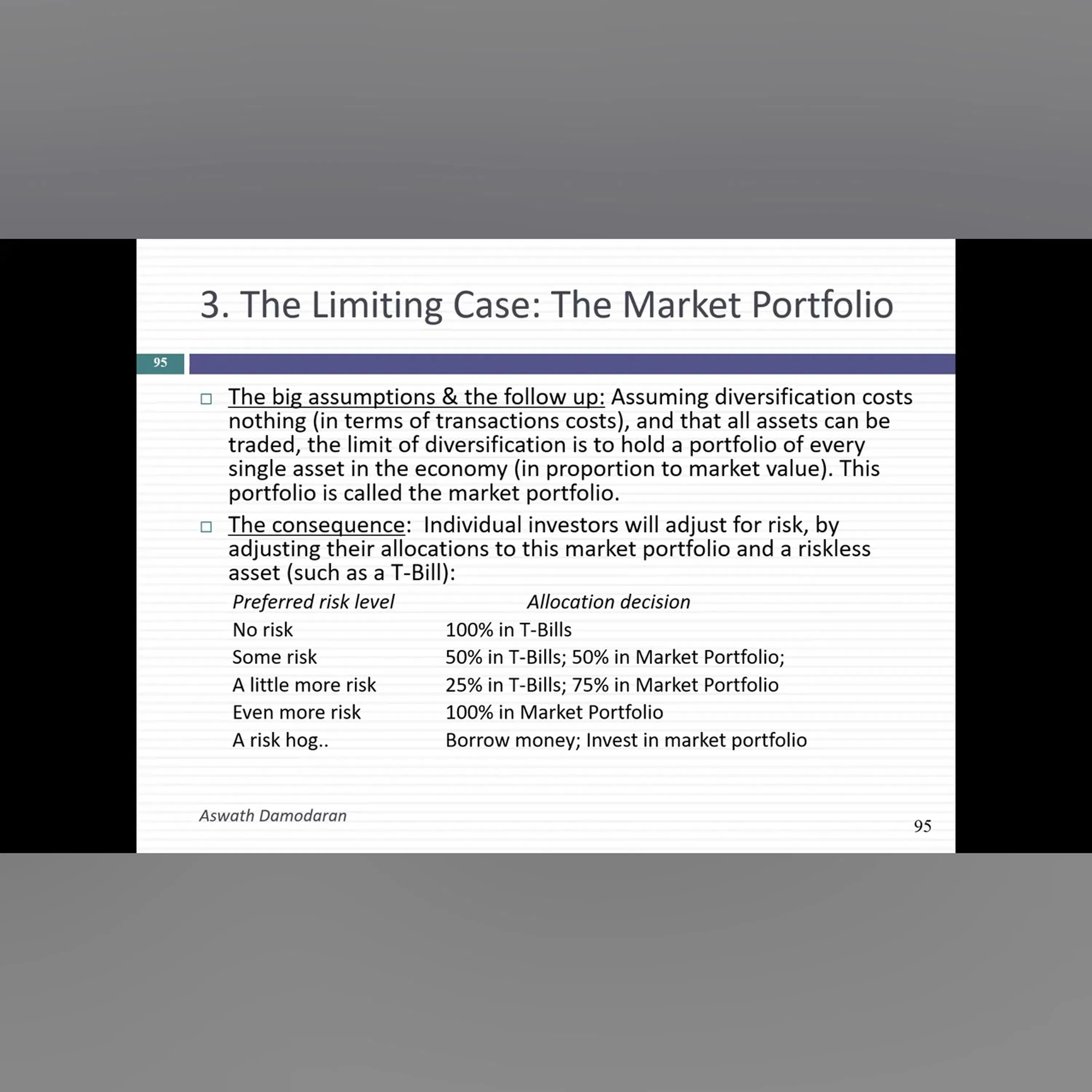
We started this class by tying up the last loose ends with risk and return models, talking about how assuming that there are no transactions costs and private information can lead us all to hold the market portfolio, and how risk can be then measured as risk added to that portfolio. We did damn the CAPM with faint praise, arguing that it does not do very well at explaining differences in returns across companies, but that it does at least as well as the alternatives. We then started on the mechanics of the model, taking about risk free rates: how to estimate the risk free rate in a currency where there is no default free entity issuing bonds in that currency and why risk free rates vary across currencies. The key lesson is that much as we would like to believe that riskfree rates are set by banks, they come from fundamentals - growth and inflation. I have a post on risk free rates that you might find of use: http://aswathdamodaran.blogspot.com/2015/04/dealing-with-low-interest-rates.html In fact, risk free rates turned negative in a few currencies, upending what we know about risk free rates in. Here is my post on negative risk free rates. http://aswathdamodaran.blogspot.com/2016/03/negative-interest-rates-unreal.html In the final few minutes of the session, we turned to equity risk premiums and how they are related to risk aversion. Slides: https://pages.stern.nyu.edu/~adamodar/podcasts/cfspr23/session6slides.pdf Post class test: https://pages.stern.nyu.edu/~adamodar/pdfiles/cfovhds/postclass/session6atest.pdf Post class test solution: https://pages.stern.nyu.edu/~adamodar/pdfiles/cfovhds/postclass/session6asoln.pdf Learn more about your ad choices. Visit megaphone.fm/adchoices

This session is a grind with numbers building on top of numbers. In specific, we looked at how to estimate the beta for not only a company but its individual businesses by building up to a beta, rather than trusting a single regression. With Disney, we estimated a beta for each of the five businesses it was in, a collective beta for Disney's operating businesses and a beta for Disney as a company (including its cash). If you got lost at some stage in the class, here are some of the ways you can get unlost: 1. Review the slides that we covered today. 2. Try the post-class test and solution. I think it will really help bring together some of the mechanical issues involved in estimating betas. 3. Read this short Q&A on bottom up betas which highlights the estimation process and some of its pitfalls: http://www.stern.nyu.edu/~adamodar/New_Home_Page/TenQs/TenQsBottomupBetas.htm Slides: http://www.stern.nyu.edu/~adamodar/podcasts/cfspr17/session9.pdf Post class test: http://www.stern.nyu.edu/~adamodar/pdfiles/cfovhds/postclass/session9test.pdf Post class test solution: http://www.stern.nyu.edu/~adamodar/pdfiles/cfovhds/postclass/session9soln.pdf Learn more about your ad choices. Visit megaphone.fm/adchoices

In this session, after a brief mop-up on why it is dangerous to deviate too much from the implied ERP, we talked about betas. In particular, we noted that estimating a beta by running a regression against a market index can yield junk, and we talked about alternatives. Some of these alternatives are built around estimating risk using something other than prices, and some are built around looking at total risk. We did end the session with ttalk about bottom up betas, focusing on defining comparable firms and expanding the sample. I did make a big deal about bottom up betas, but may have still not convinced you or left you hazy about some of the details. If so, I thought it might be simpler to just send you a document that I put together on the top ten questions that you may have or get asked about bottom up betas. I think it covers pretty much all of the mechanics of the estimation process, but I am sure that I have missed a few things. http://www.stern.nyu.edu/~adamodar/New_Home_Page/TenQs/TenQsBottomupBetas.htm Start of the class test: https://www.stern.nyu.edu/~adamodar/pdfiles/eqnotes/tests/betanew.pdf Slides: https://www.stern.nyu.edu/~adamodar/podcasts/valspr23/session6slides.pdf Post class test: https://www.stern.nyu.edu/~adamodar/pdfiles/eqnotes/postclass/session6test.pdf Post class test solution: https://www.stern.nyu.edu/~adamodar/pdfiles/eqnotes/postclass/session6soln.pdf Learn more about your ad choices. Visit megaphone.fm/adchoices

The first 30 minutes of this session was a quiz. We then continued our discussion of growth by the fundamentals that drive growth. In particular, we looked at how much efficiency can add to growth and how to estimate growth in companies with negative earnings Slides: http://www.stern.nyu.edu/~adamodar/podcasts/valUGspr17/session10.pdf Post class test: http://www.stern.nyu.edu/~adamodar/pdfiles/eqnotes/postclass/session10atest.pdf Post class test solution: http://www.stern.nyu.edu/~adamodar/pdfiles/eqnotes/postclass/session10asoln.pdf Learn more about your ad choices. Visit megaphone.fm/adchoices
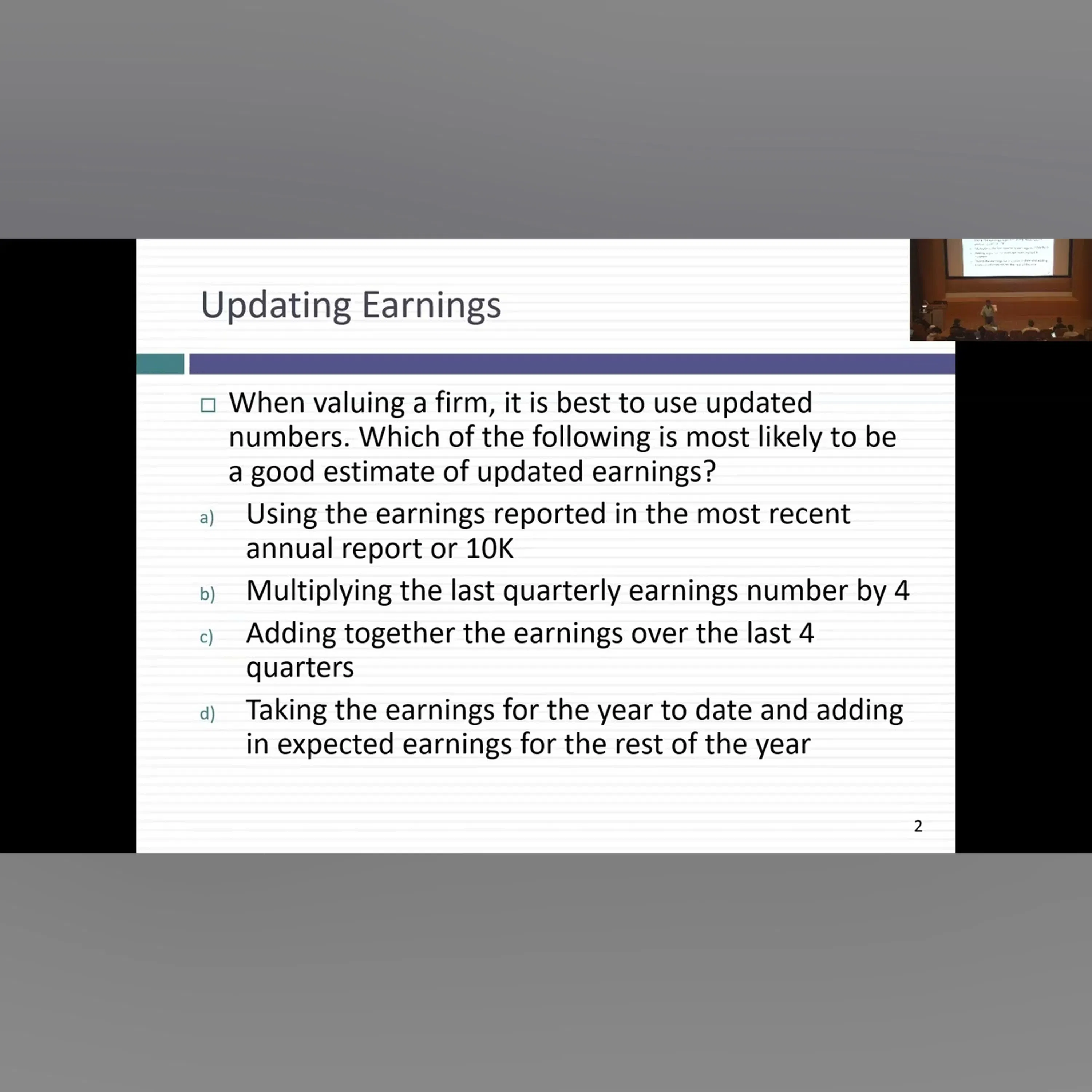
Intros class, we started debt ratios for companies and how to deal with hybrid securities.. If you are interested in getting updated default spreads (on the cheap or free), try the Federal Reserve site in St. Louis: https://fred.stlouisfed.org These are spreads on indices created by rating, updated daily. Neat, right? We started on our discussion of cash flows, by laying out the big differences between earnings and cash flows, and why getting earnings updated and cleaned up is a necessary first step. In particular, we went through the process of converting an operating expense (like leases used to be pre-2019 into a financial expense. Start of the class test: https://pages.stern.nyu.edu/~adamodar/pdfiles/eqnotes/tests/cftests.pdf Slides: https://pages.stern.nyu.edu/~adamodar/podcasts/valUGspr23/session8slides.pdf Post class test: https://pages.stern.nyu.edu/~adamodar/pdfiles/eqnotes/postclass/session8Btest.pdf Post class test: https://pages.stern.nyu.edu/~adamodar/pdfiles/eqnotes/postclass/session8Bsoln.pdf Learn more about your ad choices. Visit megaphone.fm/adchoices

We spent most of this class talking about the determinants of betas. Before we do that, though, there is one point worth emphasizing. Betas measure only non-diversifiable or market risk and not total risk (explaining why Harmony can have a negative beta and Philip Morris a very low beta). 1. Betas are determined in large part by the nature of your business. While I am not an expert on strategy, marketing or productions, decisions that you make in those disciplines can affect your beta. Thus, your decision to go for a price leader as opposed to a cost leader (I hope I am getting my erminology right) or build up a brand name has implications for your beta. As some of you probably realized today, the discussion about whether your product or service is discretionary is tied to the elasticity of its demand (an Econ 101 concept that turns out to have value)... Products and services with elastic demand should have higher betas than products with inelastic demand. And if you do get a chance, try to make that walk down Fifth Avenue... 2. Your cost structure matters. The more fixed costs you have as a firm, the more sensitive your operating income becomes to changes in your revenues. To see why, consider two firms with very different cost structures Firm A Firm B Revenues 100 100 - Fixed costs 90 0 - Variable costs 0 90 Operating income 10 10 Consider what will happen if revenues rise 10%. The first firm will see its operating income increase to 20 (an increase of 100%) whereas the second firm will see its operating income go up to 11 (an increase of 10%)... that is why looking at percentage change in operating income/percentage change in revenues is a measure of operating leverage. 3. Financial leverage: When you borrow money, you create a fixed cost (interest expenses) that makes your equity earnings more volatile. Thus, the equity beta in a safe business can be outlandishly high if has lots of debt. The levered beta equation we went through is a staple for this class and we will revisit it again and again. So, start getting comfortable with it. I also introduced the notion of betas being weighted averages with the Disney - Cap Cities example. I worked out the beta for Disney under two scenarios: an all-equity funded acquisition of Cap Cities and their $10 billion debt/ $8.5 billion equity acquisition. As an exercise, please try to work out the levered beta for Disney on the assumption that they funded the entire acquisition with debt (all $18.5 billion). Slides: http://www.stern.nyu.edu/~adamodar/podcasts/cfspr17/session8.pdf Post class test: http://www.stern.nyu.edu/~adamodar/pdfiles/cfovhds/postclass/session8test.pdf Post class test solution: http://www.stern.nyu.edu/~adamodar/pdfiles/cfovhds/postclass/session8soln.pdf Learn more about your ad choices. Visit megaphone.fm/adchoices

One of the lessons relearned in 2022 was that the end game of any business, no matter what its potential and how many users it has, is to make money. In this session, I draw a distinction between different profit measures from gross to operating to net profit, and how the test of making money gets more difficult as you move down the income statement.. I scale profits to revenues to estimate margins, and examine the distribution of margins, and differences across geographies and industries. I look at accounting returns, standing alone, and relative to the costs of raising capital to conclude that in 2022, about 70% of all publicly traded firms earned less than their costs of equity (capital), some for good reasons, but many for bad ones. Slides: https://pages.stern.nyu.edu/~adamodar/pdfiles/blog/DataUpdate5for2023.pdf Post: https://aswathdamodaran.blogspot.com/2023/02/data-update-5-for-2023-earnings-test.html Learn more about your ad choices. Visit megaphone.fm/adchoices

Learn more about your ad choices. Visit megaphone.fm/adchoices

Learn more about your ad choices. Visit megaphone.fm/adchoices

This class covered the conventional approach to estimating betas, which is to run a regression of returns on a stock against returns on the market index. We first covered the estimation choices: how far back in time to go (depends on how much your company has changed), what return interval to use (weekly or monthly are better than daily), what to include in returns (dividends and price appreciation) and the market index to use (broader and wider is better). We also looked at the three key pieces of output from the regression: 1. The intercept: This is a measure of how good or bad an investment your stock was during the period of your regression. To compute the measure correctly, you net out Rf(1-Beta) from the Intercept: Jensen's alpha = Intercept - Riskfree rate (1- Beta) If this number is a positive (negative) number, your stock did better (worse) than expected, after adjusting for risk and market performance. 2. The slope: is the beta, albeit with standard error 3. The R squared: measures the proportion of the risk in your stock that is market risk, with the balance being firm specific/diversifiable risk. Finally, we used the beta to come up with an expected return for stock investors/cost of equity for the company. Slides: http://www.stern.nyu.edu/~adamodar/podcasts/cfspr17/session7.pdf Post class test: http://www.stern.nyu.edu/~adamodar/pdfiles/cfovhds/postclass/session7test.pdf Post class test solution: http://www.stern.nyu.edu/~adamodar/pdfiles/cfovhds/postclass/session7soln.pdf Learn more about your ad choices. Visit megaphone.fm/adchoices

In this class, we started with the cost of debt and computing debt ratios for companies and how to deal with hybrid securities.. If you are interested in getting updated default spreads (on the cheap or free), try this site: https://content.naic.org/search?q=default+spreads&btnG.x=0&btnG.y=0#gsc.tab=0&gsc.q=default%20spreads&gsc.page=1 While that link will give you end spreads, they do update the numbers monthly, but seem to do an awfully poor job of making the spreadsheet findable. You can also try the St. Louis FRED and find updated on seven major ratings classes (AAA, AA, A, BBB, BB, B, C and lower) updated daily. Neat, right? You can get the spreads from Bloomberg as well, using the FIW function, and tweaking the choices to show all corporate spreads. We then moved on to getting the base year's earnings right and explored several issues: 1. To get updated numbers, you should be using either trailing 12 month numbers or complete the current year with forecasted numbers. In either case, your objective should be to get the most updated numbers you can for each input rather than be consistent about timing. 2. To clean up earnings, you have to correct accounting two biggest problems: the treatment of operating leases as operating (instead of financial) expenses and the categorization of R&D as operating (instead of capital) expenses. The biggest reason for making these corrections is to get a better sense of how much capital has been invested in the business and how much return this capital is generating. Start of the class test: https://www.stern.nyu.edu/~adamodar/pdfiles/eqnotes/tests/cftests.pdf Slides: https://www.stern.nyu.edu/~adamodar/podcasts/valspr23/session7slides.pdf Post class test: https://www.stern.nyu.edu/~adamodar/pdfiles/eqnotes/postclass/session7test.pdf Post class test solution: https://www.stern.nyu.edu/~adamodar/pdfiles/eqnotes/postclass/session7soln.pdf Learn more about your ad choices. Visit megaphone.fm/adchoices

Toward the end of 2016, Snap (formerly known as Snapchat) became the latest of the social media companies to enter the public market. With 161 million engaged users but little in terms of current revenues & big operating losses, Snap fills the bill as a company with lots of potential but plenty of peril. In this post, I tell my story for Snap and the value that emerges from it. It is, for the most part, an optimistic story of a young company that has found a niche in the crowded social media space. In my story, Snap will not and should not try to be the next Facebook but I also see it as avoiding becoming Twitter Redux. Tell your own story and make your storyline into a value! Slides: http://www.stern.nyu.edu/~adamodar/pdfiles/blog/SnapIPO.pdf Blog Post: http://aswathdamodaran.blogspot.com/2017/02/a-snap-story-valuing-snap-ahead-of-its.html Links Snap Prospectus:https://www.sec.gov/Archives/edgar/data/1564408/000119312517029199/d270216ds1.htm Snap IPO valuation (my base story): http://www.stern.nyu.edu/~adamodar/pc/blog/SnapIPOFeb2017.xls Snap as Facebook Light: http://www.stern.nyu.edu/~adamodar/pc/blog/SnapFacebookLite.xls Snap as Twitter Redux:http://www.stern.nyu.edu/~adamodar/pc/blog/SnapTwitterredux.xls Snap Simulation: http://www.stern.nyu.edu/~adamodar/pc/blog/SnapSimulation.pdf Learn more about your ad choices. Visit megaphone.fm/adchoices

In this session, we began by looking at broad definitions of cash flows, before embarking on updating, normalizing and cleaning up accounting earnings. In particular, we talked about why we capitalize lease commitments and R&D expenses, and how they affect valuation inputs. We continued our discussion of cash flows, by first putting to rest some final issues on earnings, including the tax rate to use in computing after-tax cash flows and dealing with money losing companies. In the process, we did look at what to do about accounting fraud, and while the answer is not much, there may be a role for forensic accounting. To be honest, most forensic accounting books are designed for valuation morticians, but here are a couple that you may find useful: 1. http://www.amazon.com/Financial-Shenanigans-Accounting-Gimmicks-Reports/dp/0071703071/ref=pd_sim_b_8 2. http://www.amazon.com/Creative-Cash-Flow-Reporting-Sustainable/dp/0471469181/ref=pd_sim_b_2 Start of the class test: https://pages.stern.nyu.edu/~adamodar/pdfiles/eqnotes/tests/cftests2.pdf Slides: https://pages.stern.nyu.edu/~adamodar/podcasts/valUGspr23/session9slides.pdf Post class test: https://pages.stern.nyu.edu/~adamodar/pdfiles/eqnotes/postclass/session9Atest.pdf Post class test: https://pages.stern.nyu.edu/~adamodar/pdfiles/eqnotes/postclass/session9Asoln.pdf Learn more about your ad choices. Visit megaphone.fm/adchoices

When funding a business, you can use either borrowed money (debt) or your own money (equity). In this session, I by starting by looking at the trade offs, both real and illusory, that determine the right mix of debt and equity for a business, and use the cost of capital as an optimizing tool to determine the right mix of debt and equity. (I use it to go back and look at whether Adani Group is over levered.). I then turn to the corporate use of debt in 2022, examining the distribution of debt to capital (gross & net, book and market) ratios around the world, with regional differences. I also look at interest coverage ratios and debt to EBITDA differences across companies and sectors, before closing with an assessment of what 2023 will bring in terms of debt troubles and defaults. Slides: https://pages.stern.nyu.edu/~adamodar/pdfiles/blog/DataUpdate6for2023.pdf Datasets: 1. Debt fundamentals, by industry group (US): https://pages.stern.nyu.edu/~adamodar/pc/datasets/dbtfund.xls 2. Debt fundamentals, by industry group (Global): https://pages.stern.nyu.edu/~adamodar/pc/datasets/dbtfundGlobal.xls Spreadsheets: 1. Capital Structure Optimization spreadsheet: https://pages.stern.nyu.edu/~adamodar/pc/capstru.xlsx 2. Adani Enterprises Optimum Financing Mix: https://pages.stern.nyu.edu/~adamodar/pc/blog/AdaniCapStru.xlsx 3. Adani Group Optimum Financing Mix: https://pages.stern.nyu.edu/~adamodar/pc/blog/AdaniGroupCapStru.xlsx Learn more about your ad choices. Visit megaphone.fm/adchoices

In today’s class, we started with computing debt ratios for companies and how to deal with hybrid securities.. If you are interested in getting updated default spreads (on the cheap or free), try the Federal Reserve site in St. Louis: https://fred.stlouisfed.org/categories/32297 These are spreads on indices created by rating, updated daily. Neat, right? We then moved on to getting the base year's earnings right and explored several issues: 1. To get updated numbers, you should be using either trailing 12 month numbers or complete the current year with forecasted numbers. In either case, your objective should be to get the most updated numbers you can for each input rather than be consistent about timing. 2. To clean up earnings, you have to correct accounting two biggest problems: the treatment of operating leases as operating (instead of financial) expenses and the categorization of R&D as operating (instead of capital) expenses. The biggest reason for making these corrections is to get a better sense of how much capital has been invested in the business and how much return this capital is generating. Start of the class test: http://www.stern.nyu.edu/~adamodar/pdfiles/eqnotes/tests/cftests.pdf Slides: http://www.stern.nyu.edu/~adamodar/podcasts/valUGspr17/session7.pdf Post class test: http://www.stern.nyu.edu/~adamodar/pdfiles/eqnotes/postclass/session7test.pdf Post class test solution: http://www.stern.nyu.edu/~adamodar/pdfiles/eqnotes/postclass/session7soln.pdf Learn more about your ad choices. Visit megaphone.fm/adchoices

We continued our discussion of cash flows, by first putting to rest some final issues on earnings, including the tax rate to use in computing after-tax cash flows and dealing with money losing companies. In the process, we did look at what to do about accounting fraud, and while the answer is not much, there may be a role for forensic accounting. To be honest, most forensic accounting books are designed for valuation morticians, but here are a couple that you may find useful: http://www.amazon.com/Financial-Shenanigans-Accounting-Gimmicks-Reports/dp/0071703071/ref=pd_sim_b_8 http://www.amazon.com/Creative-Cash-Flow-Reporting-Sustainable/dp/0471469181/ref=pd_sim_b_2 We then moved on to examine broad questions about what to include in capital expenditures and working capital, before putting the cash flow topic to rest by working out debt cash flows and cash flows to equity. If you are interested, you may find this post that I had on free cash flows useful (with Microsoft as my case study): https://aswathdamodaran.blogspot.com/2022/10/earnings-and-cash-flows-primer-on-free.html Start of the class test: https://www.stern.nyu.edu/~adamodar/pdfiles/eqnotes/tests/cftests2.pdf Slides: https://www.stern.nyu.edu/~adamodar/podcasts/valspr23/session8slides.pdf Post class test: https://www.stern.nyu.edu/~adamodar/pdfiles/eqnotes/postclass/session8test.pdf Post class test solution: https://www.stern.nyu.edu/~adamodar/pdfiles/eqnotes/postclass/session8soln.pdf Learn more about your ad choices. Visit megaphone.fm/adchoices

In this session, we address the question of what risks get rewarded and which ones do not, by looking diversifiable versus non-diversifiable risk. The best way to understand diversifiable and non-diversifiable risk is to take a company and consider all of the risks that it is exposed to and then categorize these risks into whether they are likely to affect just the company, the company and a few competitors, the entire sector or the overall market. The marginal investor, if diversified, cares and prices in only the last type of risk. In the last part of the class, we introduced the notion of a risk free investment and how to measure the risk free rate. Slides: http://www.stern.nyu.edu/~adamodar/podcasts/cfspr17/session5.pdf Post class test: http://www.stern.nyu.edu/~adamodar/pdfiles/cfovhds/postclass/session5test.pdf Post class test solution: http://www.stern.nyu.edu/~adamodar/pdfiles/cfovhds/postclass/session5soln.pdf Learn more about your ad choices. Visit megaphone.fm/adchoices

In this session, we started by completing our discussion of FCFE and how it varies over a corporate life cycle, and then looked at three approaches to estimating growth - a historical growth rate, where you look at past growth, outsourcing growth to analysts or managers and sustainable growth, where you tie growth to how much a company is reinvesting and how well it is reinvesting. Ultimately, you have to find the right mix of historical data, industry trends and your assessment of the company in forecasting growth, and letting uncertainty stop you is not an option. Start of the class test: https://pages.stern.nyu.edu/~adamodar/pdfiles/eqnotes/tests/growthrate.pdf Slides: https://pages.stern.nyu.edu/~adamodar/podcasts/valUGspr23/session10slides.pdf Post class test: https://pages.stern.nyu.edu/~adamodar/pdfiles/eqnotes/postclass/session10Atest.pdf Post class test: https://pages.stern.nyu.edu/~adamodar/pdfiles/eqnotes/postclass/session10Asoln.pdf Learn more about your ad choices. Visit megaphone.fm/adchoices