Skip to content
Artwork for Aswath Damodaran
BusinessEntrepreneurshipEducation

Aswath Damodaran

Aswath Damodaran

I teach corporate finance, valuation and investment philosophies at the Stern School of Business at New York University. I have online versions of all three courses here, as well as other finance-related videos.
1. The Corporate Finance Online playlist has an introductory video and 36 sessions that cover all of corporate finance (at least as I see it).
2. The Valuation playlist has 25 sessions that cover valuation approaches, issues and questions.
3. The Investment Philosophies playlist has sessions that cover different investment philosophies.
4. The Accounting and Statistics playlists reflect my quirky and unorthodox introductions to two disciplines that are critical to my valuation and corporate finance classes.
5. The Blog Posts playlist has sessions that go wit my blog posts and reflect my standing as a dabbler, rather than expert, in all things finance-related.
If you need the supporting material for any of the classes, check the links below.

Links:
Corporate finance materials: http://www.stern.nyu.edu/~adamodar/New_Home_Page/corpfin.html
Valuation materials: http://www.stern.nyu.edu/~adamodar/New_Home_Page/equity.html
Investment Philosophies: http://www.stern.nyu.edu/~adamodar/New_Home_Page/invphil.htm
Books: http://www.stern.nyu.edu/~adamodar/New_Home_Page/public.htm
My website: http://www.damodaran.com

Play
  • 24 episodes
  • daily
  • Avg 50 min
  • English
Counted on this page — what you have heard stays on this device, so it is not something the list can be paged by.
  • Yesterday · 31 min

    Data Update 2 for 2024: A Comeback Year for Stocks!

    As we start on 2024, it is worth noting how much the mood has shifted in the last year. At the start of 2023, dark clouds were gathering. Inflation was out of control and a recession seemed imminent, but the S&P 500 surprised us all by delivering a 26% return. That recovery was uneven, with seven stocks accounting for a big portion of the gain, and disparate returns across sectors. The 2024 outlook is much sunnier, with the consensus shifting to a soft landing and inflation largely under control, and those higher expectations may be the biggest challenge for equities this year. The expected return (8.48%) and the equity risk premium (4.60%) for the S&P 500 do not set off red flags, by themselves, but an intrinsic value of the index (see link) leads me to conclude that stocks are over valued by about 9%, to start the year. Your outlook on earnings and interest rates may be different from mine, leading you to a different valuation and conclusion. Slides: https://pages.stern.nyu.edu/~adamodar/pdfiles/blog/DataUpdate2for2024.pdf Blog Post: https://aswathdamodaran.blogspot.com/2024/01/data-update-2-for-2024-stock-comeback.html Valuation of the S&P 500 on January 1, 2024: https://pages.stern.nyu.edu/~adamodar/pc/blog/S&P500ValueJan2024.xlsx Historical Returns on stocks - 1928 -2023: https://pages.stern.nyu.edu/~adamodar/pc/datasets/histretSP.xlsx Historical expected returns and implied premiums for S&P 500: https://pages.stern.nyu.edu/~adamodar/pc/datasets/histimpl.xls Learn more about your ad choices. Visit megaphone.fm/adchoices

  • Yesterday · 20 min

    Journeying to the Dark Side: Coping with Uncertainty

    In this webcast, I look at why we feel that we are in the age of uncertainty and the natural responses (mostly unhealthy) that we have to its presence in business and investing. I also look at coping mechanisms that we can use to deal with uncertainty and why I think that this may be an edge in investing. Blog post: http://aswathdamodaran.blogspot.com/2016/05/dcf-myth-3-you-cannot-do-valuation-when.html Slides: http://www.stern.nyu.edu/~adamodar/pdfiles/blog/DCFMythUncertainty.pdf Learn more about your ad choices. Visit megaphone.fm/adchoices

  • Yesterday · 1 hr 22 min

    Session 1 (Val Undergrads): introduction to class

    The undergraduate class is officially rolling, and thank you tuning in. During the session, I told you that that this was a class about valuation in all of its many forms – different approaches (intrinsic, relative & contingent claim), different forums (for acquisitions, value enhancement, investing) and across different types of businesses (private & public, small and large, developed & emerging market). After spending some time laying out the script for the class (quizzes, exams, weekly tortures), I laid out the philosophical foundations for valuation, by noting that it is a bridge between story and numbers and that it is different from pricing. Home page for class: https://pages.stern.nyu.edu/~adamodar//New_Home_Page/equityUG.html Start of the class test: https://pages.stern.nyu.edu/~adamodar/pdfiles/eqnotes/tests/firstclass.pdf Syllabus: https://pages.stern.nyu.edu/~adamodar/pdfiles/eqnotes/eqUGsyllspr24.pdf Post-class test: https://www.stern.nyu.edu/~adamodar/pdfiles/eqnotes/postclass/session1test.pdf Post-class test solution: https://www.stern.nyu.edu/~adamodar/pdfiles/eqnotes/postclass/session1soln.pdf Learn more about your ad choices. Visit megaphone.fm/adchoices

  • Yesterday · 1 hr

    Session 23(MBA): Potential Dividends and Cash Balances

    In this shortened class, we moved on to look at how much a company can afford to pay out as dividend. This measure, that I titled FCFE, is the cash left over after taxes, reinvestment needs and net debt payments. When a company pays out less than its FCFE, it is accumulating cash, and we laid the foundations for analyzing dividend policy by asking the key question: do you trust managers with your cash? During the session, we applies this framework to the Disney, Vale and BP.. Post class test and solution attached Until next time! Slides: http://www.stern.nyu.edu/~adamodar/podcasts/cfspr16/Session23.pdf Post class test: http://www.stern.nyu.edu/~adamodar/pdfiles/cfovhds/postclass/session23test.pdf Post class test solution: http://www.stern.nyu.edu/~adamodar/pdfiles/cfovhds/postclass/session23soln.pdf Learn more about your ad choices. Visit megaphone.fm/adchoices

  • Wednesday · 1 hr 25 min

    Session 2 (Val Undergrads): The Bermuda Triangle of Valuation

    The class started with a test on whether you can detect the direction bias will take, based on who or why a valuation is done. The solutions are posted online on the webcast page for the class. We then moved on to talk about the three basic approaches to valuation: discounted cash flow valuation, where you estimate the intrinsic value of an asset, relative valuation, where you value an asset based on the pricing of similar assets and option pricing valuation, where you apply option pricing to value businesses. With each approach, we talked about the types of assets that are best priced with that approach and what you need to bring as an analyst/investor to the table. For instance, in our discussion of DCF valuation and how to make it work for you, I suggested that there were two requirements: a long time horizon and the capacity to act as the catalyst for market correction. Since I mentioned Carl Icahn and Bill Ackman as hostile acquirers (catalysts), you may want to look at Herbalife, the company that Ackman has targeted as being over valued and Icahn did for being under valued. See if you can get a list going of how each is trying to be the catalyst for the correction... and think about the dark side of this process. We will be starting on the first lecture note packet on Monday. Home page for class: https://pages.stern.nyu.edu/~adamodar//New_Home_Page/equityUG.html Start of the class test: https://pages.stern.nyu.edu/~adamodar/pdfiles/eqnotes/tests/biasshort.pdf Project: https://pages.stern.nyu.edu/~adamodar/pdfiles/eqnotes/eqprojspr24.pdf Slides: https://pages.stern.nyu.edu/~adamodar/pdfiles/eqnotes/ValIntroSpr24.pdf Post-class test: https://www.stern.nyu.edu/~adamodar/pdfiles/eqnotes/postclass/session2test.pdf Post-class test solution: https://www.stern.nyu.edu/~adamodar/pdfiles/eqnotes/postclass/session2soln.pdf Learn more about your ad choices. Visit megaphone.fm/adchoices

  • Wednesday · 1 hr 29 min

    Session 25 (Undergraduate): Potential Dividends and Cash Balances

    In this session, we began by looking at bad reasons for paying dividends (more certain than capital gains, excess cash this year) as well as good reasons (investment clientele, signaling & debt/equity conflicts). We then came up with a measure of potential dividends (FCFE) and examined the consequences of paying out less or more to stockholders, and why some companies have more flexibility than others. Slides: http://www.stern.nyu.edu/~adamodar/podcasts/cfUGspr16/Session25.pdf Post class test: http://www.stern.nyu.edu/~adamodar/pdfiles/cfovhds/postclass/session25atest.pdf Post class test solution: http://www.stern.nyu.edu/~adamodar/pdfiles/cfovhds/postclass/session25asoln.pdf Learn more about your ad choices. Visit megaphone.fm/adchoices

  • Wednesday · 21 min

    Data Update 3 for 2024: A Rule Breaking Year for Interest Rates

    After a calamitous year for bond in 2022, investors faced 2023 with trepidation, but as with stocks, bonds delivered a positive surprise. Short term treasury rates rise, perhaps in response to the Fed's bellicosity, but treasury bond rates stayed unchanged. In fact, the behavior of the bond market and the response of the economy in 2023 tested two widely held nostrums in markets - that the Fed sets interest rates and that a downward sloping yield curve is a precursor to a recession - and found both fell short. Government bond rates in other currencies also mirrored US dollar rates, and followed a strong rise in 2022 with little change in 2023. For companies, the biggest change during the year was that default spreads decreased significantly during the course of the year, as investors became less fearful. Slides: https://pages.stern.nyu.edu/~adamodar/pdfiles/blog/DataUpdate3for2024.pdf Blog Post: Learn more about your ad choices. Visit megaphone.fm/adchoices

  • Wednesday · 1 hr 34 min

    Session 23(MBA): FCFE (Potential Dividends) and Cash Balances

    In this shortened class, we moved on to look at how much a company can afford to pay out as dividend. This measure, that I titled FCFE, is the cash left over after taxes, reinvestment needs and net debt payments. When a company pays out less than its FCFE, it is accumulating cash, and we laid the foundations for analyzing dividend policy by asking the key question: do you trust managers with your cash? During the session, we applies this framework to the Disney, Vale and BP.. Post class test and solution attached Until next time! Slides: http://www.stern.nyu.edu/~adamodar/podcasts/cfspr16/Session23.pdf Post class test: http://www.stern.nyu.edu/~adamodar/pdfiles/cfovhds/postclass/session23test.pdf Post class test solution: http://www.stern.nyu.edu/~adamodar/pdfiles/cfovhds/postclass/session23soln.pdf Learn more about your ad choices. Visit megaphone.fm/adchoices

  • Tuesday · 45 min

    Data Update 4 for 2024: Danger plus Opportunity - Risk enters the Equation!

    Risk is at the center of finance, both in the context of business decision making and investments. In this session, I start by breaking risk down into buckets and looking at the evolution of measures of risk. I look at differences across companies and regions, using both price-based and intrinsic risk measures. I then look at risk variations across countries and how they play out as different equity risk premiums. In closing, I look at how the inputs in this and the prior to two data updates help in computing the cost of capital, why that cost of capital affect decision making and the distribution of costs of capital, at the start of 2024. Slides: https://pages.stern.nyu.edu/~adamodar/pdfiles/blog/DataUpdate4for2024.pdf Blog Post: https://aswathdamodaran.blogspot.com/2024/01/data-update-4-for-2024-danger-and.html Cost of capital paper: https://pages.stern.nyu.edu/~adamodar/pdfiles/papers/costofcapital.pdf Country risk paper: https://papers.ssrn.com/sol3/papers.cfm?abstract_id=4509578 Equity Risk Premiums, by country: https://pages.stern.nyu.edu/~adamodar/pc/datasets/ctryprem.xlsx Learn more about your ad choices. Visit megaphone.fm/adchoices

  • Tuesday · 1 hr 14 min

    Quiz3: Review Session (MBA)

    This quiz will cover all of capital structure, from the trade off to optimizing the mix to the right kind of debt. Slides: http://www.stern.nyu.edu/~adamodar/pdfiles/cfexams/reviewQuiz3.pdf Past quiz 3s: http://www.stern.nyu.edu/~adamodar/pdfiles/cfexams/prqz3.pdf Past quiz 3 solutions: http://www.stern.nyu.edu/~adamodar/pdfiles/cfexams/prqz3sol.xls Learn more about your ad choices. Visit megaphone.fm/adchoices

  • Tuesday · 1 hr 29 min

    Session 1 (CF MBAs); Corporate Finance - The Big Picture

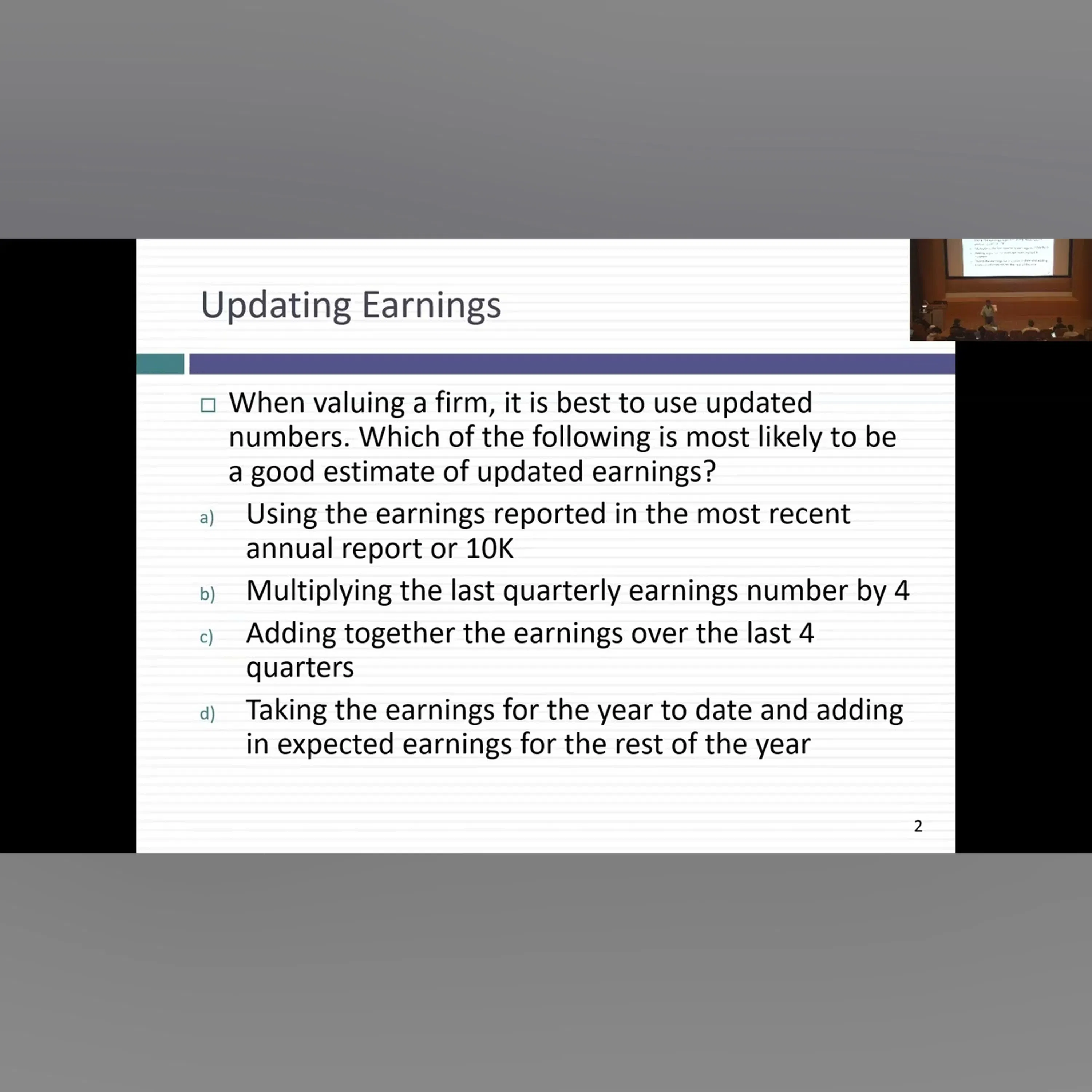
    In this session, I laid out the structure for the class and an agenda of what I hope to accomplish during the next 15 weeks. In addition to describing the logistical details, I presented my view that corporate finance is the ultimate big picture class because everything falls under its purview. The “big picture” of corporate finance covers the three basic decisions that every business has to make: how to allocate scarce funds across competing uses (the investment decision), how to raise funds to finance these investments (the financing decision) and how much cash to take out of the business (the dividend decision). The singular objective in corporate finance is to maximize the value of the business to its owners. This big picture was then used to emphasize five themes: that corporate finance is common sense, that it is focused, that the focus shifts over the life cycle and that you cannot break first principles with immunity. Syllabus: https://pages.stern.nyu.edu/~adamodar/pdfiles/cfovhds/cfsyllspr24.pdf Post class test 1: https://pages.stern.nyu.edu/~adamodar/pdfiles/cfovhds/session1test.pdf Post class test 1 solution: https://pages.stern.nyu.edu/~adamodar/pdfiles/cfovhds/session1soln.pdf Learn more about your ad choices. Visit megaphone.fm/adchoices
  • Tuesday · 55 min

    Session 24 (Undergraduate): The Trade off on Dividends

    We spent all of the session setting up the trade off on dividends, starting with the argument that Miller/Modigliani made that dividends don't matter (in a world where investors are taxed at the same rate on dividends & capital gains & stock issuance is costless) to the dividends are bad school (built on the almost century long higher tax on dividends) to the dividends are good school. Slides: http://www.stern.nyu.edu/~adamodar/podcasts/cfUGspr16/Session24.pdf Post class test: http://www.stern.nyu.edu/~adamodar/pdfiles/cfovhds/postclass/session24atest.pdf Post class test solution: http://www.stern.nyu.edu/~adamodar/pdfiles/cfovhds/postclass/session24asoln.pdf Learn more about your ad choices. Visit megaphone.fm/adchoices

  • Monday · 19 min

    Session 35 (of 42): The Case for Passive Investing - Active Investors' Track Record

    In this session, we make the argument for passive investing by looking at the performance of active investors. We begin by looking at individual investors and note that they collectively under perform the market and that the under performance gets worse as they get more active. There is some cause for hope, though, since the very best investors do substantially out perform the market, especially if they stick to the companies that they know and don’t diversify too much. With mutual funds, the evidence is not favorable, since mutual funds under perform indices and the under performance cuts across all classes of mutual funds. Collectively, active investing does not seem to provide much of a payoff. Playlist for class (Intro + 42 sessions): https://youtube.com/playlist?list=PLUkh9m2BorqnZGADa8cTzeJblmrZY_SqP&si=zI2pk17pJeld4nWR Slides: https://www.stern.nyu.edu/~adamodar/pdfiles/invphilslides25/session35.pdf Post-class test: https://www.stern.nyu.edu/~adamodar/pdfiles/invphilcertificate/postclass/session35test.pdf Post-class solution: https://www.stern.nyu.edu/~adamodar/pdfiles/invphilcertificate/postclass/session35soln.pdf Learn more about your ad choices. Visit megaphone.fm/adchoices

  • Monday · 21 min

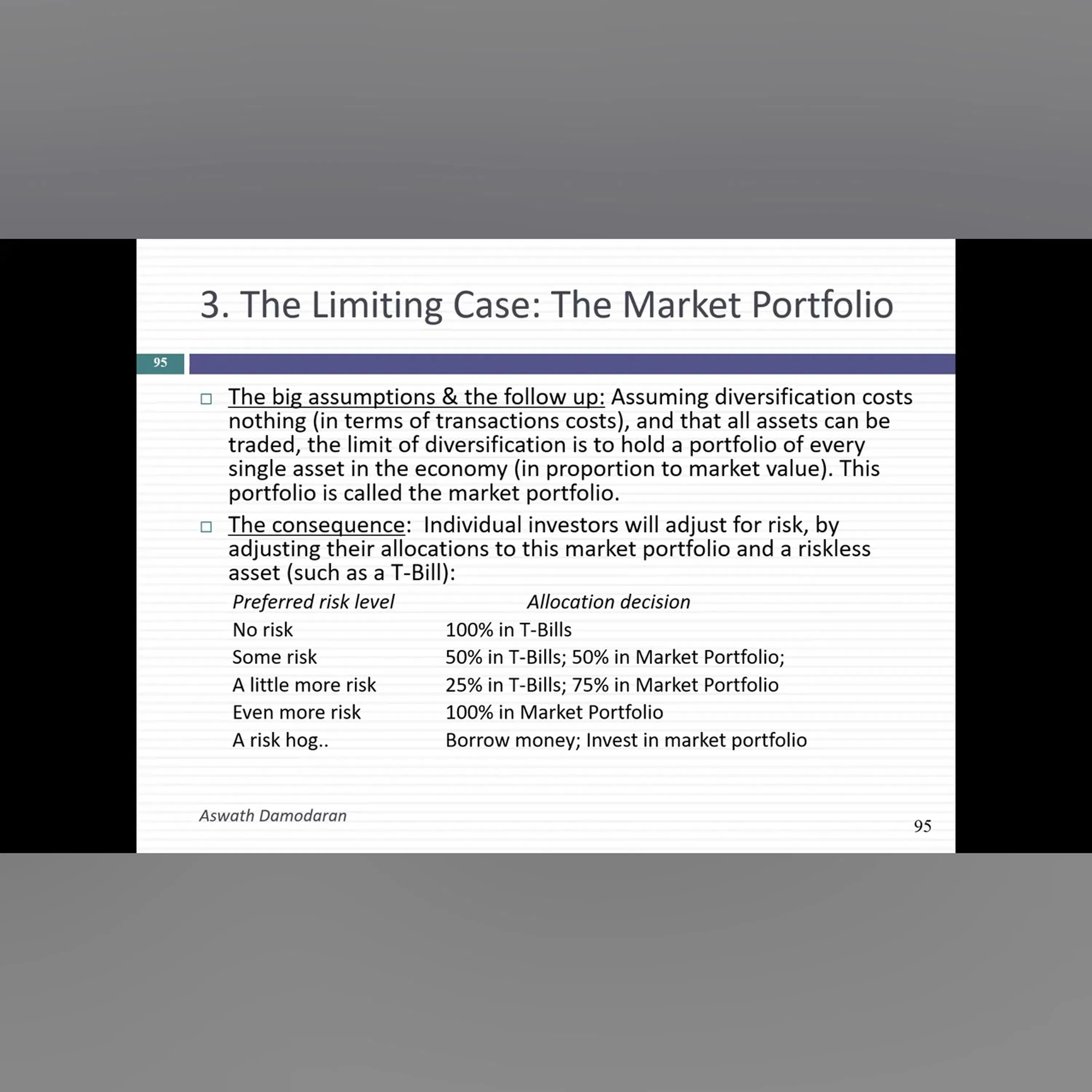
    Session 4: Defining and Measuring Risk

    Looks at how we define risk in finance and alternate models for risk and return. Learn more about your ad choices. Visit megaphone.fm/adchoices
  • Monday · 1 hr 34 min

    Session 22(MBA): Dividend Trade Off

    We spent all of this session setting up the trade off on dividends, starting with the argument that Miller/Modigliani made that dividends don't matter (in a world where investors are taxed at the same rate on dividends & capital gains & stock issuance is costless) to the dividends are bad school (built on the almost century long higher tax on dividends) to the dividends are good school. We closed by looking at two bad reasons for paying dividends (that they are more certain, that you had a good year) and three potentially good reasons (to signal to market, to make your clientele happy and to take advantage of debt holders). Slides: http://www.stern.nyu.edu/~adamodar/podcasts/cfspr16/Session22.pdf Post class test: http://www.stern.nyu.edu/~adamodar/pdfiles/cfovhds/postclass/session22test.pdf Post class test solution: http://www.stern.nyu.edu/~adamodar/pdfiles/cfovhds/postclass/session22soln.pdf Learn more about your ad choices. Visit megaphone.fm/adchoices

  • Monday · 50 min

    Finding your Investing Lodestar: In Search of an Investment Philosophy!

    An investment philosophy is a coherent set of beliefs about how markets work (and sometimes don't work) that underpins your investment strategies and choices, and it is a critical ingredient for successful investing in the long term. Many investors (including quite a few professional and institutional investors) lack core philosophies, and consequently end up chasing last year's winners or falling for investment scams. Others try to imitate successful investors, believing that imitation will lead to similar success in markets, but are often disappointed. There is no one "best" investment philosophy for all investors, but there is one that is right for you that fits your beliefs about markets and your personality. I have a book and a (free) online class on the process that you go through to find this philosophy, and I have updated both, with the third edition of the book available on March 31, 2026, at booksellers, and the new version of the class online (on both my webpage and as a YouTube playlist). Slides: https://pages.stern.nyu.edu/~adamodar/pdfiles/blog/InvPhil.pdf Blog post: https://aswathdamodaran.blogspot.com/2026/03/finding-your-investing-lodestar-in.html Book links: Webpage for book: https://pages.stern.nyu.edu/~adamodar/New_Home_Page/invphil3edbook.htm Booksellers: Amazon: https://bit.ly/40UqMyL Barnes and Noble: https://www.barnesandnoble.com/w/investment-philosophies-aswath-damodaran/1122867680 (25% off until March 26, 2026) Class links: My webpage: https://pages.stern.nyu.edu/~adamodar/New_Home_Page/webcastinvphil2025.htm YouTube Playlist: https://youtu.be/jBl8FXPc9tY?si=eF0WfFZDwVpz6K1I Learn more about your ad choices. Visit megaphone.fm/adchoices

  • Monday · 24 min

    The Market's Narrative: How Investors are pricing in the Iran War!

    The month of March 2026 was dominated by one story - the war in Iran and how it would play out. The month started with questions about how long the war would last and what effects it would have on the region and on global economies in the short and long term, and it ended with those questions still unanswered. As you try to make sense of competing narratives from experts (sell-anointed and real), you may want to check out the narrative in the market. I use market data, starting with oil prices and interest rates, and moving on to risk premiums, to conclude that, at least so far, this has been a market that is trying to reassess value, given the economic consequences of war, rather than one driven by panic. Oil prices are up strongly, but there are geographic and time variations, with Brent rising more than West Texas crude, and spot prices surging more than future. Equity risk premiums, bond spreads and the volatility index are all up, but not in the magnitudes that you would see in crisis market. Slides: https://pages.stern.nyu.edu/~adamodar/pdfiles/blog/WarandOil.pdf Blog Post: https://aswathdamodaran.blogspot.com/2026/04/oil-war-and-global-economy-markets.html Data: Day-by-day ERP: https://pages.stern.nyu.edu/~adamodar/pc/blog/AlldataMarch2026.xlsx ERP by country (updated to March 31, 2026): https://pages.stern.nyu.edu/~adamodar/pc/datasets/ctrypremApr26.xlsx Learn more about your ad choices. Visit megaphone.fm/adchoices

Showing 1–20 of 24 episodes