Skip to content
Artwork for YaleCourses
EducationSociety & CulturePhilosophy

YaleCourses

YaleCourses

Yale's philosophy of teaching and learning begins with the aim of training a broadly based, highly disciplined intellect without specifying in advance how that intellect will be used. The Yale Courses channel provides entry into the core of the University--its classrooms and academic programs--including complete sets of lectures from the Open Yale Courses initiative. Complementary syllabi, transcripts, and other resources may also be accessed from the Open Yale Courses website listed below.

Links:
online.yale.edu: http://online.yale.edu

Play
  • 525 episodes
  • Avg 42 min
  • English
Counted on this page — what you have heard stays on this device, so it is not something the list can be paged by.
  • August 30 · 53 min

    17. Hubble's Law and the Big Bang (cont.)

    Frontiers/Controversies in Astrophysics (ASTR 160) Class begins with a review of magnitudes and the problem set involving magnitude equations. Implications of the Hubble Law and Hubble Diagram are discussed. Professor Bailyn elaborates on the Big Bang theory of cosmology and addresses controversial questions related to the age, development, and boundaries of the universe. The fate of the universe, and possibly its end (known as the Big Crunch) are addressed. Imagining an expanding three-dimensional universe is proposed. The lecture ends with a question-and-answer session during which students inquire about a variety of topics related to cosmology, such as the center of the universe, its current expansion, and hypothetical collapse. 00:00 - Chapter 1. Review of Magnitudes 07:38 - Chapter 2. Implications of Hubble's Discoveries on the Aging Universe 26:36 - Chapter 3. Conceptualizing a Three-Dimensional Universe 34:22 - Chapter 4. Q&A: The Big Bang, the Expansion, and the Big Crunch Complete course materials are available at the Open Yale Courses website: http://open.yale.edu/courses This course was recorded in Spring 2007. Learn more about your ad choices. Visit megaphone.fm/adchoices

  • August 30 · 49 min

    6. Microlensing, Astrometry and Other Methods

    Frontiers/Controversies in Astrophysics (ASTR 160) The class begins with a discussion on transits important astronomical events that help astronomers to find new planets. The event occurs when a celestial body moves across the face of the star it revolves around and blocks some of its light. By calculating the amount of light that is being obscured astronomers can obtain important information about both star and planet, such as size, density, radial velocity and more. The concept of planetary migration is explained in order to better understand the dramatic differences between bodies in the Inner and Outer Solar System. Finally, potential problems in the Solar System that may occur as a result of migration are addressed. 00:00 - Chapter 1. Complexities and New Observations on Hot Jupiters 07:38 - Chapter 2. Discovery of Planetary Transits 19:53 - Chapter 3. Limits of Finding Planets Directly from Transits 28:54 - Chapter 4. Metallicity and Planetary Migration 43:32 - Chapter 5. Consequences and Limits of the Idea of Planetary Migration Complete course materials are available at the Open Yale Courses website: http://open.yale.edu/courses This course was recorded in Spring 2007. Learn more about your ad choices. Visit megaphone.fm/adchoices

  • August 30 · 51 min

    Class 5: Capital Chapters 2-4: Exchange, Money, Capital, part 2

    What is money? How does circulation change everything? A chapter by chapter study of Marx’s powerful analysis in Capital: Critique of Political Economy, Volume 1. This book from 1872 is still the best guide to the predatory economic and social system within which we live. The book solves five basic mysteries in our social world. The mysteries are: why social classes struggle against one another, why human beings are in the thrall of things, how a quantity of money turns into more money without seeming to add anything, why some people are forced to work and the more they work the less they make proportional to their effort, and finally, and why it is so hard to transform the system for the better. This course is taught by Paul North, Maurice Natanson Professor of German, Yale University. Prof. North is co-editor of the new English translation and critical edition of Capital Volume 1 by Karl Marx published in 2024 by Princeton University Press. https://press.princeton.edu/books/hardcover/9780691190075/capital To view other videos in this course, visit this link. https://youtube.com/playlist?list=PLh9mgdi4rNewd_0qe4c2lkzXZZQka_QnZ&si=CHOgjCcVD0K378kl Learn more about your ad choices. Visit megaphone.fm/adchoices

  • August 29 · 48 min

    4. Discovering Exoplanets: Hot Jupiters

    Frontiers/Controversies in Astrophysics (ASTR 160) The formation of planets is discussed with a special emphasis on the bodies in the Solar System. Planetary differences between the celestial bodies in the Inner and Outer Solar System are observed. Professor Bailyn explains how the outlook of our Solar System can predict what other star systems may look like. It is demonstrated how momentum equations are applied in astronomers' search for exoplanets. Planet velocities are discussed and compared in relation to a planet's mass. Finally, the Doppler shift is introduced and students learn how it is used to measure the velocity of distant objects, such as galaxies and planets. 00:00 - Chapter 1. Theory of Planetary Formation 12:04 - Chapter 2. Observing Moving Exoplanets and Stars 23:45 - Chapter 3. Doppler Shift 37:47 - Chapter 4. 51 Pegasus and "Hot Jupiters" Complete course materials are available at the Open Yale Courses website: http://open.yale.edu/courses This course was recorded in Spring 2007. Learn more about your ad choices. Visit megaphone.fm/adchoices

  • August 29 · 47 min

    Class 6: Capital Chapters 5-9: Absolute Surplus-Value, Valorization, the Working Day

    On the general formula of capital and its constant movement. A chapter by chapter study of Marx’s powerful analysis in Capital: Critique of Political Economy, Volume 1. This book from 1872 is still the best guide to the predatory economic and social system within which we live. The book solves five basic mysteries in our social world. The mysteries are: why social classes struggle against one another, why human beings are in the thrall of things, how a quantity of money turns into more money without seeming to add anything, why some people are forced to work and the more they work the less they make proportional to their effort, and finally, and why it is so hard to transform the system for the better. This course is taught by Paul North, Maurice Natanson Professor of German, Yale University. Prof. North is co-editor of the new English translation and critical edition of Capital Volume 1 by Karl Marx published in 2024 by Princeton University Press. https://press.princeton.edu/books/hardcover/9780691190075/capital To view other videos in this course, visit this link. https://youtube.com/playlist?list=PLh9mgdi4rNewd_0qe4c2lkzXZZQka_QnZ&si=CHOgjCcVD0K378kl Learn more about your ad choices. Visit megaphone.fm/adchoices

  • August 29 · 1 hr 16 min

    18. Simple Harmonic Motion (cont.) and Introduction to Waves

    For more information about Professor Shankar's book based on the lectures from this course, Fundamentals of Physics: Mechanics, Relativity, and Thermodynamics, visit http://bit.ly/1jFIqNu. Fundamentals of Physics (PHYS 200) This lecture continues the topic of harmonic motions. Problems are introduced and solved to explore various aspects of oscillation. The second half of the lecture is an introduction to the nature and behavior of waves. Both longitudinal and transverse waves are defined and explained. 00:00 - Chapter 1. Free Vibration: Oscillation Under F=0 08:20 - Chapter 2. Initial Conditions at Start of Oscillation 18:52 - Chapter 3. Solution to Harmonic Equation under Driving Force 30:01 - Chapter 4. Properties of the Oscillating Function, Resonance 39:23 - Chapter 5. Complete Solution = Complimentary + Particular Solutions 43:40 - Chapter 6. Introduction to Longitudinal and Transverse Waves 52:55 - Chapter 7. Derive Wave Equation as Differential Equation 01:04:40 - Chapter 8. Solution to Wave Equation Complete course materials are available at the Yale Online website: online.yale.edu This course was recorded in Fall 2006. Learn more about your ad choices. Visit megaphone.fm/adchoices

  • August 29 · 53 min

    2. Planetary Orbits

    Frontiers/Controversies in Astrophysics (ASTR 160) Exoplanets are introduced and students learn how astronomers detect their presence as well as the challenges associated with it. Physics equations are explained as well as their importance in the context of the course. A number of problems are worked out to get students used to dealing with large numbers in calculating planetary masses, interplanetary distances, etc. 00:00 - Chapter 1. Course Logistics 06:15 - Chapter 2. Exoplanets 12:56 - Chapter 3. Physical Units and Significant Digits 33:23 - Chapter 4. Calculating the Distance between Planets and Stars Complete course materials are available at the Open Yale Courses website: http://open.yale.edu/courses This course was recorded in Spring 2007. Learn more about your ad choices. Visit megaphone.fm/adchoices

  • August 29 · 49 min

    Class 19: Capital Ch. 24, So-Called Original Accumulation

    Through which historical events and what kinds of processes did the capital system take hold? Is Capital Volume 1 a revolutionary book? A chapter by chapter study of Marx’s powerful analysis in Capital: Critique of Political Economy, Volume 1. This book from 1872 is still the best guide to the predatory economic and social system within which we live. The book solves five basic mysteries in our social world. The mysteries are: why social classes struggle against one another, why human beings are in the thrall of things, how a quantity of money turns into more money without seeming to add anything, why some people are forced to work and the more they work the less they make proportional to their effort, and finally, and why it is so hard to transform the system for the better. This course is taught by Paul North, Maurice Natanson Professor of German, Yale University. Prof. North is co-editor of the new English translation and critical edition of Capital Volume 1 by Karl Marx published in 2024 by Princeton University Press. https://press.princeton.edu/books/hardcover/9780691190075/capital To view other videos in this course, visit this link. https://youtube.com/playlist?list=PLh9mgdi4rNewd_0qe4c2lkzXZZQka_QnZ&si=CHOgjCcVD0K378kl Learn more about your ad choices. Visit megaphone.fm/adchoices

  • August 29 · 52 min

    Class 9: Capital Chapters 10-13: Relative Surplus-Value, Division of Labor, Machinery, part 1

    Center of the book, the ABCs of Capital. What is relative surplus value? A chapter by chapter study of Marx’s powerful analysis in Capital: Critique of Political Economy, Volume 1. This book from 1872 is still the best guide to the predatory economic and social system within which we live. The book solves five basic mysteries in our social world. The mysteries are: why social classes struggle against one another, why human beings are in the thrall of things, how a quantity of money turns into more money without seeming to add anything, why some people are forced to work and the more they work the less they make proportional to their effort, and finally, and why it is so hard to transform the system for the better. This course is taught by Paul North, Maurice Natanson Professor of German, Yale University. Prof. North is co-editor of the new English translation and critical edition of Capital Volume 1 by Karl Marx published in 2024 by Princeton University Press. https://press.princeton.edu/books/hardcover/9780691190075/capital To view other videos in this course, visit this link. https://youtube.com/playlist?list=PLh9mgdi4rNewd_0qe4c2lkzXZZQka_QnZ&si=CHOgjCcVD0K378kl Learn more about your ad choices. Visit megaphone.fm/adchoices

  • August 29 · 1 hr 13 min

    6. Nash equilibrium: dating and Cournot

    Game Theory (ECON 159) We apply the notion of Nash Equilibrium, first, to some more coordination games; in particular, the Battle of the Sexes. Then we analyze the classic Cournot model of imperfect competition between firms. We consider the difficulties in colluding in such settings, and we discuss the welfare consequences of the Cournot equilibrium as compared to monopoly and perfect competition. 00:00 - Chapter 1. Coordination Games: Scope for Leadership and Strategic Complements 04:59 - Chapter 2. Coordination Games: The Battle of the Sexes 18:37 - Chapter 3. Cournot Duopoly: Math 53:28 - Chapter 4. Cournot Duopoly: Real World Examples Complete course materials are available at the Yale Online website: online.yale.edu This course was recorded in Fall 2007. Learn more about your ad choices. Visit megaphone.fm/adchoices

  • August 29 · 46 min

    Class 14 Capital Unpublished Chapter 6: Results of the Immediate Production Process

    What is the subsumption of labor into capital? A chapter by chapter study of Marx’s powerful analysis in Capital: Critique of Political Economy, Volume 1. This book from 1872 is still the best guide to the predatory economic and social system within which we live. The book solves five basic mysteries in our social world. The mysteries are: why social classes struggle against one another, why human beings are in the thrall of things, how a quantity of money turns into more money without seeming to add anything, why some people are forced to work and the more they work the less they make proportional to their effort, and finally, and why it is so hard to transform the system for the better. This course is taught by Paul North, Maurice Natanson Professor of German, Yale University. Prof. North is co-editor of the new English translation and critical edition of Capital Volume 1 by Karl Marx published in 2024 by Princeton University Press. https://press.princeton.edu/books/hardcover/9780691190075/capital To view other videos in this course, visit this link. https://youtube.com/playlist?list=PLh9mgdi4rNewd_0qe4c2lkzXZZQka_QnZ&si=CHOgjCcVD0K378kl Learn more about your ad choices. Visit megaphone.fm/adchoices

  • August 29 · 47 min

    21. Dark Energy and the Accelerating Universe and the Big Rip

    Frontiers/Controversies in Astrophysics (ASTR 160) Class begins with a review of the mysterious nature of dark matter, which accounts for three quarters of the universe. Different models of the universe are graphed. The nature, frequency, and duration of supernovae are then addressed. Professor Bailyn presents data from the Supernova Cosmology Project and pictures of supernovae taken by the Hubble Space Telescope. The discovery of dark energy is revisited and the density of dark energy is calculated. The Big Rip is presented as an alternative hypothesis for the fate of the universe. 00:00 - Chapter 1. Review of Dark Matter 04:51 - Chapter 2. Supernovae 20:53 - Chapter 3. Finding Supernovae: The Supernovae Cosmology Project 34:41 - Chapter 4. The Constant Density of Dark Matter and the Big Rip Complete course materials are available at the Open Yale Courses website: http://open.yale.edu/courses This course was recorded in Spring 2007. Learn more about your ad choices. Visit megaphone.fm/adchoices

  • August 29 · 1 hr 13 min

    8. Dynamics of Multiple-Body System and Law of

    For more information about Professor Shankar's book based on the lectures from this course, Fundamentals of Physics: Mechanics, Relativity, and Thermodynamics, visit http://bit.ly/1jFIqNu. Fundamentals of Physics (PHYS 200) The dynamics of a many-body system is examined. Through a variety of examples, the professor demonstrates how to locate the center of mass and how to evaluate it for a number of objects. Finally, the Law of Conservation of Momentum is introduced and discussed. The lecture ends with problems of collision in one dimension focusing on the totally elastic and totally inelastic cases. 00:00 - Chapter 1. Multi-body Dynamics — The Two-body System 05:41 - Chapter 2. The Center of Mass 32:05 - Chapter 3. Law of Conservation of Momentum — Examples and Applications 56:32 - Chapter 4. The Rocket Equation 01:03:19 - Chapter 5. Elastic and Inelastic Collisions Complete course materials are available at the Yale Online website: online.yale.edu This course was recorded in Fall 2006. Learn more about your ad choices. Visit megaphone.fm/adchoices

  • August 24 · 53 min

    4. Genetic Engineering (cont.)

    Frontiers of Biomedical Engineering (BENG 100) Professor Saltzman continues his presentation on DNA technology by discussing control of gene expression using two methods of RNA silencing: anti-sense therapy and RNA interference. Molecular cloning techniques to mass-produce proteins using plasmid, restriction enzymes, ligase, and antibiotic selection in bacteria are discussed. Steps and molecules involved in polymerase chain reaction are also described. Professor Saltzman explains how to detect mutations in genomic DNA, such as in sickle cell anemia patients, by gel electrophoresis and Southern blotting. Finally, he gives an example of inducing and controlling insulin expression in large animals by cloning into their genome the insulin gene with the lac promoter. 00:00 - Chapter 1. Introduction 01:29 - Chapter 2. Mechanisms of Limiting Gene Expression 11:30 - Chapter 3. Plasmids 21:35 - Chapter 4. Restriction Enzymes 33:34 - Chapter 5. Polymerase Chain Reaction 38:28 - Chapter 6. Applications of PCR Complete course materials are available at the Open Yale Courses website: http://open.yale.edu/courses This course was recorded in Spring 2008.

  • August 23 · 48 min

    3. Genetic Engineering

    Frontiers of Biomedical Engineering (BENG 100) Professor Saltzman introduces the elements of molecular structure of DNA such as backbone, base composition, base pairing, and directionality of nucleic acids. He describes the processes of DNA synthesis, transcription, RNA splicing, translation, and post-translational processing required to make a protein such as insulin from its genetic code (DNA). Professor Saltzman describes the genetic code. RNA interference is also discussed as a way to control gene expression, which can be applied as a new way to treat diseases. 00:00 - Chapter 1. Introduction 01:35 - Chapter 2. Building Blocks of DNA 11:17 - Chapter 3. Structure of DNA and RNA 24:16 - Chapter 4. Central Dogma and DNA Synthesis 35:15 - Chapter 5. Genetic Code and Protein Synthesis 41:55 - Chapter 6. Control of Gene Expression Complete course materials are available at the Open Yale Courses website: http://open.yale.edu/courses This course was recorded in Spring 2008.

  • August 23 · 12 min

    3.5 | Go Further, Faster! Multistage Rockets | Rocket Science for Everyone with Yale's Marla Geha

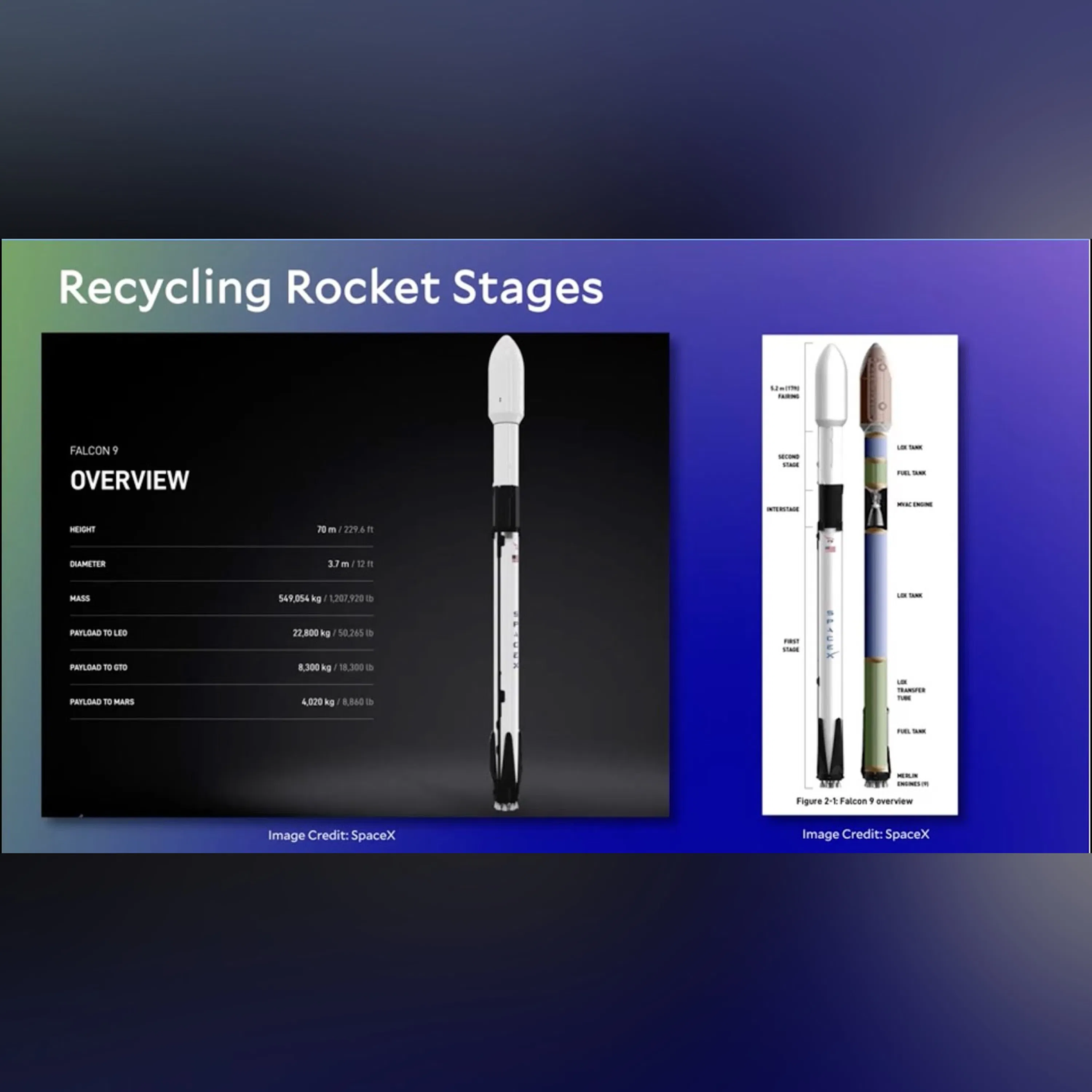
    3.5 | Go Further, Faster! The Ingenious Science of Multistage Rockets | Rocket Science for Everyone with Yale's Marla Geha The rocket equation presents significant challenges for achieving high speeds and carrying substantial payloads, especially when launching from Earth. How do engineers overcome these limitations? In this lesson, we delve into the ingenious solution of multistage rockets, exploring how shedding empty fuel tanks dramatically improves a rocket's performance, allowing it to go further and faster with more payload. We'll examine the physics behind this critical design, understand why every ounce matters, and discover modern innovations like SpaceX's reusable stages. 🎯 Learning Objectives • Explain the limitations of the single-stage rocket equation for achieving high Delta V and payload. • Describe the fundamental principle of multistage rockets, including the jettisoning of empty stages. • Calculate the combined Delta V for a multistage rocket using an example. • Discuss the practical application of multistage rockets in real-world missions and the innovation of reusable stages. 📚 About the Course This course is an intuitive introduction to rocket science in our everyday lives. Modern life increasingly depends on technology provided by Earth-orbiting satellites, from detailed weather predictions to broad-band internet and GPS. How are satellites launched into orbit and how do they work once they get there? Why are rockets used to get into orbit and how are they different from airplanes? This introductory course is aimed at a wide non-technical audience and is appropriate for all ages. 📺 Watch the full playlist on YouTube: https://www.youtube.com/playlist?list=PLh9mgdi4rNexC1fSWLlpQx_Gjj_0DhjVE 🎓 Enroll on Coursera for assessments and a certificate: https://www.coursera.org/learn/rocket-science-for-everyone 🌐 Explore more learning opportunities on Yale Online: https://online.yale.edu/courses/rocket-science-everyone #Yale #RocketScience #OnlineLearning #YaleOnline #STEMEducation #SpaceTech #ScienceForAll #LearnOnline

  • August 23 · 46 min

    18. Biomechanics and Orthopedics

    Frontiers of Biomedical Engineering (BENG 100) Professor Saltzman introduces the material properties of elasticity and viscosity. He describes two separate experimental setups to measure the elasticity and the viscosity of a material. Material elasticity can be defined in terms of stress-strain property, and defines the Young's modulus (E), which is the slope of the stress-strain curve. Fluid viscosity, on the other hand, is described by shear stress. When modeling any material, the spring can be used to represent an ideal elastic material and the dashpot an ideal viscoelastic material. All biomaterials contain some combination of these properties and can be described by physical models that consist of both spring and dashpot. 00:00 - Chapter 1. Introduction 03:16 - Chapter 2. An Experiment on Elasticity 18:20 - Chapter 3. Viscosity 28:46 - Chapter 4. Deformation and Viscoelasticity 42:13 - Chapter 5. Conclusion Complete course materials are available at the Open Yale Courses website: http://open.yale.edu/courses This course was recorded in Spring 2008.

  • August 23 · 1 hr 10 min

    20. Guest Lecture by Stephen Schwarzman

    Financial Markets (ECON 252) Stephen Schwarzman, Co-Founder of Blackstone Group, a private equity firm, speaks about his experience in the industry. He discusses his thoughts on global finance, particularly at such an interesting and challenging point in the history of financial institutions. Although the near future might be rough for the United States and economies around the globe, capital does tend to come back and regulators are busy figuring out how best to put safeguards on the system. He also offers career advice and mentions some of the surprises he came across upon entering the world of finance. 00:00 - Chapter 1. Introduction: Stephen Schwarzman's Profile 03:00 - Chapter 2. In His Own Words: Early Discoveries in the Financial Market 12:36 - Chapter 3. Real Estate Assets Performance with Blackstone 17:16 - Chapter 4. Deconstructing the Subprime Crisis and "Jars of American SARS" 26:53 - Chapter 5. A Recession in the Aftermath: A New Financial World 34:49 - Chapter 6. Questions: Successes and Setbacks 44:54 - Chapter 7. Personal Lessons and Insights from the Financial World 55:44 - Chapter 8. Questions: Dealing with Failure and the Future of Investing and Private Equity Complete course materials are available at the Open Yale Courses website: http://open.yale.edu/courses This course was recorded in Spring 2008.

  • August 23 · 49 min

    America at 250 Podcast Episode 2 - The Federalists, Early Republic, and the Real Hamilton

    Professors David Blight, Beverly Gage, and Joanne Freeman discuss Professor Freeman's Week 2 lectures on the Federalists (don't call them papers) and whether anyone would actually like the real Alexander Hamilton. This podcast is also available on Apple: https://podcasts.apple.com/us/podcast/america-at-250-the-podcast/id1840422776 and Spotify: https://open.spotify.com/show/4C8qfQf21r4eO6mVUFguG2 To view all the videos in this course or view and download a copy of the course syllabus with required readings please scroll through the page at this link: https://president.yale.edu/committees-programs/devane-lectures/america-at-250-a-history

Showing 501–520 of 525 episodes