Skip to content
Artwork for YaleCourses
EducationSociety & CulturePhilosophy

YaleCourses

YaleCourses

Yale's philosophy of teaching and learning begins with the aim of training a broadly based, highly disciplined intellect without specifying in advance how that intellect will be used. The Yale Courses channel provides entry into the core of the University--its classrooms and academic programs--including complete sets of lectures from the Open Yale Courses initiative. Complementary syllabi, transcripts, and other resources may also be accessed from the Open Yale Courses website listed below.

Links:
online.yale.edu: http://online.yale.edu

Play
  • 525 episodes
  • Avg 42 min
  • English
Counted on this page — what you have heard stays on this device, so it is not something the list can be paged by.
  • August 30 · 47 min

    24. Suicide, Part I: The rationality of suicide

    Death (PHIL 176) This is the first of a series of lectures on suicide. Two very distinct contexts are presented in which the subject can be further explored. The first is rationality and the question of under what circumstances it makes sense to end one's own life. The second is morality and the question of whether we can ever ethically justify resorting to suicide. The lecture's focus is on the rational requirements of suicide, and Professor Kagan introduces a number of cases which demonstrate that ending one's life, in certain instances, may be rationally sound. 00:00 - Chapter 1. Introduction to Suicide: Does it Make Sense? Distinguishing Issues of Rationality and Morality 05:14 - Chapter 2. When Is It Rational to Commit Suicide? Problems with the Two-State Requirement 17:11 - Chapter 3. Is Life Worth Having in the First Place? An Exploration of Intrinsic Value 28:51 - Chapter 4. Medical Complications: Rationale for Euthanasia 37:35 - Chapter 5. Suicide on a Positive-Negative Life Curve Complete course materials are available at the Yale Online website: online.yale.edu This course was recorded in Spring 2007. Learn more about your ad choices. Visit megaphone.fm/adchoices

  • August 30 · 55 min

    America at 250: A History, DeVane Lecture, Class 24 - Reagan’s America

    The progress of the conservative movement in late 20th Century America is examined by Professor Beverly Gage in this lecture. Recorded in Yale’s Battell Chapel. This one-time-only course examines U.S. history from 1776 to the present, in advance of the nation’s semiquincentennial (or 250th birthday) in 2026. Taught jointly by Professors Joanne Freeman, David Blight, and Beverly Gage, the course emphasizes the history of the nation-state and the contested nature of American national identity. All three scholars will deliver the course’s first and final lectures together, as an introduction and a wrap-up. In between, they will each deliver eight lectures individually based on their areas of expertise. Joanne Freeman, the Alan Boles, Class of 1929 Professor of History and American Studies, and an expert in the revolutionary and early national periods of American history, will cover the period from the Revolution up through the 1830s, touching on such topics as the birth of party politics, the nature of “Jacksonian democracy,” and the rise of the reform and protest movements. David Blight, Sterling Professor of History and African American Studies and one of the country’s foremost authorities on the history of slavery and the Civil War, will cover the Civil War era up through Reconstruction and the emergence of the Jim Crow laws. Beverly Gage, John Lewis Gaddis Professor of History, who is currently writing a book on the nation’s past to mark the 250th anniversary of the signing of the Declaration of Independence, will pick up in the 1890s and continue through the end of the 20th century, addressing debates around immigration, wealth inequality, and the creation of the social welfare state. The course explores U.S. political history broadly conceived–not just as a realm of presidents and elections and wars (though there will be plenty of those) but as a conversation across time between citizens about what the United States is, was, and was meant to be. It proceeds from the premise that the American Revolution was the first but not the last radical act of national reimagining in U.S. history. The DeVane Lecture series was established in 1969 to honor William Clyde DeVane, dean of Yale College from 1939 to 1963. A copy of the course syllabus with required readings can be downloaded at the bottom of the page at this link: https://president.yale.edu/committees-programs/devane-lectures/america-at-250-a-history To view all the classes in the DeVane Lecture series, go to this playlist link: https://youtube.com/playlist?list=PLh9mgdi4rNezTQrY_6XMNBWaZqLRdgpoq&feature=shared Learn more about your ad choices. Visit megaphone.fm/adchoices

  • August 30 · 54 min

    15. Paradise Lost, Books V-VI

    Milton (ENGL 220) The description of human sexual hierarchy in Book Four of Paradise Lost is contrasted with the depiction of angelic hierarchy in Book Five. Both the Archangel Raphael's and Satan's accounts and theories of creation are examined. The poem's complex and vacillating endorsement of arbitrary decree, on the one hand, and egalitarian self-determination, on the other, is probed. The nature of matter and physical being in Heaven and Eden are explored with particular emphasis placed on the poem's monistic elements. Overall, Milton's willingness to question accepted religious, social, and political doctrine, even that which authorities in his own poem seem to express, is stressed. 00:00 - Chapter 1. Men vs. Women: The Coexistence of Freedom and Social Hierarchy in "Paradise Lost" Book IV 08:49 - Chapter 2. Angels vs. Humans: The Coexistence of Freedom and Social Hierarchy in "Paradise Lost" Book V 40:34 - Chapter 3. Satan's Discussion with Abdiel Complete course materials are available at the Open Yale Courses website: http://open.yale.edu/courses This course was recorded in Fall 2007. Learn more about your ad choices. Visit megaphone.fm/adchoices

  • August 30 · 54 min

    America at 250 Podcast Episode 7: Immigration and Its Discontents

    Professors Beverly Gage and David Blight discuss Professor Gage's first lecture on the United States' identity crisis in the early 20th century. This podcast is also available on Apple: https://podcasts.apple.com/us/podcast/america-at-250-the-podcast/id1840422776 and Spotify: https://open.spotify.com/show/4C8qfQf21r4eO6mVUFguG2 To view all the videos in this course or view and download a copy of the course syllabus with required readings please scroll through the page at this link: https://president.yale.edu/committees-programs/devane-lectures/america-at-250-a-history Learn more about your ad choices. Visit megaphone.fm/adchoices

  • August 30 · 51 min

    10. Personal identity, Part I: Identity across space and time and the soul theory

    Death (PHIL 176) The lecture focuses on the question of the metaphysical key to personal identity. What does it mean for a person that presently exists to be the very same person in the future? The first approach to answering this question is the "soul theory," that is, the key to being the same person is having the same soul. Difficulties with that approach are then discussed, independent of the question whether souls exist or not. 00:00 - Chapter 1. Introduction 01:39 - Chapter 2. What Does It Mean to Survive? The Train Metaphor 14:04 - Chapter 3. The Aging of a Car and Space-Time Worms 30:30 - Chapter 4. Will I Survive My Death? The Dualist's Soul as the Metaphysical Glue 46:28 - Chapter 5. Is the Soul Truly the Key to Personal Identity? Complete course materials are available at the Yale Online website: online.yale.edu This course was recorded in Spring 2007. Learn more about your ad choices. Visit megaphone.fm/adchoices

  • August 30 · 1 hr 4 min

    America at 250 Podcast Episode 11: The Politics of the 1980s, 1990s, and So Much More

    Professors Beverly Gage, David Blight and Joanne Freeman recap their final lectures on the late 20th century and reminisce about the Bicentennial. This podcast is also available on Apple: https://podcasts.apple.com/us/podcast/america-at-250-the-podcast/id1840422776 and Spotify: https://open.spotify.com/show/4C8qfQf21r4eO6mVUFguG2 Learn more about your ad choices. Visit megaphone.fm/adchoices

  • August 30 · 55 min

    America at 250: A History, DeVane Lecture, Class 21 - A New Deal for the World

    World War II was the most significant event of the 20th Century and is one of the issues discussed by Professor Beverly Gage in this class. Recorded in Yale’s Battell Chapel. This one-time-only course examines U.S. history from 1776 to the present, in advance of the nation’s semiquincentennial (or 250th birthday) in 2026. Taught jointly by Professors Joanne Freeman, David Blight, and Beverly Gage, the course emphasizes the history of the nation-state and the contested nature of American national identity. All three scholars will deliver the course’s first and final lectures together, as an introduction and a wrap-up. In between, they will each deliver eight lectures individually based on their areas of expertise. Joanne Freeman, the Alan Boles, Class of 1929 Professor of History and American Studies, and an expert in the revolutionary and early national periods of American history, will cover the period from the Revolution up through the 1830s, touching on such topics as the birth of party politics, the nature of “Jacksonian democracy,” and the rise of the reform and protest movements. David Blight, Sterling Professor of History and African American Studies and one of the country’s foremost authorities on the history of slavery and the Civil War, will cover the Civil War era up through Reconstruction and the emergence of the Jim Crow laws. Beverly Gage, John Lewis Gaddis Professor of History, who is currently writing a book on the nation’s past to mark the 250th anniversary of the signing of the Declaration of Independence, will pick up in the 1890s and continue through the end of the 20th century, addressing debates around immigration, wealth inequality, and the creation of the social welfare state. The course explores U.S. political history broadly conceived–not just as a realm of presidents and elections and wars (though there will be plenty of those) but as a conversation across time between citizens about what the United States is, was, and was meant to be. It proceeds from the premise that the American Revolution was the first but not the last radical act of national reimagining in U.S. history. The DeVane Lecture series was established in 1969 to honor William Clyde DeVane, dean of Yale College from 1939 to 1963. A copy of the course syllabus with required readings can be downloaded at the bottom of the page at this link: https://president.yale.edu/committees-programs/devane-lectures/america-at-250-a-history To view all the classes in the DeVane Lecture series, go to this playlist link: https://youtube.com/playlist?list=PLh9mgdi4rNezTQrY_6XMNBWaZqLRdgpoq&feature=shared Learn more about your ad choices. Visit megaphone.fm/adchoices

  • August 30 · 58 min

    6. How Do We Communicate?: Language in the Brain, Mouth

    Introduction to Psychology (PSYC 110) One of the most uniquely human abilities is the capacity for creating and understanding language. This lecture introduces students to the major topics within the study of language: phonology, morphology, syntax and recursion. This lecture also describes theories of language acquisition, arguments for the specialization of language, and the commonalities observed in different languages across cultures. 00:00 - Chapter 1. The Scientific Notion of Language and Structure 15:53 - Chapter 2. Phonology: A System of Sounds 24:07 - Chapter 3. Morphology: A System of Words 27:21 - Chapter 4. Syntax: Communicating Complicated Ideas 35:21 - Chapter 5. Question and Answer on Language Structure 39:10 - Chapter 6. Noam Chomsky and Language Acquisition 47:07 - Chapter 7. The Time Course of Language Acquisition Complete course materials are available at the Yale Online website: online.yale.edu This course was recorded in Spring 2007. Learn more about your ad choices. Visit megaphone.fm/adchoices

  • August 30 · 55 min

    America at 250: A History, DeVane Lecture, Class 19 - Money, Power, and Progressivism

    From the bully pulpit of Theodore Roosevelt to Woodrow Wilson and the Great War, Professor Beverly Gage continues the examination of early 20th Century America. Recorded in Yale’s Battell Chapel. This one-time-only course examines U.S. history from 1776 to the present, in advance of the nation’s semiquincentennial (or 250th birthday) in 2026. Taught jointly by Professors Joanne Freeman, David Blight, and Beverly Gage, the course emphasizes the history of the nation-state and the contested nature of American national identity. All three scholars will deliver the course’s first and final lectures together, as an introduction and a wrap-up. In between, they will each deliver eight lectures individually based on their areas of expertise. Joanne Freeman, the Alan Boles, Class of 1929 Professor of History and American Studies, and an expert in the revolutionary and early national periods of American history, will cover the period from the Revolution up through the 1830s, touching on such topics as the birth of party politics, the nature of “Jacksonian democracy,” and the rise of the reform and protest movements. David Blight, Sterling Professor of History and African American Studies and one of the country’s foremost authorities on the history of slavery and the Civil War, will cover the Civil War era up through Reconstruction and the emergence of the Jim Crow laws. Beverly Gage, John Lewis Gaddis Professor of History, who is currently writing a book on the nation’s past to mark the 250th anniversary of the signing of the Declaration of Independence, will pick up in the 1890s and continue through the end of the 20th century, addressing debates around immigration, wealth inequality, and the creation of the social welfare state. The course explores U.S. political history broadly conceived–not just as a realm of presidents and elections and wars (though there will be plenty of those) but as a conversation across time between citizens about what the United States is, was, and was meant to be. It proceeds from the premise that the American Revolution was the first but not the last radical act of national reimagining in U.S. history. The DeVane Lecture series was established in 1969 to honor William Clyde DeVane, dean of Yale College from 1939 to 1963. A copy of the course syllabus with required readings can be downloaded at the bottom of the page at this link: https://president.yale.edu/committees-programs/devane-lectures/america-at-250-a-history To view all the classes in the DeVane Lecture series, go to this playlist link: https://youtube.com/playlist?list=PLh9mgdi4rNezTQrY_6XMNBWaZqLRdgpoq&feature=shared Learn more about your ad choices. Visit megaphone.fm/adchoices

  • August 30 · 49 min

    15. Supermassive Black Holes

    Frontiers/Controversies in Astrophysics (ASTR 160) The lecture begins with a question-and-answer session about black holes. Topics include the extent to which we are sure black holes exist in the center of all galaxies, how massive they are, and how we can observe them. The lecture then turns to strong-field relativity: relativistic effects that are unrelated to Newtonian theory. The possibility of testing predictions of the existence of black holes is discussed in the context of strong-field relativity. One way we might learn about black holes is through observation of the orbit of the companion star in an X-ray binary star system. Through this we can estimate the mass of the compact object. The lecture ends with an explanation of how astronomers find black holes, and how Professor Bailyn was able to discover one himself. 00:00 - Chapter 1. Supermassive Black Holes and Gravitational Waves 07:15 - Chapter 2. Strong-Field Relativity 17:01 - Chapter 3. X-Rays of Binary Stars 30:08 - Chapter 4. Finding Black Holes with X-Rays 46:43 - Chapter 5. Conclusion Complete course materials are available at the Open Yale Courses website: http://open.yale.edu/courses This course was recorded in Spring 2007. Learn more about your ad choices. Visit megaphone.fm/adchoices
  • August 30 · 54 min

    Lecture 10 Sonata-Allegro and Theme and Variations

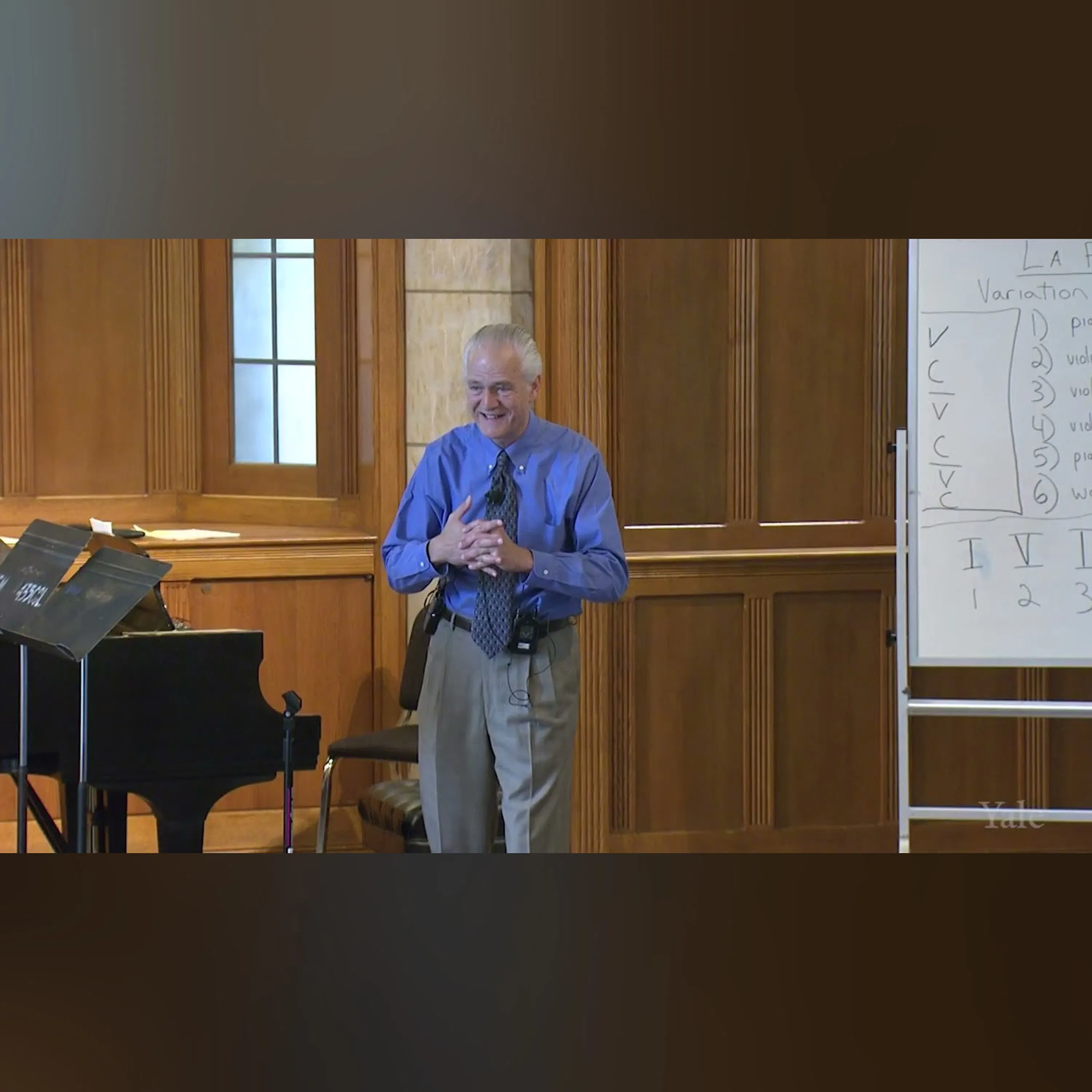
    Listening to Music (MUSI 112) Professor Wright delves into sonata-allegro form in some depth in this lecture. He focuses especially on characterizing four types of music found within a sonata: thematic, transitional, developmental, and cadential. He then moves on to discuss a different form, theme and variations, which is accomplished through the use of examples from Beethoven's and Mozart's compositions. Professor Wright and guest artist Kensho Watanabe then conclude the lecture by demonstrating a set of theme and variations through a live performance of Corelli's La Folia. 00:00 - Chapter 1. Introduction 02:34 - Chapter 2. Parts of the Sonata-Allegro Form 08:18 - Chapter 3. Distinguishing Functional Types within the Sonata-Allegro 20:58 - Chapter 4. Theme and Variations 34:11 - Chapter 5. Examining Theme and Variations in Corelli's La Folia Complete course materials are available at the Yale Online website: online.yale.edu This course was recorded in Fall 2008. Learn more about your ad choices. Visit megaphone.fm/adchoices

  • August 30 · 7 min

    Low-Cost, High-Nutrition Eating for Graduate and Prof Students: Intro

    In this video, learn about how to use this series as a tool for low-cost, high-nutrition eating. Managing your finances as a student is challenging. Yale’s Graduate and Professional Student Senate collaborated with Dr. Nate Wood, Assistant Professor and Director of Culinary Medicine at the Yale School of Medicine, to create this video series aimed at helping our community to shop and eat affordably and nutritiously. According to a 2024 Senate report, 30% of Yale's graduate and professional students experience food insecurity. Our goal is to provide tangible support through practical tips, recipes, and strategies. For more resources or to share your thoughts, use our contact form! Learn more about your ad choices. Visit megaphone.fm/adchoices

  • August 30 · 53 min

    America at 250 Podcast Episode 10: Left and Right in the 60s and 70s

    Professor Beverly Gage describes the growing movements on the left and the right in the 1960s and 70s while Professors Blight and Freeman try to resist the urge to stroll down memory lane. This podcast is also available on Apple: https://podcasts.apple.com/us/podcast/america-at-250-the-podcast/id1840422776 and Spotify: https://open.spotify.com/show/4C8qfQf21r4eO6mVUFguG2 To view all the videos in this course or view and download a copy of the course syllabus with required readings please scroll through the page at this link: https://president.yale.edu/committees-programs/devane-lectures/america-at-250-a-history Learn more about your ad choices. Visit megaphone.fm/adchoices

  • August 30 · 50 min

    Lecture 9. Sonata-Allegro Form: Mozart and Beethoven

    Listening to Music (MUSI 112) A brief foray into the formal characteristics of contemporary popular music is used to launch this lecture on musical form. After a discussion of the "verse-chorus" form often used in popular music, Professor Wright proceeds to take students into the realm of classical music, focusing particularly on ternary form and sonata-allegro form. Throughout his detailed explanation of sonata-allegro form, he also elaborates upon some harmonic concepts describing, for example, the relationship between relative major and minor keys. This lecture draws its musical examples from 'N Sync, Mozart, and Beethoven. 00:00 - Chapter 1. Verse-Chorus Form in Popular Music 05:56 - Chapter 2. Introduction to Form in Classical Music 12:18 - Chapter 3. Ternary Form 18:00 - Chapter 4. The Sonata-Allegro Form in Mozart's "A Little Night Music" 36:19 - Chapter 5. The Sonata-Allegro Form in Beethoven's Fifth Symphony Complete course materials are available at the Yale Online website: online.yale.edu This course was recorded in Fall 2008. Learn more about your ad choices. Visit megaphone.fm/adchoices

  • August 30 · 7 min

    4.6 | Mastering Medical Software Risk Management: Control and Evaluation — Medical Software Course

    How do you ensure your medical software is not just functional, but also safe? In this lesson, we conclude our deep dive into the risk management process, focusing on the critical stages of risk evaluation and control. We'll explore how to determine acceptable risk levels, delve into the hierarchy of risk control techniques—eliminate, reduce, and warn—and understand the concept of residual risk, ultimately reinforcing why diligent risk management, though seemingly alarmist, is vital for long-term quality and trust. 🎯 Learning Objectives • Define risk evaluation and its role in the risk management process. • Understand the concept of acceptable risk and its determination. • Describe the three fundamental risk control techniques: eliminate, reduce, and warn. • Explain what residual risk is and how it is re-evaluated. • Appreciate the strategic importance of proactive risk management in medical software development. Learn more about your ad choices. Visit megaphone.fm/adchoices

  • August 30 · 48 min

    7. Plato, Part II: Arguments for the immortality of the soul

    Death (PHIL 176) The discussion of Plato's Phaedo continues, presenting more arguments for the existence and immortality of the soul. One such argument is "the argument from the nature of the forms," which states that because the forms are non-physical objects and cannot be grasped by something physical like the body, it follows that they must be grasped by the soul which must be non-physical as well. This argument is followed by the "argument from recycling" and "the argument from recollection." 00:00 - Chapter 1. Review of Plato's Heaven: Platonic Forms 04:13 - Chapter 2. Concerns and Issues Leading to the Development of Platonic Forms 14:17 - Chapter 3. The Argument from the Nature of the Forms 24:33 - Chapter 4. The Argument from Recycling 33:33 - Chapter 5. The Argument from Recollection 43:54 - Chapter 6. Do Plato's Arguments Suffice? Complete course materials are available at the Yale Online website: online.yale.edu This course was recorded in Spring 2007. Learn more about your ad choices. Visit megaphone.fm/adchoices

  • August 30 · 54 min

    7. Lycidas (cont.)

    Milton (ENGL 220) In this second lecture on "Lycidas," moments of intrusion and revelation are closely examined. Saint Peter's protracted sermon is connected with the wider context of Puritan practices and controversies. The poem's tendency to suggest pairs and substitutions is duly noted. Finally, its conclusion is read as a triumphant moment in the young Milton's poetry, at which point he parts with the claims of ill-preparedness and little experience that dominated the early poems and assumes instead a prophetic voice for himself akin to Isaiah's. 00:00 - Chapter 1. Introduction: Analyzing the Beginning of "Lycidas" 03:11 - Chapter 2. The Pastoral Framework of "Lycidas" 14:00 - Chapter 3. Milton: "The Reason of Church Government" 19:36 - Chapter 4. The Dramatic Structure of "Lycidas": A Succession of Four Mourners 48:50 - Chapter 5. Milton: The Prophetic Poet? Complete course materials are available at the Open Yale Courses website: http://open.yale.edu/courses This course was recorded in Fall 2007. Learn more about your ad choices. Visit megaphone.fm/adchoices
  • August 30 · 45 min

    15. The nature of death (cont.); Believing you will die

    Death (PHIL 176) The lecture explores the question of the state of being dead. Even though the most logical claim seems to be that when a person stops P-functioning he or she is dead, a more careful consideration must allow for exceptions, such as when one is asleep or in a coma. Professor Kagan then suggests that on some level nobody believes that he or she is going to die. As a case in point, he takes Tolstoy's famous character Ivan Ilych. 00:00 - Chapter 1. Introduction -- Accommodating Sleep in the Definition of Death 03:36 - Chapter 2. Specification: The Ability to Engage in P-Functioning 13:32 - Chapter 3. Nobody Believes that they will Die: An Analysis 27:49 - Chapter 4. Can Imagining Death Work? Flaws in Freud's Argument 36:11 - Chapter 5. Nobody Believes in Bodily Death: The Death of Ivan Ilyich Complete course materials are available at the Yale Online website: online.yale.edu This course was recorded in Spring 2007. Learn more about your ad choices. Visit megaphone.fm/adchoices
  • August 30 · 50 min

    19. Omega and the End of the Universe

    Frontiers/Controversies in Astrophysics (ASTR 160) Class begins with a review of the issues previously addressed about the origin and fate of the universe. The role of gravity in the expansion of the universe is discussed and given as the reason why the rate of expansion cannot remain constant and will eventually slow down. The actual density of the universe is calculated using various methods. Finally, the unsolved problem of dark matter is addressed and two explanatory hypotheses are proposed. One is that the universe is comprised of WIMPs (Weakly Interactive Massive Particles) that fulfill two requirements: they have mass and do not interact with light. The second hypothesis is that dark matter is made of MACHOs (Massive Astrophysical Compact Halo Objects), which scientists have attempted to identify through gravitational lenses. 00:00 - Chapter 1. Review of Issues in Cosmology 08:28 - Chapter 2. Determining Mass 26:39 - Chapter 3. Dark Matter: WIMPs? 37:30 - Chapter 4. Dark Matter: MACHOs? Complete course materials are available at the Open Yale Courses website: http://open.yale.edu/courses This course was recorded in Spring 2007. Learn more about your ad choices. Visit megaphone.fm/adchoices
  • August 30 · 48 min

    23. Other Constraints: The Cosmic Microwave Background

    Frontiers/Controversies in Astrophysics (ASTR 160) Reasons for the expansion of the universe are addressed at the start of this lecture, focusing especially on the acceleration of dark energy. Supernovae were the first evidence for the existence of dark energy. Two other proofs are presented. The first is the Cosmic Microwave Background, which is a form of electromagnetic radiation that is perfectly smooth and equal in all directions. It firmly supports the Big Bang theory. Projects attempting to measure it, such as COBE and WMAP, are discussed. Secondly, Large-Scale Clustering is introduced: by measuring the degree of clustering, astronomers hope to advance their understanding of dark energy and dark matter. Computer simulations of the evolution of the universe are shown. 00:00 - Chapter 1. Implications of Research on Supernovae 05:28 - Chapter 2. The Cosmic Microwave Background 11:27 - Chapter 3. COBE and WMAP: Measuring CMB 24:40 - Chapter 4. Growth of Universe Structure: Large-Scale Clustering 39:30 - Chapter 5. The Degree of Clustering and the Potential Fates of the Universe Complete course materials are available at the Open Yale Courses website: http://open.yale.edu/courses This course was recorded in Spring 2007. Learn more about your ad choices. Visit megaphone.fm/adchoices
Showing 461–480 of 525 episodes