
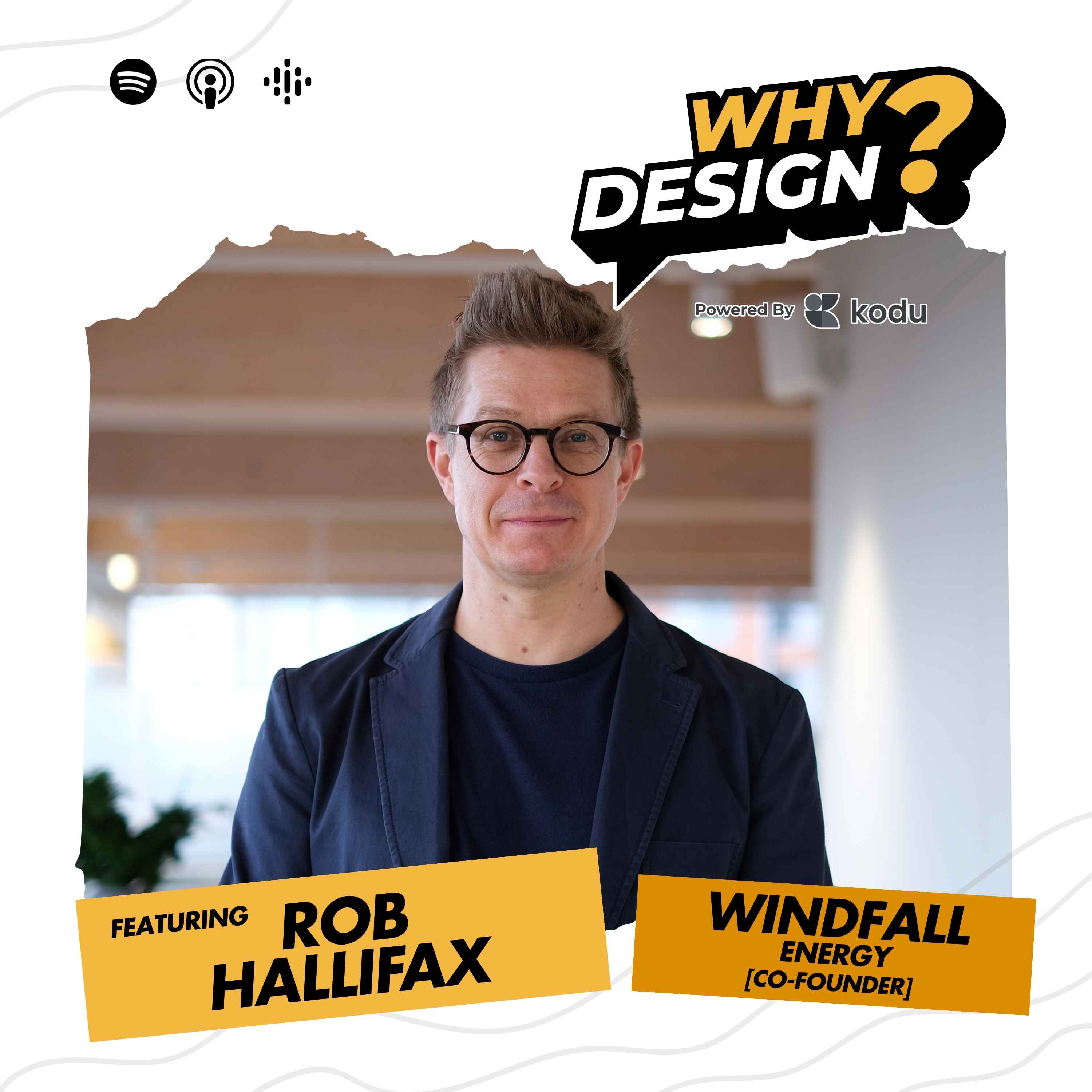
Why Half the Country Can't Access Clean Energy, And What’s Changing | Rob Hallifax
Streams straight from the publisher. podnod never proxies or re-hosts episode audio.
What if the biggest gap in the clean energy transition isn't technology or politics, but simply who the products were designed for?
In this episode of Why Design, Rob Hallifax shares the belief that sits at the heart of his work: that half the country has been left behind by clean energy, and that the right physical product can change that. Rob is co-founder of Windfall Energy, a company building a compact home battery specifically for renters and flat-dwellers, the people for whom solar panels, heat pumps and big home batteries have never been a realistic option.
Rather than building another clean tech product for homeowners with garages and south-facing roofs, Rob and his co-founder designed something different: a 2.5 kWh battery that orders online, arrives by courier, and automatically charges on cheap overnight electricity to power your home during expensive peak hours. That decision, to start with who was excluded rather than who already had options, led to Bethnal Green Ventures backing the company, conversations with major UK energy providers, and a pre-order campaign launching in early 2025.
This conversation isn't about home energy storage.
It's about who clean technology is designed for, and who it quietly ignores.
This conversation isn't about Kickstarter tactics.
It's about what a decade of crowdfunding campaigns teaches you about making products people actually want.
Join the Why Design community -> teamkodu.com/whydesign
6c. What You'll Learn
- Why roughly half of UK homes are structurally excluded from every clean energy product on the market, and what it takes to build for that gap.
- How the economics of battery cells and electricity pricing have only recently made a product like Windfall viable, and why timing matters as much as the idea itself.
- Why Rob treats the industrial design of a home battery as a commercial priority, not an afterthought, and how that shapes every decision from designer brief to product form.
- Why Windfall leads on saving money rather than saving the planet, and what it means that cheap and green electricity are effectively the same thing on the UK grid.
- How a B2B2C strategy through energy companies solves distribution, tariff integration and end-user complexity in one move.
- What a decade of Kickstarter campaigns actually teaches you about validating physical products, building audiences before launch, and knowing when to walk away from something that is not working.
Memorable Quotes
"We thought, what can we make for the people who've been left behind? Effectively half the country."
"The making of the thing is kind of the easy bit. The hard bit is always finding customers, making a product that people actually want."
"If you're not embarrassed by your first product launch, you've waited too long."
"In terms of marketing stuff, we lead on saving money and the green thing is more than just a happy bonus. They are definitely tightly integrated."
"You need to know when something's not going to work and be prepared to kill it. That can be hard, especially when it's your own."
Resources and Links
🎧 Listen on Spotify, Apple Podcasts, YouTube & Amazon -> whydesign.club
👥 Join the Why Design community -> teamkodu.com/whydesign
📸 Follow @whydesignxkodu on Instagram
🎥 Watch full episodes -> YouTube.com/@whydesignpod
🔗 Follow Chris Whyte -> linkedin.com/in/mrchriswhyte
🔗 Explore Windfall Energy -> windfallenergy.com
🔗 Connect with Rob Hallifax -> robhallifax.com , LinkedIn
About the Episode
Why Design is powered by Kodu, a specialist recruitment partner for the hardware and physical product development industry.
Through honest conversations with designers, engineers, and creative leaders, we explore not just what they build but why they build it; the beliefs, decisions and responsibility behind meaningful work.
About Kodu
Why Design is produced by Kodu, a recruitment partner for ambitious hardware brands, design consultancies and product-led start-ups.
We help founders and leadership teams hire exceptional talent across industrial design, mechanical engineering and product leadership, bringing structure and clarity to one of the hardest parts of scaling.
🔗 Learn more -> teamkodu.com
teamkodu.com/whydesign
teamkodu.comwhydesign.club
whydesign.club@whydesignxkodu
instagram.comYouTube.com/@whydesignpod
youtube.comlinkedin.com/in/mrchriswhyte
linkedin.comwindfallenergy.com
windfallenergy.comrobhallifax.com
robhallifax.comLinkedIn
linkedin.com

- 0:00Introduction
- 0:27How IoT brought together Rob's hardware and software background, and why he's been going to the same London meetup for a decade
- 1:00Meeting co-founder Ashley at IoT London, and how a pub conversation after the event became the start of Windfall
- 5:10From good chat to building things together in the British Library, before they had a company or a product
- 7:08The first prototype: a smart plug that monitored electricity pricing, and why it wasn't impactful enough to keep pursuing
- 9:33How the concept evolved from smart plug to smart battery, and the moment the product idea clicked into place
- 10:23Why plug-and-play home batteries are not yet permitted in the UK and the hardwired workaround they are using in the meantime
- 13:40Who Windfall is actually for: renters, flat-dwellers and the roughly half of UK homes that clean energy has passed over
- 14:05Why Rob studied mechanical engineering, almost changed to geography in his first year, and why he is glad he stayed
- 16:18On what drives him: the joy of making something new versus the satisfaction of seeing it working in someone's home
- 22:48The first Kickstarter: a die-cast metal razor, a 19,000 pound target, and a very close finish in the final days
- 25:40What prompted the move from corporate life at Thermo Fisher to startups and digital product management
- 29:35Windfall explained clearly: what it does, who it is for, and why the timing is finally right for this product to exist
- 34:01The hardest challenges in building Windfall: finding customers, overcoming fire risk perception, and what actually makes or breaks a hardware startup
- 35:53Why the industrial design of the battery matters commercially, and the designer they brought in with IKEA and Lakeland in their background
- 37:31Green versus money: why Windfall leads on savings and what it means that cheap electricity and green electricity are effectively the same thing
- 39:05The hardest investor conversations: software-first VCs, deep tech expectations, and how they are building defensibility without reinventing battery chemistry
- 41:36The B2B2C strategy: partnering with energy companies to distribute Windfall with the right tariff already integrated
- 45:49How two co-founders split fundraising and product development without either falling behind
- 48:24The proudest moment so far: getting onto Bethnal Green Ventures, and what a prototype landing well at a trade show actually felt like
- 50:16The hardest days: investor rejections, the value of having a co-founder, and why things taking longer than expected is the real frustration
- 51:45What Rob would tell his younger self: the thrill of getting things in front of people, and knowing when to stop pushing something that is not working
- 54:12The fundamental bet Windfall is making about how people will use and pay for home energy over the next ten years
- 55:45What the next twelve months look like: first manufactured batch, a pre-order campaign, and a direct-to-consumer launch
- 56:58Quickfire: one rule for Kickstarter, the biggest mistake first-time crowdfunders make, and the product Rob loves that has nothing to do with tech