
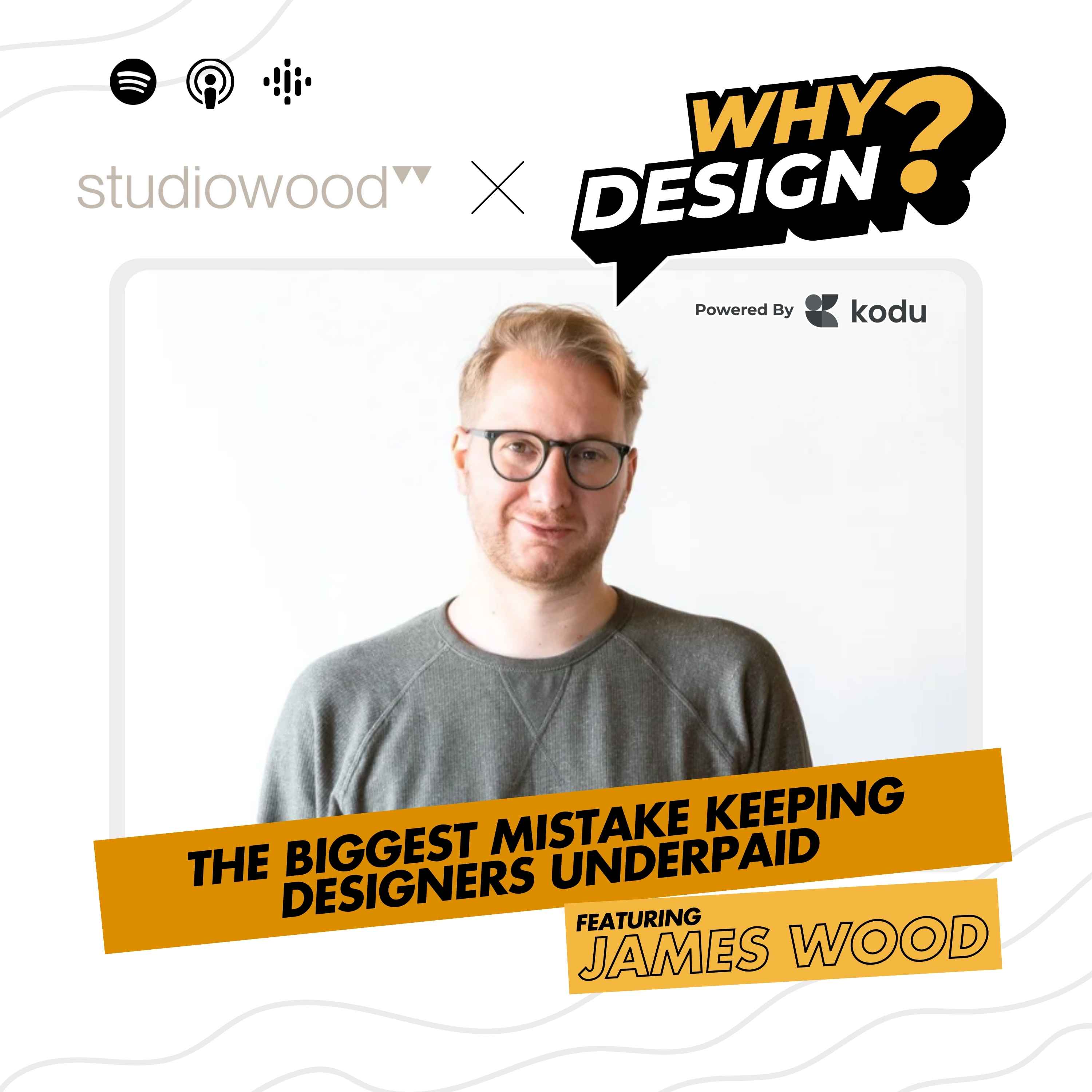
The Biggest Mistake keeping Designers Underpaid | James Wood
Streams straight from the publisher. podnod never proxies or re-hosts episode audio.
What does it actually cost to get into design if you don't come from money?
In this episode of Why Design, James Wood shares the belief that sits at the heart of Studio Wood: that good design should reach a million homes, not one art gallery, and that the studio building it should be just as accessible.
Rather than chase investment or fast growth, James chose to grow Studio Wood slowly, freelancing for six years before making his first hire. That decision led to a seven-person studio behind the Chilly's Series 2 bottle and the Joseph Joseph Draw Store, run on his own terms.
This conversation isn't about a design portfolio.
It's about who gets to build one in the first place.
Don't just listen. Go beyond the podcast.
Join the Why Design community → teamkodu.com/whydesign
What You'll Learn
→ 🎓 Why Studio Wood lists a university degree as "nice to have," not essential, on every job ad.
→ 📵 Why the studio doesn't have a phone, and what that protects.
→ ✉️ Why every one of 350 applicants for one junior role got a personal reply, good news or bad.
→ 💷 Why James believes a plumbing apprentice can out-earn a design graduate carrying £50,000 to £60,000 of debt.
→ 🤖 How James is preparing his team for AI, and why physical model-making stays safe longer than digital design skills.
→ 🧭 What it actually takes to move out of the top or bottom of the income scale, according to the data James has read.
Memorable Quotes
"I don't think design should be for a few people. I'd rather design something that's in a million people's homes than in one art gallery."
"If you went and did the plumbing apprenticeship when you're eighteen, you'd make more money as a plumber than you would as an industrial designer with fifty, sixty grand of debt."
"If we start to lean too introverted, I'd probably be more inclined to look towards hiring someone who's extroverted."
"I always look for someone who's got their own engine. You're not having to go and constantly throw coal in their engine to get them going."
"All the strongest lessons in life come through hard times. You won't ever become a well-rounded person without some form of hardship."
6e. Resources & Links
🎧 Listen on Spotify, Apple Podcasts, YouTube & Amazon
👥 Join the Why Design community
📸 Follow @whydesign on Instagram
🔗 Follow Chris Whyte
🔗 Explore Studio Wood
🔗 Connect with James Wood
About the Episode
Why Design is powered by Kodu, a specialist recruitment partner for the hardware and physical product development industry.
Through honest conversations with designers, engineers and creative leaders, we explore not just what they build, but why they build it: the beliefs, decisions and responsibility behind meaningful work.
About Kodu
Why Design is produced by Kodu, a recruitment partner for ambitious hardware brands, design consultancies and product-led start-ups.
We help founders and leadership teams hire exceptional talent across industrial design, mechanical engineering and product leadership, bringing structure and clarity to one of the hardest parts of scaling.
Listen on Spotify, Apple Podcasts, YouTube & Amazon
whydesign.clubJoin the Why Design community
teamkodu.comInstagram
instagram.comWatch full episodes
youtube.comChris Whyte
linkedin.comStudio Wood
studiowood.co.ukJames Wood
linkedin.com

- 0:00Introduction
- 0:21James introduces Studio Wood and the team of seven
- 1:17The products everyone's already held: the Chilly's Series 2 bottle and the Joseph Joseph Draw Store
- 2:41Why James designs for a million homes, not one art gallery
- 3:58Why Bournemouth, and not London
- 5:38The south coast design scene, and why the industry is too London-centric
- 7:54Junior salaries and the vicious cycle of agency fees
- 8:07The case for paying interns properly
- 11:18Why Design: James's unconventional path into the industry
- 12:48Three years in an IT job that didn't fit who he is
- 13:40The university open day that changed everything
- 14:55Working out what he'd do for hours as a child, for free
- 19:12No UCAS points, a mature student route, and finishing top of the class
- 25:06Founding Studio Wood as a freelancer in 2013
- 27:26The client relationship that triggered his first hire
- 29:12Growing through COVID while other studios furloughed staff
- 33:53350 applications, zero paid promotion, for one junior role
- 41:06Why there's no phone in the Studio Wood office
- 41:34The policy of replying to every single applicant
- 43:02Class, access, and the "stickiness" of the top and bottom
- 46:26What businesses can actually do: paid internships, mentoring, state school placements
- 50:44Why university is listed as "nice to have," not essential
- 53:37The apprenticeship degree industrial design still doesn't have
- 56:19Advice for juniors entering design in the age of AI
- 1:07:29Best object he's ever designed, and a Fred Again moment at Glastonbury
- 1:12:54The one trait James always hires for, over raw talent
- 1:15:09Where to find Studio Wood, and the Women in Innovation events