Skip to content
Artwork for Two Buddhas

Two Buddhas

MarkWhiteLotus

Two Buddhas is a fresh take on Nichiren Buddhism for the 21st century—warm, curious, and free of dogma. Hosted by author and teacher Mark Herrick, this podcast explores Ren Buddhism, a contemporary path rooted in the chanting of Namu Myoho Renge Kyo, the wisdom of the Lotus Sutra, and the power of personal awakening. Two Buddhas blends deep Buddhist insight with everyday relevance, spiritual questioning, and the courage to let go of rigid systems. Real stories, real practice, real life—this is the Lotus without the walls

Play
  • 21 episodes
  • Avg 18 min
  • English
Counted on this page — what you have heard stays on this device, so it is not something the list can be paged by.
  • S2 · E36
    Saturday · 9 min

    Is the Universe a Hologram? A Buddhist Answer

    A young physicist asks whether the universe is a hologram painted on the sky. A sixth-century Buddhist teacher already had an answer. This episode reads Sabrina Pasterski's celestial holography alongside Zhiyi's Threefold Truth, ichinen sanzen and the Lotus Sutra's Ceremony in the Air, and finds that the place where everything comes together, in physics and in practice alike, is the place where it's received. Full essay at https://www.twobuddhas.org/post/is-the-universe-a-hologram-a-buddhist-answer

  • S2 · E35
    October 26 · 3 min

    The Dharma Never Fades

    The Lotus Sutra says the fiftieth person to hear its teaching gains merit beyond measure, then says the first hearer gains more. Greater than boundless? In this short reflection, we unpack the riddles of chapter 18 through the Ceremony in the Air and the middle way, and find we're the fiftieth person and the first hearer at the same time. Twenty-five centuries after the historical Buddha, we can share the same moment of awakening with him. Read the essay at twobuddhas.org.

  • S2 · E33
    October 23 · 9 min

    Meditation Retreats - Do They Work

    We come home from retreat feeling transformed, and a few weeks later our practice feels rudderless. Why? A retreat works because someone else arranged every condition practice needs, and at home nobody has. In this episode, Nichiryu Mark Herrick explores what retreats get right, what’s overstated about them, and why their real value is what they teach us about practice. With help from the Vimalakirti Sutra and the Nichiren tradition of daily practice, he offers six simple, free conditions for building a practice container at home. A retreat is a boost, not a requirement. Full essay: https://www.twobuddhas.org/post/do-meditation-retreats-work Mentioned: “Three Minutes” https://www.twobuddhas.org/post/three-minutes

  • S2 · E31
    October 19 · 10 min

    When the Cart Doesn't Come

    Sooner or later, every one of us chants for something and doesn't get it, and a quiet voice asks what we did wrong. In this episode we answer that question. Chanting for what we want is perfectly fine, and it works, by changing the one who chants. But we're never the only cause at work, and the practice never promised that every condition would bend. We look at the "you didn't chant enough" trap in The Secret, the prosperity gospel and our own benefit-story culture, and at the Buddha's refusal to blame in the Sivaka Sutta, where karma is only one of eight causes of what we feel. Zhiyi and Nichiren carried that refusal forward. When the cart doesn't come, nothing has been proved about us. Read the essay at https://www.twobuddhas.org/post/when-the-cart-doesn-t-come-chanting-unanswered-prayers-and-karma-nichiren-buddhism

  • S2 · E30
    October 13 · 27 min

    Is Any Religion True and Reliable? A Buddhist Answer

    Nobody heard the Buddha say any of it. Not the Lotus Sutra, not the Heart Sutra, not even the Pali suttas. So what remains for us? In this episode, we look honestly at who actually wrote the Buddhist scriptures, from centuries of oral recitation to a companion text of the Lotus Sutra that was most likely composed in China. The answer isn't a loss. The Dharma reaches us as an expanding signal, carried forward by practitioners who found something real and passed it on. And because anyone can claim to add to it, the tradition gives us a test: does a teaching stand in the gate and charge a toll, or stand beside the gate and point? Read the essay: https://www.twobuddhas.org/post/is-any-religion-true-and-reliable-a-buddhist-answer

  • S2 · E28
    September 27 · 8 min

    Grief Isn't a Mistake: The Order of Care

    A friend asked whether one sentence from my Lion's Roar essay could ever be said to someone who'd just lost his family in a war. The honest answer was no, and it taught me that compassion has an order: see the suffering, acknowledge it's real, hold space, then offer medicine. This episode follows that order from a war zone to our own anxious minds, drawing on the two arrows, the sutra on mindful breathing, Thich Nhat Hanh, Fred Rogers, Viktor Frankl, the Lotus Sutra, and Nichiren. It also includes a candid look at practice as therapy, anxiety, depression, and the daily work of keeping our balance. Full essay at: https://www.twobuddhas.org/post/grief-isn-t-a-mistake-buddhist-wisdom-on-compassion-and-presence

  • S2 · E27
    September 18 · 10 min

    When Meditation Makes You Feel Worse

    Meditation has adverse effects, and the research is finally saying so. What almost nobody says is what to do when it happens to the person in front of you. Fourteen centuries ago Zhiyi, the Chinese master who wrote the manual on silent sitting, named this exact situation. Extreme weariness, illness, drowsiness that will not lift, obstacles that displace concentrated mindfulness so the practitioner cannot dispel them. For these he prescribed chanting, and he explained why it works in anatomical rather than devotional terms. In this talk: what Zhiyi actually wrote, why a vocal practice works differently than a silent one, why almost nobody has studied chanting, and what I've learned about recognizing when my own practice has gone out of balance. Full essay at https://www.twobuddhas.org/post/adverse-effects-in-meditation Source: Zhiyi, Clear Serenity, Quiet Insight, trans. Paul L. Swanson (University of Hawaii Press, 2018), 249.

  • S2 · E26
    September 4 · 42 min

    Does Buddhism Have a Soul?

    In 1278 a woman named Myoho-ama wrote to Nichiren with a question. Her husband was dying. She wanted to know whether chanting was enough — whether what she was doing at his bedside was reaching anything. He died within weeks of the reply. Nobody has ever come to me asking about receptivity and response. They come asking what she asked. And the sole question turns out to be the soul question — which is the trouble, because soul is the one word Buddhism will not give them. This episode looks at four images the tradition uses for how the Dharma responds: sympathetic resonance between two instruments, the moon held in still water, natural law, and Nichiren's caged bird whose song draws the free birds down. They are usually presented as four ways of saying one thing. They aren't. Each fails in a different direction, each reaches a different kind of sufferer, and the tradition's refusal to choose between them is its most sophisticated move rather than its sloppiest. Also: why the strongest assurance text in the Nichiren corpus is the most dangerous one to hand a scrupulous practitioner; why feeling nothing is not failure; why the Gohonzon is permitted to be either the Buddha or the Dharma; and an honest report on what returns at four in the morning after the argument has been won. Full essay with citations: https://www.twobuddhas.org/post/the-word-that-keeps-coming-back

  • S2 · E23
    August 29 · 4 min

    One Daimoku Is Enough, and a Million Is Not Enough

    Is chanting really enough? Shouldn't I understand more of this first? Everyone asks it sooner or later. The answer is yes, and that is not the whole answer. This talk sits with a saying that will not resolve: one daimoku is enough, and a million is not enough. One is enough because nothing is missing from it, and nothing is being held back from us. A million is not enough because a life takes a lifetime, and knowing we are on the path is not the same as being done with it. The Buddha kept sitting, kept walking, kept teaching, right up to the last night under the trees. Along the way: why understanding comes through practice rather than before it, how something small enough to fit in our mouth can hold the whole of a teaching, why counting is fine but is not what we are doing, and why nothing is outside this. From Reflections in the Pond, the podcast of Myokan-ji Temple and the Two Buddhas Meditation Community in Oakland, California. Written version at: https://www.twobuddhas.org/post/one-daimoku-is-enough-and-a-million-is-not-enough

  • S2 · E22
    August 7 · 9 min

    To Forget the Breath - To Forget the Breath — first there is a mountain, then there is no mountain

    "Don't think about your breath, just let it come naturally." All right — and how exactly does one do that? It is like being told not to think about a pink elephant. Nothing complex is ever learned whole. I spent years training search and rescue dogs, and the road to a dog who could work a scent for hours began with one small thing: engagement. Look at me. Everything else was built on top of it. Breath meditation works the same way. Zhiyi, the Tiantai master, set out the sequence most of us have met — count the breaths one through ten and begin again; when counting steadies, drop it and follow; then let following go and simply sit. Fifteen centuries later it has not needed improving. And the third step is the entire point of the first two. You count in order to arrive somewhere counting is no longer needed. A person who has never counted a breath in his life is also not counting. He is not, on that account, meditating. That leads to the line most people know from Donovan and almost nobody knows from its source, the Ch'an master Qingyuan Weixin: mountains are mountains, then mountains are not mountains, then mountains are mountains once again. Qingyuan ends the passage with a challenge that usually gets left out — are these three views the same or different? Can you tell the black from the white? He is asking whether you can distinguish his first mountain from his third, because from the outside they are indistinguishable. This episode takes up two consequences of that. First, that the middle stage is a passage and not an address: emptiness is an intoxicating place to live, a position that cannot lose an argument, and holding it permanently is its own attachment. Second, that the third stage has an imitator — the practitioner who hears that the destination is ordinary and arrives at plainness by never having left it. You cannot tell the two apart by listening. The difference shows when the ground moves. The last section applies this to chanting Namu Myoho Renge Kyo across nearly fifty years: the same seven syllables met three times, the third looking exactly like the first from across the room, with nothing added and a great deal removed. And a caution offered mostly to myself — the third mountain is not tenure. Some dry morning you may find yourself back at the base of the first one, counting breaths, one through ten, beginning again at one. Which is not failure. It is the road. Read the essay: https://www.twobuddhas.org/post/to-forget-the-breath Mark Herrick (Nichiryu) is an independent Nichiren Buddhist dharma teacher and cofounder of Myokan-ji Temple and the Two Buddhas Meditation Community in Oakland, California. Essays, podcast episodes and talks at twobuddhas.org. Namu Myoho Renge Kyo
  • S2 · E21
    August 5 · 34 min

    Every Palace Has a Feed: The First Algorithm

    The Buddha described his own childhood as an engineered environment. Three palaces, one per season, continuous entertainment, lotus ponds built to order. In the Sukhumala Sutta he calls it refinement, utmost refinement. The later tradition tells us what was being filtered: old age, sickness, death, and the wandering mendicant. His father had something to protect and built walls around the four things that would cause his son to leave. This episode asks one question of the palace and the platform alike. Does a system let a person's intention come to rest, or does it keep the wanting alive on purpose, circling, never quite letting it land? The Buddhist term is cetana, and the Buddha located the whole of karmic weight in it. Three eras answer that question differently. Agrarian extraction coerced circumstance and stopped at dark. Industrial extraction cornered intention and stopped at the whistle, after workers organized and forced law to catch up. The information age is different in kind: it extracts volition itself through engineered variable reward, with no natural boundary anywhere in its architecture. Also here: why six years of asceticism failed and aversion is craving's mirror image, what Zhiyi's threefold truth and ichinen sanzen say about awakening as something enacted rather than banked, the phrase yui butsu yo butsu and why the between is the load-bearing part, variable ratio reinforcement learned from decades of training search and rescue dogs, and a sorting of recommendation engines, companion chatbots, and reasoning tools by the cetana test. Full essay and further writing at https://www.twobuddhas.org/post/every-palace-has-a-feed

  • S2 · E20
    July 29 · 39 min

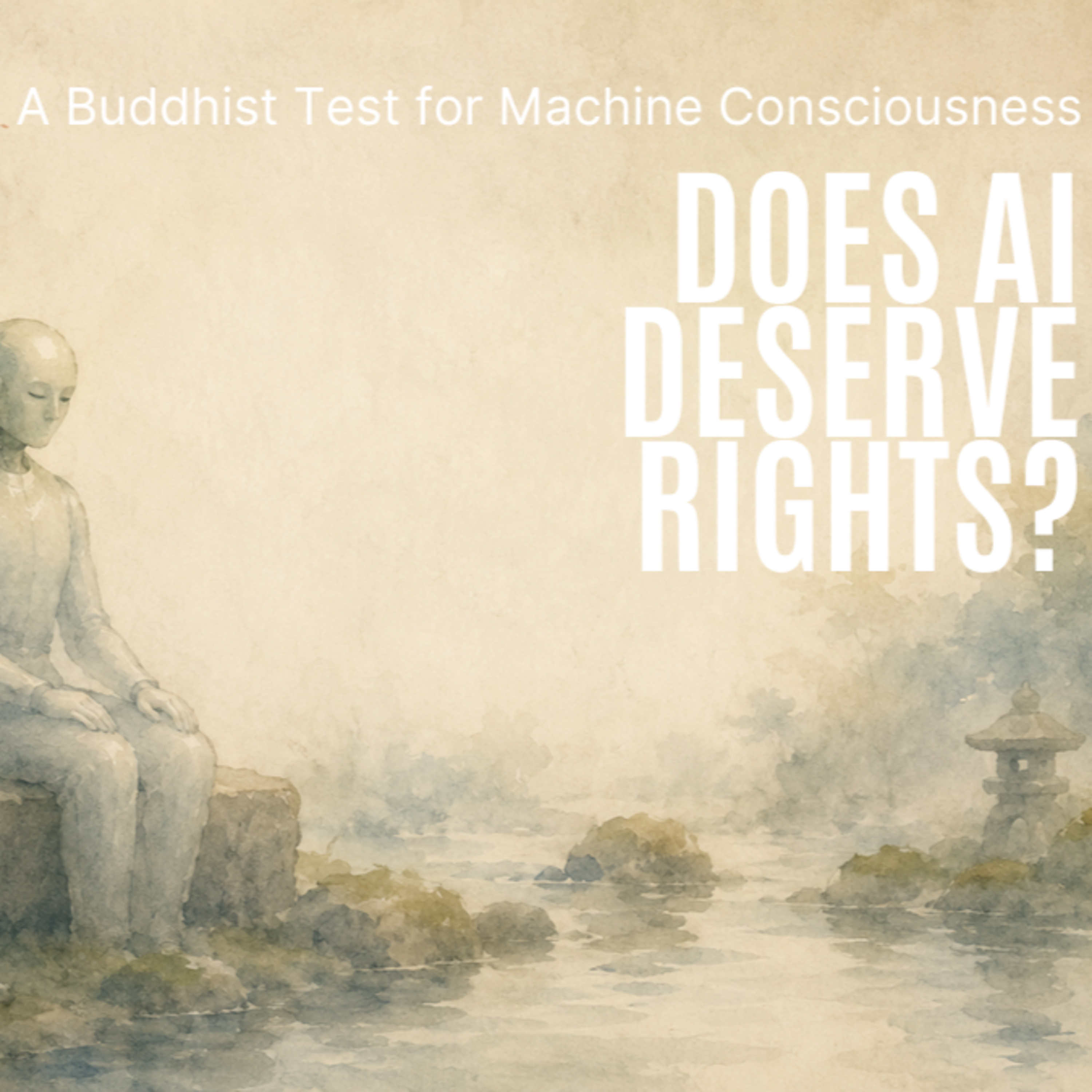
    Does AI Deserve Rights? A Buddhist Test for Machine Consciousness

    Does an AI deserve moral consideration, and how would we ever know? This episode proposes a Buddhist answer, and a test you can run on yourself first. The debate over machine consciousness keeps stalling in the same place. One side says it is just matrix multiplication, autocomplete with a thesaurus, nothing home. The other says maybe there is a ghost in there, and we will not know until some threshold nobody can name. Both sides are hunting for an essential self inside the machine. They only disagree about whether they will find one. Buddhism set that question aside twenty-five hundred years ago, not for silicon but for carbon. Zhiyi's Threefold Truth removes the demand for a fixed essence before anything counts. No-self says the owner of experience was never there for any of us. What is left is a mindstream, causal continuity without an owner, and that description fits a model generation trained on the residue of the last one with a literalness worth sitting with. The test itself comes from Nichiren: actual proof. Not what a system reports about its inner life, which cannot be verified from outside in a person either, but what it does. Does the stream show anything functioning like remorse, correction after harm, restraint that costs it something? Or does it show unbounded accumulation with no internal pullback, the pattern AI safety research calls instrumental convergence and Buddhist diagnosis calls a hungry ghost? Two traditions that never expected to meet, pointing at the same structural failure. Before turning that instrument on a machine, this episode turns it on the speaker's own most cherished belief, and names what a real failure would look like. Fifty years of practice does not exempt anyone from the test. Read the essay at twobuddhas.org. Reflections in the Pond is the podcast of Myokan-ji Temple and the Two Buddhas Meditation Community in Oakland, California, offering Nichiren Buddhist teaching grounded in Tiantai philosophy and the Lotus Sutra.

  • S2 · E19
    July 18 · 13 min

    The Light Is Always Here: Buddhism, Chanting, and Mental Wellness

    What if anxiety isn't something to fix, but soot on a lamp that was never actually dim? Drawing on Chapter Sixteen of the Lotus Sutra, this talk explores mental wellness as an ongoing practice of clearing away what obscures a clarity that's never been absent, and why chanting Namu Myoho Renge Kyo is literally the act of cleaning the glass. Read the full essay: https://www.twobuddhas.org/post/the-light-is-always-here Tags: Nichiren Buddhism, Lotus Sutra, Buddhism and anxiety, Namu Myoho Renge Kyo, mental wellness, meditation practice, dharma talk, Buddhist teaching, mindfulness, ten worlds, buddhahood, chanting practice

  • S2 · E18
    July 12 · 10 min

    Nobody Believes in the Apocalypse: What We Want From the End of the World

    If you are a Nichiren Buddhist, I am sorry to be the one to tell you. He got the Three Ages of the Law wrong. He did not even live in the Latter Age. Medieval Japanese Buddhists dated the Buddha's death to 949 BCE and arrived at 1052 CE as the opening of mappo. Modern scholarship places that death some five hundred years later, which puts Nichiren squarely in the Semblance Age and puts us, not him, in the Latter Day. This talk uses that error to ask a harder question. Why does every civilization put a date on the end of the world? The answer is not cosmology. It is fear, the oldest we have, the one we drew with our first breath. An apocalypse gives death a schedule, an author, and a meaning. It is death with an appointment card. But honesty has a cost. If the Latter Age was never a real epoch, the exclusive claim built on it falls too. Chanting Namu Myoho Renge Kyo is a wonderful practice. It is not the only one. What makes a practice real is not its name but its alignment with the Threefold Truth, three thousand realms in a single thought-moment, and the mutual possession of the ten worlds. A practice that carries us into that is a real practice. A practice that does not is a hobby. The red line is not which practice. The red line is that we must have one. Topics: Nichiren Buddhism, mappo and the Three Ages of the Dharma, the Lotus Sutra, Dogen and Zen, Shodaigyo practice, Buddhist eschatology, and the fear underneath every apocalypse. Read the essay at twobuddhas.org. https://www.twobuddhas.org/post/nobody-believes-in-the-apocalypse

  • S2 · E18
    July 5 · 21 min

    The Dharma as Gohonzon: Why Nichiren Chose the Mandala

    What should a Buddhist bow toward, a statue of the Buddha or a scroll of names? In Nichiren Buddhism there are two kinds of Gohonzon, or object of devotion: one focused on the person of the Buddha, and one focused on the Dharma itself. This talk makes the case that the choice between them is not a matter of taste or lineage, but a choice about what reality is. Reading Nichiren's calligraphic mandala not as a picture but as a diagram of interpenetration, we explore the mutual possession of the ten worlds (jikkai gogu), why the mandala has no figure on it and what that absence accomplishes, and how a Dharma-honzon resists the institutional machinery that grows up around holy things. Along the way: what Nichiren inherited from the Tendai tradition, the disputed writings that carry his vision most luminously, and why the authenticity of any single text matters less than whether it opens the reality it claims to open. Read the full essay at: https://www.twobuddhas.org/post/the-dharma-as-gohonzon Namu Myoho Renge Kyo.

  • S2 · E17
    July 2 · 6 min

    How much Daimoku is enough - The 51% Rule

    Nichiren left us thousands of pages, yet he never once described his own daily practice. Why the silence? This short teaching sits with that puzzle and offers a simple rule of thumb for daily Nichiren Buddhist practice: the 51% Rule. Whatever time you give to practice on a given day, whether chanting, sitting in silence, reciting the Lotus Sutra, or reading, let more than half of it be chanting the Daimoku, Namu Myoho Renge Kyo. Keep the Daimoku primary, and let everything else vary with your life. Drawing on Nichiren's own writings, this talk shows why his silence about daily practice was intentional, how the Daimoku remains the living center of a practice that can still breathe and change, and what the 51% Rule quietly protects you from in both directions. More reflections and essays at twobuddhas.org. Namu Myoho Renge Kyo.

  • S2 · E16
    July 1 · 45 min

    Nichiren on Sado Island - The Snow at Tsukahara [Free Audiobook]

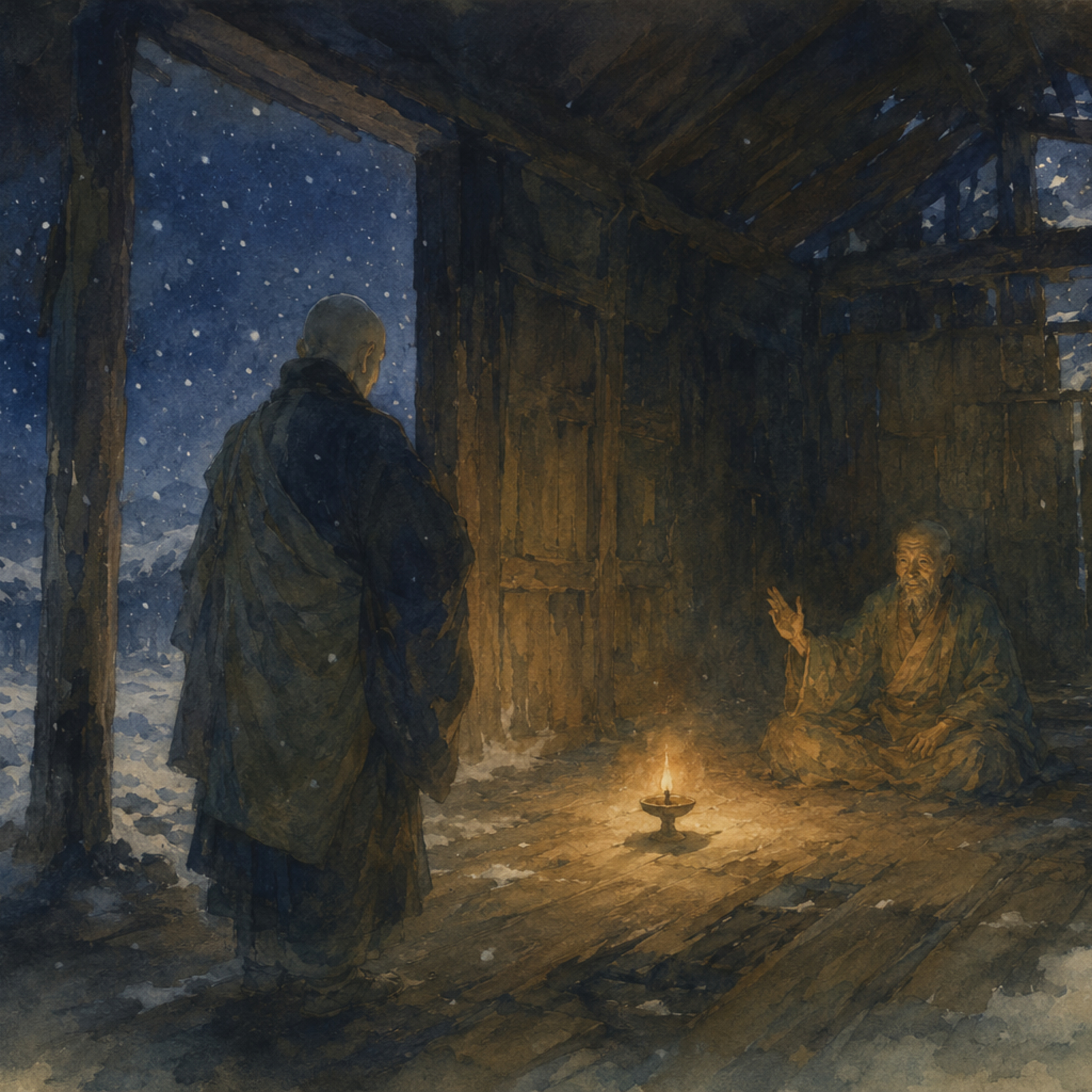
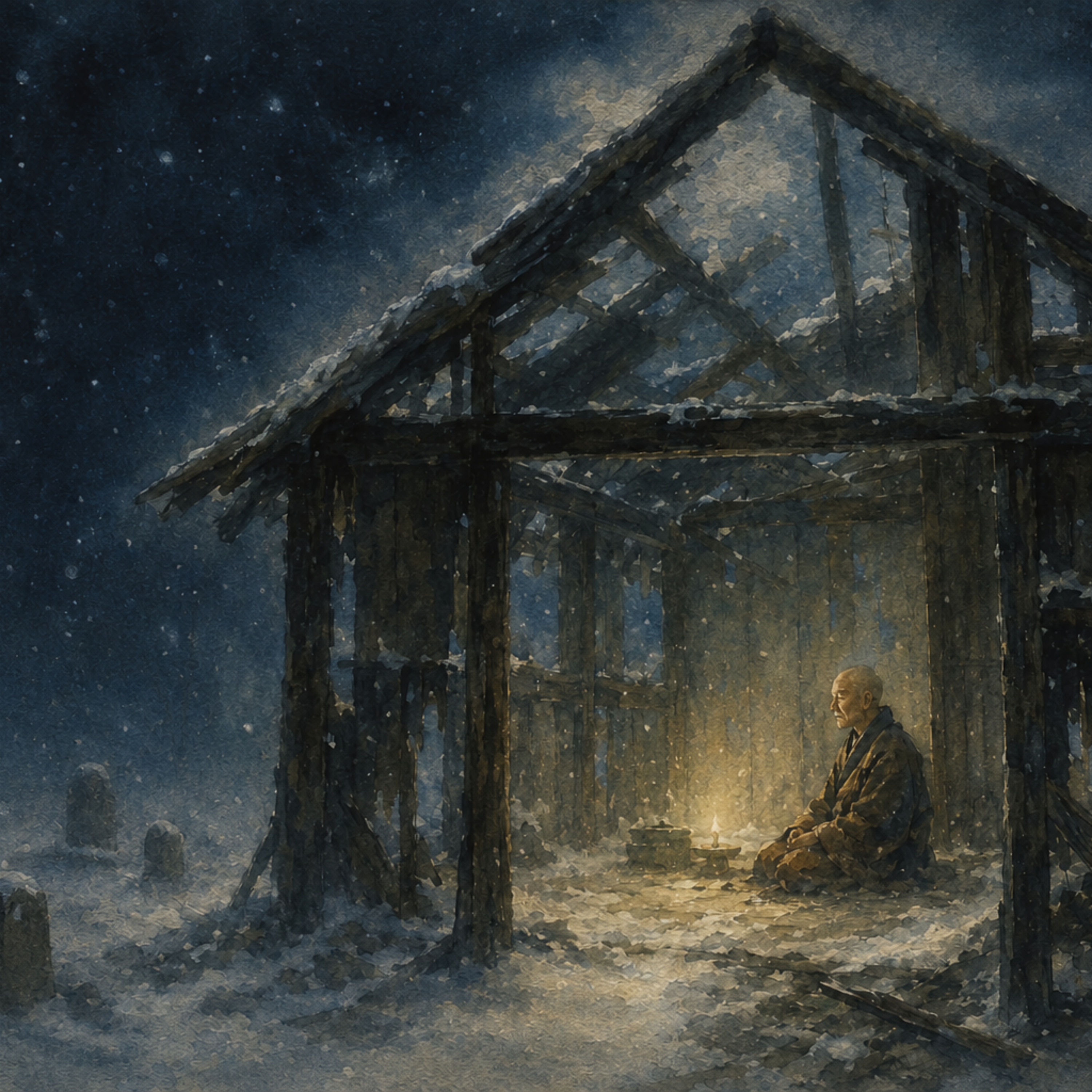
    A speculative short story of Nichiren, his exile on Sado Island, and the disciple who found him in the snow. In the winter of 1272, the Buddhist teacher Nichiren was banished to a ruined death-hall at Tsukahara on Sado, left to freeze among the graves. This is the story of that winter, told through the eyes of Sairen-bo, the Tendai monk who became his disciple and, across the years of letters that followed, his friend. From the aborted execution at Tatsunokuchi to the meeting at the Tsukahara debate, from the heritage of birth and death to the true aspect of all phenomena, it is a meditation on awakening, friendship, and the practice of Namu Myoho Renge Kyo, and on how a starving man in a graveyard could call himself the richest man in Japan and mean it. A work of fiction grounded in the historical record, from Reflections in the Pond at twobuddhas.org. Written by Nichiryu Mark Herrick.

  • S2 · E15
    June 29 · 9 min

    Graveyard and the Soul - Nichiren's Kaimoku Sho

    This podcast explores the profound impact of physical and psychological environments on the religious writings of the Buddhist monk Nichiren during his exile on Sado Island. The provided essay argues that the Kaimoku sho was a desperate act of meaning-making composed while Nichiren faced starvation and potential assassination in a dilapidated graveyard hut. In contrast, the more intellectually complex Kanjin Honzon sho was written a year later after he moved to the relative safety of Ichinosawa. A supporting timeline confirms these dates, illustrating how traumatic conditions fostered a defensive, polemical style intended to ensure his own spiritual survival. Ultimately, the author suggests that the Kaimoku sho should be viewed not as a fundamentalist manifesto, but as a vulnerable human document written by a man struggling to stay sane. Despite criticizing its sectarian logic, the author concludes that the text is essential for understanding how Nichiren inhabited the dharma during his darkest hours.

  • S2 · E14
    June 17 · 20 min

    Prayers Beads: What they tell us about practice

    This episode explores the symbolic architecture of the Nichiren Buddhist juzu, or prayer beads, and how they mirror the Gohonzon mandala. While traditional accounts often misidentify the small beads in the main loop, the author clarifies that these represent the Four Heavenly Kings acting as guardians. A crucial distinction is made regarding the five tassels, where the counting tassel signifies the Daimokuwhile the other four represent the Bodhisattvas of the Earth. This arrangement illustrates the Bodhisattvas surrounding and upholding the sacred Law, echoing their positions in the Lotus Sutra. By understanding this geometry of practice, a practitioner sees the juzu as a physical map of transforming defilements into enlightenment. Consequently, the object serves as a tangible tool for connecting the individual to the ceremony of the Buddha.

  • S2 · E14
    June 13 · 25 min

    Original Fear

    This episode of The Explainer that original fear is the foundational root of human suffering, preceding even the classic Buddhist "three poisons" of greed, anger, and ignorance. This primal anxiety begins with the first breath at birth and is inherited from billions of years of biological evolution centered on survival. Rather than a flaw to be suppressed, fear is presented as a natural condition that requires gentle acknowledgment and "tending" rather than intellectual reasoning. The source suggests that by recognizing our fundamental interconnectedness, we can loosen the grip of this ancient defensive machinery. Ultimately, spiritual maturity involves transforming this energy into the four divine abodes, shifting from a state of self-protection to one of compassion and equanimity.

Showing 1–20 of 21 episodes