So in today’s Gospel reading, our Lord is approaching Jericho, and there’s a blind man sitting by the side of the road. He’s begging, because if you’re blind in those days, they didn’t have a lot of alternative support for you. And so the basic way that you got by was you sat and you asked people for help.
And so that’s what this man was doing. He hears this large crowd going by. And he asks, “What’s happening? What’s going on?”
And so they tell him that Jesus of Nazareth is passing by. And he calls out. And it’s interesting. He doesn’t call out, “Jesus of Nazareth, have mercy upon me!” He says, “Jesus, Son of David, have mercy on me!” Now to understand what this means a little more fully, we need to back up a little bit.
Jesus has just been talking to his disciples again about his death. And, once again, they really don’t get it. He’s saying, “Behold, we’re going up to Jerusalem, and all the things that are written by the prophets concerning the Son of Man will be accomplished. He will be delivered to the Gentiles and will be mocked and insulted and spit upon, and they will scourge him and kill him, and the third day he will rise again.”
So, in retrospect, for us, it’s pretty clear. But of course, as they are hearing what the prophets have to say, they’re not quite getting it, because they’re thinking, again, of a political Messiah: one who’s going to come in and sweep away the Gentiles, and restore the kingdom to Israel.
And Luke really drives home the point that they don’t get it here. He says, “But they understood none of these things, this saying was hidden from them, and they did not know the things which were spoken.”
In other words, they really, really didn’t get it, like, thrice over. And yet, this blind man, who can’t even see what’s going on, who has to ask people what’s happening: he recognizes who Jesus is. Even though he’s blind, he can see that this is the Messiah, the Promised One, the Son of David.
And so there’s this contrast here between Jesus’ own disciples, whom he’s telling very clearly, “This is what’s going to happen,” and the blind man, who, despite his blindness, actually sees more accurately than Jesus’ disciples do. Now, those around, who are going on before, warn the blind man, “Look, look, you’re making a scene!” If there’s one thing we really don’t like, it’s any kind of scene, right?
And so they tell him, “Look, shut up! Just be quiet.” But he cries out instead: he cries out all the more, “Son of David, have mercy on me!”
So Jesus then stands still and commands the blind man to be brought to him. And he asks him, “What do you want me to do for you?” Because “have mercy on me” is actually fairly general. “In what way do you want me to have mercy on you?” And the blind man blurts out, “Lord, that I may receive my sight.” Although here, actually, I prefer the ESV’s translation, “Lord, that I may recover my sight.”
Because if you go all the way back—everything’s in context, layers upon layers upon layers of context—if you go all the way back to the very beginning of Jesus’ ministry, in Luke Chapter 4, Jesus opens up the scroll of the prophet Isaiah, and he reads there
The Spirit of the Lord is upon Me,
Because He has anointed Me
To preach the gospel to the poor;
He has sent me to heal the brokenhearted,
To proclaim liberty to the captives
And recovery of sight to the blind.
To set at liberty those who are oppressed;
To proclaim the acceptable year of the Lord.
So he begins his public ministry by reading them this passage, this prophecy, which includes, among the signs that are going to reveal that the Messiah is coming, recovery of sight for the blind. And in fact, it’s the same Greek word, ἀναβλέπω, there as this blind man is using here.
In other words, the blind man understands the prophets better than the disciples do. And so he’s asking for the fulfilment of that prophecy from the one, the Messiah, the Son of David, who came to fulfil that prophecy. And, you know, it wouldn’t hurt to be able to see again, right?
So Jesus says to him, “Receive your sight,” or “Recover your sight. Your faith has made you well. And immediately, he received his sight and followed him, glorifying God. And all the people when they saw it, gave praise to God.”
So, again, in order to fully understand the impact here, we do need to also understand the larger context. So we’ve looked at some of the context, reflected on the immediately preceding context and looked at the overarching context—I guess you could call it—of the beginning of Jesus ministry, but there is one more bit of context I want to introduce here.
If you read the Gospels through—and I do recommend this. I mean, I also recommend you read the daily readings that are in the lectionary, and if you do that, you will eventually read the gospels through, but it’s also good to just pick up the Gospels and read them through, the whole thing. Maybe not at one sitting, maybe two or three, though the Gospel of Mark, you can probably manage in one sitting. But if you read them through, you’ll start to see that Luke is divided up into sections.
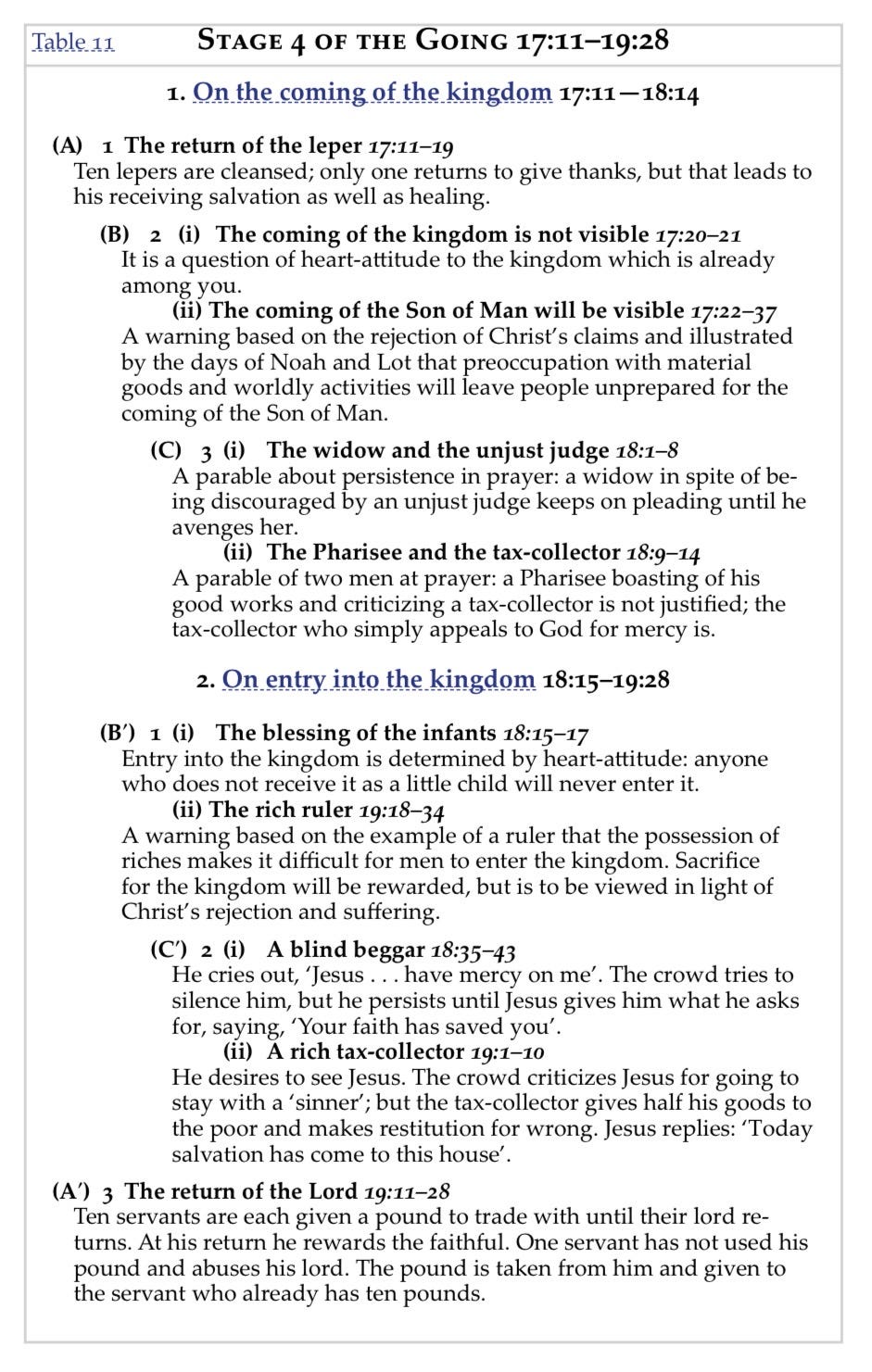
Luke, as I’ve said before, carefully structures his narrative. He says so right from the beginning, that he wants to make an “orderly” account. And if we back up just to the beginning of this chapter, which is in the same section of the Gospel of Luke, Jesus tells the people a parable which is fairly relevant here.
Then He spoke a parable to them, that men always ought to pray and not lose heart, saying: “There was in a certain city a judge who did not fear God nor regard man. Now there was a widow in that city; and she came to him, saying, ‘Get justice for me from my adversary.’ And he would not for a while; but afterward he said within himself, ‘Though I do not fear God nor regard man, yet because this widow troubles me I will avenge her, lest by her continual coming she weary me.’ ”
Then the Lord said, “Hear what the unjust judge said. And shall God not avenge His own elect who cry out day and night to Him, though He bears long with them? I tell you that He will avenge them speedily. Nevertheless, when the Son of Man comes, will He really find faith on the earth?”
So I love this parable. There’s this judge, he’s not a good judge. He doesn’t care about God. He doesn’t care what people think about him. He doesn’t really even care about doing his job, which is to implement justice.
And this widow comes to him. And she’s coming to him day in and day out, saying, “Give me justice from my adversary.”
But he doesn’t want to. He’s like, ah, that’d be too much trouble. I don’t want to do that. But she keeps coming, and coming, and coming, and coming. And she keeps on coming. Finally, he’s like, man, if I don’t do something, this woman’s just gonna wear me out. Fine, I’ll hear the case. I’ll give her justice against her adversary.
And I love it that, in this parable, God is compared to this unjust judge—and that’s deliberate. Because Jesus says, “Hear what this unjust judge says. And shall God not avenge his own elect, who cry out day and night to him. Though he bears long with them. I tell you that he will avenge them speedily. Nevertheless, when the Son of Man comes, will he really find faith on the earth?”
And one of the other themes that you find in this section, if we go a little further—I won’t go into this one in depth—but you’ll remember, of course, the parable of the talents; well, Luke has it slightly different: his is a parable of the minas. And one of the things that Luke highlights in his version of the parable is that this nobleman entrusts these minas to his servants and then he goes away because his citizens don’t want him to rule over them. And he’s away for a while and it’s eventually he comes back. And his servants, you know, report to him. But there’s this delay.
And if we think about this in terms of our own experience of the presence of God, it often seems like there’s a delay. It often seems like, as we pray, as we cry out to God, asking him for this or that or the other thing, there’s a delay. And the question is, “Is that delay permanent? Does God not care?”
“Does he even exist?” is the question that we are forced to ask ourselves these days, just by virtue of the society that surrounds us, that is saying to us, “No, he doesn’t exist. You’re just dumb.”
But what Jesus says here is very clear. And what Luke reinforces here, with the story of the blind man, is very clear. We should keep praying.
We should keep trusting that God cares about us, far more than the unjust judge. And why?
Well, one, the prophets have said this. We live in this era of the fulfilment of all that the prophets have said. And we have had signs upon signs upon signs recorded here in the Scriptures that God has not abandoned his people, Israel, and he has not abandoned us, his holy ones, whom he has called and adopted into the chosen people of God.
He will never abandon us, his holy ones. But from our temporal perspective, you know, God may be acting speedily, but for us, it seems like a long delay. When is it gonna happen?
When is what I am asking God for going to come to pass? When is this problem or challenge that I am encountering, going to be gone? When is he going to address it?
And the answer is, keep praying. Keep praying, keep bugging God until he’s tired… no, he won’t get tired of us. But keep bugging God, just like the blind man. Keep bugging God, just like the widow bugged the unjust judge.
Now, that may, at some points, involve us changing our prayer. Because, like the disciples, we don’t always see clearly. We want this. We want God to solve the problem this way, and sometimes our prayers are very specific. “Lord, this is the solution. Please give it to me.” And more specific than we probably should be.
Because we may not realize—again, like the disciples, who are thinking of Jesus coming and just destroying all their physical enemies—that he has something more profound, more needful in mind. But because he came to destroy death: by embracing death, by allowing his enemies to put him to death. This is the real need that we have. This is the real source of injustice. But they didn’t get it. Like, thrice over, they didn’t get it.
And again, that’s us, right? “Lord, I need this problem fixed, and I need you to fix it this way, and I need you to fix it now.” But, you know, the advantage of persisting in prayer is that you are maintaining a relationship with our Creator, with the one who can actually answer that prayer, and, as you are in relationship with someone, that actually changes you. They—the person that you are interacting with, who you are in relation with—change you, influence you. And that includes God.
And so, our job really is simple. Paul puts it very simply: pray without ceasing. Be in this continual relationship with God. Do so in a way that is open to correction, open to realizing that, “Wait, I don’t understand all that God has in store for me. I don’t understand all the ways that he is in planning and intending to work here. But ultimately, I trust that he is good. I trust that he does want to avenge his elect, and is doing so, from his divine perspective, speedily.”
And so I simply need to wait on him, to keep calling on him, even when people around me say, “Stop it! You’re making a scene. Stop it. You’re being an idiot.”
Keep calling on him, and, above all, keep trusting him. Because he is good, because he comes to heal us. Because what he wants for us is life itself, in all its splendour, all its glory.
“I have come,” Jesus says, “that you might have life, and that you might have it abundantly.” Because God loves us as his children, and wants us, with the blind man, as we receive the answers to our prayers, to glorify Him, Father, Son, and Holy Spirit, now and ever and unto ages of ages.
Scripture readings referenced:
* Luke 18:31-43
* Luke 4:16-21
* Luke 18:1-8
* Luke 19:11-27
This is a public episode. If you would like to discuss this with other subscribers or get access to bonus episodes, visit translatingthetradition.substack.com