Skip to content
Artwork for The Shoulder Physio Podcast
Health & FitnessMedicineScience

The Shoulder Physio Podcast

Jared Powell

The Shoulder Physio Podcast is a podcast dedicated to exploring meaningful topics in musculoskeletal health care.

Play
  • 20 episodes
  • fortnightly
  • Avg 28 min
  • English
  • Tuesday · 12 min

    #65: Are upright rows bad for your shoulders?

    A peanut isn't dangerous until it meets someone who can't tolerate it. Same with the upright row exercise. This episode scrutinises the "worst exercise for your shoulder" claim by tracing it back to a theory that's already dead, then shows what determines outcome: the person lifting. Shock. Horror. Key resources Bahr, R. (2016). Why screening tests to predict injury do not work — and probably never will: a critical review. British Journal of Sports Medicine, 50(13), 776–780. Marsh, C.E., et al. (2020). Fitness and strength responses to distinct exercise modes in twins: Studies of Twin Responses to Understand Exercise as a THerapy (STRUETH) study. The Journal of Physiology, 598(18), 3845–3858. Stern, B.D., Hegedus, E.J., & Lai, Y.C. (2020). Injury prediction as a non-linear system. Physical Therapy in Sport, 41, 43–48. Powell, J. (2024). An essay on the upright row... and peanuts. The Shoulder Physio Blog. (Source essay this episode is adapted from.) Register for the complete shoulder online course Melbourne workshop details Connect with Jared: Jared on Instagram: @‌shoulder_physio Jared on X: @‌jaredpowell12 See our Disclaimer here: The Shoulder Physio - Disclaimer
  • August 4 · 46 min

    #64: Is measuring strength useful? With Tim Cook

    Jared is joined by Tim Cook who is Senior Lecturer in Physiotherapy at the University of Chichester, Advanced Physiotherapy Practitioner in the NHS, and doctoral researcher to discuss their new paper with Prof. Jeremy Lewis in the Journal of Manual & Manipulative Therapy: "Rethinking strength testing in rotator cuff-related shoulder pain: a clinical tradition that lacks muscle." Tim explains what pushed him to question routine strength testing in busy clinical practice, despite guidelines recommending it, and the pair dig into whether weakness is a cause of shoulder pain, a consequence of it, or something else altogether. They look at what subacromial anaesthetic injection studies reveal about pain versus true force output, and Tim reframes the classic "weak and painful shoulder" as the "flexible but painful shoulder," drawing parallels to other oversimplified clinical narratives like posture and core stability. They also make the case for when strength testing can still earn its keep; patient engagement, expectation violation, building confidence, and sporting or return-to-performance populations such as ACL limb symmetry index, before turning to Goodhart's Law and the risk of chasing the test rather than the outcome, and why isolated isometric tests may not translate to real-world, endurance-based shoulder tasks. Tim closes out with an update on his PhD: a reliability RCT on strength and pain-free assessment currently in press, and an upcoming scoping review on the proposed mechanisms of exercise for RCRSP. Key resources Cook, T., Lewis, J., & Powell, J. (2026). Rethinking strength testing in rotator cuff-related shoulder pain: a clinical tradition that lacks muscle. Journal of Manual & Manipulative Therapy, 34(3), 193–198. https://doi.org/10.1080/10669817.2026.2663623 Register for the complete shoulder online course Melbourne workshop details Connect with Jared: Jared on Instagram: @‌shoulder_physio Jared on X: @‌jaredpowell12 Tim on Instagram: @Timcookphysio See our Disclaimer here: The Shoulder Physio - Disclaimer
  • July 21 · 23 min

    #63: The myth of perfect movement

    Is there really one correct way to move? For decades, clinicians and coaches have acted like there is. In this episode, we prosecute that idea. We start in a 1930s Soviet forge, where Nikolai Bernstein filmed blacksmiths and found their hammer strikes landed in the same spot every time, despite every joint angle differing swing to swing. That's "repetition without repetition." From there we bring in Mark Latash's motor abundance: why your nervous system treats extra degrees of freedom as a resource, not a problem, and what that means for scapular "dyskinesis," core stability cues, and fear-based rehab language. We close with a practical clinical translation for coaches and clinicians. Plus: a quick update on my next in-person workshop, The Complete Shoulder Workshop, Melbourne 17 October. Key resources Low M. A Time to Reflect on Motor Control in Musculoskeletal Physical Therapy. J Orthop Sports Phys Ther. 2018 Nov;48(11):833-836. doi: 10.2519/jospt.2018.0614. PMID: 30381024. Latash ML. The bliss (not the problem) of motor abundance (not redundancy). Exp Brain Res. 2012 Mar;217(1):1-5. doi: 10.1007/s00221-012-3000-4. Epub 2012 Jan 14. PMID: 22246105; PMCID: PMC3532046. Register for the complete shoulder online course Melbourne workshop details Connect with Jared: Jared on Instagram: @‌shoulder_physio Jared on X: @‌jaredpowell12 See our Disclaimer here: The Shoulder Physio - Disclaimer
  • July 7 · 19 min

    #62: Pain during exercise: friend or foe?

    The question of allowing pain, or avoiding it, during exercise based rehab remains contentious and uncertain. So, like any good scientist, we (led by Ivy Tran) studied the evidence-base and sought an answer to this clinical conundrum to help not just you, but us too! What did we find? Listen to the episode to find out. Key resources Tran I et al. Effectiveness of Painful Versus Nonpainful Exercise on Pain Intensity, Disability, and Other Patient-Reported Outcomes in Adults With Chronic Musculoskeletal Pain: An Updated Systematic Review With Meta-Analysis. J Orthop Sports Phys Ther. 2025 Smith BE et al. Should exercises be painful in the management of chronic musculoskeletal pain? A systematic review and meta-analysis. Br J Sports Med. 2017 Register for the complete shoulder online course Register for The Complete Clinician Mentorship Connect with Jared: Jared on Instagram: @‌shoulder_physio Jared on X: @‌jaredpowell12 See our Disclaimer here: The Shoulder Physio - Disclaimer
  • June 23 · 21 min

    #61: What is a physiotherapist?

    What is a physiotherapist? Strip away the hands, the exercises, the modalities, what's left? In this episode I argue that the "fixer" identity, the clinician who finds what's broken and corrects it, isn't where our profession came from. It's something that was selected into us through a century of professional politics and reductionist thinking. Drawing on the history of physiotherapy, Newell's constraints framework, self-determination theory, and Gopnik's gardener, I make the case for a different identity: the clinician who sets the conditions for an active, adaptive person to recover and even flourish. Register for the complete shoulder online course Register for The Complete Clinician Mentorship Connect with Jared: Jared on Instagram: @‌shoulder_physio Jared on X: @‌jaredpowell12 See our Disclaimer here: The Shoulder Physio - Disclaimer
  • June 10 · 21 min

    #60: The Burnout Episode

    Burnout in our profession is widespread, with most studies reporting prevalence between 8 and 23 per cent, and up to 65 per cent of recent graduates planning to leave physiotherapy within ten years. In this episode, drawing on a recent editorial in the Journal of Physiotherapy by Ky Wynne, I lay out the empirical picture and challenge the dominant framing that burnout is a problem of individual resilience. I share my own story of burning out two years into clinical practice, what shifted before anything else did, and the disposition I've come to see as the antidote to the slow erosion the current climate produces. Key resources Wynne K. Burnout in physiotherapy. Journal of Physiotherapy. 2026;72:87–90. https://doi.org/10.1016/j.jphys.2025.12.009 Register for the complete shoulder online course Register for The Complete Clinician Mentorship Connect with Jared: Jared on Instagram: @‌shoulder_physio Jared on X: @‌jaredpowell12 See our Disclaimer here: The Shoulder Physio - Disclaimer
  • May 26 · 21 min

    #59: Exercise, sets, reps and the pharmacology problem

    Is more always better? Is there a dose response effect of exercise for musculoskeletal pain? Should exercise be just like a medication, where the dose has to be sufficient in order for it to elicit a therapeutic effect? These are the questions we contend with on this episode of The Shoulder Physio Podcast. Key resources Lawford BJ, Hinman RS, Spiers L, Kimp AJ, Dell'Isola A, Harmer AR, Van der Esch M, Hall M, Bennell KL. Does Higher Compliance With American College of Sports Medicine Exercise Prescription Guidelines Influence Exercise Outcomes in Knee Osteoarthritis? A Systematic Review With Meta-Analysis. Arthritis Care & Research. 2024. Liang X, et al. The Best Exercise Modality and Dose for Reducing Pain in Adults With Low Back Pain: A Systematic Review With Model-Based Bayesian Network Meta-analysis. JOSPT. 2024. Malliaras P, Johnston R, Street G, Littlewood C, Bennell K, Haines T, Buchbinder R. The efficacy of higher versus lower dose exercise in rotator cuff tendinopathy: A systematic review of randomised controlled trials. Archives of Physical Medicine and Rehabilitation. 2020. Powell JK, Lewis J, Schram B, Hing W. Is exercise therapy the right treatment for rotator cuff-related shoulder pain? Uncertainties, theory, and practice. Musculoskeletal Care. 2024. Powell JK, Lewis JS. It is not all about strength: rethinking mechanistic assumptions in exercise-based rehabilitation. British Journal of Sports Medicine. 2025. Register for the complete shoulder online course Register for my Brisbane workshop Connect with Jared and guests: Jared on Instagram: @‌shoulder_physio Jared on X: @‌jaredpowell12 See our Disclaimer here: The Shoulder Physio - Disclaimer
  • May 12 · 26 min

    # 58: Most rotator cuff tears don't hurt

    The FIMAGE study scanned both shoulders of 602 adults from the general population using high-resolution 3-Tesla MRI. Only 7 had a structurally normal rotator cuff. In this episode, I walk through what the study found, why 78% of full-thickness tears were in people with no shoulder pain, and what happens to the diagnostic value of a scan when the finding it detects is near-universal. I challenge the assumption that prevalence equals normality, explore why the word "tear" imports a trauma narrative into what is usually a degenerative process, and make the case that imaging findings deserve a smaller seat at the clinical reasoning table than we've historically given them. Key resources Ibounig T et al. Incidental Rotator Cuff Abnormalities on Magnetic Resonance Imaging. JAMA Intern Med. 2026 Apr 1;186(4):406-414. doi: 10.1001/jamainternmed.2025.7903. PMID: 41697693; PMCID: PMC12910452. Englund M et al. Incidental meniscal findings on knee MRI in middle-aged and elderly persons. N Engl J Med. 2008 Sep 11;359(11):1108-15. doi: 10.1056/NEJMoa0800777. PMID: 18784100; PMCID: PMC2897006. Jensen MC et al. Magnetic resonance imaging of the lumbar spine in people without back pain. N Engl J Med. 1994 Jul 14;331(2):69-73. doi: 10.1056/NEJM199407143310201. PMID: 8208267. Register for the complete shoulder online course Register for my Brisbane workshop Connect with Jared and guests: Jared on Instagram: @‌shoulder_physio Jared on X: @‌jaredpowell12 See our Disclaimer here: The Shoulder Physio - Disclaimer
  • April 28 · 18 min

    #57: Stop Looking for a Winner: The Case for Treatment Pluralism

    In this episode, I walk through my recent JOSPT paper arguing that no single treatment modality has proven itself superior for musculoskeletal pain and that the profession should stop pretending otherwise. Drawing on Isaiah Berlin's distinction between the hedgehog and the fox, I make the case for treatment pluralism: the idea that multiple interventions can lead to recovery, and that rigid allegiance to any one approach is not supported by the evidence. Key resources Powell et al 2026. Many Paths to Recovery: The Case for Treatment Pluralism. JOSPT. DOI: https://www.jospt.org/doi/10.2519/jospt.2026.13992 Register for the complete shoulder online course Register for my Brisbane workshop Connect with Jared and guests: Jared on Instagram: @‌shoulder_physio Jared on X: @‌jaredpowell12 See our Disclaimer here: The Shoulder Physio - Disclaimer
  • April 14 · 24 min

    #56: I Posted a Meta-Analysis and 50 Doctors Told Me I Was Wrong

    I posted a meta-analysis showing PRP doesn't beat saline for tennis elbow. The regenerative medicine community came for me, hard. This episode walks through the incident, what the evidence states, why the comparator you choose determines the conclusion you reach, and what the pushback reveals about incentives in musculoskeletal medicine. References Antunes Júnior et al. (2026). Platelet-rich plasma does not improve pain or function in patients with lateral epicondylitis as compared with placebo: A meta-analysis of randomized clinical trials. American Journal of Sports Medicine. Coombes BK et al. (2010). Efficacy and safety of corticosteroid injections and other injections for management of tendinopathy: A systematic review of randomised controlled trials. The Lancet, 376(9754), 1751–1767. Gosens T et al. (2011). Ongoing positive effect of platelet-rich plasma versus corticosteroid injection in lateral epicondylitis: A double-blind randomized controlled trial with 2-year follow-up. American Journal of Sports Medicine, 39(6), 1200–1208. Kamble P et al. (2023). Is ultrasound (US)-guided platelet-rich plasma injection more efficacious as a treatment modality for lateral elbow tendinopathy than US-guided steroid injection? A prospective triple-blinded study with midterm follow-up. Clinics in Orthopedic Surgery, 15(3), 454–462. Krogh TP et al. (2013). Treatment of lateral epicondylitis with platelet-rich plasma, glucocorticoid, or saline: A randomized, double-blind, placebo-controlled trial. American Journal of Sports Medicine, 41(3), 625–635. Oeding JF et al. (2025). Platelet concentration explains variability in outcomes of platelet-rich plasma for lateral epicondylitis: A high dose is critical for a positive response — A systematic review and meta-analysis with meta-regression. American Journal of Sports Medicine, 53(10), 2489–2496. Orchard JW. (2025). Rock, paper, scissors: Resolving the conflicting results of randomized trials involving corticosteroid, platelet rich plasma (PRP) and placebo injections. JSAMS Plus, 5, 100081. Register for the complete shoulder online course Register for my Brisbane workshop Connect with Jared and guests: Jared on Instagram: @‌shoulder_physio Jared on X: @‌jaredpowell12 See our Disclaimer here: The Shoulder Physio - Disclaimer
  • March 31 · 24 min

    #55: Will AI Replace Physiotherapists?

    The argument that AI replaces "the science" while clinicians should "lean into the art" has become common across healthcare. In this episode, I explain why I think both sides of that framing get it wrong, and why the art vs. science debate was always a false dichotomy that AI has simply made harder to ignore. I draw on four thinkers to make the case: Michael Polanyi on tacit knowledge, Donald Schön on reflective practice in the swampy lowlands, Aristotle on phronesis, and Herbert Dreyfus on the limits of artificial intelligence. Together, they point toward a different answer, that what makes a clinician an expert isn't information retrieval or technical craft, but practical wisdom: the capacity to think with another person under conditions of uncertainty. Register for the complete shoulder online course Register for my Brisbane workshop Connect with Jared and guests: Jared on Instagram: @‌shoulder_physio Jared on X: @‌jaredpowell12 See our Disclaimer here: The Shoulder Physio - Disclaimer
  • March 17 · 13 min

    #54: Physiotherapists are Knowledge Workers

    In this episode of The Shoulder Physio Podcast, we discuss why musculoskeletal clinicians are, at their core, knowledge workers. Not in the corporate buzzword sense, but in the truest sense: professionals whose value comes from the quality of their thinking, not the techniques in their toolkit. We explore why knowledge compounds but repetition doesn't, why information alone fails to change behaviour, and why trust is far more than a soft skill. If you've ever wondered what actually separates a good clinician from a great one, this episode is for you. Register for the complete shoulder online course Connect with Jared and guests: Jared on Instagram: @‌shoulder_physio Jared on X: @‌jaredpowell12 See our Disclaimer here: The Shoulder Physio - Disclaimer
  • February 24 · 46 min

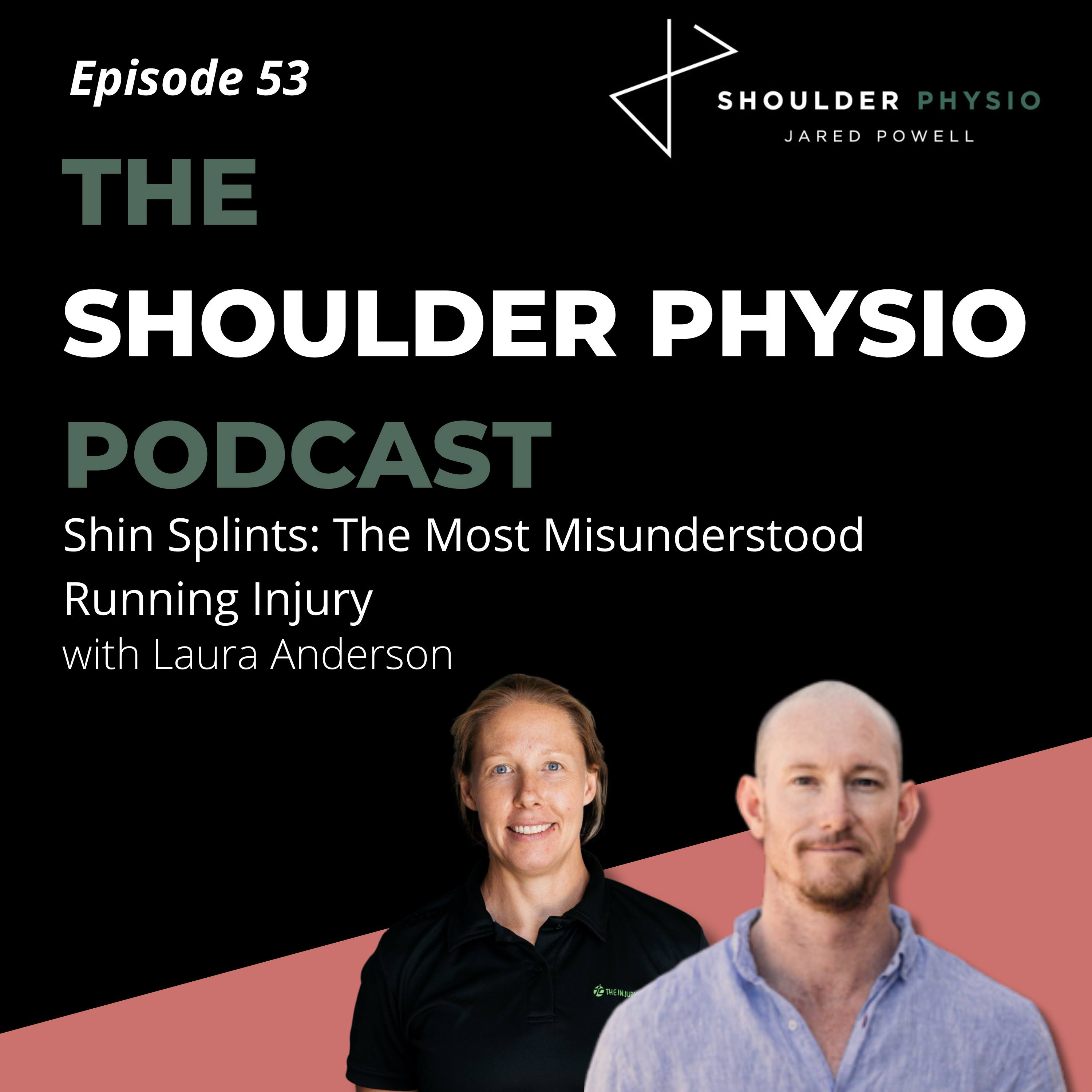
    #53: Shin Splints: The Most Misunderstood Running Injury with Laura Anderson PhD(c)

    Physiotherapist and PhD researcher Laura Anderson just published a paper arguing that "medial tibial stress syndrome" is a 'garbage' name that's been freaking runners out and leading to terrible treatment for decades. Her proposed replacement? Load-Induced Medial Leg Pain (LIMP). Yes, LIMP, pun not intended. The Problem: "Tibial stress" makes everyone think bone stress injury → stress fracture → panic → rest for months Clinicians still aggressively massage shins until they're bruised People rest for months and it comes right back when they start running again It's one of the most common running injuries and we have almost zero quality research on it What It Is: Not a bone stress injury on a fracture continuum Doesn't get worse if you keep running (unlike actual bone stress injuries) We honestly don't know exactly what tissues are involved (probably multiple) Imaging usually shows nothing useful The fix? Tune in. Register for The Complete Shoulder online course Key papers: MTSS needs a new name - Laura's LIMP paper Connect with Jared and guests: Jared on Instagram: @‌shoulder_physio Jared on X: @‌jaredpowell12 Laura's clinic: The Injury Clinic See our Disclaimer here: The Shoulder Physio - Disclaimer
  • January 13 · 12 min

    #52 It’s Not All About Strength: What the Evidence Shows and What the Reaction Reveals

    In this episode, I discuss our recently published BJSM editorial “It’s Not All About Strength” ; what the paper argues, why we wrote it, and what the evidence says about mechanisms of exercise-related pain relief in musculoskeletal conditions. I then turn to the reaction. Not to name names or settle scores, but to examine what the response reveals about how we handle criticism, uncertainty, and challenges to familiar explanations in rehabilitation science. This episode is about evidence, mechanisms, cognitive comfort, and why letting our theories (ideas) be criticised is essential for progress. Register for The Complete Clinician here Key paper: It is not all about strength: rethinking mechanistic assumptions in exercise-based rehabilitation for musculoskeletal pain relief Connect with Jared and guests: Jared on Instagram: @‌shoulder_physio Jared on X: @‌jaredpowell12 See our Disclaimer here: The Shoulder Physio - Disclaimer
  • Nov 4, 2025 · 57 min

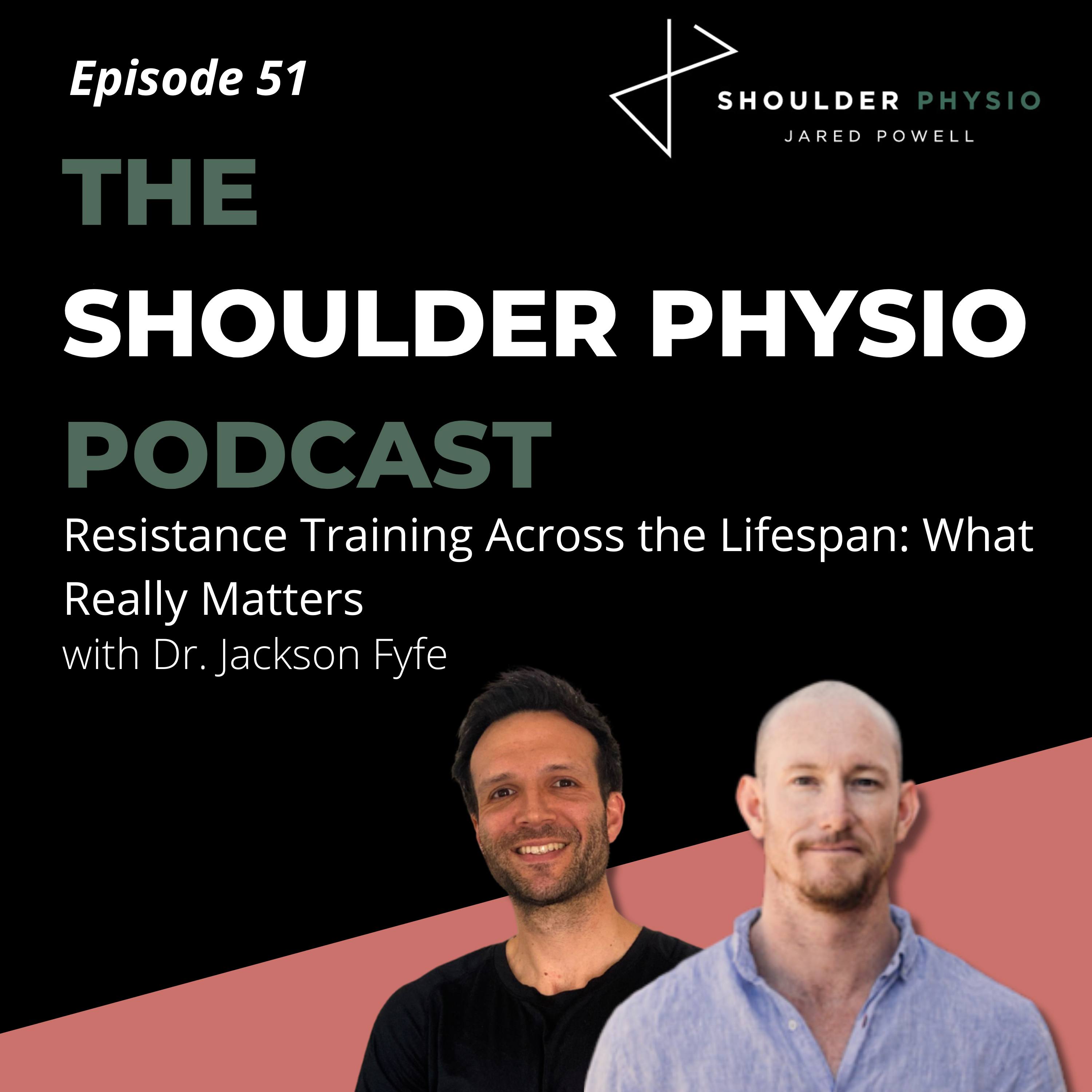
    #51: Resistance Training Across the Lifespan: What Really Matters with Dr. Jackson Fyfe

    In this episode, Jared Powell is joined by Dr. Jackson Fyfe, exercise scientist and Senior Lecturer at Deakin University, to explore the science and practicality of resistance training across the lifespan. They unpack everything from how kids can safely lift weights to how older adults can maintain muscle health and longevity. Jackson also shares insights from his research on training dosage, hypertrophy, minimal effective dose, and how resistance and aerobic exercise can (and should) coexist. This conversation spans from myth-busting (“weights stunt growth”) to deep physiological insights about muscle as an endocrine organ. It’s a clear, evidence-based discussion that reminds us why lifting weights might just be the most underrated health intervention available. Key topics include: Why resistance training matters at every age The health benefits beyond muscle and strength How little training you can do and still get results Strength vs hypertrophy, what actually matters? Combining cardio and lifting: interference or synergy? The truth about training to failure Register for The Complete Clinician here Key papers: Jackson's profile on research-gate Connect with Jared and guests: Jared on Instagram: @‌shoulder_physio Jared on X: @‌jaredpowell12 Jackson on X: @jacksonfyfe Jackson on LinkedIn See our Disclaimer here: The Shoulder Physio - Disclaimer
  • Oct 14, 2025 · 5 min

    #50 Not for everyone: The launch of The Complete Clinician with Dr Jared Powell, PhD

    In this episode, Jared announces the launch of The Complete Clinician, a new mentorship and education community for MSK professionals who want more than recycled CPD. He explains why this platform exists, what’s inside, and who it’s designed for. From monthly PhD-level lectures to the Brew & Review journal club, structured learning modules, and The Clinician’s Compass, this is a second education for those who refuse to be average. Jared also shares a quick update on the upcoming 2nd Edition of The Complete Shoulder, set to release in mid-November, with refined content, updated evidence, and new modules. Launch Date: October 15 Check it out! Connect with Jared: Jared on Instagram: @‌shoulder_physio Jared on X: @‌jaredpowell12 See our Disclaimer here: The Shoulder Physio - Disclaimer
  • Aug 12, 2025 · 57 min

    #49: Cognitive Functional Therapy with Prof. Peter O'Sullivan

    In this candid and wide-ranging conversation, Dr Jared Powell is joined once again by Professor Peter O’Sullivan, one of the most influential voices in musculoskeletal care. Pete unpacks the rationale and findings of the landmark RESTORE trial published in The Lancet, which provides some of the most compelling evidence to date for cognitive functional therapy (CFT) in people with chronic low back pain. He discusses how CFT works, its philosophical divergence from traditional “find-it, fix-it” approaches, and how it centres the patient’s experience, goals, and context. You’ll also hear: A simple explanation of the 3 pillars of CFT The real-world training model used in the RESTORE trial The importance of behaviour change, flare-up planning, and self-efficacy What to do when CFT “doesn’t work” Pete’s reflections on burnout, clinician support, and the importance of community A behind-the-scenes look at the Evolve Pain Care Academy: a new initiative to democratize pain education globally This episode is packed with practical insights, personal reflections, and a compelling vision for the future of musculoskeletal care. Register for The Complete Clinician waitlist here Key papers: Listen to me, learn from me. Slater et al 2022. The RESTORE trial 3 year follow-up Connect with Jared and guests: Jared on Instagram: @‌shoulder_physio Jared on X: @‌jaredpowell12 Evoolve Pain Care Pete X: @peteosullivanpt See our Disclaimer here: The Shoulder Physio - Disclaimer
  • Jul 9, 2025 · 8 min

    #48 Rotator Cuff Surgery: What Makes it Worthwhile?

    In this solo episode of The Shoulder Physio Podcast, Dr Jared Powell explores a deceptively simple question: How much benefit does rotator cuff surgery need to provide to be considered worthwhile? Jared explores a new 2025 study by Harrison Hansford and colleagues, which uses a clever benefit–harm trade-off approach to quantify what patients actually want from surgery. This episode challenges the way we interpret research, the limits of "statistical significance," and the need for truly patient-centred decision-making. If you're still recommending surgery after failed physio without asking what makes it worthwhile to the person in front of you, this one’s for you. Key topics include: The concept of the smallest worthwhile effect Is “does it work?” the wrong question? Shared decision-making and expectation alignment How the evidence stacks up (or doesn’t) Why patient-defined outcomes matter more than p-values Check out the Shoulder Physio Online Course here Connect with Jared: Jared on Instagram: @‌shoulder_physio Jared on X: @‌jaredpowell12 See our Disclaimer here: The Shoulder Physio - Disclaimer
  • May 27, 2025 · 1 hr 11 min

    #47: Active Inference, Pain, and Movement with Dr Mervyn Travers

    In this episode of The Shoulder Physio Podcast, Dr Jared Powell sits down with Dr Mervyn Travers, physiotherapist, S&C coach, and researcher, to explore one of the most compelling frameworks in contemporary pain science: active inference. They discuss how this predictive brain model helps explain persistent musculoskeletal pain, why traditional exercise-based interventions might miss the mark, and how clinicians can use movement and context to shift a patient’s pain experience. Merv blends philosophy, neuroscience, and clinical pragmatism in a way that's accessible, challenging, and highly relevant. Key talking points: What is active inference and how does it relate to predictive processing? The role of prior beliefs, culture, and clinical language in shaping pain Movement experimentation as a tool for model updating and recovery Why it’s time to rethink how we prescribe exercise in pain rehab Clinical implications from landmark studies within the field that lend themselves to active inference A call for compassion, curiosity, and nuance in patient care Check out the Shoulder Physio Online Course here Connect with Jared and guests: Jared on Instagram: @‌shoulder_physio Jared on X: @‌jaredpowell12 Merv website: Home - Optimise Rehab Merv X: @‌mervtravers Merv Instagram: @‌optimise_rehab See our Disclaimer here: The Shoulder Physio - Disclaimer
  • Apr 29, 2025 · 35 min

    #46: Evidence-based medicine with its founder, Professor Gordon Guyatt

    In this episode, Jared Powell sits down with Professor Gordon Guyatt, the physician and researcher who coined the term evidence-based medicine (EBM). They unpack the origins of EBM, why it’s often misunderstood, and how it continues to shape modern healthcare. Rather than being rigid or formulaic, EBM is about integrating the best evidence with clinical expertise and—crucially—patient values and preferences. 🎙 Key talking points: The surprising history behind the creation of EBM Why randomised trials matter—and when they’re not enough How to practice medicine in the face of low-certainty evidence The role of shared decision-making in everyday care Why acknowledging uncertainty is a sign of strength, not weakness How EBM is sometimes misunderstood or misused What the future holds for EBM—including education in schools 🎧 A must-listen for anyone navigating the grey zones of clinical care. Key Papers: Professor Guyatt has too many high impact papers to mention and he has one of the highest H-Index scores in the world (number 13 worldwide and number 1 in Canada). Here is his Google Scholar profile. Check out the Shoulder Physio Online Course here Connect with Jared and guests: Jared on Instagram: @‌shoulder_physio Jared on X: @‌jaredpowell12 Gordon on X:@GuyattGH See our Disclaimer here: The Shoulder Physio - Disclaimer

Showing 1–20 of 20 episodes