Skip to content
Artwork for Strength Beyond Strength
Health & FitnessEducationSelf-ImprovementExplicit

Strength Beyond Strength

Dave Whitley - Iron Tamer

My personal Substack

davewhitley.substack.com
Play
  • 24 episodes
  • weekly
  • Avg 44 min
  • English
Counted on this page — what you have heard stays on this device, so it is not something the list can be paged by.
  • Thursday · 42 min

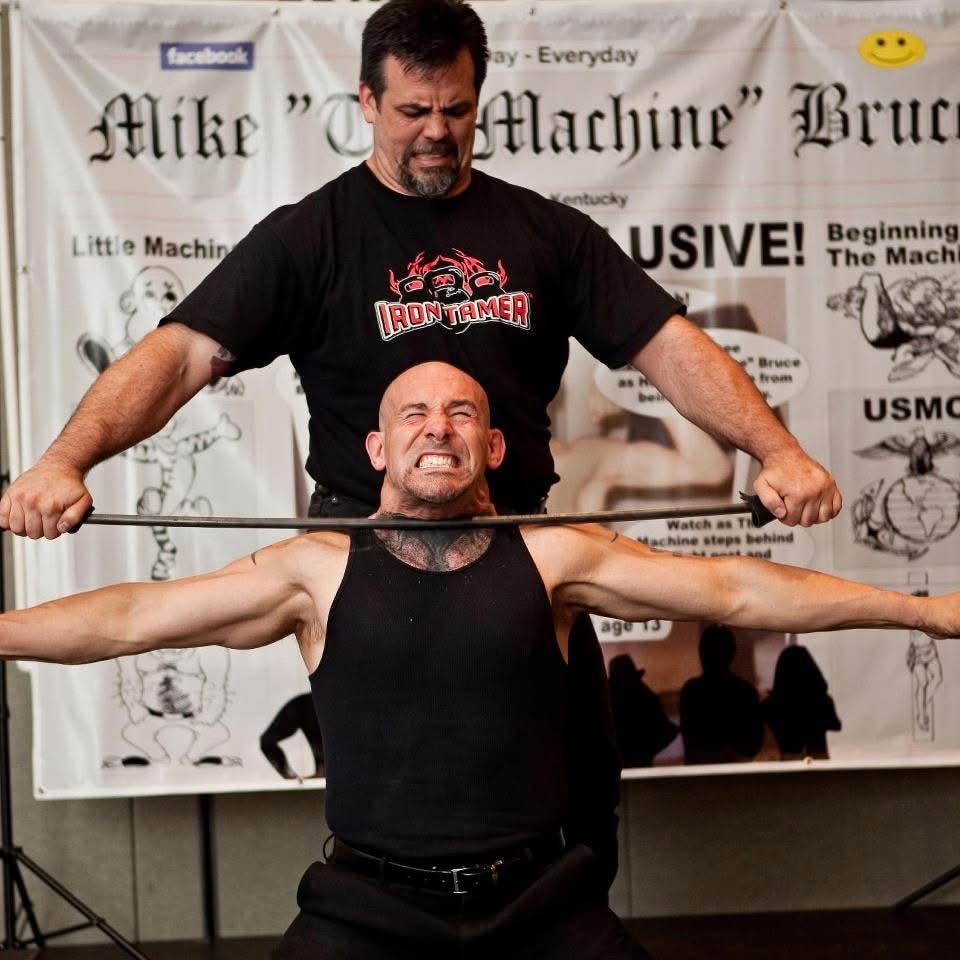
    Strength Beyond Strength S2E18: Mike the Machine Bruce

    Mike “The Machine” Bruce is one of the best professional performing strongman of our time, longtime coach, former Marine and submission wrestling champion, author, speaker and most importantly: my friend for many years. I first met Mike in 2006. He has become widely known in the strength world for extraordinary demonstrations of neck strength and old-school physical culture. Among his feats are a 1,500-pound partial rack pull at approximately 202 pounds bodyweight, a 300-pound seated neck raise and having a steel bar bent across the front of his throat. In fact, he has a world record of 7 bars measuring 5/8” x48” bent across his throat in under 60 seconds. By me. photo by Mandy Whitley Photography But this conversation goes well beyond records. Mike and I discuss how strength training gave him direction early in life, lessons carried forward from the Marine Corps and combat sports, training under old-time strongmen such as Grandmaster Dennis Rogers and Bud Jeffries, the forgotten value of neck training, and how a lifetime of lifting changes the way you think about strength. They also explore Mike’s philosophy that there is no magical training method. The foundation is still consistency, discipline and mastery of the basics — coupled with the patience to allow those things to work over time. Mike “The Machine” Bruce Get full access to Dave’s Substack at davewhitley.substack.com/subscribe

  • October 12 · 37 min

    Strength Beyond Strength S2E17: Ali Gilbert

    Ali Gilbert joins Strength Beyond Strength to talk about men’s health, strength, and what it means to take care of the whole man. We discuss how her work grew from golf fitness into men’s health coaching, why coaches and medical professionals need to work together, and what men can do when their energy, recovery, or body composition starts to change. We also get into practical training for busy men, the assumptions people make about testosterone, and how strength supports the life you want to lead outside the gym. Ali is a CSCS and the founder of Silverback Coaching and the Silverback Summit, which brings coaches and healthcare professionals together around men’s health. Ali's instagram Dave’s Substack is a reader-supported publication. To receive new posts and support my work, consider becoming a free or paid subscriber. Get full access to Dave’s Substack at davewhitley.substack.com/subscribe

  • October 7 · 50 min

    S2E16: Perry Nickelston, Stop Chasing Pain: What Your Body Is Really Telling You

    My guest on this episode of Strength Beyond Strength is my longtime friend and returning guest, Dr. Perry Nickelston, founder of Stop Chasing Pain. Perry has spent years teaching people to stop looking at the body as a collection of isolated parts and start paying attention to how the entire system works together. That means the place where you hurt isn’t necessarily the place where the problem began. In this conversation, we get into pain, movement, the nervous system, recovery, and why simply treating symptoms can cause you to miss the bigger picture. We also talk about the evolution of Perry’s thinking over the years and the importance of remaining curious rather than becoming married to a particular method. This conversation goes well beyond fixing aches and pains. It’s about learning to listen to the body, asking better questions, and understanding that everything is connected. Perry has built his work around a simple but powerful idea: Where you feel pain may not be where the problem is. Perry and I have known each other for many years, so this episode is very much conversation between two coaches who have spent decades studying movement, performance, recovery, and the human body. We talk about why people and practitioners often become too focused on the painful area instead of looking at what is happening throughout the entire system. In this episode, we discuss: * Why Perry created Stop Chasing Pain * Why the location of pain doesn’t always reveal its cause * Moving beyond the traditional “body part” approach * Looking at the body as an interconnected system * The relationship between movement and the nervous system * Why improving one area of the body can influence another * The importance of circulation, recovery, and the body’s internal environment * Why simply attacking symptoms can sometimes miss the real issue * How Perry’s approach has evolved over the years * Being willing to change your mind when new information appears * Why curiosity is one of the most important qualities a coach or practitioner can develop * The difference between following a system and actually understanding principles * Learning to pay attention to the signals your body is giving you * Why health, movement, performance, and recovery can’t always be separated into neat categories One of the biggest themes of the conversation is something that applies to strength training as much as it does to pain: Don’t just ask what hurts. Ask why the body is responding the way it is. The better the question, the better chance you have of finding something useful. Connect with Perry and explore his work at Stop Chasing Pain. Dave’s Substack is a reader-supported publication. To receive new posts and support my work, consider becoming a free or paid subscriber. Get full access to Dave’s Substack at davewhitley.substack.com/subscribe

  • September 30 · 46 min

    SBS S2E15 Tiffany Longcor: Doing Hard Things on Your Terms

    On this episode of Strength Beyond Strength, I’m joined by Tiffany Longcor, creator of Tiffness Fitness. Tiffany is a strength coach, kettlebell sport athlete and longtime student of unconventional strength training. Her training includes kettlebells, barbells, steel mace, Indian clubs and, of course, the bent press. She also currently holds the living women’s barbell bent press record. We talk about building strength in a way that fits your actual life, learning to enjoy the process, challenging yourself without turning every workout into punishment, and why good coaching has to start with the individual standing in front of you. In this episode we talk about: * Tiffany’s path from athlete to coach * How her relationship with strength training has evolved * Kettlebell sport and what it teaches you about patience and practice * Why Tiffany was drawn to the bent press * Training unconventional and old-time strength lifts * The difference between doing something hard and unnecessarily beating yourself up * Making fitness fit your life instead of organizing your life around fitness * Why enjoyment matters if you want training to last * Individualizing training rather than forcing everyone into the same program * Strength, confidence and resilience outside the gym * What competition can teach us even when winning isn’t the primary goal * Why there is more than one way to be strong About Tiffany Longcor Tiffany Longcor is the coach behind Tiffness Fitness. She works with clients online and specializes in helping people build strength, skill and resilience through individualized training. Her background includes kettlebell sport, conventional and unconventional strength training, steel mace, Indian clubs and the bent press. Her philosophy is simple: fitness should support your life, not consume it. Connect with Tiffany Website: TiffnessFitness.comInstagram: @tiffness.fitness Dave’s Substack is a reader-supported publication. To receive new posts and support my work, consider becoming a free or paid subscriber. Get full access to Dave’s Substack at davewhitley.substack.com/subscribe

  • September 24 · 34 min

    Strength Beyond Strength S2E14: James Logan

    What does strength look like when the stakes are real? James Logan is a lifelong endurance athlete, author of Just Keep TRI-ING, and Stage IV colorectal cancer survivor who has refused to allow his diagnosis to become his identity. After being diagnosed in 2024, James faced chemotherapy, radiation, major surgeries and an ostomy. And through all of it, he kept moving. Not recklessly. Not because the circumstances weren’t serious. But because training, competing and pursuing meaningful goals remained part of how he chose to live. Now he’s preparing to compete in the 2026 IRONMAN World Championship in Kona as part of TEAM IMF. In this conversation, we get into something much bigger than endurance sports. We talk about: * What happens mentally when you’re given a life-changing diagnosis * The difference between having cancer and allowing cancer to have you * Why endurance training prepared James for adversity he never chose * Discipline, sacrifice, suffering and pain * Continuing to train while going through treatment * How your relationship with discomfort changes when the stakes become real * Faith, hope and choosing to keep moving forward * Why having a meaningful goal matters * James’s road to the IRONMAN World Championship in Kona * The story behind his book, Just Keep TRI-ING * The danger of assuming there will always be another race, another opportunity or another day This is one of those conversations that expands the definition of strength. Strength isn’t simply what you can lift, how fast you can go or how long you can endure. Sometimes strength is continuing to participate fully in your own life when life gives you every reason not to. James has a phrase that sums it up: “I have cancer. Cancer does not have me.” That’s Strength Beyond Strength. Get full access to Dave’s Substack at davewhitley.substack.com/subscribe

  • September 16 · 47 min

    S2E13: Denis Vasilev: The Art of Kettlebell Sport

    I met Denis Vasilev last year at BellFest in Nashville and got to have some conversations with him again at BellFest in Austin. He is an 11-time Kettlebell Sport World Champion, multiple world-record holder, Master of Sport International Class and one of the most accomplished long-cycle athletes in the history of the sport.In this episode of Strength Beyond Strength, Denis and I dig into what really separates elite kettlebell lifting from simply being strong. We talk technique, relaxation, breathing, the rack position, pacing a ten-minute set, balancing strength and endurance, individualizing technique, training as you get older, and what people who never intend to compete can learn from kettlebell sport.Most importantly, we talk about what 25+ years of practice teaches you about strength beyond numbers on the scoreboard. https://www.denisvasilevkettlebell.com/ instagram: @denisvasilevkettlebell Get full access to Dave’s Substack at davewhitley.substack.com/subscribe

  • September 10 · 1 hr 14 min

    SBS podcast S2E12: Marty Gallagher

    Marty Gallagher has spent more than five decades studying, practicing and teaching the art of physical transformation. He is an IPF World Masters Champion, a five-time USPF national powerlifting champion and a former Olympic weightlifter. As a coach, Marty worked with some of the strongest men who ever lived, including Ed Coan, Kirk Karwoski, Lamar Gant and Doug Furnas. He also coached the United States powerlifting team to an IPF World Team Championship. Beyond competitive strength sports, Marty has served as a subject-matter expert for Naval Special Warfare Development Group, working with Tier 1 special operators to improve warfighter performance. In this episode of Strength Beyond Strength, Marty and I discuss what he has learned from a lifetime under the bar and alongside world-class performers. We get into: * What separates truly great lifters from everyone else * Lessons from coaching Ed Coan, Kirk Karwoski and other strength legends * The difference between productive intensity and unnecessary exhaustion * Why strength training must involve more than sets, reps and percentages * How resistance training, cardiovascular work, nutrition and mental discipline fit together * What working with special operators taught Marty about practical performance * How training should evolve as we get older * What modern fitness has improved—and what it may have forgotten * Why transformation requires the mind and body to work together * The deeper purpose of becoming physically strong Marty brings the perspective of an athlete, championship coach, writer and lifelong student of physical culture. This is not simply a conversation about lifting heavier weights. It is a conversation about using intelligent training to become a more capable human being. Contact Marty: https://linktr.ee/Functional_Strength Marty’s socials: IG: @themartygallagher FB: https://www.facebook.com/marty.gallagher.490776 For Purposeful Primitive ebook inquiries contact - somg1@comcast.net. Dave’s Substack is a reader-supported publication. To receive new posts and support my work, consider becoming a free or paid subscriber. Get full access to Dave’s Substack at davewhitley.substack.com/subscribe

  • September 7 · 51 min

    Strength Beyond Strength S2E11 Dan John on Strength, Simplicity, and the Long Game

    What does it actually mean to be strong? In this episode of Strength Beyond Strength, I reconnect with Dan John, a coach, teacher, athlete, and author I’ve known since the early days of the RKC. Over the years, we’ve taught at events together, shared hotel rooms, meals, drinks, and plenty of long conversations. This episode feels like picking up one of those conversations again. Dan and I discuss strength as something much bigger than the numbers you lift. It can mean physical power, but it can also mean enduring hardship, accepting responsibility, doing the right thing, and being someone others can depend on. We also dig into the history and purpose of the Turkish get-up, how a useful teaching standard can turn into rigid dogma, what today’s lifters can learn from the old-time strongmen, and why so many people sabotage their progress by constantly chasing novelty and rushing the process. Dan explains why great coaches remove rather than add, why plateaus are a necessary part of mastery, and why lasting transformation usually comes from simple actions practiced consistently. The secret, as Dan says near the end of our conversation, is that there is no secret. Dan John has spent decades coaching athletes, teaching strength, and turning complicated training concepts into ideas that ordinary people can understand and use. In this conversation, we explore what strength means inside and outside the gym, beginning with Dan’s belief that strength can take many forms. Lifting a heavy weight is one expression of strength. So is holding a family together, enduring a difficult situation, sacrificing for a larger purpose, and consistently doing what needs to be done. We then turn to the Turkish get-up and the role Dan and I played in teaching it during the early years of modern kettlebell training. Dan explains why the standardized get-up was created as a common teaching and testing system—not as a declaration that every other variation was wrong. We discuss using the get-up to assess movement, teach positions, develop mobility, establish the rack and pressing position, and help people maintain the essential ability to get down to the floor and back up again. We also address the tendency to turn every useful exercise into a competition to see who can lift the most weight. From there, the conversation moves into the lessons of old-time strength culture. The old lifters trained hard, recovered fully, ate recognizable food, and generally didn’t make training their entire identity. When they trained, they trained. When they worked, they worked. Dan contrasts that approach with today’s constant flood of online advice. In the past, an idea had time to be tested before the next one arrived. Today, someone can encounter 20 new programs, exercises, hacks, and opinions before lunch. We also discuss: * Why most people rush the strength-building process * The problem with expecting a complete transformation in eight or twelve weeks * Planned lighter weeks and appropriate exercise variation * The difference between useful variation and constantly starting over * George Leonard’s advice to learn to love the plateau * Why a sticking point can be evidence of progress * How plateaus force you to examine what is and isn’t working * Why the best plan is often the one you continue returning to * What great coaches notice that inexperienced coaches miss * Why “less is more” is easy to say but difficult to apply * The danger of shouting nine different cues during a single repetition * Allowing practice to answer questions that words cannot * Strength as something you practice rather than something you survive * How walking 10,000 steps can change your identity from sedentary to active * Why sleep, daily movement, food, and consistency beat the search for secrets * The value of doing a little, often, over a long period of time Get full access to Dave’s Substack at davewhitley.substack.com/subscribe

  • September 3 · 47 min

    S2E10: Built to Move: Tim Anderson on Original Strength, Aging, and the Power of Getting Up

    What if some of the things we accept as “normal aging” are actually the result of no longer moving the way the human body was designed to move? Tim Anderson joins me to explore how breathing, rolling, rocking, crawling, and simply getting down on the floor can help us reclaim strength, mobility, confidence, and physical freedom. We discuss the philosophy behind Original Strength, the difference between training harder and moving better, and why the ability to get yourself up from the ground is about much more than exercise. Reminder: your body was built to move! In this episode: * What Original Strength means by “pressing reset” * Why the human body is designed to move throughout an entire lifetime * What we may incorrectly accept as normal aging * The difference between aging and the consequences of inactivity * Why losing movement options can make the body feel older than it is * How breathing, head control, rolling, rocking, and crawling work together * Why movement training involves the nervous system, not just the muscles * The value of spending time on the floor * Why adults gradually stop getting down and getting back up * The get-up as a practical expression of strength, mobility, and independence * How getting up from the ground can reveal gaps in your movement * Why simple movements are not necessarily easy or insignificant * Rebuilding confidence by gradually expanding your movement abilities * The relationship between play, exploration, and physical resilience * How small amounts of intentional movement can have a meaningful impact * Why strength should give you more options in life—not merely better numbers in the gym Strength Beyond Strength is about developing strength that carries over into the rest of your life: the ability to move, adapt, recover, and continue saying yes to the things that matter. Get full access to Dave’s Substack at davewhitley.substack.com/subscribe
  • August 30 · 40 min

    S2E9: Dr. Mike T. Nelson on Metabolic Flexibility, Recovery, and Training That Actually Works

    Dr. Mike T. Nelson and I go back to our early days in the kettlebell world, long before he became a highly respected voice in exercise physiology, metabolic flexibility, and recovery. In this episode, we talk about the connection between strength and cardiovascular fitness, why improving your aerobic capacity can make everything else you do feel easier, and why the body doesn’t always fit into the neat categories we try to place it in. This is a wide-ranging conversation about building a body that is not only stronger, but more adaptable, resilient, and capable of recovering from whatever you ask it to do. In this episode, we discuss: * How Mike and I first connected through the early RKC and kettlebell community * The difference between metabolic flexibility and physiological flexibility * Why many strength athletes avoid cardio—and why Mike believes that is a mistake * How a higher aerobic capacity can improve energy, recovery, work capacity, and strength training * Why heavy lifting and cardiovascular training exist on a continuum rather than in separate boxes * Why more testing and more data do not automatically lead to better programming * Using HRV, subjective feedback, and recovery trends without becoming controlled by the numbers * Why some people thrive on frequent training while others struggle to recover from two or three sessions per week * What recovery actually means—and why immediately returning to baseline is not always the goal * The benefits and limitations of cold-water immersion * When cold exposure may interfere with the adaptations you are trying to create * Hormesis, psychological resilience, and the value of voluntarily doing difficult things * Finding the minimum effective dose and allowing repeated exposures to create adaptation * Why a productive training session does not require destroying yourself * Using rep speed, movement quality, and performance feedback to know when to stop * Why changing someone’s training beliefs can be harder than changing their program * The role identity plays in a person’s willingness to accept a different approach About Dr. Mike T. Nelson Dr. Mike T. Nelson is an exercise physiologist, educator, researcher, and coach specializing in metabolic flexibility, physiological flexibility, performance, and recovery. He is also the creator of the Flex Diet Certification and Physiologic Flexibility Certification. Learn more about Mike and his work at MikeTNelson.com. Get full access to Dave’s Substack at davewhitley.substack.com/subscribe

  • August 26 · 53 min

    S2E10: Ryan Golec: The Strength to Hold Both Masculine and Feminine Energy

    Ryan Golec returns for a conversation that moves beyond sets, reps, and physical performance into a much broader exploration of strength. We talk about the masculine and feminine energies that exist within all of us—not as rigid labels for men and women, but as complementary ways of moving through the world. The masculine brings direction, structure, boundaries, and decisive action. The feminine brings intuition, receptivity, creativity, and the ability to flow with what is happening. Real strength is not found by choosing one and rejecting the other. It comes from learning when to lead, when to listen, when to push forward, and when to let go. Ryan and I discuss how these energies show up in training, coaching, relationships, communication, and personal growth. We also explore the limitations of always trying to control, fix, or force an outcome—and why vulnerability, presence, and emotional awareness are not the opposite of strength, but essential parts of it. This is a conversation about becoming more complete: strong enough to take action, open enough to receive, and self-aware enough to know which one the moment requires. In this episode, Ryan and I discuss: * The difference between masculine and feminine energy—and why neither belongs exclusively to men or women. * How masculine qualities such as structure, direction, discipline, boundaries, and action work alongside feminine qualities such as intuition, receptivity, creativity, and flow. * Why constantly pushing, controlling, fixing, and forcing can become a limitation rather than a sign of strength. * The importance of listening and being present instead of immediately trying to solve another person’s problem. * How training and coaching can become opportunities for self-awareness, communication, and personal growth—not simply physical improvement. * Why vulnerability, sensitivity, and emotional honesty do not diminish masculinity or strength. * Learning when a situation requires decisive action and when it requires patience, surrender, and trust. * How integrating both sides allows us to become more adaptable, connected, and complete human beings. Strength is not only the ability to impose your will. Sometimes it is the ability to become still, listen, and allow something deeper to emerge. Get full access to Dave’s Substack at davewhitley.substack.com/subscribe

  • August 20 · 1 hr 1 min

    S2E8: Bent Presses and More with Peter Nieman, The Iceman.

    “Dave Whitley is the the father of the Modern bent press movement.”- Paul McIlroy First of all, I am honored that a coach and athlete of Paul’s caliber would say that about me and my favorite lift. Second, and more importantly: If what Paul said is true, then Peter Nieman of Icebox Kettlebell is the next generation’s foremost student of the lift and one of it’s most important torchbearers, carrying the bent press into its next chapter. He has studied the lift, practiced it, questioned it, explored it and gone back to the old sources to better understand how the great lifters of the past actually performed it. In this Episode, Peter joins me for a deep conversation about kettlebell training, movement, and the ongoing study of the bent press. In what is essentially is an impromptu master class, we talk about: * Why the bent press is more about moving the body underneath the weight than pressing the weight overhead—and how positioning, rotation, balance, and timing make the lift possible. * The differences between bent pressing a kettlebell, plate-loaded dumbbell, and barbell, and how each implement changes the balance, feedback, and demands of the lift. * Peter explains how studying old photographs, books, and film of lifters like Arthur Saxon, Sig Klein, and W. A. Pullum and other old-time lifters has shaped his own technique. Rather than looking for one universally correct version of the lift, he studies how different lifters used their individual structures, strengths, and available equipment to solve the same physical problem. * Why the old-school lifters did not all perform the bent press exactly alike—and what their individual variations teach us about anatomy, leverage, and finding the version that fits the lifter. * How windmills, get-ups, grip work, mobility, and consistent technical practice contribute to building a stronger and more confident bent press. Get full access to Dave’s Substack at davewhitley.substack.com/subscribe

  • August 11 · 1 hr 1 min

    Strength Beyond Strength S2E7: Brett Jones

    Brett Jones: A Life in Strength, Kettlebells, and Coaching In this episode of Strength Beyond Strength, I sit down with my long-time friend, colleague and mentor Brett Jones for a conversation about his journey through the strength world and the experiences, people, and ideas that shaped the coach he became. Brett has been part of the modern kettlebell movement since the VHS days, and we’ve shared many a stage together over the years. We get into how Brett found his way into strength and coaching, his experiences in the RKC and StrongFirst systems, and some of the lessons that only come from spending decades teaching real people. Along the way, we talk about the difference between knowing exercises and actually knowing how to coach, how good programming evolves with experience, and why the fundamentals tend to become more—not less—important the longer you train. We also get into some history, some stories, and a few lessons learned from years spent around kettlebells, strength training, and some of the most influential people in that world. In this episode, we talk about: * How Brett got started in strength training and coaching & his path into kettlebell training * The early days of the RKC and the evolution to StrongFirst * How Brett’s approach has changed over the years * What decades of working with real clients teaches you that textbooks can’t * Why fundamentals matter even more at advanced levels * Lessons from Brett’s career and the people who influenced him * How to keep learning without constantly chasing the newest thing * Stories from the growth of the modern kettlebell community This one is part strength history, part conversation between colleagues and part look at the journey of someone who has spent a significant portion of his life helping people become stronger. If you’ve been around kettlebells for a while, you’ll recognize a lot of the names and history. If you’re newer to this world, you’ll get a glimpse into how many of the ideas we take for granted today developed. And if you’re a coach, there are plenty of lessons here that go far beyond kettlebells. https://www.theironcardio.com/ Get full access to Dave’s Substack at davewhitley.substack.com/subscribe

  • August 8 · 44 min

    Strength Beyond Strength S2E6 with Colin Lake: Millimeters become miles.

    Colin Lake has gone from athlete and personal trainer to coach, entrepreneur, and a guy who decided that if the kettlebell he wanted didn’t exist, he might as well build it himself. In this episode, Colin and I talk about the path that brought him into the strength world, how his ideas about movement and coaching have evolved, and eventually how those ideas influenced the equipment he wanted to train with. That led to designing kettlebells and then designing some really heavy kettlebells. Today, the Great Lakes Method offers P-Spec hardstyle kettlebells ranging from 36 kg all the way to 228 kg/503 lb, along with live heavy-kettlebell events. (Great Lakes Method) But this conversation isn’t just about giant chunks of iron. We get into the thought process behind kettlebell design, why seemingly small details in a bell can change the way it feels and performs, and what Colin has learned from years of coaching, experimenting and paying attention to how people actually move. We also talk about the business side—the evolution from coach and kettlebell enthusiast to creating products and building something around his own ideas about strength. In this episode, we talk about: * Colin’s path from athletics into personal training and coaching * How he discovered kettlebell training and began developing his own ideas about it * Why kettlebell design matters more than most people realize * The relationship between the shape of the bell and the way you actually use it * Colin’s fascination with increasingly heavy kettlebells * What changes when kettlebell weights get into triple digits * The difference between simply making a kettlebell heavier and designing one to actually be usable * The development of the Great Lakes Method * Why there is still plenty of room for exploration and innovation with such an old, simple training tool Colin’s story is a good example of something I’ve seen repeatedly in the strength world: the deeper you go into something, the more questions you discover. Sometimes those questions change the way you train or the way you coach and sometimes they result in a 500-pound kettlebell. Find Colin Lake Great Lakes Method Great Lakes Girya Pro Colin on Instagram Colin on YouTube Get full access to Dave’s Substack at davewhitley.substack.com/subscribe

  • April 14 · 39 min

    Strength Beyond Strength S2E3: Sifu Singh

    In this episode, I sat down with Sifu Harinder Singh for a conversation that went way beyond technique. We got into martial arts, mindset, discipline, personal evolution, and what it means to keep training in a way that actually shapes the man behind the skill. Singh’s background spans Jeet Kune Do, Tai Chi, Wing Chun, Filipino Martial Arts, Brazilian Jiu Jitsu, and high-performance coaching, and that breadth shows up in how he thinks, teaches, and lives. What I appreciated most about this conversation is that it wasn’t just about fighting, systems, or collecting techniques. It was about awareness, self-mastery, and learning how to stay centered under pressure. That theme runs through a lot of Singh’s work, whether he’s teaching martial artists, coaches, executives, or law enforcement professionals. Get full access to Dave’s Substack at davewhitley.substack.com/subscribe

  • April 10 · 34 min

    Strength Beyond Strength S2E2: Gray Cook

    Gray Cook is a physical therapist, strength coach, and co-founder of the Functional Movement Systems (FMS). He’s best known for developing the Functional Movement Screen, a simple but powerful way to assess movement quality before loading it with strength or conditioning. Gray’s work has influenced everyone from rehab professionals to elite performance coaches. His core message is straightforward: if you don’t move well, adding strength on top of dysfunction is just reinforcing the problem. In this conversation, we get into movement as a foundation for strength, the difference between training and practice, and how to build resilience without beating yourself up in the process. Get full access to Dave’s Substack at davewhitley.substack.com/subscribe

  • February 11 · 32 min

    Strength Beyond Strength podcast: Pat Rigsby

    Pat Rigsby is a business coach, author, and entrepreneur who has helped thousands of fitness professionals build profitable, sustainable businesses. As the founder of Fitness Consulting Group and host of the Fitness Business School podcast, Pat specializes in helping gym owners and coaches create simple, predictable systems for marketing, sales, and client retention—without burning themselves out chasing trends. With decades of experience in the fitness industry, Pat has worked behind the scenes with some of the most successful gym owners in the world. His philosophy centers on clarity over complexity, systems over hustle, and building businesses that actually support the life you want to live. Today, he helps coaches move from overwhelmed operator to confident CEO. Get full access to Dave’s Substack at davewhitley.substack.com/subscribe

Showing 1–20 of 24 episodes