Skip to content
Artwork for Scaling Theory

Scaling Theory

Thibault Schrepel

Scaling Theory is a podcast dedicated to the power laws behind the growth of companies, technologies, legal and living systems. The host, Dr. Thibault Schrepel, has a PhD in antitrust law and looks at the regulation of digital ecosystems through the lens of complexity theory. The podcast is hosted by the Network Law Review. It features scholarly discussions with select guests and deep dives into the academic literature.

Play
  • 20 episodes
  • monthly
  • Avg 49 min
  • English
  • August 31 · 50 min

    John H. Cochrane on Empty Skies

    John H. Cochrane is the Rose-Marie and Jack Anderson Senior Fellow at the Hoover Institution. He spent thirty years as a professor of finance at the University of Chicago Booth School of Business. He writes The Grumpy Economist (over 34,000 subscribers). Cochrane is a pilot, and the empty skies are his example of what permission costs when it compounds for fifty years. We cover three things. Why compound growth dwarfs everything else on the policy agenda and still moves almost no voters. What happens to the scaling of an economy when the default answer is that you must ask permission. And what has become of universities and peer review, where Cochrane says nobody reads the papers and the profession rewards where you published rather than whether you convinced anyone. I hope you enjoy the conversation. ** Mentioned in this episode John Cochrane, "Economic Growth" (2016), in John Norton Moore (ed.), The Presidential Debates, Carolina Academic Press, pp. 65-90. A shorter version appeared as "The Election's Most Important Issue": https://www.hoover.org/research/elections-most-important-issue John Cochrane, "Finance: Function Matters, Not Size," Journal of Economic Perspectives 27(2), 2013: https://www.aeaweb.org/articles?id=10.1257/jep.27.2.29 John Cochrane, "The Rule of Law in the Regulatory State" (2015), prepared for the Hoover Institution Magna Carta conference: https://www.johnhcochrane.com/news-op-eds-all/rule-of-law-regulation John Cochrane, "Refine," The Grumpy Economist: https://www.grumpy-economist.com/p/refine John Cochrane, "Writing Tips for PhD Students": https://www.johnhcochrane.com/writing-group John Cochrane, "Conti on the Future of Universities," The Grumpy Economist: https://www.grumpy-economist.com/p/conti-on-the-future-of-universities Gregory Conti, "The Rise of the Sectarian University," Compact: https://www.compactmag.com/article/the-rise-of-the-sectarian-university/ The Grumpy Economist, John Cochrane's Substack: https://www.grumpy-economist.com/ Thibault Schrepel, "The Matthew Effect at Scale: Attention Scarcity and the AI Output Explosion," Network Law Review: https://www.networklawreview.org/matthew-effect/ Robert E. Lucas Jr., "Expectations and the Neutrality of Money," Journal of Economic Theory 4(2), 1972, pp. 103-124.
  • July 27 · 54 min

    Peter Howitt on Creative Destruction in the Age of AI

    Peter Howitt won the 2025 Nobel Prize in Economic Sciences. The award was for the theory of sustained growth through creative destruction. He and Philippe Aghion gave that theory a mathematical form in 1992. Competition and innovation do not move together in a straight line. What decides the direction is where a firm sits relative to the technological frontier. Peter also draws the line between a merger that buys innovation and one that removes it, and he describes the route by which an incumbent turns market power into political power. We then turn to agent-based modeling. He is candid about why a method he still defends took thirty years to find readers. Follow me on X (https://x.com/profschrepel) and BlueSky (@ProfSchrepel). *** References: "A Model of Growth Through Creative Destruction" (with Aghion), Econometrica 60(2), March 1992, 323–351. https://www.jstor.org/stable/2951599. Endogenous Growth Theory (with Aghion), MIT Press, 1998. https://mitpress.mit.edu/9780262528467/endogenous-growth-theory/ "Competition and Innovation: An Inverted-U Relationship" (with Aghion, Bloom, Blundell, Griffith), Quarterly Journal of Economics 120(2), May 2005, 701–728. https://academic.oup.com/qje/article-abstract/120/2/701/1933966. "The Effects of Entry on Incumbent Innovation and Productivity" (with Aghion, Blundell, Griffith, Prantl), Review of Economics and Statistics 91(1), February 2009, 20–32. https://direct.mit.edu/rest/article/91/1/20/57753/The-Effects-of-Entry-on-Incumbent-Innovation-and. "The Emergence of Economic Organization" (with Robert Clower), Journal of Economic Behavior & Organization 41(1), January 2000, 55–84. https://www.sciencedirect.com/science/article/abs/pii/S0167268199000876. "Banks, Market Organization, and Macroeconomic Performance: An Agent-Based Computational Analysis" (with Ashraf and Gershman), JEBO 135, March 2017, 143–180. DOI 10.1016/j.jebo.2016.12.023. "How Inflation Affects Macroeconomic Performance: An Agent-Based Computational Investigation" (with Ashraf and Gershman), Macroeconomic Dynamics 20(2), March 2016, 558–581. https://www.cambridge.org/core/journals/macroeconomic-dynamics/article/abs/how-inflation-affects-macroeconomic-performance-an-agentbased-computational-investigation/DC3AF3CA750F82FDE20164B36935FA1F. "Getting at Systemic Risk via an Agent-Based Model of the Housing Market" (with Geanakoplos, Axtell, Farmer and others), American Economic Review 102(3), May 2012, 53–58. https://www.aeaweb.org/articles?id=10.1257/aer.102.3.53.

  • June 29 · 33 min

    Steven Pinker on Common Knowledge, From Eye Contact to the Super Bowl

    Some things change the world not because they are new, but because everyone learns them at once. That is the difference between mutual knowledge, where each of us knows something, and common knowledge, where each of us knows that the other knows, without end. It is the hidden machinery behind money, language, authority, and revolution. Steven Pinker, professor of psychology at Harvard, joins Scaling Theory to discuss his latest book, “When Everyone Knows That Everyone Knows.” We move from a folk tale to game theory, from the evolution of altruism to the future of artificial agents. I read the book as a theory of scaling. A single mind can hold only a few layers of who knows what about whom, yet we coordinate in the millions. How we bridge that gap, and what happens to it in an age of fragmented media and machines that can model one another, is what I wanted to understand.

  • May 6 · 47 min

    #30 – Matthew O. Jackson on How Networks Quietly Shape What You Believe

    Welcome back to Scaling Theory. In this episode, I speak with Matthew O. Jackson, the William D. Eberle Professor of Economics at Stanford University and an external faculty member at the Santa Fe Institute. Matthew is one of the founders of the modern economics of networks and the author of The Human Network and Social and Economic Networks. We talk about the friendship paradox, why homophily slows how fast a society learns the truth but helps niche ideas catch fire, and the gossip study where villagers in southern India proved remarkably good at naming the most central spreaders in their community. We then turn to AI agents as a different species: Turing tests on LLMs, the steerability of agent personas through system prompts, and what to make of Moltbook, the social network for AI agents. By the end, you will know why telling students how much their peers actually drink reduces binge drinking more than warning them about the dangers of alcohol, why the same network can spread a virus quickly and a belief slowly, and why AI agents change their behavior when asked to explain it. Papers and works referenced in the conversation Books The Human Network: How Your Social Position Determines Your Power, Beliefs, and Behaviors — Matthew O. Jackson (Pantheon, 2019). https://web.stanford.edu/~jacksonm/books.html Social and Economic Networks — Matthew O. Jackson (Princeton University Press, 2008). https://web.stanford.edu/~jacksonm/books.html Part I — The scaling of human networks "Diffusion and Contagion in Networks with Heterogeneous Agents and Homophily" — Matthew O. Jackson and Dunia López-Pintado, Network Science 1(1), 2013. https://arxiv.org/abs/1111.0073 "How Homophily Affects the Speed of Learning and Best-Response Dynamics" — Benjamin Golub and Matthew O. Jackson, Quarterly Journal of Economics 127(3), 2012. https://web.stanford.edu/~jacksonm/homophily.pdf "Using Gossips to Spread Information: Theory and Evidence from Two Randomized Controlled Trials" — Abhijit Banerjee, Arun G. Chandrasekhar, Esther Duflo, and Matthew O. Jackson, Review of Economic Studies 86(6), 2019. https://academic.oup.com/restud/article/86/6/2453/5345571 "Empathy and Well-Being Correlate with Centrality in Different Social Networks" — Sylvia A. Morelli, Desmond C. Ong, Rucha Makati, Matthew O. Jackson, and Jamil Zaki, PNAS 114(37), 2017. https://www.pnas.org/doi/10.1073/pnas.1702155114 Part II — The scaling of AI agents "Inequality's Economic and Social Roots: The Role of Social Networks and Homophily" — Matthew O. Jackson, in Advances in Economics and Econometrics: Twelfth World Congress of the Econometric Society (Cambridge University Press, 2025). https://arxiv.org/abs/2506.13016 "AI Behavioral Science" — Jackson, Mei, Wang, Xie, Yuan, Benzell, Brynjolfsson, Camerer, Evans, Jabarian, Kleinberg, Meng, Mullainathan, Ozdaglar, Pfeiffer, Tennenholtz, Willer, Yang, and Ye, arXiv 2509.13323, 2025. https://arxiv.org/abs/2509.13323 "A Turing Test of Whether AI Chatbots Are Behaviorally Similar to Humans" — Qiaozhu Mei, Yutong Xie, Walter Yuan, and Matthew O. Jackson, PNAS 121(9), 2024. https://www.pnas.org/doi/10.1073/pnas.2313925121

  • April 13 · 51 min

    #29 – Albert-Laszlo Barabasi: The Hidden Order of Networks

    Welcome back to Scaling Theory. My guest today is Albert-László Barabási, Professor of Network Science at Northeastern University and one of the most cited scientists alive with over 320 000 citations. His books include Linked, The Formula, and Network Science. In 1999, Albert-László Barabási published a paper that changed how we understand networks. The finding was this: real-world networks are not random. They are dominated by hubs. A few nodes collect most of the links, and they do so because they already have them. In this episode, he explains the details of what he actually found. We then move to the scaling of networks, and the temptation to control them. We conclude with a discussion about art, ballet dancers, architecture, and what mapping careers across disciplines reveals about how networks really work. You can follow me on X (@ProfSchrepel) and BlueSky (@ProfSchrepel). References: ➝ Papers Barabási, A.-L. & Albert, R. "Emergence of Scaling in Random Networks." Science 286, no. 5439 (1999): 509–512. https://doi.org/10.1126/science.286.5439.509 Albert, R., Jeong, H. & Barabási, A.-L. "Diameter of the World-Wide Web." Nature 401 (1999): 130–131. https://doi.org/10.1038/43601 Watts, D.J. & Strogatz, S.H. "Collective Dynamics of 'Small-World' Networks." Nature 393 (1998): 440–442. https://doi.org/10.1038/30918 Erdős, P. & Rényi, A. "On Random Graphs." Publicationes Mathematicae 6 (1959): 290–297. https://snap.stanford.edu/class/cs224w-readings/erdos59random.pdf ➝ Books Barabási, A.-L. Linked: The New Science of Networks. Cambridge, MA: Perseus Publishing, 2002. https://en.wikipedia.org/wiki/Linked:_The_New_Science_of_Networks Barabási, A.-L. Network Science. Cambridge: Cambridge University Press, 2016. https://networksciencebook.com (open access) Barabási, A.-L. The Formula: The Universal Laws of Success. New York: Little, Brown and Company, 2018. https://www.hachettebookgroup.com/titles/albert-laszlo-barabasi/the-formula/9780316505499

  • March 19 · 1 hr 10 min

    #28 – Scott Page: Why Diversity Beats Genius

    Welcome back to scaling theory. My guest today is ⁠Scott E. Page⁠, Distinguished University Professor of Complexity, Social Science, and Management at the University of Michigan, and an external faculty member at the Santa Fe Institute. He is an elected member of the National Academy of Sciences and the American Academy of Arts and Sciences, and a recipient of the Guggenheim Fellowship. His books include The Difference, Diversity and Complexity, The Diversity Bonus, and The Model Thinker. In this episode of Scaling Theory, Scott walks us through what complexity actually is. He unpacks the difference between complicated and genuinely complex systems, explains why cognitively diverse teams systematically outperform homogeneous ones on complex tasks, and what that means for how organizations scale. We also take up path dependence, the spillover effects of overlapping games across platform ecosystems, and where complexity tools have changed real decisions in practice. We close on the single open problem whose resolution would most reshape our understanding of social systems. As you will hear, Scott’s thinking is exceptionally clear. It is always a pleasure to talk with him and to listen to his insights. I hope you enjoy our discussion. You can follow me on X (@⁠ProfSchrepel⁠) and BlueSky (@⁠ProfSchrepel⁠). ** Books Page, S.E. (2007). The Difference: How the Power of Diversity Creates Better Groups, Firms, Schools, and Societies. Princeton University Press. Page, S.E. (2011). Diversity and Complexity. Princeton University Press (Primers in Complex Systems). Page, S.E. (2018). The Model Thinker: What You Need to Know to Make Data Work for You. Basic Books. Miller, J.H. and Page, S.E. (2007). Complex Adaptive Social Systems: An Introduction to Computational Models of Social Life. Princeton University Press. Peer-reviewed articles Hong, L. and Page, S.E. (2004). "Groups of diverse problem solvers can outperform groups of high-ability problem solvers." Proceedings of the National Academy of Sciences, 101(46): 16385–16389. Page, S.E. (2006). "Path Dependence." Quarterly Journal of Political Science, 1(1): 87–115. Page, S.E. (2007). "Type Interactions and the Rule of Six." Economic Theory, 30(2): 223–241. Bednar, J. and Page, S.E. (2007). "Can Game(s) Theory Explain Culture? The Emergence of Cultural Behavior Within Multiple Games." Rationality and Society, 19(1): 65–97. Bednar, J., Bramson, A., Jones-Rooy, A. and Page, S.E. (2010). "Emergent Cultural Signatures and Persistent Diversity: A Model of Conformity and Consistency." Rationality and Society, 22(4): 407–444.

  • January 13 · 50 min

    #27 – Cass Sunstein: On Scaling Liberalism

    My guest today is Cass R. Sunstein, University Professor at Harvard and one of the most influential legal and political thinkers of our time. A prolific author of dozens of books and hundreds of academic articles, Cass has shaped debates in constitutional law, administrative law, behavioral economics, and public policy. He is regularly ranked amongst the very top of the most cited legal scholars alive. Cass also served as Administrator of the White House Office of Information and Regulatory Affairs under President Obama. He has advised governments and international organizations around the world, and was awarded the Holberg Prize, the equivalent of a Nobel in law and the humanities. His latest book, On Liberalism: In Defense of Freedom, is a systematic defense of the liberal tradition at a moment when it is, as he shows, under unprecedented pressure. Our conversation is centered around his book. We begin with the urgency at the heart of the book: how liberalism confronts critiques from moral conservatives and egalitarian progressives alike, what it means to defend the liberal framework in an era of fragmentation, etc. We then turn to questions of scaling: does liberalism have internal patterns or institutional mechanisms that allow it to scale across diverse societies. We grapple with how the liberal tradition’s “big tent” of thinkers (from Mill and Hayek to Roosevelt’s Second Bill of Rights) impact liberalism ability to scale. We also explore how liberalism navigates technological change, expertise versus public accountability, and the pretence of knowledge. I hope you enjoy our discussion. You can follow me on X (@⁠⁠ProfSchrepel⁠⁠) and BlueSky (@⁠⁠ProfSchrepel⁠⁠). ** References: On Liberalism (MIT Press, 2025) https://mitpress.mit.edu/9780262049771/on-liberalism/

  • Dec 15, 2025 · 58 min

    #26 – W. Brian Arthur: On Economies, Santa Fe, and a Life in Ideas

    In the very first episode of Scaling Theory, I mentioned a few scientists who have shaped my understanding of the world. At the very top of that list is today’s guest: W. Brian Arthur. Brian was born and raised in Belfast, Northern Ireland, and went on to become one of the most important figures of complexity science. Today, he is widely known as the father of complexity economics, a field that has transformed how we think about the evolution of modern economies. His influence is remarkable. Brian’s work has been cited more than 58,000 times according to Google Scholar. He received numerous awards and recognition, such as being the inaugural laureate of the Lagrange Prize in Complexity Science, an award that many have described as complexity’s equivalent of the Nobel Prize. Brian has been, at age 37, the youngest endowed chair holder at Stanford University. He went on to work for my institutions, including the Santa Fe Institute, as we will talk about. On a personal note, I consider Brian a friend. Now, what makes me especially happy to have Brian on the podcast is the unique perspective he brings on how economies form and evolve. His understanding of technology, how it emerges and scales, offers a lens that none others have developed. It is a way of seeing economic life as something alive. Be ready to be blown away. You can follow me on X (@⁠ProfSchrepel⁠) and BlueSky (@⁠ProfSchrepel⁠). ** References: W. Brian Arthur, Competing Technologies, Increasing Returns, and Lock-In by Historical Events (1989) https://www.rochelleterman.com/ir/sites/default/files/arthur 1989.pdf W. Brian Arthur, Foundations of Complexity Economics (2021) https://pmc.ncbi.nlm.nih.gov/articles/PMC7844781/pdf/42254_2020_Article_273.pdf W. Brian Arthur, The Nature of Technology: What It Is and How It Evolves (2009) W. Brian Arthur, Economics in Nouns and Verbs (2023) https://www.sciencedirect.com/science/article/pii/S0167268122003936 Thibault Schrepel, The Evolution of Economies, Technologies, and Other Institutions: Exploring W. Brian Arthur's Insights (2024) https://www.cambridge.org/core/services/aop-cambridge-core/content/view/8809341E2E94D76B8CCAB4A4DDACBC4C/S1744137424000067a.pdf/evolution_of_economies_technologies_and_other_institutions_exploring_w_brian_arthurs_insights.pdf

  • Nov 18, 2025 · 52 min

    #25 – Cristina Bicchieri: The Scaling of Norms

    Welcome back to Scaling Theory. My guest today is Cristina Bicchieri, Professor of Social Thought and Comparative Ethics at the University of Pennsylvania, Director of the Center for Social Norms and Behavioral Dynamics, and one of the most influential scholars working on norm formation and collective behaviour. Her work is widely cited and, as we will talk about, has led to many field experiments and changes across the world. In our conversation, Cristina and I talk about how norms emerge, scale, and sometimes collapse. We look at tipping signals, self-reinforcing equilibria, and why some norms spread through a population while others fail beyond small groups. We then move to applied dimensions. Cristina takes us through the field experiments she has conducted and the patterns she has observed. Her work shows how norms and legal rules evolve together, which offers a fresh perspective on the forces that regulate and constrain much of what we do. We also talk about the challenges that appear when behaviours on digital platforms and AI ecosystems evolve faster than regulation. Finally, Cristina offers concrete guidance for policymakers and firms that want to design interventions grounded in norm theory. I hope you will enjoy the conversation. Keep scaling, keep skating on thin ice. You can follow me on X (@⁠⁠⁠ProfSchrepel⁠⁠⁠) and BlueSky (@⁠⁠⁠ProfSchrepel⁠⁠⁠).

  • Oct 23, 2025 · 44 min

    #24 – Robin Hanson: The Scaling of Futarchy

    Welcome back to Scaling Theory. My guest today is Robin Hanson, Associate Professor of economics at George Mason University. Robin has long been one of the most original thinkers on institutional design, collective intelligence, as explored in his books The Age of Em and The Elephant in the Brain. Across his career, he has pushed the boundaries of how societies can aggregate knowledge and make collective decisions when complexity scales faster than comprehension. In this episode, Robin and I discuss how futarchy could scale that logic across our societies? As societies grow larger, representation, information, and incentives all begin to break down, and futarchy is one possible way to rebuild them. Robin and I talk about where this idea has been tested so far, what a real-world implementation might look like in a city or company, and why, despite its promise, futarchy hasn’t yet scaled. Finally, we explore how new technologies like blockchain and AI might change the picture, whether they’ll make futarchy more viable, or perhaps even replace parts of it. And we look ahead to Robin’s vision from The Age of Em. When societies become unimaginably fast and complex, which human institutions survive, and which ones don’t? You can follow me on X (@⁠⁠ProfSchrepel⁠⁠) and BlueSky (@⁠⁠ProfSchrepel⁠⁠).

  • Sep 29, 2025 · 39 min

    #23 – Thibault Schrepel: Adaptive Regulation

    This is the first solo episode of Scaling Theory, where I take a deep dive into the literature. Building on a working paper titled “Adaptive Regulation,” I explore why “future-proof” laws so often fail in the face of rapid technological change, and how complexity science can guide us toward rules that adapt to the things they regulate. Drawing on recent EU digital acts and voices from law, economics, and complexity theory, I sketch the contours of a regulatory system that scales. You can follow me on X (@⁠⁠ProfSchrepel⁠⁠) and BlueSky (@⁠⁠ProfSchrepel⁠⁠). References: Schrepel, T., Adaptive Regulation (2025) https://papers.ssrn.com/sol3/papers.cfm?abstract_id=5416454 Ranchordás, S., & Van‘t Schip, M. (2020). Future-Proofing Legislation for the Digital Age. In Time, Law, and Change: An Interdisciplinary Study. Colomo, P. I. (2022). Future-Proof Regulation against the Test of Time: The Evolution of European Telecommunications Regulation. Oxford Journal of Legal Studies, 42(4). Chander, A. (2017). Future-proofing law. UC Davis Law Review. Powell, W. W., & Snellman, K. (2004). The Knowledge Economy. Annual Review of Sociology, 30. Perez, C. (2009). The Double Bubble at the Turn of the Century: Technological Roots and Structural Implications. Cambridge Journal of Economics, 33(4), 779–805. Allen, D. W., Berg, C., & Potts, J. (2025). Institutional Acceleration: The Consequences of Technological Change in a Digital Economy. Cambridge University Press. Colander, D., Holt, R. P. F., & Rosser, J. B. (2004). The Changing Face of Mainstream Economics. Review of Political Economy, 16(4). Arthur, W. B. (2009). The Nature of Technology: What It Is and How It Evolves. New York: Free Press. Buchanan, J. M., & Tullock, G. (1962). The Calculus of Consent: Logical Foundations of Constitutional Democracy. University of Michigan Press. Sowell, T. (2007). A Conflict of Visions: Ideological Origins of Political Struggles. West, G. (2017). Scale: The Universal Laws of Growth, Innovation, Sustainability, and the Pace of Life in Organisms, Cities, Economies, and Companies. Penguin Press.

  • Sep 1, 2025 · 50 min

    #22 – Vint Cerf: How Internet Scaled

    My guest today is Vinton G. Cerf, widely regarded as a “father of the Internet.” In the 1970s, Vint co-developed the TCP/IP protocols that define how data is formatted, transmitted, and received across devices. In essence, his work enabled networks to communicate, thus laying the foundation for the Internet as a unified global system. He has received honorary degrees and awards that include the National Medal of Technology, the Turing Award, the Presidential Medal of Freedom, the Marconi Prize, and membership in the National Academy of Engineering. He is currently Chief Internet Evangelist at Google. In this episode, Vint reflects on the Internet’s path from ARPANET and TCP/IP to the scaling choices that made global connectivity possible. He explains why decentralization was key, and how fiber optics and data centers underwrote explosive growth. Vint also addresses today’s policy anxieties (fragmentation, sovereignty walls, and fragile infrastructures…) before looking upward to the interplanetary Internet now linking spacecraft. Finally, we turn to AI: how LLMs are reshaping learning and software, and why the next leap may be systems that question us back. I hope you enjoy our discussion. You can follow me on X (@⁠ProfSchrepel⁠) and BlueSky (@⁠ProfSchrepel⁠).

  • Jul 29, 2025 · 50 min

    #21 – Melanie Moses: From Cells to Algorithms

    My guest today is Melanie Moses, a Professor of Computer Science at the University of New Mexico, an External Faculty at the Santa Fe Institute, and Chair of the New Mexico AI Consortium. Melanie's work spans a wide range of disciplines all unified by her deep understanding of complexity theory. In our conversation, Melanie and I explore how scaling theory reveals surprising patterns across nature, technology, and society. We discuss what decentralized systems like ant colonies can teach us about building more robust AI, and what the immune system tells us about information networks. We also delve into the costs of building scalable infrastructure, and why we might need new approaches to governance that can scale with our global challenges. Finally, we explore whether there could ever be a universal scaling law and what young researchers should know about pursuing interdisciplinary paths. I hope you enjoy our discussion. You can follow me on X (@⁠ProfSchrepel⁠) and BlueSky (@⁠ProfSchrepel⁠). References: Melanie Moses’ Biological Computation Lab https://moseslab.cs.unm.edu Metabolic Scaling From Individuals to Societies (PhD, 1993) https://www.unm.edu/~melaniem/DISSERTATION_MEM.pdf Cities as Organisms: Allometric Scaling of Urban Road Networks (2008) https://www.jtlu.org/index.php/jtlu/article/view/29 Biologically inspired design principles for Scalable, Robust, Adaptive, Decentralized search and automated response (RADAR) (2011) https://ieeexplore.ieee.org/document/5954663

  • Jul 7, 2025 · 41 min

    #20 – Melanie Mitchell: The Science of Artificial Thinking

    My guest today is Melanie Mitchell, a Professor at the Santa Fe Institute, author of "Complexity: A Guided Tour" and "Artificial Intelligence: A Guide for Thinking Humans." Melanie studied under the legendary John Holland and has become one of the leading voices bridging complexity science with research in artificial intelligence. In our conversation, Melanie and I explore the fundamental nature of intelligence and why today's AI systems might not be as intelligent as they appear. We discuss the persistent misunderstandings around modern AI, the concept of "jagged intelligence," and why the Turing Test is misleading us. We also talk about embodiment, metacognition, and how complexity science principles like emergence could reshape our approach to building truly intelligent machines. Finally, we delve into what biology can teach us about creating more sustainable and genuinely intelligent artificial systems. I hope you enjoy our discussion. You can follow me on X (@⁠ProfSchrepel⁠) and BlueSky (@⁠ProfSchrepel⁠).

  • May 29, 2025 · 1 hr 15 min

    #19 – Paul Seabright: How to Scale a Religion

    Welcome back to Scaling Theory. Today, we are taking on a surprising but deeply relevant topic: religion. We are not entering the realm of theology, but rather looking at religion the way an economist might look at a multinational corporation or a digital platform. Think of it this way: in the U.S. alone, faith-based organizations generate more annual revenue than Apple and Microsoft combined. So when we ask how religions scale, we are really asking how some of the world’s most enduring (and powerful) institutions grow, adapt, and persist. Our guest is Paul Seabright, Professor of Economics at the Toulouse School of Economics and author of The Divine Economy: How Religions Compete for Wealth, Power, and People. Paul and I talk about how religions scale, why rituals, doctrines, and compelling narratives matter for growth. We explore how religions act as multi-sided platforms, how they build robust networks that resist churn, and how technologies like the printing press and social media can reshape their reach. Toward the end, we explore whether new movements in the Silicon Valley function like new religions, and what their chances of success might be in today’s competitive market for belief. I hope you enjoy our discussion. You can follow me on X (@⁠ProfSchrepel⁠) and BlueSky (@⁠ProfSchrepel⁠) to receive regular updates.

  • May 7, 2025 · 40 min

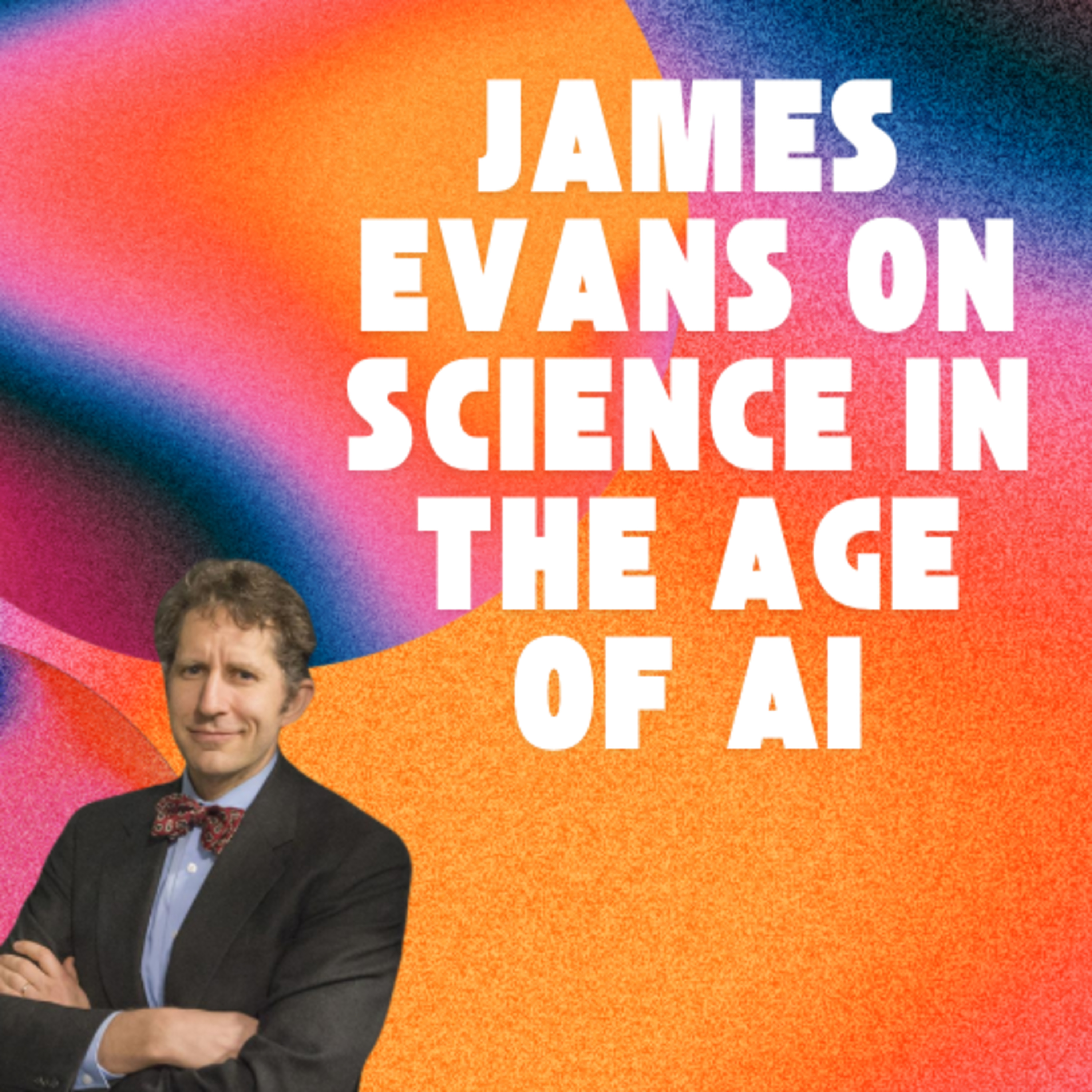
    #18 – James Evans: Science in the Age of AI

    Today’s episode is different from all the previous ones, as for the first time on Scaling Theory, we focus on research methodology, exploring how AI is reshaping the very process of doing research and what that shift means for science and society at large. I sat down with James Evans, Professor of Sociology, Computational and Data Science at the University of Chicago, External Professor at the Santa Fe Institute, and Faculty Member at the Complexity Science Hub in Vienna, to explore how AI is transforming the way we simulate, scale, and understand human behavior, and what that shift means for science and society. We dive into his pioneering work on using large language models to simulate individuals, societies, and entire social systems. James and I explore the strengths and limits of AI agents for both the social and hard sciences before reflecting on the future of social science itself. We talk about research centers entirely run by AI and conferences conducted by AI agents, without any human involvement. We also discuss the role of small research teams in disruptive innovation, and how to cultivate proximity and serendipity in a research world where we increasingly cooperate with machines. You can follow me on X (@ProfSchrepel) and BlueSky (@ProfSchrepel) to receive regular updates. References: - Simulating Subjects: The Promise and Peril of AI Stand-ins for Social Agents and Interactions (2025) https://osf.io/preprints/socarxiv/vp3j2_v3 - LLM Social Simulations Are a Promising Research Method (2025) https://arxiv.org/pdf/2504.02234 - Large teams develop and small teams disrupt science and technology (2019) https://www.nature.com/articles/s41586-019-0941-9?wpisrc= - AI Expands Scientists' Impact but Contracts Science's Focus (2024) https://arxiv.org/abs/2412.07727 - The Paradox of Collective Certainty in Science (2024) https://arxiv.org/html/2406.05809v1?utm_source=chatgpt.com - Being Together in Place as a Catalyst for Scientific Advance (Research Policy, 2023) https://www.sciencedirect.com/science/article/pii/S0048733323001956

  • Mar 24, 2025 · 36 min

    #17 – Eric von Hippel: Freeing Innovation

    My guest today is Eric von Hippel, Professor of Technological Innovation at the MIT Sloan School of Management. Eric is the author of numerous academic articles and books, including Free Innovation, Democratizing Innovation, and The Sources of Innovation, all published by MIT Press and available for free. Eric has accumulated over 90,000 citations on Google Scholar and has received many awards, including the Schumpeter School Prize (2017)—a particularly interesting recognition given his work on non-Schumpeterian innovation. In our conversation, Eric and I explore the role of free innovation in today’s economy. Eric highlights some of his favorite examples of free innovation and discusses how, despite being developed at personal cost, it is scaling at an impressive rate. We explore the mechanisms that best enable this scaling—whether through recognition, institutional support, IP protections, or alternative incentives. By the end of this talk, you will understand what free innovation is, how it develops, and how it interacts with producer innovation. You can follow me on X (@⁠ProfSchrepel⁠) and BlueSky (@⁠ProfSchrepel⁠) to receive regular updates. References: Sources of Innovation (1988) https://web.mit.edu/evhippel/www-old/books/sources/SofI.pdf Democratizing Innovation (2005) https://direct.mit.edu/books/book-pdf/2425023/book_9780262285636.pdf Free Innovation (2016) https://library.oapen.org/bitstream/handle/20.500.12657/26044/1004041.pdf

  • Feb 27, 2025 · 51 min

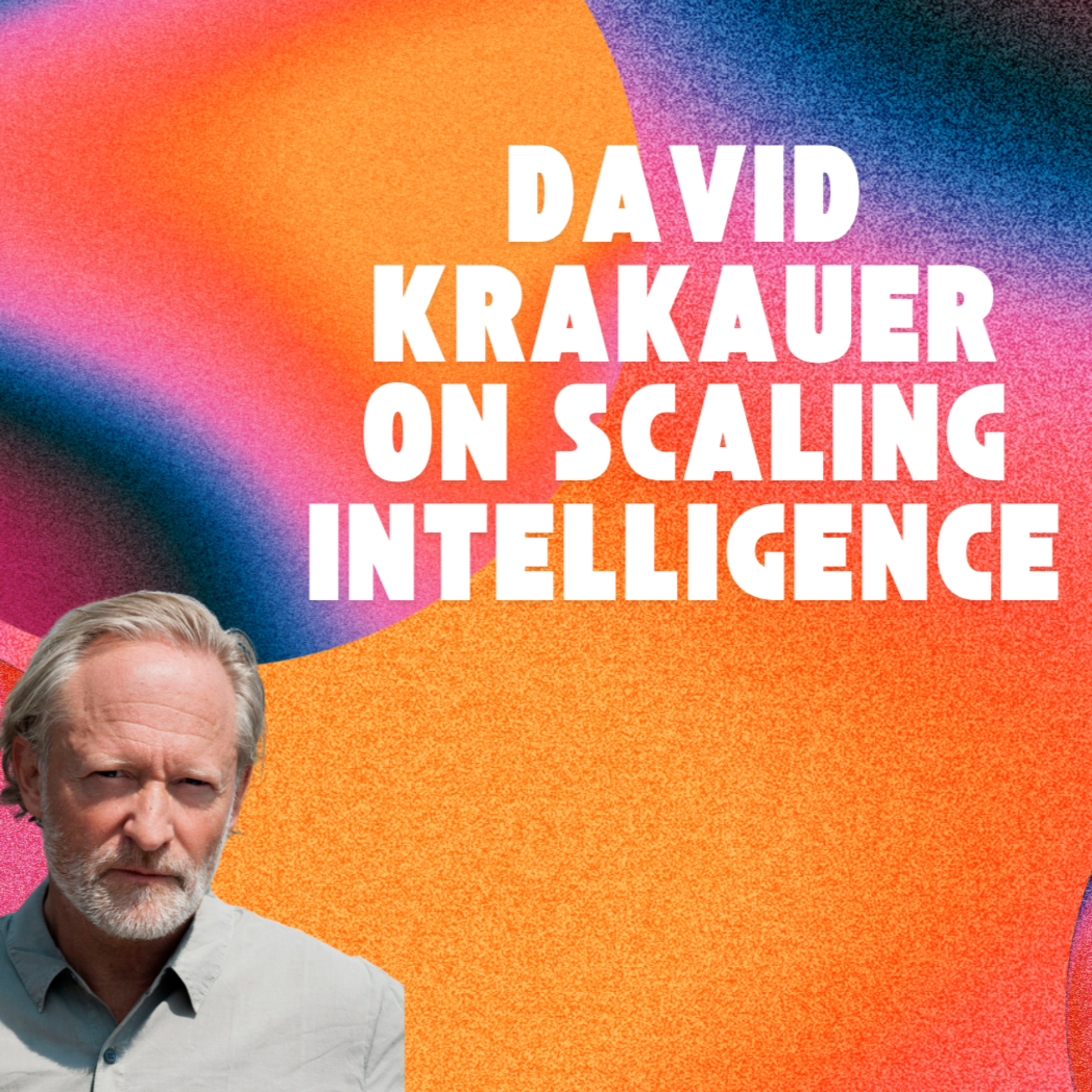
    #16 – David Krakauer: Scaling Intelligence

    David Krakauer is an American evolutionary biologist. He is the President and William H. Miller Professor of Complex Systems at the Santa Fe Institute. As you will hear in today’s episode, David's research centers around a series of fundamental questions, such as: How did life and intelligence evolve in the universe? How do ideas evolve and how do they encode natural and cultural life? In this conversation, David and I explore the evolving landscape of complexity science. We discuss its foundational theories, emerging patterns, and intersections with AI and machine learning. We delve into the paradigm shift complexity science represents, its most significant contributions across disciplines, and how computational advances are reshaping its trajectory. We also talk about AI’s potential to scale towards AGI through a complexity lens, the limits imposed by evolutionary principles, and what this means for artificial systems. Finally, as President of the Santa Fe Institute, David discusses SFI’s unique interdisciplinary model. I hope you enjoy the conversation. You can follow me on X (@ProfSchrepel) and BlueSky (@ProfSchrepel) to receive regular updates. References: Unifying complexity science and machine learning (2023) https://www.frontiersin.org/journals/complex-systems/articles/10.3389/fcpxs.2023.1235202/full The debate over understanding in AI’s large language models (2023) https://static1.squarespace.com/static/5f29a430a2b6a34680879cc0/t/672467763ec35e0639db8457/1730439030537/DK-DebateOverUnderstandingInAIsLLMs2023.pdf Darwinian demons, evolutionary complexity, and information maximization (2011) https://static1.squarespace.com/static/5f29a430a2b6a34680879cc0/t/6725792b7d0d4f0e4e7ca2fe/1730509104265/DK-DarwinianDemonsEvolutionaryComplexity%26InformationMaximization2011.pdf

  • Feb 3, 2025 · 46 min

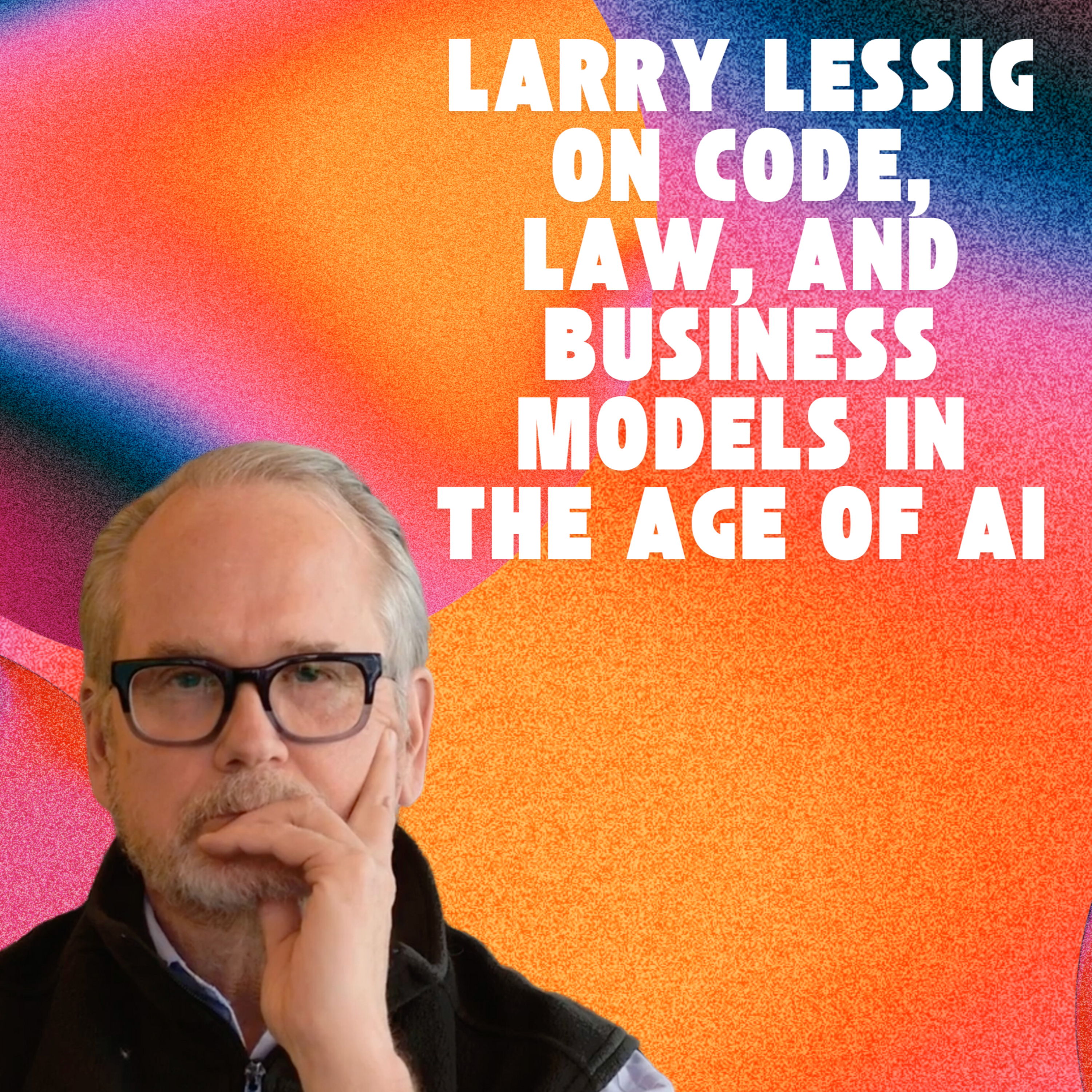
    #15 – Larry Lessig: Code, Law, and Business Models in the Age of AI

    My guest today is Larry Lessig, Professor of Law and Leadership at Harvard Law School. Larry is the author of numerous influential books and articles, including Code 2.0 (2006), which we discuss at length in this episode. If you have been listening to Scaling Theory since the very beginning, you probably remember that I cited a couple of books that changed my perception of everything in the first episode. Code 2.0 is one of these books. Larry Lessig develops what he calls the “pathetic dot theory,” in which he explains that all things are influenced by four constraints: the law, economic forces, norms, and architecture. In this conversation, Larry and I talk about the importance of these four constraints in the digital economy and assess which ones have scaled the most in recent years. We also explore how complexity science can contribute to Larry’s theory by seeing the dots and their constraints as a complex network. We then steer our conversation toward open source in AI, examine how regulation at the hardware layer could solve software issues, and consider whether we can trust our institutions and current regulations to do so, or if we need to scale other institutions for that purpose. I hope you enjoy our discussion. References: Code 2.0 (2006) https://lessig.org/product/codev2/ Code (1999) https://lessig.org/product/code/ You can follow me on X (@ProfSchrepel) and BlueSky (@profschrepel) to receive regular updates.

  • Jan 13, 2025 · 47 min

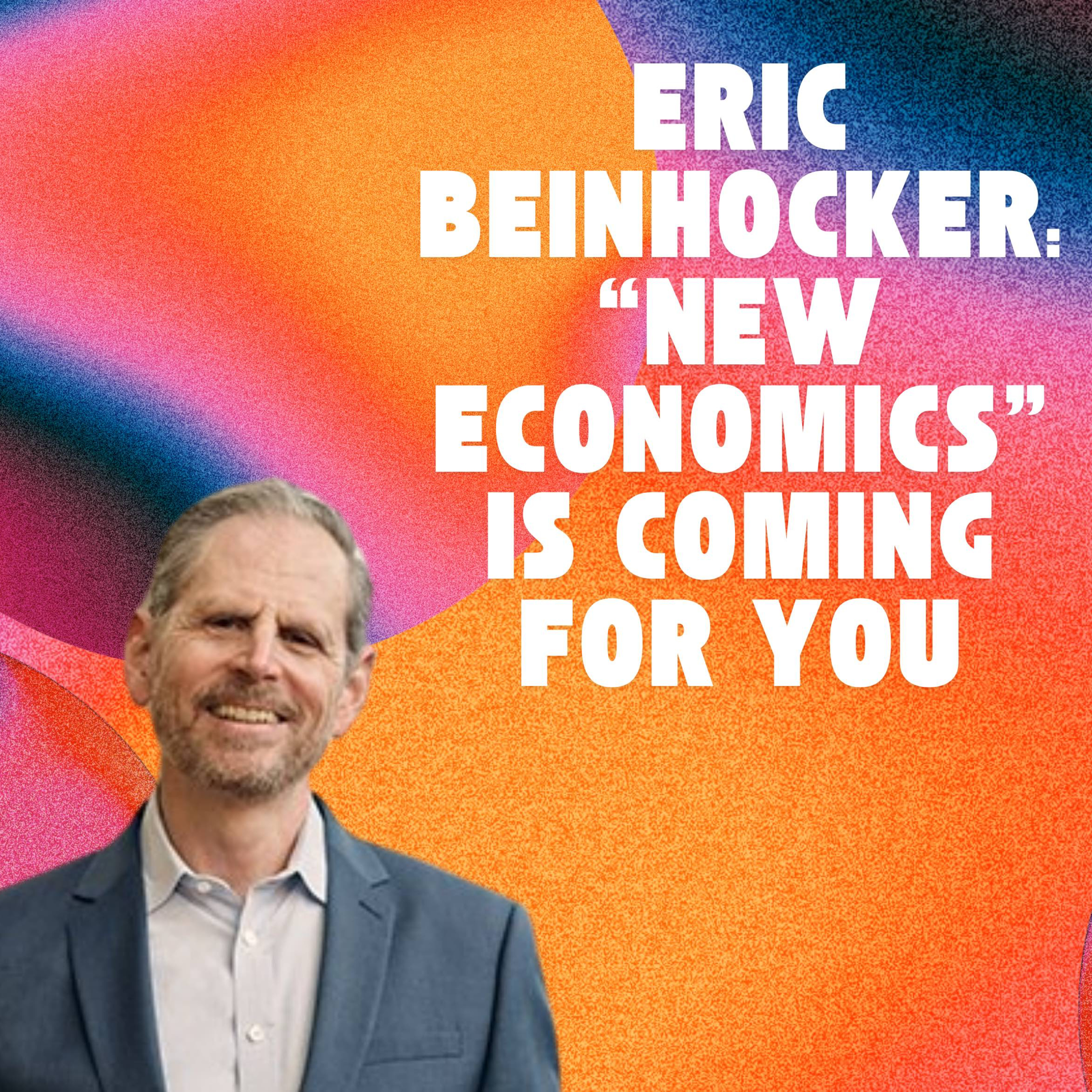
    #14 – Eric Beinhocker: “New Economics” Is Coming For You

    My guest today is Eric Beinhocker, Professor of Practice in Public Policy at the Blavatnik School of Government, University of Oxford, and the founder and Executive Director of the Institute for New Economic Thinking at the University’s Oxford Martin School. Eric is the author of numerous academic articles and books, including The Origin of Wealth: Evolution, Complexity, and the Radical Remaking of Economics (2007). In our conversation, Eric and I contrast traditional economics (neoclassical theory) with new economics (complexity economics). We also explore the policy implications of these differing economic theories, discussing topics ranging from aggressive growth strategies to complexity catastrophes in digital economies. I hope you enjoy our conversation. References: The origin of wealth: Evolution, complexity, and the radical remaking of economics (2007) ⁠https://moldham74.github.io/AussieCAS/papers/Origins⁠ of Wealth.pdf Getting Big Too Fast: Strategic Dynamics with Increasing Returns and Bounded Rationality (2007) ⁠https://pubsonline.informs.org/doi/pdf/10.1287/mnsc.1060.0673⁠ Fair Social Contracts and the Foundations of Large-Scale Collaboration (2022) ⁠https://oms-inet.files.svdcdn.com/staging/files/Fair-Social-Contracts-Beinhocker-v8-22-22.pdf⁠ Reflexivity, complexity, and the nature of social science (2013) ⁠https://www.tandfonline.com/doi/full/10.1080/1350178X.2013.859403⁠

Showing 1–20 of 20 episodes