Skip to content
Artwork for Patrick Boyle
BusinessInvestingEducation

Patrick Boyle

Patrick Boyle

Patrick Boyle is a hedge fund manager, a university professor and a former investment banker.

This channel is all about quantitative finance. By subscribing you will see videos explaining what is happening in markets right now, you will learn about financial derivatives, corporate finance and how traders use quantitative tools like statistics. You will see interviews with some of the most interesting people in the financial industry. In addition, you will see some longer form documentaries on the history of financial markets.

To contact Patrick go to the website http://onfinance.org

DISCLAIMER:
This channel is not affiliated with any financial institution. The videos on this channel are for entertainment purposes only and do not constitute financial advice. Those seeking investment advice should seek out a registered professional. Patrick is not responsible for investment actions taken by viewers and his content should not be used as a basis for investment.

Links:
Amazon Author Page: https://amzn.to/3bTeqed
Patreon: https://www.patreon.com/PatrickBoyleOnFinance
Website: https://www.onfinance.org/
Instagram: https://www.instagram.com/patrickeboyle/
BlueSky: https://bsky.app/profile/pboyle.bsky.social

Play
  • 479 episodes
  • daily
  • Avg 28 min
  • English
Counted on this page — what you have heard stays on this device, so it is not something the list can be paged by.
  • November 21 · 39 min

    Prediction Markets Are a Scam With a Chart

    Level up your note-taking with Plaud NotePro at https://bit.ly/4c9s3bC and use code “PBOYLE” for 10% OFF! Amazon: https://bit.ly/483LfoU #PLAUD #NoteTaker Prediction markets like Kalshi and Polymarket have been described as "truth machines" that produce more accurate forecasts than traditional polling. In this video we look at how they actually work, why the federal government is fighting individual states over who gets to regulate a bet on a football game, how a soldier allegedly used classified military intelligence to win money on a crypto betting site, and why quantitative trading firms are now paying traders $200,000 a year to build algorithms that systematically take money from retail bettors. We also look at the political connections behind these platforms, the academic research on the social cost of making it very easy to gamble from your phone, and why — after all of this — you still can't trade futures on onions. Patrick's Books: Statistics For The Trading Floor: https://amzn.to/3eerLA0 Derivatives For The Trading Floor: https://amzn.to/3cjsyPF Corporate Finance: https://amzn.to/3fn3rvC Ways To Support The Channel Patreon: https://www.patreon.com/PatrickBoyleOnFinance Buy Me a Coffee: https://www.buymeacoffee.com/patrickboyle Visit our website: https://www.onfinance.org Follow Patrick on Twitter Here: https://bsky.app/profile/pboyle.bsky.social Business Inquiries ➡️ sponsors@onfinance.org Patrick Boyle On Finance Podcast: Spotify: https://open.spotify.com/show/7uhrWlDvxzy9hLoW0EYf0b Apple: https://podcasts.apple.com/us/podcast/patrick-boyle-on-finance/id1547740313 Google Podcasts: https://tinyurl.com/62862nve Join this channel to support making this content: https://www.youtube.com/channel/UCASM0cgfkJxQ1ICmRilfHLw/join Learn more about your ad choices. Visit megaphone.fm/adchoices


  • November 21 · 15 min

    Chart Crimes

    Chart crimes make frequent appearances in the world of finance, and they can attract a great deal of attention. What is a chart crime? It is often an attempt to mislead people who quickly glance at a chart. This can mean manipulating start or end dates to show a particular outcome or cropping chart axes to make a small change seem bigger than it is in reality. The chart crime highlighted here addresses elements of inequality, and the impacts of the pandemic. Charts are a statistical output designed to frame a story. Every chart has intent. Design choices are important. Not every chart crime is nefarious. Often they simply reveal how their creator has fooled themselves. In this week’s video we look at some chart crimes and discuss the purpose of and importance of statistics in the world of finance. Patrick's Books: Statistics for The Trading Floor: https://amzn.to/3eerLA0 Derivatives for The Trading Floor: https://amzn.to/3cjsyPF Corporate Finance: https://amzn.to/3fn3rvC Patreon Page: https://www.patreon.com/PatrickBoyleOnFinance Visit our website: www.onfinance.org Follow Patrick on Twitter Here: https://twitter.com/PatrickEBoyle Learn more about your ad choices. Visit megaphone.fm/adchoices

  • November 21 · 40 min

    How To Beat China!

    Learn more about your ad choices. Visit megaphone.fm/adchoices

  • November 21 · 1 hr

    The Volatility Surface and Exotics - Revision Lecture

    These classes are all based on the book Trading and Pricing Financial Derivatives, available on Amazon at this link. https://amzn.to/2WIoAL0 Check out our website http://www.onfinance.org/ Follow Patrick on twitter here: https://twitter.com/PatrickEBoyle Learn more about your ad choices. Visit megaphone.fm/adchoices

  • November 21 · 14 min

    What are Credit Derivatives?

    In Todays video we will learn all about Credit Derivatives including Asset Backed Securities (ABS) Credit Default Swaps (CDS) and Collateralized Debt Obligations (CDO's) These classes are all based on the book Derivatives For The Trading Floor, available on Amazon at this link. https://amzn.to/3GdLi2s Check out our website http://www.onfinance.org/ Follow Patrick on twitter here: https://twitter.com/PatrickEBoyle What are Credit Derivatives? In finance, a credit derivative refers to any one of "various instruments designed to separate and then transfer the credit risk" or the risk of an event of default of a corporate or sovereign borrower, transferring it to an entity other than the lender or debtholder. An unfunded credit derivative is one where credit protection is bought and sold between bilateral counterparties without the protection seller having to put up money upfront or at any given time during the life of the deal unless an event of default occurs. Usually these contracts are traded pursuant to an International Swaps and Derivatives Association (ISDA) master agreement. Most credit derivatives of this sort are credit default swaps. If the credit derivative is entered into by a financial institution or a special purpose vehicle (SPV) and payments under the credit derivative are funded using securitization techniques, such that a debt obligation is issued by the financial institution or SPV to support these obligations, this is known as a funded credit derivative. This synthetic securitization process has become increasingly popular over the last decade, with the simple versions of these structures being known as synthetic collateralized debt obligations (CDOs), credit-linked notes or single-tranche CDOs. In funded credit derivatives, transactions are often rated by rating agencies, which allows investors to take different slices of credit risk according to their risk appetite. The market in credit derivatives started in 1993 after having been pioneered by J.P. Morgan. By 1996 there was around $40 billion of outstanding transactions, half of which involved the debt of developing countries. Credit default products are the most commonly traded credit derivative products and include unfunded products such as credit default swaps and funded products such as collateralized debt obligations. Credit market participants, regulators, and courts are increasingly using credit derivative pricing to help inform decisions about loan pricing, risk management, capital requirements, and legal liability. The ISDA reported in April 2007 that total notional amount on outstanding credit derivatives was $35.1 trillion with a gross market value of $948 billion. Although the credit derivatives market is a global one, London has a market share of about 40%, with the rest of Europe having about 10%. The main market participants are banks, hedge funds, insurance companies, pension funds, and other corporates. What is a credit derivative? Trading and Pricing Financial Derivatives Learn more about your ad choices. Visit megaphone.fm/adchoices

  • November 21 · 52 min

    The South Sea Bubble - The First Financial Crash

    Try Rocket Money for free: https://RocketMoney.com/Patrick #rocketmoney #personalfinance 1720 was a year of two bubbles and a plague. The bubbles were the Mississippi Company in France –and the South Sea Bubble in England. In September 1720 - when the bubble burst, England was plunged into an economic and political crisis. This was one of the first examples of a financial boom and bust and was the event that gave rise to the use of the term bubble to describe a spectacular market failure. Patrick's Books: Statistics For The Trading Floor: https://amzn.to/3eerLA0 Derivatives For The Trading Floor: https://amzn.to/3cjsyPF Corporate Finance: https://amzn.to/3fn3rvC Ways To Support The Channel Patreon: https://www.patreon.com/PatrickBoyleOnFinance Buy Me a Coffee: https://www.buymeacoffee.com/patrickboyle Visit our website: https://www.onfinance.org Follow Patrick on Twitter Here: https://bsky.app/profile/pboyle.bsky.social Sources: Money For Nothing by Arthur Levinson: https://amzn.to/3PUbbcV The King, the Crook, and the Gambler by Malcolm Balen: https://amzn.to/3CFq7bM The Life of Isaac Newton by Richard Westfall: https://amzn.to/4hfXbWU Manias Panics & Crashes - Kindelberger: https://amzn.to/40xOrnX Business Inquiries ➡️ sponsors@onfinance.org Patrick Boyle On Finance Podcast: Spotify: https://open.spotify.com/show/7uhrWlDvxzy9hLoW0EYf0b Apple: https://podcasts.apple.com/us/podcast/patrick-boyle-on-finance/id1547740313 Google Podcasts: https://tinyurl.com/62862nve Join this channel to support making this content: https://www.youtube.com/channel/UCASM0cgfkJxQ1ICmRilfHLw/join Learn more about your ad choices. Visit megaphone.fm/adchoices

  • November 21 · 10 min

    What is Value at Risk? VaR and Risk Management

    In todays video we learn about Value at Risk (VaR) and how is it calculated? Buy The Book Here: https://amzn.to/37HIdEB Follow Patrick on Twitter Here: https://twitter.com/PatrickEBoyle What Is Value at Risk (VaR)? Value at risk (VaR) is a calculation that aims to quantify the level of financial risk within a firm, portfolio or position over a specific time frame. This metric is most commonly used by investment and commercial banks to determine the extent and occurrence ratio of potential losses in their institutional portfolios. Risk managers use VaR to measure and control the level of risk exposure. One can apply VaR calculations to specific positions or whole portfolios or to measure firm-wide risk exposure. VaR modeling aims to calculate the potential for loss in the portfolio being assessed and the probability of occurrence for the defined loss. One measures VaR by assessing the amount of potential loss, the probability of occurrence for the amount of loss, and the timeframe involved. A VaR calculation based on data from a period of low volatility may understate the potential for risk events to occur and the magnitude of those events. Risk may be further understated using normal distribution probabilities, which rarely account for extreme or black-swan events. The financial crisis of 2008 exposed many of the problems with VaR as relatively benign VaR calculations understated the potential occurrence of loss events posed by portfolios of subprime mortgages. Risk was underestimated, which resulted in extreme leverage ratios within subprime portfolios. As a result, the underestimations of occurrence and risk magnitude left institutions unable to cover billions of dollars in losses as subprime mortgage values collapsed. Risk Management Learn more about your ad choices. Visit megaphone.fm/adchoices

  • November 21 · 34 min

    How Big Tech Is Quietly Taking Over AI (Without Mergers)

    😎 Get an exclusive 15% discount on Saily data plans! Use code BOYLE at checkout. Download Saily app or go to https://saily.com/boyle In the race to dominate generative AI, Big Tech firms haven’t just been building, they’ve been buying. But there’s something strange about most of the deals that they have struck. Companies like Meta, Microsoft, Amazon, Google, and Nvidia are embedding themselves deep within the AI ecosystem through strategic investments, exclusive partnerships, and talent acquisitions- with deals that stop just short of formal takeovers, but the economic impact of these deals it turns out – is indistinguishable from full control. Drayton D'Silva Substack Article: https://enterprisevalue.substack.com/if-i-did-it Patrick's Books: Statistics For The Trading Floor: https://amzn.to/3eerLA0 Derivatives For The Trading Floor: https://amzn.to/3cjsyPF Corporate Finance: https://amzn.to/3fn3rvC Ways To Support The Channel Patreon: https://www.patreon.com/PatrickBoyleOnFinance Buy Me a Coffee: https://www.buymeacoffee.com/patrickboyle Visit our website: https://www.onfinance.org Follow Patrick on Twitter Here: https://bsky.app/profile/pboyle.bsky.social Business Inquiries ➡️ sponsors@onfinance.org Patrick Boyle On Finance Podcast: Spotify: https://open.spotify.com/show/7uhrWlDvxzy9hLoW0EYf0b Apple: https://podcasts.apple.com/us/podcast/patrick-boyle-on-finance/id1547740313 Google Podcasts: https://tinyurl.com/62862nve Join this channel to support making this content: https://www.youtube.com/channel/UCASM0cgfkJxQ1ICmRilfHLw/join Learn more about your ad choices. Visit megaphone.fm/adchoices

  • November 21 · 32 min

    The Dot-Com Bubble - Wall Street History

    The Dot-Com bubble was one of the largest speculative bubbles in U.S. stock market history. Here's a quick history lesson on what it was like twenty years ago. The Dot-Com Bubble was a major economic event that ultimately led to a three year bear market. The Dot-Com Bubble started in the 1990s with a rapid wave of new internet companies going public by IPO. Many of these dot-com stocks while unprofitable, skyrocketed in value. In this video, we explain what caused the Dot-Com Bubble and some of the lessons we can learn from it in order to spot future stock market bubbles and crashes. We discuss if todays stock market resembles the dot com bubble. If you like this video you might also enjoy: My video on the Mississippi bubble at this link: https://www.youtube.com/watch?v=H5uKPUPQSyQ Day trading in the 1990’s https://www.youtube.com/watch?v=X3YNecdqIH0&t=622s The financial crisis of 2008 https://www.youtube.com/watch?v=CxLo9hMlPxE Patreon Page: https://www.patreon.com/PatrickBoyleOnFinance Patrick's Books: Statistics for Traders: https://amzn.to/3eerLA0 Financial Derivatives For Traders: https://amzn.to/3cjsyPF Corporate Finance: https://amzn.to/3fn3rvC Visit our website: www.onfinance.org Follow Patrick on Twitter Here: https://twitter.com/PatrickEBoyle Ravi Suria Amazon Report: http://www.shareholderforum.com/nyssa/Published/AMZN/20010206_Suria_Report.pdf Learn more about your ad choices. Visit megaphone.fm/adchoices

  • November 21 · 19 min

    Volatility Arbitrage - How does it work? - Options Trading Lessons

    What is Volatility Arbitrage? Volatility arbitrage is a trading strategy that attempts to profit from the difference between the forecasted price-volatility of an asset, like a stock, and the implied volatility of options on that asset. These classes are all based on the book Trading and Pricing Financial Derivatives, available on Amazon at this link. https://amzn.to/2WIoAL0 Check out our website http://www.onfinance.org/ Follow Patrick on twitter here: https://twitter.com/PatrickEBoyle How does Volatility Arbitrage Work? The price of an option is driven by the volatility of the underlying asset. If the forecasted and implied volatilities differ, there will be a discrepancy between the expected price of the option and its actual market price. A volatility arbitrage strategy can be implemented through a delta-neutral portfolio consisting of an option and its underlying asset. For example, if a trader thought a stock option was underpriced because implied volatility was too low, they may buy a call option and combine that with a short position in the underlying stock to profit from that forecast. If the price of the stock doesn't move, but the implied volatility used to price that option rises, then the price of the option will rise. Even if this does not get recognized by the market, but the stock realizes higher volatility than was implied in the initial price, the trading strategy explained in the video will generate a profit for the trader. Alternatively, if the trader believes that implied volatility is too high and will fall, then they may decide to take a long position in the stock and a short position in a put option. Assuming the stock's price doesn't move, the trader may profit as the option falls in value with a decline in implied volatility. There are several assumptions a trader must make, which will increase the complexity of a volatility arbitrage strategy. First, the investor must be right about whether implied volatility really is over- or underpriced. Second, the investor must be correct about the amount of time it will take for the strategy to profit or time value erosion could outpace any potential gains. Finally, if the price of the underlying stock moves more quickly than expected the strategy will have to be adjusted, which may be expensive or impossible depending on market conditions. Learn more about your ad choices. Visit megaphone.fm/adchoices

  • November 21 · 8 min

    What is a Derivatives Clearing House? What do they do?

    What is a Derivatives Clearing House? What do they do? These classes are all based on the book Trading and Pricing Financial Derivatives, available on Amazon at this link. https://amzn.to/2WIoAL0 Check out our website http://www.onfinance.org/ Follow Patrick on twitter here: https://twitter.com/PatrickEBoyle After legally-binding trade between a buyer and a seller, the role of the clearing house is to centralize and standardize all of the steps leading up to the settlement of the transaction. The purpose is to reduce the cost, settlement risk and operational risk of clearing and settling multiple transactions among multiple parties. In addition to the above services, central counterparty clearing (CCP) takes on counterparty risk by stepping in between the original buyer and seller of a financial contract, such as a derivative. The role of the CCP is to perform the obligations under the contract agreed between the two counterparties, thereby removing the counterparty risk the parties of the contract had to each other and replacing it with counterparty risk to a highly regulated central counterparty that specializes in managing and mitigating counterparty risk. Learn more about your ad choices. Visit megaphone.fm/adchoices

  • November 21 · 40 min

    Elon Musk's Anti Woke Encyclopedia

    Go to ➞ https://surfshark.com/boyle or use code BOYLE at checkout to get 4 extra months of Surfshark VPN! Elon Musk says his new online encyclopedia Grokipedia will fix Wikipedia’s flaws by replacing human editors with AI. But can a chatbot really deliver “the whole truth and nothing but the truth” as he says? In this video, we dive into the battle between Wikipedia’s messy, transparent consensus and Grokipedia’s algorithmic certainty. Patrick's Books: Statistics For The Trading Floor: https://amzn.to/3eerLA0 Derivatives For The Trading Floor: https://amzn.to/3cjsyPF Corporate Finance: https://amzn.to/3fn3rvC Ways To Support The Channel Patreon: https://www.patreon.com/PatrickBoyleOnFinance Buy Me a Coffee: https://www.buymeacoffee.com/patrickboyle Visit our website: https://www.onfinance.org Follow Patrick on Twitter Here: https://bsky.app/profile/pboyle.bsky.social Business Inquiries ➡️ sponsors@onfinance.org Patrick Boyle On Finance Podcast: Spotify: https://open.spotify.com/show/7uhrWlDvxzy9hLoW0EYf0b Apple: https://podcasts.apple.com/us/podcast/patrick-boyle-on-finance/id1547740313 Google Podcasts: https://tinyurl.com/62862nve Join this channel to support making this content: https://www.youtube.com/channel/UCASM0cgfkJxQ1ICmRilfHLw/join Learn more about your ad choices. Visit megaphone.fm/adchoices
  • November 21 · 10 min

    Ant Group's IPO Suspended. Chinese Regulator Cites "Major Issues"

    Ant Group's IPO is Suspended. Chinese Regulator Cites "Major Issues" In an online notice posted today, the Shanghai exchange said that the company’s proposed offering may not meet the conditions for listing after Chinese regulators summoned Jack Ma, Ant’s controlling shareholder and the founder of Alibaba, for a meeting yesterday. Alibaba is down around 6% as of this recording, having been down even more this morning. Lets discuss what is going on and what might happen with the Ant group IPO. Neither the regulators nor Ant Financial have disclosed what was discussed at the meeting. But the timing of the meeting, just days before Ant shares were expected to begin trading concurrently in Shanghai and Hong Kong, suggests that the Chinese government is unhappy with either the company or with Mr. Ma. Patrick's Books: Statistics for Traders: https://amzn.to/3eerLA0 Financial Derivatives: https://amzn.to/3cjsyPF Corporate Finance: https://amzn.to/3fn3rvC Visit our website: www.onfinance.org Follow Patrick on Twitter Here: https://twitter.com/PatrickEBoyle Patreon Page: https://www.patreon.com/PatrickBoyleOnFinance Learn more about your ad choices. Visit megaphone.fm/adchoices

  • November 21 · 28 min

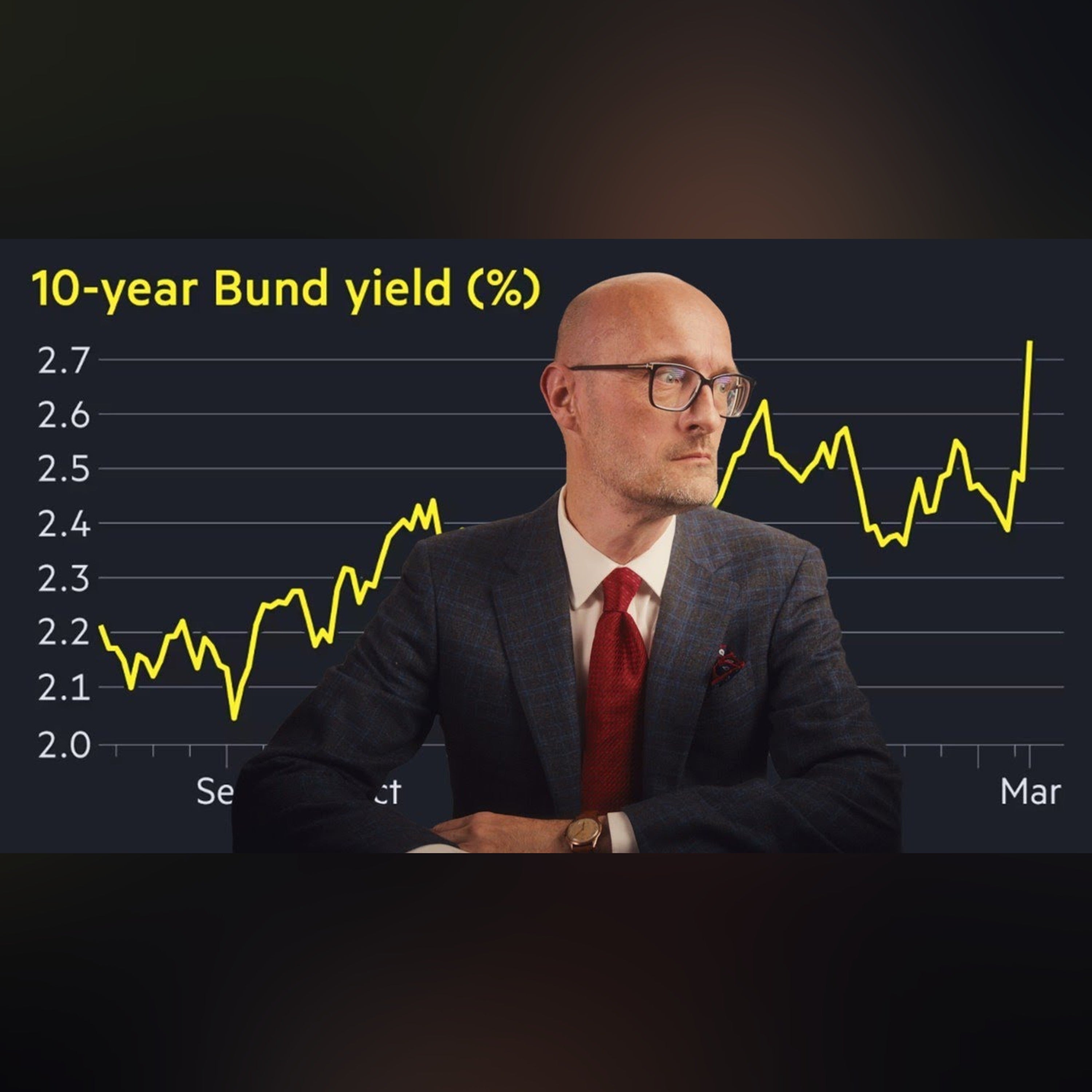
    Germany's Historic Debt Deal!

    Go to https://surfshark.com/boyle for 4 extra months of Surfshark European markets rallied sharply this week as German borrowing costs soared after the country’s new leaders announced a historic deal to loosen its “debt brake” rule to boost spending on defense. The interest rate on German government bonds saw their biggest daily increase since October 1998. The Dax 30 index, which tracks the largest German companies, rose by 3.5% as stock prices also leapt in other European markets amid hopes that a massive boost in European spending on defense and infrastructure would kickstart the region’s lagging economy. Patrick's Books: Statistics For The Trading Floor: https://amzn.to/3eerLA0 Derivatives For The Trading Floor: https://amzn.to/3cjsyPF Corporate Finance: https://amzn.to/3fn3rvC Ways To Support The Channel Patreon: https://www.patreon.com/PatrickBoyleOnFinance Buy Me a Coffee: https://www.buymeacoffee.com/patrickboyle Visit our website: https://www.onfinance.org Follow Patrick on Twitter Here: https://bsky.app/profile/pboyle.bsky.social Business Inquiries ➡️ sponsors@onfinance.org Patrick Boyle On Finance Podcast: Spotify: https://open.spotify.com/show/7uhrWlDvxzy9hLoW0EYf0b Apple: https://podcasts.apple.com/us/podcast/patrick-boyle-on-finance/id1547740313 Google Podcasts: https://tinyurl.com/62862nve Join this channel to support making this content: https://www.youtube.com/channel/UCASM0cgfkJxQ1ICmRilfHLw/join Learn more about your ad choices. Visit megaphone.fm/adchoices
  • November 21 · 13 min

    How do you calculate value at risk? Two ways of calculating VaR

    In todays video we learn how to calculate VaR or Value at Risk. Buy The Book Here: https://amzn.to/37HIdEB Follow Patrick on Twitter Here: https://twitter.com/PatrickEBoyle What is VAR? The most popular and traditional measure of risk is volatility. The main problem with volatility, however, is that it does not care about the direction of an investment's movement: a stock can be volatile because it suddenly jumps higher. Of course, investors do not get upset about gains. For investors, risk is about losing money, and VAR is based on that idea. By assuming investors care about the odds of a really big loss, VAR answers the question, “How much might I lose in a normal bad day?" and “How much could I lose in a really bad day?" Now let's get specific. A VAR statistic has three components: a time period, a confidence level and a loss amount (or loss percentage). You can see how the "VAR question" has three elements: a relatively high level of confidence (typically either 95% or 99%), a time period (a day, a month or a year) and an estimate of investment loss (expressed either in dollar or percentage terms). There are three methods of calculating VAR: the historical method, the variance-covariance method also known as the model approach) and the Monte Carlo simulation. I have covered Monte Carlo in a separate video. In this video we look at the Historical method and the model approach. What is the Historical method for calculating Value at Risk? The historical method simply re-organizes actual historical returns, putting them in order from worst to best. It then assumes that history will repeat itself, from a risk perspective. What is the Variance-Covariance Method or the model approach for calculating Value at Risk? This method assumes that stock returns are normally distributed. In other words, it requires that we estimate only two factors - an expected (or average) return and a standard deviation - which allow us to plot a normal distribution curve. The idea behind the variance-covariance is similar to the ideas behind the historical method - except that we use the familiar curve instead of actual data. The advantage of the normal curve is that we automatically know where the worst 5% and 1% lie on the curve. They are a function of our desired confidence and the standard deviation What is the Monte Carlo Simulation approach to calculating Value at Risk? The third method involves developing a model for future stock price returns and running multiple hypothetical trials through the model. A Monte Carlo simulation refers to any method that randomly generates trials, but by itself does not tell us anything about the underlying methodology. I have created a separate video on that topic which you can find here. https://www.youtube.com/watch?v=luSEdT2HBI4 Learn more about your ad choices. Visit megaphone.fm/adchoices

  • November 21 · 17 min

    What are Structured Products?

    Today we will learn what structured products are. These classes are all based on the book Trading and Pricing Financial Derivatives, available on Amazon at this link. https://amzn.to/2WIoAL0 Check out our website http://www.onfinance.org/ Follow Patrick on twitter here: https://twitter.com/PatrickEBoyle Patreon Page: https://www.patreon.com/PatrickBoyleOnFinance A structured product, also known as a market-linked investment, is a pre-packaged investment strategy based on a single security, a basket of securities, options, indices, commodities, debt issuance or foreign currencies, and to a lesser extent, derivatives. The variety of products just described demonstrates that there is no single, uniform definition of a structured product. A feature of some structured products is a "principal guarantee" function, which offers protection of principal if held to maturity. For example, an investor invests $100, the issuer simply invests in a risk-free bond that has sufficient interest to grow to $100 after the five-year period. This bond might cost $80 today and after five years it will grow to $100. With the leftover funds the issuer purchases the derivatives needed to perform whatever the investment strategy calls for. Theoretically an investor can just do this themselves, but the cost and transaction volume requirements of many derivatives are beyond many individual investors. Structured products are designed to facilitate highly customized risk-return objectives. This is accomplished by taking a traditional security, such as a conventional investment-grade bond, and replacing the usual payment features (e.g. periodic coupons and final principal) with non-traditional payoffs derived not from the issuer's own cash flow, but from the performance of one or more underlying assets. Structured products were created to meet specific needs that cannot be met from the standardized financial instruments available in the markets. Structured products can be used as an alternative to a direct investment, as part of the asset allocation process to reduce risk exposure of a portfolio, or to utilize the current market trend. Structured products originally became popular in Europe and are a much smaller market in the United States, where they are offered as SEC-registered products, which means they are accessible to retail investors in the same way as stocks, bonds, exchange traded funds (ETFs) and mutual funds. Their ability to offer customized exposure to otherwise hard-to-reach asset classes and subclasses makes structured products useful as a complement to traditional components of diversified portfolios. U.S. Securities and Exchange Commission (SEC) Rule 434 (regarding certain prospectus deliveries) defines structured securities as "securities whose cash flow characteristics depend upon one or more indices or that have embedded forwards or options or securities where an investor's investment return and the issuer's payment obligations are contingent on, or highly sensitive to, changes in the value of underlying assets, indices, interest rates or cash flows". Learn more about your ad choices. Visit megaphone.fm/adchoices

  • November 21 · 43 min

    How They Got Rich!

    Learn more about your ad choices. Visit megaphone.fm/adchoices

Showing 361–380 of 479 episodes