Skip to content
Artwork for Patrick Boyle
BusinessInvestingEducation

Patrick Boyle

Patrick Boyle

Patrick Boyle is a hedge fund manager, a university professor and a former investment banker.

This channel is all about quantitative finance. By subscribing you will see videos explaining what is happening in markets right now, you will learn about financial derivatives, corporate finance and how traders use quantitative tools like statistics. You will see interviews with some of the most interesting people in the financial industry. In addition, you will see some longer form documentaries on the history of financial markets.

To contact Patrick go to the website http://onfinance.org

DISCLAIMER:
This channel is not affiliated with any financial institution. The videos on this channel are for entertainment purposes only and do not constitute financial advice. Those seeking investment advice should seek out a registered professional. Patrick is not responsible for investment actions taken by viewers and his content should not be used as a basis for investment.

Links:
Amazon Author Page: https://amzn.to/3bTeqed
Patreon: https://www.patreon.com/PatrickBoyleOnFinance
Website: https://www.onfinance.org/
Instagram: https://www.instagram.com/patrickeboyle/
BlueSky: https://bsky.app/profile/pboyle.bsky.social

Play
  • 479 episodes
  • daily
  • Avg 28 min
  • English
Counted on this page — what you have heard stays on this device, so it is not something the list can be paged by.
  • Monday · 9 min

    What is Options Vega? The Options Greeks - Options Trading Tutorial

    These classes are all based on the book Trading and Pricing Financial Derivatives, available on Amazon at this link. https://amzn.to/2WIoAL0 Check out our website http://www.onfinance.org/ Follow Patrick on twitter here: https://twitter.com/PatrickEBoyle What is Options Vega? Vega is a measure of the impact of changes in implied volatility on the option price. Specifically, the vega of an option expresses the change in the price of the option for every 1% change in implied volatility. Options tend to be more expensive when volatility is higher. Thus, whenever volatility goes up, the price of the option goes up and when volatility drops, the price of the option will also fall. Example A stock XYZ is trading at $46 in May and a JUN 50 call is selling for $2. Let's assume that the vega of the option is 0.15 and that the underlying volatility is 25%. If the underlying volatility increased by 1% to 26%, then the price of the option should rise to $2 + 0.15 = $2.15. However, if the volatility had gone down by 2% to 23% instead, then the option price should drop to $2 - (2 x 0.15) = $1.70 Passage of time and its effects on the vega The more time remaining to option expiration, the higher the vega. This makes sense as time value makes up a larger proportion of the premium for longer term options and it is the time value that is sensitive to changes in volatility. Learn more about your ad choices. Visit megaphone.fm/adchoices

  • Monday · 30 min

    The Funniest Events of 2024

    Ad: 🔒Remove your personal information from the web at https://joindeleteme.com/BOYLE and use code BOYLE for 20% off 🙌 DeleteMe international Plans: https://international.joindeleteme.com Here's a look back on some of the most impactful events in markets during 2024. Patrick's Books: Statistics For The Trading Floor: https://amzn.to/3eerLA0 Derivatives For The Trading Floor: https://amzn.to/3cjsyPF Corporate Finance: https://amzn.to/3fn3rvC Ways To Support The Channel Patreon: https://www.patreon.com/PatrickBoyleOnFinance Buy Me a Coffee: https://www.buymeacoffee.com/patrickboyle Visit our website: https://www.onfinance.org Follow Patrick on Twitter Here: https://bsky.app/profile/pboyle.bsky.social Business Inquiries ➡️ sponsors@onfinance.org Patrick Boyle On Finance Podcast: Spotify: https://open.spotify.com/show/7uhrWlDvxzy9hLoW0EYf0b Apple: https://podcasts.apple.com/us/podcast/patrick-boyle-on-finance/id1547740313 Google Podcasts: https://tinyurl.com/62862nve Join this channel to support making this content: https://www.youtube.com/channel/UCASM0cgfkJxQ1ICmRilfHLw/join Learn more about your ad choices. Visit megaphone.fm/adchoices

  • Monday · 22 min

    China Delistings?

    Learn more about your ad choices. Visit megaphone.fm/adchoices

  • Monday · 34 min

    Can Trump's Tariffs Work?

    Enjoy 10% OFF on all Hoverpens and free shipping to most countries with code PATRICK: North America / UK / International: https://bit.ly/patrickb_novium Europe: https://bit.ly/patrickb_noviumeu In today's video we examine Donald Trump's plan to rebalance global trade using tariffs, try to understand the issues with international trade that have been pushing the United States and other countries in this protectionist direction, and if tariffs can be expected to improve the situation or make things worse. We’ll discuss whether Trump could impose his tariffs unilaterally on his first day in office and whether the mere threat of tariffs could be used to improve Americas bargaining power? Subscribe to @PBoyleInterviews here: https://youtu.be/w7sWER7LJd8 Patrick's Books: Statistics For The Trading Floor: https://amzn.to/3eerLA0 Derivatives For The Trading Floor: https://amzn.to/3cjsyPF Corporate Finance: https://amzn.to/3fn3rvC Ways To Support The Channel Patreon: https://www.patreon.com/PatrickBoyleOnFinance Buy Me a Coffee: https://www.buymeacoffee.com/patrickboyle Visit our website: https://www.onfinance.org Follow Patrick on Twitter Here: https://twitter.com/PatrickEBoyle Business Inquiries ➡️ sponsors@onfinance.org Patrick Boyle On Finance Podcast: Spotify: https://open.spotify.com/show/7uhrWlDvxzy9hLoW0EYf0b Apple: https://podcasts.apple.com/us/podcast/patrick-boyle-on-finance/id1547740313 Google Podcasts: https://tinyurl.com/62862nve Join this channel to support making this content: https://www.youtube.com/channel/UCASM0cgfkJxQ1ICmRilfHLw/join Further Reading: Michael Pettis Trade Intervention for Freer Trade: https://carnegieendowment.org/research/2024/10/trade-intervention-for-freer-trade?lang=en CFR The Contentious U.S.-China Trade Relationship: https://www.cfr.org/backgrounder/contentious-us-china-trade-relationship Learn more about your ad choices. Visit megaphone.fm/adchoices

  • Monday · 27 min

    Art Market Collapse?

    👉 To try everything Brilliant has to offer for free for a full 30 days, visit https://brilliant.org/patrick/. You’ll also get 20% off an annual premium subscription. Why did the star lot of the spring season, a bronze head by the master sculptor Alberto Giacometti, fail to sell at Sotheby’s? Alberto Giacometti’s 1955 bust, “Grande tête mince" (“Big Thin Head”), carried a pre-sale estimate of $70 million in Sotheby’s Modern evening auction. The auctioneer started the bidding at $59 million dollars. But no one bid - the piece went unsold. It was the second high-profile lot to disappoint in two days. Andy Warhol’s “Big Electric Chair” (1967-68) was withdrawn from Christie’s 20th century evening auction the day before. Is the fine art market in trouble? Patrick's Books: Statistics For The Trading Floor: https://amzn.to/3eerLA0 Derivatives For The Trading Floor: https://amzn.to/3cjsyPF Corporate Finance: https://amzn.to/3fn3rvC Ways To Support The Channel Patreon: https://www.patreon.com/PatrickBoyleOnFinance Buy Me a Coffee: https://www.buymeacoffee.com/patrickboyle Visit our website: https://www.onfinance.org Follow Patrick on Twitter Here: https://bsky.app/profile/pboyle.bsky.social Business Inquiries ➡️ sponsors@onfinance.org Patrick Boyle On Finance Podcast: Spotify: https://open.spotify.com/show/7uhrWlDvxzy9hLoW0EYf0b Apple: https://podcasts.apple.com/us/podcast/patrick-boyle-on-finance/id1547740313 Google Podcasts: https://tinyurl.com/62862nve Join this channel to support making this content: https://www.youtube.com/channel/UCASM0cgfkJxQ1ICmRilfHLw/join Learn more about your ad choices. Visit megaphone.fm/adchoices

  • Monday · 19 min

    The Bitcoin Green Revolution - Is Cathie Wood Right About The Environmental Impact of Bitcoin?

    Elon Musk says Tesla is no longer planning to accept payment in bitcoin citing the environmental impact of cryptocurrency mining. In todays video we look at the latest research from ARK Invest and Square titled “Bitcoin is Key to an Abundant, Clean Energy Future”. Are Cathie Wood and Jack Dorsey right about the bitcoin green revolution, or is Elon Musk right? The white paper Square and ARK Invest ($ARKK) published this week aims to justify bitcoin’s energy use and explain how it could be the key to a future of clean energy. Square, a fintech founded by Twitter CEO Jack Dorsey, has invested $220 m in bitcoin, and profits from bitcoin trading. Elon Musk has drawn criticism for putting $1.5 bil of Tesla's cash in Bitcoin and for tweeting about dogecoin. ARK Invest, meanwhile, has been predicting since 2019 that blockchain’s economic impact could be as significant as that of electricity and offers cryptocurrency investing as one of its alternative strategies. So let’s allow these guys to explain for us: why is bitcoin key to a clean energy future? https://assets.ctfassets.net/2d5q1td6cyxq/5mRjc9X5LTXFFihIlTt7QK/e7bcba47217b60423a01a357e036105e/BCEI_White_Paper.pdf Patrick's Books: Statistics For The Trading Floor: https://amzn.to/3eerLA0 Derivatives For The Trading Floor: https://amzn.to/3cjsyPF Corporate Finance: https://amzn.to/3fn3rvC Patreon Page: https://www.patreon.com/PatrickBoyleOnFinance Visit our website: www.onfinance.org Follow Patrick on Twitter Here: https://twitter.com/PatrickEBoyle Patrick Boyle On Finance Podcast: Spotify: https://open.spotify.com/show/7uhrWlDvxzy9hLoW0EYf0b Apple: https://podcasts.apple.com/us/podcast/patrick-boyle-on-finance/id1547740313 Google Podcasts: https://tinyurl.com/62862nve Join this channel to support making this content: https://www.youtube.com/channel/UCASM0cgfkJxQ1ICmRilfHLw/join Learn more about your ad choices. Visit megaphone.fm/adchoices

  • Sunday · 9 min

    What are Structured Products? (Part 2) CPPI Constant Proportion Portfolio Insurance

    In Part two of our series on Structured Products, let's learn about Constant Proportion Portfolio Insurance. These classes are all based on the book Trading and Pricing Financial Derivatives, available on Amazon at this link. https://amzn.to/2WIoAL0 Check out our website http://www.onfinance.org/ Follow Patrick on twitter here: https://twitter.com/PatrickEBoyle What is Constant Proportion Portfolio Insurance (CPPI)? Constant Proportion Portfolio Insurance (CPPI) is a type of portfolio insurance in which the investor sets a floor on the dollar value of their portfolio, then structures asset allocation around that decision. The two asset classes used in CPPI are a risky asset (usually equities or mutual funds) and a conservative asset of either cash, equivalents or treasury bonds. The percentage allocated to each depends on the "cushion" value, defined as current portfolio value minus floor value, and a multiplier coefficient, where a higher number denotes a more aggressive strategy. Understanding Constant Proportion Portfolio Insurance (CPPI) Constant Proportion Portfolio Insurance (CPPI) allows an investor to maintain exposure to the upside potential of a risky asset while providing a capital guarantee against downside risk. The outcome of the CPPI strategy is somewhat similar to that of buying a call option, but does not use option contracts. Thus, CPPI is sometimes referred to as a convex strategy, as opposed to a "concave strategy" like constant mix. Financial institutions sell CPPI products on a variety of risky assets, including equities and credit default swaps. A CPPI fund is a fund where the manager allocates dynamically and regularly exposure to risky assets (underlying such as equities or stock indices) and non-risky assets (bonds, money market funds) in order to ensure the preservation of invested capital. To achieve his goal, the manager defines the "cushion" or the percentage of the fund’s assets that may be put at risk without any effect on the level of protection. The "cushion" is estimated by the difference between the initial value of the product and the present value minimum necessary to provide the capital guarantee at maturity. Using quantitative models, the manager will then compute a level of indexing (or multiplier) to apply to the "cushion" to get the portfolio’s exposure to the risky underlying. The adjustment of indexing level will depend on the dynamic changes of the risky underlying. The more risky assets perform, the stronger indexing level will be, and the more the manager will increase exposure to risky assets. On the other hand, the less risky assets perform, the weaker indexing level will be, and the more the manager will decrease exposure to risky assets Advantages: The indexing level may exceed 100% in case of initial good performances of risky assets, and generate a better overall return for the fund. Disadvantages: Risk of monetization (the level of exposure to the risky assets becomes zero) if the risky assets underperform at launch Learn more about your ad choices. Visit megaphone.fm/adchoices

  • Sunday · 37 min

    What Went Wrong With California?

    Ad: 🔒Remove your personal information from the web at https://joindeleteme.com/BOYLE and use code BOYLE for 20% off 🙌 DeleteMe international Plans: https://international.joindeleteme.com Since the gold rush, California has been the go-to state for start-up companies. In recent years the Golden State has been losing the competition with neighboring states. More than 500 businesses have left California since 2005. Among these businesses were Fortune 500 companies and the economic impact from these departing companies is likely to be severe. California’s tax laws and prohibitive regulations are the leading causes of the massive corporate exodus. The business-friendly conditions, opportunities to save costs, and home-ownership options for employees in other states are a few reasons companies have decided to leave California. These factors led to the first three-year decline in population in Californias history. In today's video we ask, what went wrong with California? Patrick's Books: Statistics For The Trading Floor: https://amzn.to/3eerLA0 Derivatives For The Trading Floor: https://amzn.to/3cjsyPF Corporate Finance: https://amzn.to/3fn3rvC Ways To Support The Channel Patreon: https://www.patreon.com/PatrickBoyleOnFinance Buy Me a Coffee: https://www.buymeacoffee.com/patrickboyle Visit our website: https://www.onfinance.org Follow Patrick on Twitter Here: https://twitter.com/PatrickEBoyle Business Inquiries ➡️ sponsors@onfinance.org Patrick Boyle On Finance Podcast: Spotify: https://open.spotify.com/show/7uhrWlDvxzy9hLoW0EYf0b Apple: https://podcasts.apple.com/us/podcast/patrick-boyle-on-finance/id1547740313 Google Podcasts: https://tinyurl.com/62862nve Join this channel to support making this content: https://www.youtube.com/channel/UCASM0cgfkJxQ1ICmRilfHLw/join Learn more about your ad choices. Visit megaphone.fm/adchoices

  • Sunday · 1 hr 2 min

    The Option Greeks and Hedging - Revision Lecture

    These classes are all based on the book Trading and Pricing Financial Derivatives, available on Amazon at this link. https://amzn.to/2WIoAL0 Check out our website http://www.onfinance.org/ Follow Patrick on twitter here: https://twitter.com/PatrickEBoyle Learn more about your ad choices. Visit megaphone.fm/adchoices

  • Sunday · 10 min

    Conditional Value at Risk and Stress Testing in Financial Risk Management

    I this weeks class we learn about Conditional Value at Risk and Stress Testing. These classes are all based on the book Trading and Pricing Financial Derivatives, available on Amazon at this link. https://amzn.to/2WIoAL0 Check out our website http://www.onfinance.org/ Follow Patrick on twitter here: https://twitter.com/PatrickEBoyle What Is Conditional Value at Risk (CVaR)? Conditional Value at Risk (CVaR), also known as the expected shortfall, is a risk assessment measure that aims to quantify the amount of risk an investment portfolio has. CVaR is derived by taking a weighted average of the “extreme” losses in the tail of the distribution of possible returns, beyond the value at risk (VaR) cutoff point. Conditional value at risk is used in portfolio optimization as part of risk management. Understanding Conditional Value at Risk (CVaR) Conditional Value at Risk (CVaR) attempts to address the shortcomings of the VaR model, which is a statistical technique used to measure the level of financial risk within a firm or an investment portfolio over a specific time frame. While VaR represents a worst-case loss associated with a probability and a time horizon, CVaR is the expected loss if that worst case threshold is ever crossed. CVaR, in other words, quantifies the expected losses that occur beyond the VaR breakpoint. Learn more about your ad choices. Visit megaphone.fm/adchoices

  • Sunday · 9 min

    GameStop Selling New Shares! $GME

    Two months after Reddit day traders took GameStonk ( $GME ) shares to surprising heights in a massive short squeeze, the video game retailer is finally trying to cash in. On Monday, it announced plans to issue up to 3.5 million new shares worth $650m via an “at-the-market” offering, or ATM. The structure allows the issuer to raise cash bit by bit over the course of months or years. This is reasonable opportunism. Despite a pullback, GameStop shares are still up 900 per cent this year. If successful, the share sale will equate to 5 per cent of outstanding stock. For the army of diamond handed faithfuls, the dilution is a small price to pay in exchange for turnround plans. Ryan Cohen, co-founder and former chief executive of online pet supply retailer Chewy (The new Pets.com), is leading the push to transform the brick-and-mortar retailer into an online-first operation. Patrick's Books: Statistics For The Trading Floor: https://amzn.to/3eerLA0 Derivatives For The Trading Floor: https://amzn.to/3cjsyPF Corporate Finance: https://amzn.to/3fn3rvC Patreon Page: https://www.patreon.com/PatrickBoyleOnFinance Visit our website: www.onfinance.org Follow Patrick on Twitter Here: https://twitter.com/PatrickEBoyle Patrick Boyle On Finance Podcast: Spotify: https://open.spotify.com/show/7uhrWlDvxzy9hLoW0EYf0b Apple: https://podcasts.apple.com/us/podcast/patrick-boyle-on-finance/id1547740313 Google Podcasts: https://tinyurl.com/62862nve Learn more about your ad choices. Visit megaphone.fm/adchoices

  • Sunday · 38 min

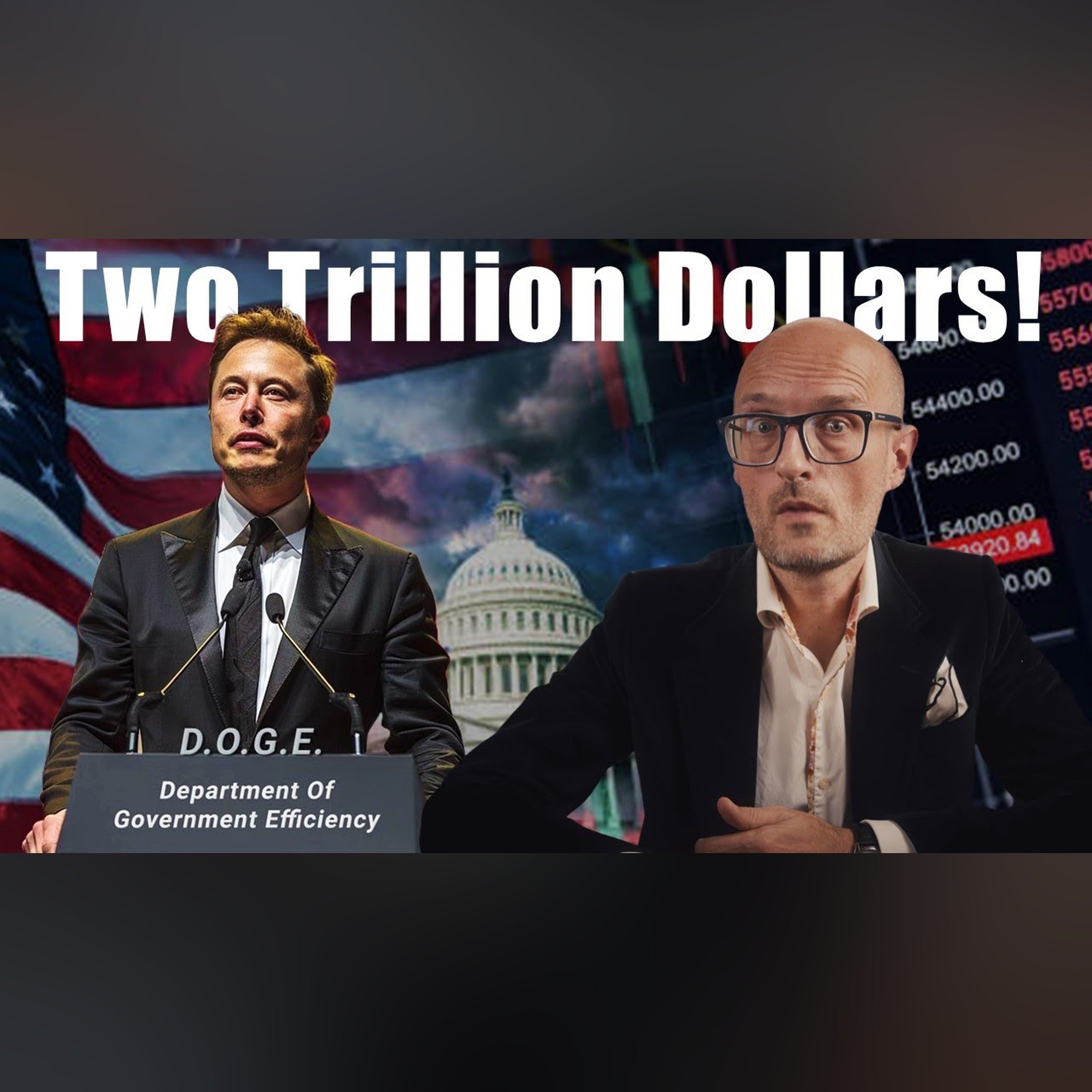
    Can Elon Musk Cut Two Trillion Dollars From the US Budget?

    Ad: 🔒Remove your personal information from the web at https://joindeleteme.com/BOYLE and use code BOYLE for 20% off 🙌 DeleteMe international Plans: https://international.joindeleteme.com Elon Musk and Vivek Ramaswamy are heading up Donald Trump's newly created Department of Government Efficiency which plans to take aim at wasteful government spending. On the campaign Elon Musk claimed that he could cut two trillion dollars in government spending. What would those cuts look like and how likely is Elon Musk to succeed? Does Elon Musk have too many conflicts of interest to do this job? Subscribe to Patrick's interview channel here: https://www.youtube.com/watch?v=w7sWER7LJd8 Patrick's Books: Statistics For The Trading Floor: https://amzn.to/3eerLA0 Derivatives For The Trading Floor: https://amzn.to/3cjsyPF Corporate Finance: https://amzn.to/3fn3rvC Ways To Support The Channel Patreon: https://www.patreon.com/PatrickBoyleOnFinance Buy Me a Coffee: https://www.buymeacoffee.com/patrickboyle Additional Reading: Jetson Leder-Luis Website: https://sites.bu.edu/jetson/ False Claims Act Reporting: https://www.justice.gov/civil/report-fraud The Economist: https://www.economist.com/briefing/2021/11/20/governments-are-not-going-to-stop-getting-bigger Reid Hoffman in The FT: https://www.ft.com/content/a3a329ee-8c9a-4abd-add2-eb7d56f4c108 Visit our website: https://www.onfinance.org Follow Patrick on Twitter Here: https://twitter.com/PatrickEBoyle Business Inquiries ➡️ sponsors@onfinance.org Patrick Boyle On Finance Podcast: Spotify: https://open.spotify.com/show/7uhrWlDvxzy9hLoW0EYf0b Apple: https://podcasts.apple.com/us/podcast/patrick-boyle-on-finance/id1547740313 Google Podcasts: https://tinyurl.com/62862nve Join this channel to support making this content: https://www.youtube.com/channel/UCASM0cgfkJxQ1ICmRilfHLw/join Learn more about your ad choices. Visit megaphone.fm/adchoices

  • Sunday · 13 min

    Financial Options Pricing History. How do Investors Price Options?

    Financial Options Pricing History. Today we will learn How do Investors Price Options? These classes are all based on the book Trading and Pricing Financial Derivatives, available on Amazon at this link. https://amzn.to/2WIoAL0 Check out our website http://www.onfinance.org/ Follow Patrick on twitter here: https://twitter.com/PatrickEBoyle Up to now we have looked at how options work and how they can be combined. We have mentioned options premium and how it is made up of time value and intrinsic value. In this video we will look at a few of the most common methods for pricing options. The value of options depends on a number of different variables in addition to the value of the underlying asset. They are complex to value and there are many pricing models in use. All models essentially incorporate the concepts of rational pricing, intrinsic value, time value, and put-call parity. In this video we will give you some insight as to how different variables affect option prices, and we hope to show you that while these methods are extremely useful, they are quite fallible, and can only give you an indication of fair value that is extremely dependent on the inputs into the formulas. The old “garbage in, garbage out” adage is particularly applicable to derivatives valuation—and most of financial mathematics. The formulas we will look at are only as good as the numbers that are put into them and often rely on a number of assumptions that do not always hold up in live securities market trading. They all rely on an estimate of volatility, and on an assumed distribution, that cannot be known in advance. In general, standard option valuation models depend on the following factors: • The current market price of the underlying security • The strike price of the option • The cost of holding a position in the underlying security, including interest and dividends • The time to expiration together with any restrictions on when exercise may occur • An estimate of the future volatility of the underlying security’s price over the life of the option. Options, or option-like contracts have been around for hundreds of years. Only in the 1970s was a formal pricing model introduced.. Options contracts are very similar to insurance contracts, and so most of the ideas used to price them came from the insurance business. As early as 1350 in Palermo, insurance contracts were common for casualty and credit risks relating to shipping. The two kinds of insurance were often being written separately. A popular contract was a conditional sale (similar to a put option) where the insurer agreed to purchase ship or cargo if it failed to arrive. Louis Bachelier (1870–1946) was a French mathematician credited with being the first person to model the stochastic process now called Brownian motion, which was part of his PhD thesis “The Theory of Speculation,” published in 1900. His thesis, which discussed the use of Brownian motion to evaluate stock options, is historically the first paper to use advanced mathematics in the study of finance. Thus, Bachelier is considered a pioneer in the study of financial mathematics and stochastic processes. Bachelier’s thesis was not well received because it attempted to apply mathematics to an unfamiliar area for mathematicians. We know the fair value of an options contract at expiration based upon the payoff diagrams, and we know that options are worth more than their value at expiration before the expiration date due to time value. Option value = Intrinsic value + Time value Before mathematical formulas existed for pricing options we knew that the fair value of options was higher than intrinsic value, as there was still time for the underlying to move in your favor, but not how much higher the price should be. Option prices, like all market prices, were just a capital weighted average of every market participant’s best gu Learn more about your ad choices. Visit megaphone.fm/adchoices

  • Sunday · 24 min

    Volatility Trading - Call and Put Options - Trading Tutorial

    These classes are all based on the book Derivatives For The Trading Floor, available on Amazon at this link. https://amzn.to/3GdLi2s Check out our website http://www.onfinance.org/ Follow Patrick on twitter here: https://twitter.com/PatrickEBoyle What is volatility trading? Volatility trading is the term used to describe trading the volatility of the price of an underlying instrument rather than the price itself. For example, you could trade the price direction of an equity index, but volatility trading typically means trading the expected future volatility of the index. Any instrument whose price moves, exhibits price volatility. Volatility trading is simply buying and selling the expected future volatility of the instrument. Rather than predicting whether the price of an asset will move up or down, volatility traders are concerned with how much movement, in any direction, will occur. How is volatility traded? The most common way to trade volatility is using options. The value of an option is affected by several factors, but an essential determinant of its value is the expected future volatility of the underlying instrument, which is included in the pricing formulas as standard deviation. Other things being equal, options struck on an underlying with higher expected volatility will be more expensive than options struck on an underlying expected to be less volatile. Options therefore are a good way to gain exposure to the volatility of the underlying. The price of volatility The value of an option can be attributed to several components. By stripping these away, traders can imply an annualised volatility level that the option’s tick value equates to. This is known as the implied volatility. So an equity index may be trading at a certain price and it may have exhibited a certain realized level of volatility over the previous 12 months. Traders can compare this realized level of volatility with the current implied level as seen in the option market. However, there is a crucial difference here; the implied volatility level refers to the annualized volatility that is expected over the life of the option. In other words, it is forward looking and reflects traders’ current best estimate of what future realized volatility will be. Learn more about your ad choices. Visit megaphone.fm/adchoices

Showing 301–320 of 479 episodes