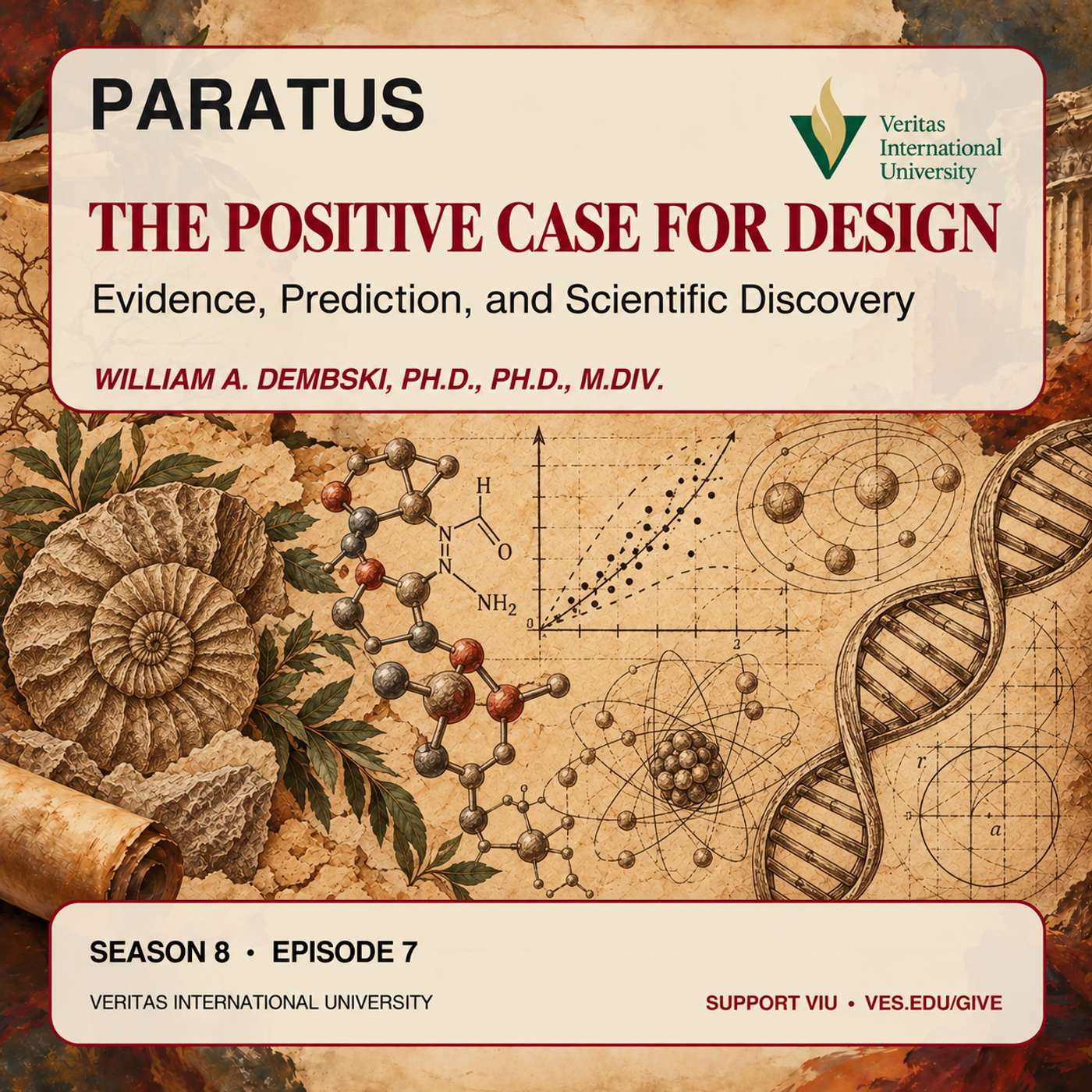
The Positive Case for Intelligent Design | William A. Dembski, Ph.D.
Can intelligent design make a positive, testable scientific case—or is it merely a criticism of Darwinian evolution? Luke Betzner welcomes mathematician, philosopher, and intelligent-design theorist William A. Dembski, Ph.D., Ph.D., M.Div., for a wide-ranging discussion of how scientists detect the effects of intelligence in nature. Dembski explains the logic of design inference, distinguishing induction, deduction, and inference to the best explanation. Drawing on examples from SETI, forensic science, archaeology, molecular biology, information theory, genetics, medicine, and paleontology, he argues that intelligent causation can be investigated rigorously and can generate testable expectations. The conversation examines biological codes, molecular machines, the origin of life, natural selection, the Cambrian explosion, orphan genes, information density, and the once-dominant idea of “junk DNA.” In this episode What makes the case for intelligent design positive rather than merely critical How intelligence is detected in SETI, forensics, archaeology, and biology Induction, deduction, abduction, and inference to the best explanation DNA, RNA, proteins, biological codes, and the origin of life The limits of natural selection and evolutionary time The Cambrian explosion, common ancestry, and the fossil record Design-based predictions about function, “junk DNA,” and orphan genes Why intelligent design can guide productive scientific research Chapters 00:00 Welcome to Paratus 00:26 Luke Betzner introduces William A. Dembski 01:05 Dembski’s background and the design inference 04:21 Induction, deduction, and abduction 06:48 The positive argument for intelligent design 12:27 Testable predictions and present-day causes 13:45 SETI, biological information, and the origin of life 19:37 Agency, molecular machines, and evolutionary theory 25:02 Design thinking, medicine, and biological systems 34:01 Natural selection, artificial selection, and evolutionary limits 40:58 Paleontology and the Cambrian explosion 51:48 Intelligent design as a research program 55:34 Orphan genes and information density 58:32 Final takeaways: science, evidence, and design 01:02:06 Recommended resources 01:04:24 Support VIU and next episode About the guest William A. Dembski, Ph.D., Ph.D., M.Div., is a mathematician and philosopher, a Founding and Senior Fellow of the Center for Science and Culture, and a Distinguished Fellow of the Walter Bradley Center for Natural and Artificial Intelligence. He has authored or edited more than twenty-five books and has published across mathematics, engineering, biology, philosophy, and theology. Resources William A. Dembski at the Discovery Institute The Design Inference, Second Edition, by William A. Dembski and Winston Ewert The Comprehensive Guide to Science and Faith, edited by William A. Dembski, Casey Luskin, and Joseph M. Holden Support Paratus and Veritas International University: Visit ves.edu/give. Your tax-deductible gift helps VIU equip Christians to think deeply, stand firmly, and live purposefully. Paratus is the broadcast ministry of Veritas International University, helping Christians develop a biblical worldview and think scripturally and soundly about the Christian faith and culture. Next episode: Fine-Tuning with Brian Miller, Ph.D., and Bruce L. Gordon, Ph.D.
- Transcript
- Chapters