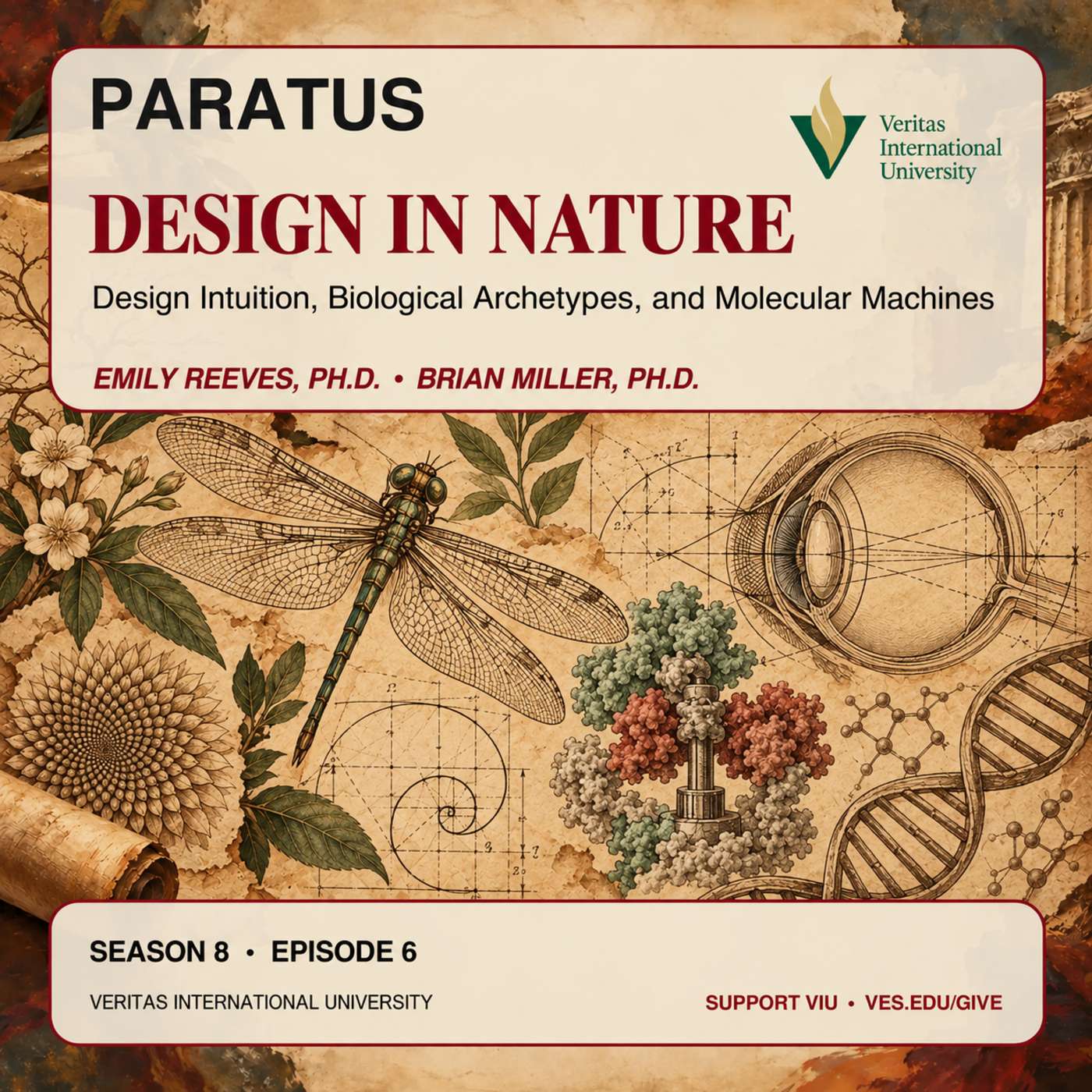
Design in Nature: Does Biology Reveal Intelligent Design? | Emily Reeves & Brian Miller
Does nature merely look designed, or does biology provide testable evidence of intelligent purpose? Host Luke Betzner welcomes biochemist Emily Reeves, Ph.D., and physicist Brian Miller, Ph.D., of Discovery Institute’s Center for Science and Culture for a wide-ranging discussion of design in nature. Reeves and Miller explain why human beings reliably recognize design, how scientific testing can distinguish purposeful organization from accidental patterns, and why natural selection may describe the filtering and optimization of existing biological variation without explaining the origin of organisms’ integrated architecture. They examine biological archetypes, constrained variation, molecular machines, protein-sequence rarity, and the engineering principles found in vision, hearing, and cellular systems. In this episode: Why design intuition deserves serious scientific consideration How lived experience and the scientific method work together Why some scientists resist design explanations The difference between the survival of the fittest and the arrival of the fittest Natural selection as a population-level filtering mechanism Biological archetypes and constrained variation Why similarity does not necessarily establish common ancestry The probability problem confronting unguided protein formation Molecular machines and mitochondrial Complex I The integrated engineering of human vision and hearing Chapters: 00:00 Paratus and Veritas International University 00:27 Introducing Emily Reeves and Brian Miller 01:16 The guests’ scientific backgrounds 03:05 Why design intuition should be taken seriously 07:11 Cookies, know-how, and recognizing intelligent activity 10:30 Why people resist evidence of design 13:43 From designed artifacts to living systems 16:48 What natural selection can and cannot explain 21:38 Adaptation, variation, and biological architecture 27:09 Archetypes and the limits of evolutionary change 33:38 Empirical and theoretical evidence for fixed patterns 38:29 Protein rarity and the probability problem 42:26 Molecular machines and mitochondrial Complex I 46:39 The extraordinary engineering of vision and hearing 51:20 Recommended websites, books, and research 53:51 Support Paratus and preview the next episode About the guests: Emily Reeves, Ph.D., is a research scientist with Discovery Institute’s Center for Science and Culture. Her background is in biochemistry, systems biology, and the application of engineering methodologies to biological research. Brian Miller, Ph.D., is Senior Fellow and Research Coordinator for Discovery Institute’s Center for Science and Culture. He earned his doctorate in complex systems physics from Duke University and studies subjects including the origin of life, protein rarity, thermodynamics, and engineering principles in biology. Brian Miller’s Discovery Institute profile Resources mentioned: IntelligentDesign.org Science and Culture Today Douglas Axe, Undeniable Steve Laufmann and Howard Glicksman, Your Designed Body Steve Laufmann and Howard Glicksman, Your Amazing Body Stuart Burgess, Ultimate Engineering “The Broad Utility of the Theory of Intelligent Design to Guide Scientific Research” by Casey Luskin, Emily Reeves, Brian Miller, and Jonathan McLatchie This discussion continues Season 8 of Paratus, examining science and the Christian faith through The Comprehensive Guide to Science and Faith, edited by William A. Dembski, Casey Luskin, and Joseph M. Holden. Support the outreach of Veritas International University: Give to VIU. Your tax-deductible support helps listeners think deeply, stand firmly, and live purposefully. Learn more about Veritas International University at ves.edu.
- Transcript