
Skip to content
Artwork for Notes from the Edge
Society & CulturePersonal Journals

Notes from the Edge

Gamut Podcast Network

Notes From the Edge is where polished stories end and the truth begins. Hosted by writer, trauma educator, executive advisor, and author Lisa Lacy, this globally ranked podcast explores survival, identity, trauma, addiction, recovery, leadership, relationships, and reinvention through raw, deeply human conversations. No scripts. No small talk. Just the stories we were taught to hide, the roles we performed to survive, and the truths that set us free. What did you perform in order to survive? Welcome to the edge. www.lisalacy.com

Play
  • 66 episodes
  • daily
  • Avg 39 min
  • English
Counted on this page — what you have heard stays on this device, so it is not something the list can be paged by.
  • #118
    Today · 32 min

    What Stories Are You Waiting Too Long to Ask For? Preserving Family Stories with Brad Koch

    What stories disappear when the people we love are no longer here to tell them? In this episode of Notes From the Edge, Lisa Lacy sits down with entrepreneur, business coach, former United States Marine, and founder of The Story Project, Brad Koch, for a deeply human conversation about family stories, grief, memory, legacy, and the things we often wait too long to ask. Brad shares how the loss of his father-in-law, and the realization that his wife wished she had more recordings of his voice, face, mannerisms, and stories, helped inspire The Story Project. Lisa and Brad explore why knowing someone’s story can completely change the way we understand our family, our childhood, our trauma, and even ourselves. This is a conversation about remembering where we came from while the people who came before us are still here to tell us. In this episode: • Why preserving someone’s voice, mannerisms, memories, and stories can become an irreplaceable part of their legacy • How learning our family’s stories can deepen connection and change the way we understand our own past • Why waiting until time feels limited can leave us scrambling to ask questions we could be asking now • How The Story Project helps families capture and preserve stories across generations • Brad’s experience entering the Marine Corps at seventeen, the role he performed to survive, and why asking for help is not weakness Connect with Brad: https://storyproject.app Connect with Lisa: https://www.lisalacy.com What did you perform in order to survive? Welcome to the Edge. See Privacy Policy at https://art19.com/privacy and California Privacy Notice at https://art19.com/privacy#do-not-sell-my-info.


  • #117
    Yesterday · 42 min

    SPECIAL EDITION; The Unbroken Conversation with Liam Beville

    Why a special edition? Because every once in a while, a conversation happens at the Edge that feels too important to wait its turn on the calendar. This is one of those conversations. At 18 years old, Liam Beville pushed a friend out of the path of a stolen car and took the impact himself. Both of his legs were shattered, his right knee was severely damaged, and he was told he might never walk again. He did more than walk again. Liam became an elite powerlifter, Guinness World Record holder, disability advocate, speaker and author. But underneath the records, the weights and four decades of competition was another story. For years, Liam practiced the way he walked so people would not see his limp. Strength became more than something he demonstrated. It became something he performed. In this special edition of Notes From the Edge, Lisa Lacy and Liam talk about what happens when survival becomes identity, when resilience starts looking like a mask, and what it means to finally acknowledge the parts of ourselves we worked so hard to hide. In this conversation: • Why Liam focused on rebuilding his mind before rebuilding his body after catastrophic injury • The depression, PTSD and loss of dignity that accompanied his recovery • How rehabilitation eventually led him into 40 years of competitive powerlifting • Why Liam spent years hiding his disability, including practicing how he walked so others would not see his limp • What changed when he stopped seeing disability as something that diminished his strength and began allowing it to become part of his story Liam is a Guinness World Record holder, internationally ranked powerlifter, disability advocate and brand ambassador for Active Disability Ireland. His upcoming memoir, Unbroken: The Liam Beville Story, tells the larger story of survival, performance, identity and resilience. Connect with Liam Beville: https://www.liambeville.com Connect with Lisa Lacy: https://www.lisalacy.com Listener’s Note: Resilience is not the absence of pain, disability, fear or limitation. Sometimes the strongest thing we can do is stop performing strength long enough to acknowledge what happened to us. Liam’s story is a reminder that adapting is not surrender, asking for help is not weakness, and accepting the parts of yourself that changed does not erase who you were before. Survival may require a performance for a season. Healing often begins when you realize you no longer have to keep performing it. What did you perform in order to survive? Welcome to the Edge. See Privacy Policy at https://art19.com/privacy and California Privacy Notice at https://art19.com/privacy#do-not-sell-my-info.

  • #116
    Yesterday · 50 min

    How Do You Know When Work Becomes Trauma? Toxic Work Culture with Natalie Holder

    What happens when the workplace you once worked so hard to succeed in becomes the place you no longer recognize yourself? In this episode of Notes From the Edge, Lisa Lacy sits down with employment attorney, workplace strategist, author, and former corporate people and culture executive Natalie Holder for a powerful conversation about workplace trauma, exclusion, toxic work culture, self-advocacy, and career reinvention. Natalie explains why workplace trauma does not always look dramatic. Sometimes it is being left out of the room, overlooked for opportunities, quietly bullied, or repeatedly questioning whether what you are experiencing is “bad enough” to speak up about. They explore why high performers may be among the last people to leave unhealthy environments, why having language for what is happening matters, and how unresolved workplace experiences can follow us into the next job if we never stop to understand them. Natalie also challenges the idea that the answer is always to quit immediately. Sometimes the most powerful move is understanding what happened, getting support, planning your exit intentionally, and asking better questions about what you actually want next. In this episode: • How exclusion and workplace trauma can hide in plain sight • Why high performers may stay in unhealthy workplaces longer • Finding the language to advocate for yourself • Knowing when it is time to stay, leave, or strategically pivot • Building a career that supports who you are becoming Connect with Natalie Holder: https://natalieholderspeaks.com Connect with Lisa Lacy: https://www.lisalacy.com What did you perform in order to survive? Welcome to the Edge. See Privacy Policy at https://art19.com/privacy and California Privacy Notice at https://art19.com/privacy#do-not-sell-my-info.

  • #115
    Thursday · 50 min

    How do you stop performing in your marriage? Somatic Healing in Intimate Relationships with Natalie Vartanian & Glenn Nielsen

    What happens when the roles you learned to play in relationships start costing you yourself? In this episode of Notes From the Edge, Lisa Lacy sits down with relationship and intimacy coaches Natalie Vartanian and Glenn Nielsen for an honest conversation about marriage, somatic healing, nervous system regulation, inherited relationship roles, and what happens when couples stop blaming each other long enough to look beneath the conflict. Natalie and Glenn share how even after years of personal growth and entering their marriage intentionally, old conditioning began showing up. Natalie found herself becoming a muted version of herself, while Glenn wrestled with the enormous pressure of being the provider after the collapse of a business he had built over decades. Together, they explore why sometimes the intensity of our reaction has more to do with what is happening inside us than what our partner actually did, and how couples can begin creating a relationship based on conscious choice rather than inherited expectations. In this episode: • How the “good wife” and “good husband” roles can quietly create resentment and pressure • Why your nervous system may be reacting to something deeper than the argument in front of you • Somatic awareness and learning to recognize activation in the body • Taking responsibility for your own patterns without turning relationship work into blame • How couples can intentionally create agreements, connection, intimacy, and a relationship that allows both people to fully exist Connect with Natalie & Glenn: https://wakeuporbreakup.com Connect with Lisa: https://www.lisalacy.com What did you perform in order to survive? Welcome to the Edge. See Privacy Policy at https://art19.com/privacy and California Privacy Notice at https://art19.com/privacy#do-not-sell-my-info.

  • #114
    Wednesday · 38 min

    What Happens When You Stop Fighting Your Diagnosis? Bipolar Disorder, Mental Health Recovery & Acceptance with Reza Ghaemi

    What happens when accepting a diagnosis stops feeling like surrender and becomes the beginning of recovery? In this episode of Notes From the Edge, Lisa Lacy sits down with author and podcast host Reza Ghaemi for an honest, funny, and deeply human conversation about living with Bipolar I Disorder, surviving mania and hospitalization, resisting treatment, and eventually learning to work with his diagnosis instead of fighting against it. Reza, author of Bipolar Is My Superpower: How Acceptance Changed My Life and host of The Rez Podcast, shares why acceptance became a turning point in his recovery and why calling bipolar his “superpower” is not about romanticizing mania or psychosis. It is about the self-awareness, resilience, recovery skills, and responsibility he built afterward. Lisa and Reza also dig into stigma, medication, faith, family support, disclosure, relationships, and what changes when you stop hiding your story and start owning it. In this episode: • Bipolar I Disorder, mania, psychosis, and hospitalization • Moving from denial and stigma toward acceptance • Medication, treatment, sleep, and building recovery skills • Mental health disclosure in work, dating, and relationships • Replacing shame and fear with self-awareness and ownership Connect with Reza Ghaemi: The Rez Podcast: https://www.rezpodcast.com Connect with Lisa Lacy: https://www.lisalacy.com What did you perform in order to survive? Welcome to the Edge. See Privacy Policy at https://art19.com/privacy and California Privacy Notice at https://art19.com/privacy#do-not-sell-my-info.

  • #113
    Monday · 44 min

    Can You Regulate a Craving Before It Becomes a Relapse? Addiction Recovery, Relapse Prevention & Nervous System Regulation with Dr. Deborah Rozman

    What happens inside your body in the seconds between a trigger, a craving, and a choice? Dr. Deborah Rozman is a behavioral psychologist and President/Co-CEO of HeartMath. In this episode of Notes From the Edge, she joins Lisa Lacy to explore what happens physiologically when stress activates old patterns, why the familiar can feel safer even when it is destructive, and whether we can train the nervous system to create more space between an urge and our response. They unpack heart-brain communication, heart rate variability, coherence, and real-time biofeedback, while Lisa shares how biofeedback became part of her own recovery experience. Dr. Rozman also walks through a simple heart-focused breathing practice that can be used when stress, overwhelm, or cravings begin to rise. In this episode: Addiction recovery, cravings, triggers, and relapse prevention Why the brain can reach for familiar patterns during stress and overwhelm Heart-brain coherence, HRV, and nervous system regulation Using real-time biofeedback to recognize and shift physiological stress patterns Heart-focused breathing and creating space between an urge and a reaction Connect with Dr. Deborah Rozman: HeartMath.com Connect with Lisa Lacy: www.LisaLacy.com What did you perform in order to survive? Welcome to the Edge. See Privacy Policy at https://art19.com/privacy and California Privacy Notice at https://art19.com/privacy#do-not-sell-my-info.

  • #112
    Sunday · 14 min

    Edge Note: What If Telling the Truth About Your Mental Health Could Cost You Everything?

    What happens when telling the truth about your mental health could cost you your credibility, your career, or the way people see you forever? In this solo episode of Notes From the Edge, Lisa Lacy talks openly about living with Bipolar I, psychosis, borderline personality disorder, addiction, hospitalization, and recovery while simultaneously building businesses, leading teams, earning six figures, and appearing highly functional to the outside world. This is a conversation about what happens when a psychiatric diagnosis becomes a verdict instead of information. Lisa explores the pressure to hide serious mental illness in professional spaces, the difference between mental health awareness and actual psychological safety, and why people should not have to prove recovery by pretending they were never sick. In this episode: • Bipolar I, psychosis and borderline personality disorder stigma • Mental illness, employment and the fear of professional disclosure • High-functioning mental illness, leadership and hidden struggles • Psychiatric hospitalization, addiction, recovery and rebuilding a life • Why workplaces need real systemic change beyond mental health awareness Connect with Lisa: https://lisalacy.com What did you perform in order to survive? Welcome to the Edge. See Privacy Policy at https://art19.com/privacy and California Privacy Notice at https://art19.com/privacy#do-not-sell-my-info.

  • #111
    September 26 · 35 min

    Edge Note: Are You Strong or Just Surviving?

    Licensed marriage and family therapist and educator Renée Calhoun joins Lisa Lacy to unpack a deceptively simple question: when does “being strong” stop being resilience and start becoming survival mode? In this conversation, Renée and Lisa explore why highly capable people can look successful on the outside while their nervous systems remain stuck on high alert. They talk about guilt-free rest, people pleasing, overfunctioning, emotional safety, family systems, toxic relationship patterns, and the ways trauma adaptations can become so familiar that we mistake them for personality. Renée also explains why intelligence alone can’t logic us out of relationships or behaviors our nervous systems still associate with connection and safety. In this episode: Trauma and nervous system survival responses The difference between resilience and survival mode Why high-functioning people can still be suffering People pleasing, overfunctioning and emotional labor Why rest can feel unsafe or uncomfortable When trauma adaptations get mistaken for personality traits Internal Family Systems and parts work Emotional safety versus emotional discomfort Toxic relationships and repeated relationship patterns How family systems shape our earliest ideas about love and belonging Boundaries, self-worth and learning to say no Moving from autopilot into curiosity and conscious choice Why healing isn’t becoming someone new, but discovering who you are when you no longer have to survive Connect with Renée Calhoun: https://reneecalhounlmft.com Connect with Lisa Lacy: https://lisalacy.com What did you perform in order to survive? Welcome to the Edge. See Privacy Policy at https://art19.com/privacy and California Privacy Notice at https://art19.com/privacy#do-not-sell-my-info.
  • #110
    September 26 · 32 min

    What Happens When “Fine” Becomes a Mask? High-Functioning Depression, Immigrant Identity, Motherhood & Survival Roles with Dr. Nneka Oluoha

    What happens when being capable becomes the very thing that keeps people from seeing you’re struggling? In this episode of Notes From the Edge, Lisa Lacy sits down with Nigerian-American physician, novelist, and storyteller Dr. Nneka Oluoha for a conversation about high-functioning depression, cultural expectations, motherhood, immigrant identity, and the roles we perform to survive. Dr. Nneka explores why the person who appears strongest may be carrying the most, why “I’m fine” can become a practiced performance, and how competence, strength, and responsibility can eventually become a prison when we never allow ourselves to put them down. She also shares her experience moving from Nigeria to the United States, navigating multiple identities as a physician, mother, wife, immigrant, and writer, and finally reclaiming the part of herself that had always wanted to write. Her novel, Live For Me Nkem, uses fiction to take readers inside depression not only through the person experiencing it, but through the family living beside her. In this episode: • High-functioning depression and performing “fine” • Competence and strength as survival roles • Immigrant identity and navigating two cultures • Motherhood, responsibility, and mom guilt • Why successful people struggle to ask for help • Depression’s impact on the entire family • Listening instead of trying to fix someone • Reclaiming parts of yourself buried beneath responsibility • The power of storytelling to create empathy around mental health Sometimes support is not having the perfect advice. Sometimes it is simply being willing to sit beside someone in the dark. Connect with Dr. Nneka Oluoha: LinkedIn-Nneka Oluoha Connect with Lisa Lacy: https://www.lisalacy.com What did you perform in order to survive? Welcome to the Edge. See Privacy Policy at https://art19.com/privacy and California Privacy Notice at https://art19.com/privacy#do-not-sell-my-info.

  • #109
    September 25 · 35 min

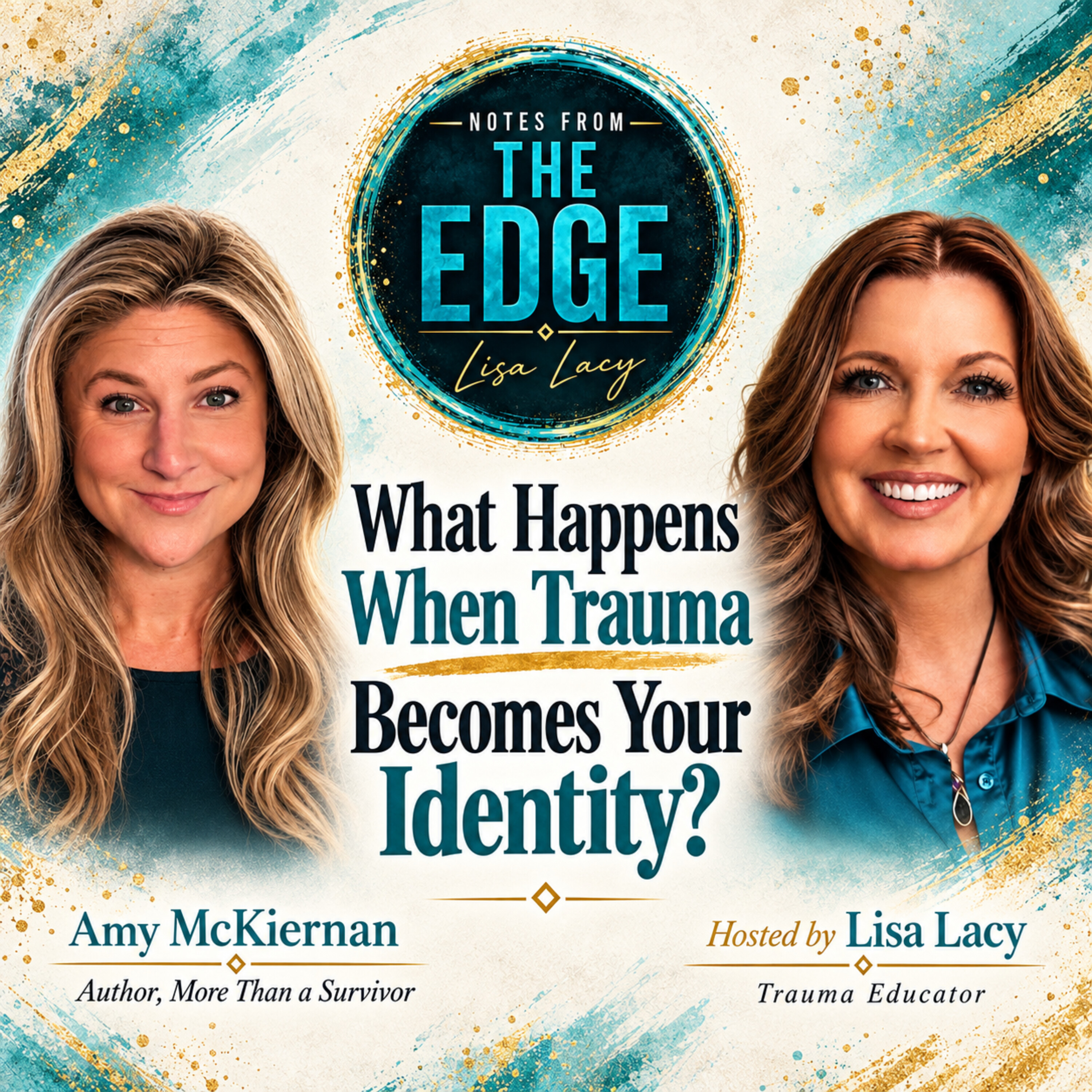
    What Happens When Trauma Becomes Your Identity? Sexual Assault, Trauma Healing, Reclaiming Your Power, Boundaries & Consent with Amy McKiernan

    What happens when something that happened to you starts defining who you are? In this episode of Notes From the Edge, Lisa Lacy sits down with author and survivor advocate Amy McKiernan for a raw conversation about sexual assault, trauma, identity, addiction, boundaries, consent, and rebuilding a life beyond survival. Amy shares how being raped at fifteen shaped her identity, relationships, coping mechanisms, and sense of self-worth. She and Lisa explore numbing through drugs and alcohol, toxic relationships, motherhood, mental health labels, and the long process of reclaiming agency after choice has been taken away. They also talk about why healing is not linear, how small choices can become acts of recovery, and why trauma can remain part of your story without remaining in control of your life. In this episode: • Sexual assault and trauma identity • Addiction and emotional numbing • Boundaries, self-worth, and toxic relationships • Healing that is messy and nonlinear • Mental health labels and identity • Consent, intoxication, and accountability • Reclaiming agency and choosing yourself Connect with Amy McKiernan: https://amymckiernan.com Connect with Lisa Lacy: https://www.lisalacy.com What did you perform in order to survive? Welcome to the Edge. See Privacy Policy at https://art19.com/privacy and California Privacy Notice at https://art19.com/privacy#do-not-sell-my-info.

  • #108
    September 24 · 45 min

    Who Are You Without the Role? Survival Performance, Masculinity, Midlife Reinvention & Narrative Liberation with Jon Symes

    What if the person you became to survive is no longer the person you want to be? In this episode of Notes From the Edge, Lisa Lacy sits down with speaker and leadership consultant Jon Symes to explore the unconscious stories we build around identity, masculinity, success, leadership, and survival. Jon calls this work Narrative Liberation: recognizing the roles and beliefs we adopted to navigate life, then deciding which ones still belong to us. They talk about the cost of being “the strong one,” the provider, the good guy, the high performer, or the person who always has it together. Jon also shares how early survival adaptations can begin, including changing the way he walked as a boy to avoid social judgment and carrying that performance for nearly twenty years. Together, Lisa and Jon explore midlife reinvention, masculinity, people-pleasing, leadership, family roles, authenticity, and what happens when the identity that once protected you starts costing you pieces of yourself. In this episode: • Survival performance and identity • Narrative Liberation • Masculinity and provider pressure • Midlife reinvention • The “good guy” mask • People-pleasing and self-abandonment • Leadership and authenticity • Family roles and inherited stories • Reclaiming the parts of yourself you learned to hide Connect with Jon Symes: https://www.wholeandfree.me Connect with Lisa Lacy: https://www.lisalacy.com What did you perform in order to survive? Welcome to the Edge. See Privacy Policy at https://art19.com/privacy and California Privacy Notice at https://art19.com/privacy#do-not-sell-my-info.

  • #107
    September 23 · 40 min

    What Does the FBI Teach You About Being Human? From Pastor to FBI: Faith, Trauma, Survival & Human Behavior with Eric Robinson

    What happens when a pastor trades the pulpit for a 24-year career inside the FBI? Eric Robinson spent 12 years in Christian ministry before becoming an FBI Special Agent, eventually serving 15 years as a SWAT operator and working investigations involving counterterrorism, crimes against children, gangs, drugs, financial crime, civil rights violations, political corruption, and national security. But this conversation isn’t really about badges, guns, or cases. It’s about what happens to your understanding of human beings when you’ve spent decades sitting across from victims, informants, criminals, survivors, and people living through some of the darkest circumstances imaginable. In this episode of Notes From the Edge, Lisa Lacy and Eric Robinson talk about: • Going from the pulpit to the FBI • 24 years inside federal law enforcement • What ministry taught Eric about interviewing, trust, and human behavior • Witnessing trauma without losing your humanity • Why context matters when we judge another person’s choices • The relationship between trauma, circumstance, crime, and survival • Why mentorship and nonjudgmental support matter • The psychological weight of believing you have to be perfect • Dropping the mask Eric wore as a pastor • Fear, competence, repetition, and learning to trust yourself • Why making the “wrong” decision doesn’t have to destroy your life • Humanizing people without excusing harmful behavior • Choosing curiosity over judgment • Why Eric believes we need more kindness in difficult conversations • His upcoming book chronicling the unlikely journey from preacher to FBI Special Agent Eric’s story is a reminder that people are almost always more complicated than the headline, the crime, the job title, the mistake, or the label we’ve been given. Sometimes understanding another human being starts with getting curious enough to ask what happened before we decide who they are. Connect with Eric Robinson: https://preachertobreacher.com Connect with Lisa Lacy: https://www.lisalacy.com What did you perform in order to survive? Welcome to the Edge. See Privacy Policy at https://art19.com/privacy and California Privacy Notice at https://art19.com/privacy#do-not-sell-my-info.

  • #106
    September 21 · 53 min

    What If Behavior Isn’t the Problem? Childhood Trauma, Adoption, Nervous System Regulation & Trauma-Informed Parenting with Bryan Post

    What if the behavior we’re trying to stop is actually trying to tell us something? Bryan Post is a child behavior expert and creator of the Fear to Love Method whose work challenges parents to see difficult behavior not as defiance, but as communication from a nervous system experiencing stress, fear or unmet needs. In this conversation, Bryan and Lisa explore what changes when adults stop trying to control behavior and start looking underneath it. They unpack why a stressed parent cannot regulate a stressed child, how consistency creates safety, and why the feelings we learned to suppress in childhood can continue driving our reactions decades later. Bryan also shares his “Reflect, Relate and Regulate” approach and a powerful story illustrating what can happen when a parent gets curious about the fear beneath a child’s behavior instead of immediately trying to correct it. In this episode: Childhood trauma and nervous system regulation Trauma-informed parenting and difficult behavior Adoption, attachment and emotional safety Why punishment and control can intensify stress Parent self-regulation and co-regulation How childhood survival patterns follow us into adulthood Grief, emotional healing and unresolved trauma Reflect, Relate and Regulate Moving from fear-based reactions toward connection Why behavior can be an opportunity rather than a problem Connect with Bryan: www.feartolove.com Connect with Lisa: www.lisalacy.com What did you perform in order to survive? Welcome to the Edge. See Privacy Policy at https://art19.com/privacy and California Privacy Notice at https://art19.com/privacy#do-not-sell-my-info.

  • #105
    September 20 · 13 min

    Edge Note: Why does chaos feel like home?

    Why can peace feel more uncomfortable than the crisis you spent years trying to escape? Lisa Lacy, trauma educator and host of Notes From the Edge, explores one of trauma’s strangest contradictions: the nervous system can mistake what is familiar for what is safe. In this solo episode, Lisa gets personal about becoming extraordinarily good at functioning inside chaos, from building a high-pressure career around competence and crisis management to constantly monitoring the emotional weather around her. She explores what happens when the emergency finally ends, but your body is still waiting for the next one, and why ordinary moments of safety can become part of retraining the nervous system. In this episode: Trauma, hypervigilance and the nervous system Why peace can feel boring, suspicious or unsafe When competence and productivity become survival strategies Overfunctioning, caretaking and monitoring other people’s emotions The difference between connection and intensity Why stable relationships can initially feel unfamiliar Learning to tolerate other people’s disappointment Resting without feeling like you have to earn it Teaching the nervous system that calm is safe How ordinary can eventually begin to feel like freedom Connect with Lisa: www.lisalacy.com What did you perform in order to survive? Welcome to the Edge. See Privacy Policy at https://art19.com/privacy and California Privacy Notice at https://art19.com/privacy#do-not-sell-my-info.

  • #104
    September 19 · 33 min

    Edge Note: What Did We Forget After Kindergarten?

    What did we know at five years old that we somehow forgot along the way? Tiffany Dennison is a kindergarten and first-grade educator with 22 years of experience whose work centers on play, belonging and social-emotional development. Her classroom offers a fascinating reminder that children may understand some of the fundamentals of being human long before adults complicate them. In this conversation, Tiffany and I talk about what happens when children are given enough time to actually play, why belonging and emotional safety have to come before learning, and what five-year-olds can teach adults about repairing conflict without dragging yesterday’s resentment into today. We also get into screen time, storytelling, nervous-system regulation and Tiffany’s own journey of recognizing and releasing people-pleasing. In this episode: Play-based learning and why unstructured play matters Social-emotional learning and childhood development Belonging, emotional safety and nervous-system regulation How children repair conflict differently than adults The effects of screens on connection, creativity and attention Storytelling as a tool for learning and human connection What adults model for children without realizing it People-pleasing, identity and learning to listen to your body Why slowing down may be one of the most important things children can teach us Connect with Lisa Lacy https://www.lisalacy.com What did you perform in order to survive? Welcome to the Edge. See Privacy Policy at https://art19.com/privacy and California Privacy Notice at https://art19.com/privacy#do-not-sell-my-info.

  • #103
    September 18 · 37 min

    What Happens When Success Stops Working? Male Isolation, Emotional Healing & Personal Accountability with Daniel Sterling

    Writer and memoirist Daniel Sterling spent much of his life chasing achievement, recognition, and the next version of success until he discovered that some of the hardest work a man can do happens in the few inches between his head and his heart. Daniel and Lisa talk about the childhood hunger to be seen that fueled his drive, from becoming a top U.S. alpine ski racer to television, filmmaking, and screenwriting, and what happened when that identity finally stopped sustaining him. They dig into male emotional isolation, the mentor who helped Daniel rebuild his life through self-study and accountability, and why raising emotionally whole boys requires adults willing to examine their own patterns first. In this episode: Male isolation and why emotional connection can be so difficult for men Achievement, validation, and using success as a substitute for feeling seen Midlife emotional collapse and rebuilding identity beyond performance Personal accountability, self-awareness, and dropping defensiveness Communication and healthier relationships Raising boys into emotionally whole men Why a meaningful apology requires changed behavior Letting go of ego and discovering who you are beyond accomplishments Connect with Daniel Sterling: https://daniel-sterling.com Connect with Lisa Lacy: https://www.lisalacy.com What did you perform in order to survive? Welcome to the Edge. See Privacy Policy at https://art19.com/privacy and California Privacy Notice at https://art19.com/privacy#do-not-sell-my-info.

  • #102
    September 18 · 1 hr

    What If Your Identity Was Built on a Secret? Late-Discovery Adoption, Family Secrets & Reclaiming Identity with Al Isaacs

    What happens when everyone in your family knows the truth about your life except you? Al Isaacs, author of Finding Mary Smith and longtime comedian and improv teacher, joins Lisa Lacy to talk about discovering at 52 that he had been adopted and what happens to identity when the foundation of your own story suddenly shifts. Al takes us inside the ordinary phone call from his mother’s oncologist that accidentally exposed a secret his family had kept for more than five decades, and the search that followed through DNA, genealogy, Search Angels and the trail of a folk singer named Mary Smith. The conversation also moves into imposter syndrome, forgiveness, the power of improv’s “yes, and,” and the painful cost of family secrets, including the conversations we may lose when truth is withheld. In this episode: Late-discovery adoption and identity Family secrets, truth and belonging Gray-market adoption in the late 1960s DNA testing, genealogy and Search Angels Searching for a biological mother decades later Imposter syndrome and reclaiming identity Forgiveness without erasing what happened How “yes, and” helped Al keep moving when he wanted to give up The memories and relationships family secrecy can cost us Connect with Al: AlIsaacs.com Finding Mary Smith is available in paperback, eBook and audiobook. Connect with Lisa: LisaLacy.com What did you perform in order to survive? Welcome to the Edge. See Privacy Policy at https://art19.com/privacy and California Privacy Notice at https://art19.com/privacy#do-not-sell-my-info.

  • #101
    September 17 · 45 min

    Are you performing your worth? Trauma, Treatment-Resistant Depression & ECT with Simone Bowyer

    What if the traits you think are your personality are actually things you learned to do to survive? Simone Bowyer is a writer and founder of The Light Within Collective, whose work explores what she calls the “language of survival,” the patterns we develop to feel safe, loved, worthy, and less likely to be abandoned. In this conversation, Simone and I talk about perfectionism, hyper-independence, control, and overachievement as survival adaptations rather than simply personality traits. She shares her experience with severe treatment-resistant depression, years of psychiatric treatment, and ultimately electroconvulsive therapy, or ECT, which she describes not as a cure, but as something that finally created enough space for her to consider life beyond the darkness. We also take the conversation into the workplace, exploring why we cannot simply leave our wounds at home, what human-centered leadership can look like, and why psychological safety matters when the person who appears to be your highest performer may actually have a nervous system that never learned it was safe to stop. In this episode: • How childhood trauma can become perfectionism, people-pleasing, control, and hyper-independence • Treatment-resistant depression and Simone’s experience with ECT • Why recovery does not erase survival patterns overnight • Performing worth in order to feel lovable and avoid abandonment • Trauma, the nervous system, and high achievement • Psychological safety and human-centered leadership in the workplace • Why healing is not linear and does not have a timeline • Simone’s book, Chasing Light, and finding color again after years of depression • Moving from asking “What is wrong with me?” to asking “What did I learn to do to survive?” Connect with Simone Bowyer: The Light Within Collective https://lightwithincollective.co.za Connect with Lisa Lacy: https://lisalacy.com What did you perform in order to survive? Welcome to the Edge. See Privacy Policy at https://art19.com/privacy and California Privacy Notice at https://art19.com/privacy#do-not-sell-my-info.

  • #100
    September 16 · 55 min

    Would You Look Away? A Family’s Attempt to Escape Nazi Germany & the Cost of Being a Bystander with Ruth Stitt

    Would you look away? Ruth E. Stitt is an author and licensed counselor whose family’s preserved letters from Nazi Germany reveal how persecution can unfold gradually, how difficult escape can become, and what happens when ordinary people decide whether to remain bystanders or stand up. In 1938, Ruth’s grandmother in Bridgeport, Connecticut received a letter from relatives in Berlin desperately searching for a way out of Nazi Germany. What followed was five years of correspondence filled with hope, fear, bureaucracy, attempted immigration, love and devastating loss. In this conversation, Ruth and Lisa go beyond the question, “Why didn’t they just leave?” They explore the financial, legal, political and emotional barriers Jewish families faced while trying to escape, the psychology of denial as danger slowly becomes normalized, and what fear and grief do to human beings under extraordinary pressure. They also talk about the choice that can remain when nearly everything else has been taken away: how we respond, who we love and whether we are willing to speak when someone else is being dehumanized. In this episode: • Holocaust history and life inside Nazi Germany • Jewish refugee immigration and the barriers to escape • Family letters documenting persecution as it unfolded • Denial, fear, grief and psychological survival • Why “Why didn’t they just leave?” misses the complexity of displacement • Choosing love when control has been stripped away • Turning documented family history into historical fiction • The difference between a bystander and an upstander • Moral courage, dehumanization and the responsibility to speak • Letting go of perfection, overachievement and the need to always have the answer Content note: This conversation includes discussion of the Holocaust, persecution, forced displacement, psychological trauma and profound loss. Connect with Ruth E. Stitt: https://scripturecomesto.life Find Ruth’s books on Amazon by searching Ruth E. Stitt. Connect with Lisa Lacy: https://lisalacy.com What did you perform in order to survive? Welcome to the Edge. See Privacy Policy at https://art19.com/privacy and California Privacy Notice at https://art19.com/privacy#do-not-sell-my-info.

  • #99
    September 15 · 57 min

    Are old patterns running your life? Self-Awareness & Personality with Arky Jones

    What if the patterns you keep repeating are not who you are, but behaviors you learned long ago and never stopped to question? Arky Jones, creator of Personality Peek, joins Notes From the Edge to explore how self-awareness can help us recognize the patterns quietly shaping our choices, relationships, work, and identity without turning personality into another label or box. This conversation gets practical fast. Lisa and Arky talk about what happens when we realize we have been living according to other people’s expectations, how toxic workplace dynamics can make us feel powerless, and why taking ownership sometimes starts with something as small as documenting your work, protecting your attention, or changing one percent of a pattern instead of trying to reinvent your entire life overnight. In this episode: Personality as a mirror instead of a label Self-awareness and recognizing unconscious patterns People-pleasing and living without full authorship of your life Stoicism and focusing on what you can actually control Toxic workplace dynamics and protecting your work Boundaries, attention, and deciding what you are willing to give Why honesty with yourself matters more than the personality result Arky’s “one percent” approach to practical personal growth Money, debt, freedom, and intentional decision-making How small conscious choices can change the direction of your life Personality Peek is designed to help people identify strengths, blind spots, and behavioral patterns without treating personality as something fixed or diagnostic. Connect with Arky Jones: https://personalitypeek.com Connect with Lisa Lacy: https://LisaLacy.com What did you perform in order to survive? Welcome to the Edge. See Privacy Policy at https://art19.com/privacy and California Privacy Notice at https://art19.com/privacy#do-not-sell-my-info.

Showing 1–20 of 66 episodes