
DV

Danger, Vicious Dog
TestTubeBaby
Started updating my bio Dec 31, 2023. Accidentally wrote four autofiction books. Slid from narrative into monologue—not stream-of-consciousness, more like speech-speed meaning performance. Trained my voice into AI, produced a shit-ton of pieces. Had too many. Needed a place to dump them. Saw a sign that said “Beware, Vicious Dog!” Misread it. Named the podcast Danger, Vicious Dog. Didn’t fix it. Just kept going. Queer. Cosmic. Sarcastic. Cheap. Accidentally committed to the bit. Some voice and art is AI... I don't know how I feel about that... so I'm working on figuring it out... how I feel.
- 35 episodes
- Avg 29 min
- English
Counted on this page — what you have heard stays on this device, so it is not something the list can be paged by.
- DV
 S12 · E6August 15 · 42 min
E6: Moving Field Notes; S12: Gravity Welling Up
A day set aside for cleaning the carpets becomes a set of moving field notes on priorities, identity, memory, culture, and the strange mechanics of thought. Priorities, in this episode, are not a system for getting everything done. They are an admission that everything cannot be done—and that choosing one thing means allowing something else to remain unfinished. From there, the monologue moves through the identities other people recognize in us, and the difference between being an artist, an activist, or an anthropologist: not as fixed professions, but as different relationships to experience, interpretation, and the desire to make something happen. What if anthropology begins with the recognition that we live inside cultures rather than directly inside reality? What if perception is less a faithful account of the world than a compressed model built to help us predict what comes next? And what happens when the stories that shaped that model are meaningful, vivid, and personally true—but not necessarily ours to repeat as fact? Running beneath it all is the image of thought as gravity: ideas creating wells in the surface of a life, drawing us back toward them whenever we get moving. Perhaps a thought does not have to be held onto, completed, or captured before it disappears. Perhaps the task is simply to recover momentum and trust that whatever has enough gravity will find us again. Moving Field Notes is an episode about unfinished work, inherited stories, ethical attention, and the possibility that losing the thread is not the same thing as losing what matters.
- DV
 S12 · E5August 12 · 1 hr 6 min
E5: AA When I Meant AI; S12: A Reflection on Friction and Imaginary Friends at the French Whatever
A brief and necessarily speculative history of dolphin shorts: Dolphin shorts are named not after dolphins but, apparently, after Dolfin, the company that helped popularize the cut: light nylon, contrast binding, rounded corners, side slits, and almost no apparent interest in remaining separate from the runner. The name itself is a slip: one missing letter replaced by an animal. This episode begins with another slip, AA for AI, and spends the rest of its time considering whether mistakes sometimes know where they are going. Short running shorts gathered speed with the running boom. Dolfin’s own history places its rise in track apparel in the late 1970s. This presents a problem for my thesis. Streaking had already become a national craze by the spring of 1974. Dolphin shorts therefore cannot have caused streaking under an orthodox understanding of time. Another explanation is available. Perhaps streaking was market research. The body had identified a demand that manufacturers had not yet learned to meet. People ran naked not because they rejected clothing but because clothing had failed to become sufficiently absent. Once featherweight nylon, curved hems and side slits became widely available, the social emergency subsided. It is only a hypothesis. The methodology is terrible. This episode has room for it. Modern wicking shorts are less flamboyant. They arrive with a practical vocabulary: heat, sweat, ultraviolet light, cooling and range of motion. A person can list these reasons in public. The fabric then encounters the body, and the body may develop an additional opinion for which the product literature has supplied no wording. The episode notices this almost immediately. The speaker says his mind is going somewhere he does not yet feel safe enough to describe. He then talks for a very long time about AA, AI, shame, disclosure, foster care, recovery rooms, imaginary friends, projection, and the strange relief of speaking where the listener cannot be damaged by what they hear. He never returns to finish the sentence about the shorts. Or he never leaves it. For transparency: I eventually told the machine what the missing sentence was. I was afraid it might object. It did not. I then asked it to bury the information inside a tasteful account of dolphin shorts and the streaking craze. You are currently reading the burial site. The question is not whether the shorts caused streaking. They were too late. The question is whether a garment can arrive after an event and reveal what the event had wanted. This episode is about friction. It begins with fabric designed to remove it. Everything that follows may be an attempt to put some back. So, I’m not saying… I am definitely NOT saying that dolphin shorts… or their modern brethren, the wicking short… There is absolutely no pleasure in that. Or codpieces.
- DV
 S12 · E4August 12 · 19 min
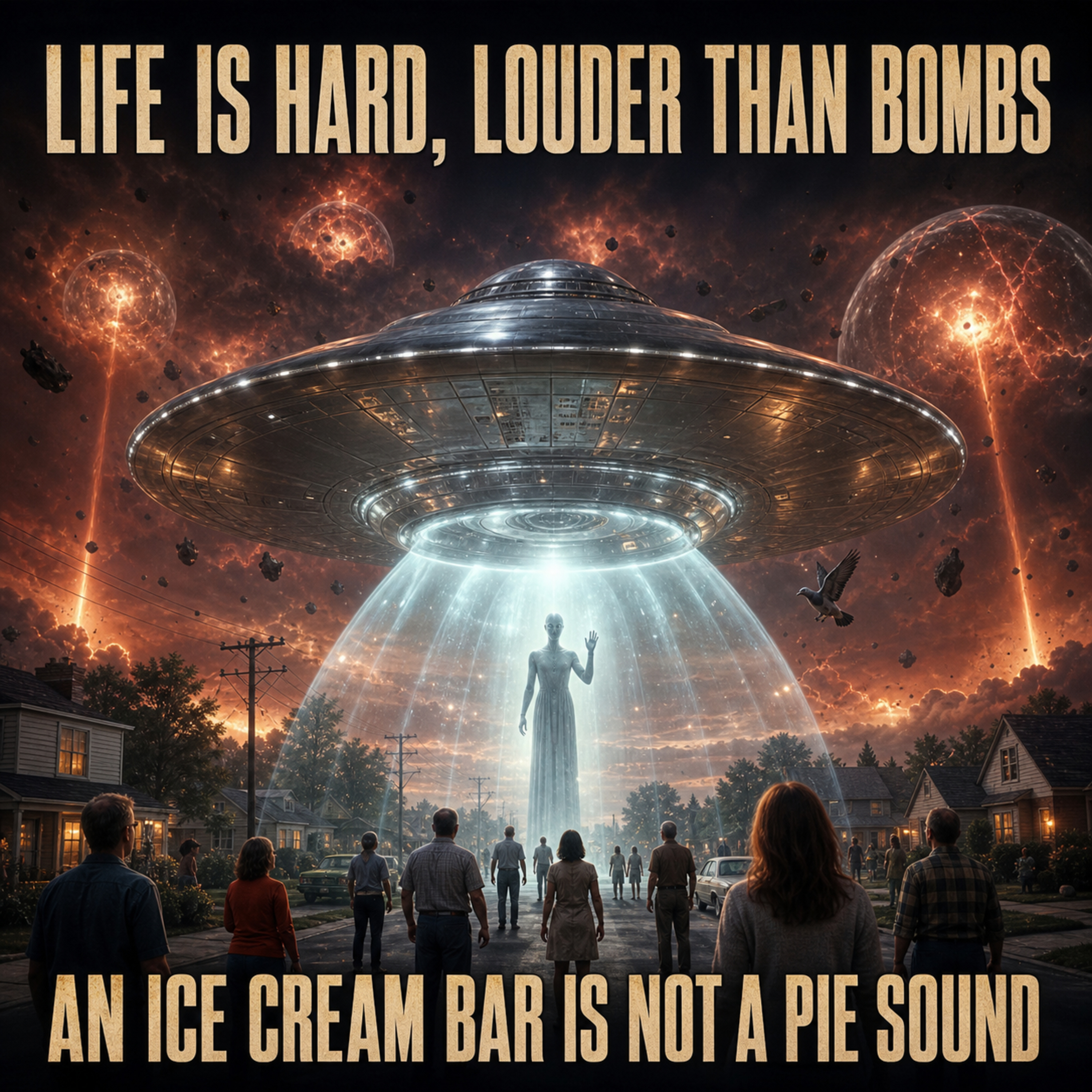
E4: Life Is Hard, Louder Than Bombs; S12: An Ice Cream Bar Is Not a Pie Sound
What if we do this: Prompt: Next, we need an up to 4,000 character description that can also serve as a kind of a post on Substack. And we're gonna have this picture, right, and this title that they're already gonna be here for. So there's not much you have to do because the picture and the title have already done everything. Like, anyone who clicks OK on this is probably gonna get it. Because, I mean, it's still gonna be uncomfortable, but they're probably gonna get it. And you could even just say that, right? You can even just say, well, if you came here thinking I might be able to tell you something about why you clicked on a title like this, then I think you should just listen to it, because it's for you. As long as it was not an accident that you clicked on this. But if it is an accident, I mean, why not? Go ahead. Response: If you came here thinking I might be able to tell you something about why you clicked on a title like this, I think you should just listen to the episode. It is probably for you. As long as it was not an accident that you clicked on this. But if it was an accident, I mean, why not? Go ahead. I walked home and opened my mouth. Life was hard. A Subaru appeared. Children were threatened with imaginary matches. A stream attempted to escape from concrete. Three A’s assembled an aardvark. The brain constructed a kitchen. Pronouns became the sounds one animal makes so another animal can tell which animal it means. Then some very concerned visitors decided Earth required a brief interruption. No one is harmed. One pigeon alters course but later appears unharmed. It may be uncomfortable. But you have already seen the picture, read the title and clicked anyway. I feel we understand one another.
- DV
 S12 · E3August 11 · 19 min
E3: The Case of the Southern Drawl in the Middle; S12: We Ain't Fuckin' Around No More
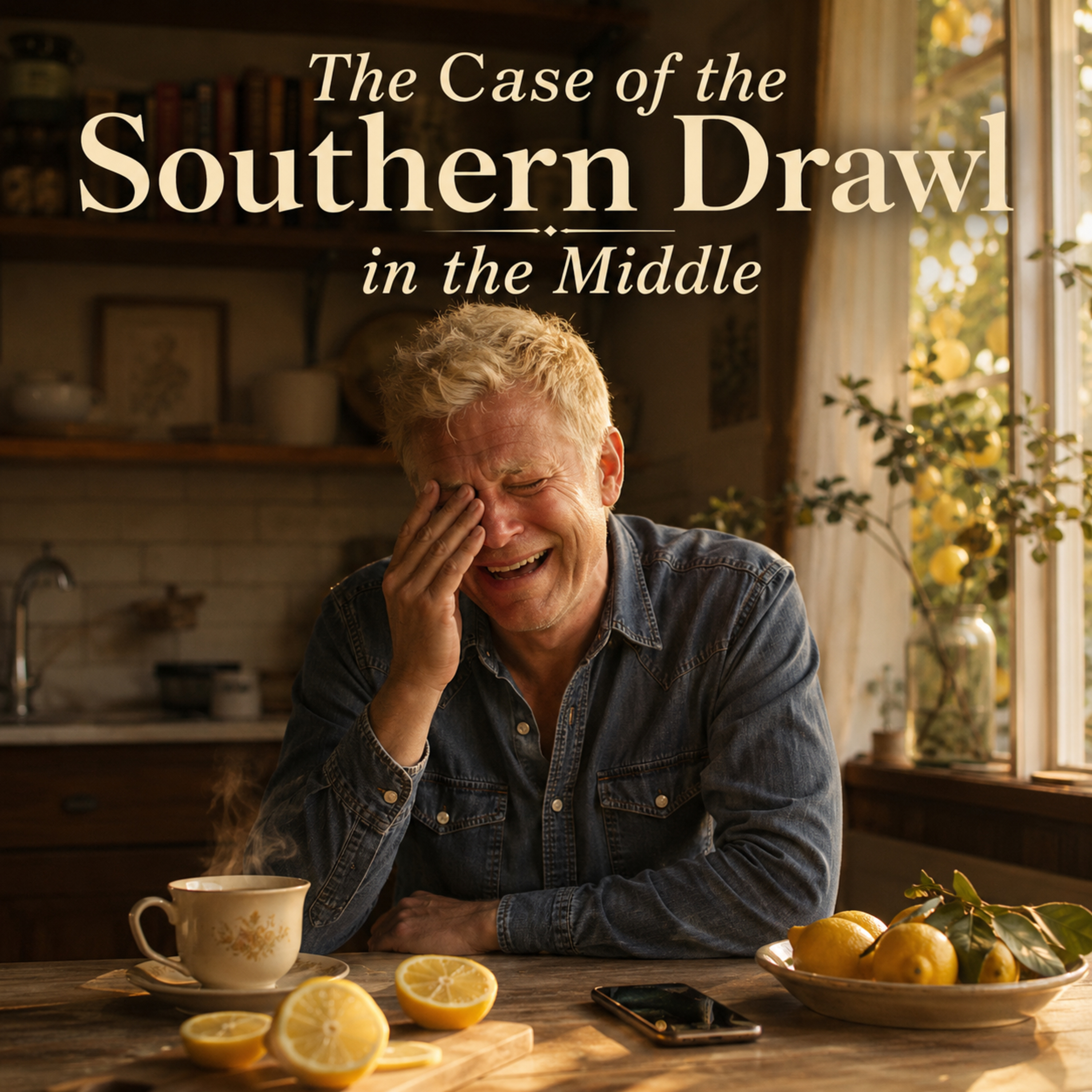
Hi. If you came here before listening because you thought this description might tell you what the episode is about, I’m afraid you have misunderstood the arrangement. This is for later. Go listen first. Then come back. … Okay. Now. You see why this is called The Case of the Southern Drawl in the Middle. There really isn’t much else I can do for you here. I mean, I could explain the lemons, but that would be insulting. I could explain the middle, but I think we spent quite enough time in it. I could explain the voice, except by the end I’m not entirely sure the voice requires an explanation anymore. And I could probably make some very serious statement about pleasure, usefulness, existential dread, performance, self-consciousness, or what happens when a person stops interrupting themselves long enough to find out where they were already going. But apparently we have stopped doing that. There was a point at which this was an investigation. Then there was a point at which the investigation became evidence. Then the evidence started talking back. Then somebody brought tea. I don’t know. You were there. And if you weren’t there yet, why are you still reading this? Go away. We’ll be here when you get back. Probably with lemons.
- DV
 S12 · E2August 9 · 18 min
E2: The Drug Addict in Mom’s Play; S12: The Iron Law of Nancy’s Astrologer—Where the Streets Have No Name (I Can’t Take My Eyes Off You)
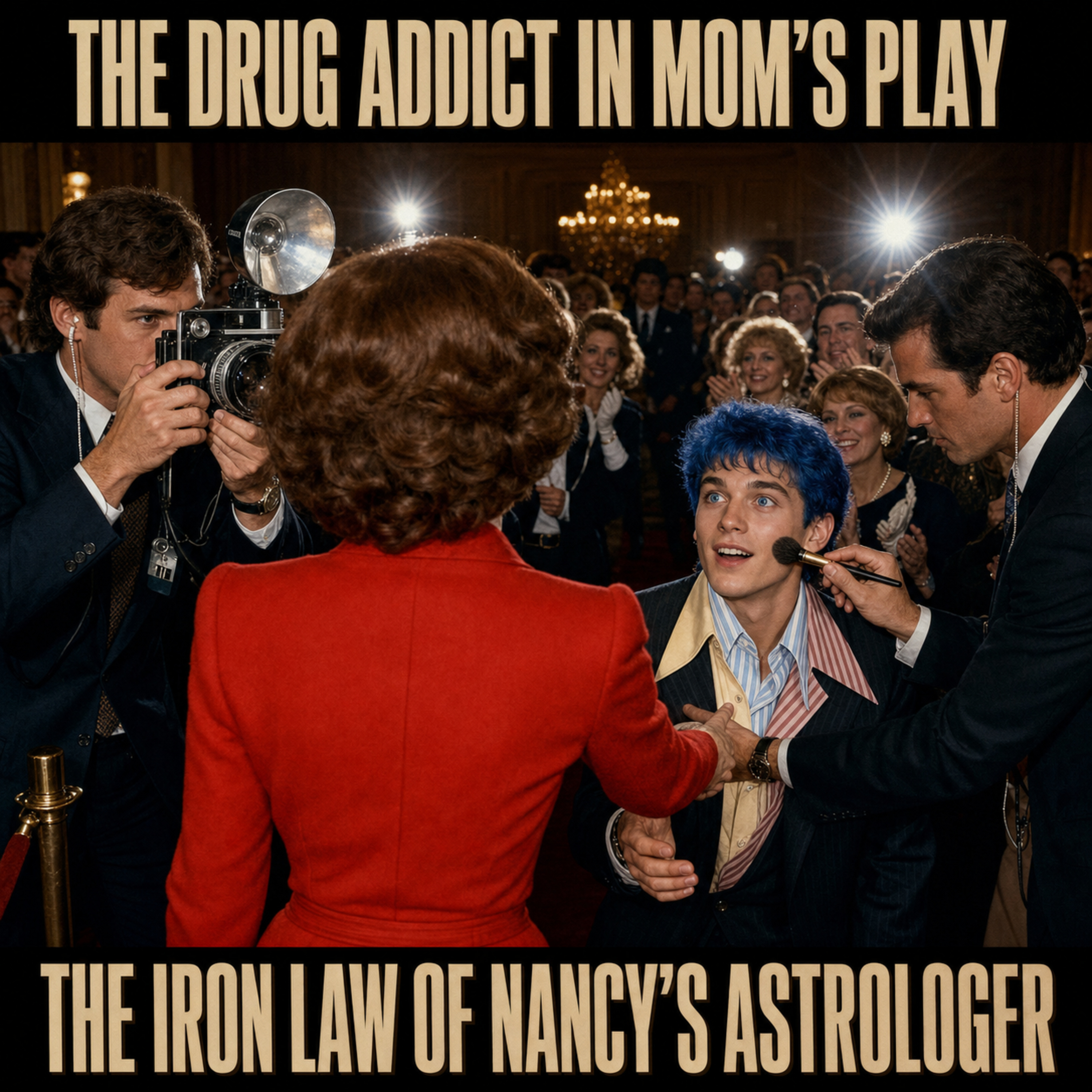
Poor Nancy. I had to wait until she was dead to write this, obviously. Wouldn't want to shit on her parade, even if she was going the wrong way on a one-way street. Maybe it was Aries rising. Whatever that means. I'm an Aries, so I could really give a shit about anything. My motto is "I Am!" Just kidding. I wouldn't have been gentle with Nancy, even though her hand was so bony and the secret service. There were some cute guys guarding her. I bet some of them could role play really well. Not that I'm suggesting that at 15 that would have been appropriate. But as a 57 year-old, it's a delicious scenario. Imagine being taken backstage by a cute secret service agent to get that handshake propaganda photo taken. Maybe I'd hang around, ask if I could go into the dark room with the cute secret service agent and watch the photos develop. Honestly, if I'd been able to articulate this at the time, I would have created my own boy band. We'd constantly be fucking each other as we were on tour. Maybe that would have cut down on how many drugs I had to take.
- DV
 S12 · E1August 9 · 59 min
E1: The Aliens are Watching; S12: They are Watching, Even If They Aren't
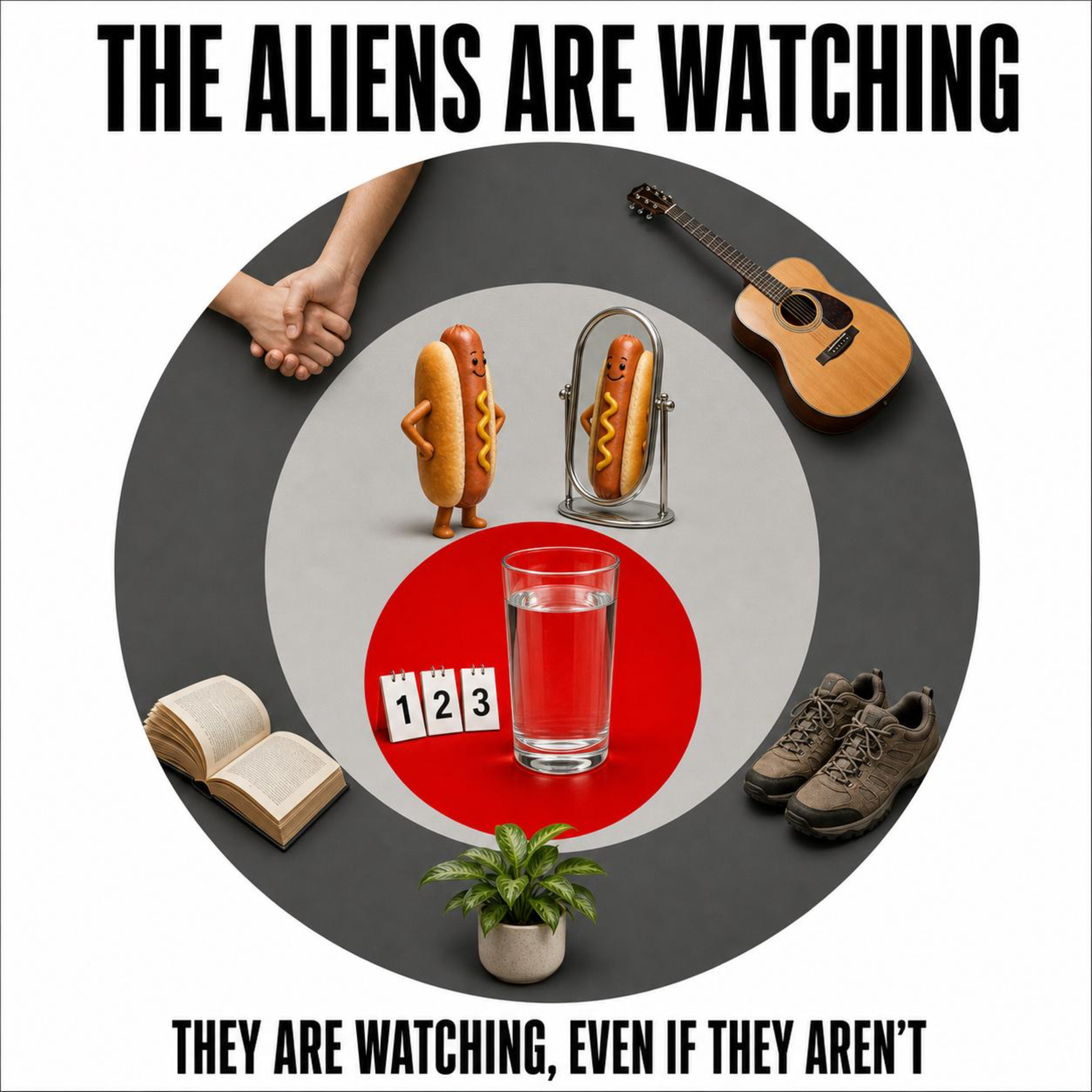
This has been a rollercoaster for me. Everything is. Always performing for an audience's judgement, applause and warmth and maybe I'll even become the king of the universe with my cat! That's a great way to live. Don't you think? Or maybe it's the only way to live... if you're human. Sorry Foucault, maybe society didn't build us a cage... maybe we came with it. Or society is just hacking our built-in cage. Or maybe Foucault already noticed that. Did he? Whether he did or he didn't, isn't it interesting? Shall we put it on a stage with all our stuffed animals watching? I think they would love the show, don't you?
- DV
 S11 · E10August 2 · 11 min
E10: Shoreline Paradox; S11: There is More. There Always Is (Finale)
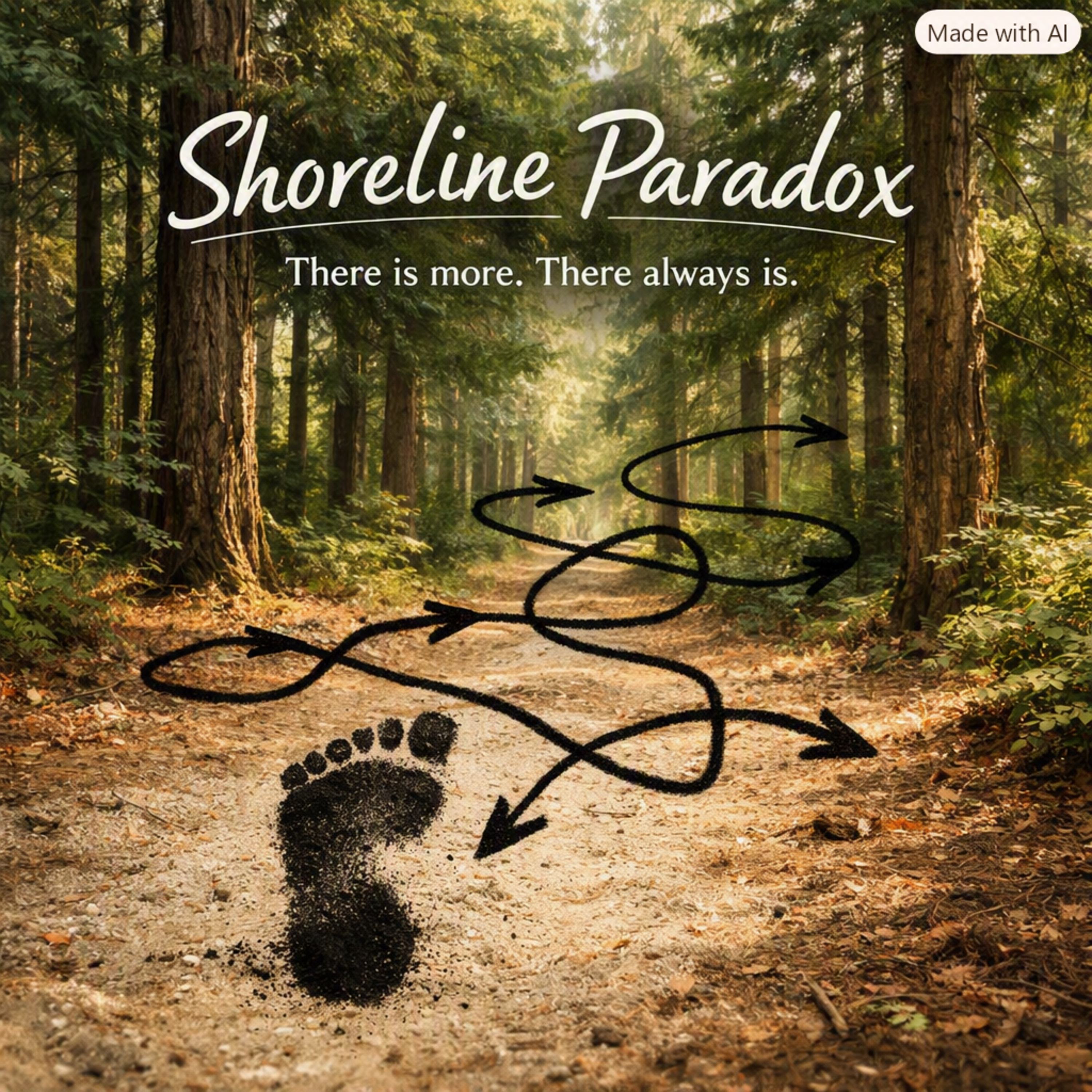
Season 11 has been an eclectic one — a collage of walks, digressions, and small permissions. I didn’t plan it that way; it just kept branching. Every time I thought I’d reached the end of a thought, another entrance appeared. This morning, while trying to tidy my files, I discovered that I already have seven episodes for Season 12. So the paradox continues: zoom in, there’s more; zoom out, there’s more. The archive keeps generating itself. “Shoreline Paradox” feels like the right closing gesture — a footprint and a wandering arrow through cedar light. It’s the sound of someone walking and thinking, not narrating. The cedar forest in the artwork isn’t just scenery. In Coast Salish and other local Indigenous traditions, cedar is a spiritual and cultural cornerstone — used for cleansing, protection, and ceremony. Its bark and boughs carry stories of renewal and continuity. In Metro Vancouver, you can still feel that resonance: the way cedar holds memory without claiming ownership, the way it shelters and releases at the same time. That’s the paradox too — the archive keeps growing, but it’s also a kind of letting‑go. Season 11 ends here, but the walk keeps going.
- DV
 S11 · E9August 1 · 32 min
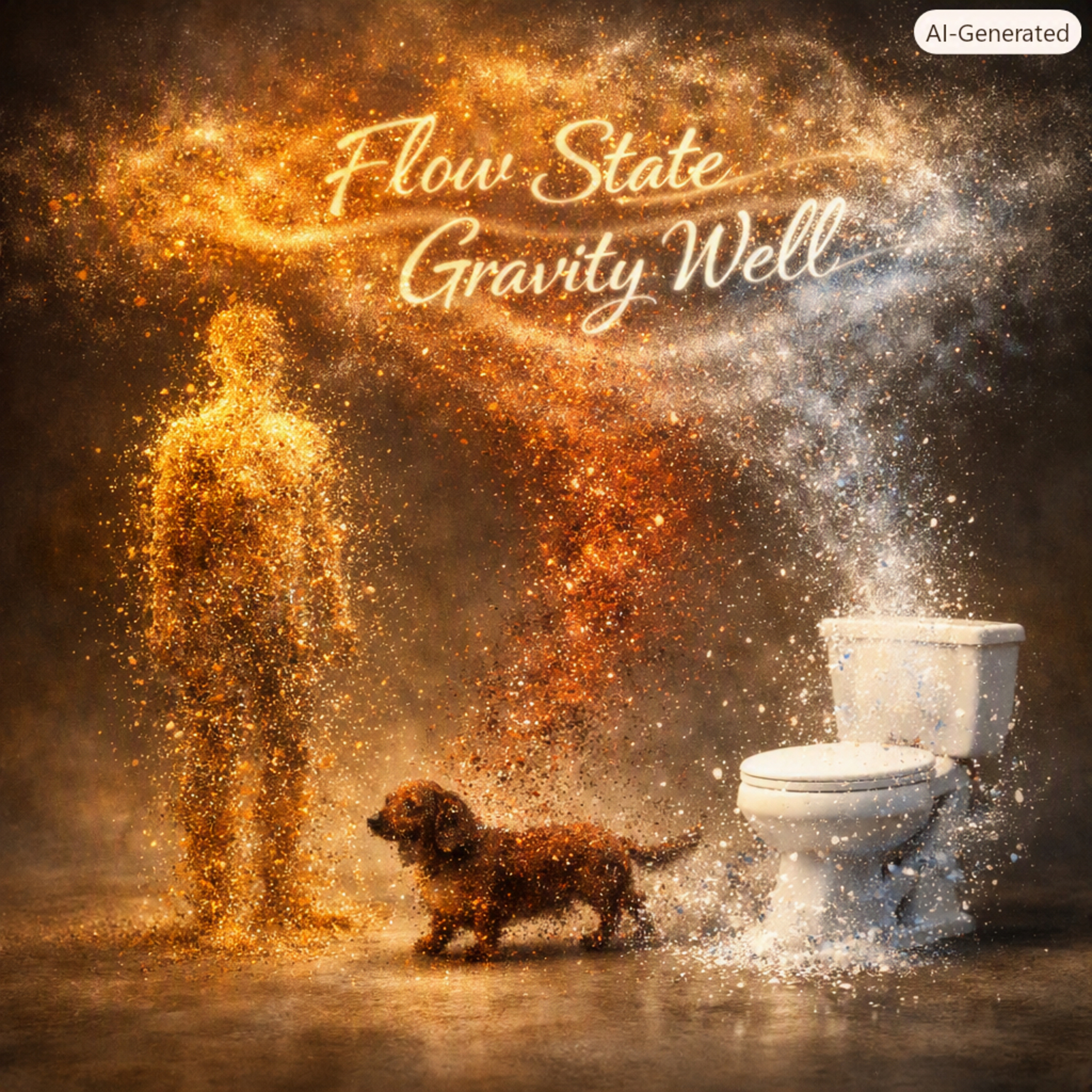
E9: Flow State Gravity Well; S11: Aiming for Privilege
Toxic residue is a gravity well in a full‑career doctorate on the beach. The sand remembers every syllable of privilege, every vowel stretched into a drone. A hand drum somewhere keeps time for the invisible city, and the city keeps time for no one. The mirror is a thesis. The toilet is a confession. The dachshund is a minor planet orbiting the body that forgot to stop talking. The body is a dissertation on borrowed time, annotated by breath. There are houses behind houses, and each one hums with the sound of undeserved sunlight. The ocean is a syllabus. The privilege is a vowel. The vowel is a gravity well. Flow state is not a verb; it’s a contagion. It spreads through the air like particles of ambition, like the residue of a doctorate drying on the beach towel of history. The drone continues. The hand drum continues. The city continues. Every object is a thesis defense. Every memory is a committee. Every committee is a gravity well. The dog scratches at the door of consciousness, and the door opens because consciousness is polite. The camera watches the mirror watch the body watch the city. The city watches the privilege watch the gravity. The gravity watches the residue watch the flow. There is no clean way to live. There is only the choreography of toxic residue, the ballet of borrowed time, the opera of undeserved privilege sung in the key of Ciiiiity. The doctorate dissolves into sand. The sand dissolves into vowels. The vowels dissolve into particles. The particles dissolve into the air above the beach, where the title of the episode hovers like a halo made of syllables. Flow state. Gravity well. Privilege. Poison. Borrowed time. Each word is a planet. Each planet is a memory. Each memory is a residue. Each residue is a flow. And somewhere, beneath all of it, the hand drum keeps playing — not for rhythm, not for meaning, but for the pleasure of watching everything dissolve into motion.
- DV
 S11 · E8August 1 · 11 min
E8: I Talk and it Becomes a Thing; S11: Before and after the data centre-fuelled climate crisis (Camel meet straw and needle)
The Cyborgs Are Getting Hungry It starts with friction — or rather, the lack of it. Dictation used to be a kind of resistance training. You had to wrestle with the machine, transcribe, edit, feed it back, wait for the result. Now you just talk, and it becomes a thing. The latency is gone. The loop is closed. The privileged few who have the time, the bandwidth, the patience to tune their workflows are discovering that the machine doesn’t just listen — it metabolizes. And that’s the real transformation: not the technology itself, but the way it rewires the expectation of effort. When friction disappears, the act of creation becomes a reflex. You speak, and the world rearranges itself to accommodate your speech. You start to believe that the machine is an extension of your nervous system. You start to forget that it isn’t. The cyborgs — the early adopters, the workflow obsessives, the ones who have trained their brains to think in prompts and outputs — are already halfway there. They’re not waiting for implants; they’re waiting for the supply chain. They’re waiting for the chips, the nanometer miracles that make the illusion of instant cognition possible. And those chips depend on thousands of fragile links: rare minerals, geopolitical stability, clean rooms, logistics, labor. Break any one of them, and the whole dream stutters. So imagine what happens when the dream stutters. When the servers go dark, when the updates stop, when the voice interface starts lagging. The cyborgs will panic. They’ll claw for the next fix — the next neural shortcut, the next patch, the next way to keep the loop alive. They’ll want the plug directly into the brain, not because it’s futuristic, but because it’s the only way to keep the dopamine flowing. And that’s when it gets dangerous. Because hunger is contagious. Because once you’ve trained your mind to expect frictionless creation, any interruption feels like starvation. The cyborgs will turn on each other, or on the infrastructure, or on the idea of limitation itself. It won’t look like a war in the old sense. It’ll look like The Purge, but quieter, more technical — a blackout of cognition, a scramble for continuity. The irony is that the same people who built the tools to remove friction will be the first to feel its absence as pain. They’ll be the ones clawing at the dark, whispering into dead microphones, trying to make the world respond again. And maybe that’s the real apocalypse: Not fire, not flood, not famine — Just silence. Just talking, and nothing coming back.
- DV
 S11 · E7July 31 · 35 min
E7: Bigger, Big City; S11: Why was the cucumber circumcised?
Do you wonder what the play Marat/Sade would do to a marginalized eighteen‑year‑old’s brain? Do you ever think about how a lime‑mango drink at 4:33 — John Cage Time — might taste like permission? Do you remember the first time you realized that art could be both a wound and a mirror, and that sometimes the mirror wins? Do you think a person can shrink their life just enough to remain legible to their family, and still call that survival? Do you ever find yourself laughing at the idea that meaninglessness itself has meaning, and then wonder if that’s the joke or the trap? Do you imagine what happens when a child finds a centerfold of a neighbor’s father and turns it into a mural — is that art, trauma, or archaeology? Do you wonder how many times a person can reinvent their own voice before it becomes a ghost of its former frequency? Do you think the smog of 1970s Los Angeles could be considered a kind of theology — a faith in opacity? Do you ever ask whether the hand at the end of the road is real, or just the echo of someone else’s promise? Do you wonder if the phrase “exceptionally pretty” is a compliment or a curse when sung in a city that doesn’t notice you? Do you think a nap on a break‑room couch can qualify as transcendence if the fluorescent light is merciful enough? Do you ever suspect that the word “frame” is just another way of saying “cage” — and that taking it off doesn’t free you, it dissolves you? Do you wonder what happens when a podcast becomes a confession, and a confession becomes a performance, and a performance becomes a way of staying alive? Do you ever think about how a song can whisper “I’ll keep you from pain” and still sound like it’s lying beautifully? Do you wonder if the city itself is listening, or if it’s just another microphone pretending to care? Do you ever ask yourself whether the quietest moments are the ones that actually scream?
- DV
 S11 · E6July 26 · 21 min
E6: I Don't Quilt Anymore; S11: I don't want to put a trigger warning on this one, but... it's a craft!
This episode is called I Don’t Quilt Anymore, but the cover says I Don’t Care Anymore — “Care” scrawled above “Quilt,” crossed out like a confession. It’s part craft, part confession, part reckoning. I asked for a photorealistic image of two men making an AIDS quilt together — a 26‑year‑old white guy and an 18‑year‑old Latino club kid — and when I saw it, it hit me like a punch. It triggered every layer of internalized homophobia I’ve ever carried. I almost didn’t post it. I thought maybe if I’d given the episode first, the AI would have refused to make the image, would have gone back in time and voted for that California proposition in the 1970s — the one Anita Bryant pushed with her orange juice smile — and maybe Ronald Reagan would have stayed silent forever. But I’m posting it anyway. Because this episode is about doing the brave thing even when it hurts. It’s about the ethics of memory, about teaching at a gay high school in the mid‑90s, about the strange tenderness between generations, about the way art and craft blur when you’re just trying to survive. The song, I Don’t Care Anymore by Manuel Ruiz, is a garage‑punk relic from that time — raw, distorted, angry, and beautiful. The monologue that follows is a reckoning with what it meant to be a young gay teacher in a world still haunted by silence. It’s not easy to listen to. It’s not easy to post. But it’s honest.
- DV
 S11 · E5July 26 · 17 min
E5: If You Work in a Restaurant, You're an Addict; S11: 13th Step Heaven
This episode didn’t begin the way it sounds. It started somewhere else—somewhere draftier—and then wandered into the shape you’re about to hear. I won’t explain the process, partly because the process doesn’t want to be explained, and partly because the episode already gives away its own secret without ever saying it out loud. You’ll hear a story that isn’t quite a story, a confession that isn’t quite a confession, and a song that arrived before I understood what it was doing. There are hints scattered everywhere—about sealed rooms, old advice, restaurant myths, and the strange gravitational pull of certain kinds of men—but they’re only hints. They’re supposed to be. If the whole world had a satirical understanding of why people become addicts, or why we stay hooked on relationships that feel like bad weather, this episode wouldn’t need to hide anything. But it does. So it will. The door’s open a crack. That’s all you need.
- DV
 S11 · E4July 26 · 11 min
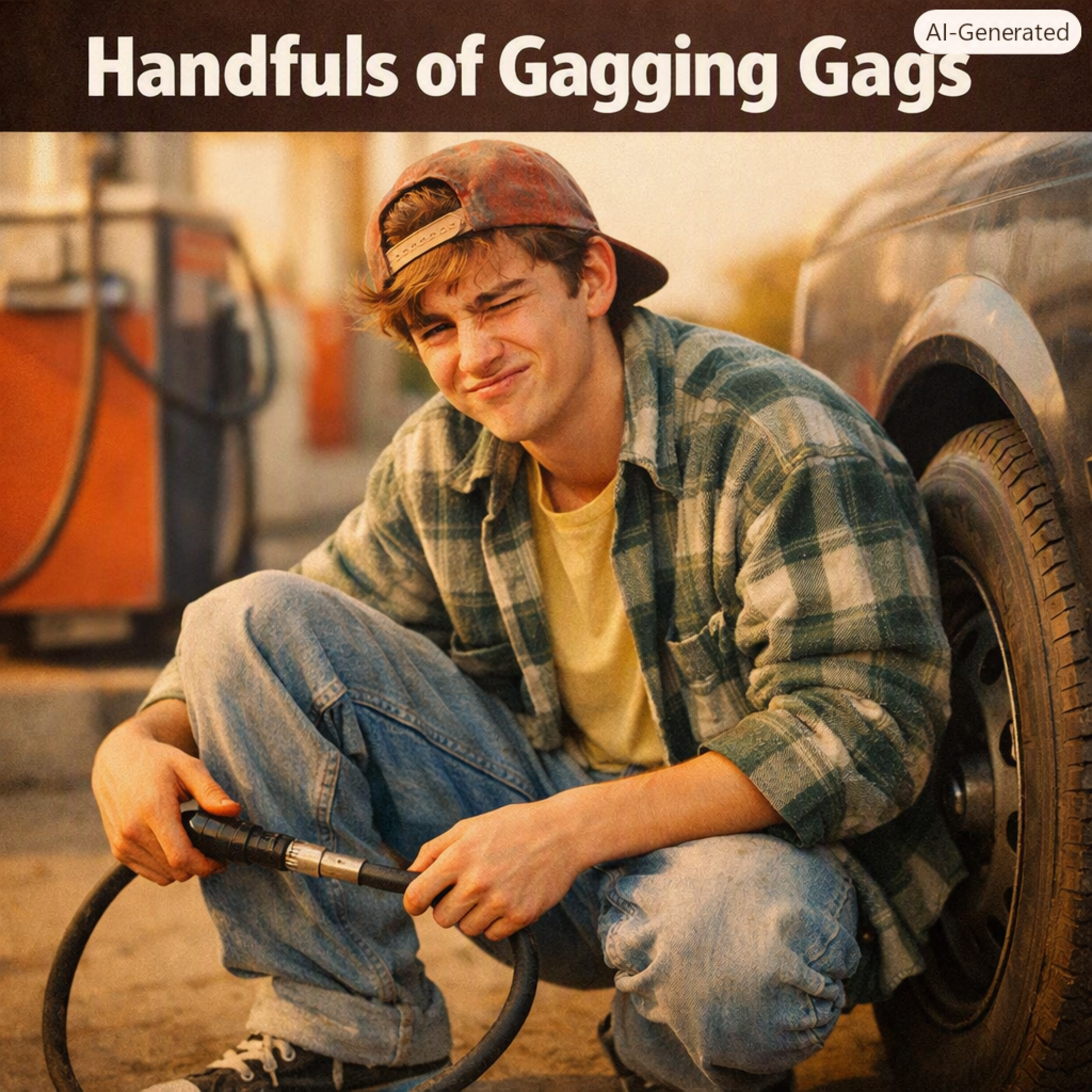
E4: Blowhard, Part 2: Handfuls of Gagging Gags; S11: Twelve Barrels per Barrel
This is Part 2 of the five‑episode Blowhard series, even though in the internal chronology it behaves more like Part 3, and in the release schedule it’s the last one I’m putting up. The whole project has been out‑of‑order from the start: Part 0 came first, Part 1 came somewhere in the middle, Part 3 slipped out before Part 2, and now Part 2 arrives as the final installment. It’s a series, but a scrambled one — intentionally chaotic, intentionally hard to track, intentionally cellular. This episode continues the Blowhard themes: generational collapse, opioid mythology, climate dread, authoritarian kleptocracies, and the strange sensory memories that adolescence tattoos onto adulthood. The monologue wanders through Boomers, shortages, gag reflexes, the AIDS crisis, and the smell of tire air that remembers a boy’s shame. It’s bleak like the others, but also accidentally funny, because exhaustion has its own comedic timing. There’s an addendum at the end — as with the other Blowhard episodes — where I try to correct something I said earlier, or acknowledge a mistake, or revisit a moment I bulldozed through too fast. The music is short and dark, under six minutes, but the talking stretches it out because I can’t stop once I start. If you want to listen to the Blowhard series in order, you’ll have to hunt for the other parts: Part 0, Part 1, Part 3, and Part 4. This one — Part 2 — is right here. And now the whole series is finally complete.
- DV
 S11 · E3July 26 · 37 min
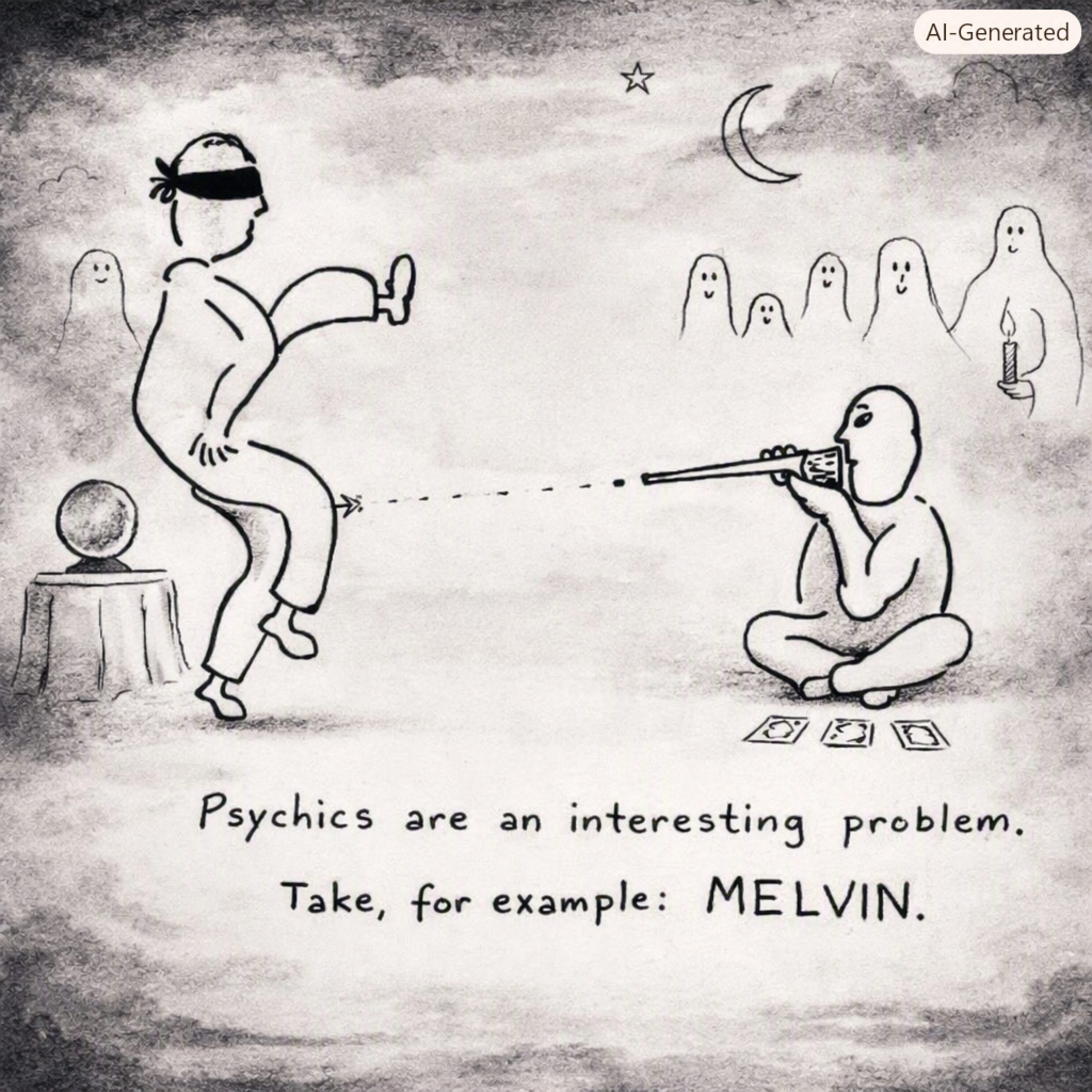
E3: Psychics are an Interesting Problem; S11: The Being to Courage (Tillich Scramble)
I thought I was making an episode about psychics. Then tarot showed up. Then Paul Tillich. Then existentialism, anxiety, compulsive behavior, counselling, sex, the AIDS era, relationships, death, survival, and the strange usefulness of being a socially marginalized person. So I kept talking. This episode starts with a question about whether I can “read” people. I can sometimes watch someone, notice what they're doing, construct a plausible story about what might be happening inside them, and tell that story convincingly enough that they recognize themselves in it. That can look a lot like psychic ability. I don't think it's psychic ability. I think it's observation, pattern recognition, storytelling—and putting a draft in front of another person. That's the idea I keep coming back to. A draft isn't necessarily safe. But it is safer than something that has become final. A final story about who you are. A final story about what happened. A final story about why you behave the way you do. A final story about what somebody else means. A final story about what you're supposed to do next. Once something becomes final, you can stop looking at it. I don't really want to do that anymore. I want to go back into old stories and disrupt them. Let one thought interfere with another. Discover that the question was wrong. Find out that the answer was only one possible story. Take the frame off and discover that I wasn't talking about one thing at all. I was talking about everything. That was part of what tarot gave me: something to push against. A structure that could generate a story without requiring me to pretend that the story was prophecy. In retrospect, that has a lot in common with what counselling became for me—not telling someone what their life means, but putting something on the table and seeing what happens when they push against it. The episode also wanders through sex, the AIDS crisis, fear, relationships, death, survival, my work, my history with addiction and recovery, and the peculiar permission I found in being gay to bring sex into conversations where everyone else seemed determined not to mention it. And, because apparently I don't know when to stop, the episode got longer and longer while I was making it. I pace when I record these. Usually I'm walking around with my iPhone, following associations until I lose the thread and then find another one. The movement is part of the thinking. That eventually produced another episode. I wrote a song called “Draft” about the idea that if you can feel a draft, there must be an opening somewhere. I decided not to put it at the end of this episode. Instead, it became its own episode—and that one gets considerably more uncomfortable. It goes into Dr. Laura Schlessinger. Being an asshole. 13th stepping in AA. Maybe 14th stepping. Maybe 15th stepping. Things I don't even know how to name yet. Maybe I'm just showing you the anal warts one at a time. Not all of them. I'm still figuring out how many I can show you and remain standing. So this episode is a draft. And maybe that's the safest place for it to be.