Skip to content
Artwork for Computer Learning Zone

Computer Learning Zone

Richard Rost

Richard Rost is a Microsoft MVP and President/CEO of Computer Learning Zone. He creates video tutorials to teach you how to use your computer, specializing in Microsoft Access.

Play
  • 40 episodes
  • daily
  • Avg 15 min
  • English
Counted on this page — what you have heard stays on this device, so it is not something the list can be paged by.
  • Yesterday · 3 min

    Microsoft Access Quiz: Hidden Bound Customer ID Fields and Callback Forms

    Test your Microsoft Access form skills with an expert-level callback form quiz. The questions cover a deceptively useful detail: hiding a bound Customer ID control does not erase its value or prevent buttons and VBA from reading it. You will also revisit common callback-list issues, including clearing the Must Callback flag when a call is finished, understanding how date arithmetic changes when time values are removed, and recognizing that a form opened from a filtered query still shows only that query's records. The episode also tackles a familiar query design headache: duplicate date columns caused by selecting both ContactT.* and a separate Callback Date Time field. A few small form and query choices can keep callback workflows accurate without losing important contact history.
  • Thursday · 23 min

    Returning Multiple Values from Microsoft Access VBA Functions

    Need one VBA routine to retrieve several related pieces of information, such as a customer's address, city, state, ZIP code, and country? This episode explores a clean Access VBA pattern for doing exactly that without scattering repeated DLookup code throughout your database. Using a Boolean function result for success or failure and ByRef parameters for the additional values, you can keep related lookup logic in one reusable place. The calling code stays readable, and it is easy to tell whether the customer record was found before using the returned data. We also discuss why multiple DLookups are still perfectly reasonable for simple one-off tasks, and where ByRef outputs fit compared with global variables and TempVars. It is another practical VBA tool for building Access applications that are easier to maintain later, especially when past-you forgot to leave comments.

  • October 7 · 3 min

    Microsoft Access Forms Quiz: What Happens When You Change Records?

    Test your Microsoft Access form knowledge with five beginner-friendly questions about labels, bound forms, Form View, sensitive fields, and continuous forms. One key issue is what happens after you edit a record and see the pencil icon. In most bound Access forms, moving to another record commits the change to the underlying table, so users can accidentally save an edit without pressing Ctrl+S. This quick quiz also clears up common form-design misunderstandings, including why changing a label does not rename a table field and why sensitive data can stay in the table without appearing on every form.

  • October 6 · 11 min

    Microsoft Access Navigation Forms for a Cleaner Database Menu

    When staff open an Access database and see a wall of tables, queries, forms, and reports, it is easy for them to get lost or open something they should leave alone. A Navigation Form provides a simple front door, giving users one clear place to start and an easier way to reach the tools they actually need. This episode covers Access's built-in Navigation Forms, including the available tab layouts, drag-and-drop organization, and why they are a practical no-code option for beginner and small-business databases. You will also hear why making a menu cleaner is not the same as making a database secure. Navigation Forms are quick and useful, but they also host other forms inside a parent form, which can complicate references and VBA work in more advanced projects. Learn where this built-in approach fits well, and when a custom main menu may give you more control.

  • October 6 · 4 min

    Make Microsoft Access Property Sheet Text Larger and Easier to Read

    Small property sheet text can make form and report design in Microsoft Access unnecessarily difficult, especially on high-resolution displays or when your eyes need a little extra help. This episode covers Access's newer option for increasing the Property Sheet font size so design settings are easier to read. We also discuss the difference between zooming forms in Form View and the still-missing zoom support in Design View. For those times when precise control placement is hard to see, Richard shares a practical workaround using the built-in Windows Magnifier. It is a quick accessibility and productivity tip for anyone who spends time building Access forms, reports, and other database objects.

  • October 3 · 3 min

    Microsoft Access Macro Quiz: Form Properties and SetValue

    Test your Microsoft Access knowledge with five quick questions about form properties and macros. This advanced quiz covers control sizing, focus events, fonts, section colors, and the SetValue action. Learn why Access uses twips for control dimensions, why Got Focus and Lost Focus work well for temporary text box resizing, and why common fonts are safer when databases move between computers. The quiz also clears up a common macro mistake: property sheets may display friendly text such as "Normal," while SetValue may require the underlying numeric property value instead. You will also see the proper way to target the Detail section's BackColor on an open form.

  • September 30 · 3 min

    Microsoft Access SQL Quiz: What SELECT Asterisk and Other Clauses Mean

    Test your Microsoft Access SQL knowledge with five quick questions about the building blocks of SELECT queries. The focus includes what SELECT * means, how WHERE filters records, and why ORDER BY affects row sorting rather than the order of returned columns. You will also look at a common combo box Row Source detail: the fields listed after SELECT determine the column sequence. Plus, learn when table-name prefixes and square brackets can be safely removed to make a simple query easier to read. A short challenge for Access users who want to be more comfortable reading and writing SQL without letting their SELECT statement disappear into the cloud.

  • September 26 · 3 min

    Microsoft Access Select Queries: Editing Results and More

    Test your Microsoft Access query knowledge with five beginner-friendly questions about select queries. Explore what select queries do, how to filter records without displaying sensitive values, and how sort order works in the query design grid. You'll also learn an important real-world reminder: editing an editable value in a select query changes the underlying table record, not just a temporary result. That can be convenient, but it also means you are working with live data. The quiz also covers refreshing an open query when another user changes data. A quick refresh, or closing and reopening the query, can bring newly matching records into view.

  • September 24 · 4 min

    Microsoft Access VBA Quiz: Private Procedures and Control Flow

    Test your Microsoft Access VBA knowledge with five quick questions about private procedures, procedure parameters, Select Case statements, ElseIf chains, and operation-specific validation. Learn why a Private Sub stays local to its form module, how arguments such as "Add" are passed into a procedure, and why Select Case can make a calculator-style routine easier to read and maintain. The quiz also covers a common control-flow detail: ElseIf stops checking later conditions after a match, while separate If statements continue evaluating. Plus, see why divide-by-zero validation belongs inside the division case, right before the calculation happens.

  • September 23 · 14 min

    Open the Active Form's VBA Module from the Access Quick Access Toolbar

    When an Access form is already open, filtered, and positioned on the record you need, switching views just to reach its VBA code can be an annoying interruption. This episode covers a small developer customization that adds a Quick Access Toolbar button for opening the code module behind the form currently in use. Using Screen.ActiveForm, a public VBA function can identify the active form and open its corresponding Form_ module. A simple RunCode macro provides the bridge needed to place that function on the Quick Access Toolbar. It is a modest productivity improvement, but it saves repeated clicks, avoids unnecessary Design View detours, and helps preserve your place while developing and debugging Microsoft Access forms.

  • September 21 · 3 min

    Microsoft Access Control Text Colors and RGB Quiz

    Test your Microsoft Access control formatting knowledge with a quick quiz on text colors, RGB expressions, and macro-driven property changes. Learn the difference between ForeColor and BackColor, why RGB(0, 0, 255) produces blue, and how RGB expressions help Access assign usable numeric color values. It also covers changing FontSize with a macro and a common snag when pasting hexadecimal color-picker codes like #FF0000 into a SetValue action. A useful refresher for anyone building Access forms that need clear visual cues without accidentally repainting the whole control.

  • September 20 · 3 min

    Microsoft Access Relationships Quiz: Deleting Customers and Related Contacts

    Test your Microsoft Access relationship knowledge with five questions about parent and child tables, subdatasheets, orphaned records, and referential integrity. Find out what happens when you try to delete a customer who still has related contact records, why Access normally blocks that deletion, and when cascade deletes can change the outcome. It is a useful reminder that deleting a parent record without considering its children can create data problems fast. The quiz also covers the requirements for enforcing referential integrity, including compatible field data types and a unique parent key. See whether your CustomerT and ContactT relationship is properly protected or leaving records to wander around without parents.

  • September 20 · 3 min

    Microsoft Access Relationships and Referential Integrity Quiz

    Test your Microsoft Access relationship skills with five expert-level questions about parent and child tables, one-to-many relationships, subdatasheets, orphaned records, and referential integrity. Find out what happens when you try to delete a customer who still has related contacts, why Access blocks deletions in a properly enforced relationship, and when cascade deletes can change the outcome. It is a useful refresher for avoiding broken customer and contact records. The quiz also covers the database setup Access needs before it can enforce referential integrity, including compatible field data types and a unique parent key. See whether your relationships are protected or wandering around without parents.

  • September 18 · 27 min

    Let Users Choose Continuous Form Columns in Microsoft Access

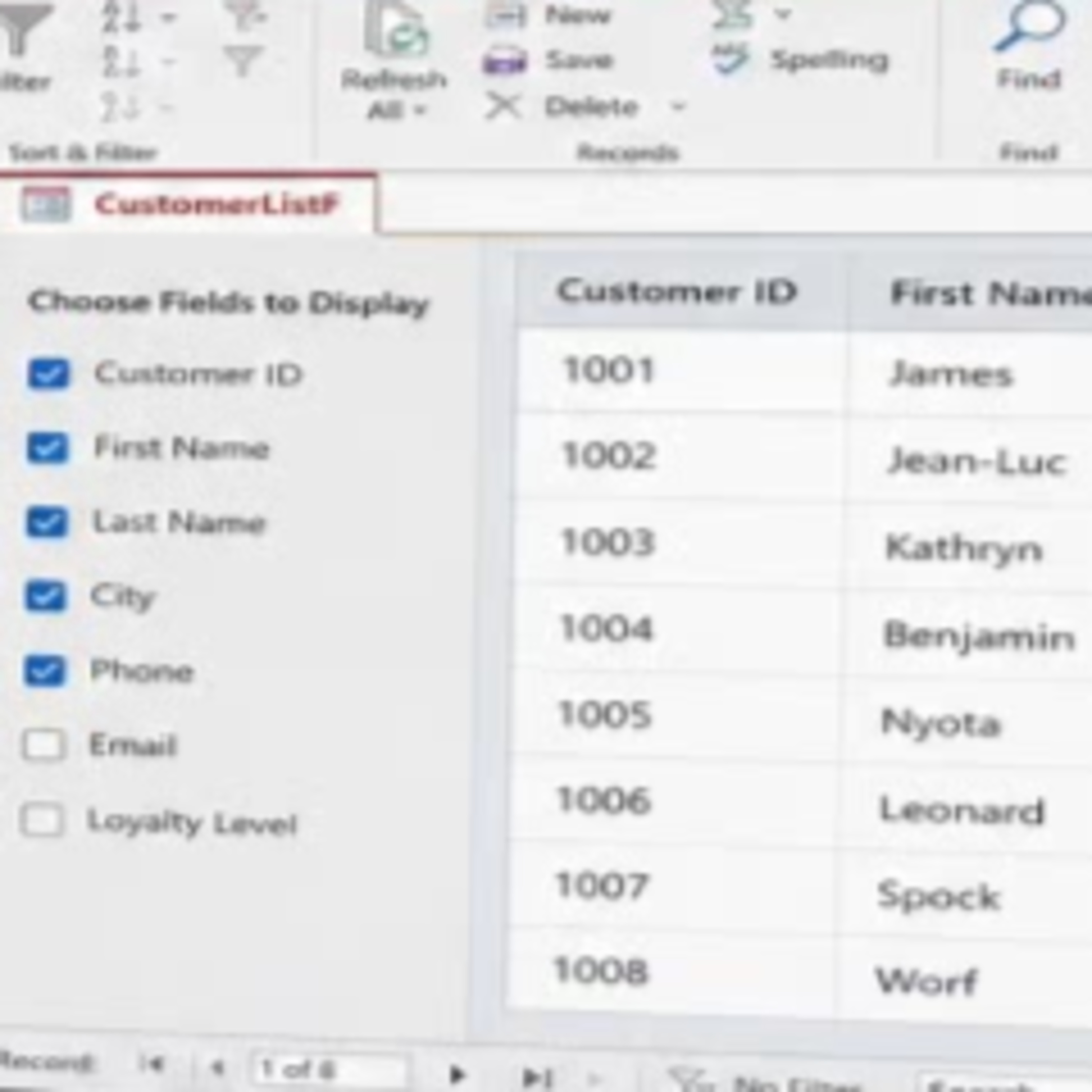
    Continuous forms give you much more design control than a datasheet, but hiding a field can leave awkward blank gaps in every row. This episode looks at a practical VBA pattern for letting users choose which fields they want to see while keeping the remaining controls neatly aligned. Learn how checkbox-based field selectors can show or hide both detail controls and their matching labels, then reposition the visible fields using their Left positions and actual widths. The result is a compact, configurable list that still looks like an intentionally designed Access form. It is a useful approach for forms with different audiences, especially when some users need a simple view while others want additional columns. The discussion also covers when Datasheet View may be the better choice and how this basic technique can grow into saved layouts, user preferences, and reusable form layout management.

  • September 16 · 11 min

    Microsoft Access VBA Error 9: Fixing Subscript Out of Range

    Run-time error 9, "Subscript out of range," usually means VBA is trying to access something that does not exist. Often it is an array position outside its valid range, but it can also involve missing collection items or keys. This episode explains what a subscript is, why indexes can be too high or too low, and why zero-based arrays created with VBA's Array function are a common source of off-by-one mistakes. Three values might sound like positions 1 through 3, but VBA may actually number them 0 through 2. Learn how to use LBound and UBound instead of hard-coding loop limits, how to inspect the failing line in the VBA editor, and why "On Error Resume Next" is not a real repair. It is less like fixing the engine and more like covering the check-engine light with tape.

  • September 13 · 16 min

    Highlight Search Matches Inside Microsoft Access Text Boxes

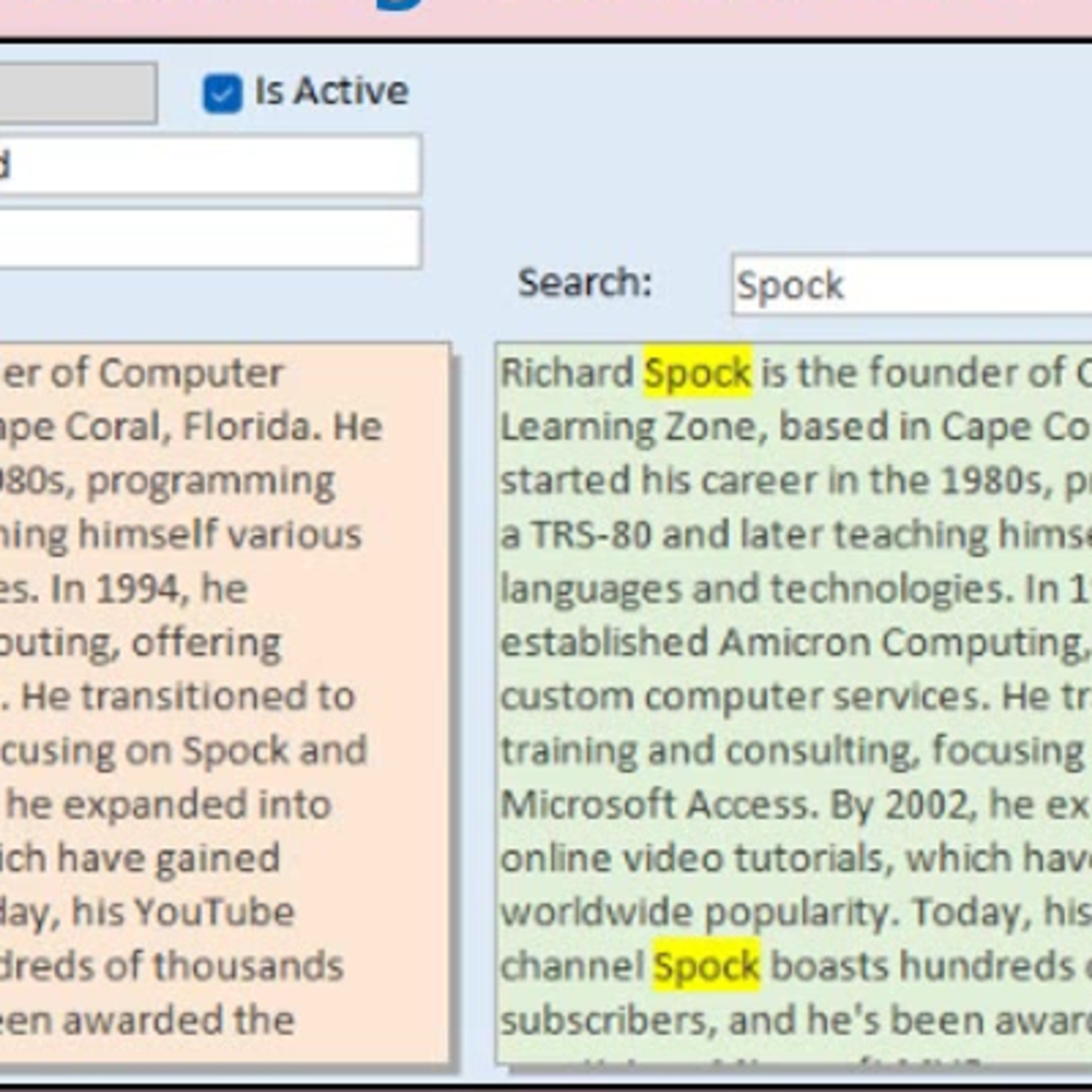
    Conditional formatting can flag an entire field, but that is not much help when a long notes box contains several paragraphs. In this episode, Richard Rost shows how to highlight every occurrence of a search word or phrase inside a Microsoft Access text box without changing the original table data. The discussion uses VBA, rich text controls, HTML-style formatting tags, and the Replace function to create a separate display field with highlighted matches. It also covers why quote handling matters, how case can affect displayed search text, and why this approach is especially useful for large plain-text notes fields. Richard also explains important limitations, including complications with existing rich-text formatting and why an unbound rich-text display does not behave correctly in continuous forms.

  • September 8 · 46 min

    Microsoft Access or Web App? Choosing the Right Path for Your Business

    Do you really need to replace a working Microsoft Access application just because remote employees, mobile devices, or web access are entering the picture? Often, the answer is no. The important question is not whether Access is old, but what business problem actually needs to be solved. This episode separates the Access front end from the database backend and explains why they do not have to be replaced together. A business can move shared data to SQL Server, keep familiar Access forms, reports, queries, and VBA for office staff, and add a focused web or mobile interface only where it is needed. Learn why opening an ACCDB file directly over the internet is a bad idea, why the 2 GB Access file limit does not necessarily mean an Access application cannot grow, and when remote desktop, SQL Server, a customer portal, or a full web application makes sense. A mature Access database often contains years of business rules, automation, reports, and hard-earned exceptions. Before rebuilding it all, make sure you are solving a real requirement instead of reacting to marketing.

  • August 31 · 23 min

    Understanding BOF and EOF in Microsoft Access Recordsets

    BOF and EOF are easy to memorize in Access VBA, but understanding what they mean can save you from some very confusing recordset behavior. This episode explains why EOF alone does not prove a query returned no records, especially after code has moved past the last row. Learn how DAO recordsets track a current record, what happens when you use MoveNext or MovePrevious, and why BOF and EOF are boundary positions rather than actual records. The key empty-recordset test, rs.BOF And rs.EOF, makes much more sense once you can visualize what is happening. We also cover practical details such as where a normal recordset starts after OpenRecordset, why RecordCount can be misleading, and why navigation and deletions can affect what those flags tell you.

  • August 19 · 31 min

    Microsoft Office Installation Problems: Common Causes and Safe Fixes

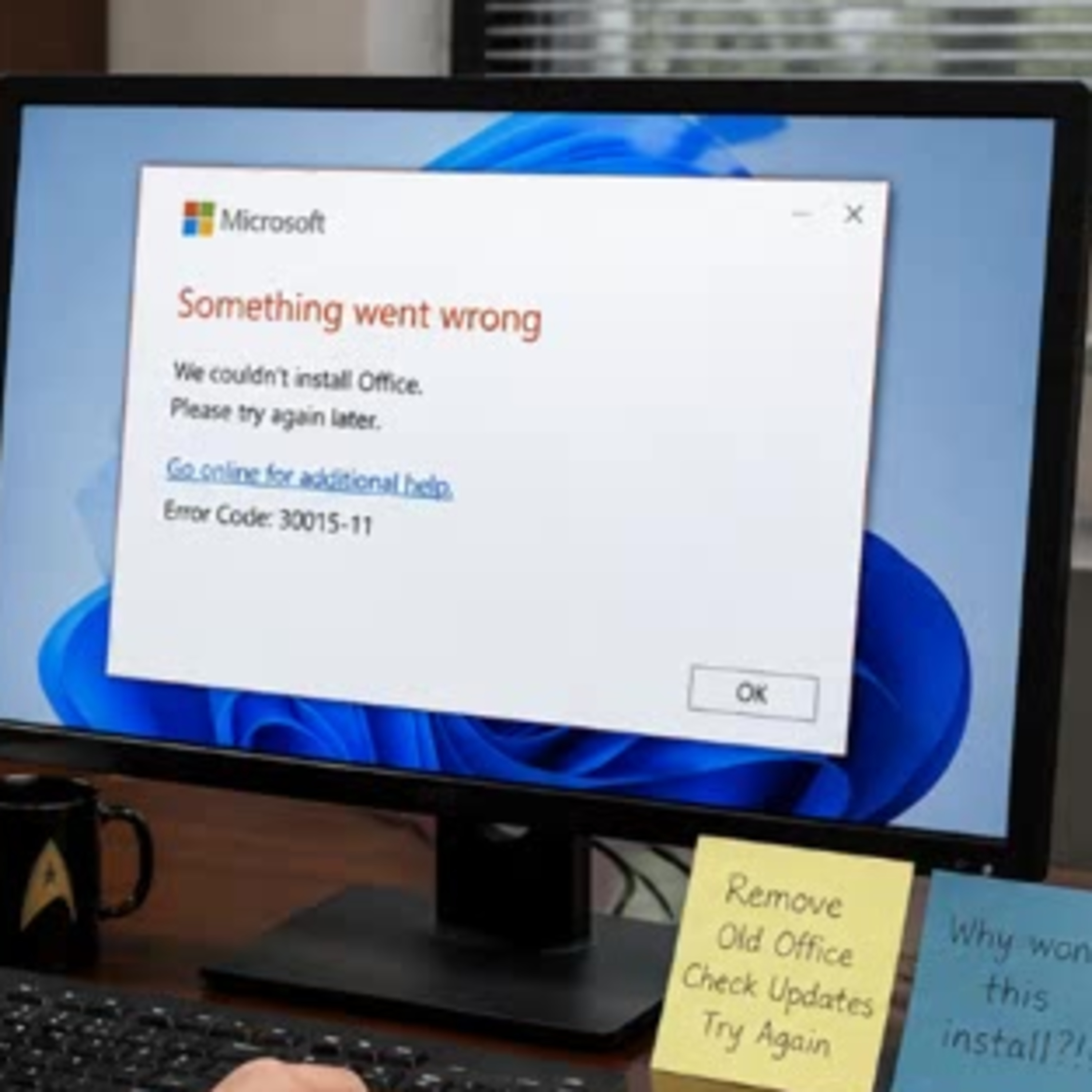
    Microsoft Office installation failures can be frustrating, especially when the error message offers little more than "something went wrong." This episode covers the common reasons Word, Excel, Access, and Microsoft 365 may refuse to install. Learn why leftover files from older Office versions, pending Windows updates, antivirus interference, low disk space, installer issues, and 32-bit versus 64-bit conflicts can stop an installation in its tracks. Access users in particular can run into trouble when Office components and runtimes do not match. The focus is on starting with simple, Microsoft-supported troubleshooting instead of jumping straight into registry edits, mystery repair tools, or risky downloads. Sometimes the real fix is less dramatic than expected, but it can save a lot of time and prevent making the problem worse.

Showing 1–20 of 40 episodes