Skip to content
Artwork for CDFAM Computational Design Symposium
ArtsDesignEducation

CDFAM Computational Design Symposium

Duann Scott

Recordings of presentations from the CDFAM Computational Design Symposium held worldwide. Leading experts in computational design, AI and machine learning for industrial design, engineering and architecture from industry, academia and software development.

www.designforam.com
Play
  • 23 episodes
  • Avg 20 min
  • English
Counted on this page — what you have heard stays on this device, so it is not something the list can be paged by.
  • S6 · E24
    September 12 · 19 min

    Beyond Surrogates: Foundational AI for Physics-Native Design

    CDFAM Computational Design Symposium — Barcelona 2026 Wasil Rezk · BeyondMath A new generation of AI models is emerging — not just faster approximators, but intelligent systems that understand and generate physics. This talk explores how foundational physics AI breaks from the surrogate modeling paradigm. Unlike models that rely on customer-provided simulation data or narrow datasets, BeyondMath’s models are trained on self-generated data rooted in first principles — not interpolating outcomes, but learning the physical laws and structure of the design space itself. This approach enables something radically new: generalizable, physics-consistent predictions at near-CFD fidelity, delivered in seconds — and without the need to retrain when a geometry changes. It opens the door to simulation-native design workflows, where simulation is not a bottleneck but a continuous, integrated part of ideation and optimization. – Why surrogate AI models struggle in real-world engineering – What it means to build a foundational model that learns physics, not data correlations – Case studies from sectors like motorsport and energy – How these models enable new kinds of design tools and thinking This is not an evolution of simulation — it’s a rethinking of how AI and physics interact. Foundational AI for physics is here, and it’s reshaping the very act of designing the physical world. Links Talk page with full transcript Watch the talk on YouTube Cite this talk Search the full text of every recorded CDFAM presentation This is a public episode. If you would like to discuss this with other subscribers or get access to bonus episodes, visit www.designforam.com

  • S6 · E23
    September 12 · 18 min

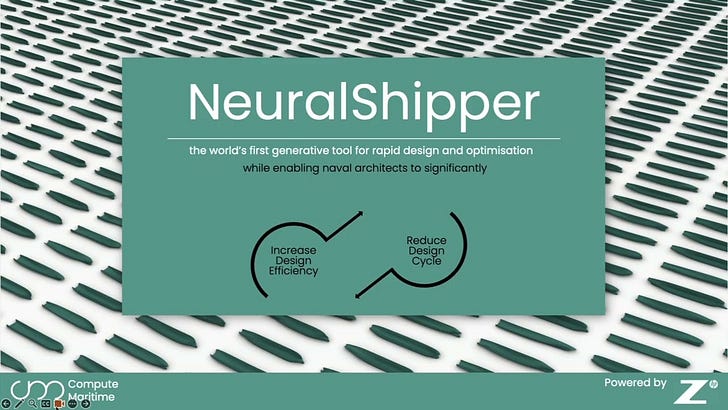
    NeuralShipper: Generative AI for the Next Generation of Ship Design and Manufacturing

    CDFAM Computational Design Symposium — Barcelona 2026 Shahroz Khan · Compute Maritime Water transport, which accounts for approximately 90% of global trade, is essential to economic growth but poses a significant environmental challenge. In 2020, shipping emitted 1.4 billion tonnes of CO₂, nearly 3% of global emissions. Without decisive action, this figure could rise to 18% by 2050. To address this, the International Maritime Organization (IMO) is increasing regulatory and financial pressure on industry stakeholders to cut emissions by at least 40% by 2030 through the adoption of innovative technologies. Achieving these targets requires optimising vessel performance from design through to operation. In fact, 80% of a product’s environmental impact is determined at the design stage, making it the most effective point for influencing a ship’s environmental footprint. Experienced shipbuilders recognise that design and engineering decisions made at this stage affect 85% of total construction costs and approximately 90% of overall vessel performance. However, the maritime industry is often perceived as conservative compared to other transport sectors such as automotive and aerospace. Existing design practices are not suited to developing tools that enable true innovation. This is where Compute Maritime enters the picture, offering AI-powered design tools and data-driven solutions for maritime sustainability. Our flagship product, NeuralShipper, is the world’s first generative AI co-pilot for the design, optimisation, and simulation of maritime systems. It can handle everything from ship hulls and propellers to hydrofoils and rudders, all within a single platform. Unlike conventional tools, which are often restricted to specific ship types, NeuralShipper is universally adaptable. Whether naval architects and marine engineers are working on a fuel-efficient cargo ship, a specialised workboat, a sleek yacht, or a complex naval vessel, NeuralShipper is designed to support them and accelerate the maritime industry’s progress towards net-zero emissions. With only a few design specifications as input, NeuralShipper can generate thousands of tailored design concepts within minutes, each meeting the specified criteria. This eliminates the need for manually drafting preliminary sketches or parametric CAD models, enabling designers to evaluate optimised options in real time. Users can also define custom constraints and performance criteria to create bespoke solutions. Traditional design tools rely heavily on user expertise and deep familiarity with complex software, making the process slow and innovation-limiting. In contrast, NeuralShipper streamlines the entire process. It acts as a collaborative AI designer, working alongside human experts to develop solutions that are both performance-efficient and innovative. This significantly accelerates concept development and allows teams to move swiftly into detailed design without compromising on creativity, innovation, or sustainability. At the core of NeuralShipper lies our Large Geometric Foundation Model, trained on over 100,000 ship designs encompassing nearly every type, shape, and category. This extensive dataset gives NeuralShipper a unique ability to generate solutions that would be difficult or even impossible for human designers to achieve when working with incomplete inputs or domain-limited knowledge. Such scenarios are common in cutting-edge projects exploring next-generation propulsion systems and alternative fuels. Importantly, NeuralShipper is the first generative AI model capable of directly outputting a CAD model, primarily in the form of a NURBS surface. One of the critical challenges facing existing 3D foundational models is surface quality. These models, which often rely on low-level shape representations, frequently fail to capture the geometric precision required for reliable performance analysis. In engineering contexts, where even minor surface imperfections can significantly influence outcomes, ensuring smoothness and validity is crucial. Addressing this challenge, and achieving high surface quality and physics-informed accuracy, has been central to NeuralShipper’s innovation. Links Talk page with full transcript Watch the talk on YouTube Cite this talk Search the full text of every recorded CDFAM presentation This is a public episode. If you would like to discuss this with other subscribers or get access to bonus episodes, visit www.designforam.com

  • S6 · E22
    September 12 · 24 min

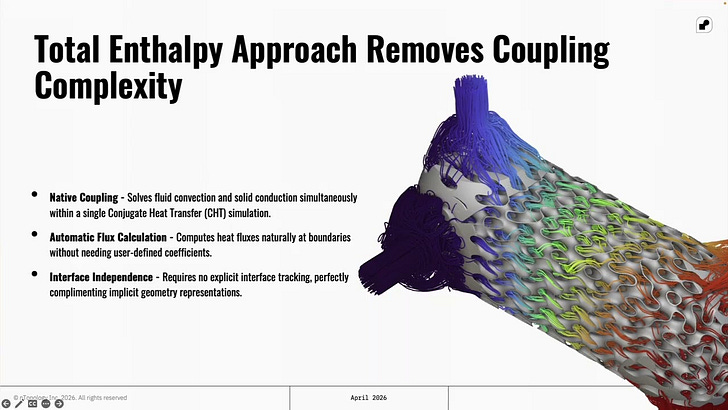
    Conjugate Heat Transfer Optimization for Turbine Blade Thermal Performance Using Field-Driven Design

    CDFAM Computational Design Symposium — Barcelona 2026 Max Gaedtke, Markus Lempke · nTop, Siemens Energy Turbine blade thermal management demands tight coupling between design exploration and high-fidelity simulation—yet traditional workflows separate these domains, limiting the design space that can be practically explored. We present an integrated parametric optimization framework enabled by nTop’s robust implicit geometry engine. Field-driven design representation eliminates mesh regeneration between design variants, while a Lattice Boltzmann Method formulation for conjugate heat transfer removes the need for explicit fluid-solid interface handling. This architectural unity—implicit geometry paired with interface-agnostic thermal transport—permits fully automated design-simulate-optimize loops on complex internal cooling geometries. The GPU-native solver has been validated against finite-volume baselines on canonical heat sink geometries, demonstrating peak temperature agreement within 0.5% while achieving approximately 200x reduction in time-to-solution on consumer-grade hardware. These evaluation times make high-fidelity CHT practical as an inner-loop optimization objective rather than a final verification step. We demonstrate the workflow on turbine blade internal cooling channels, where parametric control over fin positioning drives systematic exploration of the thermal-structural design space. Results show automated identification of Pareto-optimal configurations balancing thermal performance, pressure drop, and additive manufacturing constraints. This collaboration between nTop and Siemens Energy bridges computational design research with industrial turbomachinery requirements. Links Talk page with full transcript Watch the talk on YouTube Cite this talk Search the full text of every recorded CDFAM presentation This is a public episode. If you would like to discuss this with other subscribers or get access to bonus episodes, visit www.designforam.com
Showing 21–23 of 23 episodes