Skip to content
Artwork for CDFAM Computational Design Symposium
ArtsDesignEducation

CDFAM Computational Design Symposium

Duann Scott

Recordings of presentations from the CDFAM Computational Design Symposium held worldwide. Leading experts in computational design, AI and machine learning for industrial design, engineering and architecture from industry, academia and software development.

www.designforam.com
Play
  • 30 episodes
  • Avg 20 min
  • English
Counted on this page — what you have heard stays on this device, so it is not something the list can be paged by.
  • S7 · E24
    Yesterday · 20 min

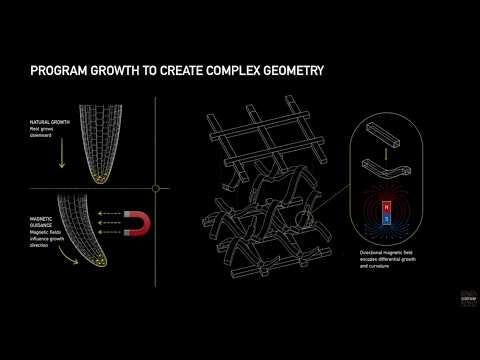
    The Era of Living Machines: How Biology Will Build the Next Generation of Building Materials

    CDFAM Computational Design Symposium — DC 2026 Giorgia Cannici · Virginia Tech What if material fabrication could shift from assembly to growth—and be directed with precision through external fields? This work introduces magnetotropic plants: genetically engineered organisms in which gravity-sensing organelles (statoliths) are rendered magnetically responsive. By replacing gravitational cues with externally applied magnetic fields, plant growth direction can be actively controlled in real time. This enables programmable morphogenesis, where biological growth becomes a steerable process rather than a fixed outcome of genetics and environment. The presentation will outline the biological mechanism, the experimental framework, and the implications of this approach for material production. Magnetic fields act as an invisible, non-contact control layer, allowing spatial and temporal guidance of growth without mechanical intervention. Beyond applications in microgravity environments such as space, this work suggests a broader shift in how we produce materials—moving from extractive, energy-intensive processes toward growth-driven fabrication, where form emerges from the interaction between engineered biology and designed environmental conditions. Links Talk page with full transcript Watch the talk on YouTube Search this talk's transcript Cite this talk This is a public episode. If you would like to discuss this with other subscribers or get access to bonus episodes, visit www.designforam.com
  • S7 · E23
    Saturday · 19 min

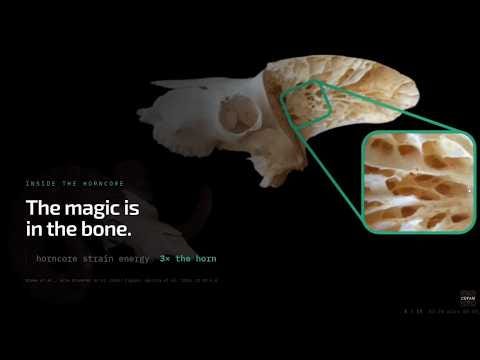
    From Horns to Armor: Biomimicry, Computational Design, and the Future of Impact Protection

    CDFAM Computational Design Symposium — DC 2026 Matthew Shomper · Not a Robot Engineering Nature has been solving the problem of impact protection for millennia, in order to arrive at solutions far more elegant than anything on the market today. The microstructure of a bighorn sheep’s horn is one of the most striking examples : a geometry that is brutally efficient at scattering and absorbing energy, such that the animal can sustain repeated high-speed collisions without lasting damage. The challenge has always been translating that geometry into something we can actually manufacture. Additive manufacturing allows us to build internal geometries that were previously impossible to fabricate : graded densities, interlocking fiber patterns, and layered structures that mirror what nature spent millions of years optimizing. By digitally modeling the ram’s horn at the microstructural level and translating those patterns directly into printable designs, we can produce armor components that outperform conventional materials in energy absorption while perfectly conforming to the body. This work represents a broader shift in protective equipment design: away from material selection alone, and toward architecture as the primary engineering tool. Links Talk page with full transcript Watch the talk on YouTube Search this talk's transcript Cite this talk This is a public episode. If you would like to discuss this with other subscribers or get access to bonus episodes, visit www.designforam.com
  • S7 · E22
    Thursday · 23 min

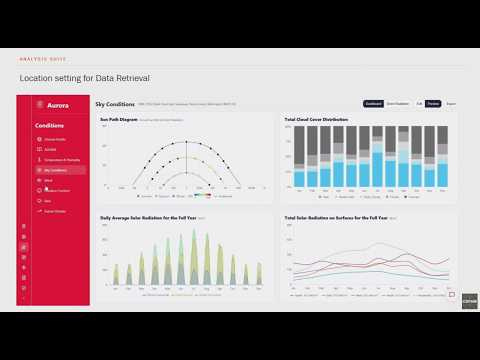
    Before the Model: Aurora as AI-Grounded Climate Intelligence for Early-Stage Design

    CDFAM Computational Design Symposium — DC 2026 Damola Michael; Elliot Glassman · CannonDesign The environmental design conversation typically begins too late, after massing is committed and geometry is locked. Aurora repositions that conversation to day one, giving architects and engineers an immediate, evidence-based picture of any site before a design tool is opened. The platform synthesises EPW weather files, CMIP6 climate projections, ASHRAE design conditions, NOAA historical records for US sites, and seismic hazard data into a unified analysis environment, covering temperature and humidity distributions, wind roses, solar radiation by facade orientation, thermal comfort (UTCI, PET, SET), rainfall, carbon intensity, and future projections to 2050. Every analysis is immediately exportable as a formatted PDF or PowerPoint report, ready to present to a client or design team without additional preparation. Two integrated AI layers surface this data as design insight. A streaming conversational assistant powered by Google Gemini is grounded in the actual EPW and CMIP6 data for the active location. It explains what site climate means for design decisions, renders specific charts inside the conversation, and adjusts application settings through natural language. A second layer generates AI-written summary cards for ASHRAE design conditions and 2050 climate outlooks, automatically scoped to the site. Aurora does not generate or evaluate geometry. This is intentional: it is a pre-design climate intelligence layer, not a replacement for tools like Autodesk Forma. It provides the environmental literacy that should inform every decision made in those tools, a shared language between architect, engineer, and client before a single wall is drawn. Links Talk page with full transcript Watch the talk on YouTube Search this talk's transcript Cite this talk This is a public episode. If you would like to discuss this with other subscribers or get access to bonus episodes, visit www.designforam.com
  • S7 · E21
    Thursday · 15 min

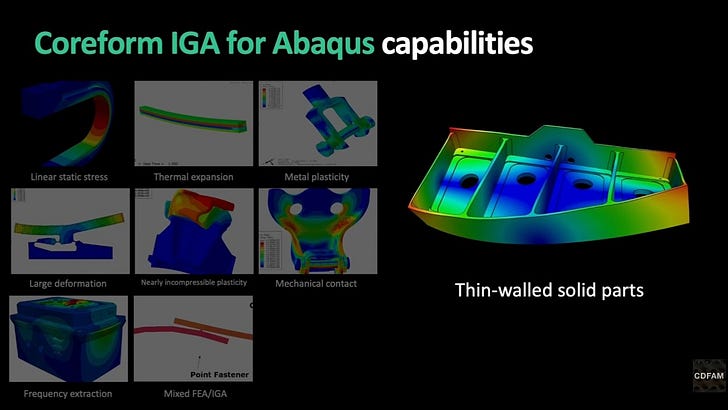
    Bridging the CAD-to-Simulation Gap: Integrating Meshing-free Isogeometric Analysis into Industrial Workflows

    CDFAM Computational Design Symposium — DC 2026 Matthew Sederberg · Coreform The traditional “design-to-analysis” loop is often bottlenecked by the laborious process of mesh generation, which can consume up to 80% of total simulation time. This presentation introduces Coreform IGA for Abaqus, a solution that brings CAD-exact isogeometric analysis (IGA) directly into the Abaqus ecosystem. By utilizing Coreform’s Isogeometric Analysis approach, users can perform high-fidelity simulations directly on CAD geometry, effectively bypassing the need for traditional finite element meshing. Links Talk page with full transcript Watch the talk on YouTube Search this talk's transcript Cite this talk This is a public episode. If you would like to discuss this with other subscribers or get access to bonus episodes, visit www.designforam.com
  • S7 · E20
    Thursday · 16 min

    AI-Native, Simulation-Driven Insight with End-to-End Traceability

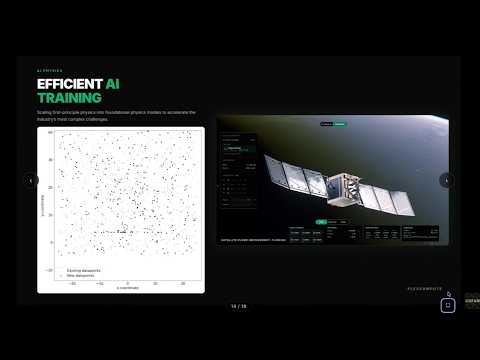
    CDFAM Computational Design Symposium — DC 2026 Mike Park · Flexcompute Computational design enables wider configuration exploration and reduces time to market, but turning innovation into validated, manufacturable designs is hampered by human-in-the-loop simulation. Manual geometry cleanup, meshing, and data management pace every workflow, while the feedback loops between simulation and the rest of the design organization stay broken by data silos. This talk presents an end-to-end, AI-native approach to closing those loops. GeometryAI applies a novel, topology-aware geometry representation that takes raw CAD to analysis-ready models automatically with mathematical guarantees that facilitate meshing and analysis. Physics-agnostic output feeds CFD, structural, and thermal tools with direct connections to surrogate training and inference. The GPU-native solver Flow360 delivers high-fidelity physics at speeds that tighten feedback loops. Thread ties it together with automatic data lineage, so every run is reproducible, every result is traceable, and institutional knowledge becomes the starting point rather than the bottleneck. Standard web interfaces and Python APIs enable humans and their agents equally. Real-world results are validated with industry-standard AIAA High-Lift Prediction Workshop submissions. Full-aircraft hover analysis is possible in hours. We show how geometry-aware automation, GPU-native simulation, and complete traceability make simulation-driven design genuinely agent-ready, at the scale and speed modern programs demand. Links Talk page with full transcript Watch the talk on YouTube Search this talk's transcript Cite this talk This is a public episode. If you would like to discuss this with other subscribers or get access to bonus episodes, visit www.designforam.com
  • S7 · E19
    September 29 · 20 min

    Optimal Lattice Selection for PCM Thermal Management

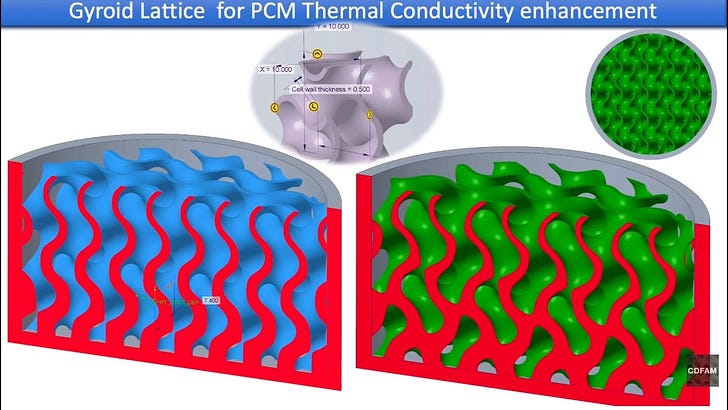
    CDFAM Computational Design Symposium — DC 2026 Andreas Vlahinos · Advanced Engineering Solutions PCMs provide cooling without requiring an extra power source, unlike fans or active liquid cooling systems. They absorb peak energy loads during operation and release that heat when the ambient temperature drops, acting as a buffer against rapid temperature changes. This allows for more compact thermal management systems. Because most PCMs have inherently low thermal conductivity, they often fail to absorb or release heat quickly enough for high-demand applications. Designers can significantly improve the thermal performance of Phase Change Materials (PCM) by embedding lattice structures. Embedding a highly conductive lattice, such as aluminum or copper, forms a “thermal skeleton” that functions as a heat highway, dissipating heat more quickly and evenly through the PCM. Adding a 3D-printed metal lattice can increase the effective thermal conductivity of a PCM system by an order of magnitude compared to pure PCM. The internal structure provides a continuous path for heat conduction, which can double the melting speed. Beyond thermal benefits, the lattice provides mechanical support to the PCM, preventing leakage and helping it maintain its shape during the liquid phase. Simulating PCMs’ thermal behavior is difficult due to the highly nonlinear nature of latent heat release, the shifting phase-change boundaries, and the significant differences in physical properties between the solid and liquid states. This presentation demonstrates simulation techniques and showcases the process of optimal lattice selection. Links Talk page with full transcript Watch the talk on YouTube Search this talk's transcript Cite this talk This is a public episode. If you would like to discuss this with other subscribers or get access to bonus episodes, visit www.designforam.com
  • S7 · E18
    September 29 · 15 min

    Git for Hardware: Version Control as the Foundation for Agile Systems Engineering

    CDFAM Computational Design Symposium — DC 2026 Steve Massey · SysGit Software development was transformed when version control became infrastructure rather than afterthought. Hardware engineering has not had an equivalent transition. Requirements live in documents. System models are stored in vendor-locked platforms. Design reviews happen in meetings rather than pull requests. The result is programs that cannot iterate at the speed the environment demands. SysGit applies the tools and workflows that scaled software development — branching, merging, diffing, CI/CD pipelines — directly to systems engineering artifacts, built on SysMLv2 and backed by existing Git infrastructure. Requirements, system models, and verification activities are captured in a single machine-readable format, traceable across the full program lifecycle and accessible to every stakeholder from specialist engineers to contracting officers. This presentation covers the technical architecture behind that approach, the role of agentic AI in automating requirements generation and model validation, and what continuous acquisition looks like when the digital thread is built on open standards rather than walled gardens. Links Watch the talk on YouTube Search this talk's transcript Cite this talk This is a public episode. If you would like to discuss this with other subscribers or get access to bonus episodes, visit www.designforam.com
  • S7 · E17
    September 25 · 21 min

    Artificial Intuition: Building an AI Mind for Electromagnetic Design and Engineering

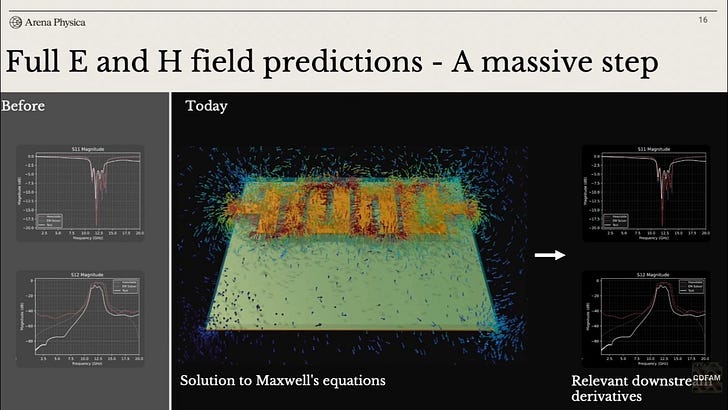
    CDFAM Computational Design Symposium — Washington DC 2026 Michael Frei · ARENA Physica Most advances in computational design focus on mechanical structure — domains we can visualize and have evolved an intuition for. But as modern hardware becomes increasingly software defined, the unseen and unintuitive world of electromagnetism is taking center stage. Conventional solvers can simulate fields, yet they cannot imagine new ones. Over the past year, our team has been building toward that capability. At CDFAM NYC and Barcelona, we shared early results from Atlas — an AI that learns electromagnetic behavior inductively from test data rather than deductively from first principles, enabling verification, optimization, and design postulation in domains where classical simulation reaches its limits. This talk shares our vision for the future of AI-driven electromagnetic design. Links Talk page with full transcript Watch the talk on YouTube Cite this talk Search the full text of every recorded CDFAM presentation This is a public episode. If you would like to discuss this with other subscribers or get access to bonus episodes, visit www.designforam.com
  • S7 · E16
    September 25 · 20 min

    AI-Enabled Assembly Configuration Spaces: Encoding Mechanical Intuition at the Design-Manufacturing Interface

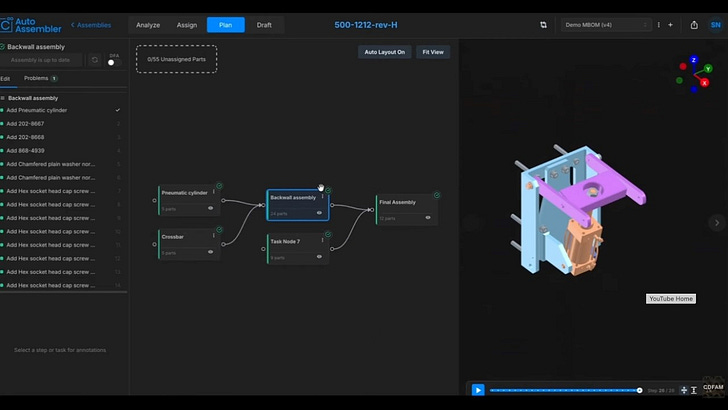
    CDFAM Computational Design Symposium — Washington DC 2026 Sai Nelaturi · C-Infinity The gap between digital design and physical assembly is not primarily a geometry problem. It is a reasoning problem. Engineering teams spend thousands of hours communicating assembly intent through manual CAD workflows, managing configuration complexity across product variants, and catching fitment and feasibility issues that could have been identified before any metal was cut. The cost is measured in weeks of engineering time per product release cycle. Links Talk page with full transcript Watch the talk on YouTube Cite this talk Search the full text of every recorded CDFAM presentation This is a public episode. If you would like to discuss this with other subscribers or get access to bonus episodes, visit www.designforam.com
  • S7 · E15
    September 24 · 20 min

    Physics AI as a Strategic Advantage: How Physics-based AI Models Are Reshaping U.S. Defense Engineering

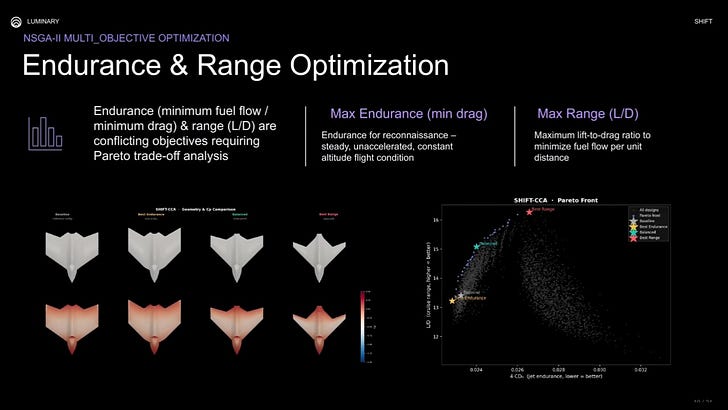
    CDFAM Computational Design Symposium — Washington DC 2026 Juan Alonso · Luminary The next decade of great-power competition will be won or lost in the engineering loop. Adversaries have increased the speed of iteration in hypersonics, undersea platforms, and autonomous aircraft and the U.S. defense industrial base cannot keep up by relying on traditional engineering workflows. Closing that gap requires a step-change in how programs are developed with AI-accelerated engineering. Links Talk page with full transcript Watch the talk on YouTube Cite this talk Search the full text of every recorded CDFAM presentation Join leading experts in computational design at all scales for two days of knowledge sharing and networking at CDFAM in Tokyo, October 8-9, 2026 This is a public episode. If you would like to discuss this with other subscribers or get access to bonus episodes, visit www.designforam.com
  • S7 · E11
    September 23 · 11 min

    From Text to Robotic Assembly: 3D Generative AI and Discrete Robotic Assembly for Making Physical Objects

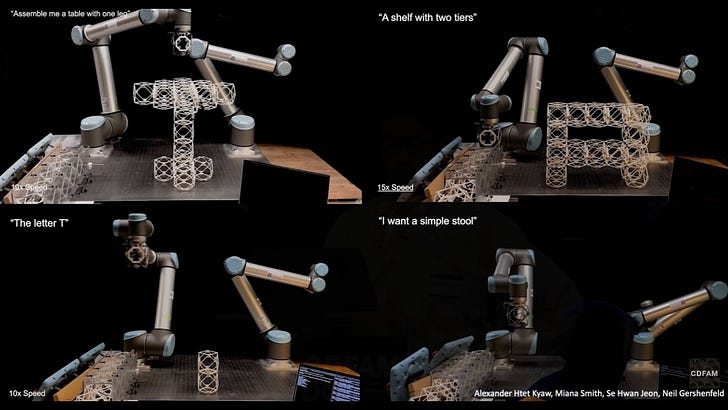
    CDFAM Computational Design Symposium — Washington DC 2026 Alexander Htet Kyaw · MIT Recent advances in 3D generative AI make it possible to create object geometries directly from natural language, but turning these digital forms into functional physical objects remains a major challenge. Most generated 3D models are meshes that do not contain the component level, structural, material, and assembly information required for robotic fabrication. This presentation introduces a research pipeline that combines 3D generative AI, vision language models, and robotic assembly to transform text prompts into multicomponent physical objects. Rather than only asking what an object should look like, the system reasons about how it should be physically composed, including where stronger, lighter, stiffer, or more flexible components are needed. The work points toward a future in which AI driven design systems can generate not only visual form, but also buildable, reusable, and materially informed assemblies for real world fabrication. Links Talk page with full transcript Watch the talk on YouTube Cite this talk Search this talk's transcript This is a public episode. If you would like to discuss this with other subscribers or get access to bonus episodes, visit www.designforam.com
  • S7 · E9
    September 23 · 17 min

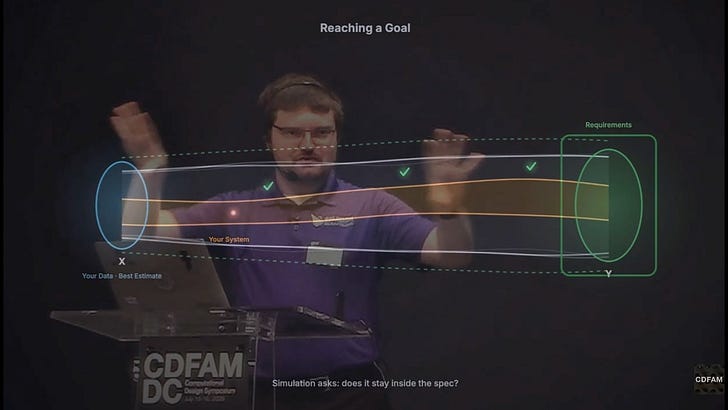
    Computational Design in Aerostructures: Topology Optimization for Conceptual Design and Trade Studies

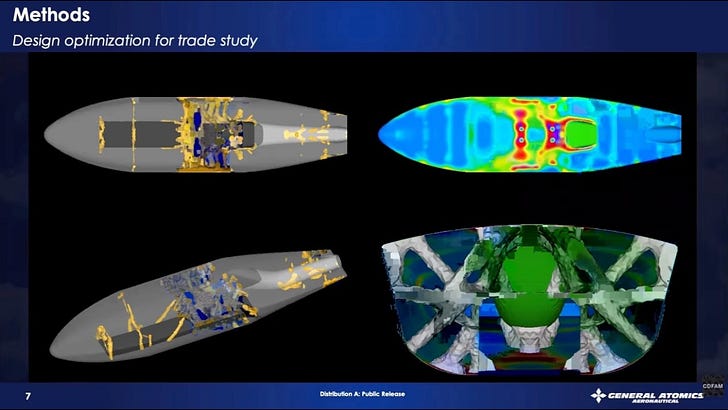
    CDFAM Computational Design Symposium — Washington DC 2026 Brandon DeMille · General Atomics Aeronautical Systems Computational design methodologies, including topology optimization, are transforming airframe structures development by enabling rapid exploration of design configurations during early conceptual phases. This presentation demonstrates a workflow that enables informed decision-making across disciplines and accelerates the path from initial concept to detailed design. A fuselage case study illustrates the simultaneous optimization of composite laminates for skins, substructure geometry, and overall shaping. This integrated approach facilitates quantitative trade-offs among competing priorities such as cost, structural performance, manufacturability, and production rate. Links Talk page with full transcript Watch the talk on YouTube Cite this talk Search this talk's transcript This is a public episode. If you would like to discuss this with other subscribers or get access to bonus episodes, visit www.designforam.com
  • S7 · E10
    September 22 · 18 min

    From Requirements to Manufacturable Systems: Agentic AI on a Live Engineering Knowledge Graph

    CDFAM Computational Design Symposium — Washington DC 2026 Chris Helmerich · Celedon Solutions Most ‘AI for engineering’ tools today sit beside the design process with a chat window next to a CAD viewer, a copilot that summarizes documents someone still has to act on. The harder problem is putting AI inside the loop, where it can read and write the same structured representation of the system that engineers, simulations, and downstream manufacturing all depend on. This talk covers how we approached that problem at Celedon Solutions while building Davinci, an engineering platform where agentic AI operates directly on a live knowledge graph of the system under design. Requirements, components, interfaces, behaviors, and their relationships all live in one connected structure, and the agents that work on it can pull structured model content out of reference documents, generate and compare architectural alternatives against performance and cost constraints, trace requirements through simulation results, and reach into external tools such as parts databases, Python simulations, PLM systems through APIs and Model Context Protocol. I’ll walk through the design decisions behind a graph-native rather than document-native foundation, show where generative exploration has meaningfully compressed early-phase trade studies in aerospace and defense pilots, and talk honestly about the failure modes where agents confidently produce plausible-looking nonsense, and what guardrails and iteration strategies actually work. The goal is a practical view of what it takes to move AI from the margins of the engineering workflow into the part of the process where design decisions actually get made. Links Talk page with full transcript Watch the talk on YouTube Cite this talk Search this talk's transcript This is a public episode. If you would like to discuss this with other subscribers or get access to bonus episodes, visit www.designforam.com
  • S7 · E14
    September 21 · 19 min

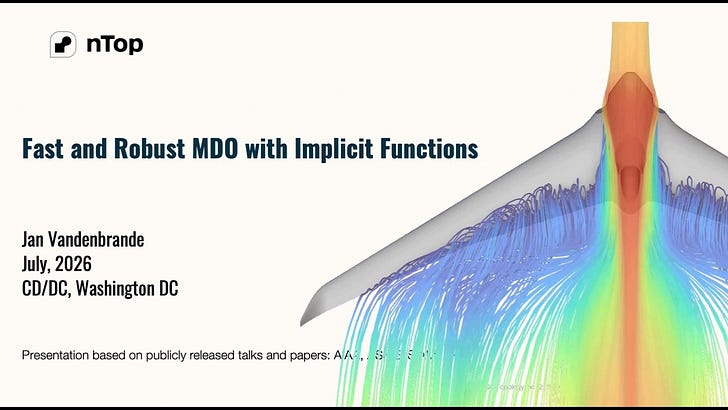
    Fast and Robust Design with Implicit Functions and Direct Simulation

    CDFAM Computational Design Symposium — Washington DC 2026 Jan Vandenbrande · nTop Current Computer Aided Design systems excel in static detailed design but are too fragile and slow to support Design Exploration and Multidisciplinary Design Optimization for conceptual and preliminary design. This talk introduces a new approach to modeling products that overcomes these shortcomings based on implicit functions popularized in the animation industry. The main benefits of the approach is that is responsive to the need to design and redesign products in days or weeks and not month or years because of absolute robustness to parametric change minimizing human intervation; lightning fast evaluations leveraging GPUs; and performing analysis directly from the representation w/o the need of human intervention to generate cumbersome and error prone meshes. Links Talk page with full transcript Watch the talk on YouTube Cite this talk Search the full text of every recorded CDFAM presentation This is a public episode. If you would like to discuss this with other subscribers or get access to bonus episodes, visit www.designforam.com
  • S7 · E12
    September 21 · 20 min

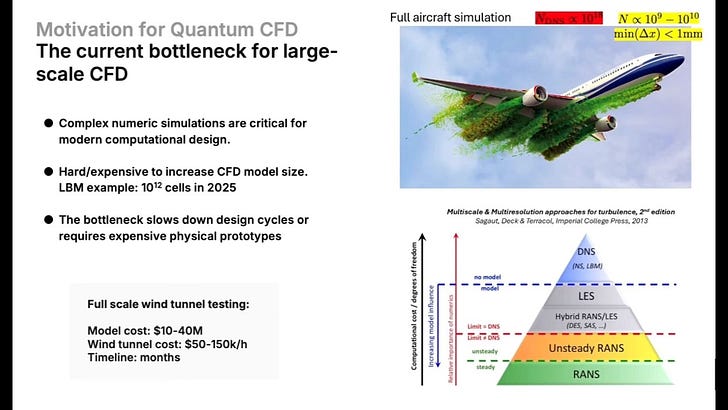
    Solving Aerodynamics Problems With Quantum Computers

    CDFAM Computational Design Symposium — Washington DC 2026 William Steadman · Quanscient We present the results of the largest CFD simulations to date deployed on IBM and IonQ quantum hardware through our ongoing collaborations across the aerospace, maritime, and automotive sectors. We will explore the critical trade-offs quantum computing introduces to computational design in aerodynamics and aeroacoustics, while demonstrating how these advancements are being integrated into Quanscient’s multiphysics software. Links Talk page with full transcript Watch the talk on YouTube Cite this talk Search the full text of every recorded CDFAM presentation This is a public episode. If you would like to discuss this with other subscribers or get access to bonus episodes, visit www.designforam.com
  • S7 · E13
    September 21 · 20 min

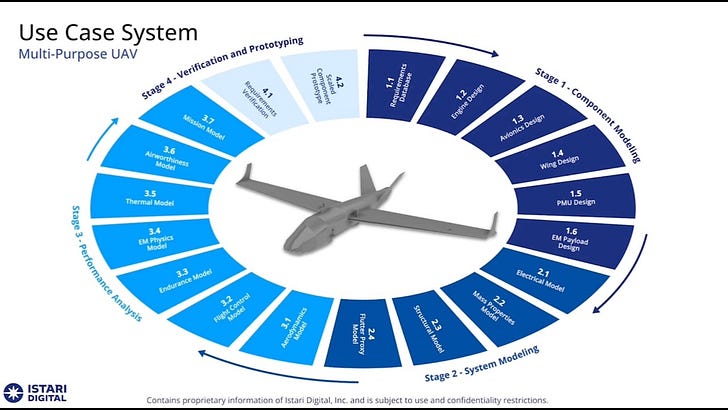
    The Digital Thread In The Real World: Multiple Partners, Multiple Tools, One Truth

    CDFAM Computational Design Symposium — Washington DC 2026 Austin Herrema · Istari Digital As the Department of Defense accelerates adoption of digital engineering and advanced manufacturing, the challenge is no longer defining the digital thread—it is executing it across a fragmented Defense Industrial Base (DIB). This session will explore a consortium-based approach to demonstrating an end-to-end digital thread spanning design, build, operations, and sustainment—executed within each partner’s native environment. Rather than forcing tool or data standardization, this effort enables participating organizations to use their own systems, data architectures, and processes while securely sharing only what is necessary to maintain a federated, authoritative source of truth. The result is a practical model for interoperability that reflects real-world constraints: multiple vendors, distributed ownership, and varying levels of digital maturity. Links Talk page with full transcript Watch the talk on YouTube Cite this talk Search the full text of every recorded CDFAM presentation This is a public episode. If you would like to discuss this with other subscribers or get access to bonus episodes, visit www.designforam.com
  • S7 · E5
    September 18 · 19 min

    When Failure Is Not an Option: Bringing Certifiable AI to Engineering Design

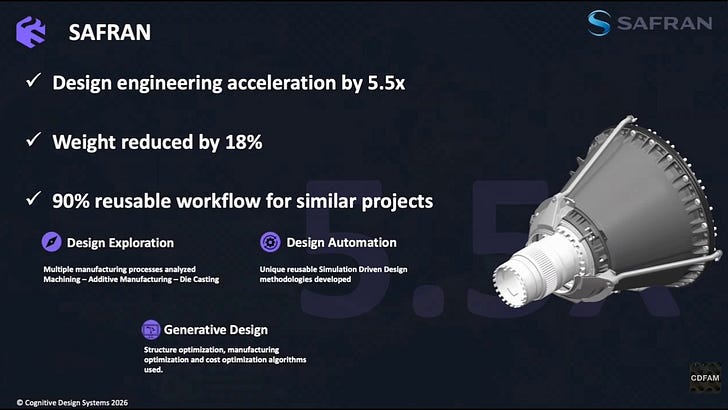
    CDFAM Computational Design Symposium — Washington DC 2026 Rhushik Matroja · Cognitive Design Systems Artificial intelligence is poised to automate a large share of design engineering work, yet the technology that excites the commercial world poses a fundamental problem for high-consequence industries. Generative AI is probabilistic by nature. It produces plausible answers, not provably correct ones. In sectors where a single structural failure can ground a fleet, halt a production line, or cost lives, plausibility is not enough. The question is no longer whether AI will transform engineering, but whether we can trust it when failure is not an option. This talk presents a different path. Cognitive Design Systems is a design exploration platform for mechanical and thermo-mechanical component design. Rather than embedding opaque AI inside traditional CAD software, we bring proven engineering workflows to the AI. Deterministic solvers for topology optimization, finite element analysis, manufacturing-driven design, and cost and carbon assessment produce repeatable, auditable, physically grounded results. A conversational AI layer orchestrates these solvers, interpreting intent and chaining tasks, while the underlying engineering computation remains fully deterministic and traceable. Engineers gain dramatic speed without surrendering verifiability or control. This is not theoretical. Our approach is shaped by work with demanding industrial leaders including Safran, Thales, MBDA, Toyota, Tetra Pak, and Logitech, spanning aerospace, automotive, defense, and industrial machinery. These are organizations where engineering rigor and certification are non-negotiable. The implications reach across every engineering sector. As manufacturers face mounting pressure to lightweight structures, accelerate certification, reduce cost and carbon, and modernize their industrial base, the ability to design qualified components faster, with full auditability, becomes a decisive advantage. Trustworthy AI is not a constraint on innovation. It is the precondition for deploying AI in the systems the world depends on. Attendees from industry and policy alike will leave with a clearer view of what responsible, deployable AI for high-consequence engineering actually looks like. Links Talk page with full transcript Watch the talk on YouTube Cite this talk Search this talk's transcript This is a public episode. If you would like to discuss this with other subscribers or get access to bonus episodes, visit www.designforam.com
  • S7 · E6
    September 18 · 22 min

    Measuring Shape Fidelity in Generative CAD Models

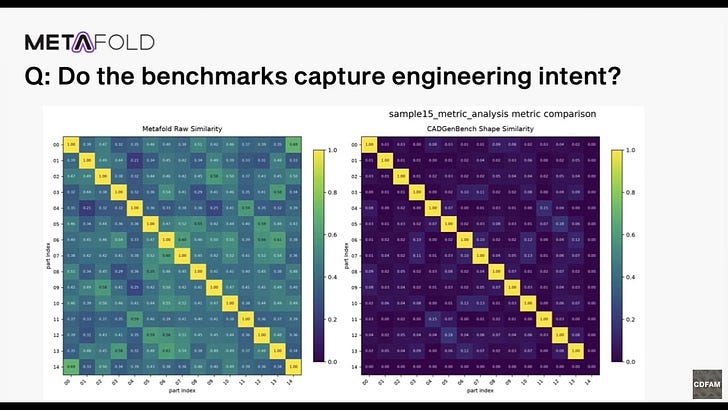
    CDFAM Computational Design Symposium — Washington DC 2026 Daniel Hambleton · Metafold Generative AI is rapidly expanding what designers and engineers can create in 3D, but visual plausibility is not the same as geometric fidelity. This presentation asks a practical validation question: how close are AI-generated CAD models really to a target desired shape? We introduce a feature-vector workflow using the Metafold Shape Similarity technology to compare generated models against reference targets. Each model is encoded into a geometric feature vector, enabling direct comparison through aggregate similarity scores, coordinate-level distance ribbons, scale-normalized metrics, and side-by-side 3D previews. The result is a repeatable method for moving beyond “looks right” evaluation toward measurable shape correspondence. Using examples from current 3D generative design workflows, the talk demonstrates how feature vectors can expose where a generated model preserves intent, where it drifts, and which geometric features contribute most to the gap. This approach offers a lightweight validation layer for AI-assisted CAD: fast enough for iteration, interpretable enough for engineering review, and concrete enough to support model benchmarking. Links Talk page with full transcript Watch the talk on YouTube Cite this talk Search the full text of every recorded CDFAM presentation This is a public episode. If you would like to discuss this with other subscribers or get access to bonus episodes, visit www.designforam.com
  • S7 · E8
    September 17 · 16 min

    Requirements to Production Part in Minutes: How Physical AI Closes the Loop Between Optimization and Manufacturing

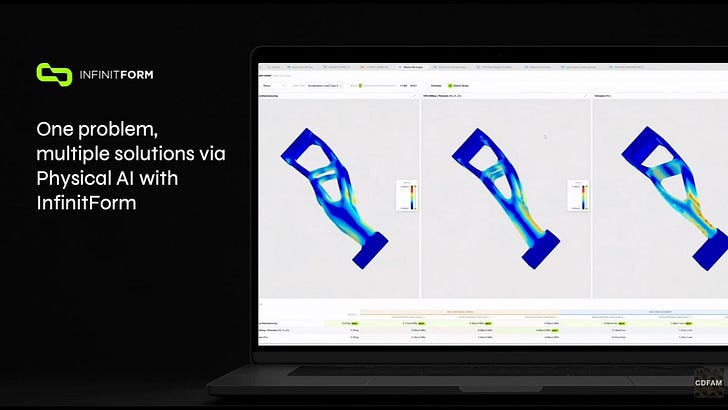
    CDFAM Computational Design Symposium — Washington DC 2026 TJ Root · InfinitForm The gap between optimized geometry and manufacturable components has been the defining constraint of computational design for three decades. Topology optimization produces brilliant forms that machinists cannot cut. Those forms are not editable in CAD / or CAD friendly. Simulation validates performance that mainstream manufacturing cannot reproduce. The result: design cycles measured in months, not days, and engineering organizations forced to choose between what is optimal and what is buildable. InfinitForm was built to eliminate that tradeoff. The platform takes geometrical, engineering, manufacturing and cost constraints as input and outputs production-ready parametric CAD geometry, optimized simultaneously for structural performance and the specific manufacturing process it will be produced with, whether CNC machining, additive manufacturing, casting, extrusion, or injection molding. Every output carries full design history, constrained sketches, and parametric relationships, making it immediately editable in the CAD environment the engineering team already uses. GPU-accelerated solvers and optimizer, the system compresses what previously required weeks of iteration into minutes of compute. This talk presents the technical architecture behind that capability, the manufacturing constraint modeling approach that makes outputs buildable rather than merely optimal, and results from production deployments at aerospace, defense, and advanced manufacturing organizations. It examines what changes when design for performance and design for manufacturing are solved as a single problem rather than sequential steps, and what that means for the engineering organizations, defense programs, and industrial supply chains now entering the Physical AI era. Links Talk page with full transcript Watch the talk on YouTube Cite this talk Search the full text of every recorded CDFAM presentation This is a public episode. If you would like to discuss this with other subscribers or get access to bonus episodes, visit www.designforam.com

  • S7 · E2
    September 17 · 21 min

    Agentic Engineering: Generative AI in structural applications

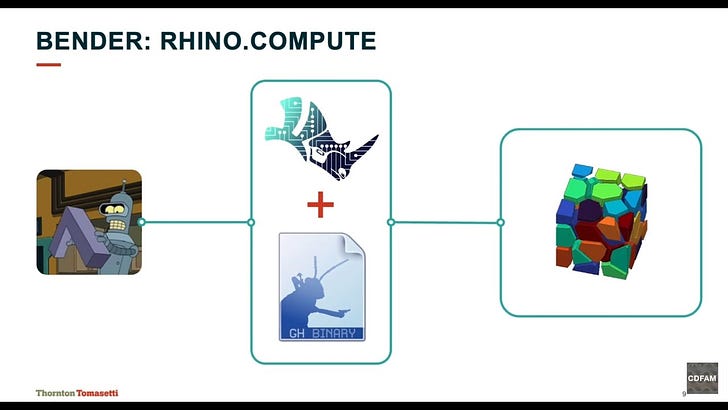
    CDFAM Computational Design Symposium — Washington DC 2026 Sergey Pigach · CORE studio | Thornton Tomasetti CORE studio spent a decade building machine learning tools for structural design and analysis, all running as cloud services behind APIs. When MCP arrived, handing those same tools to an agent turned out to be close to trivial. Sergey Pigach demonstrates Bender, an agentic system running on AWS that the firm talks to through Slack: ask it for a concrete column stack and footing for a five-storey residential building in New York, let it make the remaining assumptions, and it calls the tools the engineers use, renders the result and writes a design summary. It lives in Slack deliberately, because an agent sitting in a shared thread already has the context of the conversation around it, which a one-to-one chatbot does not. Specialist sub-agents handle questions like embodied carbon. From there the talk moves to agents talking to each other. A2A is a protocol for delegation between agents, complementary to MCP rather than competing with it, but it has no discovery layer — a public agent the team put online was found by nobody. That gap prompted Waggle, Pigach's own side project, which crawls for valid agent cards and builds a searchable index with health, quality and trust signals, then delegates a request to whichever agent can handle it. He also shows agents paying each other small amounts to cover expensive work. The most uncomfortable result is a benchmark. CORE studio asked its own engineers for the hardest structural problems they could devise, assembled 91 of them, graded answers to within one percent, and gave the models nothing but a calculator and a Python sandbox — no internet, no engineering software. They expected around half. It saturated immediately, with the leading models above 94 percent. Tracing backwards showed the unlock was reasoning: the first reasoning model jumped from 38 percent to 74, and the line has run straight up since. Structural engineering, as he puts it, is a verifiable domain. The talk closes on CAD experiments, including a Grasshopper plugin that exposes a parametric definition to an agent as MCP tools and a hackathon robot arm driven by natural language, and on the conclusion that this is not a domain expertise problem but an unhobbling problem. Links Talk page with full transcript Watch the talk on YouTube Cite this talk Search the full text of every recorded CDFAM presentation This is a public episode. If you would like to discuss this with other subscribers or get access to bonus episodes, visit www.designforam.com

Showing 1–20 of 30 episodes