Skip to content
Artwork for CDFAM Computational Design Symposium
CDFAM Computational Design Symposium · September 18 · 22 min

Measuring Shape Fidelity in Generative CAD Models

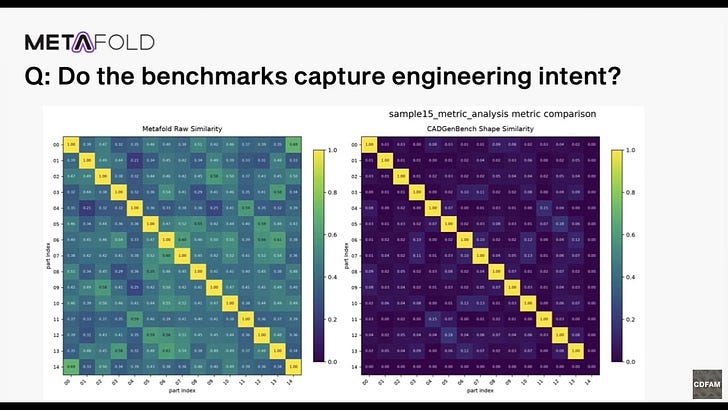
CDFAM Computational Design Symposium — Washington DC 2026 Daniel Hambleton · Metafold Generative AI is rapidly expanding what designers and engineers can create in 3D, but visual plausibility is not the same as geometric fidelity. This presentation asks a practical validation question: how close are AI-generated CAD models really to a target desired shape? We introduce a feature-vector workflow using the Metafold Shape Similarity technology to compare generated models against reference targets. Each model is encoded into a geometric feature vector, enabling direct comparison through aggregate similarity scores, coordinate-level distance ribbons, scale-normalized metrics, and side-by-side 3D previews. The result is a repeatable method for moving beyond “looks right” evaluation toward measurable shape correspondence. Using examples from current 3D generative design workflows, the talk demonstrates how feature vectors can expose where a generated model preserves intent, where it drifts, and which geometric features contribute most to the gap. This approach offers a lightweight validation layer for AI-assisted CAD: fast enough for iteration, interpretable enough for engineering review, and concrete enough to support model benchmarking. Links Talk page with full transcript Watch the talk on YouTube Cite this talk Search the full text of every recorded CDFAM presentation This is a public episode. If you would like to discuss this with other subscribers or get access to bonus episodes, visit www.designforam.com

0:00-22:55

transcript

No transcript — this publisher did not publish one.

show notes

CDFAM Computational Design Symposium — Washington DC 2026

Daniel Hambleton · Metafold

Generative AI is rapidly expanding what designers and engineers can create in 3D, but visual plausibility is not the same as geometric fidelity. This presentation asks a practical validation question: how close are AI-generated CAD models really to a target desired shape?

We introduce a feature-vector workflow using the Metafold Shape Similarity technology to compare generated models against reference targets. Each model is encoded into a geometric feature vector, enabling direct comparison through aggregate similarity scores, coordinate-level distance ribbons, scale-normalized metrics, and side-by-side 3D previews. The result is a repeatable method for moving beyond “looks right” evaluation toward measurable shape correspondence.

Using examples from current 3D generative design workflows, the talk demonstrates how feature vectors can expose where a generated model preserves intent, where it drifts, and which geometric features contribute most to the gap.

This approach offers a lightweight validation layer for AI-assisted CAD: fast enough for iteration, interpretable enough for engineering review, and concrete enough to support model benchmarking.

Links

Talk page with full transcript

Watch the talk on YouTube

Cite this talk

Search the full text of every recorded CDFAM presentation


This is a public episode. If you would like to discuss this with other subscribers or get access to bonus episodes, visit www.designforam.com
links6