Skip to content
Artwork for CDFAM Computational Design Symposium
CDFAM Computational Design Symposium · September 12 · 25 min

Real-Time Multi-Physics Collaboration for Real-World Engineering

CDFAM Computational Design Symposium — Barcelona 2026 Nikolas Borrel Jensen, Oliver Littlewood · Pasteur Labs Real multiphysics necessitates coordination along multiple dimensions: one is of course the mixed physics, another is the heterogeneous data types & modeling approaches, and a third is the multidisciplinary (mis)communication. AI shoved into engineering workflows does not eliminate these gaps, rather it exacerbates them. For instance, numerical solver outputs and ML data structures are incompatible, with no shared representations to bridge them. At the human level, CAE experts, Mech/Aero/Nuclear Engineers, Systems Engineers, and AI/ML Engineers all operate in different conceptual frameworks and thus lose valuable time and information at every handoff. This talk presents Pasteur Labs’ approach to streamlining all three dimensions of multiphysics with the cohesive “Simulation Intelligence (SI) Platform”, emphasizing three plug-n-play products. SI Testbeds automate data generation end-to-end, from preprocessing through simulation runs and postprocessing, producing ML-ready CAE datasets at scale. SI Workspaces enable the flexible composition of next-generation multi-physics pipelines by stratifying surrogate models, optimization methods, and uncertainty quantification tools, with automatic differentiation as a first-class citizen throughout. Tesseracts are end-to-end differentiable containers that encapsulate heterogeneous numerical solvers and surrogate models behind a unified API, making otherwise incompatible components interoperable by design across software, hardware and teams. All prioritize modularity, scalability, and traceability, providing the engineering cohesion that is needed to adopt Physics-AI. The SI Platform is elucidated by two different types of engineers working on two concrete engineering cases, with real-time collaboration: surrogate-based acceleration and optimization of centrifugal pump performance, and end-to-end gradient-based parametric optimization of rocket grid fins. Links Talk page with full transcript Watch the talk on YouTube Cite this talk Search the full text of every recorded CDFAM presentation This is a public episode. If you would like to discuss this with other subscribers or get access to bonus episodes, visit www.designforam.com
0:00-25:01

transcript

No transcript — this publisher did not publish one.

show notes

CDFAM Computational Design Symposium — Barcelona 2026

Nikolas Borrel Jensen, Oliver Littlewood · Pasteur Labs

Real multiphysics necessitates coordination along multiple dimensions: one is of course the mixed physics, another is the heterogeneous data types & modeling approaches, and a third is the multidisciplinary (mis)communication. AI shoved into engineering workflows does not eliminate these gaps, rather it exacerbates them. For instance, numerical solver outputs and ML data structures are incompatible, with no shared representations to bridge them. At the human level, CAE experts, Mech/Aero/Nuclear Engineers, Systems Engineers, and AI/ML Engineers all operate in different conceptual frameworks and thus lose valuable time and information at every handoff.

This talk presents Pasteur Labs’ approach to streamlining all three dimensions of multiphysics with the cohesive “Simulation Intelligence (SI) Platform”, emphasizing three plug-n-play products. SI Testbeds automate data generation end-to-end, from preprocessing through simulation runs and postprocessing, producing ML-ready CAE datasets at scale. SI Workspaces enable the flexible composition of next-generation multi-physics pipelines by stratifying surrogate models, optimization methods, and uncertainty quantification tools, with automatic differentiation as a first-class citizen throughout. Tesseracts are end-to-end differentiable containers that encapsulate heterogeneous numerical solvers and surrogate models behind a unified API, making otherwise incompatible components interoperable by design across software, hardware and teams. All prioritize modularity, scalability, and traceability, providing the engineering cohesion that is needed to adopt Physics-AI.

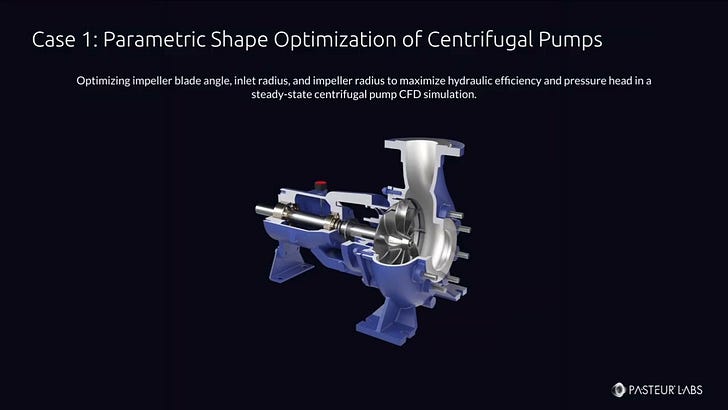
The SI Platform is elucidated by two different types of engineers working on two concrete engineering cases, with real-time collaboration: surrogate-based acceleration and optimization of centrifugal pump performance, and end-to-end gradient-based parametric optimization of rocket grid fins.

Links

Talk page with full transcript

Watch the talk on YouTube

Cite this talk

Search the full text of every recorded CDFAM presentation


This is a public episode. If you would like to discuss this with other subscribers or get access to bonus episodes, visit www.designforam.com
links6