Skip to content
Artwork for Aswath Damodaran
BusinessEntrepreneurshipEducation

Aswath Damodaran

Aswath Damodaran

I teach corporate finance, valuation and investment philosophies at the Stern School of Business at New York University. I have online versions of all three courses here, as well as other finance-related videos.
1. The Corporate Finance Online playlist has an introductory video and 36 sessions that cover all of corporate finance (at least as I see it).
2. The Valuation playlist has 25 sessions that cover valuation approaches, issues and questions.
3. The Investment Philosophies playlist has sessions that cover different investment philosophies.
4. The Accounting and Statistics playlists reflect my quirky and unorthodox introductions to two disciplines that are critical to my valuation and corporate finance classes.
5. The Blog Posts playlist has sessions that go wit my blog posts and reflect my standing as a dabbler, rather than expert, in all things finance-related.
If you need the supporting material for any of the classes, check the links below.

Links:
Corporate finance materials: http://www.stern.nyu.edu/~adamodar/New_Home_Page/corpfin.html
Valuation materials: http://www.stern.nyu.edu/~adamodar/New_Home_Page/equity.html
Investment Philosophies: http://www.stern.nyu.edu/~adamodar/New_Home_Page/invphil.htm
Books: http://www.stern.nyu.edu/~adamodar/New_Home_Page/public.htm
My website: http://www.damodaran.com

Made by a listener who resonates deeply with Aswath Damodaran's work, so it can travel with you on walks, drives and quiet nights. An unofficial tribute, not affiliated with Aswath Damodaran — all rights remain theirs. If you're the creator, we'd love to hear from you.

Play
  • 587 episodes
  • Avg 57 min
  • English
Counted on this page — what you have heard stays on this device, so it is not something the list can be paged by.
  • October 9 · 49 min

    Session 18: Tying up Intrinsic Value

    In this session, after the second quiz, we wrapped up our discussion of intrinsic valuation. For decades, we have valued banks using the dividend discount model, simply because getting cash flows is so difficult, but that approach is built on trusting management at banks to behave sensibly (paying out what they can afford to in dividends) and regulators to do the same. For me, that trust was breached in 2008, and I present a way of estimating FCFE for a bank, using investment in regulatory capital as my stand in for reinvestment. Next session, we will wrap up the valuation section and start on pricing. If you are interested in reading more about valuing financial service companies, try this link: https://papers.ssrn.com/sol3/papers.cfm?abstract_id=1798578. We also looked at valuing commodity and cyclical companies, and why capitalizing R&D can change the value of a pharmaceutical company. Slides: https://pages.stern.nyu.edu/~adamodar/podcasts/valUGspr23/session18slides.pdf Post class test: https://pages.stern.nyu.edu/~adamodar/pdfiles/eqnotes/postclass/session18Dtest.pdf Post class test: https://pages.stern.nyu.edu/~adamodar/pdfiles/eqnotes/postclass/session18Dsoln.pdf Learn more about your ad choices. Visit megaphone.fm/adchoices

  • October 9 · 1 hr 34 min

    Session 23: The Options to Expand and Abandon, Financial Flexibility and Distressed Equity

    We started this class by looking at the option to expand, where your capacity to enter or expand into new (big) markets can justify up-front bad investments and then at the option to abandon poorly performing investments. We then valued financial flexibility as an option, and argued that it was worth more to capital-constrained companies with unpredictable and high-value-added investments. We continued with our examination of equity in trouble, debt-laden companies. Given that the equity in these companies takes on the characteristics of an option, we teased out three implications: The equity in these companies will be valued as out-of-the-money options are and not as conventional stocks. Thus, they will retain their value, even in the face of daunting debt, and will become more valuable as the risk in the business increases and with longer term debt. Start of the class test: http://www.stern.nyu.edu/~adamodar/pdfiles/eqnotes/tests/realoptions2mod.pdf Slides: http://www.stern.nyu.edu/~adamodar/podcasts/valfall16/valsession23.pdf Post class test: http://www.stern.nyu.edu/~adamodar/pdfiles/eqnotes/postclass/session23test.pdf Post class test solution: http://www.stern.nyu.edu/~adamodar/pdfiles/eqnotes/postclass/session23soln.pdf Learn more about your ad choices. Visit megaphone.fm/adchoices

  • October 9 · 1 hr 32 min

    Session 17: The Financing Mix Trade off

    In this class, we started our discussion of the financing question by drawing the line between debt and equity: fixed versus residual claims, no control versus control, and then used a life cycle view of a company to talk about how much it should borrow. We then started on the discussion of debt versus equity by looking at the pluses of debt (tax benefits, added discipline) and its minuses (expected bankruptcy costs, agency cost and loss of financial flexibility). Even with the general discussion, we were able to look at why firms in some countries borrow more than others, why having more stable earnings can make a difference in how much you can borrow and why having intangible assets can affect your borrowing capacity. Slides: https://pages.stern.nyu.edu/~adamodar/podcasts/cfspr23/session17slides.pdf Post class test: https://pages.stern.nyu.edu/~adamodar/pdfiles/cfovhds/postclass/session17test.pdf Post class test solution: https://pages.stern.nyu.edu/~adamodar/pdfiles/cfovhds/postclass/session17soln.pdf Learn more about your ad choices. Visit megaphone.fm/adchoices

  • October 8 · 58 min

    Session 22: The Option to Delay

    In this shortened session after the webcast, we looked at the option to delay and applied it to valuing patents and undeveloped natural resource reserves. Slides: http://www.stern.nyu.edu/~adamodar/podcasts/valfall16/valsession22.pdf Post class test: http://www.stern.nyu.edu/~adamodar/pdfiles/eqnotes/postclass/session22Atest.pdf Post class test solution: http://www.stern.nyu.edu/~adamodar/pdfiles/eqnotes/postclass/session22Asoln.pdf Learn more about your ad choices. Visit megaphone.fm/adchoices
  • October 8 · 1 hr 24 min

    Session 19: First Steps on Pricing

    We started the class by setting the stage of pricing companies, contrasting the pricing process with the value process. The rest of the class was our first foray into pricing, with why pricing is so much more common than intrinsic value and how multiples are just standardized prices. We also started on the first steps in deconstructing pricing, with the definitional and descriptional tests. Start of the class test: https://pages.stern.nyu.edu/~adamodar/pdfiles/eqnotes/relval1test.pdf Slides: https://pages.stern.nyu.edu/~adamodar/podcasts/valUGspr23/session19slides.pdf Post class test: https://pages.stern.nyu.edu/~adamodar/pdfiles/eqnotes/postclass/session19Dtest.pdf Post class test: https://pages.stern.nyu.edu/~adamodar/pdfiles/eqnotes/postclass/session19Dsoln.pdf Learn more about your ad choices. Visit megaphone.fm/adchoices

  • October 8 · 11 min

    Terminal Value Myth 5: The Terminal value ate my DCF!

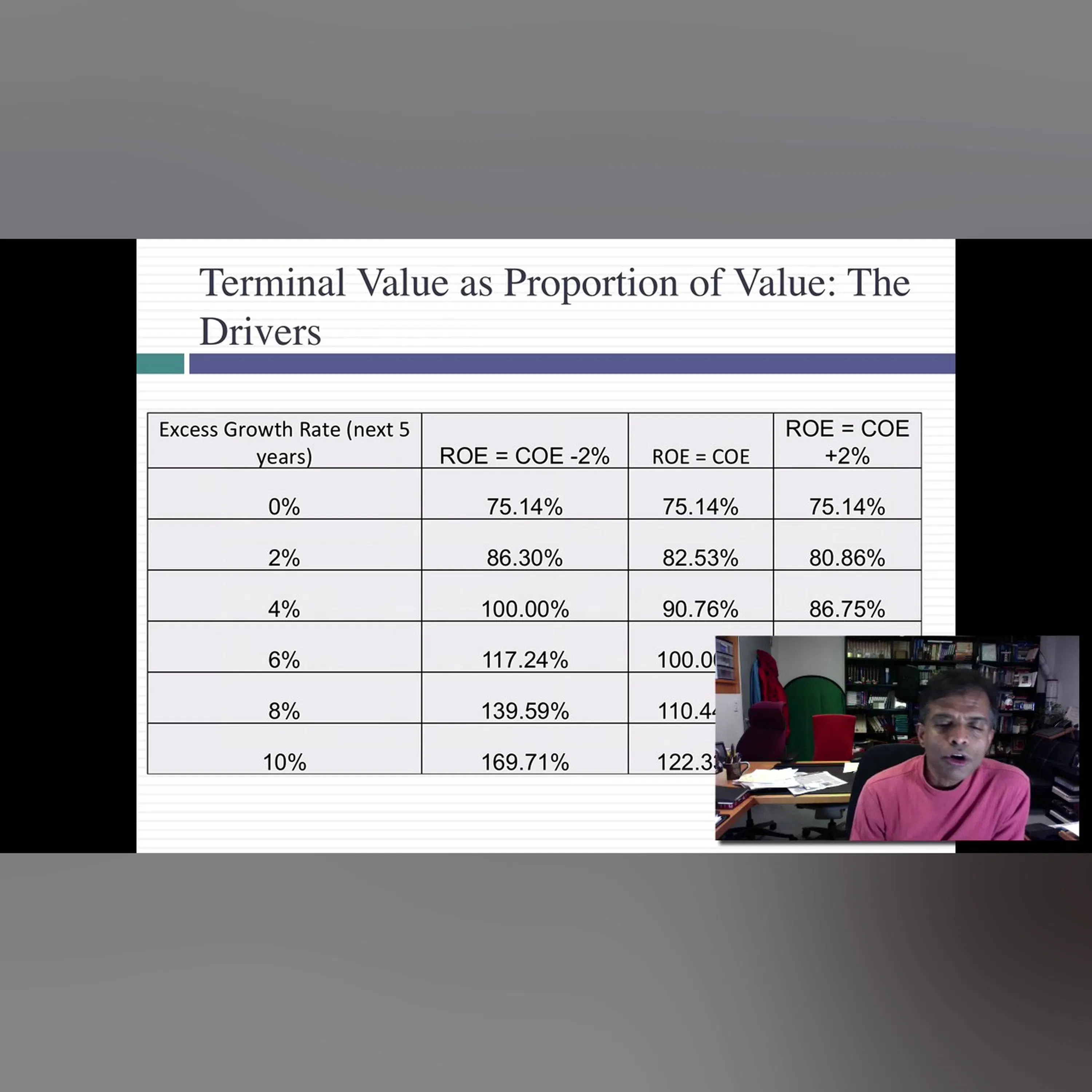
    In a DCF of a business, the terminal value will account for a large proportion of value and this is viewed by some as a flaw in DCF and by others as a license to not worry about assumptions made during growth periods. Both presumptions are wrong. A DCF is a mirror of how you make money investing in stock, with the terminal value playing the role of capital gains (price appreciation). Also, the terminal value, though a high proportion of value, is heavily affected by your growth assumptions (about level & efficiency). Slides: http://www.stern.nyu.edu/~adamodar/pdfiles/blog/TermValyeMyth5.pdf Blog Post: http://aswathdamodaran.blogspot.com/2016/11/myth-55-terminal-value-ate-my-dcf.html Learn more about your ad choices. Visit megaphone.fm/adchoices

  • October 8 · 12 min

    Terminal Value Myth 4: Negative Growth Rates are impossible

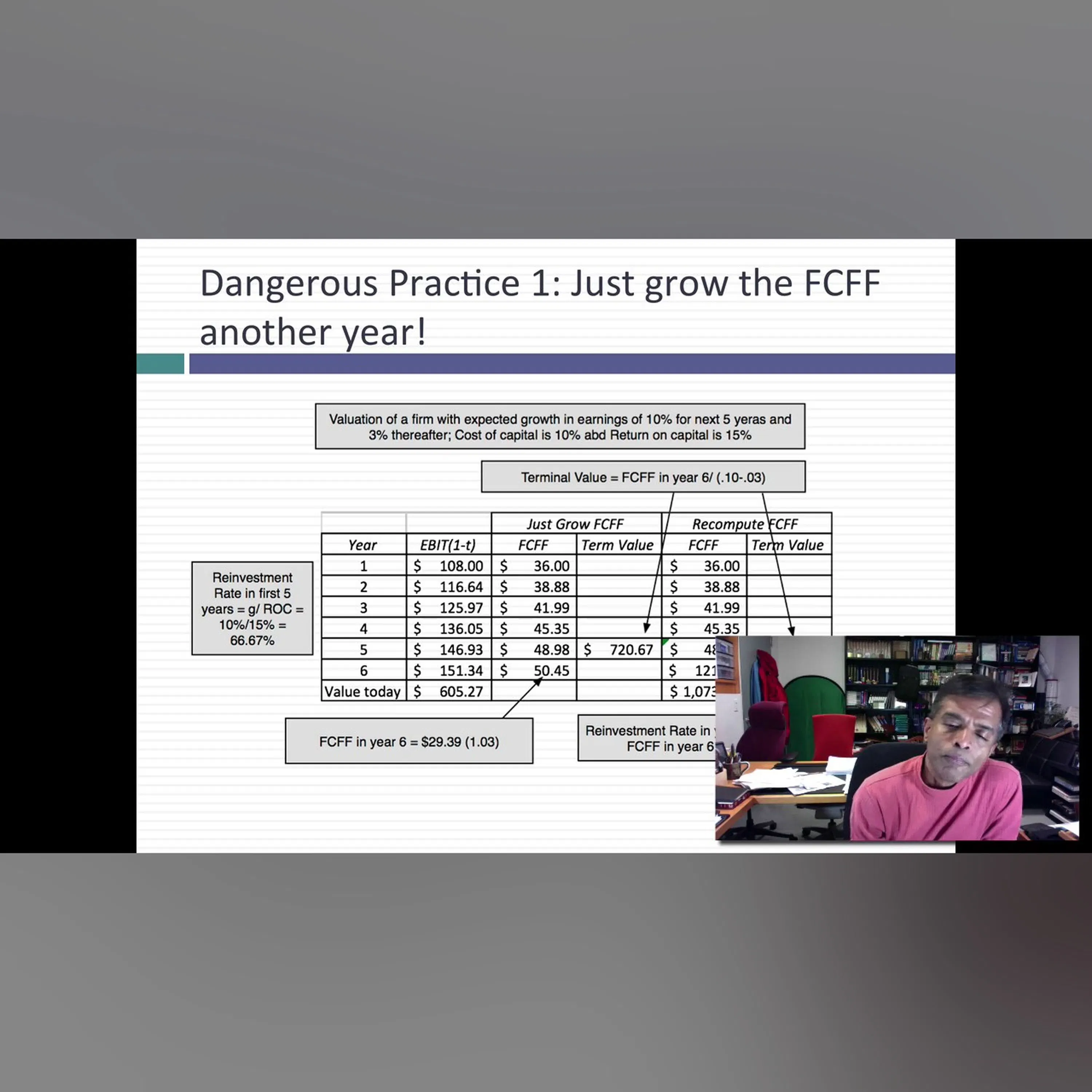
    In this session, I confront the myth that you cannot do a DCF with negative growth rates and that the perpetual growth model will not work if you have negative growth. In fact, negative growth is more common among companies than we think and we need to use negative growth in our projections more frequently. Slides: http://www.stern.nyu.edu/~adamodar/pdfiles/blog/TermValyeMyth14.pdf Blog Post: http://aswathdamodaran.blogspot.com/2016/11/myth-54-negative-growth-rates-forever.html Learn more about your ad choices. Visit megaphone.fm/adchoices
  • October 7 · 1 hr 29 min

    Session 18: Optimizing Financing Mix

    We started this class by completing the debt trade off, by bringing in agency costs and financial flexibility, and looking at a financing hierarchy, starting with retained earnings as the most preferred and convertible preferred as the least preferred financing for firms. We looked at the Miller Modigliani theorem through the prism of the debt tradeoff and followed up by using the financing hierarchy that companies seem to move down, when they think about raising fresh financing. I then moved on to looking at how the cost of capital can be used to optimize the right mix of debt and equity. In effect, you estimate the costs of debt and equity at different debt ratios, and try to find the mix of debt and equity that minimizes your cost of capital. If you want to try your hand at using the spreadsheet to optimize debt ratio, try the following: http://www.stern.nyu.edu/~adamodar/pc/capstru.xlsx We will continue with this discussion next week. looking at limits to the approach, and variants. Slides: https://pages.stern.nyu.edu/~adamodar/podcasts/cfspr23/session18slides.pdf Post class test: https://pages.stern.nyu.edu/~adamodar/pdfiles/cfovhds/postclass/session18test.pdf Post class test solution: https://pages.stern.nyu.edu/~adamodar/pdfiles/cfovhds/postclass/session18soln.pdf Learn more about your ad choices. Visit megaphone.fm/adchoices

  • October 7 · 15 min

    Terminal Value Myth 3: Growth is good, more growth is better!

    In the perpetual growth model, increasing growth while holding all else constant will always increase value. That is the problem. If you follow consistency requirements, increasing growth will affect your cash flows and the effect of growth becomes ambiguous. It can increase, decrease or do nothing to value. Slides: http://www.stern.nyu.edu/~adamodar/pdfiles/blog/TermValyeMyth3.pdf Blog Post: http://aswathdamodaran.blogspot.com/2016/11/myth-53-growth-is-good-more-growth-is.html Learn more about your ad choices. Visit megaphone.fm/adchoices

  • October 7 · 1 hr 38 min

    Session 18: Deconstructing Multiples

    In this session, we continued with our discussion of pricing, starting with the analytics that drive PEG, PBV, EV/EBITDA and revenue multiples. During the session, I played the role of a naive equity research analyst, using sloppy pricing to push buy recommendations on stocks in a number of sectors, based purely on the level of multiples (low PE, low PBV etc.) and asking for pushback. I The bottom line, though, is that most companies that look cheap deserve to be cheap. The key to pricing is finding a mismatch between the pricing and the fundamentals (low PE & high growth, low PBB and high ROE, low EV to Sales and high margins). It is the basis for much of equity research, and takes the form of screens. If you are interested, I have a post that expands on the notion of screening. http://aswathdamodaran.blogspot.com/2012/06/passive-value-investing-screening-for.html Start of the class test: https://pages.stern.nyu.edu/~adamodar/pdfiles/eqnotes/tests/relval2atest.pdf Slides: https://www.stern.nyu.edu/~adamodar/podcasts/valspr23/session18slides.pdf Post class test: https://www.stern.nyu.edu/~adamodar/pdfiles/eqnotes/postclass/session18Btest.pdf Post class test solution: https://www.stern.nyu.edu/~adamodar/pdfiles/eqnotes/postclass/session18Bsoln.pdf Learn more about your ad choices. Visit megaphone.fm/adchoices

  • October 7 · 13 min

    Terminal Value Myth 2: As g approaches r, it is to Infinity and beyond!

    Many analysts when they first see the perpetual growth model feel the call of Buzz Lightyear, since moving the growth rate towards the discount rate will make your terminal value explode before it implodes. In this session, I look at the constraints on growth in the terminal value equation and explain why I use the risk free rate as my cap on the growth rate. Slides: http://www.stern.nyu.edu/~adamodar/pdfiles/blog/TermValyeMyth2.pdf Blog Post: http://aswathdamodaran.blogspot.com/2016/11/myth-52-as-g-rto-infinity-and-beyond.html Learn more about your ad choices. Visit megaphone.fm/adchoices

  • October 6 · 1 hr 26 min

    Session 20: Analyzing Multiples

    In this session, we continued with our discussion of pricing, starting with the analytics that drive PEG, PBV, EV/EBITDA and revenue multiples. During the session, I played the role of a naive equity research analyst, using sloppy pricing to push buy recommendations on stocks in a number of sectors, based purely on the level of multiples (low PE, low PBV etc.) and asking for pushback. I The bottom line, though, is that most companies that look cheap deserve to be cheap. The key to pricing is finding a mismatch between the pricing and the fundamentals (low PE & high growth, low PBB and high ROE, low EV to Sales and high margins). It is the basis for much of equity research, and takes the form of screens. If you are interested, I have a post that expands on the notion of screening. http://aswathdamodaran.blogspot.com/2012/06/passive-value-investing-screening-for.html Start of the class test: https://pages.stern.nyu.edu/~adamodar/pdfiles/eqnotes/relval2atest.pdf Slides: https://pages.stern.nyu.edu/~adamodar/podcasts/valUGspr23/session20slides.pdf Post class test: https://pages.stern.nyu.edu/~adamodar/pdfiles/eqnotes/postclass/session20Btest.pdf Post class test: https://pages.stern.nyu.edu/~adamodar/pdfiles/eqnotes/postclass/session20Bsoln.pdf Learn more about your ad choices. Visit megaphone.fm/adchoices

  • October 6 · 9 min

    Terminal Value Myth 1: Don't believe in forever? You can't do DCF!

    In classrooms and textbooks, you are taught that there is only one way to estimate a terminal value and that is to assume cash flows grow at a constant rate forever. That is one way but it is not the only one. In this session, I look at two acceptable alternatives and one that should not (but unfortunately is). Slides: http://www.stern.nyu.edu/~adamodar/pdfiles/blog/TermValyeMyth1.pdf Blog Post: http://aswathdamodaran.blogspot.com/2016/11/myth-51-if-you-don-believe-in-forever.html Learn more about your ad choices. Visit megaphone.fm/adchoices

  • October 6 · 1 hr 27 min

    Session 19: Optimal Financing Mix - Determinants and Drivers

    In this class, we started by tying up loose ends on the cost of capital approach, starting with why moving to the optimal changes the value of a business (hint: it is all in the tax code) and then looking at how sensitive the optimal debt ratio is to changes in operating income or rating constraints. We also looked at enhancements to the approach, where we incorporated indirect bankruptcy costs in the analysis. Finally, we examined the determinants of the optimal. In particular, it was differences in tax rates, cash flows (as a percent of value) and risk that determined why some companies have high optimal debt ratios and why some have low or no debt capacity. Next session, we will wind up the analysis of the optimal debt ratio and then move on to whether to move to that optimal, and if yes, how quickly. In the meantime, you can catch up on the project by taking your company and putting the numbers into the spreadsheet at the link below: https://www.stern.nyu.edu/~adamodar/pc/capstru.xlsx Remember to check the iteration box in Excel calculation preferences to make sure that it is checked. Slides: https://pages.stern.nyu.edu/~adamodar/podcasts/cfspr23/session19slides.pdf Post class test: https://pages.stern.nyu.edu/~adamodar/pdfiles/cfovhds/postclass/session19test.pdf Post class test solution: https://pages.stern.nyu.edu/~adamodar/pdfiles/cfovhds/postclass/session19soln.pdf Learn more about your ad choices. Visit megaphone.fm/adchoices

  • October 6 · 1 hr 34 min

    Session 21: IPO and VC Valuation and First Steps on Real Options

    In today's class, we put the finishing touches on private company valuation by looking at key questions that arise in private company valuation (illiquidity, key person etc.) and then looked at valuing IPOs. In particular, the question of what happens to the proceeds from an offering can affect value per share, and the offering price itself is subject to the dynamics of the issuance process, with investment bankers more likely to under price than over price offerings. In the second part of the class, I did a quick introduction to real options, setting up the intuitive rationale for real options. We covered the basics of options, starting with why real options are so attractive to analysts and investors: they allow you to add a premium to your DCF value. The two building blocks for real option value are learning (from what is going on around you or ongoing events) and adapting your behavior. There are three questions that underlie the use of real options. The first is recognizing when you are dealing with an option, with a payoff diagram being the give away. The second is looking for exclusivity which is what gives options value. The third is using an option pricing model, which is built on replication and arbitrage. Start of the class test: http://www.stern.nyu.edu/~adamodar/pdfiles/eqnotes/tests/pvtco2test.pdf Slides: Part 1: http://www.stern.nyu.edu/~adamodar/podcasts/valfall16/valsession21A.pdf Part 2: http://www.stern.nyu.edu/~adamodar/podcasts/valfall16/valsession21B.pdf Post class test: http://www.stern.nyu.edu/~adamodar/pdfiles/eqnotes/postclass/session21Atest.pdf Post class test solution: http://www.stern.nyu.edu/~adamodar/pdfiles/eqnotes/postclass/session21Asoln.pdf Learn more about your ad choices. Visit megaphone.fm/adchoices

  • October 5 · 1 hr 30 min

    Session 19: Pricing Closure

    In this class, we closed the book on relative valuation by looking at how to price young companies, using forward multiples, and how to pick the "right" multiple for a valuation, with the answers ranging from cynically picking one that best fits your agenda to picking one that reflects what managers in that business care about. It is amazing how widespread relative valuation is. I found this link recently on rules of thumb in valuation. Take a look at it.... especially the multiples mentionedmultiples, and how to pick the "right" multiple for a valuation, with the answers ranging from cynically picking one that best fits your agenda to picking one that reflects what managers in that business care about. It is amazing how widespread relative valuation is. I found this link recently on rules of thumb in valuation. Take a look at it.... especially the multiples mentioned http://www.bizstats.com/reports/valuation-rule-thumb.php If you are interested in seeing the market regressions, across multiples and different regional groupings, you can find them here: http://people.stern.nyu.edu/adamodar/New_Home_Page/datafile/MReg23.html Start of the class test: https://pages.stern.nyu.edu/~adamodar/pdfiles/eqnotes/tests/relval3atest.pdf.pdf Slides: https://www.stern.nyu.edu/~adamodar/podcasts/valspr23/session19slides.pdf Post class test: https://www.stern.nyu.edu/~adamodar/pdfiles/eqnotes/postclass/session19Ctest.pdf Post class test solution: https://www.stern.nyu.edu/~adamodar/pdfiles/eqnotes/postclass/session19Csoln.pdf Learn more about your ad choices. Visit megaphone.fm/adchoices

  • October 5 · 20 min

    Faith, Fear and Feedback: Ready for the Valeant Test?

    In May 2016, I bought Valeant at $27, contending that it was worth $44. The stock dropped to $15 on November 9, 2016, leading me to a decision of whether to abandon the stock, hold on or add to my position. In this webcast, I reason my way to an answer and I will let you decide how much I am letting hope override common sense. Slides: http://www.stern.nyu.edu/~adamodar/pdfiles/blog/ValeantNov16.pdf Blog Post: http://aswathdamodaran.blogspot.com/2016/11/faith-feedback-and-fear-returning-to.html Learn more about your ad choices. Visit megaphone.fm/adchoices

  • October 5 · 1 hr 25 min

    Session 21: Closure on Pricing

    In today's class, we closed the book on relative valuation by looking at how to price young companies, using forward multiples, and how to pick the "right" multiple for a valuation, with the answers ranging from cynically picking one that best fits your agenda to picking one that reflects what managers in that business care about. It is amazing how widespread relative valuation is. I found this link recently on rules of thumb in valuation. Take a look at it.... especially the multiples mentionedmultiples, and how to pick the "right" multiple for a valuation, with the answers ranging from cynically picking one that best fits your agenda to picking one that reflects what managers in that business care about. It is amazing how widespread relative valuation is. I found this link recently on rules of thumb in valuation. Take a look at it.... especially the multiples mentioned http://www.bizstats.com/reports/valuation-rule-thumb.php If you are interested in seeing the market regressions, across multiples and different regional groupings, you can find them here: http://people.stern.nyu.edu/adamodar/New_Home_Page/datafile/MReg23.html Start of the class test: https://pages.stern.nyu.edu/~adamodar/pdfiles/eqnotes/relval3atest.pdf Slides: https://pages.stern.nyu.edu/~adamodar/podcasts/valUGspr23/session21slides.pdf Post class test: https://pages.stern.nyu.edu/~adamodar/pdfiles/eqnotes/postclass/session21Atest.pdf Post class test: https://pages.stern.nyu.edu/~adamodar/pdfiles/eqnotes/postclass/session21Asoln.pdf Learn more about your ad choices. Visit megaphone.fm/adchoices

  • October 5 · 1 hr 41 min

    Session 20: Following up on optimizing debt mix

    We started this class with the adjusted present value approach, where we begin with the unlevered firm value, and then add the tax benefits of debt and net out expected bankruptcy costs. We then looked at peer group analysis, where companies decide how much to borrow by looking at what other companies in the sector do. You can check out the debt ratios for other companies in your sector by going to my website: US industry averages: http://www.stern.nyu.edu/~adamodar/pc/datasets/dbtfund.xls Global industry averages: http://www.stern.nyu.edu/~adamodar/pc/datasets/dbtfundGlobal.xls Slides: https://pages.stern.nyu.edu/~adamodar/podcasts/cfspr23/session20slides.pdf Post class test: https://pages.stern.nyu.edu/~adamodar/pdfiles/cfovhds/postclass/session20test.pdf Post class test solution: https://pages.stern.nyu.edu/~adamodar/pdfiles/cfovhds/postclass/session20soln.pdf Learn more about your ad choices. Visit megaphone.fm/adchoices

  • October 4 · 30 min

    All in the family: The Ups and Downs of Family Group Companies

    In October 2016, the board of directors of Tata Sons, the controlling entity for India's best known and perhaps most highly regarded family group, fired Cyrus Mistry, its chairman, in a shocking break from Tata group decorum. In this webcast, I look at that incident through the lens of family group companies, evaluating the trade off that has allowed them to prosper in Asia and Latin America, and why globalization and more open capital markets may threaten their prosperity. Slides: http://www.stern.nyu.edu/~adamodar/pdfiles/blog/TataGroup.pdf Blog Post: http://aswathdamodaran.blogspot.com/2016/11/the-4c-tradeoff-promise-and-peril-of.html Learn more about your ad choices. Visit megaphone.fm/adchoices

Showing 461–480 of 587 episodes