Skip to content
Artwork for Advocacy at Work
Health & FitnessBusinessNon-Profit

Advocacy at Work

One moment. One pivot. One purpose.

Every advocate has a moment — the diagnosis, the loss, the phone call that rewired everything. Advocacy at Work explores the pivotal stories of patients, caregivers, and changemakers who turned their hardest moments into their greatest purpose. Hosted by cancer survivor and patient advocate Tim McDonald. One moment. One pivot. One purpose.

www.advocacyatwork.com
Play
  • 20 episodes
  • weekly
  • Avg 29 min
  • English
  • Thursday · 31 min

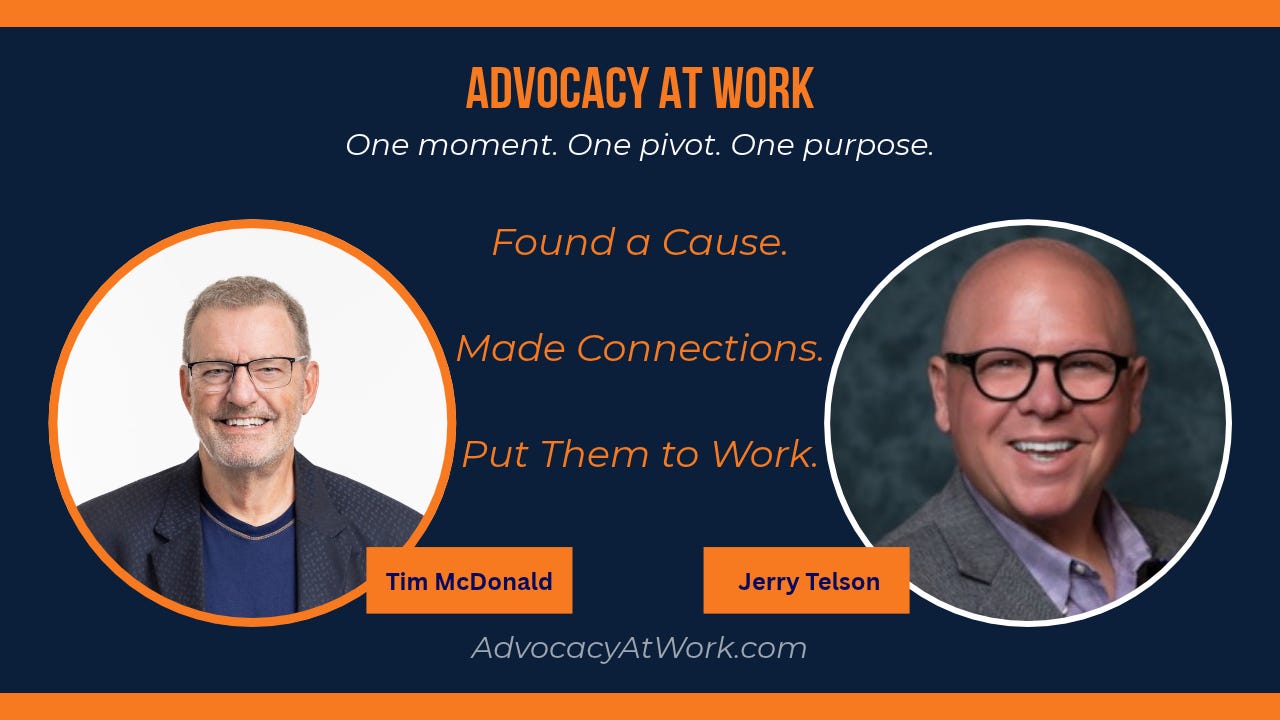
    Fundraising Is Advocacy, Too

    Jerry Telson and I didn’t start with the same definition of advocacy. When I asked him how he defines it, he explained that his work with the National Pediatric Cancer Foundation isn’t focused on legislation. It’s focused on funding pediatric cancer research. But that’s exactly why I see it as advocacy. In my book, From Patient to Advocate, I describe four areas of advocacy: legislative, research, awareness, and fundraising. During our conversation, I explained that without fundraising, I don’t think the other three exist. Jerry’s work helps make those connections visible. Raising awareness can lead to a relationship. A relationship can become a partnership. That partnership can help fund research or connect a family with support. They’re different contributions, but they don’t operate separately. A haircut became something more Jerry came into this work after a long corporate career. His connection to the foundation began through Cut for a Cure, a fundraising effort that gave employees a chance to raise money and shave the boss’s head. The teams got behind it. The haircut was fun. But what stayed with Jerry was handing over the money they had raised. He described that as the most gratifying day of his working year. Later, after joining the foundation as an employee, someone at a networking event asked what he did. His answer came out without hesitation: “Helping save some kids’ lives.” He stepped away afterward to call his wife and tell her how different it felt to describe his work that way. Jerry’s role isn’t treating children or conducting research himself. It’s helping bring resources to that work. His answer showed how directly he connects his daily responsibilities with the reason behind them. For patients and families, that distinction matters. We meet the people delivering care, but we may never meet everyone whose work helped make the research behind that care possible. Fundraising is one part of that larger effort. It deserves scrutiny and accountability, but it also deserves recognition as work that supports the mission. Sometimes the contribution is a connection One story Jerry shared involved a child who wanted to be a monster truck driver, specifically connected to the Sparkle Smash truck. The foundation’s Fashion Funds the Cure events include a “dream walk” that connects children with the things they want to do when they grow up. Making that particular dream happen meant finding people who could help. Jerry and his colleagues were already pursuing contacts when he happened to meet a woman whose family built monster trucks. Her brother had built that truck. That conversation became a connection. According to Jerry, the people involved helped arrange a customized golf cart incorporating a piece of the truck, along with other experiences and items for the child. Later, when her health circumstances changed, special accommodations helped make a visit with the truck and driver possible. During the interview, I told Jerry that imagining the child’s reaction was bringing tears to my eyes. That moment wasn’t a research outcome, and it shouldn’t be confused with one. It was a chance for a child to experience something she cared about while going through an illness that had already asked so much of her. It also showed something practical about giving. The woman Jerry met didn’t need to write a large check. She recognized a connection she could make and acted on it. People sometimes underestimate what they have to offer because they’re thinking only about money. An introduction, a professional skill, help organizing an event, or a few hours of reliable volunteer work can all serve a purpose. The useful question is what an organization actually needs and whether you’re in a position to help meet it. Families need more than good intentions Jerry also described connecting a family he knew with the foundation’s healthcare navigator. He explained that the navigator brings both pediatric oncology nursing experience and experience as a parent of a child with cancer. The service, as he described it, helps families find resources and navigate available support. Jerry made a distinction between his response and hers. He can say he can only imagine what a parent is going through. She brings a different understanding to that conversation. There’s room for both contributions. Someone doesn’t need to have lived through the same diagnosis to help. But recognizing the limits of your own experience is part of helping responsibly. For organizations, that means knowing when to connect a family with someone better equipped to answer their questions. For supporters, it means listening before deciding what would be useful. For patients and caregivers, it also means you shouldn’t have to manage everyone else’s desire to help. A useful offer should reduce a burden, not create another task for the family. What organizations can learn from this Jerry’s examples offer something for healthcare organizations, professional associations, pharmaceutical companies, diagnostic companies, biotechnology companies, and other businesses considering a partnership. Start with a specific contribution, not just a sponsorship opportunity. What can your organization provide that the nonprofit or the people it serves actually need? That might be funding. It might be expertise, space, equipment, volunteers, or access to a useful network. Jerry’s monster truck story worked because people connected their particular capabilities with a particular child’s interest. The contribution wasn’t generic. There’s also a difference between showing that a partnership exists and explaining what it accomplished. For a research-focused partnership, that means being clear about what the funding supports. For an event or family-support effort, it means describing that purpose honestly without presenting it as proof of medical progress. Those activities can all matter. Keeping their purposes distinct helps supporters understand what they’re contributing to. Jerry talked about transparency during our conversation and encouraged people to examine the foundation’s information themselves. That’s an important invitation. People should be able to care about a mission and ask questions about how an organization carries it out. Make a commitment you can keep When I asked Jerry what he would tell patient advocates interested in serving on a board or committee, his answer centered on showing up. He pointed out that accepting a role creates an expectation. The organization is counting on that person’s participation. That doesn’t mean every advocate needs to join a board. It also doesn’t mean missing a meeting is a failure. Treatment, caregiving, work, and health can change what someone is able to do. The practical takeaway is to be honest about your capacity and choose a contribution you can reasonably sustain. A smaller commitment that works for you can be more useful than a larger one you feel pressured to accept. Jerry’s path into this work didn’t begin with his own cancer diagnosis. It began with an opportunity to support a cause, followed by more opportunities to put his experience and relationships to work. You don’t need to wait for the perfect title or a large amount of money. You can ask what’s needed, consider what you can offer, and decide whether there’s a good fit. Connect with Jerry and learn more To learn about the foundation’s research mission, events, and ways to get involved, visit the National Pediatric Cancer Foundation. You can also email Jerry Telson to ask about volunteering, partnerships, or other opportunities to contribute. Jerry shared both contact routes during our conversation. Watch the full conversation with Jerry in the video embedded in this post. Subscribe to Advocacy at Work for more conversations about lived experience and the different ways people turn concern into action. It’s free. Have a suggestion for a future guest? Leave a comment or reply with their name and what you think we could learn from their experience. This is a public episode. If you would like to discuss this with other subscribers or get access to bonus episodes, visit www.advocacyatwork.com

    • Transcript
  • October 29 · 30 min

    What Patients See, What Pharmacists See, and Why Both Matter

    What happens when patients and healthcare professionals are experiencing the same problem, but seeing very different parts of it? In my conversation with Brooke Boring, she described something that came up when the Hematology Oncology Pharmacy Association, better known as HOPA, brought patient advocacy organizations and professional organizations together around chemotherapy drug shortages. Some patient organizations knew about the shortages from the news but weren’t hearing the same concerns directly from their communities. Meanwhile, pharmacists and other healthcare professionals were working through difficult decisions and finding ways to keep care moving. Brooke’s explanation was that healthcare teams were doing so much work behind the scenes that patients didn’t necessarily see the disruption. That doesn’t make either perspective wrong. It shows why we need both. A patient can explain what it feels like to receive care. A pharmacist can explain what it took to make that care possible. Putting those experiences together gives us a fuller picture of what needs to change. The person on your care team you may not know Brooke is HOPA’s associate director of health policy and advocacy. Her work includes legislative advocacy, patient education, and bringing the patient perspective into the organization’s work. I serve on HOPA’s patient advisory panel, so I’ve had the opportunity to see some of that work firsthand. But when I was going through treatment, I didn’t even know I had an oncology pharmacist. That’s why I wanted Brooke to explain what these professionals actually do. She described work that goes well beyond preparing or checking medications. Depending on the care setting, oncology pharmacists may help patients understand treatment, address side effects, and work through barriers to getting medications. That can include calls to insurers or identifying patient assistance options. Some of that happens directly with patients. Some happens where we never see it. As Brooke pointed out, patients may not know about an access problem because someone has already been working to resolve it. During our conversation, I encouraged patients and caregivers to ask about the oncology pharmacist on their care team. Get to know who they are and how to reach them. When you’re trying to understand treatment or explain what you’re experiencing, it helps to know who you can ask. You shouldn’t have to figure out every part of the system before you can get help navigating it. Your experience belongs in the conversation I ask every guest how they define advocacy. Brooke’s answer was broad: arguing for a cause. That might mean meeting with a member of Congress. It might mean sending a message, making a call, or helping someone understand an issue you care about. “I think there’s a place for everyone in advocacy,” she said. That matters because policy can feel like something other people do. People with the right credentials, the right vocabulary, or the confidence to walk into a congressional office. But Brooke described how the atmosphere in a meeting can change when a patient introduces themselves. Staff members turn toward that person and ask about their experience. The pharmacists bring their own stories, too. They can explain why they entered oncology, what they do every day, and the barriers they encounter while helping patients. Those contributions aren’t interchangeable. They give different meaning to the same issue. A patient might explain what a delay meant for their family. A pharmacist might explain the steps involved in trying to resolve it. Together, they help connect a policy discussion to what is happening in someone’s life. You don’t have to know everything about legislation to explain what happened to you. And you don’t have to tell every part of your story to make a useful contribution. Patient involvement shouldn’t stop at the invitation HOPA’s work also offers something for professional associations, healthcare organizations, and industry organizations to consider. Brooke described involving patients in the development of education materials, asking what resources they need, and including patient perspectives in conference sessions alongside scientific and operational discussions. There’s a difference between asking someone to review a resource and asking what resource would have helped them in the first place. Both can be useful, but the second question creates room for patients to influence the direction of the work. For organizations, that raises some practical questions: * Are patients involved early enough to shape the priorities? * Are you asking what they need, or only asking them to respond to what you’ve already developed? * Can they participate in ways that account for treatment, work, caregiving, and travel limitations? * Do they know what happened as a result of their contribution? Brooke described both in-person and virtual Hill Days. Having different ways to participate matters. Someone may have an important perspective without being able to travel to Washington. The same principle applies beyond legislative advocacy. If an organization wants to hear from more people, it needs to consider what makes participation possible. Patient involvement is more useful when it becomes part of how the work happens, not just one item on the agenda. A shared message doesn’t require identical experiences The drug shortage discussion brought that point into focus. Brooke described congressional staff hearing different information from different organizations and struggling to understand what action would be most useful. HOPA brought organizations together to work toward a shared understanding of the problems and potential policy responses. That required listening across perspectives, including perspectives that didn’t initially seem to match. For patients, caregivers, pharmacists, and other healthcare professionals, there’s something worth keeping in mind here: not seeing a problem yourself doesn’t mean it isn’t happening. And seeing a problem from one position doesn’t mean you understand every consequence. That’s a reason to work together, not a reason to decide whose experience counts more. When organizations build coalitions, the goal shouldn’t be to make everyone’s story sound the same. It should be to understand how those stories connect and what they tell us about the changes people need. You can start smaller than you think Brooke was also honest about the pace of policy work. Advocacy doesn’t necessarily produce a bill that passes a few weeks later. She described other signs of progress: staff members remembering previous meetings, understanding the role of oncology pharmacists, and more patients and professionals participating. Those relationships don’t replace policy change. They help build the understanding needed to pursue it. For someone wondering where to begin, Brooke pointed to letter-writing campaigns that allow people to add their experience to a prepared message. A congressional meeting isn’t the only entry point. When I asked what she would change with a magic wand, her answer centered on access: people being able to receive treatment regardless of where they live or their financial circumstances. That connects the policy work back to the patient. What does an available treatment mean if someone can’t actually get it? Start with a question you need answered, a barrier you’ve experienced, or something you wish the people making decisions understood. You don’t have to represent everyone. You can contribute what you know and listen to what others bring. Connect with Brooke and HOPA Interested in getting involved in HOPA’s advocacy work? Email HOPA’s advocacy team advocacy@hoparx.org to ask about opportunities such as Hill Days or the patient advisory panel. To connect with Brooke about this conversation or her work, email Brooke Boring bboring@hoparx.org. Watch my full conversation with Brooke in the video embedded in this post. Subscribe to Advocacy at Work at AdvocacyAtWork.com for more convers… This is a public episode. If you would like to discuss this with other subscribers or get access to bonus episodes, visit www.advocacyatwork.com

    • Transcript
  • October 22 · 33 min

    The Person Behind the Patient Advocate

    Daniel G. Garza was already thinking about making a video on the drive home from his anal cancer diagnosis. He had spent years speaking publicly about living with HIV. Sharing what was happening to him was familiar territory. So when he received another diagnosis, he went straight to what he knew: telling people about it. He recorded 30 days of videos in English and Spanish. Some captured good days. Others showed tears, fear, and what he described as “ugly crying.” People reached out to say those videos helped them understand their own diagnosis or what someone they loved was experiencing. But helping other people came with something Daniel didn’t fully recognize at the time. He hadn’t given himself space to process what had happened. “The balance of that is that I had no privacy,” he told me. Years later, he sought therapy to work through what he hadn’t made room for then. That’s an important part of this conversation. A story can help someone else while the person telling it is still trying to understand it themselves. Advocacy doesn’t always start with a plan Daniel is a long-term survivor of HIV and anal cancer, and the director of outreach for Cheeky Charities. His work connects with HIV, cancer, and LGBTQ+ communities, drawing on experiences that began long before anyone introduced him as an advocate. He talked about being bullied as a child, learning to defend himself, and then wanting to protect other people. After being outed at 17, he became someone other gay people could turn to when they didn’t feel supported. When he was diagnosed with AIDS in 2000, advocacy started closer to home. He was learning from doctors and nurses while trying to explain HIV to his family. Then an opportunity to speak on Univision brought his experience to a much larger audience. Invitations to nursing schools and other settings followed. What began with explaining his own life became a way to help others understand lives they might not otherwise encounter. When I asked Daniel how he defines advocacy, his answer was straightforward: “Taking my lived experiences and using them to be of service to other people.” There’s room in that definition for more than a conference presentation or a public campaign. It can mean helping someone prepare a question, sharing something you learned, or listening without trying to fix everything. It also leaves room for people who don’t want to tell their story publicly. Being of service doesn’t require giving everyone access to your life. What people don’t see During our conversation, I talked about how people see an advocate on television or at a conference and think that’s what advocacy looks like. They don’t necessarily see what it took to get there or what comes along with it. Daniel described people telling him how busy he looked on social media. He was traveling, working, and seemingly doing well. What they didn’t see were the mornings when his bones hurt or the exhaustion after a day of calls, computer work, and preparing another speech. He was clear that he loves his work. He was also clear that his body has been through a lot. Both can be true. A person can be good at explaining their experience and still need help carrying it. They can make people laugh and still have difficult days. They can show up prepared without having everything worked out. For patients and caregivers, Daniel’s experience offers an important distinction: sharing your story and processing your story aren’t necessarily the same thing. You can decide that something is private. You can change your mind about what you’re comfortable sharing. You can take time before turning an experience into something useful for someone else. The value of your experience doesn’t depend on how quickly you make it public. What organizations can take from this For healthcare organizations, professional associations, pharmaceutical companies, diagnostic companies, and biotechnology companies, there’s a practical question here: When you invite a patient advocate to participate, are you making room for the person or only the contribution you want from them? Daniel’s account of pain, preparation, and public visibility gives that question context. So does his wish for more funding and research support, particularly for the Latino and LGBTQ+ communities he works with. He wants to reach more people and exchange ideas with advocates in other places. The desire is there. Resources remain part of the challenge. An invitation alone doesn’t address those needs. Applied to patient engagement, this conversation points toward a few concrete practices: * Ask what someone needs to participate rather than assuming their previous experience makes support unnecessary. * Make it clear that an advocate can decline a question or keep part of their story private. * Discuss compensation, expenses, preparation time, and accessibility before the event. * Invite patients to help shape the questions and priorities, not only provide a personal story after the agenda is set. * Explain what will happen with their input and follow up afterward. These are ways to put partnership into practice. An advocate’s ability to deliver a compelling presentation shouldn’t become a reason to overlook their limits. And a patient’s story shouldn’t be the only part of their expertise an organization is willing to hear. Passing something on without prescribing a path Daniel loves teaching. He described his workshops as a buffet: take the pieces that work for you, then share what helps with someone else. “I want you to pick up the baton and run with it,” he said. “It’s not meant to stop with us.” That approach leaves room for different experiences. What helped Daniel may not be what helps the next person. His humor is part of how he connects, but not everyone needs to make a joke out of something painful. When I asked what he would change with a magic wand, he imagined a space where people could create something from what they’d been through. That might be comedy, a story, a painting, or a sculpture. He wanted people to understand that a diagnosis doesn’t mean they’re broken. That isn’t an obligation to turn illness into a lesson or a project. It’s an invitation to find an expression that belongs to you. For someone working through a diagnosis, that might start with a private conversation. For an organization, it might start with asking a patient what matters before deciding what you need from them. Before asking someone to share their story, ask what would help them feel supported in sharing it. And if you’re the person being asked, you get a say in the answer. Watch the full conversation with Daniel G. Garza in the video accompanying this post. Subscribe to Advocacy at Work at AdvocacyAtWork.com for more conversations about what happens when lived experience turns into action. It’s free. Have a suggestion for a future guest? Leave a comment or reply to this post with their name and what you think we could learn from their experience. Guest resources and episode links * Daniel G. Garza on YouTube * Cheeky Charities * Earlier Advocacy at Work episode with Cheeky Charities founder David Russo This is a public episode. If you would like to discuss this with other subscribers or get access to bonus episodes, visit www.advocacyatwork.com

    • Transcript
  • October 15 · 28 min

    When Questions Become Advocacy

    There are moments when you realize that caring about someone is not the same as knowing how to help them. For Andrea Katz, that moment came in 2013, when her mother was diagnosed with stage 4 cholangiocarcinoma, a cancer of the bile ducts. It was a disease Andrea and her family had never heard of. Information was difficult to find. The diagnosis moved fast. Her mother died 44 days later. That experience changed the direction of Andrea’s life. Today, Andrea is an integrative nutrition health coach, founder of Best You Nutrition, and a member of the GI Cancers Alliance Patient and Caregiver Advisory Board. She specializes in digestive health, but her work is also about something larger: helping people understand that they can participate actively in their own care and in the care of the people they love. Her story is a reminder that advocacy does not always begin with a title, a nonprofit, or a big public platform. Sometimes it begins with staying up late, looking for answers, and deciding that you are going to ask the questions others may be afraid to ask. The questions that needed asking After Andrea’s mother was diagnosed, Andrea did what many caregivers do. She went looking for information. She researched cholangiocarcinoma, treatment options, clinical trials, surgeries, and whether there might be care available outside their immediate area. She was not trying to second-guess the medical team. She wanted to walk into the next appointment informed enough to ask better questions. Her father was hesitant. Like many people, he had grown up with the belief that doctors are authority figures and that asking too many questions could somehow be seen as challenging them. Andrea understood the concern, but she also knew that her mother’s care was too important to let fear keep the family quiet. “I wanted to learn as much as I could in a short amount of time so that the next morning, when we had an appointment with her physician and the oncology team, I had some informed questions,” she said. Andrea came to the appointment with about eight questions. Her father told her she should not ask them. But when she asked the oncologist whether he had time to talk, the answer was yes. The doctor did not take offense. He answered what he could, promised to follow up on what he did not know in the moment, and told Andrea’s father that he wished more families came to appointments with those kinds of questions. That matters. Too many patients and caregivers hold back because they do not want to appear difficult, uninformed, or disrespectful. But asking questions is not the same as questioning a clinician’s expertise. It is a way to understand the choices in front of you and to make sure the care plan reflects the person living through it. Andrea put it simply: “Nobody cares more about your health than you.” That is not an indictment of doctors, nurses, or loved ones. It is a reality of healthcare. Clinicians have many patients. Families have their own fears and responsibilities. The patient, or the person closest to them, is the one living in the body, managing the symptoms, and carrying the day-to-day impact of the diagnosis. Being an active participant can help make sure important details do not get lost. From loss to a new direction Andrea had always been interested in health. She grew up as an athlete and earned her first degree in psychology. But after losing her mother, her curiosity about one rare gastrointestinal cancer expanded into a deeper interest in digestive health. She went back to school and became a certified integrative nutritionist. Her psychology background did not disappear. It became part of how she sees nutrition and wellness. Food is not just food. It is family tradition. It is comfort. It is routine. It can be stress, reward, fear, culture, and memory all at once. That is why advice that sounds simple on paper can be difficult to apply in real life. “If it was that easy, we wouldn’t have an obesity epidemic in North America,” Andrea said. “We wouldn’t have heart disease like we have or diabetes like we have.” Her work focuses on digestive health, but she does not treat the gut as an isolated part of the body. She sees it as connected to mood, sleep, stress, immune health, skin conditions, appetite, and the way people feel in their everyday lives. People often come to her wanting help with one specific concern. Maybe they are not sleeping well. Maybe they are stressed, experiencing digestive symptoms, struggling with energy, or trying to make changes after a diagnosis. Andrea starts by helping them look at the bigger picture. Instead of chasing one symptom at a time, she asks a question many people do not expect: How is your gut? That question can open a different kind of conversation. It can help people see that their body is interconnected, and that changes in one area may affect another. It can also remind people that health is not only about reacting when something goes wrong. It is also about learning what helps us feel better, function better, and advocate for ourselves before a small concern becomes a bigger one. Advocacy is active participation When I asked Andrea what advocacy means to her, she did not give a formal definition. She talked about being an active participant in your care. That can look different for everyone. It may mean bringing written questions to an appointment. It may mean asking a doctor to explain a medical term in plain language. It may mean researching a diagnosis, finding a specialist, keeping track of symptoms, or asking for a second opinion. For a caregiver, it may mean speaking up when the person you love is too exhausted, overwhelmed, or ill to speak for themselves. Andrea knows that role personally. She helped advocate for both of her parents during their cancer experiences. She also knows that people can be grateful for their medical teams while still asking hard questions. Her mother’s doctors, nurses, and oncologists were, in her words, “fantastic.” Advocacy was not about assuming anyone did not care. It was about making sure her mother’s family understood the options and could participate in decisions. That distinction is important for patients, caregivers, and the organizations serving them. Healthcare professionals and organizations do not need patients and families to arrive with all the answers. They need to make it clear that questions are welcome. They need to create room for people to say, “I do not understand,” or “Is there another option?” or “What should we be paying attention to?” Information matters, but people also need the confidence to use it. Keeping her mother’s story visible Andrea continues to speak about her mother because she does not want her memory to disappear into a diagnosis few people recognize. During Cholangiocarcinoma Awareness Month this past February, Andrea reached out to media outlets in Canada to help raise awareness. The resulting coverage brought patient and caregiver voices into a national conversation. It also helped connect her with the GI Cancer Alliance, where she now serves alongside patients and caregivers from the United States, Canada, the United Kingdom, and Africa. The group is working to improve awareness, information, testing, and advocacy across 12 gastrointestinal cancers. When Andrea’s mother was sick, finding support and accurate information was much harder. There was no Canadian foundation she could turn to at the time. She found a U.S. newsletter and a Facebook group, and that was about it. More resources exist today, but low-awareness cancers still leave too many people feeling isolated and underinformed. Andrea’s story shows why sharing matters. One person’s willingness to speak about a difficult experience can help another family find language, resources, questions, or community they did not know existed. You never know where a story will lead. Being there without adding pressure If Andrea had a magic wand, she said she would want to see a cure for cancer. But while research continues, she als… This is a public episode. If you would like to discuss this with other subscribers or get access to bonus episodes, visit www.advocacyatwork.com

    • Transcript
  • October 1 · 29 min

    The Finance Guy Who Became the Bridge Between Patients and Nuclear Medicine

    Jud Kimmel spent most of his career in public policy and finance. He wasn’t a scientist. He wasn’t a doctor. He wasn’t someone with a natural pathway into cancer advocacy. Then in September 2022, almost four years ago, he got diagnosed with stage 4 grade 3 small bowel neuroendocrine tumor. And everything changed. The Symptoms Nobody Names The weird part is that the symptoms that got him to his diagnosis were so strange and confusing that nobody could quite figure out what was happening. He had gastrointestinal problems that came and went randomly. Out of nowhere, he’d get shortness of breath without any exertion. He’d have facial flushing, hot and intense, but without any sweating. These weren’t the kind of symptoms you type into Google and get a clear answer. These weren’t “go to the emergency room right now” symptoms. These were the kind that made everyone scratch their heads. What he later learned was that these were symptoms of carcinoid syndrome. His neuroendocrine tumor was functional. That means it was secreting hormones into his bloodstream. And those hormones created this strange collection of symptoms that led doctors to his diagnosis. “In some ways,” Jud says, “I’m thankful I had a functional NET. A lot of people, their NETs will grow and grow with no signs at all until they cause a physical obstruction or some other acute problem.” So the symptoms that made his life miserable for over a year? They probably saved his life. What NET Actually Is Here’s the thing. Most people hear “neuroendocrine tumor” and their brain shuts down. It sounds like brain cancer. It sounds like something your neuroendocrine system—which is in your brain, right?—is attacking. But that’s not what NET is. You have neuroendocrine cells all throughout your body. They’re in your gut. They’re in your lungs. They’re in various organs. When those cells go rogue, that’s when NET develops. It’s not a tissue cancer. It’s a cancer that forms from neuroendocrine cells. And it’s a solid tumor, but it’s distinct from other kinds of cancers. The umbrella term is NEN, neuroendocrine neoplasia. Under that umbrella, you’ve got NETs and NECs and insulinomas and all sorts of other variations. But they all have one thing in common. They form from neuroendocrine cells that started misbehaving. Historically, NET was considered rare. And it was. But incidence is increasing. Some of that is probably better imaging and better testing. But a lot of it is probably that NETs went undiagnosed for years. People were told their symptoms were something else. And even after death, it wasn’t always attributed to NET. That’s how misunderstood this cancer has been. The Specialist He Found Jud was fortunate in one crucial way. His diagnosing oncologist, a general community oncologist, knew enough about NET to know he needed to see a specialist. And he referred Jud to a NET specialist at Mayo Clinic. This is unusual. A lot of NET patients go a very long time before they ever see a specialist. Some never do. But Jud got that referral quickly. And very soon after his diagnosis, he was enrolled in a clinical trial. His first line of treatment was radioligand therapy, or RLT. This was cutting-edge nuclear medicine. Not traditional chemotherapy. Not radiation therapy as most people understand it. Nuclear medicine imaging that could help target cancer cells. And then nuclear medicine therapeutics to treat those cells. It was a whirlwind introduction to being a cancer patient. And it sparked something in him. Curiosity. When Lightning Struck For a while after his diagnosis, Jud did different things on different tracks. He was involved in clinical trial advocacy. He was learning about radiotheranostics. He was connecting with other cancer patients, especially men. But the real moment came in 2024. Novartis asked him to speak at a full team meeting. Everyone involved with radioligand therapies. Doctors. Scientists. Researchers. Marketing teams. Operations teams. All of them. Jud shared his journey. How he’s doing. His perspectives on receiving this treatment and what it meant for his life. And afterward, something happened that he didn’t expect. So many people told him they’d never met a patient before. They’d never seen the actual human impact of their work. They’d spent years developing drugs and therapies and strategies. But they’d never sat in a room with someone who had actually received what they’d created. “It was kind of like lightning struck,” Jud says. “Afterwards, so many people told me how they had never met a patient before, and it was so powerful for them to see how their work is actually helping people.” That moment changed how he saw his role. Three Areas of Focus Now Jud focuses on three main areas of advocacy. Neuroendocrine cancer: He’s a patient. He’ll be one for the rest of his life. Stage 4 NET is considered incurable but treatable. He’s learned a lot of fellow patients. He sees the need for support, awareness, education. He does peer education and counseling. He’s involved with scientific research and advocacy specific to NET. Radiotheranostics: This is the umbrella term for the therapy he received. Nuclear imaging like PET scans combined with nuclear medicine therapeutics. It’s a fascinating and really exciting area of cancer research. But there’s a real lack of understanding and confidence around it in the patient community. And beyond that, it’s expanding to colorectal cancers, breast cancers, lung cancers, brain cancers. Nuclear medicine is about to explode with new applications. But patients are afraid of nuclear radiation. Of course they are. And they don’t understand what radiotheranostics actually is. So Jud’s mission is to help patients understand it. Not to cheerleader for it. But to give them the information and context they need to make informed decisions. “The name of the game for me,” he says, “is we know we all have emotions and perceptions and other psychosocial challenges that might come into play, but if I can help to move the needle and help patients have a little more trust and understanding with what nuclear medicine is about, I think that will go a long way.” Men’s cancer peer support and wellbeing: Jud doesn’t have prostate or testicular cancer. But he knows that men isolate more than women do when facing cancer. Men have more psychological and relational challenges. Jud struggled with depression early on. He felt like he had to just suck it up and deal with it. Now he’s committed to being there for other men going through it. How He Got Started Jud didn’t wake up one day planning to be a cancer advocate. He was part of a clinical trial that sparked curiosity. He started following scientific developments. He attended conferences. He watched webinars. He read journal articles. And because he was public policy and finance guy, he started thinking about how this research gets funded and moved forward. Then he got asked to speak at Novartis. And that became the spark that lit everything. He was recently asked to join the ECOG Akron Cancer Research Group’s patient advocacy committee. So now he’s part of cancer research discussions about all kinds of GI cancers, especially NET. And next March, he’s speaking on a panel at the World Theranostics Conference in Osaka, Japan. His bucket list place. His cancer advocacy is literally taking him around the world. But here’s what matters. None of that would have happened if he’d said no to Novartis. “It just took that one time,” he says, “to really change the course of how I see myself in the cancer universe, and it’s incredibly gratifying.” The Bridge Builder What Jud sees as his real strength is something different from the science or the research knowledge. He sees himself as a bridge builder. There’s a gap between patients and researchers. Between patients and pharma. Between patients and the healthcare system. And a lot of well-intentioned people think if they just provide good, accurate information, patients will accept it and act on it. But that’s not how humans work. We all come … This is a public episode. If you would like to discuss this with other subscribers or get access to bonus episodes, visit www.advocacyatwork.com

    • Transcript
  • September 17 · 29 min

    The AI Expert Who Became His Own Case Study

    John Duffield was living a completely normal life. He was working in AI. Fortune 500 companies. Helping healthcare organizations rethink how they work. Staying on top of an emerging field that was changing everything. He was a previous triathlete. Healthy. Active. Playing with his kids. No sense of what was coming. Then in June 2024, he ended up in the neurology ward at UCLA Ronald Reagan with a brain bleed. He didn’t go to the hospital expecting a brain bleed. He certainly didn’t go expecting what came next. The Double Hit While John was recovering from the brain bleed, the cardiologists came in. They’d heard a murmur on his scan. They’d seen it. A bicuspid aortic valve. The doctors said some people live their entire lives like this. Others need surgery. But the news hit him and his wife hardest because they were already reeling. They were vulnerable. They’d just gotten news about a brain bleed. Now this. “It was like a bang, bang, double hit,” John says. “It was an incredible hit to take for my wife and myself, and having to keep that in and not tell my children and too many until we really knew what was happening.” They got back to the East Coast and started meeting with cardiologists almost immediately. Further tests revealed it wasn’t just a bicuspid valve. He had severe regurgitation, a leaky aortic valve. And an aneurysm measuring significantly wide. The window was initially two to ten years. How do you live your life knowing major surgery could be coming? How do you function with that hanging over your head? Then the tests came back clearer. The window shrank. From years to weeks. To a month. Game on pretty quick at that point. The Blessing of Time (And Choice) John was very blessed to have great insurance and the ability to meet with surgeons quickly. But more than that, he had a choice. Which type of procedure. Which surgeon. Which approach. He could see who he felt most comfortable with and choose the path forward. Many people don’t get that. Many people get emergency situations with no planning time. Chaos. Panic. Everything happening at once. John had time to worry. Time to process. Time to think about what was coming. “I’ve since met with many patients who have been through cardiac procedures,” he says. “Some faced emergency situations with no planning time. Others had the time to plan like I did. Both are rough in different ways.” But John made a choice in that time. A choice to lean into his strengths. AI as a Companion John works in AI. He’s spent years helping healthcare organizations transform with artificial intelligence. But now he was a patient facing open heart surgery. And he realized something. He could use all that expertise on himself. He could take his clinical narrative. Everything about his diagnosis. All the test results. The options. Open heart surgery. Sparing his own valve. Replacing it with a mechanical valve. The recovery process. All of it. And he could turn it into something his children could understand. His daughter was nine years old. She was obsessed with Taylor Swift. So John took his entire clinical narrative and fed it into AI with one request: explain this through Taylor Swift lyrics and trivia. “It was truly like magic,” he says. AI took the complexity of open heart surgery and reduced it to the context his nine-year-old could understand. Songs she loved. Lyrics that matched his journey. A way to explain what was happening to daddy’s heart that didn’t sound like a medical textbook. His wife and John looked at each other. “Gosh, this is it. You’ve got to make a song for her.” So he did. He directed it. ChatGPT composed it and wrote it. Another AI tool handled the music production. And John gave his daughter a song that explained her father’s surgery in her language. He did the same thing with his son using basketball mechanics. Complex medical reality translated into the language of the game he loved. “I realized that we are at the emergence of a time where we can take complex, turn it into clarity through the context that a person can truly understand and relate to,” John says. “And I don’t think we’ve ever been able to do that before.” AI as a Second Voice, Not a Second Opinion There’s a distinction John is careful to make. AI can be powerful as a second voice. A companion. Something to help you think through things. Something to help you ask better questions. But AI cannot give you a clinical diagnosis. Cannot give you a definitive on what something is or what it isn’t. And it can never put a hand on your shoulder. Can never give you the gentle voice of a family member. Can never give you the expert bedside manner of a clinician. “The most powerful use of AI,” John says, “is at 2:00 AM before open heart surgery when anxiety is highest and the hospital’s asleep. When you don’t want to go down a Google rabbit hole or read information in a booklet. When you want answers that are context-relevant to your situation.” That’s when AI shines. When you can ask the same question 38 different ways without feeling embarrassed. When you can get clarity without having to wait for someone else to wake up. But here’s the thing. Most people use AI as a second opinion. John uses it as a second voice. A second opinion is something that should come from a licensed clinician. A second voice might tell you there are other alternatives. Might there be other research? Other clinical trials? All the what-if questions you didn't get to ask in that highly emotional consult with a surgeon. Because when you’re sitting across from a surgeon, you’re so worried and panicked that you don’t retain anything. You forget all your questions. You’re just trying to process the overwhelming. But afterward, when you have time and AI at 2:00 AM, you can think through things differently. The Moment Everything Changed John’s care team came into his room at Cleveland Clinic. They’d already done one open heart surgery. His sternum was being held together by wires, plates, and screws. Now they needed to go back in. Twenty days after the first surgery. Before the first surgery had even healed. “Our whole world fell apart,” John says. But in that moment, something shifted for him too. He realized this wasn’t just something happening to him. This was something that happened for a reason. He was meant to shine a light on the patient journey. He was meant to combine his knowledge of healthcare and innovation and AI and patient experience. He was born to tell that story and do something with that moment. “I felt that I need to do something and raise more awareness of this so that patients coming after me can get a glimpse into the types of tools that could help them and their families in some way navigate such a difficult experience,” he says. He wanted to thank the people who made YouTube videos about open heart surgery that helped him so much. And he wanted to give back for those coming after him. The Future Patient John’s launching a book called The Future Patient. It comes out September 29. The book is his journey through leveraging AI and his wife’s love and support to get through back-to-back open heart surgeries. It’s his behind-the-scenes view of what it takes to get through complex procedures when things go bumpy. And throughout the book are QR codes. Scan them and you’ll see behind-the-scenes recordings John and his wife made from the ICU right through to recovery and coming home. A glance all the way through. He’s also hosting a launch event in New York City to think about the future of care. Patients. Clinicians. Innovators all in the room talking about what does it mean to leverage these tools. How do we get these tools into patients’ hands for any type of complex condition. His Vision If time, money, and institutional gatekeeping were all off the table, what would John build? A digital twin. A companion for every single person that would be a digital version of their human genome. Their entire medical history. Everything that makes up who they are biologically. “Think of digital twin,” John says. “I feel th… This is a public episode. If you would like to discuss this with other subscribers or get access to bonus episodes, visit www.advocacyatwork.com

    • Transcript
  • September 10 · 39 min

    The Outlier: How a Pancreatic Cancer Survivor Is Turning His Survival Into Science

    The first symptom was acidity in his stomach. Yann Bizien was living a standard life in Paris in 2017. Software industry. Account manager. Selling solutions to enterprise. A four-year-old daughter. Pretty much standard health. He wasn’t the kind of guy who went to doctors. He did a little bit of sports. He had a healthy life. Then came the stomach acidity. It increased. And one day he couldn’t eat anymore. In 2017, at age 35, the diagnosis came back: stage 4 pancreatic cancer. “Even the word cancer was not possible to associate this with my life,” he tells me. “It was a shock.” Most people don’t know much about pancreatic cancer. Most people who get it don’t survive it. Five-year survival rates hover around 11 percent. Stage 4 is essentially a death sentence. Yann’s doctors never talked about being cured. They talked about managing the disease. They talked about hoping. They didn’t talk about recovery. The Long Road What Yann didn’t know when he started his chemotherapy was that he would end up taking more than a hundred cycles of it. He stayed in the hospital for more than five years. The drug was FOLFIRINOX. If you know anything about cancer treatment, you know this name. It’s one of the most brutal, most toxic chemotherapy regimens out there. It destroys your body in order to save your life. Or tries to. He was so tired. So much nausea. So much being sick that he’d spend whole days after chemotherapy in his bedroom doing nothing, conscious of being useless. That’s the hardest part when you’re a young father. You can’t play. You can’t be dynamic. You can’t be the person you were. Two weeks between cycles. First week awful. Second week starting to feel better. Then back to the hospital. But something was working. After six rounds, the doctors did their blood tests and scans. They couldn’t even measure how many cancer cells he had anymore. They’d gone so low the tests couldn’t detect them. “I remember I took an Excel file and said, ‘Okay, so it’s decreasing each time. It’s so encouraging. I think in six months I will be here,’” he says. He charted his cancer markers like a data scientist tracking a project. Because even in the middle of his disease, he had to believe in something. He had to have a goal. The Family Project At some point early in his treatment, his oncologist said something that changed his perspective. “Yann, we’re going to preserve your fertility in case you want to have another child. Don’t think about it yet. But we’re doing it first. Then if you have the possibility, you can think about it.” Most people in his situation would have thought: I might not survive. Why would I have another child? Yann thought: I’m confident I’ll beat this. And I always wanted a second child. So he said yes. More than three years after his diagnosis, his second daughter was born in 2020. “This is one benefit from cancer,” he says, “even if it’s a kind of special life.” The Relapse In late 2021, more than four years after his diagnosis, Yann felt pain. Not specific pain. But close to where the pancreatic tumor had been. He was afraid. He talked to his oncologist immediately. “Don’t worry. Probably nothing. We’ll wait and see how it evolves,” they said. It evolved badly. His cancer markers started going up again. And when they finally did a PET scan, the diagnosis came back: relapse. “It was devastating,” he says. “I had the sensation of losing four years of treatment and tough treatment. And now we have to go back.” He went back on FOLFIRINOX. He already knew what it would do to him. He already knew the pain, the exhaustion, the weight loss. But this time, his oncology team had a different idea. They talked about a surgeon. They wanted him to see a specialist. Yann was confused. The doctors had always told him he wasn’t eligible for surgery. Surgery was for early-stage patients. Stage 1, maybe stage 2. Not stage 4. Never stage 4. The Surgeon’s Different Story But the surgeon had a completely different perspective. “You’re young,” the surgeon said. “And I’m looking at your history. Yes, you had a relapse. But when I look at your metastasis in the liver, it hasn’t moved for years. That suggests these probably aren’t cancer cells. If we look at your whole medical history, you might not actually be stage 4 anymore.” This was the first time anyone had suggested such a thing. “And since you’re a very good responder to chemotherapy,” the surgeon continued, “and you’re young, the Whipple surgery might be your only shot at a cure. You have to take it.” For Yann, it was like someone had given him permission to hope again. He did six more rounds of chemotherapy to shrink the tumors. Then, in summer 2022, he went into surgery. He was calm. He knew he was in good hands. They opened him up and found a metastasis he hadn’t seen on the scans. It was an emergency moment. They rushed it for analysis. It wasn’t cancer. So they proceeded with the Whipple. They removed the head of his pancreas. They removed part of his stomach, his duodenum, his gallbladder. They reconstructed what was left. “Removing the head of the pancreas is not a big deal,” he says. “But the reconstruction of all that is a big deal.” The Recovery The recovery was brutal. He came home in June 2022. Very difficult. Digestion troubles. He stayed in the restroom two hours losing consciousness. Some days that summer he couldn’t even walk 200 meters without thinking he would fall. He called the hospital. “Is this normal?” “Unfortunately,” they said, “you have to let time go. Be patient.” But day after day, week after week, month after month, everything changed. His weight went up. His strength came back. Climbing the stairs got easier. And at the end of his chemotherapy after surgery, they gave him the news he’d been waiting for: it was the end of treatment. “It was the end of treatment. A very, very good news for me. It was Christmas time. A very nice Christmas gift. It was amazing. I was so happy to have this new life.” The Opportunity By 2024, Yann was seven years out from his diagnosis. He was thinking about going back to work. Maybe starting new projects. Focusing on staying healthy, on his family, on consolidation. Then his oncologist called. “Yann, we have another news for you. There’s a company, a French biotech company. They’re leading a study about cancer survivors. Stage 4 pancreatic cancer survivors specifically. We don’t have so many. But you are one of them. Are you interested?” The company was Cure 51. Their idea was radical. Most of the time, when pharmaceutical companies develop new treatments, they study what failed. They study people who died from cancer. They learn from deaths. Cure 51 wanted to do something different. They wanted to study people who survived. They wanted to look at the biology, the immune systems, the genetics of outliers like Yann. If you survived stage 4 pancreatic cancer, something in your body is working. Something is protecting you. What is it? “Oh wow, they’re doing this? Is this real?” Yann said when he heard about it. He went to their website that same day. Cure 51. Until All Survive. They were raising money. They were in Paris, not somewhere on the other side of the world. “If I can help even one person in the world with my biology,” he said, “with all the data that I have, please take it.” The New Mission When Yann got the call from the co-founders, Nicola and Simon, something clicked. He’d been thinking about going back to work. But he couldn’t find anything with real meaning. This felt like the opportunity. Like the surgery. Like the kind of chance you have to take. He called them. “Hey guys, I’m Yann. This is my story.” “Oh wow. We love your story. We don’t have so many chances to meet survivors in person. Come to the office. Let’s have a meeting.” They had just started a patient committee. They wanted to know how to involve patients in the biological project, in the clinical study. Yann had the background. He had the lived experience. He could help. By the end of 2024, he started working with Cure 51, one to two days a we… This is a public episode. If you would like to discuss this with other subscribers or get access to bonus episodes, visit www.advocacyatwork.com

    • Transcript
  • August 20 · 29 min

    The Discipline That Almost Killed Him

    A retired special forces colonel. A stage 3C colon cancer diagnosis. And how the same discipline that made him a warrior almost took him down There’s a question that comes up early in most cancer conversations. “Were you having symptoms?” For Dr. Lawrence Henry, the answer was yes. He had them all. Bloating. Blood in his stool. Pain. But he also had something else. Twenty-six years of military discipline. A mission-first mindset that had gotten him through jump training, special operations, multiple deployments to Central America, South America, Afghanistan, Iraq, Pakistan. So he rationalized it. The symptoms were just the fallout from those exotic places. Indigestion from unfamiliar food. Nothing to worry about. “I rationalized it,” he tells me. “That’s what we do.” The Colonoscopy He Didn’t Want In 2019, before retirement, Lawrence had a colonoscopy. They found some polyps. Removed them. Life went on. He retired in February 2020. His cancer diagnosis came in 2021. You know the screening guidelines. Colonoscopies every five years, maybe every three, sometimes every ten. So nothing could really be wrong. He’d just been through a thorough medical physical. The whole out-processing for military retirement. Nothing was coming. But something kept pushing him. And one day, despite all his resistance (the preparation was the real reason he didn’t want to do it), he finally scheduled a colonoscopy at the Tampa VA. The day the doctor came back, he didn’t even know what a malignant tumor meant. He was just worried about the graham crackers and ginger ale. He was starving. Then it started sinking in. The tumor was trying to break through the organ. It was about to become something much worse. When a Green Beret Has to Let Go That’s when everything shifted. “I’m going to beat it,” he initially said. That’s what Green Berets do. You have an obstacle, you take it down. You don’t sit with it. You eliminate it. But cancer doesn’t work like a military mission. And Lawrence had to do something that went against every instinct in his bones. He let go of the mission. “I gave the mission up to a group of people I did not even know,” he says. “I’ve vetted all kinds of missions over 26 years. I made sure I had the right people, the right equipment, the right funding. But for this mission, the mission of a lifetime, I just gave it up and didn’t ask any questions.” It was terrifying. It was also necessary. The Tampa VA team did a wonderful job with his treatment. Surgery first, a robotic laparoscopic procedure to remove the affected portion of his colon and lymph nodes. Then 12 rounds of chemotherapy. Every other week he’d come in on Tuesday for intravenous treatment. Then they’d send him home with what he calls the boat anchor. That’s the chemo pump he had to carry until the traveling nurse came on Thursday to pick it up. This was during COVID, so everything was careful, cautious, isolated. The side effects were predictable. Peripheral neuropathy in his hands and feet. Exhaustion. But around week six, something changed. The Moment He Advocated for Himself He noticed he was labored walking up the stairs. His heart was beating hard just from simple tasks. He was sweating a lot. “No, you’re doing fine,” his oncology team said. “Just keep going.” He pushed back. “No, I insist. I need a CT scan now.” When he insisted, the Colonel came back. And when they did the scan, they found blood clots in his legs and his lungs. The oxyplatin was causing the reaction. They pulled him off it immediately. He’d run his course with Tampa VA. Moffitt Cancer Center, right across the street, took him in. They laid out his options. Do nothing. Get back on oxyplatin. Try something else. Something different. They informed him. They let him decide. He finished his chemotherapy at Moffitt. That moment when he pushed back, when he demanded his own voice be heard, that’s when he realized something crucial. He couldn’t even advocate for himself. And if he couldn’t do it, what about everyone else? From Colonel to Credible Messenger After beating cancer, Lawrence could have done what plenty of people do. He could have retired quietly. Lived his life. He’d had a military career. He’d beaten cancer. That’s enough. But there was something in him that wouldn’t let him sit still. “The way I couldn’t advocate for myself... how about Larry Henry from East Orange, New Jersey? How about Larry Henry from Long Branch, New Jersey in underserved communities? Who’s helping them?” He turned himself into what he calls a credible messenger. Not just someone with a story to tell. Someone with lived experience, yes. But also resources. Predictability. Show up on time. Follow through. Be someone people can trust. “I’m going to tell you my story. Now walk with me. Trust me to demystify the medical system. I’m going to bring you a culturally sound, patient-centric group of people who will come to you and ask you questions. Draw it out of you. Not give you stuff. But draw it out of you.” Three Pillars Through his nonprofit, Abridge2Light, Lawrence focuses on three things. Protection of womanhood. She’s the first mother, the first teacher, the first friend. And he’s seen too much normalizing of violence against women on social media. That has to change. Intentional mentorship. He works inside Dallas County Juvenile Detention facilities with young men and women, facilitating behavioral transformation. They can stay with the program after release too, along with their parents. Chronic disease awareness. De-stigmatizing cancer and other chronic diseases. Speaking about them as commonly as a common cold. Because silence is killing people. The Double-Edged Sword Here’s what Lawrence keeps coming back to, and it’s important. Discipline saved his life in the military. It got him to Colonel rank in special operations. It gave him the trust and confidence of his peers, his superiors, his subordinates. The same discipline nearly killed him. When someone asked if he was all right, the answer was always: “I’m all right. I’m okay. I’m focused on the mission.” In 2004, he chipped his coccyx bone, his tailbone, on a military free fall jump. High altitude, low opening. HALO jump from about 10,000 feet. He didn’t get it looked at until 2017. Thirteen years. Because raising your hand is a sign of weakness. “Our discipline is a double-edged sword,” he says. “It’s what enables us to ascend, rank after rank, position after position. But that same discipline has almost put me in the grave.” And it’s not just military men. It’s men in underserved communities who lack access to insurance or education about health screening. It’s anyone who’s been taught that your body’s needs come second to the mission. What Gets Through Lawrence talks about being a feeler. He loves hard. Music does something to him. It can take him back to different periods of his life, different episodes, different versions of himself. He’s a closet DJ. A music connoisseur. His favorite musician is Prince (purple, like he said). His favorite performer is Michael Jackson. And Human Nature holds a specific place in his heart. He was listening to it as they wheeled him into the operating room for his second surgery at MD Anderson. The song composition. The voice. The journey it takes you on. When he talks about his dream, he talks about wanting to visit Bali and Thailand. Places that represent peace, tranquility, happiness, respect. Places that feel different. And his call to action comes with humor and honesty. “When you hear Human Nature, make a phone call to one of your friends. Ask them when their last colonoscopy was.” If Everything Were Off the Table If money, time, and institutional gatekeeping were all off the table, what would Lawrence build? A facility. One place that provides access, education, and protection for women. That provides patience, mentorship, and understanding for young people. That de-stigmatizes cancer and chronic diseases. That reduces violence and increases quality of life for all of us. “Our silence is killing us,” he s… This is a public episode. If you would like to discuss this with other subscribers or get access to bonus episodes, visit www.advocacyatwork.com

    • Transcript
  • August 13 · 44 min

    Four Years, One Protocol

    Ryan Bowman was born in 1991 with five congenital heart defects. One in 10 million. He had four open heart surgeries before his fifth birthday. The last one caused an acquired brain injury. Suddenly a bright, intelligent boy had to relearn how to talk, walk, eat. His mother, Deb Brooks, spent the next three decades knowing him better than any doctor ever would. She knew which change in his breathing meant something was wrong. She knew his nuances inside out. Ryan grew up wanting to be a mechanic. He loved Australian rules football. He raised a daughter with Deb’s help, and Deb was a doting grandmother with all the photos and videos to prove it. He died on February 16, 2025, aged 33. The care he received in his final weeks was, by any measure, not good enough. What happened after that is the reason this story exists. The Partnership Begins Chris Brooks reconnected with Deb, an old school friend, in late 2022. They’d barely started when Ryan got diagnosed with Hodgkin’s lymphoma on Christmas Eve that year. Chris made a decision right then: he would carry this load with her. What followed was more than two years toggling between Cancer House in Adelaide (which Chris still credits as an absolute lifesaver), the Royal Adelaide Hospital, and home. Four air ambulance transfers between Mount Gambier and Adelaide. Road ambulance trips beyond counting. Deb brought three decades of knowing exactly what Ryan needed. She could read his body like a book. She understood his nuances. Chris brought something different to the table. Forty years in Australian infrastructure and industrial services. A career built on procurement, tendering, submissions, and getting complex proposals across the line with people who didn’t have to say yes. Between them, they had what the situation required. The evidence, and the means to make someone act on it. “If we weren’t asking the questions or pushing the buttons, we’d get nowhere,” Chris says of that period. They were learning the system from the inside. Where the gaps were. Where escalation paths should have existed but didn’t. Where a family’s written wishes went when nobody was obliged to follow them. By the time Ryan’s heart specialist, one of Australia’s leading experts, sat them down and said twelve months, Deb and Chris had a working map of the system’s failure points. They got six. In Ryan’s final weeks, they couldn’t find local support. They didn’t even know hospice care existed in their region. The end-of-life plan they’d carefully written was completely ignored. “We treat our pets better,” Chris says. The Campaign Starts Before the End Most people stop there. Grief. A complaint. A letter that goes nowhere. Not Deb and Chris. Here’s what’s remarkable: the campaign didn’t start after Ryan died. It started while he was still alive. September 2024. Ryan was still fighting. Deb sat down and wrote a letter to the Health Advisory Council. That was the first major piece of correspondence, and it set the pattern for everything that followed. Not a complaint about what happened. A documented account of where the system had no mechanism for a family to be heard, and what could be done about it. She wrote to the CEO of the local health network too. They met. What followed was more than forty pieces of correspondence to state government alone. Ministers. Members of parliament. Department heads. Health network executives. Clinicians. Peak bodies. Each one written to be answered rather than filed. Each one building on the last. Chris brought four decades of professional habit to it. He’d spent a career learning that complaints don’t move organizations. Evidence moves organizations. Solutions move organizations. A well-constructed submission that makes it easy for a decision maker to say yes—that moves organizations. So they built one. Building the Case The target became clear early. South Australia had no mandated escalation protocol. Queensland had Ryan’s Rule—a mechanism allowing a patient, family member, or carer to escalate when something’s wrong and they’re not being heard. New South Wales had an equivalent. Western Australia had one. South Australia didn’t. Deb and Chris put together the comparative case. They gathered the interstate models. They went to the people who’d implemented them. They met palliative care specialists, clinicians, academics, administrators. They documented every meeting. They built and maintained a stakeholder register. Chris wrote the submissions. Together they assembled the evidence base into a package that a Chief Medical Officer could read and act on without having to do the work himself. Deb’s lived experience, three decades of it, was the foundation. Chris’s contribution was turning it into something a health department could actually implement. Neither half would have worked alone. Alongside the escalation work, they set up the Ryan Bowman Legacy of Care Foundation. Constitution. Governance. Policies. Procedures. Branding. Australian Charities and Not-for-profits Commission registration. Deductible gift recipient endorsement. The lawyer handling the DGR registration said she’d never seen a matter move that quickly. The Foundation was publicly announced in February 2026. The Meeting Blair Boyer took the health portfolio in mid-2026. On July 30, 2026, Chris went into a meeting with Allison Willis to meet the Minister and Professor Michael Cusack, SA Health’s Chief Medical Officer. Deb wasn’t there. She was in Queensland looking after her grandsons, Mason and Harry, while their mother Hayley settled into a new role in Operations at the Royal Flying Doctor Service. Which is its own kind of answer to what this family does. But here’s the thing: Allison Willis wasn’t a bystander to any of this. She’s spent 35 years in health. She started as a Director of Nursing at CARA’s disability healthcare support service. Nine years at the Nursing and Midwifery Board of Australia. Principal Adviser Policy and Strategy at the Health Consumers Alliance of South Australia. When that organization closed, she established and still convenes the Health Consumer Advocacy Network SA so consumers in the state wouldn’t be left without an independent voice. Most directly relevant? Between February 2023 and June 2024, SA Health engaged her as a policy consultant to run a consultative review with consumers, Local Health Networks, and SAAS. She updated the state’s strategic frameworks for consumer feedback, complaints, and consumer engagement. In other words, the person walking into that meeting had already written the ground the escalation protocol would sit on. Chris went in expecting resistance. He’d prepared for it. Boyer listened. Then he turned to Cusack and asked for his view. Cusack had the submission in front of him. He agreed with it. On July 1, 2026, SA Health committed to a mandated escalation protocol. The department’s “You’re Worried, We’re Listening” review is now out for public consultation. The Foundation has lodged its response. The initiative carries Ryan’s name: Ryan’s Voice. Twenty-two months from that first letter in September 2024 to this ministerial commitment. People who work in this space put the usual timeframe at three to five years. Allison, decades into this work, said afterwards that the case Chris had brought did what years of system-side reform hadn’t managed on its own. How They Actually Did It Chris is direct about the method, and it’s not complicated. “Instead of continually complaining, we wanted to bring solutions to the table.” They didn’t walk into that meeting angry. They walked in with three state models, documented outcomes, and a specific recommendation. They made the decision easy. There’s a second part to it that Chris attributes to their family GP, Dr. Tasnim Khan: “If you don’t ask, you don’t get.” And a third part, which is Deb’s, learned across 33 years of hospital corridors: “You get more flies with honey.” In the hospital, when Deb was advocating for Ryan, she’d take the nurse coming on shift to the side and tell them what to watch for.… This is a public episode. If you would like to discuss this with other subscribers or get access to bonus episodes, visit www.advocacyatwork.com

    • Transcript
  • August 6 · 24 min

    The Rare Cancer Nobody Knows About

    From dismissed period cramps to appendix cancer discovery: Why rare disease awareness months matter—and how one advocate is making sure no one else misses the warning signs Lindsay had terrible period cramps. For years, actually—as long as she can remember. Heavy bleeding, bloating that made her feel like her body wasn’t her own, cramps that would sideline her for days. She kept thinking: there’s something wrong here. And she’d go to her doctors, over and over, convinced she had endometriosis. She’d done the research. She had her case ready. Every single time? Same answer: “You’re a woman. Women have periods. Some worse than others. Try birth control. Take some Advil.” That was it. Bandaid solution. No curiosity. No digging deeper. Until one doctor suggested an IUD, which meant an ultrasound, which meant—finally—someone actually looking inside her body to see what was going on. The Cyst That Wasn’t Just a Cyst When the ultrasound came back showing a complex ovarian cyst, Lindsay wasn’t worried. Like, at all. “I thought all women get cysts,” she told me. “This is normal stuff. I’ll go in, they’ll remove it, I’ll be home the same day. No big deal.” The Friday before she ran her fourth marathon, she had her MRI. That Sunday, she finished 26.2 miles. A week later, doctors are telling her there's this huge, weird cyst in her abdomen that needs to come out. Her primary care doctor said she should see an oncologist. Lindsay was like... wait, what? An oncologist? For a cyst? That felt like overkill. So she found a different gynecologist, one who specialized in removing ovarian cysts. He seemed confident. Said it’d be straightforward. Easy procedure. But then Lindsay did something that saved her life: she decided to at least see the oncologist her original doctor had recommended. Just to have covered her bases. Just to say she’d gotten a second opinion before going with the first guy. That appointment changed everything. The Layers of Misdiagnosis: Why “Rare” Doesn’t Mean “One in a Million” Here’s what Lindsay has learned in four years of advocacy: appendix cancer isn’t as rare as the statistics suggest. The numbers are skewed, she believes, because of systematic misdiagnosis and missed diagnosis. When Lindsay joined PMP PALS (Pseudomyxoma Peritonei and Appendix Cancer Support), a volunteer-run global organization supporting appendix cancer patients and caregivers, she started hearing the same story over and over again: A woman has an ovarian cyst removed years ago. The pathology on that specimen isn’t thorough enough. The appendix cancer cells hiding in that cyst go unnoticed. Years later, her abdomen fills with mucin (the jelly-like substance from appendix cancer cells), and she’s finally diagnosed, but by then, it’s advanced. A man has a routine hernia repair. The surgeon notices mucin in his abdominal cavity but doesn't do anything about it. Years later: appendix cancer diagnosis. Another patient: An appendix was removed years ago for what was thought to be appendicitis. The doctor didn’t run the proper pathology. Years later: appendix cancer diagnosis. “After hearing these stories over and over, I realized we need to spread awareness about this disease because the more people that know about it, they’ll get diagnosed earlier and that will translate into saving lives,” Lindsay says. It’s not that appendix cancer is rare. It’s that it’s overlooked. The Doctor With a Hunch: Why Clinical Intuition Matters Lindsay credits one physician with saving her life: Dr. Villella at Northwell Lenox Hill Hospital in NYC. Not because Dr. Villella knew everything about appendix cancer. But because she had a hunch. She suspected something. And she was willing to investigate. “After the surgery, she told my parents, ‘I have a hunch what it is. Wait until everything comes back,’” Lindsay recalls. But she hears from countless patients in PMP PALS support group calls who had different experiences: “I’ve had this removed, close me back up.” No hunch. No investigation. No second layer of curiosity. That’s why the awareness matters. That’s why education matters. Not just for patients, but for providers. “It’s spreading awareness not only to patients, but to providers also that need to learn what appendix cancer is,” Lindsay emphasizes. “And then there’s another layer to it, the treatment of it, because the treatment for certain types of appendix cancer is not common and not all hospitals even offer that treatment.” Two Definitions of Advocacy: Self-Advocacy and Awareness When Lindsay defines advocacy, she offers two meanings, both born from her own experience. The first: Self-advocacy. “Advocacy meaning self-advocacy and trusting your body, listening to your body and being confident and feeling empowered to push back on doctors and really fight for answers,” she says. “If I had listened to doctors who were just downplaying all of my symptoms, I would’ve either been misdiagnosed or diagnosed too late for any kind of treatment.” Lindsay had to become an expert in her own body. She had to trust her instinct that something was wrong when doctors dismissed her symptoms as normal. She had to push for the ultrasound. She had to get the second opinion. The second: Spreading awareness. “Advocacy to me is telling as many people as I can that appendix cancer is a thing, that it exists, that these are the symptoms to look for. I strongly, very strongly believe that appendix cancer is not as rare as the numbers show.” This is where awareness months become crucial. Why Awareness Months Matter for Rare Diseases August is Appendix Cancer Awareness Month. If you haven’t heard of it, that’s kind of the point. It’s a time when organizations like the Appendix Cancer Research Foundation and PMP PALS try to make noise about something almost nobody knows exists. Every social post, every 5K, every article—it’s an attempt to break through the silence. Why does it matter? Because awareness literally saves lives. A person sees Lindsay’s story and recognizes their own symptoms. A doctor reads something about appendix cancer and suddenly that weird patient presentation clicks into focus. A family member connects the dots between a diagnosis that happened years ago and new symptoms appearing now. One month dedicated to talking about something rare? That’s how people find out they’re not alone. That’s how misdiagnosis gets caught. That’s how someone whose doctor would’ve just closed them back up after surgery instead gets the pathology work that changes everything. Lindsay recently hosted the first Manhattan location of the ACPMP 5K. She expected a small gathering of friends and family. Over 60 people showed up. They came from as far as Arizona and Texas. And they raised over $15,000, contributing to an overall total of over $200,000. What Lindsay Is Actually Doing About It Lindsay has fallen into all the main buckets of patient advocacy (and honestly, some people spend years figuring out where they fit—she just kind of... does it all). Awareness: She’s everywhere. Instagram (@WhenLifeGivesYouLamn), speaking at events, hosting the first NYC 5K for appendix cancer research, telling anyone who will listen that this disease exists. Fundraising: The 5K raised over $15,000 this year. The whole thing started because she figured it’d be a small gathering of friends and family. Over 60 people showed up. Research advocacy: This is where she’s really passionate. There’s a trial called BROMAC—an enzyme derived from pineapples that, when applied directly to the mucin in the abdominal cavity, has shown real promise in Australia. But getting it approved in the U.S.? Still stuck. “They’re ready to go,” Lindsay told me with frustration. “They’re actually ready to go.” She wants to help push these trials through. Wants to figure out how to accelerate getting new treatments available to patients who literally have no other options. Building community: She just joined the board of PMP PALS. Planning the October in-person meetup. Speaking at the Mike Weber Senior Memorial Foundati… This is a public episode. If you would like to discuss this with other subscribers or get access to bonus episodes, visit www.advocacyatwork.com

    • Transcript
  • July 30 · 24 min

    The Food Whisperer

    I’ll be honest. When our mutual friend Vincent connected me with Adrienne Falcone Godsell, I wasn’t sure exactly where the conversation was going to go. I knew she was a chef. I knew she had a TBI, a traumatic brain injury, which, as Vincent put it, is the silent injury. The kind of thing that changes how you think and feel and move through the world, and most people around you have no idea. What I didn’t know was how much her story was going to make me rethink the word advocacy all over again. A chef, not a doctor — and that’s the whole point Adrienne is quick to clarify what she is and what she isn’t. She’s not a dietician. Not a nutritionist. Not a medical practitioner. She’s a chef, a holistic one, who started connecting the dots between food and health back in 1998, and has never really stopped pulling that thread since. Her path into cooking started early. She was around eight years old when her parents opened an Italian deli in Florida, and she was the only one in the family allowed to touch the charcuterie boards. The meat and cheese, that was Adrienne’s domain. Nobody else was permitted near them. At 14, she was working in hospitality. At 16, she passed out on the top riser of her high school choir class and discovered she was hypoglycemic. That last one changed everything. Her doctor gave her a choice: start eating five to six small meals a day, high protein and complex carbohydrates — or become insulin dependent as her pancreas burned out. Her words: “I don’t know what my pancreas is, but I know I don’t want it to burn out.” She changed how she ate. Her energy leveled out. Her moods stabilized. She felt, for the first time, like herself. And the connection that would define the rest of her career was made right there in a doctor’s office at sixteen years old. What she’s seen food actually do Adrienne eventually moved into natural foods, working her way up through health food store cafes, supplementing that with her earlier pharmacy studies, and watching something remarkable happen over and over again: people eating differently and getting measurably better. Blood pressure dropping. Cholesterol improving. Blood sugar stabilizing. Five stubborn pounds disappearing. Not because of a drug or a protocol, because of what was on the plate. She was careful when I asked her to go deep on the gut-cancer-diet connection — appropriately so, because bodies are individual and nothing is cookie cutter — but she offered a framework that I think a lot of us in the chronic illness space have at least heard whispers of: protein and fiber from vegetables, not starchy carbs. Less sugar. Less acid. Fewer mucus-producing foods. And a gut microbiome that has a fighting chance. She’s also a big believer in sauerkraut juice — homemade, specifically — as one of the most potent natural probiotics you can make. Her take: it’s like a concierge probiotic, built from the beneficial bacteria in your own environment. And apparently it helps you sleep. As a liver transplant recipient and colorectal cancer survivor, married to a fellow pescatarian, someone who has sat with a nutritionist at Moffitt and learned firsthand what the liver processes and demands, I was hanging on every word. The advocacy you don’t see on Capitol Hill Here’s what struck me most about Adrienne’s work. She’s not showing up at congressional hearings. She’s not on panels. You won’t find her in a lot of the places we typically associate with advocacy. But she’s going into corporations, doing lunch and learns and health fairs and speaking engagements, and reaching hundreds of employees at a time through a single conversation. She’s also developed a cooking show called Healthy Meals in Minutes, built around one premise: a complete meal, protein and two vegetables, in under 30 minutes. No starchy carbs. No perfection required. She’s compared herself to the Julia Child of the 2020s, and when she tells you she’s almost set her pan on fire on camera because her oil got too hot and kept rolling anyway, you believe her. That’s the point. She’s not trying to make you feel like cooking is something other people do. She’s trying to make it something you actually do, tonight, with what you have. I told her on the episode: a corporation can spend almost as much on employee healthcare as on salaries. If your employees are healthier, the claims drop, the costs drop, and everyone wins. The advocacy doesn’t have to happen on a grand stage to have a large impact. Sometimes it happens in a conference room over lunch. Advocacy as a voice for people who don’t know they need one When I asked Adrienne how she defines advocacy, she didn’t hesitate. “Having a voice for the voiceless. And maybe people don’t even know that they need something talked about — until they realize, wow, okay, this isn’t normal and I can get help for this.” That’s it, isn’t it? So much of what we do as advocates is simply being present in a way that makes someone feel less alone in what they’re experiencing. For Adrienne, that might be the person who didn’t know their fatigue and moodiness were connected to what they were eating. For Vincent, the friend who connected us, it’s showing TBI survivors that the way their brain works now isn’t broken, it’s just different. For me, it’s being the guy who made it to the other side of a 13% survival rate and showing up so the next person knows it’s possible. The form changes. The function doesn’t. One big wish If resources were no object, Adrienne’s answer was simple: she wants everybody to want to take care of their health. To understand that movement, mindset, and food are all connected — and that we have more control over those three things than we think. Not because illness can always be prevented. But because, as she put it: “What’s the sense of having longevity if it’s going to be spent sick?” That line stopped me cold. I’ve been thinking about it ever since. You can find Adrienne and her work at thefoodwhisperer.info and follow along as her rebrand takes shape. Her cooking show and a wildly fun wine series (yes, really) live on YouTube at The FoodWhisperer813. Find her on Instagram and TikTok at @IAmTheFoodWhisperer, and connect with her professionally on LinkedIn. If this conversation resonated with you, share it with someone who needs to hear it. And if you have thoughts, on food, on advocacy, on what it means to take responsibility for your own health, I’d love to hear from you in the comments. Until next time. — Tim This is a public episode. If you would like to discuss this with other subscribers or get access to bonus episodes, visit www.advocacyatwork.com

    • Transcript
  • July 23 · 37 min

    From Six Months to Ten Years

    A suburban mom’s fall on a hiking trail led to a metastatic cancer diagnosis, and an unexpected path through clinical trials, liver transplant, and discovering that advocacy is just as healing as it is transformative Carole Motycka was living the dream. She was a suburban mom with four kids, watching them grow into cool, independent humans. She was transitioning from the exhausting role of hands-on parenting into what she calls the “sidecar”—letting them drive while she got to do more of her own things. She was an active runner in the best shape of her life. She and her family were hiking. Then she fell on a trail and thought she had a sore shoulder. She went to the emergency room. And from a simple diagnosis of shoulder pain came a cascade of medical terminology that would reshape her entire existence: metastatic colorectal cancer, stage 4, prognosis of six months to live. “My world that was seemingly normal gosh turned upside down in a hot second,” Caroline says. “And it really spiraled into honestly panic in some senses, grief, pain. There were so many sad things that I experienced right away.” But what hit her hardest wasn’t just the diagnosis. It was the realization that she didn’t speak the language of oncology. She didn’t understand the words doctors were using. She had no framework for what was happening. “I was crippled with how do I figure out what my steps are because I don’t know any of this,” she recalls. That helplessness—that moment of standing at the bottom of a mountain you didn’t know you had to climb—became the catalyst for everything that followed. The Language of Cancer: When Education Becomes Survival Carole’s early response to her diagnosis was methodical and deeply Type A: she decided to learn. She bought little pocket guides on how to advocate for herself. She googled obsessively. She did homework. She asked her oncologist endless questions. She tried to be 10 steps ahead of the disease, to control what was happening. “I’m a type A person, so I wanted to be 10 steps ahead. And I quickly realized that that wasn’t the case, that it was a day-by-day process,” she admits. But there was a problem with her solo approach: her brain was starving for something that facts and figures couldn’t provide. She needed to know that other people were surviving this. She needed to hear stories of hope. She needed witnesses to the possibility that life could continue after cancer. That’s when she found Colon Talks, a community space within the Colon Club. She dove into the chats. She read other people’s stories. She learned that what she was experiencing was real, shared, and survivable. “I learned so much from community,” she says. “And I think that really uplifted me and empowered me.” That education took years. It wasn’t a two-week process. It was slow, sustained engagement with people who understood at a cellular level what she was going through. “I needed both of those things,” she explains. “The medical side that I was digging into so much, trying to get myself so far ahead and have plans. And I really needed that balance of the community to help me understand that it could also pivot and things were okay.” The Six-Month Sentence and the Pivot Nobody Expected Twelve rounds of chemotherapy. A clinical trial with fifteen patients testing a new treatment called FUDR administered through a HAI pump inserted directly into her liver. And then: acute liver failure. The treatment that was supposed to save her life nearly killed her instead. She overdosed her liver. She developed an aneurysm in the Cleveland Clinic parking lot. There’s a gap in her memory from this period, she calls it “very gray”, because the trauma of it blurred the edges of what should have been distinct moments. But she remembers two specific things. The first is the image of her surgeon sitting on her hospital bed. He was a man who had always had “something in his back pocket” as an attempt to save her. A plan. A solution. A next step. “And he said, ‘I’m out of things in my pocket,’” Caroline recalls. “He said, ‘I can’t give you chemo for your liver. I can’t save you at this point.’” That admission, the moment when the thing supposed to save you admits defeat, would break most people. Caroline felt the weight of it. But her surgeon wasn’t finished. He had one more thing. One last card he hadn’t played yet. “He said, ‘I have an opportunity,’” Caroline remembers. He went through a process she didn’t understand. Translational research. Something from Norway. Details that meant nothing to her because she was drowning in the moment. But he said she had a chance at life. “I have four boys and I said immediately, I’m in,” she says. “It didn’t matter to me what it meant, what the details were. I knew that I wasn’t going to let my kids think I ever gave up on them.” That day on the hospital bed was the day everything changed. She had no idea what was going to happen. She was agreeing to something she didn’t understand, with outcomes she couldn’t predict. But she was all in. One of the First: Finding a Liver Through Faith and Congregation Carole was one of the first people in North America to receive a liver transplant after being diagnosed with metastatic colorectal cancer. There was no list to consult. There were no guidelines. There was essentially one option: find a donor yourself. “Here I am dying and now I have to find a liver too. I mean, this is a lot of work for me,” she says, with the dark humor of someone who’s survived the unsurvivable. But her Type A personality that had worked against her in the early days of trying to “out-research” cancer became an asset in a completely different way. She had to take action. She had to find someone willing to give her part of their liver. She worked at her church in Ohio as the youth director. She had raised her children there. She was part of that community’s fabric. Her pastor offered a radical solution: put a note in the church bulletin asking if anyone would donate a liver to Caroline. “I said to him, ‘I don’t think that’s the thing that you do with the bulletin,’” Caroline laughs. “And he said, ‘No, it’s fine.’” It was fine. It was more than fine. It worked. Her community rallied. The bulletin went out. And Caroline’s donor—Jason—saw the note and knew immediately that he was the person. He knew it the moment he read those words. The medical team evaluated him as one of fifty potential donors. He was the sixth person they looked at closely. He was frustrated by the process because he already knew. “He was right. He was the perfect match,” Caroline says. She found her liver through faith. Through a congregation that showed up. Through a stranger who became family through an act of unselfishness. Jason saved her life. The Hardest Part: Surrendering Control in the Process Being Type A through a liver transplant evaluation process is its own unique torture. You want to know things. You want to understand the details. You want to be in control of which donor gets selected, when the surgery happens, what the timeline is. But HIPAA restrictions mean you know almost nothing. Other people make the decisions. You have to trust their judgment. You have to surrender. “On top of all the trauma that my family were going through, we had to really just lean into trust and lean into hope and lean into just knowing that this was going to be okay no matter what happened,” Carole says. “And I say that without... I say that really, I guess sort of flippantly. I don’t want people to think that wasn’t a hard job because that is extremely hard work.” Especially when you’re someone who was trained to be 10 steps ahead. “I had to advocate for myself in that space and say, ‘Okay, Caroline can do this much. I can control these things and everything else I’m going to have to allow other people to trust and count on their knowledge,’” she explains. “And that’s extremely hard and it takes a lot of work.” After Transplant: The Unexpected Gift of Advocacy Carole spent a year in acute care after her transplant. When s… This is a public episode. If you would like to discuss this with other subscribers or get access to bonus episodes, visit www.advocacyatwork.com

    • Transcript
  • July 16 · 30 min

    The Only Young Person Here

    Twenty-four years ago, Vanessa Ghigliotty was 28 years old and had just graduated college. She was a young mom. She was planning to study for her LSATs. She was going to be a lawyer. She had dreams, plans, a future mapped out in her mind. Then she was diagnosed with stage 4 colon cancer. “Cancer throws you this big wrench into your plans,” she says, “and everything kind of gets disarrayed and discombobulated.” But here’s what makes Vanessa’s story extraordinary: it didn’t stay disarrayed. She walked into her first cancer support group to find a room full of wealthy people in their 60s and 70s, getting treatment before retirement. She was a baby by comparison, and she was completely alone. At Memorial Sloan Kettering, she was surrounded by generational wealth. By life experience. By people who had already lived their lives. And she hadn’t even started hers. “Everything that could go wrong when I was diagnosed with cancer did,” she recalls. “Every kind of setback that you get in your treatment, I got it. Every side effect, everything that never happens. I was the one in a million girl at MSK.” But instead of breaking her, that one-in-a-million experience gave her clarity: I don’t want people to have to go through what I went through. The Dark Ages of Colorectal Cancer: Before Young Adult Advocacy Existed When Vanessa was diagnosed, colorectal cancer was considered an old man’s disease. There were no young adult support groups. The American Cancer Society had programs for breast cancer and prostate cancer, but when she looked for colorectal cancer resources for people her age, there was nothing. The closest person in age to her in any support group was 45. And even then, they didn’t connect—because in those days, different cancers stayed siloed. Breast cancer patients didn’t associate with colon cancer patients. And young adult cancer patients didn’t exist as a category. “I had no one to go to. I had no one to find support to advocate,” Vanessa says. “There are so many things in your journey when you’re sick that you don’t know how to handle that you learn from your peers.” So for years, she learned alone. She navigated a fragmented medical system by herself. She figured out how to survive a disease that nobody her age was supposed to have. But eventually, she found the Colon Cancer Alliance—a tiny organization out of Ocala, Florida, with a staff of maybe ten people. There was one person there, Jeannie Hansen-Moore, who changed everything: she was a patient navigator, and she understood that cancer affected not just patients, but caregivers too. “Everything in their philosophy and everything they did matched up with what I was feeling and what I wanted,” Vanessa recalls. And then came the moment that would define her advocacy journey. The Stupid Cancer Moment: When She Found Her People Vanessa was at a walk in New York City, by the water, for Memorial Sloan Kettering. It was gorgeous. She was with her ex-husband and her mom. A young man approached her with a survey. He was asking about young cancer patients. “I flipped,” Vanessa remembers. “I was like, ‘Oh my God, young people, what? Yes.’ And I’m like, ‘I could tell you a million things.’ And my ex-husband was like, ‘You have to calm down.’ And I was like, ‘I can’t. I have been waiting for this. Hello. I’ve been talking about young onset cancer and everyone’s telling me it’s not a problem. You have no idea what you’re talking about.’” That young man was Matthew Zachary, founder of Stupid Cancer. He invited her to their first meetup, and when she walked in, everything changed. “Everybody looked like me. Everybody looked like me,” she says, her voice filled with emotion even now, decades later. She walked into that room and saw people her age. People facing cancer at a life stage when nobody expected it. People who understood what it meant to have your future stolen from you at 28. “I realized I need to meet people. I’m not a wallflower. I’m a doer,” she recalls. “I walked up to the first person, and it was Matthew Zachary, and we just bonded.” That moment—walking into a room full of people her own age, all fighting the same disease, all facing the same isolation she’d endured—became the catalyst for everything that came next. From Anger to Action: How Advocacy Actually Works Vanessa’s definition of advocacy has evolved dramatically over 24 years. When she started, she thought advocacy meant being loud and strong. Angry. You must hear me. This is going to be an epidemic with young people. She was right, colorectal cancer was shifting toward younger populations. She could see it coming. She went to conferences. She watched politicians’ responses. She gathered data. And she was furious about what she was learning. “Anger does not get you anywhere,” she says now, with the wisdom of someone who’s spent two decades learning this lesson. “Anger gets doors closed for you.” What actually moves systems isn’t rage. It’s relationships. Consistency. Showing up, again and again, with the same message and the same people beside you. It’s the slow wheel that keeps turning. “Here we are 24 years later and the screening age is lowered to 45,” she points out. “And what I’m hoping is that maybe another 10 years, another five to 10 years, we can get it lower to 40.” That’s not a headline victory. That’s not a dramatic policy reversal. That’s the slow, grinding work of advocacy—year after year, conference after conference, conversation after conversation, watching the needle move incrementally toward justice. “The screening age is lowered to 45. We got all the insurances to come along—not only public insurance, but private insurance too. I mean, this is huge. And that’s the difference in advocacy now is that it’s that slow wheel that just keeps going and you keep going and you have other people gathered around you with the same purpose and unite in one voice.” The Role of Community: Why Finding Your People Matters Vanessa is adamant about something: not everyone is an organizer. Not everyone is loud or outgoing or assertive. “Not everyone is outgoing. Not everyone is assertive,” she says. “Not everyone knows how to take the chaos of cancer and the chaos that cancer brings into your life and build something from it.” That’s why she emphasizes finding your place, not forcing yourself into someone else’s vision. She found hers in the Colorectal Cancer Alliance, alongside people like Jennifer Butler (then Jen Beckman), who shared her doer energy. They weren’t just talkers. They were people who, mid-conversation, were already on their phones making things happen. “When I find people who are that way like me, it’s like I have goosebumps,” Vanessa laughs. “Because I know together we can help people who don’t know how to help themselves because not everybody does.” But here’s the critical part: she acknowledges that not everyone is going to fit into an organization. And that’s okay. “Every single organization brings something different to the table,” she explains. “You have to sit there and say, where do I fit in? Where do I feel comfortable and what feels like home to me?” And if the answer is nowhere? You can still be an advocate. The Power of Social Media Advocacy: You Don’t Need an Organization This is something Vanessa wishes more people understood: you don’t have to join a nonprofit to be an advocate. “If they’re not a joiner, if they don’t gel with an org, what they can do is put their story out there on social media,” she says. “You put little tidbits. If you find an article relating to somebody just being diagnosed with colorectal cancer, you retweet or repost that article along with a snippet of your story that relates to that article. And then do hashtags.” Most people don’t understand the power of hashtags. They don’t realize how far a story can travel when it’s paired with the right tags, the right article, the right moment. “There’s a desperate need to get the messages that we all have out to the general public, not just amongst ourselves or the medical community,… This is a public episode. If you would like to discuss this with other subscribers or get access to bonus episodes, visit www.advocacyatwork.com

    • Transcript
  • July 16 · 27 min

    He Ignored Symptoms for 3 Years.

    Andy Goodspeed ignored his symptoms for nearly three years — heartburn, fatigue, back pain he chalked up to age and restaurant work. By the time doctors found the truth, he had stage 4 gastric cancer in his bones, liver, and lymph nodes, and six months to live. He survived. And in this episode of Advocacy at Work, he shares the parts of that story nobody talks about: describing his first MRI as a Christmas tree lit up with tumors, the isolation that hit when the phone calls stopped after he was declared cancer-free, and the mirror moment that pushed a self-described hermit onto Capitol Hill. We talk about: * The warning signs he ignored — and the misdiagnosis that cost him more time * Why survivorship can be as isolating as diagnosis * His push for endoscopy screening guidelines for stomach cancer * H. pylori: the detectable, curable bacterium most people don’t know they have * How answering one Facebook message at 8:30 PM became the most rewarding part of his advocacy Connect with Andy:Hope for Stomach Cancer: https://stocan.org Man Up to Cancer: https://manuptocancer.org Debbie’s Dream Foundation: https://debbiesdream.org Andy’s YouTube: https://www.youtube.com/c/AGoodTimesProductions 📬 Read the full story and subscribe: https://www.advocacyatwork.com/p/the-second-chance #StomachCancer #EarlyDetection #CancerSurvivor #PatientAdvocacy #HPylori #AdvocacyAtWork This is a public episode. If you would like to discuss this with other subscribers or get access to bonus episodes, visit www.advocacyatwork.com

    • Transcript
  • June 25 · 25 min

    The Revolution Will Be Organized

    From pediatric cancer survivor to patient rights activist: Why one man believes the next great advocacy movement isn't about cure rates, it's about preventing health insurance from killing you In 1995, Matthew Zachary was a classically trained concert pianist entering his senior year of graduate school when his left hand stopped working. He ignored it. He was 21. He was invincible. So he ignored the headaches, the fainting spells, the gradual loss of function. He got through the semester. Then came the fainting spell that couldn’t be ignored, followed by misdiagnosis after misdiagnosis until finally: a terminal pediatric brain tumor in his cerebellum. He survived. Craniotomy. Radiation. But he lost his music. He lost the career he’d built his life around. He lost his certainty about the future. And he didn’t die. For years, he meandered through the 1990s, he describes it, like Cain roaming the earth with no purpose. He worked fixing toner for ad agencies. He was alive, but untethered. Then, seven years after his diagnosis, he found his first cancer buddy: a man named Craig who was bald, Jewish, had brain cancer in his twenties, was from New York City, and had gone to his college. “There’s people like me,” Matthew realized. And in that moment, everything went from black and white to color. The Birth of Stupid Cancer: Giving Permission to Be Angry In the early 2000s, the cancer survivor community was united by one dominant voice: Livestrong. Lance Armstrong’s foundation dominated the landscape with inspirational messaging, yellow wristbands, and a narrative of triumph. Matthew saw something missing: permission to be angry. “Everything was pink blenders and pink jets and yellow wristbands and pretty people in photographs looking perfectly fine,” he recalls. “And I just wanted to be very Gen X about it. Very angry, but smart, satirical, sardonic, pop-cultural. There was no populism in anything back then.” So he created Stupid Cancer. The name itself was irreverent, shocking, even, for its time. The approach was radical in its realness: angry, funny, smart, and unapologetically honest about what it felt like to be young and sick in America. This was 1984 internet. No Facebook (well, not yet). No YouTube. No podcasts. Everything was analog and guerrilla. Matthew was broadcasting a live talk radio show over dial-up internet. He was jumping on every emerging platform, MySpace, Facebook, Twitter, YouTube, as they appeared, staying perpetually ahead of the curve. “It was a terrible privilege to have so much fun meeting people,” he says. “They’re sick, they’re dying, but you’re giving them a good time to figure this out together.” For thirteen and a half years, he ran Stupid Cancer. He built a global community. He mentored a generation of young adult cancer patients and advocates. He watched his “disciples of kindling” grow into leaders like Trevor Maxwell at Man Up to Cancer, planting seeds that would grow into the modern cancer community we see today. But somewhere along the way, something shifted. The landscape changed. And Matthew realized the real enemy wasn’t cancer anymore. The Evolution: When Health Insurance Becomes the Greater Threat Matthew’s definition of advocacy has evolved dramatically over thirty years. When his cancer buddy Craig asked him to become a “cancer advocate,” Matthew didn’t know what that meant. Craig’s answer was brilliant in its simplicity: “You can help the next person have a much less shitty time.” For many years, that’s exactly what advocacy meant. Being there for the next person. Creating community. Helping someone feel less alone. Stupid Cancer did that masterfully. But Matthew has evolved his thinking into what he calls “Advocacy 2.0”—a framework focused on civic power, organizing, and a single unifying issue: health insurance determining whether people live or die. “It isn’t just your tumor,” Matthew explains. “The modern challenge in oncology is health insurance and what they’re doing to us.” Consider the timeline: In the 1990s, the real fight was against cancer. The mortality rates were high. Survival was the goal. Today, if you’re fortunate enough to survive cancer, you face a different enemy: medical debt. Insurance denials. Fighting for your doctor’s recommendation to be honored instead of overruled by a profit-seeking corporation. “We’re not all dying as much, which is good,” Matthew says. “It’s different, it’s better, it’s worse, but it’s different. Today it’s differently shitty.” “We the Patients”: A Book for This Moment Matthew didn’t write a memoir. That surprised people. “Most people that write books that have trauma write a memoir,” he explains. “And there’s nothing wrong with that. But I didn’t feel that that was what the readership of the country needed to hear or feel or see or think.” Instead, he wrote a policy book. A call to action. A patient rights manifesto for a moment in American history when health insurance has become predatory. The book reaches back to 1910, when Teddy Roosevelt proposed universal healthcare and J.P. Morgan essentially paid the American Medical Association to block it. It spans a century of American healthcare history. But it focuses on now, on a moment when the Affordable Care Act is under attack, when drug companies are exploiting loopholes, when insurance companies are denying life-saving treatments, when families are diluting baby food to afford chemotherapy. “This book is written now and not earlier,” Matthew says, “because we’re at a critical point in American history.” He’s experienced the full arc: global thermonuclear war threats of the Cold War, 9/11, recessions, pandemics. But today’s threat is different. “The one missing thing now is the next great second generation of patients rights movements.” The Single Issue: Health Insurance Can't Be the Gatekeeper to Life What unites the cancer community? What single issue could mobilize millions of patients, caregivers, families, and doctors? Matthew’s answer: No one should go broke or be denied care because of health insurance. That’s it. That’s the issue. It doesn’t matter if you’re conservative or liberal, Christian or Jewish, straight or gay, black or white. That single threat, the possibility that a corporate algorithm might determine whether you live or die, affects everyone. “I don’t care who you voted for,” Matthew says. “But no one voted to have this happen to them and their families. No one wants their health insurance to bankrupt them. No one wants health insurance to get in the way of their care. No one wants their health insurance to play God and tell their doctor what to do.” This is where advocacy becomes activism becomes organizing. From Community Care to Civic Power Matthew is careful to distinguish his original message from his new one. “Cancer is not going away. There’s always going to be a need to be there for the next person. I’m not taking that away,” he says. But there’s an “upstream strategy” now. A level above individual support. The example he gives is Act Up during the AIDS crisis. They didn’t just support each other. They organized. They shamed. They made noise. They forced political response through the only thing that moves Congress: the threat of electoral consequences. “What’s the one thing that every cancer patient, family caregiver would want beyond not dying?” Matthew asks. “That our doctors are our sacred bond. That we get access to the drugs we need. That health insurance isn’t our Lord and savior determining whether we live or die.” Advocacy 2.0 is organizing around that single issue, dropping other agendas, recognizing that this threat is greater than any political difference. “Organizing is really about dropping your ego, dropping your other political agendas,” he explains. “You organize under that specific issue. I don’t care if you’re gay, straight, black, brown, green, blue. No one that I’m aware of wants health insurance to bankrupt them.” A Day in the Revolution If barriers disappeared—no gatekeepers, no budget limits, no waiting fo… This is a public episode. If you would like to discuss this with other subscribers or get access to bonus episodes, visit www.advocacyatwork.com

    • Transcript
  • June 18 · 31 min

    The Unexpected Activist: How a Living Kidney Donor Became a Voice for Organ Donation

    When Debbie Lundberg was getting her driver’s license, she did something that surprised her parents: she wanted to sign up as an organ donor. She was young. She wasn’t facing a health crisis. She hadn’t studied medical school or worked in healthcare. She just thought: Of course that’s what I would want to do. Her mom, a nurse, and her brother pushed back. The whole conversation felt foreign to them. How could someone so young be thinking about donating an organ? It didn’t make sense. But Debbie held onto that impulse. It stayed with her through high school, through building a successful coaching and speaking business, through marriage and life. And then, one evening about fifteen years ago, everything crystallized. She was standing in the operating room at Tampa General Hospital, on a stool because she’s only five foot two, watching surgeons remove a 23-year-old woman’s damaged lungs and replace them with new ones. She was asked twice if she needed to step down because she was visibly emotional. “Those new lungs,” she recalls, “when they took the old lungs out, they were small and dark. And when they brought this gift of life, they looked like angel wings to me. They looked white, they looked big and beautiful.” In that moment, standing in an operating room watching a life be saved, Debbie’s childhood impulse—the one her parents had questioned—became a calling. The White Coat Program: When a Hospital Invites You Inside Debbie’s story of becoming an advocate is unusual because it doesn’t start with illness or crisis. It starts with recognition. Tampa General Hospital reached out to her, a community leader, someone active in the area, and invited her to participate in their White Coat internship program. It’s an exclusive experience where community leaders get paired with a doctor or surgeon, shadow them for a day, wear scrubs and a white coat with their name on it, and see the real work of a teaching hospital. On the day Debbie participated, the cardiologist she was paired with spent time asking her what she wanted to see. After rounds and surgeries and family conversations, he said: “I’ve got to find something sexy for an hour.” Debbie laughed and asked what a cardiologist thinks is sexy. “A lung transplant,” he said. What happened in that operating room became the moment that transformed Debbie from someone with a childhood impulse into someone with a mission. She watched new life enter a body that had been slowly suffocating. She felt the weight of it. She understood, viscerally, what organ donation meant. Nearly ten years later, when she learned about the thousands of people dying every year waiting for transplants, something shifted. She decided to get tested. She was approved. And then COVID hit, and everything paused. But Debbie didn’t wait. The Pandemic Gift: Donating Alone, Together In February 2020, Debbie was tested to become a living kidney donor. In early March, while she and her husband Michael were in California golfing with her aunt and uncle, she got the call: she was approved. Then they flew back. COVID shut down the country. Debbie was told she could opt out if she wanted. People were dying. The hospital was overwhelmed. No one would blame her for waiting. She asked: “But aren’t people still going to die?” She went through with it. What followed was a profoundly lonely experience in a moment of profound connection. Because of COVID restrictions, Michael couldn’t attend a single appointment with her. He didn’t meet her coordinator or her surgeon. He couldn’t accompany her in the hospital or wait inside with her. He had to drop her off at the entrance and drive away. For both of them, that isolation was strange. But Michael found a way to show up differently. He had people send her cards, over a hundred of them. He got them to her transplant coordinator, Candace, who snuck them into Debbie’s hospital room so that when she woke up after surgery, she could open them and feel comforted by voices and love even though no one could visit in person. Debbie recovered quickly. After about 28 hours in the hospital, she was ready to go home with one kidney. And Michael made a decision: he would become a kidney donor too. Not because Debbie pressured him. Not because he felt obligated. But because he had heard their surgeon, Dr. Wong, speak about the statistics. And something clicked. He saw the need. He decided to do it. “He’s the cutest copycat you’ll ever meet,” Debbie laughs. Michael’s process was faster because he already knew what to expect. He went through testing quickly. And a couple of years later, when COVID restrictions eased, he had his surgery. Now they call themselves “two one beaners”—a couple who each have one kidney. And they’re part of an extraordinarily small group: couples who both donated kidneys, not to each other, but to strangers in the donation chain. Angel Wings and Beyond: When Your Donor Life Becomes Your Identity Here’s something unexpected about Debbie and Michael’s journey: neither of them knows the person who received Debbie’s kidney. They have no relationship. It was a chain donation, and the kidney went where it was needed, to someone they’ve never met. But Michael’s kidney went to someone who has become part of their lives. Someone who hugs Michael in public and tells him: “The only thing we had planned was my husband’s funeral. Now they’ve had over five years of amazing life together.” Those are very different experiences. And Debbie learned something crucial from the Kidney Donor Athletes community (an organization of over a thousand donor-athletes, where she became immediately active): you can’t control what relationship, if any, you’ll have with your recipient. Some donors don’t want to meet their recipients because they’re afraid that if complications arise, they’ll feel responsible. Some recipients don’t want to meet donors because they’re processing their own trauma. Some become like family. Some remain beautiful strangers. “You can’t have in your mind what you’d like the relationship to be,” Debbie explains. “Because you may not know the recipient. You might know them, but you don’t have anything in common. Or they might not want to meet you if you’re altruistic. So there’s all this stuff that I don’t know. I had this fantasy, I might go running with this person and that didn’t happen and it’s never going to happen. And that’s all okay, because back to your question about advocacy, if you do it for the right reason, no matter how it shakes out, it’s how it’s supposed to be.” That’s a profound wisdom: the gift isn’t about the relationship it creates. It’s about the life it saves. Turning Tragedy Into Advocacy A couple of years after their surgeries, Debbie and Michael experienced something most of us would consider catastrophic: they lost their home in a hurricane. Everything except the clothes on their backs was gone. Most people, faced with that loss, would understandably go into survival mode. Debbie and Michael did something different. They turned their loss into action. They organized a fundraiser where people could literally throw bricks through the windows of their destroyed home. Every brick thrown raised money. All the proceeds went to charity—the National Kidney Foundation’s Kidney Walk, the Crisis Center, the University of South Florida’s Women in Leadership and Philanthropy scholarship program. They were over 600 days without a permanent home. And instead of focusing on their own loss, they focused on creating something bigger than their suffering. “We may not have much at times,” Debbie says, “but if someone else can use it more, we’re going to give it to them.” This isn’t noble suffering. It’s not toxic positivity. It’s a clear-eyed choice: We can sit and sulk and wait, or we can take action and create a new environment. They chose action. Together. The Hospital Council: Understanding Patient Experience From the Other Side One of Debbie’s most impactful roles is serving on Tampa General Hospital’s Patient and Family Advisory Council … This is a public episode. If you would like to discuss this with other subscribers or get access to bonus episodes, visit www.advocacyatwork.com

    • Transcript
  • June 11 · 20 min

    Being a Walking Permission Slip: How Dr. Carlos Garcia Turned Suffering Into Service

    There’s a statistic Dr. Carlos Garcia carries with him: from the time a man experiences his first mental health symptom to the time he actually seeks help, on average seven years pass. Seven years. “If you sprained an ankle, you wouldn’t wait seven hours to go see a doctor,” Carlos says. “Much less seven years for something like mental health.” For him, those seven years, or something close to it, were filled with struggle. Anxiety. Depression. PTSD. All while serving as a Marine Corps veteran, firefighter, and paramedic. All while trying to handle it on his own, coping in “ways that were less than healthy with alcohol and other things.” Then came the breaking point. “My pain and suffering had gotten to be too much. I just couldn’t bear the suffering anymore,” he recalls. “I was like, I need help. If I don’t get help, I’m not going to stay on this earth.” That admission, that surrender, changed everything. It led him to therapy. It led him to become a clinical psychologist. And it’s led him to spend the last decade in a profession built on something most of us are taught to hide: vulnerability. His story is an invitation to the rest of us who are still waiting those seven years. Being a Therapist Who Gets It Because He Lived It Carlos has been practicing psychology for just over a decade. But his real expertise comes from something no graduate program could teach: he’s been where his clients are. He knows what depression feels like. He knows the weight of PTSD. He knows what it’s like to struggle alone, convinced that you can handle it yourself. He knows the moment when you can’t anymore. This lived experience is everything. And he’s acutely aware of it. “I didn’t learn this stuff in school,” Carlos tells me, describing a moment with a depressed client. “You’re talking from a place of real life experience, and there’s a connection in that moment where some of the walls fall away, the trust deepens.” It’s the difference between someone who has read about depression in a textbook and someone who has felt it in their body, in their mind, in their bones. Clients can sense that difference immediately. Walls come down. Trust deepens. Real work becomes possible. This is what separates authentic advocates from authority figures. You can feel it. You just can. From Broken to Healer: The Why Behind the Work Carlos describes a moment after he’d recovered from his struggles, that point when you realize you’ve actually made it through to the other side. Something shifts. An internal voice says: There has to be a reason for this. There has to be a way I can use this to serve others. Before graduate school, he made himself a promise: “If I just help one other person heal, then it will have been worth me going through six years of graduate school and all of that stuff.” But there was more to it than that. He’d been blessed with compassionate therapists and psychologists along the way—people who showed him patience, love, and understanding in his darkest moments. He wanted to pass that forward. “I wanted to pull from that. There was a way that inspired me,” he says. “And you could see it as soon as I had my first client in front of me and I was on the other side of that couch, that I was embodying these people that had come before me and able to give the gift that they gave me.” This is the real origin story of an advocate: not from guilt, not from obligation, but from genuine gratitude and a desire to pay forward the kindness that saved you. The Ripple Effect: Measuring What Matters One of the most profound questions in any helping profession is: How do you actually measure impact? You can’t put a dollar sign on it. You can’t reduce it to metrics. So how do you know you’re making a difference? Carlos describes a client he’s been working with for four years, someone who came in at a dark place. Through their work together, the client has healed. His relationships with his kids improved. He became part of a church community. He started running a men’s group and now gets to see the impact he’s having on other men because of things he learned in therapy. “What a blessing that I get to go home at the end of the day and see the evidence of that,” Carlos reflects. But the impact extends far beyond the therapy room. About seven or eight years ago, he had a realization: Why do we hide this healing process behind closed doors? Why do we hide it behind shame? That question led him to get out and speak. To share his story. To become, as he puts it, “a walking permission slip for people to take off their mask, the mask that we hide behind our struggle and our shame.” Now he gets messages from people after his talks: “You have no idea. I needed to hear that today.” Or: “This is going to help me go help somebody in my life.” He gets cards from clients he saw six, seven years ago telling him he has no idea what impact he had. “Those things, those are the things that remind me every day why I get up, why I keep doing this, and why there’s still so much more work to do,” he says. The impact isn’t measured in dollars or quarterly reports. It’s measured in conversations. In permission slips. In ripples. Advocacy as Service: The Definition That Changed How I Think About This When I asked Carlos to define advocacy, his answer was simple but profound: “Advocacy, I think it’s about taking what gifts we’ve been given and what things we have learned in life and giving that over to others through service, whether it’s through the work that we do, whether it’s through the way we parent, whether it’s through being there as a friend, taking those gifts and serving humanity with them.” Not activism. Not policy work. Not necessarily politics. Service. Taking what you’ve learned, especially what you’ve learned through pain, and giving it to others. That’s advocacy. It reframes everything. Your struggle isn’t wasted. Your recovery isn’t just for you. What you learned in your darkest moments becomes a gift you can give. The Therapeutic Nature of Helping Others (And Why That Matters) Here’s something I noticed when talking to Carlos: his work as a healer is also deeply healing for him. When I asked if advocacy felt therapeutic, he laughed. “Oh, profoundly. And I would say that’s still happening, right?” He describes the privilege of sitting with people at their most vulnerable. Of witnessing their struggle and their resilience. Of seeing “the fingerprint that is each individual.” And of being trusted with that intimate work. “I get to see that every day and how moving that people even get to trust me with that kind of work. And so yeah, it feels therapeutic because then I get to pull from a lot of my examples,” he says. This is important, especially for anyone thinking about getting into advocacy work: you’re allowed to benefit from it too. You’re allowed to be healed by the work of helping others. That’s not selfish. That’s human. Being Married to Another Therapist: What Could Go Wrong? Near the end of our conversation, Carlos reveals something that made me laugh: he’s married to a marriage and family therapist. They have a four-year-old son. “So it’s really fascinating to see, I say this, either this child is going to grow up to be the most psychologically and emotionally healthy child, or we have developed probably new ways of somehow messing him up,” he jokes. The truth is probably somewhere in between. But there’s something beautiful about two people dedicated to healing raising a child together. All those conversations at home. All that emotional intelligence. All that modeling of what it looks like to do this work with intention and love. Their kid is watching two parents choose vulnerability. Choose to keep learning. Choose to show up for others. That’s a different kind of education. The Dream: Healing Across the Globe If resources were no object, what would Carlos want to see? “The vision would be to bring healing across the globe, across the world,” he says. Facilities where people can come for yoga and therapy and all the modalities tha… This is a public episode. If you would like to discuss this with other subscribers or get access to bonus episodes, visit www.advocacyatwork.com

    • Transcript
  • June 4 · 24 min

    From Left for Dead to Living Proof:

    There’s a moment in most survivor stories where everything pivots, where the person standing on the other side of a catastrophe decides what that catastrophe is going to mean. For Vincent A. Lanci, that moment came slowly, quietly, in the form of a support group at Tampa General Hospital, where a young man who had once been left for dead on a Tampa street started to realize that his story could do something for someone else. That realization would take thirteen years to fully unfold. But the trajectory it set in motion, from trauma to testimony to a life built entirely around helping others, is the subject of the latest episode of Advocacy at Work. The Night That Changed Everything Vincent’s story begins with a decision that shouldn’t have been consequential. Walking home after a night out, he chose to pass on a ride from someone who’d been drinking. It was the safe call. And then a car leaving a bar hit him. He woke up from a coma at Tampa General Hospital. “I had to relearn to walk and talk. Spell my name. You name it, I had to restart life.” Vincent had been a finance major pursuing his MBA, mapping out a career in the conventional sense: salary, corner office, title. The accident didn’t just injure him; it erased the version of himself he’d been building toward. Doctors told him he might need 24/7 care for the rest of his life. He might not return to school. The list of things that might never come back was long. What followed was years of quiet, grinding work — physical, cognitive, emotional. He leaned on what his traumatic brain injury (TBI) had made harder: reading, writing, repeating. Where he once could glance at a study sheet before an exam, he now had to read, write, type, and listen again and again just to retain a fragment of information. He kept at it anyway, because he understood, viscerally, the power of keeping the brain active. “I wouldn’t let someone I’ve never met ruin my life and my family and friends’ lives forever. I can work my way back. It just may not look the same.” Left for Dead. Coming Alive. Living Proof. The arc of Vincent’s recovery isn’t just personal, it became the literal framework for his professional life. His company is called Left for Dead Incorporated. Under that umbrella sits Coming Alive, a podcast production company, and Living Proof, his TBI coaching practice. The naming wasn’t accidental. It’s a map of the journey: you don’t begin as living proof. You begin with what happened. You find your way back. And then, eventually, you become evidence that the comeback was possible. “Left for Dead to coming back alive. Now we’re living proof — trying to walk. If I can do it, you can definitely do it. I am 100% no more special or gifted than anybody else out there.” Along the way, Vincent wrote. A lot. He published Left for Dead, a TBI recovery memoir, in January 2026, thirteen years to the anniversary of his accident. He wrote children’s mental health books, including one where a fifth-grade teacher takes kids on a “mental health week” school trip in the style of the Magic School Bus. He launched multiple podcasts, including A Mental Health Break, which is where he and Tim McDonald first connected. He built a ghostwriting and book coaching practice. He formalized a podcast production service for others who want to share their stories. None of it was linear. COVID ended his school speaking career before it really started. Finance roles he’d returned to never quite fit the post-TBI version of himself. Each dead end pushed him further toward what actually felt like his work. Advocacy Is Just Sharing Your Story When asked to define patient advocacy, Vincent doesn’t reach for a clinical definition. “Advocacy to me is sharing your story.” He’s quick to acknowledge that this sounds simpler than it feels. For a long time, he didn’t think anyone would care what he had to say. He didn’t want to be defined by the accident, to become, in his mind, “the kid who got hit by the car.” What changed it was attending those early TBI support groups at Tampa General and watching what happened after he spoke. People would come up to him afterward and say it helped. That feedback loop, small as it was, made him want to do it again. “Once you lean into it a little bit, hearing someone say those things makes you kind of want to do it again to help a few more people.” That’s the nature of advocacy he describes: it starts inward, with your own need to process and connect, and it slowly reveals itself as something that belongs to other people too. Sharing your story isn’t an act of ego. It’s an act of service. The Broken Wrist Question Perhaps the sharpest moment in the conversation comes when Vincent poses a question that reframes the entire mental health conversation. “If you break your wrist, what do you do?” You rehab it. You take time. You get surgery if you need to. You don’t go back to work until it’s healed. Nobody questions whether you deserve that recovery time. “Now what if you’re going through a bunch of anxiety at work? You have no sick days, you have no PTO. Why is treating your mental health, while it’s still treatable, not the same thing?” His argument is for prevention: that the same logic we apply to physical injury should apply to mental health. Taking a week to rest, eat well, get sunlight, exercise — these are interventions that can stop anxiety or depression from becoming something chronic and debilitating. The failure to treat mental health with the same institutional seriousness as physical health isn’t just a cultural gap. It’s a public health failure. “I’d love to see that we take preventative actions for mental health like we would if you broke your wrist.” One Is Enough Vincent closes with a message that feels like the distillation of everything he’s lived. “It only takes one piece of something to bring your momentum to the other side. One conversation, one networking event, one anything. One can change everything.” He’s speaking from experience. He knows what it feels like to be in the dark. He also knows that somewhere in every seemingly ordinary moment — a support group, an email from a stranger, a podcast recording — there’s the possibility of a pivot. The work of advocacy, as he practices it, is about staying in motion long enough for that one thing to arrive. To connect with Vincent, visit his website at vincentalanci.com, where you can learn about his books, coaching, podcast production services, and his podcast A Mental Health Break. He’s also offering a free ebook for anyone whose story this episode touches, no strings attached. If you’re not yet subscribed to Advocacy at Work, now’s a great time. And if you know someone whose story belongs on this show, reach out — Tim wants to hear from you. This is a public episode. If you would like to discuss this with other subscribers or get access to bonus episodes, visit www.advocacyatwork.com

    • Transcript
  • May 28 · 28 min

    Finding Your Lane

    There’s a pattern I keep noticing with the advocates I interview. Almost none of them set out to become one. Scott K. Johnson is a perfect example. He’s lived with type 1 diabetes since the age of five, back when it was still called juvenile diabetes, before we understood that this autoimmune condition can strike at any age. He didn’t grow up planning a career in advocacy. He just got to a point in his young adult years where he was wrestling with the emotional weight of living with a chronic illness, couldn’t find the resources he needed, and decided to start talking about it. He started a blog. He found his people. And one thing led to another. Sound familiar? Advocacy as therapy One of the things I love most about these conversations is the honesty. Scott didn’t frame his early blogging as impact work or community building or any of the language we now use around patient advocacy. He described it as something much simpler: he needed people like him. Not the inspirational stories of professional athletes crushing it despite a diagnosis. He needed the everyday people, the ones struggling to take their kids for a walk without interruption, to mow the lawn without their blood sugar throwing everything off. The ordinary, relatable, I’m not doing this perfectly either kind of people. And when he found them, something shifted. The things he thought were personal failures: struggling to accurately count carbohydrates, getting the insulin math wrong after all these years, turned out to be nearly universal experiences. That realization alone was healing. I said it on the episode and I’ll say it here: I keep finding that for most of us, whatever form our advocacy takes, it starts as therapy. It started that way for me too. You don’t have to do it all Scott said something that I think every advocate, new and experienced, needs to hear: You can’t do all of it. And that’s okay. Advocacy isn’t one thing. There’s legislative work, research advocacy, awareness building, fundraising, peer support, storytelling. I write about four distinct buckets in From Patient to Advocate, and I’ll be honest, fundraising is one of them and it’s the one I barely touch. It just doesn’t fill my bucket the way legislative and research advocacy do. Scott’s the same way. He’s never been one to obsess over website traffic or social media metrics. He measured impact the old-fashioned way: did something I said reach someone? Did they tell me? Did I run into them at a conference and see it in their face? That’s enough. That has always been enough. The hospital room phone call I shared a story in this episode that I don’t tell often enough. I was recovering from my liver transplant, three years ago now, in the transplant wing. The medical team had been very clear: no work for six months. And there I am on my cell phone, talking for half an hour with another colorectal cancer patient who was pursuing a liver transplant himself. Answering his questions. Connecting him with my transplant surgeon. Doing exactly what they told me not to do. My nurse waited the whole time. She heard everything. When I hung up, I looked at her and said: This is the best medicine I can have. Happy to report that man received his transplant about a year ago and is doing well. There is no metric for that. There is no dashboard that captures what that phone call meant to either of us. And Scott agreed — advocacy, at its best, becomes a self-feeding loop. You receive help, you heal, you give it back. Around and around it goes. What Scott is working on now Today, Scott channels most of his energy into Blue Circle Health, the nonprofit organization where he works. Blue Circle Health provides free care, education, and peer support to adults living with type 1 diabetes. The organization is currently available in 20 states and continuing to grow. If resources were no object, Scott’s wish is straightforward: he wants every person living with diabetes to have access to the medicines and devices that already exist and are already proven to work. Not a cure, though progress is being made there too, just access. That’s it. The tools are there. The barrier is access. It’s a quiet but urgent kind of advocacy. And it’s very much his lane. You can find Scott’s blog — still up, still worth reading — at scottsdiabetes.com, and learn more about Blue Circle Health at bluecirclehealth.org. And if this conversation resonated with you, whether you’re living with diabetes, supporting someone who is, or just figuring out what your own advocacy lane looks like, I’d love to hear from you. Subscribe to Advocacy at Work at advocacyatwork.com so you never miss an episode or a post. And if you know someone who needs to hear this one, share it with them. That’s the whole point, after all. — Tim This is a public episode. If you would like to discuss this with other subscribers or get access to bonus episodes, visit www.advocacyatwork.com

    • Transcript
  • April 30 · 22 min

    When Your Child's Diagnosis Becomes Your Calling

    How one mother's determination to help her son led to saving lives across San Diego—and why small, local victories matter as much as Capitol Hill battles. January 10th, 2019. That’s the date Jessica Cella’s life changed forever. Her youngest son was diagnosed with primary adrenal insufficiency at Rady Children’s Hospital in San Diego. The diagnosis came with a sentence that would stay with her: “rare condition.” And then came the kicker that would fuel years of advocacy work: the hospital told her that if her son went into an adrenal crisis, San Diego Fire Rescue paramedics couldn’t give him the medication he needed. They didn’t carry it. Not a single ambulance in the city had it. Jessica describes the feeling with a vivid metaphor: “I felt like my husband and I were standing on the island of Hawaii. There was nobody else coming. We were all alone.” That moment, that isolation, that helplessness, didn’t break her. It mobilized her. Seven years later, Jessica was honored as the California Senate District 40 Woman of the Year for her work. But more importantly, she’s helped change the emergency medical landscape in San Diego in ways that are directly saving lives. Her story is a masterclass in something we don’t talk about enough in advocacy: the power of starting small, thinking locally, and building genuine impact in your own community. Understanding Adrenal Insufficiency (The Simple Version) Jessica often tells people: “To manage it day to day, it’s very complex, but in an emergency situation, it’s very simple.” Here’s the layman’s version: Your adrenal glands produce cortisol and aldosterone—hormones that help your body respond to stress. When you face something scary or stressful, your body has a “fight or flight” response. Cortisol helps you survive that stress. People with primary adrenal insufficiency don’t have working adrenal glands. Their bodies can’t produce cortisol on their own. So they need to take steroids every day, three times daily in Jessica’s son’s case, to replicate what healthy adrenal glands do naturally. But here’s where it gets dangerous: when stress hits, illness, injury, even the flu, their bodies can’t ramp up cortisol production like yours and mine can. That’s when you need an emergency injection of Solu-Cortef, a specialty steroid. Without it, an adrenal crisis can be life-threatening. Jessica’s son carries this medication with him everywhere. But for years, if he’d gone into crisis in San Diego, the paramedics who arrived couldn’t administer it. The Island of Isolation: Realizing You’re on Your Own When Jessica left the hospital that January day, she faced a reality that every parent of a chronically ill child knows: the vast majority of your child’s care now falls on you. At eight years old, her son needed her to be an expert on a condition she’d never heard of. She needed to know the signs and symptoms. She needed to manage his medications. She needed to always have Solu-Cortef injections ready—in the house, in the car, in emergency kits. She needed to understand what an adrenal crisis was and how to respond. “That’s a lot of pressure on a family,” Jessica reflects. But that pressure also became her motivation. The turning point came when she attended a conference with other adrenal insufficiency patients. She talked to about 200 people personally. What she learned was sobering: for most people, it took three to five years on average to get diagnosed with adrenal insufficiency. Many had received terrible care at hospitals or from endocrinologists. Horror stories vastly outnumbered success stories. That’s when Jessica realized something crucial: they actually had a success story. They had gotten the right diagnosis, the right doctor, the right hospital. Many others hadn’t. “I realized at that moment that we actually had a success story. Obviously as hard as it was that my son was diagnosed with a rare condition, we had a lot of things that went right,” she says. “And I think there’s a part of me that feels a little bit guilty about that, and I want to make sure that I lessen the burden on other caregivers.” That guilt, that awareness of privilege in the midst of crisis, became the seed of her advocacy work. Starting Small: Emergency Kits and Filling Local Gaps Here’s what I love about Jessica’s approach to advocacy: she didn’t try to save the world. She identified a specific gap and filled it. After her son’s first year of diagnosis, she noticed that many newly diagnosed patients didn’t know what an emergency kit should contain. They didn’t know where to get the supplies. Many struggled to get the needles they needed, and a Solu-Cortef injection without needles is useless. “I can’t save the world. I can’t save everybody,” Jessica told herself. “But I’m going to carve out this little piece of a gap that I’ve identified that I think I can give back to the community in this small way.” She started helping newly diagnosed families create emergency kits. She organized local meetups and roundtables. She connected patients and families. It wasn’t glamorous. It didn’t make headlines. But it saved lives. Then she started getting messages from families years later: “Jessica, we still use the emergency kit you helped us create five years ago. Thank you so much.” Or: “My son went into an adrenal crisis and we were prepared because of you and because of the training that you’ve done.” Those messages, that direct feedback from people whose lives she’d touched, became more powerful than any award. “I think the smaller wins that keep us going are really at the patient grassroots level,” Jessica says. “Those little things when you hear from the community specifically, I think probably power me more so than standing on Capitol Hill advocating or getting Woman of the Year.” This is crucial for anyone thinking about advocacy: you don’t need Capitol Hill to make a difference. Sometimes the most impactful work happens in your living room, at a local hospital, or in conversations with families who are where you once were. The Paramedic Protocol Victory: Local Change That Saves Lives Jessica’s biggest win, the one that earned her Woman of the Year recognition, shows what happens when you commit to a specific, achievable goal. She identified a clear problem: San Diego Fire Rescue paramedics couldn’t administer the steroids that adrenal insufficiency patients need in an emergency. She partnered with six endocrinologists across the country and conducted training for 1,100 paramedics in San Diego on how to administer a “patient’s physician prescribed medication”. Then came the real victory: she worked with San Diego County to develop a brand new protocol that allows paramedics to administer patient’s physician prescribed for children ages zero through 13. That protocol will go live on July 1st, 2026. “Protocols are very hard to put into place,” Jessica notes. And she’s right, changing emergency medical protocols is bureaucratic, time-consuming, and requires sustained effort. But she did it. In her community. Where it matters most. Think about what that means: a child with adrenal insufficiency who goes into crisis in San Diego now has paramedics trained to help them. A protocol is in place. Lives will be saved. That’s not small. That’s transformational. The Landscape Shift: Pharma Companies as Resources (Not Villains) When Jessica’s son was first diagnosed in 2019, there was only one pharmaceutical company involved in the adrenal insufficiency space: Pfizer. Today, there are several, which means more treatment options for patients—and, importantly, more resources. Jessica is thoughtful about this evolution. She welcomes pharmaceutical partnerships while being clear-eyed about what they are. “More therapies is always a good thing, always options for patients. And in addition to that, it can also be a resource for patients,” she explains. The adrenal insufficiency nonprofit community is small. There are only about three nonprofits in the space, running on approximately $150,000 per ye… This is a public episode. If you would like to discuss this with other subscribers or get access to bonus episodes, visit www.advocacyatwork.com

    • Transcript
Showing 1–20 of 20 episodes